






Taekwondo Uniforms - V-Neck Tae Kwon Do Gi & TKD Dobok
-

 🔍︎ QUICK VIEW
From $49.95
🔍︎ QUICK VIEW
From $49.95 -
 🔍︎ QUICK VIEW
 (1)
(1)Taekwondo Uniforms - V-Neck Tae Kwon Do Gi & TKD Dobok
If you train in taekwondo, you already know that your uniform, your dobok, is more than just a piece of clothing. It represents your commitment to the art, your personal journey, and your school's style. Whether you're just getting started or you're preparing for a tournament, wearing the right taekwondo uniform matters. At KarateMart.com, we carry a wide selection of high-quality taekwondo uniforms designed to meet the needs of TKD students at every level. From lightweight student options to heavy-duty sparring-ready doboks, we've got the right fit for you.
The taekwondo uniform, also called a dobok, has its roots in traditional Korean martial arts. It didn't always look the way it does today. In the early days of modern taekwondo, most practitioners wore martial arts uniforms that closely resembled the Japanese karate gi. These featured wrap-around jackets with open fronts and belts to hold everything in place. Over time, taekwondo began to distinguish itself, not just in terms of technique, but also through its uniform. That's when the v-neck gi became standard for many taekwondo styles, especially those affiliated with the World Taekwondo (WT) federation.
Why the change in design? The v-neck jacket, unlike the traditional karate gi, doesn't need to be tied across the chest. That means less hassle during training and more freedom to move. If you've ever had your wrap-around gi come undone mid-sparring or during a high kick, you'll appreciate how the closed v-neck style stays put. It's all about functionality, especially in a martial art like taekwondo that emphasizes fast, high kicks and explosive motion.
Another big difference between a taekwondo dobok and a standard karate gi is the material. A typical taekwondo gi is made from lightweight fabric, usually a cotton and polyester blend. This allows for better breathability and a greater range of motion. Karate gis, by comparison, tend to be thicker and more rigid to withstand the pulling and grabbing common in that art. For taekwondo, the uniform should feel light and flexible, giving you the ability to move freely and comfortably through forms, drills, or sparring sessions.
Taekwondo itself is a relatively modern martial art that was officially established in Korea during the 1950s. It combines elements of older Korean styles like Taekkyeon and Subak, with some influences from Japanese karate. What sets taekwondo apart is its focus on kicking techniques, fast footwork, and dynamic motion. Today, most practitioners belong to either World Taekwondo (WT) or the International Taekwon-Do Federation (ITF). WT practitioners usually wear the classic v-neck gi, while ITF styles often stick with the older wrap-around jacket design. Both are still considered doboks, but the cut and style can differ significantly depending on your organization.
No matter which taekwondo path you're on, we've got something that fits. KarateMart.com offers a full range of tae kwon do uniforms, from entry-level student doboks to competition-ready gear. We stock both traditional crossover jackets and modern v-neck styles, so you can find what works best for your school and training style. We even carry plus-size options, because martial arts should be for everyone, regardless of body type or experience level.
One thing we've learned over the years is that TKD students can be very particular about their uniforms, and for good reason. If your taekwondo uniform doesn't fit right or isn't made to handle the demands of training, it can seriously affect your performance. That's why we only offer doboks that are designed to meet the high standards of today's athletes. Whether you're working through your first white belt form or preparing for your black belt test, your tkd dobok needs to keep up.
When you're choosing a taekwondo gi, there are a few things to consider. First, ask your instructor if your school has any specific requirements. Some WT schools require students to wear a white v-neck gi, while black belts might be asked to wear a dobok with black trim around the collar. ITF schools often include school patches, crests, or logos on their uniforms. Whatever your school needs, you'll find something here that fits both the rules and your personal style.
Sizing can also vary from brand to brand, but our product descriptions and sizing guides make it easy to choose the right fit. Doboks are typically numbered by height, and we offer everything from kids' sizes to adult plus sizes. The uniform should be loose enough to allow free movement, but not so baggy that it gets in your way. If you're unsure what size to go with, our team is always here to help.
The fabric weight of your taekwondo uniform is another important factor. Lightweight doboks are ideal for students, casual training, or hot climates, while super middleweight or heavier tkd uniforms are better for sparring, tournaments, or high-impact training. Heavier doboks tend to be more durable and have a crisp "snap" sound when executing techniques, which many advanced students love.
It's worth mentioning that while taekwondo uniforms are primarily associated with taekwondo, other Korean martial arts use similar doboks. Hapkido and Tang Soo Do also use uniforms that look very much like the tae kwon do gi, sometimes with small variations in cut, collar color, or patches. But if you're looking for the classic taekwondo dobok, especially the v-neck variety, you've come to the right place.
At KarateMart.com, we've been outfitting martial artists for years, and we understand what you're looking for. Our taekwondo doboks are built to last, easy to move in, and comfortable enough to wear through hours of training. If you need something that stands up to repeated washing, intense workouts, and regular use, you're in the right place.
Browse our full selection of tkd uniforms today and find the perfect fit for your martial arts journey. From basic student sets to advanced competition-ready taekwondo gis, we've got options for every skill level and budget. Get ready to train with confidence, knowing you've got the right gear from the start.
If you're new to martial arts or shopping for a uniform for the first time, it's easy to get confused by the terms dobok and gi. While they might look similar at first glance, they're not the same thing. The difference comes down to the martial art they're used for, how they're designed, and what kind of movement they're built to support.
The word gi is short for keikogi, which is Japanese for training clothes. It's the standard uniform for Japanese martial arts like karate, judo, and jiu-jitsu. A gi typically consists of a wrap-around jacket that overlaps in the front and is secured with a belt. The pants use a drawstring or elastic waist, and the uniform is usually made from heavier cotton fabric to handle grabbing, pulling, and repeated contact.
Dobok is a Korean word that translates to clothing of the way. It's the traditional uniform for Korean martial arts like taekwondo, hapkido, and tang soo do. Like a gi, a dobok includes pants, a jacket, and a belt to indicate rank. Where it differs is in design, fit, and purpose.
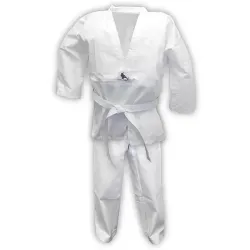
The most noticeable difference between a dobok and a gi is the jacket style. Taekwondo doboks, especially those used in World Taekwondo schools, feature a v-neck pullover jacket that goes on over the head. This design keeps the uniform secure during high kicks, spins, and fast footwork.
A gi uses a crossover jacket that opens in the front and ties shut. This works well for karate and judo, where grabbing and throwing are common, but it can come loose during the explosive movements typical in taekwondo.
Another major difference is fabric weight. Taekwondo uniforms are usually made from lighter materials, often a cotton and polyester blend. This keeps the dobok breathable and flexible, which is ideal for fast kicking combinations and fluid motion.
Karate gis are typically heavier and stiffer, sometimes made from thick cotton canvas. This added weight helps absorb impact and holds up better during grabbing and clinch-based techniques.
Sound and feel matter to many martial artists. Heavier karate gis are known for producing a sharp snap during punches and blocks, which provides feedback for proper technique. Some higher-end taekwondo doboks are also designed to create a snapping sound during kicks, offering similar feedback while maintaining a lighter feel.
Uniform styling also varies by organization. In World Taekwondo, black belts typically wear v-neck doboks with black trim, while color belts wear all white. ITF schools often use crossover-style jackets and may include school patches or federation logos.
Karate uniforms are generally more minimal, with fewer decorative elements unless required by a specific dojo.
Functionally, these uniforms were built for different kinds of movement. Taekwondo focuses heavily on kicking, speed, and mobility, which is why the dobok is lightweight and secure. Karate places more emphasis on hand techniques and grappling fundamentals, so the gi is reinforced and designed to handle pulling and contact.
There's also a cultural element. The dobok reflects Korean martial traditions that emphasize clean lines, formality, and presentation. The gi reflects Japanese martial philosophy rooted in simplicity, durability, and efficiency.
While many people casually use the word gi to describe any martial arts uniform, that's not technically correct. In Korean martial arts, the proper term is dobok. Calling it a taekwondo gi is common, but traditionalists and experienced practitioners will usually point out the distinction.
A dobok is used in Korean martial arts like taekwondo. A gi is used in Japanese martial arts like karate. Doboks are lighter, often feature a v-neck pullover design, and are built for kicking and dynamic movement. Gis are heavier, wrap in the front, and are better suited for grabbing, blocking, and grappling.
At KarateMart.com, we specialize in high-quality taekwondo uniforms designed to meet the demands of modern training. Whether you call it a taekwondo gi, tkd dobok, or simply your training uniform, you'll find options here that fit properly, move comfortably, and hold up to real use.
The History of the Taekwondo Dobok
The taekwondo uniform, also called a dobok, has its roots in traditional Korean martial arts. It didn't always look the way it does today. In the early days of modern taekwondo, most practitioners wore martial arts uniforms that closely resembled the Japanese karate gi. These featured wrap-around jackets with open fronts and belts to hold everything in place. Over time, taekwondo began to distinguish itself, not just in terms of technique, but also through its uniform. That's when the v-neck gi became standard for many taekwondo styles, especially those affiliated with the World Taekwondo (WT) federation.
Why Taekwondo Uniforms Use a V-Neck Design
Why the change in design? The v-neck jacket, unlike the traditional karate gi, doesn't need to be tied across the chest. That means less hassle during training and more freedom to move. If you've ever had your wrap-around gi come undone mid-sparring or during a high kick, you'll appreciate how the closed v-neck style stays put. It's all about functionality, especially in a martial art like taekwondo that emphasizes fast, high kicks and explosive motion.
Dobok Materials and Comfort
Another big difference between a taekwondo dobok and a standard karate gi is the material. A typical taekwondo gi is made from lightweight fabric, usually a cotton and polyester blend. This allows for better breathability and a greater range of motion. Karate gis, by comparison, tend to be thicker and more rigid to withstand the pulling and grabbing common in that art. For taekwondo, the uniform should feel light and flexible, giving you the ability to move freely and comfortably through forms, drills, or sparring sessions.
WT vs ITF Uniform Styles
Taekwondo itself is a relatively modern martial art that was officially established in Korea during the 1950s. It combines elements of older Korean styles like Taekkyeon and Subak, with some influences from Japanese karate. What sets taekwondo apart is its focus on kicking techniques, fast footwork, and dynamic motion. Today, most practitioners belong to either World Taekwondo (WT) or the International Taekwon-Do Federation (ITF). WT practitioners usually wear the classic v-neck gi, while ITF styles often stick with the older wrap-around jacket design. Both are still considered doboks, but the cut and style can differ significantly depending on your organization.
Finding the Right Taekwondo Uniform
No matter which taekwondo path you're on, we've got something that fits. KarateMart.com offers a full range of tae kwon do uniforms, from entry-level student doboks to competition-ready gear. We stock both traditional crossover jackets and modern v-neck styles, so you can find what works best for your school and training style. We even carry plus-size options, because martial arts should be for everyone, regardless of body type or experience level.
One thing we've learned over the years is that TKD students can be very particular about their uniforms, and for good reason. If your taekwondo uniform doesn't fit right or isn't made to handle the demands of training, it can seriously affect your performance. That's why we only offer doboks that are designed to meet the high standards of today's athletes. Whether you're working through your first white belt form or preparing for your black belt test, your tkd dobok needs to keep up.
School Requirements, Fit, and Sizing
When you're choosing a taekwondo gi, there are a few things to consider. First, ask your instructor if your school has any specific requirements. Some WT schools require students to wear a white v-neck gi, while black belts might be asked to wear a dobok with black trim around the collar. ITF schools often include school patches, crests, or logos on their uniforms. Whatever your school needs, you'll find something here that fits both the rules and your personal style.
Sizing can also vary from brand to brand, but our product descriptions and sizing guides make it easy to choose the right fit. Doboks are typically numbered by height, and we offer everything from kids' sizes to adult plus sizes. The uniform should be loose enough to allow free movement, but not so baggy that it gets in your way. If you're unsure what size to go with, our team is always here to help.
Fabric Weight and Training Needs
The fabric weight of your taekwondo uniform is another important factor. Lightweight doboks are ideal for students, casual training, or hot climates, while super middleweight or heavier tkd uniforms are better for sparring, tournaments, or high-impact training. Heavier doboks tend to be more durable and have a crisp "snap" sound when executing techniques, which many advanced students love.
Doboks in Other Korean Martial Arts
It's worth mentioning that while taekwondo uniforms are primarily associated with taekwondo, other Korean martial arts use similar doboks. Hapkido and Tang Soo Do also use uniforms that look very much like the tae kwon do gi, sometimes with small variations in cut, collar color, or patches. But if you're looking for the classic taekwondo dobok, especially the v-neck variety, you've come to the right place.
Why Buy Taekwondo Uniforms from KarateMart.com
At KarateMart.com, we've been outfitting martial artists for years, and we understand what you're looking for. Our taekwondo doboks are built to last, easy to move in, and comfortable enough to wear through hours of training. If you need something that stands up to repeated washing, intense workouts, and regular use, you're in the right place.
Browse our full selection of tkd uniforms today and find the perfect fit for your martial arts journey. From basic student sets to advanced competition-ready taekwondo gis, we've got options for every skill level and budget. Get ready to train with confidence, knowing you've got the right gear from the start.
What Is the Difference Between a Dobok and a Gi?
If you're new to martial arts or shopping for a uniform for the first time, it's easy to get confused by the terms dobok and gi. While they might look similar at first glance, they're not the same thing. The difference comes down to the martial art they're used for, how they're designed, and what kind of movement they're built to support.
What Is a Gi?
The word gi is short for keikogi, which is Japanese for training clothes. It's the standard uniform for Japanese martial arts like karate, judo, and jiu-jitsu. A gi typically consists of a wrap-around jacket that overlaps in the front and is secured with a belt. The pants use a drawstring or elastic waist, and the uniform is usually made from heavier cotton fabric to handle grabbing, pulling, and repeated contact.
What Is a Dobok?
Dobok is a Korean word that translates to clothing of the way. It's the traditional uniform for Korean martial arts like taekwondo, hapkido, and tang soo do. Like a gi, a dobok includes pants, a jacket, and a belt to indicate rank. Where it differs is in design, fit, and purpose.
Design and Fit Differences
The most noticeable difference between a dobok and a gi is the jacket style. Taekwondo doboks, especially those used in World Taekwondo schools, feature a v-neck pullover jacket that goes on over the head. This design keeps the uniform secure during high kicks, spins, and fast footwork.
A gi uses a crossover jacket that opens in the front and ties shut. This works well for karate and judo, where grabbing and throwing are common, but it can come loose during the explosive movements typical in taekwondo.
Material and Weight
Another major difference is fabric weight. Taekwondo uniforms are usually made from lighter materials, often a cotton and polyester blend. This keeps the dobok breathable and flexible, which is ideal for fast kicking combinations and fluid motion.
Karate gis are typically heavier and stiffer, sometimes made from thick cotton canvas. This added weight helps absorb impact and holds up better during grabbing and clinch-based techniques.
Sound, Feel, and Performance
Sound and feel matter to many martial artists. Heavier karate gis are known for producing a sharp snap during punches and blocks, which provides feedback for proper technique. Some higher-end taekwondo doboks are also designed to create a snapping sound during kicks, offering similar feedback while maintaining a lighter feel.
Style and Rank Differences
Uniform styling also varies by organization. In World Taekwondo, black belts typically wear v-neck doboks with black trim, while color belts wear all white. ITF schools often use crossover-style jackets and may include school patches or federation logos.
Karate uniforms are generally more minimal, with fewer decorative elements unless required by a specific dojo.
Function and Philosophy
Functionally, these uniforms were built for different kinds of movement. Taekwondo focuses heavily on kicking, speed, and mobility, which is why the dobok is lightweight and secure. Karate places more emphasis on hand techniques and grappling fundamentals, so the gi is reinforced and designed to handle pulling and contact.
There's also a cultural element. The dobok reflects Korean martial traditions that emphasize clean lines, formality, and presentation. The gi reflects Japanese martial philosophy rooted in simplicity, durability, and efficiency.
Dobok vs Gi: Clearing Up the Terminology
While many people casually use the word gi to describe any martial arts uniform, that's not technically correct. In Korean martial arts, the proper term is dobok. Calling it a taekwondo gi is common, but traditionalists and experienced practitioners will usually point out the distinction.
Which One Should You Choose?
A dobok is used in Korean martial arts like taekwondo. A gi is used in Japanese martial arts like karate. Doboks are lighter, often feature a v-neck pullover design, and are built for kicking and dynamic movement. Gis are heavier, wrap in the front, and are better suited for grabbing, blocking, and grappling.
At KarateMart.com, we specialize in high-quality taekwondo uniforms designed to meet the demands of modern training. Whether you call it a taekwondo gi, tkd dobok, or simply your training uniform, you'll find options here that fit properly, move comfortably, and hold up to real use.