



Rebreakable Boards vs Wooden Boards: Which Is Better?
April 24th, 2026
If you are getting into board breaking for the first time, one of the first decisions you will face is whether to use rebreakable boards or traditional wooden boards. At a glance, they might seem like two versions of the same thing, but they offer very different experiences when it comes to training, cost, and practicality. Some martial artists prefer the realism of wood, while others like the convenience and repeatability of rebreakable options. Understanding the differences between the two will help you choose the right type for your training style, skill level, and long-term goals.
What Are Rebreakable Boards?
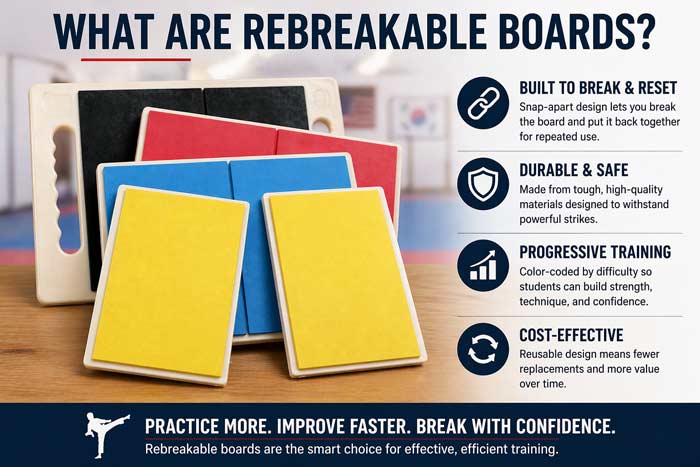
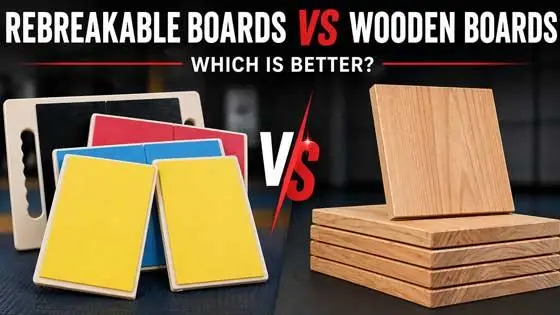
Rebreakable boards are training tools designed to simulate the experience of breaking wood without the need to constantly replace your materials. Instead of snapping and becoming unusable like traditional boards, these are built with a locking or hinge-style mechanism that allows them to break apart under pressure and then snap back together for repeated use. This makes them especially popular in schools and training environments where students are practicing breaking techniques on a regular basis.
Most rebreakable boards are made from durable plastic with padded or textured striking surfaces. They are often color-coded to represent different difficulty levels, which helps students gradually build strength and technique over time. For example, a beginner might start with a more flexible board and work their way up to stiffer versions that require more force to break.
One of the biggest advantages of rebreakable boards is consistency. With wooden boards, no two pieces are exactly the same. Grain direction, moisture, and small imperfections can all affect how easily a board breaks. Rebreakable boards remove that variable, giving you a predictable level of resistance every time you strike. This makes them ideal for drilling techniques and building confidence before attempting a real break.
They are also widely used for demonstrations and testing environments where multiple attempts may be needed. Since they can be reset instantly, instructors can focus on technique and repetition without worrying about running out of materials or dealing with cleanup between attempts.
If you are training regularly or working on improving your breaking technique, rebreakable boards offer a practical and efficient way to practice. They are not meant to fully replace traditional boards, but they serve as a reliable tool for building the skills needed to break with proper form and control.
What Are Wooden Breaking Boards?
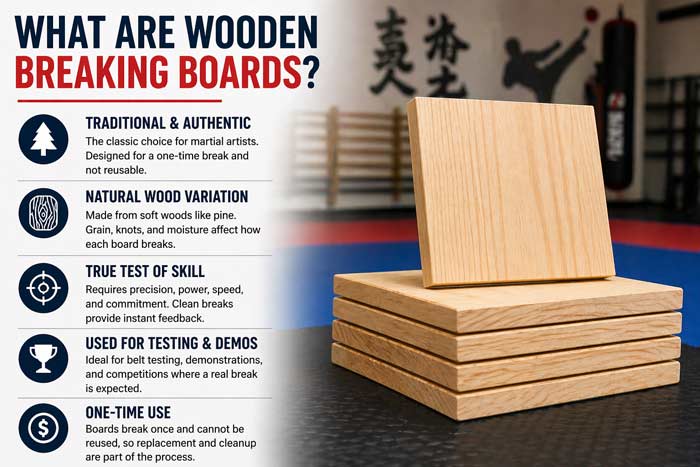
Wooden breaking boards are the traditional choice for martial arts breaking practice and have been used for decades in karate, taekwondo, and other striking arts. Unlike rebreakable boards, these are designed for a one-time break. Once you strike them correctly, they split apart and cannot be reused. That single-use nature is part of what gives them their reputation as the more "authentic" option for testing power and technique.
Most wooden boards used for breaking are made from soft woods like pine, which are chosen because they provide a balance between resistance and breakability. Even within the same type of wood, no two boards are exactly alike. Factors like grain direction, knots, and moisture content can all affect how easily a board breaks. This variability is one of the biggest differences compared to rebreakable boards.
Because of that inconsistency, wooden boards require more precision and confidence. A clean break depends not just on strength, but also on proper technique, speed, and follow-through. This is why they are often used for belt testing, demonstrations, and competitions where a true break is expected. When a board splits cleanly, it gives immediate feedback that your technique was solid.
Wooden boards also create a more realistic experience. There is a psychological element involved when you know the board will not reset if you hesitate or strike incorrectly. This can make them more intimidating, especially for beginners, but it also helps build focus and commitment over time.
The downside is that wooden boards require constant replacement and can create extra cleanup after each break. If you are practicing frequently, the cost and inconvenience can add up quickly. That is why many martial artists use them more selectively, saving them for testing or special training sessions rather than everyday practice.
For those who want a traditional breaking experience and a true test of their technique, wooden boards still play an important role in martial arts training.
Rebreakable Boards vs Wooden Boards: Key Differences
Now that you understand what each type of board is, it becomes much easier to compare them side by side. While both are used for breaking practice, they serve different purposes and create very different training experiences. Choosing between them really comes down to how you train and what you want to get out of your practice.
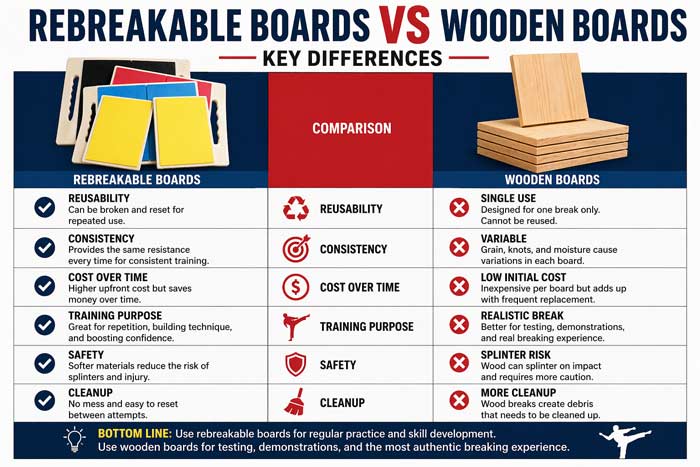
One of the biggest differences is reusability. Rebreakable boards can be used over and over again, which makes them ideal for regular training sessions. Wooden boards, on the other hand, are designed for a single break. Once they split, they are done. This makes them less practical for frequent practice but more meaningful for testing and demonstrations.
Another key difference is consistency. Rebreakable boards provide a predictable level of resistance every time you use them. This allows you to focus on technique without worrying about variations in the material. Wooden boards are less predictable because of differences in grain, moisture, and density. That variability can make them more challenging, but it also makes each break feel more real.
Cost over time is also worth considering. While rebreakable boards usually cost more upfront, they can save money in the long run since you do not need to keep replacing them. Wooden boards are inexpensive individually, but if you are practicing often, the cost adds up quickly because you need a new board for every attempt.
There is also a clear difference in training purpose. Rebreakable boards are great for building technique, confidence, and repetition. They let you practice safely and consistently without hesitation. Wooden boards are better suited for testing your skills under real conditions, where commitment and proper execution matter more than repetition.
If you are looking to improve your technique with consistent practice, rebreakable boards are usually the better choice. If your goal is to experience a true break and challenge your skills in a more traditional way, wooden boards still play an important role.
For most martial artists, the best approach is not choosing one over the other, but understanding how to use both effectively as part of a complete training routine.
Which Type of Board Is Better for Beginners?
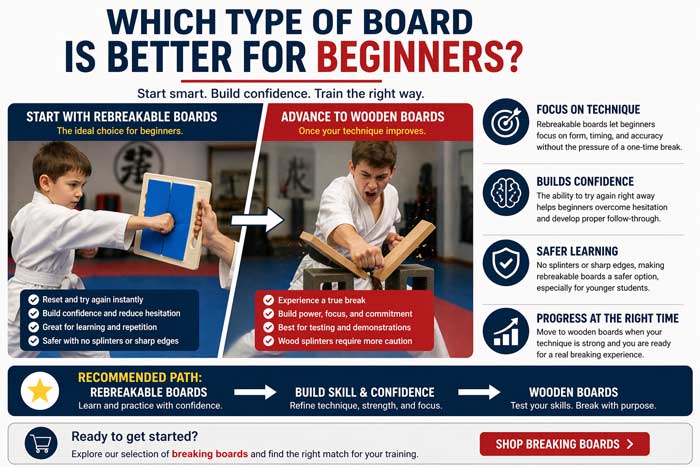
If you are just getting started with breaking practice, rebreakable boards are usually the better place to begin. They allow you to focus on learning proper technique without the pressure of getting everything perfect on the first try. Since they can be reset instantly, you can practice the same strike multiple times and make adjustments as you go, which is exactly what most beginners need.
One of the biggest challenges for beginners is hesitation. When you are unsure about your technique or worried about getting hurt, it is easy to hold back on your strike. Rebreakable boards help remove that mental barrier because you know you can try again right away. This builds confidence much faster and encourages proper follow-through, which is critical for clean breaks later on.
They are also generally safer to train with. Because they are designed to split and reconnect without splintering, there is less risk of sharp edges or debris. This makes them a popular choice in schools, especially when younger students are learning how to break for the first time.
That said, wooden boards still have a place in beginner training, just not right away. Once you have developed solid technique and feel comfortable committing to your strikes, transitioning to wood can help you understand what a real break feels like. It adds a level of intensity and focus that rebreakable boards do not fully replicate.
For most beginners, the best approach is to start with rebreakable boards to build skill and confidence, then gradually introduce wooden boards as your technique improves. This progression helps you develop the right habits without unnecessary frustration or risk early on.
If you are looking to get started, you can explore different types of breaking boards to find options that match your current skill level and training goals.
When Should You Use Rebreakable vs Wooden Boards?
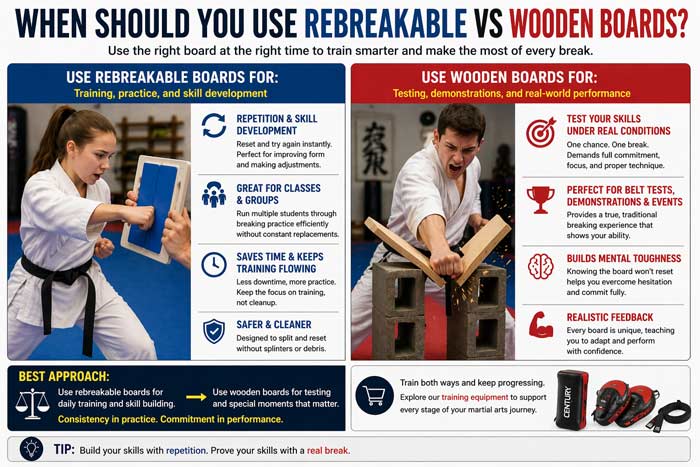
Knowing when to use each type of board is where everything really comes together. Rebreakable boards and wooden boards are not competing tools as much as they are different stages of the same training process. Using them at the right time can help you improve faster while avoiding unnecessary frustration or injury.
Rebreakable boards are best used during regular training sessions when your goal is repetition and skill development. If you are working on improving your form, building confidence, or refining your technique, these are the boards you want to use. Being able to reset them instantly means you can focus on making small adjustments and getting consistent feedback with every attempt.
They are also ideal for drills, classes with multiple students, and situations where time and efficiency matter. Instructors can run entire groups through breaking practice without constantly replacing boards or stopping to clean up. This keeps the pace of training smooth and allows everyone to get more practice in a shorter amount of time.
Wooden boards are better suited for moments when you want to test your skills under real conditions. This includes belt testing, demonstrations, and personal milestones where the goal is to execute a clean, committed break. Because they only give you one chance, they require a higher level of focus and confidence.
They are also useful for developing mental toughness. There is a different mindset that comes with knowing the board will not reset. That pressure helps you commit fully to your strike and trust your technique, which is an important part of progressing in martial arts.
For most people, the best approach is to use rebreakable boards during day-to-day training and save wooden boards for testing and special situations. This combination gives you the benefits of both consistency and realism, helping you build skill while still challenging yourself when it matters most.
If you want to train both ways, you can browse a range of training equipment to find tools that support every stage of your progress.
Final Thoughts: Should You Choose Rebreakable or Wooden Boards?
By now, the choice between rebreakable boards and wooden boards should be a lot clearer. Each one has its own purpose, and neither is strictly better than the other. It really comes down to how you train and what you are trying to accomplish at each stage of your progress.
Rebreakable boards are the practical choice for most day-to-day training. They allow you to practice repeatedly, build confidence, and fine-tune your technique without worrying about wasting materials. If you are training consistently or working with beginners, they make the process more efficient and less intimidating.
Wooden boards, on the other hand, bring a level of realism that cannot be fully replicated. They are best used when you want to test your skills, push your limits, or demonstrate what you have learned. The one-time break forces you to commit fully, which is an important part of developing both technique and mindset.
For most martial artists, the best approach is to use both. Rebreakable boards help you build the foundation, while wooden boards give you the opportunity to apply those skills under real conditions. Using them together creates a more complete training experience and helps you progress more effectively over time.
If you are ready to start training or upgrade your current setup, you can explore a variety of breaking boards to find options that match your goals, skill level, and training style.
You May Also Be Interested In:
- What Are Rebreakable Boards and How Do They Work?
- Does Breaking Boards Actually Prove Striking Power?
- Rebreakable Board Breakdown
- What's the Right Wooden Bo Staff for You?
- What Is a Bokken? A Beginner Guide to Wooden Swords
- Free-Standing Wing Chun Wooden Dummy Product Review
- Foam Practice Swords vs Wooden Swords: Which Is Better?
Leave a Reply