




Why Do Caltrops Always Land With a Spike Pointing Up?
August 13th, 2026

Drop a handful of caltrops onto a road, trail, or battlefield and they do something that still surprises people today. No matter how they tumble, one spike ends up pointing upward while the others support the weapon against the ground. There is no mechanism inside, no weighted base, and no need for anyone to carefully position them. The secret is hidden entirely in the arrangement of four points, a remarkably simple piece of geometry that allowed soldiers to scatter caltrops quickly across enormous areas and know that they would immediately become obstacles. That clever shape helped the caltrop survive for thousands of years, appearing in conflicts from the ancient world through the age of cavalry and even into modern warfare. But once you understand the geometry behind it, the fact that a caltrop always seems to land correctly stops looking like luck at all.
The Secret Is Hidden in a Tetrahedron
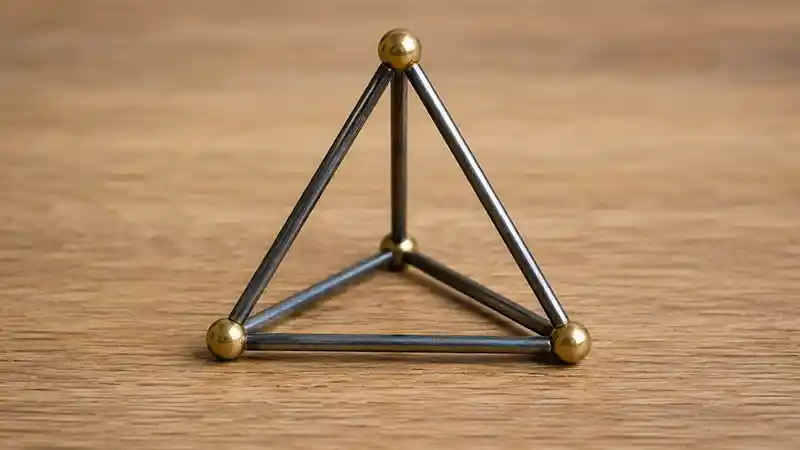
A traditional four-point caltrop looks chaotic at first glance. Its spikes jut outward in different directions, with no obvious top or bottom. But the arrangement is anything but random. The four points are positioned in roughly the same directions as the four corners of a tetrahedron, one of the simplest three-dimensional geometric forms.
A tetrahedron has four triangular faces. Set one of those faces against a flat surface and the opposite corner necessarily points away from it. A four-spiked caltrop uses essentially the same principle. Whichever three spikes end up contacting the ground create a stable base, leaving the remaining spike projecting upward.
Turn the caltrop over and the trick repeats. Rotate it sideways and it happens again. There is no "wrong side" because every possible resting orientation creates another three-point base beneath an exposed fourth point. Gravity does the positioning automatically.
That was an enormous practical advantage. Soldiers did not need to plant thousands of individual spikes upright or carefully arrange them across a road. Caltrops could simply be scattered over the desired area, and their geometry did the rest. Even in darkness, confusion, or hurried battlefield conditions, the basic design remained effective without requiring precise placement.
The remarkable part is how little the concept needs in order to work. No moving components. No springs. No complicated mechanism. Just four points arranged so that whichever way the object falls, one of them has nowhere to go but up.
The Romans Knew the Trick More Than 2,000 Years Ago
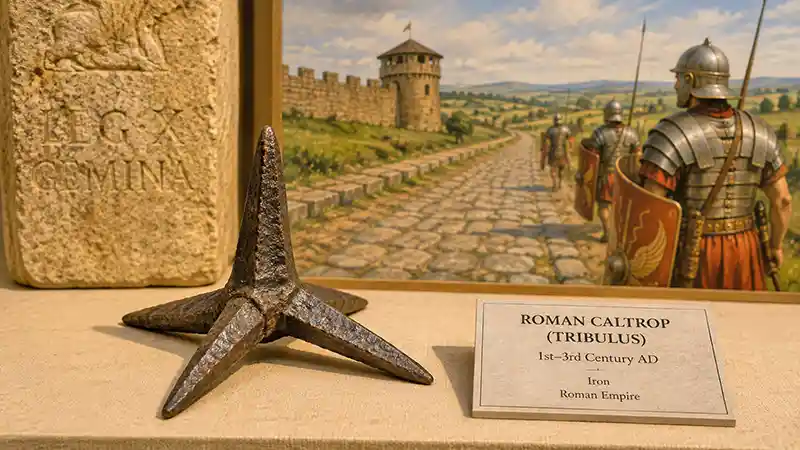
The caltrop's clever geometry is ancient. Greek writers described devices known as triboloi, while the Romans used similar obstacles commonly referred to by the Latin term tribulus. The names themselves are connected with the idea of multiple points, and ancient military writers understood exactly what made these small objects useful: once scattered, an exposed point remained ready regardless of how the object came to rest.
One of the clearest ancient descriptions appears in the writings of Vegetius, a late Roman military author who discussed defensive preparations against enemy forces. Caltrops could be distributed across ground where cavalry or other troops were expected to advance, creating a hazard that was difficult to see and inconvenient to remove during an attack.
Their real value was not that a single caltrop could defeat an army. It was that thousands of small obstacles could change how an army moved. Horses were particularly vulnerable to dangerous ground, and cavalry depended on maintaining momentum and formation. Even the possibility of caltrops ahead could force riders to slow down, avoid a route, or approach a defensive position differently.
That made the caltrop part of a much larger family of battlefield devices whose purpose was controlling movement rather than fighting an opponent directly. Like many weapons designed to stop or restrict an enemy, its greatest effect could occur before direct combat even began.
What is remarkable is how little the underlying concept needed to change afterward. Empires rose and disappeared, armor evolved, and completely new weapons transformed warfare, yet the basic four-point geometry remained useful because the physical principle behind it never became obsolete.
Caltrops Could Stop Cavalry Without Touching the Rider
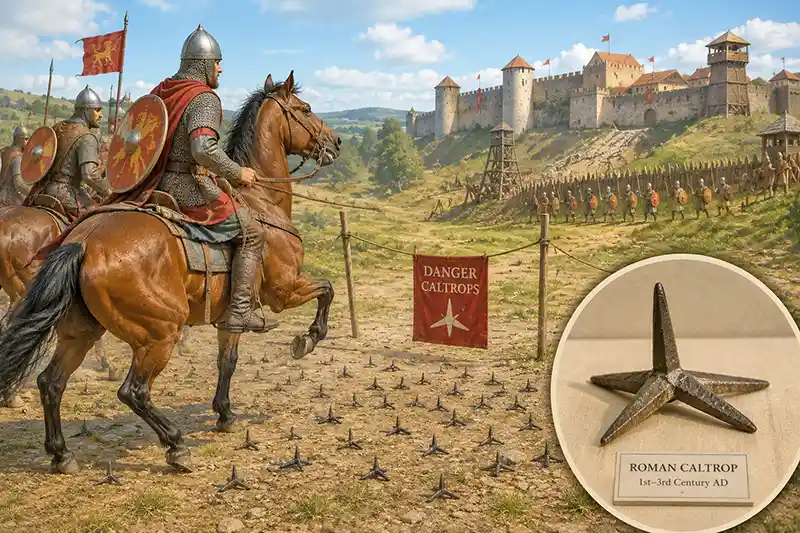
For much of military history, one of the caltrop's most important targets was not the soldier at all. It was the horse underneath him. A cavalry charge depended on speed, confidence, and relatively predictable ground. Caltrops threatened all three without requiring defenders to meet mounted troops head-on.
A horse could not understand that a small piece of metal was hidden among dirt, grass, or debris ahead. If the animal encountered dangerous footing, the result could disrupt far more than a single rider. Horses slowing suddenly, refusing to advance, or losing formation could interfere with the cavalry behind them and turn an organized charge into confusion.
This helps explain why such a tiny object could matter on a battlefield dominated by much larger weapons. The caltrop did not need the reach of a spear or the striking power of an axe. Its job was to make a particular patch of ground unreliable. Once that happened, defenders could influence where mounted troops traveled and how quickly they approached.
Caltrops were especially useful because the effect was psychological as well as physical. Once soldiers knew caltrops might be present, apparently open ground could no longer be trusted. An obstacle only a few inches across could force an enemy to pay attention to every step of terrain that previously looked harmless.
That is the real genius of the caltrop. Its four-point geometry did more than guarantee an upward-facing spike. It transformed the ground itself into part of the defensive system.
Medieval Armies Kept Rediscovering the Same Simple Design
The collapse of the Roman Empire did not make the caltrop disappear. Variations continued to appear in medieval warfare because the problem it solved had not changed. Armies still depended on horses, roads still funneled troops through predictable routes, and fortifications still needed ways to make the ground outside their walls more difficult to cross.
Caltrops could complement larger defensive obstacles rather than replace them. Ditches, stakes, walls, barricades, and natural terrain could direct attackers toward particular approaches, while small scattered obstacles made those routes less reliable. Compared with constructing a ditch or wooden barrier, a caltrop was compact enough to transport and could be deployed without permanently altering the landscape.
They were also remarkably indifferent to advances in personal armor. A better helmet or stronger breastplate did little to solve the problem of dangerous ground beneath a horse. As medieval cavalry became increasingly formidable, disrupting the animal carrying an armored rider remained one way defenders could interfere with the advantages of mounted troops without having to overcome the rider's armor directly.
This helps explain the caltrop's extraordinary longevity. Many battlefield weapons became obsolete when armor improved or tactics changed. The caltrop attacked a more fundamental vulnerability: armies could only move effectively if the ground beneath them remained usable.
For such a crude-looking object, that was an unusually sophisticated idea. The caltrop did not have to defeat the strongest soldier on the battlefield. It only had to make him reconsider where he was willing to go.
Japan Developed Its Own Answer to the Caltrop
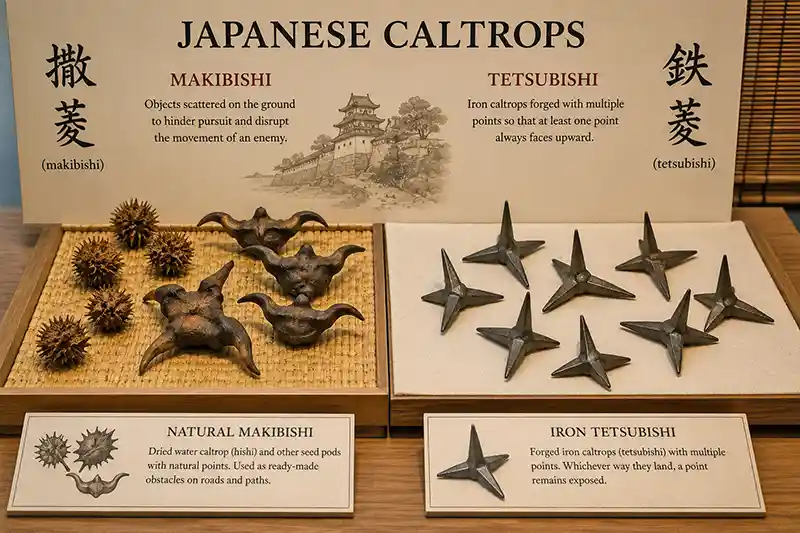
The same basic idea appeared in Japan in forms commonly known as makibishi. Rather than being one standardized object, the term could refer to small objects scattered on the ground to interfere with pursuit. Some were made from iron, while others took advantage of naturally hard seed pods whose pointed shapes already performed much the same trick.
Iron versions are often called tetsubishi, and their resemblance to European caltrops is immediately recognizable. Multiple projecting points meant that whichever way one landed, a point could remain exposed. They are now strongly associated with ninja imagery, joining throwing stars and other unusual objects among the pieces of ninja equipment that have become famous in popular culture.
The natural version is even more fascinating. The dried fruit of the water caltrop has several hard projections and could provide a ready-made obstacle without requiring a smith to forge anything. In fact, the Japanese word hishi refers to the water caltrop plant, helping explain the terminology associated with these devices.
Stories commonly describe shinobi scattering makibishi behind themselves while escaping pursuers, particularly on paths where anyone following would have to slow down and watch their footing. The general concept is plausible and appears in historical discussions of shinobi tools, but modern entertainment has greatly exaggerated many aspects of ninja weapons. Makibishi are better understood as simple obstacles for disrupting movement than as spectacular secret weapons.
That makes the Japanese example particularly interesting. Cultures separated by enormous distances encountered the same basic problem and arrived at remarkably similar solutions: if you want a small object to remain troublesome regardless of how it lands, geometry can do most of the work for you.
Natural Caltrops May Have Inspired the Weapon

Long before anyone forged a four-pointed obstacle from iron, nature had already produced something remarkably similar. Several plants develop hard fruits or seed pods covered with sharp projections, and one of the most famous is the water caltrop, a plant in the genus Trapa. Its distinctive fruit can form multiple rigid horns that make it surprisingly unpleasant to step on.
The resemblance is so strong that the English word "caltrop" eventually became associated with both the manufactured obstacle and certain spiny plants. Even more intriguingly, the ancient Roman term tribulus was also used in connection with thorny plants, while Japanese hishi refers to the water caltrop whose dried fruit could itself be used as makibishi.
It is tempting to imagine that someone thousands of years ago stepped on a spiny seed pod and immediately realized that the same principle could be reproduced in metal. Unfortunately, archaeology cannot give us that neat moment of invention. Caltrop-like military devices are ancient, but proving that a particular plant directly inspired the first manufactured version is much harder.
Still, the comparison reveals something important. The famous "always points up" principle does not belong exclusively to human engineering. A shape with several rigid projections can naturally settle with some points supporting it while others remain exposed. Human beings simply recognized how useful that geometry could be and reproduced it in a more durable material.
The Japanese use of natural hishi makes the connection especially tangible. Sometimes there was no need to manufacture the idea at all. Nature had already done the engineering.
The Caltrop Worked Because It Was Easy to Scatter and Hard to Notice
The caltrop's geometry solved only half of the problem. Its other advantage was size. Unlike a barricade, ditch, or row of stakes, individual caltrops could be small enough to disappear visually against rough terrain. Dirt, grass, leaves, mud, and battlefield debris could make a scattered field of them surprisingly difficult to recognize from a distance.
That mattered because an obvious obstacle gives an approaching force time to react. A wall can be seen. A ditch can often be identified before someone reaches it. Small objects scattered across irregular ground were different. By the time troops realized the terrain ahead contained caltrops, simply maintaining speed could become a risk.
Their compact size also made them portable. A collection of small iron obstacles could be transported to a defensive position and distributed only when needed. Once scattered, there was no requirement that every individual piece be positioned correctly because the four-point arrangement handled that automatically.
This combination made the caltrop unusually efficient: small enough to transport, simple enough to produce in quantity, difficult to notice on rough ground, and capable of orienting itself without assistance. Few battlefield obstacles packed so much usefulness into such a tiny object.
It also explains why caltrops fit so naturally among the more unusual forms of ninja gear associated with disrupting pursuit. The concept did not depend on overpowering someone directly. Its effectiveness came from turning ordinary ground into something that suddenly demanded attention.
Caltrops Survived the Gunpowder Age
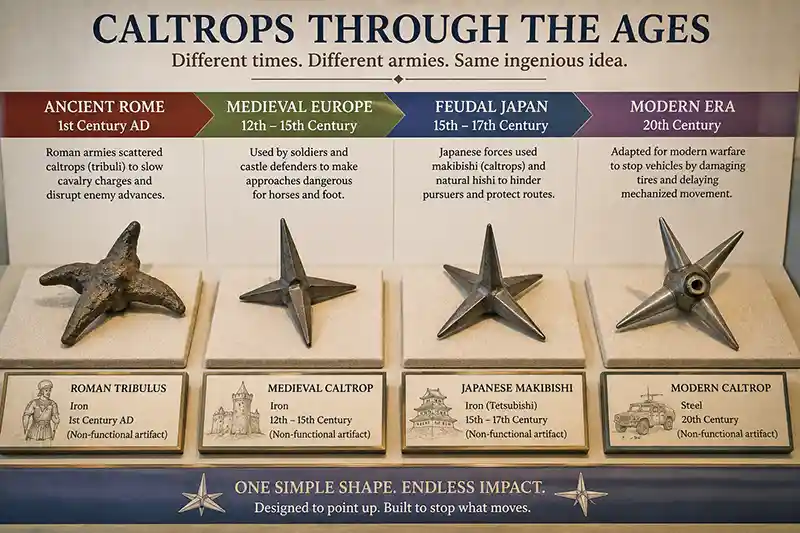
The arrival of firearms transformed warfare, but it did not eliminate the basic problem the caltrop was designed to exploit. Soldiers, horses, wagons, and eventually vehicles still needed usable ground beneath them. As long as armies depended on movement, there remained a place for simple obstacles capable of interfering with that movement.
Caltrops continued appearing long after knights and ancient cavalry disappeared from battlefields. During the 20th century, the same underlying concept was adapted into larger devices intended to interfere with pneumatic tires. The target had changed from the vulnerable foot of a horse to the vulnerable tire of a vehicle, but the geometric idea was remarkably familiar: create an object that remains effective regardless of how it comes to rest.
This is where the caltrop's history becomes especially unusual. Most ancient weapons eventually became museum pieces because technology made their original function irrelevant. The caltrop survived because it was never dependent on defeating armor, matching the range of another weapon, or delivering greater force than an opponent. It exploited movement itself.
Modern versions could look very different from hand-forged ancient examples, and specialized designs eventually developed around modern transportation. Yet the survival of the concept demonstrates just how difficult it is to make good geometry obsolete.
More than two thousand years after ancient armies recognized the value of a multi-point obstacle, the same fundamental principle was still solving essentially the same problem. The battlefield had changed almost beyond recognition. The tetrahedron had not.
The Caltrop Was Really a Weapon Against Movement
Calling a caltrop a weapon can create the wrong mental picture. It was not something a soldier normally held, aimed, or swung at an opponent. Its real purpose was to interfere with movement, which puts it closer to a portable battlefield obstacle than a conventional weapon.
That distinction helps explain why the design appeared in so many different places and periods. Ancient armies wanted to disrupt cavalry. Medieval defenders wanted to make approaches to fortifications more difficult. Japanese warriors could use small obstacles to complicate pursuit. Later militaries faced vehicles instead of horses. The target changed, but the underlying problem remained remarkably consistent.
This also meant caltrops could influence an enemy even when nobody actually encountered one. Once their presence was suspected, troops had a reason to slow down, inspect the terrain, avoid particular routes, or choose a different approach. In that sense, a field of caltrops could affect decisions simply by making otherwise ordinary ground uncertain.
That principle helps separate historical caltrops from the exaggerated gadgets often associated with popular depictions of ninja weapons. Their effectiveness did not depend on a spectacular attack. The entire idea was to create a small obstacle, leave it behind, and let terrain and uncertainty do the rest.
For something small enough to disappear among dirt and vegetation, that was an impressive amount of influence. The caltrop did not need to overpower an opponent. It only needed to make moving forward more difficult than going somewhere else.
Not Every Caltrop Had Exactly Four Points
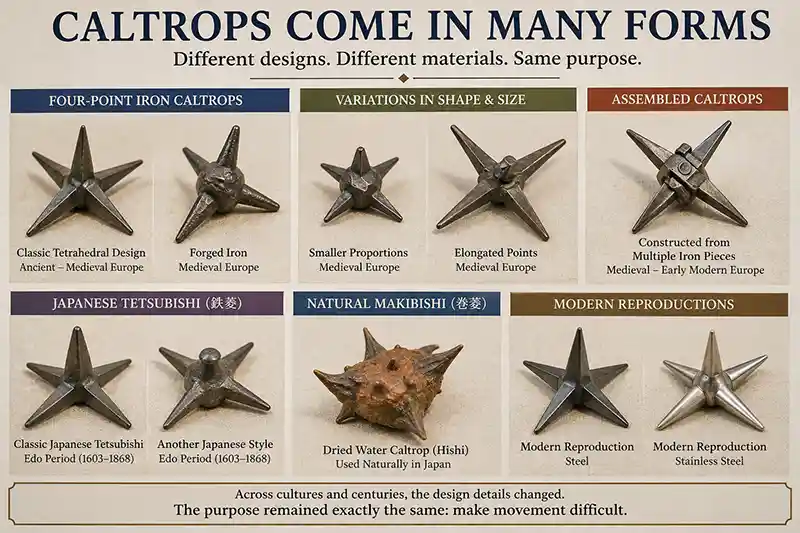
The classic caltrop is defined in the popular imagination by four spikes arranged around a central point, but historical examples were not manufactured according to one universal blueprint. Surviving artifacts vary in size, proportions, materials, and construction, and some caltrop-like obstacles used different numbers or arrangements of projections.
What mattered was not necessarily having exactly four identical spikes. The important feature was creating an object that could settle naturally while leaving one or more dangerous projections exposed. The tetrahedral four-point arrangement accomplished this with exceptional simplicity, which helps explain why it became such a recognizable form.
Manufacturing methods varied as well. Some examples were forged as individual pieces, while others could be assembled from multiple iron components joined together. Regional smithing traditions, available materials, intended targets, and the period in which they were made could all influence the finished object.
Japanese examples make the variety particularly obvious. Iron tetsubishi could resemble familiar metal caltrops, while natural makibishi might be nothing more than carefully selected dried seed pods. Today, reproductions of the Japanese form can still be found among specialized ninja accessories, even though their historical counterparts were far less standardized than modern products might suggest.
So the famous four-point caltrop should be understood as an especially elegant solution rather than the only possible design. Across history, people kept modifying the details while preserving the same underlying idea: create a small object that cannot easily settle into a harmless orientation.
One Tiny Shape Survived Thousands of Years of Warfare
The most remarkable thing about the caltrop may not be that ancient engineers discovered its geometry. It is that later generations found so little reason to change the basic idea. Weapons normally have short lives by historical standards. Armor improves, tactics evolve, new materials appear, and yesterday's breakthrough eventually becomes obsolete. The caltrop resisted that cycle remarkably well.
Its longevity came from exploiting something technology could never completely eliminate: movement requires contact with the ground. Whether the approaching force consisted of ancient cavalry, medieval soldiers, pursuing warriors in Japan, or machines from a much later battlefield, mobility still depended on traveling safely across terrain.
The caltrop also demonstrates why the simplest inventions can sometimes be the hardest to improve. Once four points had been arranged so that three could form a stable base while another remained exposed, there was no complicated mechanism demanding refinement. Different cultures could alter the material, size, proportions, and manufacturing technique while leaving the underlying geometry essentially intact.
That helps explain why an object associated today with specialized ninja caltrops has a history stretching far beyond Japan. The familiar form belongs to a much larger story that connects ancient Mediterranean armies, medieval battlefields, Japanese martial traditions, and later military engineering through one extraordinarily persistent idea.
Thousands of years of technological progress transformed almost everything surrounding the caltrop. The soldiers changed. The transportation changed. The battlefields changed. Yet four points arranged around a center kept solving the same geometric problem.
The Genius of the Caltrop Was Its Simplicity
The caltrop never needed gears, springs, moving parts, or sophisticated engineering to become one of history's most persistent battlefield obstacles. Its brilliance came from solving a complicated problem with an almost absurdly simple shape. Arrange several points correctly and gravity takes care of everything else.
That simple geometry allowed versions of the same idea to appear across cultures separated by centuries and thousands of miles. Romans scattered them against approaching forces, medieval armies incorporated them into defensive terrain, and Japanese warriors developed their own forms of makibishi and tetsubishi. Even nature produced seed pods that seemed to understand the principle before humans ever forged it from iron.
Perhaps that is why the caltrop remains so fascinating. Most famous historical weapons impress us because of their craftsmanship, size, or complexity. The caltrop is impressive for precisely the opposite reason. Once you see how the geometry works, the design feels almost inevitable.
So why does a caltrop always land with a spike pointing up? Because there really is no other way for the classic four-point design to land. Three points become the base, the fourth remains above them, and a tiny piece of geometry performs exactly the same trick every single time.
What Is a Caltrop?
A caltrop is a small multi-pointed obstacle designed so that when it is dropped or scattered, at least one point remains facing upward. The classic version has four spikes arranged in a tetrahedral pattern, allowing three points to support the object while the fourth projects above the ground. Caltrops have appeared in warfare for more than two thousand years, with versions used in the ancient Mediterranean world, medieval Europe, Japan, and much later conflicts.
Why Does a Caltrop Always Land Point Up?
The classic four-point caltrop uses the same basic geometry as a tetrahedron. When it lands, three of its points form a stable triangular base against the ground, which necessarily leaves the fourth point projecting upward. Rotate or flip the object and a different set of three points becomes the base, so there is effectively no harmless side for the caltrop to land on.
How Old Are Caltrops?
Caltrops are more than two thousand years old. Devices based on the same multi-pointed principle were known in the ancient Mediterranean world, with Greek and Roman military sources describing their use against approaching forces. Their exact origin is difficult to establish, but the concept was already well developed in antiquity and continued appearing in warfare for centuries afterward.
Did the Romans Use Caltrops?
Yes. The Romans used caltrop-like devices commonly referred to by the Latin term tribulus. Roman military writers described scattering pointed obstacles across ground where enemy troops or cavalry might advance. Their small size made them useful alongside larger defenses because they could interfere with movement without requiring the construction of permanent barriers.
Were Caltrops Used Against Horses?
Yes. Horses were among the most important historical targets of battlefield caltrops because cavalry depended on speed, formation, and reliable footing. Scattered obstacles could make a route dangerous for mounted troops and potentially force riders to slow down, change direction, or avoid an area altogether. This allowed a relatively small object to influence the movement of much larger cavalry forces.
Did Ninja Really Use Caltrops?
Japanese historical traditions include small scattered obstacles known as makibishi, which are strongly associated with shinobi today. Accounts of ninja equipment describe such devices as useful for interfering with pursuit, although popular culture has exaggerated many aspects of their use. Rather than spectacular secret weapons, makibishi are better understood as simple tools intended to make movement across an area more difficult.
What Is the Difference Between Makibishi and Tetsubishi?
Makibishi is a broader Japanese term associated with small pointed objects scattered on the ground, while tetsubishi specifically refers to versions made from iron. Natural makibishi could be made from hard, pointed seed pods, particularly the fruit associated with the water caltrop. Both relied on projecting points rather than a complicated mechanical system.
Were Caltrops Always Made of Metal?
No. Although many historical European caltrops were forged from iron, the same basic principle could be achieved with other materials and naturally pointed objects. Japanese makibishi provide a particularly interesting example because hard, horned seed pods could be used without reproducing the shape in metal. This shows that the underlying concept mattered more than the material from which the obstacle was made.
Are Caltrops Shaped Like a Tetrahedron?
The classic four-point caltrop follows the basic geometry of a tetrahedron, although an actual caltrop does not necessarily have solid triangular faces like the geometric shape. Its four points extend in directions corresponding roughly to the four vertices of a tetrahedron. When three points contact a flat surface, they form a stable base while the remaining point projects upward.
Who Invented the Caltrop?
There is no known individual inventor of the caltrop. Multi-pointed obstacles appear so far back in recorded military history that their precise origin is difficult to determine. Ancient Greek and Roman sources demonstrate that the principle was understood thousands of years ago, while similar ideas later appeared in other parts of the world. The design may have been independently developed more than once because its geometry is so simple and effective.
Were Caltrops Still Used After Medieval Times?
Yes. The basic concept survived long after medieval cavalry disappeared from battlefields. Caltrop-like obstacles continued to appear in later warfare, and versions were eventually adapted to interfere with wheeled transportation and pneumatic tires. The targets and materials changed, but the underlying principle remained useful because armies still depended on reliable movement across the ground.
Did Caltrops Really Work on Battlefields?
Historical sources and surviving artifacts show that caltrops were genuine military obstacles rather than weapons invented by later storytellers. Their usefulness did not depend on stopping an entire army by themselves. They could supplement fortifications, disrupt movement, complicate cavalry approaches, and make particular routes less attractive. Their repeated appearance across widely separated periods and cultures is strong evidence that commanders considered the basic concept worthwhile.
You May Also Be Interested In:
Leave a Reply