



Deadly Weapons Designed to Capture Instead of Kill
July 23rd, 2026
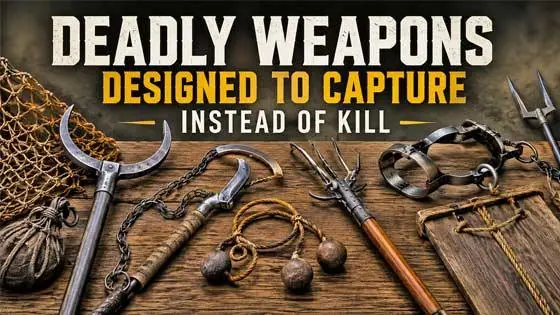
When we think of historical weapons, we usually picture swords, axes, spears, and other tools built for one purpose: killing an enemy. But throughout history, warriors, guards, and law enforcement officers also carried a very different class of weapon. Instead of delivering a fatal blow, these unusual devices were designed to trap, restrain, or immobilize a person long enough to take them alive. In many cases, that made them even more terrifying. A captured prisoner could be questioned, ransomed, publicly punished, or forced to watch as their fate slowly unfolded, turning survival into only the beginning of their ordeal.
From Japan's ingenious sasumata and sodegarami to Europe's fearsome man catchers and the bolas of South America, these remarkable weapons reveal that history wasn't always about defeating an enemy on the battlefield. Sometimes, the greatest victory was making sure they couldn't escape. Here are some of the most fascinating capture weapons ever created and the surprising reasons they were often preferred over deadly force.
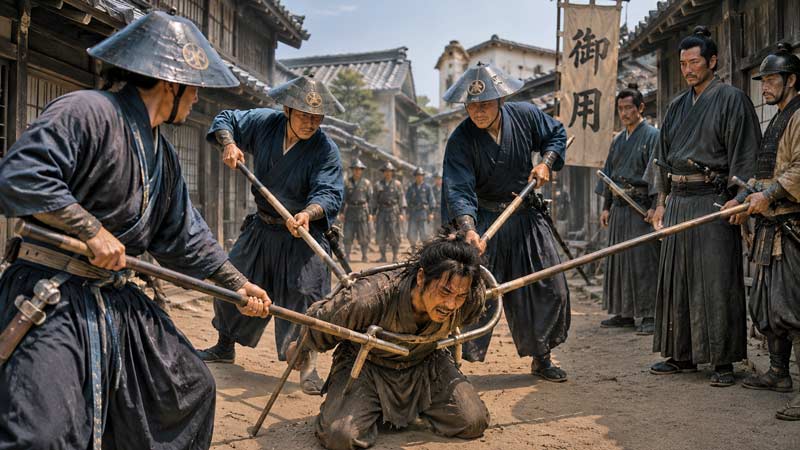
It might seem strange to build a weapon that couldn't easily kill, but throughout history, taking someone alive was often far more valuable than leaving them dead. A captured enemy could reveal military secrets, identify fellow conspirators, or be exchanged for money, political favors, or the release of other prisoners. For kings, generals, and law enforcement officials, information was often worth far more than another body on the battlefield.
Capture also served as a powerful form of public control. A criminal dragged through the streets in restraints sent a much stronger message than one who died resisting arrest. Likewise, capturing a dangerous warrior demonstrated both authority and discipline. Rather than relying on brute force alone, specialized capture weapons allowed guards and soldiers to subdue people while reducing the risk of killing them outright.
Many of these devices were surprisingly sophisticated. Some pinned an opponent to the ground without cutting them. Others snagged clothing, trapped limbs, or wrapped around a fleeing target's legs to stop an escape. They required skill to use effectively, but in the hands of trained officers, they could end a confrontation with remarkable efficiency. As explored in The Weapons That Were Far More Effective Than Swords, the most effective weapon wasn't always the one that dealt the deadliest blow.
Although many of these tools now seem unusual compared to modern police equipment, they were once an essential part of maintaining order. Long before handcuffs, tasers, or riot shields existed, societies around the world developed ingenious ways to stop dangerous people without immediately taking their lives. Some of those inventions remain among the most fascinating and intimidating exotic weapons ever created.
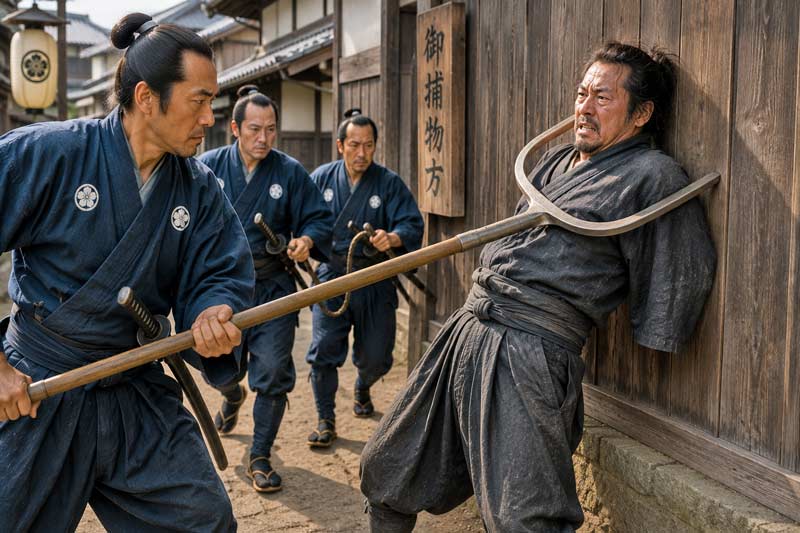
Among the most recognizable capture weapons in Japanese history was the sasumata, a long pole fitted with a wide U-shaped metal head. Rather than stabbing an opponent, it was designed to pin them against a wall, force them to the ground, or hold them at a safe distance until additional officers could move in. Its shape gave guards leverage over the chest, waist, shoulders, or limbs without requiring them to step within reach of a sword.
The sasumata became especially useful during the Edo period, when authorities faced the difficult task of arresting armed suspects in crowded streets, private homes, and castle towns. Killing every dangerous person was neither practical nor always desirable. Officials often needed prisoners alive for questioning or public trial, and a long capture pole allowed several men to control one violent suspect while reducing the risk to everyone involved.
Some versions included spikes along the shaft or around the metal fork. These were not necessarily meant to deliver a fatal wound. They made the pole harder to grab, slide past, or wrestle away from the officer holding it. Used alongside other specialized tools, the sasumata could turn an attempted sword fight into a coordinated restraint, with one guard pinning the suspect while others hooked their clothing or attacked their balance.
The weapon also reveals how misleading modern categories can be. At first glance, the sasumata resembles the forked heads found on certain historical spears, yet its purpose was almost the opposite. It was a polearm built not to pierce an enemy, but to deny them movement. That unusual combination of reach, control, and intimidation is what made it one of Japan's most ingenious capture weapons.
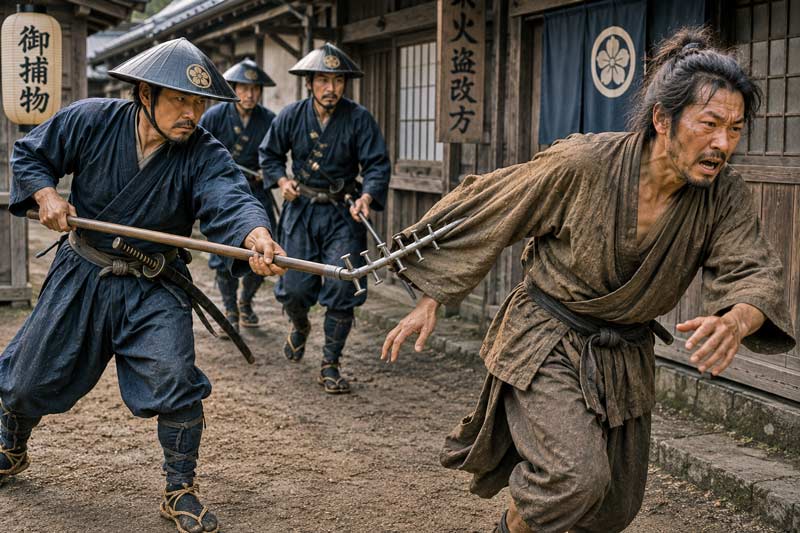
If the sasumata was built to pin a suspect in place, the sodegarami was designed to make escape nearly impossible. Its name roughly translates to "sleeve entangler," and its head was covered with rows of sharp, backward-facing hooks. These weren't intended to slash or stab. Instead, they snagged loose clothing, sleeves, armor cords, or belts, making it incredibly difficult for a fleeing person to pull away without becoming even more entangled.
The weapon was commonly carried by Japanese law enforcement officers alongside other specialized capture tools. Rather than relying on a single device, officers worked as a team. One might pin a suspect with a sasumata while another used a sodegarami to hook an arm or shoulder, preventing any sudden movement. A third officer could then move in safely to restrain the prisoner. This coordinated approach made capture far less dangerous than attempting to wrestle an armed opponent at close range.
Because the sodegarami depended on snagging fabric rather than piercing flesh, it reflected a remarkable understanding of leverage and control. The more a suspect struggled, the more their clothing became trapped among the hooks. It turned a person's own movement against them, reducing the need for deadly force while still giving officers a significant tactical advantage. Few historical Japanese weapons demonstrate this level of specialized design.
Today, the sodegarami remains one of the most unusual polearms ever created. At first glance, it resembles an intimidating battlefield weapon, yet its purpose was surprisingly restrained. Like the jutte, which allowed officers to control sword-wielding suspects without matching blade against blade, the sodegarami shows that some of history's most ingenious weapons were designed not to kill an opponent, but to leave them with nowhere to run.
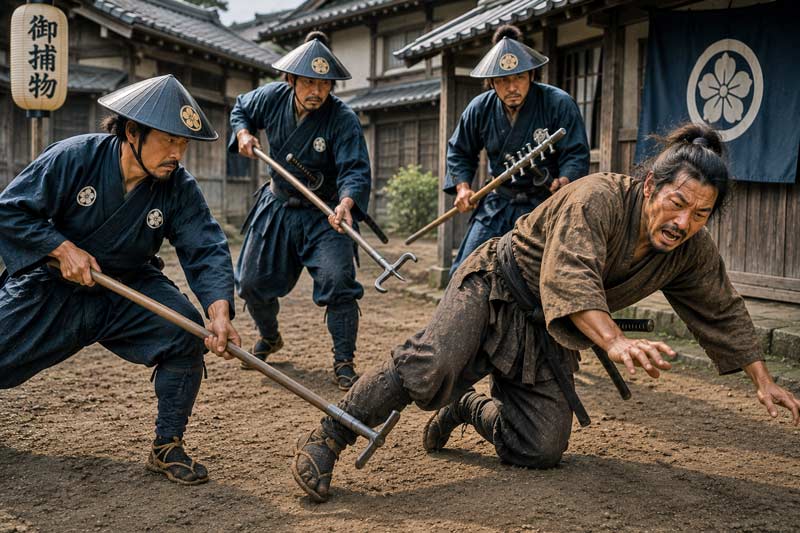
The third member of Japan's famous trio of arresting tools was the tsukubo, a long pole fitted with a T-shaped or hooked metal head. While the sasumata pinned the body and the sodegarami entangled clothing, the tsukubo was built to disrupt balance. Officers could use it to shove a suspect backward, pull their legs from beneath them, or catch an ankle before the person could escape.
Its design made it especially useful against someone carrying a sword. Closing the distance against an armed samurai could be fatal, but the tsukubo allowed an officer to attack the suspect's footing from several feet away. Once the target stumbled or fell, other officers could move in with the sasumata, sodegarami, ropes, or shorter arresting weapons to complete the capture.
Like the other torimono sandogu, the tsukubo was rarely intended to work alone. These weapons were most effective as part of a coordinated system in which several officers controlled different parts of the suspect's body at once. One blocked movement, another trapped clothing, and another destroyed the prisoner's balance. Together, they could overwhelm even a skilled fighter without turning the arrest into a lethal sword fight.
That teamwork helps explain why these tools deserve a place among Asia's most fascinating historical weapons. None of them looked as elegant as a katana, but elegance was never the point. They were practical instruments of control, created for the dangerous moment when authorities needed an armed person alive and unwilling to surrender.
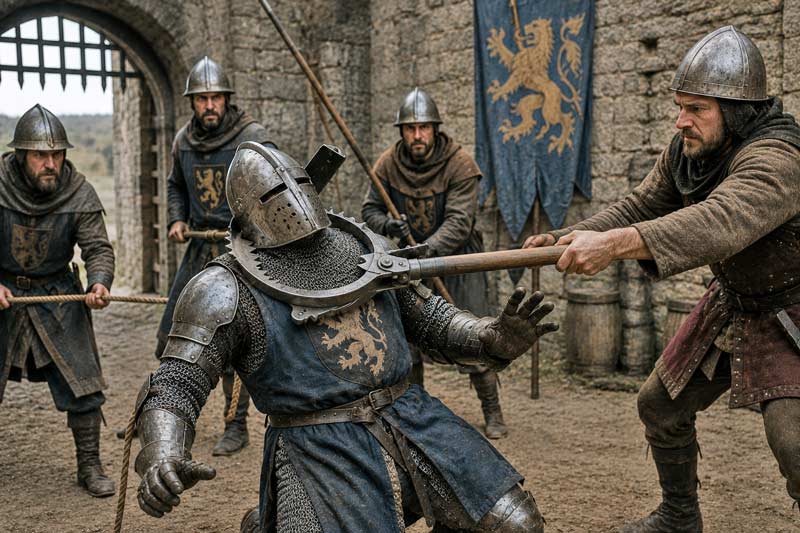
While Japan developed sophisticated polearms for arresting criminals, medieval Europe produced one of history's most intimidating capture weapons: the man catcher. At first glance, it looked like something pulled from a nightmare. Mounted on the end of a long pole, its hinged metal jaws formed a large ring that could snap shut around a person's neck, torso, or upper body. The goal wasn't to kill an opponent, but to restrain them from a safe distance where they could no longer fight or flee.
The weapon was especially useful against dangerous individuals who couldn't be approached safely. An armored knight, a violent criminal, or a fleeing prisoner could all pose an enormous threat in close combat. Instead of risking a deadly sword duel, several guards could surround the suspect and use a man catcher to control their movement until ropes or chains were secured. In many situations, taking a prisoner alive was far more valuable than adding another casualty to the battlefield. That practicality made the man catcher one of the most unusual weapons ever created, rivaling many of the devices featured in The Strangest Weapons Ever Carried into Real Battles.
Unlike many medieval swords, which required skillful strikes at close range, the man catcher relied on distance, leverage, and teamwork. Once its jaws closed around a suspect, escaping became extremely difficult. Guards could push, pull, or force the prisoner to the ground without exposing themselves to a desperate counterattack. The psychological impact was just as powerful as its physical design. Seeing those iron jaws closing in would have been enough to make almost anyone surrender.
Although surviving examples differ in shape and size, they all reflect the same idea: victory didn't always mean killing an enemy. Sometimes the most effective weapon was the one that ensured your opponent was still alive when the fight was over. Few capture devices demonstrate that principle more dramatically than the European man catcher.
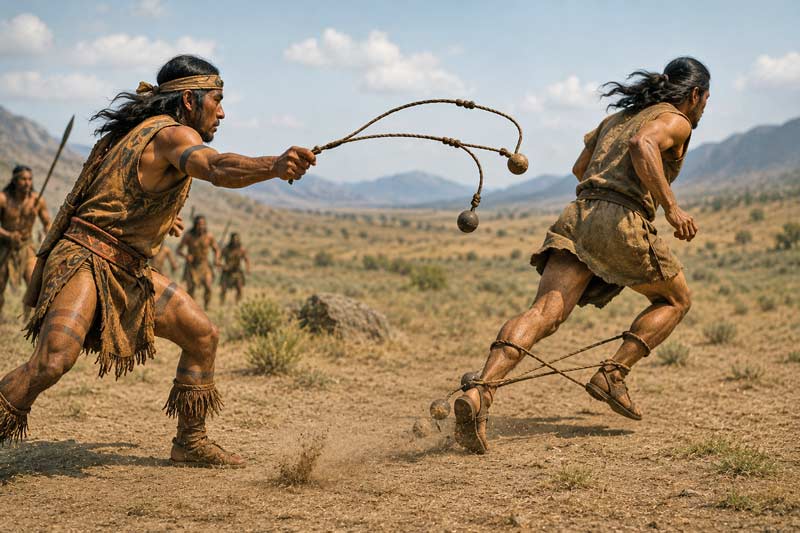
Unlike the rigid polearms used in Japan and Europe, the bolas relied on speed, timing, and momentum rather than brute strength. Traditionally made from two or three weighted balls connected by leather cords, the weapon was thrown so it spun rapidly through the air before wrapping around an opponent's legs or an animal's limbs. A clean throw could stop a running target almost instantly without delivering a fatal blow, making the bolas one of history's most ingenious non-lethal capture weapons.
Although the bolas are most closely associated with the indigenous peoples of South America, they proved remarkably effective for both hunting and warfare. Hunters used them to bring down fast-moving animals without damaging valuable hides, while warriors could use them to tangle an enemy before closing in to capture them. A person who suddenly found their legs bound together often had little chance of escaping, especially if they hit the ground at full speed. As explored in The Hidden History of the Bolas, this deceptively simple weapon remained in use for centuries because of its reliability and versatility.
The bolas also demonstrate that effective capture weapons didn't always need intimidating blades or heavy metal jaws. Their design took advantage of physics instead of force. Once the cords wrapped around a target, every additional step only tightened the entanglement, making escape increasingly difficult. It was an elegant solution that required skill from the thrower but minimized the need for direct hand-to-hand combat.
Compared to many of history's famous intimidating weapons, the bolas looked almost harmless. Yet their ability to stop a fleeing person from a considerable distance made them one of the most practical capture weapons ever developed. Sometimes, the simplest invention proved to be the hardest to escape.
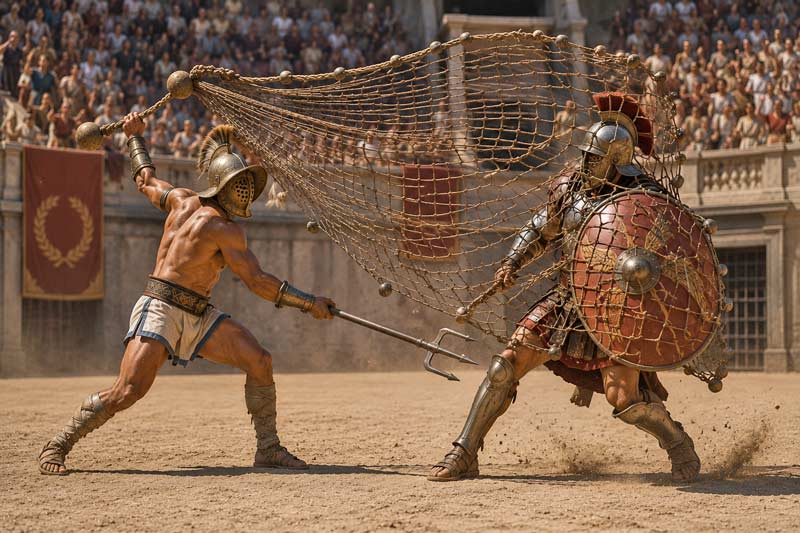
Long before blacksmiths created hinged jaws, hooked poles, or elaborate restraints, people already possessed one of the most effective capture tools ever invented: the net. A well-thrown net could wrap around a person's arms, trap their legs, obscure their vision, and pull them off balance almost simultaneously. Unlike a blade, it didn't require the attacker to land a precise strike. It only needed to spread across enough of the target to limit their movement.
The most famous combat use of the net came from ancient Rome. The retiarius was a lightly armored gladiator who entered the arena carrying a weighted net, a trident, and a dagger. His usual opponent was far more heavily protected, so the retiarius depended on speed and distance. By casting the net over his opponent, he could interfere with the man's shield, restrict his sword arm, or create the brief opening needed to strike with the trident. Surviving Roman artwork confirms that this distinctive style of gladiator was a familiar part of arena combat.
Of course, the retiarius was not trying to make a peaceful arrest. Roman gladiatorial combat could still end in death. Yet the net itself worked through capture rather than injury. It transformed a stronger, better-armored opponent into someone who could barely move, proving that immobilizing an enemy could be just as decisive as cutting through their defenses.
That same principle appeared far beyond the arena. Nets could be used to control animals, stop fleeing targets, protect entrances, or overwhelm an opponent before ropes and restraints were applied. They lacked the frightening appearance of metal traditional weapons, but their simplicity was part of their strength. A tangled person did not need to be wounded to become helpless.
At first glance, a weapon designed to spare your life might seem less frightening than a sword or spear. In reality, many capture weapons inspired even greater fear because they represented something far worse than dying in battle. Being taken alive often meant imprisonment, interrogation, torture, ransom, forced labor, or public execution. For many warriors throughout history, death on the battlefield was considered a more honorable fate than surviving to face whatever punishment awaited them.
Capture weapons also had a powerful psychological effect during a confrontation. A sword threatened immediate injury, but devices like the sasumata, man catcher, or bolas threatened to strip away a person's freedom. Once trapped, escape became nearly impossible. Every failed attempt to break loose only tightened the situation, whether it meant becoming more entangled in hooks, pinned beneath a pole, or wrapped in cords. That feeling of helplessness could be just as effective as physical force in ending a fight.
Many of these weapons were deliberately intimidating in appearance as well. The iron jaws of a European man catcher, the rows of hooks on a sodegarami, or the long poles carried by groups of officers sent a clear message before anyone made contact. They told the suspect that resistance was unlikely to succeed. As discussed in The Most Intimidating Weapons in History, a weapon's reputation could be just as valuable as its practical effectiveness.
Perhaps that's why so many of these remarkable designs continue to fascinate us today. They challenge our assumptions about what a weapon is supposed to do. Rather than focusing solely on destruction, they were engineered to control, restrain, and overpower through ingenuity instead of lethal force. That unusual purpose is what makes them some of history's most memorable historical weapons.
Many of history's most ingenious capture weapons gradually faded away, not because they stopped working, but because the world around them changed. As firearms became more common, confrontations grew deadlier and unfolded at much greater distances. A pole designed to pin someone or a hook meant to snag clothing offered little protection against a musket or pistol. The age of specialized capture weapons slowly gave way to new tactics and new technology.
Professional police forces also evolved. Instead of relying on teams carrying long capture poles through city streets, officers began using equipment that was lighter, easier to carry, and more practical in crowded urban environments. Handcuffs, batons, restraints, and eventually modern less-lethal tools replaced many of the bulky devices that had once been standard equipment. Their mission remained the same, but the methods changed dramatically.
Even so, the ideas behind these historic weapons never completely disappeared. Modern riot shields, restraint poles used in correctional facilities, animal control catch poles, and other specialized equipment all rely on the same principle: controlling a dangerous individual while reducing the need for deadly force. Although they look very different from the sasumata or the European man catcher, they are solving the same problem that guards faced hundreds of years ago.
Today, these remarkable designs survive as museum pieces, historical reproductions, and collectibles that remind us there was more than one way to win a fight. They also continue to inspire modern replicas found among collections of exotic weapons. Their legacy proves that some of history's most brilliant inventions weren't created to kill an enemy at all. They were created to make sure no one escaped.
History often celebrates the weapons that inflicted the greatest destruction, but the capture weapons of Japan, Europe, South America, and ancient Rome tell a different story. Their designers weren't trying to create the sharpest blade or the longest spear. They were solving a far more complicated problem: how to stop a dangerous person without killing them. The answer produced some of the most creative and specialized weapons ever carried into battle or used by law enforcement.
Many of these devices looked terrifying, yet their true purpose was restraint rather than destruction. Whether it was a sasumata pinning a swordsman, a sodegarami catching a fleeing suspect's clothing, a man catcher locking onto an armored knight, or a set of bolas wrapping around a runner's legs, each weapon relied on leverage, teamwork, and clever design instead of brute force. They remind us that victory has never been measured solely by how many enemies were defeated, but sometimes by how many were taken alive.
Today, these remarkable inventions continue to fascinate collectors, historians, and martial arts enthusiasts because they challenge our assumptions about what a weapon is meant to do. If you'd like to explore more unusual designs from around the world, check out our collection of exotic weapons, or discover even more surprising examples in our article on hidden weapons that look like ordinary objects.
Not entirely. While these weapons were designed to restrain rather than kill, they could still cause serious injuries if used improperly or with excessive force. A suspect pinned by a sasumata could suffer broken bones, a man catcher could injure the neck or chest, and a fall caused by bolas could be severe. Their purpose was to increase the chances of taking someone alive, not to guarantee a harmless arrest. In many cases, capture was simply the first step before imprisonment, trial, or another form of punishment.
Yes. One of the most fascinating things about capture weapons is that civilizations separated by thousands of miles often arrived at remarkably similar solutions. Feudal Japan developed tools like the sasumata, sodegarami, and tsukubo for law enforcement, while medieval Europe created the man catcher for taking armored opponents alive. In South America, indigenous hunters perfected the bolas to entangle prey and fleeing enemies. Although these weapons looked very different, they all shared the same goal: stop a target without delivering a fatal blow. That parallel evolution shows how universal the challenge of capturing a dangerous person has been throughout history.
There isn't a single definitive answer because every capture weapon was designed for a specific situation. The Japanese sasumata was highly effective for pinning armed suspects in narrow streets or buildings, while the European man catcher excelled at controlling heavily armored opponents without getting within sword range. Bolas were unmatched for bringing down fast-moving targets in open terrain, and nets proved incredibly versatile in both hunting and combat. Rather than one weapon being the best, each represented an ingenious solution to the unique challenges faced by the people who created and used it.
Capture weapons were excellent for controlling one person at a time, but large-scale battles were chaotic and fast-moving. Soldiers had to defend themselves against multiple opponents, cavalry charges, volleys of arrows, and later firearms. In those conditions, weapons designed to pin, hook, or entangle an enemy were often too slow and specialized to be practical. They also typically required teamwork to use effectively, making them far more useful for guards, police, castle defenders, or soldiers trying to capture a specific high-value target than for ordinary infantry fighting in the middle of a battlefield.
Why Capturing an Enemy Was Sometimes Better Than Killing Them
It might seem strange to build a weapon that couldn't easily kill, but throughout history, taking someone alive was often far more valuable than leaving them dead. A captured enemy could reveal military secrets, identify fellow conspirators, or be exchanged for money, political favors, or the release of other prisoners. For kings, generals, and law enforcement officials, information was often worth far more than another body on the battlefield.
Capture also served as a powerful form of public control. A criminal dragged through the streets in restraints sent a much stronger message than one who died resisting arrest. Likewise, capturing a dangerous warrior demonstrated both authority and discipline. Rather than relying on brute force alone, specialized capture weapons allowed guards and soldiers to subdue people while reducing the risk of killing them outright.
Many of these devices were surprisingly sophisticated. Some pinned an opponent to the ground without cutting them. Others snagged clothing, trapped limbs, or wrapped around a fleeing target's legs to stop an escape. They required skill to use effectively, but in the hands of trained officers, they could end a confrontation with remarkable efficiency. As explored in The Weapons That Were Far More Effective Than Swords, the most effective weapon wasn't always the one that dealt the deadliest blow.
Although many of these tools now seem unusual compared to modern police equipment, they were once an essential part of maintaining order. Long before handcuffs, tasers, or riot shields existed, societies around the world developed ingenious ways to stop dangerous people without immediately taking their lives. Some of those inventions remain among the most fascinating and intimidating exotic weapons ever created.
The Sasumata: Japan's Human-Catching Spear
Among the most recognizable capture weapons in Japanese history was the sasumata, a long pole fitted with a wide U-shaped metal head. Rather than stabbing an opponent, it was designed to pin them against a wall, force them to the ground, or hold them at a safe distance until additional officers could move in. Its shape gave guards leverage over the chest, waist, shoulders, or limbs without requiring them to step within reach of a sword.
The sasumata became especially useful during the Edo period, when authorities faced the difficult task of arresting armed suspects in crowded streets, private homes, and castle towns. Killing every dangerous person was neither practical nor always desirable. Officials often needed prisoners alive for questioning or public trial, and a long capture pole allowed several men to control one violent suspect while reducing the risk to everyone involved.
Some versions included spikes along the shaft or around the metal fork. These were not necessarily meant to deliver a fatal wound. They made the pole harder to grab, slide past, or wrestle away from the officer holding it. Used alongside other specialized tools, the sasumata could turn an attempted sword fight into a coordinated restraint, with one guard pinning the suspect while others hooked their clothing or attacked their balance.
The weapon also reveals how misleading modern categories can be. At first glance, the sasumata resembles the forked heads found on certain historical spears, yet its purpose was almost the opposite. It was a polearm built not to pierce an enemy, but to deny them movement. That unusual combination of reach, control, and intimidation is what made it one of Japan's most ingenious capture weapons.
The Sodegarami: Catching an Opponent by Their Clothing
If the sasumata was built to pin a suspect in place, the sodegarami was designed to make escape nearly impossible. Its name roughly translates to "sleeve entangler," and its head was covered with rows of sharp, backward-facing hooks. These weren't intended to slash or stab. Instead, they snagged loose clothing, sleeves, armor cords, or belts, making it incredibly difficult for a fleeing person to pull away without becoming even more entangled.
The weapon was commonly carried by Japanese law enforcement officers alongside other specialized capture tools. Rather than relying on a single device, officers worked as a team. One might pin a suspect with a sasumata while another used a sodegarami to hook an arm or shoulder, preventing any sudden movement. A third officer could then move in safely to restrain the prisoner. This coordinated approach made capture far less dangerous than attempting to wrestle an armed opponent at close range.
Because the sodegarami depended on snagging fabric rather than piercing flesh, it reflected a remarkable understanding of leverage and control. The more a suspect struggled, the more their clothing became trapped among the hooks. It turned a person's own movement against them, reducing the need for deadly force while still giving officers a significant tactical advantage. Few historical Japanese weapons demonstrate this level of specialized design.
Today, the sodegarami remains one of the most unusual polearms ever created. At first glance, it resembles an intimidating battlefield weapon, yet its purpose was surprisingly restrained. Like the jutte, which allowed officers to control sword-wielding suspects without matching blade against blade, the sodegarami shows that some of history's most ingenious weapons were designed not to kill an opponent, but to leave them with nowhere to run.
The Tsukubo: Pushing, Pulling, and Knocking Suspects Off Balance
The third member of Japan's famous trio of arresting tools was the tsukubo, a long pole fitted with a T-shaped or hooked metal head. While the sasumata pinned the body and the sodegarami entangled clothing, the tsukubo was built to disrupt balance. Officers could use it to shove a suspect backward, pull their legs from beneath them, or catch an ankle before the person could escape.
Its design made it especially useful against someone carrying a sword. Closing the distance against an armed samurai could be fatal, but the tsukubo allowed an officer to attack the suspect's footing from several feet away. Once the target stumbled or fell, other officers could move in with the sasumata, sodegarami, ropes, or shorter arresting weapons to complete the capture.
Like the other torimono sandogu, the tsukubo was rarely intended to work alone. These weapons were most effective as part of a coordinated system in which several officers controlled different parts of the suspect's body at once. One blocked movement, another trapped clothing, and another destroyed the prisoner's balance. Together, they could overwhelm even a skilled fighter without turning the arrest into a lethal sword fight.
That teamwork helps explain why these tools deserve a place among Asia's most fascinating historical weapons. None of them looked as elegant as a katana, but elegance was never the point. They were practical instruments of control, created for the dangerous moment when authorities needed an armed person alive and unwilling to surrender.
The European Man Catcher: A Weapon Built for Taking Prisoners Alive
While Japan developed sophisticated polearms for arresting criminals, medieval Europe produced one of history's most intimidating capture weapons: the man catcher. At first glance, it looked like something pulled from a nightmare. Mounted on the end of a long pole, its hinged metal jaws formed a large ring that could snap shut around a person's neck, torso, or upper body. The goal wasn't to kill an opponent, but to restrain them from a safe distance where they could no longer fight or flee.
The weapon was especially useful against dangerous individuals who couldn't be approached safely. An armored knight, a violent criminal, or a fleeing prisoner could all pose an enormous threat in close combat. Instead of risking a deadly sword duel, several guards could surround the suspect and use a man catcher to control their movement until ropes or chains were secured. In many situations, taking a prisoner alive was far more valuable than adding another casualty to the battlefield. That practicality made the man catcher one of the most unusual weapons ever created, rivaling many of the devices featured in The Strangest Weapons Ever Carried into Real Battles.
Unlike many medieval swords, which required skillful strikes at close range, the man catcher relied on distance, leverage, and teamwork. Once its jaws closed around a suspect, escaping became extremely difficult. Guards could push, pull, or force the prisoner to the ground without exposing themselves to a desperate counterattack. The psychological impact was just as powerful as its physical design. Seeing those iron jaws closing in would have been enough to make almost anyone surrender.
Although surviving examples differ in shape and size, they all reflect the same idea: victory didn't always mean killing an enemy. Sometimes the most effective weapon was the one that ensured your opponent was still alive when the fight was over. Few capture devices demonstrate that principle more dramatically than the European man catcher.
Bolas: The Capture Weapon That Wrapped Around Its Target
Unlike the rigid polearms used in Japan and Europe, the bolas relied on speed, timing, and momentum rather than brute strength. Traditionally made from two or three weighted balls connected by leather cords, the weapon was thrown so it spun rapidly through the air before wrapping around an opponent's legs or an animal's limbs. A clean throw could stop a running target almost instantly without delivering a fatal blow, making the bolas one of history's most ingenious non-lethal capture weapons.
Although the bolas are most closely associated with the indigenous peoples of South America, they proved remarkably effective for both hunting and warfare. Hunters used them to bring down fast-moving animals without damaging valuable hides, while warriors could use them to tangle an enemy before closing in to capture them. A person who suddenly found their legs bound together often had little chance of escaping, especially if they hit the ground at full speed. As explored in The Hidden History of the Bolas, this deceptively simple weapon remained in use for centuries because of its reliability and versatility.
The bolas also demonstrate that effective capture weapons didn't always need intimidating blades or heavy metal jaws. Their design took advantage of physics instead of force. Once the cords wrapped around a target, every additional step only tightened the entanglement, making escape increasingly difficult. It was an elegant solution that required skill from the thrower but minimized the need for direct hand-to-hand combat.
Compared to many of history's famous intimidating weapons, the bolas looked almost harmless. Yet their ability to stop a fleeing person from a considerable distance made them one of the most practical capture weapons ever developed. Sometimes, the simplest invention proved to be the hardest to escape.
Nets: The Oldest Capture Weapon May Have Been the Simplest
Long before blacksmiths created hinged jaws, hooked poles, or elaborate restraints, people already possessed one of the most effective capture tools ever invented: the net. A well-thrown net could wrap around a person's arms, trap their legs, obscure their vision, and pull them off balance almost simultaneously. Unlike a blade, it didn't require the attacker to land a precise strike. It only needed to spread across enough of the target to limit their movement.
The most famous combat use of the net came from ancient Rome. The retiarius was a lightly armored gladiator who entered the arena carrying a weighted net, a trident, and a dagger. His usual opponent was far more heavily protected, so the retiarius depended on speed and distance. By casting the net over his opponent, he could interfere with the man's shield, restrict his sword arm, or create the brief opening needed to strike with the trident. Surviving Roman artwork confirms that this distinctive style of gladiator was a familiar part of arena combat.
Of course, the retiarius was not trying to make a peaceful arrest. Roman gladiatorial combat could still end in death. Yet the net itself worked through capture rather than injury. It transformed a stronger, better-armored opponent into someone who could barely move, proving that immobilizing an enemy could be just as decisive as cutting through their defenses.
That same principle appeared far beyond the arena. Nets could be used to control animals, stop fleeing targets, protect entrances, or overwhelm an opponent before ropes and restraints were applied. They lacked the frightening appearance of metal traditional weapons, but their simplicity was part of their strength. A tangled person did not need to be wounded to become helpless.
Why Capture Weapons Inspired More Fear Than Deadly Ones
At first glance, a weapon designed to spare your life might seem less frightening than a sword or spear. In reality, many capture weapons inspired even greater fear because they represented something far worse than dying in battle. Being taken alive often meant imprisonment, interrogation, torture, ransom, forced labor, or public execution. For many warriors throughout history, death on the battlefield was considered a more honorable fate than surviving to face whatever punishment awaited them.
Capture weapons also had a powerful psychological effect during a confrontation. A sword threatened immediate injury, but devices like the sasumata, man catcher, or bolas threatened to strip away a person's freedom. Once trapped, escape became nearly impossible. Every failed attempt to break loose only tightened the situation, whether it meant becoming more entangled in hooks, pinned beneath a pole, or wrapped in cords. That feeling of helplessness could be just as effective as physical force in ending a fight.
Many of these weapons were deliberately intimidating in appearance as well. The iron jaws of a European man catcher, the rows of hooks on a sodegarami, or the long poles carried by groups of officers sent a clear message before anyone made contact. They told the suspect that resistance was unlikely to succeed. As discussed in The Most Intimidating Weapons in History, a weapon's reputation could be just as valuable as its practical effectiveness.
Perhaps that's why so many of these remarkable designs continue to fascinate us today. They challenge our assumptions about what a weapon is supposed to do. Rather than focusing solely on destruction, they were engineered to control, restrain, and overpower through ingenuity instead of lethal force. That unusual purpose is what makes them some of history's most memorable historical weapons.
Why Capture Weapons Eventually Disappeared
Many of history's most ingenious capture weapons gradually faded away, not because they stopped working, but because the world around them changed. As firearms became more common, confrontations grew deadlier and unfolded at much greater distances. A pole designed to pin someone or a hook meant to snag clothing offered little protection against a musket or pistol. The age of specialized capture weapons slowly gave way to new tactics and new technology.
Professional police forces also evolved. Instead of relying on teams carrying long capture poles through city streets, officers began using equipment that was lighter, easier to carry, and more practical in crowded urban environments. Handcuffs, batons, restraints, and eventually modern less-lethal tools replaced many of the bulky devices that had once been standard equipment. Their mission remained the same, but the methods changed dramatically.
Even so, the ideas behind these historic weapons never completely disappeared. Modern riot shields, restraint poles used in correctional facilities, animal control catch poles, and other specialized equipment all rely on the same principle: controlling a dangerous individual while reducing the need for deadly force. Although they look very different from the sasumata or the European man catcher, they are solving the same problem that guards faced hundreds of years ago.
Today, these remarkable designs survive as museum pieces, historical reproductions, and collectibles that remind us there was more than one way to win a fight. They also continue to inspire modern replicas found among collections of exotic weapons. Their legacy proves that some of history's most brilliant inventions weren't created to kill an enemy at all. They were created to make sure no one escaped.
History's Most Ingenious Weapons Weren't Always the Deadliest
History often celebrates the weapons that inflicted the greatest destruction, but the capture weapons of Japan, Europe, South America, and ancient Rome tell a different story. Their designers weren't trying to create the sharpest blade or the longest spear. They were solving a far more complicated problem: how to stop a dangerous person without killing them. The answer produced some of the most creative and specialized weapons ever carried into battle or used by law enforcement.
Many of these devices looked terrifying, yet their true purpose was restraint rather than destruction. Whether it was a sasumata pinning a swordsman, a sodegarami catching a fleeing suspect's clothing, a man catcher locking onto an armored knight, or a set of bolas wrapping around a runner's legs, each weapon relied on leverage, teamwork, and clever design instead of brute force. They remind us that victory has never been measured solely by how many enemies were defeated, but sometimes by how many were taken alive.
Today, these remarkable inventions continue to fascinate collectors, historians, and martial arts enthusiasts because they challenge our assumptions about what a weapon is meant to do. If you'd like to explore more unusual designs from around the world, check out our collection of exotic weapons, or discover even more surprising examples in our article on hidden weapons that look like ordinary objects.
Were Capture Weapons Actually Non-Lethal?
Not entirely. While these weapons were designed to restrain rather than kill, they could still cause serious injuries if used improperly or with excessive force. A suspect pinned by a sasumata could suffer broken bones, a man catcher could injure the neck or chest, and a fall caused by bolas could be severe. Their purpose was to increase the chances of taking someone alive, not to guarantee a harmless arrest. In many cases, capture was simply the first step before imprisonment, trial, or another form of punishment.
Did Different Cultures Invent Similar Capture Weapons Independently?
Yes. One of the most fascinating things about capture weapons is that civilizations separated by thousands of miles often arrived at remarkably similar solutions. Feudal Japan developed tools like the sasumata, sodegarami, and tsukubo for law enforcement, while medieval Europe created the man catcher for taking armored opponents alive. In South America, indigenous hunters perfected the bolas to entangle prey and fleeing enemies. Although these weapons looked very different, they all shared the same goal: stop a target without delivering a fatal blow. That parallel evolution shows how universal the challenge of capturing a dangerous person has been throughout history.
What's the Most Effective Capture Weapon Ever Invented?
There isn't a single definitive answer because every capture weapon was designed for a specific situation. The Japanese sasumata was highly effective for pinning armed suspects in narrow streets or buildings, while the European man catcher excelled at controlling heavily armored opponents without getting within sword range. Bolas were unmatched for bringing down fast-moving targets in open terrain, and nets proved incredibly versatile in both hunting and combat. Rather than one weapon being the best, each represented an ingenious solution to the unique challenges faced by the people who created and used it.
Why Didn't Armies Use More Capture Weapons on the Battlefield?
Capture weapons were excellent for controlling one person at a time, but large-scale battles were chaotic and fast-moving. Soldiers had to defend themselves against multiple opponents, cavalry charges, volleys of arrows, and later firearms. In those conditions, weapons designed to pin, hook, or entangle an enemy were often too slow and specialized to be practical. They also typically required teamwork to use effectively, making them far more useful for guards, police, castle defenders, or soldiers trying to capture a specific high-value target than for ordinary infantry fighting in the middle of a battlefield.
You May Also Be Interested In:
- 5 Deadly Weapons You Wish You Had!
- Tactical War Hammer and Other Deadly Weapons!
- Deadly Throwing Axe and Other Dangerous Weapons!
- Titanium Nunchaku and Other Deadly Weapons
- Throwing Knives and Other Deadly Weapons
- Deadly Illegal Weapons! Should They Be Banned? ????
- Transforming Spear Staff and Other Deadly Weapons!
- Hidden Icepick Escrima and Other Deadly Weapons
- Spring-Loaded Stun Gun and Other Deadly Weapons
- Solid Metal Nunchucks and Other Deadly Weapons
Leave a Reply