


Could a Samurai Actually Defeat a Medieval Knight?
October 15th, 2026
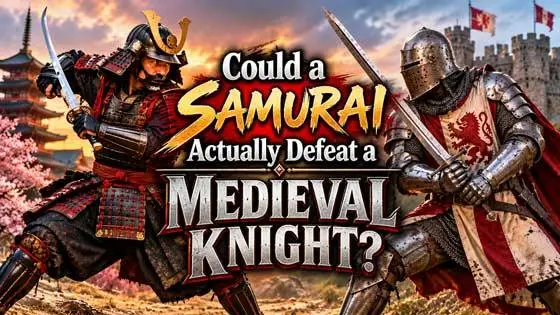
Imagine a battle that history never gave us. On one side stands a Japanese samurai, his razor-sharp katana drawn, his armor bearing the marks of countless battles. Across from him waits a medieval European knight, encased in polished steel and gripping a longsword forged for war. Both warriors have spent years mastering the art of combat. Both come from cultures that produced some of history's most formidable fighters. But if these two legendary warriors actually faced each other, who would walk away alive? Would the samurai's speed and precision overcome the knight's heavy armor, or would European steel prove too much for the Japanese swordsman? The answer is far more complicated than most people realize, and some of the biggest advantages might come from weapons neither warrior is holding.
Could a Katana Actually Cut Through Medieval Plate Armor?
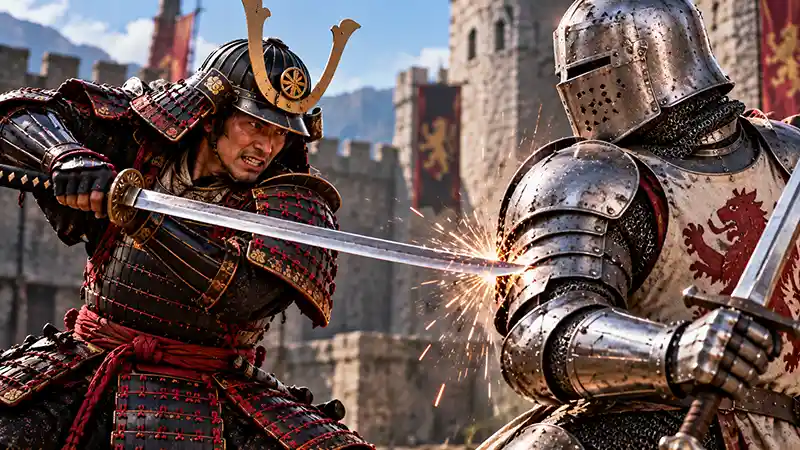
Picture the moment when our two warriors finally meet. The samurai lunges forward, bringing his katana down in a powerful strike aimed directly at the knight's shoulder. The blade connects with polished steel, and for a fraction of a second, everything seems to stop. Does the legendary Japanese sword slice through the armor like Hollywood would have us believe, or does the knight simply shrug off the attack and prepare his counterstrike?
This question gets to the heart of one of the biggest misconceptions surrounding samurai swords. The katana has developed an almost mythical reputation for sharpness, with countless movies, television shows, and internet videos suggesting that a properly forged Japanese blade can cut through practically anything. Some enthusiasts even claim that traditional Japanese steel was so advanced that European armor would have offered little protection against it.
Unfortunately for our samurai, medieval armorers were considerably better at their jobs than these stories suggest.
By the fifteenth century, European knights could wear sophisticated suits of articulated plate armor made from carefully shaped iron or steel. These weren't simply heavy metal shells thrown together by blacksmiths. Armorers understood how to create curved surfaces that could deflect incoming blows, reinforce vulnerable areas, and distribute the force of impacts. High-quality plate armor was specifically designed to resist the swords, axes, and other weapons commonly encountered on European battlefields.
A katana, despite its remarkable cutting capabilities, wasn't designed to slice through substantial steel plate. Its curved, single-edged blade excels at delivering controlled cuts against appropriate targets, but striking hardened armor presents an entirely different challenge. The blade might slide across the surface, glance away, or potentially suffer damage from the impact. Even an exceptionally sharp sword cannot simply ignore the physical properties of the material it's striking.
This doesn't mean Japanese swords were inferior. Far from it. Traditional Japanese swordsmiths developed sophisticated forging and heat-treatment techniques that produced blades with a hard cutting edge and a comparatively resilient body. The distinctive curvature and geometry of the samurai swords we recognize today reflected centuries of refinement for the combat conditions in which they were used. But those conditions weren't identical to the armored warfare of late medieval Europe.
Japanese armor followed its own fascinating evolutionary path. Earlier samurai armor often incorporated overlapping scales or lamellar construction, while later designs increasingly used larger metal plates. By the sixteenth century, some Japanese armor incorporated substantial iron or steel breastplates, including designs influenced by European armor. The idea that samurai always wore lightweight protection while European knights were encased in heavy steel is an oversimplification of two long and complicated military traditions.
There's another important consideration: medieval knights weren't invulnerable simply because they wore plate armor. Their equipment included articulated joints, openings for vision and ventilation, and areas where different protective components met. European fighting manuals describe techniques intended to deal with armored opponents, including specialized grips, grappling, and the use of weapons better suited to overcoming armor. Medieval warriors understood that defeating an armored opponent often required something more sophisticated than simply swinging harder.
And what about the knight's own sword? European medieval swords weren't magical armor-cutting weapons either. Although some designs incorporated stiff, sharply tapered points suitable for specialized thrusting techniques, ordinary sword cuts were generally ineffective against good-quality plate armor. European fighters adapted their techniques accordingly, often relying on other weapons or methods when confronting heavily armored opponents.
Perhaps the most surprising revelation is that the katana's famous sharpness wouldn't necessarily be the deciding factor in this encounter. A sword's effectiveness depends on far more than how easily it cuts through a rolled-up mat or a piece of bamboo. Blade geometry, durability, the target's protective equipment, and the circumstances of the fight all matter. As we explored in our article The Biggest Myths About Samurai Swords, the reputation of Japanese blades has become tangled with centuries of legend and modern exaggeration.
So where does that leave our hypothetical showdown? If the knight is wearing a well-made fifteenth-century suit of plate armor and the samurai is relying primarily on his katana, the European warrior has a substantial defensive advantage against conventional sword cuts. That doesn't guarantee victory, and it certainly doesn't mean the samurai is helpless. But it does mean that the familiar image of a katana effortlessly slicing through European armor belongs more to fantasy than historical reality.
Armor Advantage: Medieval Knight. Against a conventional katana cut, high-quality European plate armor offers formidable protection. The samurai would need to overcome that advantage through skill, tactics, or a different weapon rather than relying on the legendary sharpness of his blade.
Katana vs. Longsword: Which Sword Was Actually Better?
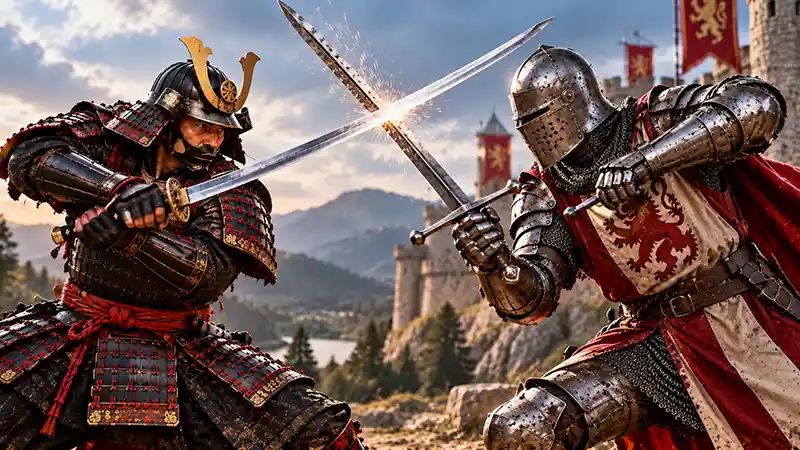
Few weapons inspire as much loyalty as the Japanese katana and the European longsword. Ask a room full of sword enthusiasts which one is superior, and you might start an argument that lasts longer than the battle itself. Katana supporters praise the Japanese blade's sharpness, balance, and legendary craftsmanship. Longsword enthusiasts point to the European weapon's versatility, reach, and ability to deliver powerful cuts and precise thrusts. Both sides have compelling arguments, but there's one problem with the debate: these swords were developed for different fighting traditions, and neither was designed to defeat every opponent imaginable.
Let's start with the katana. The familiar Japanese sword typically features a curved, single-edged blade measuring approximately 60 to 80 centimeters, although historical examples vary considerably. Its distinctive shape makes it particularly effective for controlled cutting techniques, while its long handle allows the wielder to generate power with both hands. The katana also has a usable point for thrusting, something that often gets overlooked when people describe it as purely a slashing weapon.
The European longsword presents a different approach. Many historical examples feature straight, double-edged blades approximately 85 to 110 centimeters long, with enough variation that some overlap with the dimensions of Japanese swords. The longer examples could provide a reach advantage, while the double-edged design allowed cuts from either edge without having to rotate the weapon as much. A typical longsword also offered a substantial crossguard, providing additional hand protection and opportunities for controlling an opponent's blade.
But the real difference becomes apparent when we examine how these weapons were used.
European swordsmanship included techniques that modern audiences rarely associate with medieval combat. Historical fighting manuals describe thrusting, grappling, blade control, and even striking with the sword's pommel or crossguard. One particularly interesting technique, known as half-swording, involved gripping part of the blade with a hand to gain greater control over the point. This was especially useful when fighting armored opponents, where precise placement could matter far more than the power of a conventional cut.
Japanese swordsmanship developed its own sophisticated methods of controlling distance, timing, and blade movement. The katana's curved edge could deliver devastating cuts when used against suitable targets, and its two-handed grip allowed precise manipulation of the weapon. Samurai also practiced thrusting, defensive actions, and techniques for exploiting an opponent's openings. Anyone who imagines Japanese swordsmanship as nothing more than dramatic overhead slashes is overlooking a remarkably complex martial tradition.
There's also the question of weight. Popular culture often portrays the katana as an impossibly light weapon and the European longsword as a massive piece of steel requiring extraordinary strength. In reality, many historical katanas weighed roughly 1 to 1.4 kilograms, while many longswords fell around 1.1 to 1.8 kilograms. Individual examples varied, but the difference was nowhere near as dramatic as Hollywood suggests. Both weapons were carefully balanced tools intended for skilled fighters, not crude metal clubs.
And here's something that might surprise readers who have spent years watching sword comparison videos: the quality of the steel alone probably wouldn't decide the fight. Japanese swordsmiths developed impressive methods of working with available iron and steel, while European swordmakers produced blades using their own sophisticated metallurgical techniques. Both traditions created exceptional weapons, and both produced blades of varying quality. The popular claim that Japanese swords were universally superior to European swords, or vice versa, simply isn't supported by the historical evidence.
Our article Samurai Sword vs. Katana: What's the Difference? explores the terminology surrounding Japanese swords, which is worth understanding because the katana wasn't the only blade a samurai might carry. Japanese warriors used different sword designs across different periods, including the longer, more deeply curved tachi that was particularly associated with mounted warriors.
So what happens when our samurai and knight finally cross blades?
If both warriors are unarmored, the fight becomes extraordinarily difficult to predict. A skilled katana wielder could deliver a decisive cut or thrust, while an equally skilled longsword fighter could exploit reach, the double-edged blade, and a wide variety of techniques. Neither sword possesses some mysterious property that automatically defeats the other. Timing, positioning, experience, and a single mistake could matter more than the design of either weapon.
Put the knight back into his full plate armor, however, and the equation changes. The longsword's suitability for half-swording and specialized armored fighting techniques becomes particularly relevant. That doesn't make the European sword universally superior, but it does mean that a knight trained to fight armored opponents might have a more immediately applicable set of techniques for this particular encounter.
There's one final twist. If our warriors were allowed to choose any weapon from their respective arsenals, there's a good chance neither would select the sword as his first choice. Historically, both Japanese and European warriors relied heavily on spears, polearms, bows, and other battlefield weapons. The iconic sword was important, but it was only one part of a much larger military tradition.
Weapon Advantage: Too Close to Call. The longsword offers certain advantages in reach, guard design, and armored fighting techniques, while the katana is a highly capable cutting and thrusting weapon in skilled hands. Against a fully armored knight, the European swordsmanship tradition has some relevant advantages, but in an unarmored duel, the better fighter would likely matter far more than the blade.
Samurai vs. Knight: Who Had the Better Combat Training?
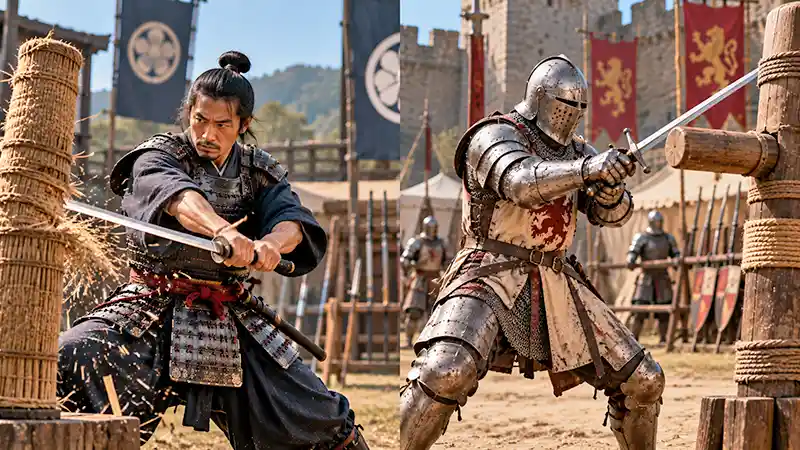
Imagine spending your entire life preparing for battle, only to discover that your opponent has spent his entire life doing exactly the same thing. That's the situation our samurai and medieval knight would find themselves in. Both belonged to warrior traditions that placed enormous importance on martial skill, discipline, and military service. Both could spend years learning to fight with multiple weapons, ride horses, and survive the chaos of warfare. Yet popular culture has created a curious imbalance in how we remember them. Samurai are frequently portrayed as philosophical masters of swordsmanship, while European knights are sometimes reduced to heavily armored men who relied on brute strength. The historical reality is considerably more interesting.
Let's begin with the samurai. Contrary to the image of a warrior who spent every waking moment perfecting his katana technique, a samurai's education could encompass a surprisingly broad range of skills. Depending on the historical period, family circumstances, and military responsibilities, these might include archery, spear fighting, horsemanship, grappling, and the use of various swords. Earlier samurai were particularly associated with mounted archery, while the large-scale warfare of Japan's Sengoku period placed considerable emphasis on spears and coordinated battlefield tactics.
Swordsmanship was certainly important, but it was never the entire story. Japanese martial traditions developed sophisticated systems for managing distance, controlling an opponent's movements, and recognizing opportunities to attack. Some schools preserved techniques for fighting in armor, while others emphasized different circumstances and weapons. There was no single universal samurai fighting style, just as there was no single way that every European knight learned to fight.
The European knight's education was similarly demanding. A young nobleman destined for knighthood might begin learning horsemanship, weapon handling, and the expectations of military service while still a child. As his training progressed, he could develop proficiency with swords, lances, daggers, shields, and other weapons. Wrestling was particularly valuable because medieval combat could quickly become a contest of balance, leverage, and physical control rather than an elegant exchange of sword strikes.
One of the most revealing pieces of evidence comes from surviving European fighting manuals. Masters such as Fiore dei Liberi, who wrote in the early fifteenth century, documented elaborate systems involving swordsmanship, wrestling, daggers, polearms, and armored combat. His teachings describe a technical fighting tradition that looks very different from the clumsy sword swinging often associated with medieval knights in movies.
And Fiore wasn't alone. The German fencing tradition associated with Johannes Liechtenauer also preserved sophisticated approaches to timing, blade control, attacking, and defending. These systems demonstrate that European martial artists understood many of the same fundamental problems that concerned Japanese swordsmen: how to control distance, create openings, maintain balance, and defeat an opponent who was actively trying to do the same thing.
Here's where the comparison becomes especially fascinating. Both traditions recognized that fighting an armored opponent required different techniques from fighting someone without armor. Both developed grappling methods, and both understood that controlling an opponent's body or weapon could be more important than delivering a spectacular strike. The similarities don't mean their martial arts were identical, but they reveal how experienced fighters in different parts of the world arrived at practical solutions to similar problems.
However, there's an important historical complication that makes declaring a winner almost impossible: the samurai and the medieval knight weren't necessarily training for the same battlefield.
A Japanese warrior fighting during the Sengoku period might have experience with large infantry formations, spear combat, castle warfare, and increasingly widespread firearms. A fifteenth-century European knight might be familiar with armored men-at-arms, cavalry charges, polearms, and the specialized techniques required to confront opponents wearing sophisticated plate armor. Each fighter's training reflected the threats he expected to encounter, and those expectations would influence his decisions in our hypothetical duel.
Social status also didn't automatically guarantee exceptional fighting ability. Some samurai and knights were extraordinarily experienced warriors. Others might have possessed impressive equipment and prestigious family connections without having survived many serious battles. A veteran who had fought through years of warfare could be a very different opponent from a young nobleman whose experience consisted largely of formal instruction and practice.
We should also be careful about applying later romantic ideals to earlier warriors. The familiar image of the samurai as a perfectly disciplined swordsman guided by an unchanging code of bushido owes much to interpretations that became influential after Japan's great age of civil warfare. European chivalry underwent its own romantic transformation. Neither tradition was as uniform, noble, or predictable as the legends suggest.
So if we placed two equally experienced warriors in an arena, could one training system provide a decisive advantage? Not necessarily. A samurai accustomed to facing lightly armored opponents might initially struggle against European plate armor. A knight unfamiliar with Japanese swordsmanship might misjudge the timing or angles of an unfamiliar attack. But experienced fighters are also capable of adapting, and neither warrior would suddenly forget his years of training simply because his opponent came from another continent.
Ultimately, the most important distinction might not be Japanese versus European at all. It might be veteran versus novice, specialist versus generalist, or a fighter familiar with his opponent's equipment versus one encountering it for the first time. History is filled with examples of skilled warriors being defeated by less celebrated opponents because of circumstances, mistakes, or simple bad luck.
Training Advantage: Draw. Both samurai and medieval knights belonged to sophisticated martial traditions that demanded far more than basic swordsmanship. Individual experience, preparation, and familiarity with the opponent's equipment would likely matter more than the warrior's country of origin.
Samurai vs. Knight: Two Very Different Fighting Styles
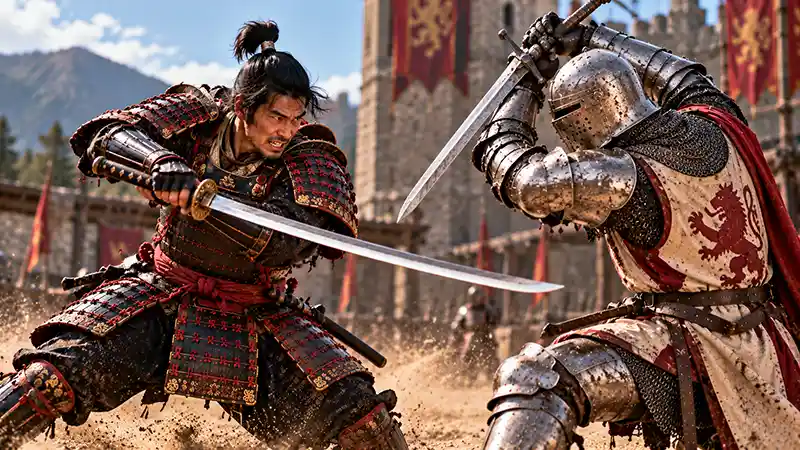
Imagine our samurai and medieval knight standing just beyond striking distance, each waiting for the other to make the first move. The samurai shifts his weight, keeping his katana ready. The knight raises his longsword, carefully watching his opponent's hands and shoulders. Neither warrior knows exactly what to expect. Their weapons are unfamiliar to one another, their armor is different, and the techniques they've spent years perfecting were developed thousands of miles apart. Yet despite these differences, both men are facing the same fundamental problem: how do you strike an opponent without getting struck yourself?
Popular culture would have us believe that samurai fought with graceful, lightning-fast movements while European knights relied on powerful, lumbering attacks. It's an appealing contrast, especially when filmmakers want to emphasize the elegance of Japanese swordsmanship. Unfortunately, it's also a terrible representation of how these warriors actually fought.
Let's begin with one of the most persistent misconceptions about medieval knights: that their armor made them slow and clumsy. A well-fitted suit of plate armor distributed its weight across the body rather than concentrating it entirely on the shoulders. Although armor certainly required additional effort to wear, experienced knights could run, climb, wrestle, and perform surprisingly athletic movements. Modern demonstrations using historically accurate armor have repeatedly challenged the familiar image of knights struggling to stand after falling over.
That mobility was essential because European swordsmanship was anything but stationary. Surviving medieval fighting manuals describe an intricate system of footwork, timing, blade control, and counterattacks. A skilled longsword fighter could transition between different guards, threaten with cuts or thrusts, and manipulate an opponent's weapon to create an opening. Some techniques involved closing the distance and wrestling, particularly when fighting someone wearing armor.
Japanese swordsmanship placed its own emphasis on timing, distance, and decisive action. Different schools developed distinctive approaches, but many traditional techniques involved carefully controlling the space between opponents and exploiting brief openings. The katana's curved blade could deliver powerful cuts, while its two-handed grip provided considerable control over the weapon's movement. Japanese swordsmanship also included thrusts, defensive actions, and methods for dealing with opponents at close range.
One particularly interesting difference involves the European longsword's crossguard. The long, projecting quillons provided protection for the hands and could help control an opponent's blade during close exchanges. The katana's circular or shaped handguard, known as a tsuba, served a protective function as well, but the two designs offered different possibilities for manipulating weapons at close range.
However, it would be a mistake to assume that every Japanese swordsman fought in one particular way. Japanese martial traditions evolved over centuries, and techniques varied depending on the school, weapon, armor, and intended circumstances. The same was true in Europe, where different fencing traditions developed their own approaches to swordsmanship.
Here's where our hypothetical battle becomes especially interesting. What happens when two experienced fighters encounter techniques they've never seen before?
The samurai might initially find the knight's use of the crossguard, blade grips, or grappling techniques unfamiliar. The knight, meanwhile, would have to adjust to the katana's curvature, the samurai's preferred striking angles, and movements that might differ from those he practiced against European opponents. Neither warrior could safely assume that his opponent would react exactly like the fighters he trained against.
But unfamiliarity cuts both ways. A skilled fighter doesn't need to recognize the name of a technique to understand that a sharp blade is approaching his body. Both traditions developed methods for judging distance, reading an opponent's intentions, and responding to unexpected attacks. Experience and adaptability would be enormously important.
There's also a significant difference between a formal sword duel and an actual battlefield encounter. On a battlefield, warriors had to contend with uneven terrain, surrounding enemies, limited visibility, exhaustion, and the possibility of being attacked from unexpected directions. A technique that works beautifully in a controlled training environment might become considerably more difficult when the fighter is wearing armor, struggling for footing, or surrounded by other combatants.
And neither warrior would necessarily insist on keeping the fight elegant. If the distance collapsed, the encounter could quickly become a brutal wrestling match. Historical Japanese martial traditions included grappling and methods for controlling armored opponents, while European fighting manuals devoted considerable attention to throws, joint manipulation, and close-quarters combat. Both warriors understood that survival mattered more than making their fighting style look impressive.
This raises an uncomfortable possibility for anyone hoping to see a beautiful exchange of sword techniques: the fight might be decided by something as ordinary as a stumble, a successful grapple, or a momentary lapse in balance. The winning move might not resemble anything audiences associate with either samurai or knights.
So which fighting style would be superior? Without specifying the individual warriors, their equipment, and the circumstances of the encounter, there's no convincing way to answer that question. Japanese and European martial traditions both produced highly capable fighters who developed sophisticated solutions to the challenges of armed combat. Their differences are fascinating, but those differences don't automatically establish superiority.
Fighting Style Advantage: Draw. Samurai and medieval knights used different weapons and techniques, but both traditions emphasized timing, distance, adaptability, and control. The fighter who adjusted most effectively to an unfamiliar opponent would have the advantage, regardless of which continent his techniques originated from.
Would the Battlefield Give the Samurai or Knight an Advantage?
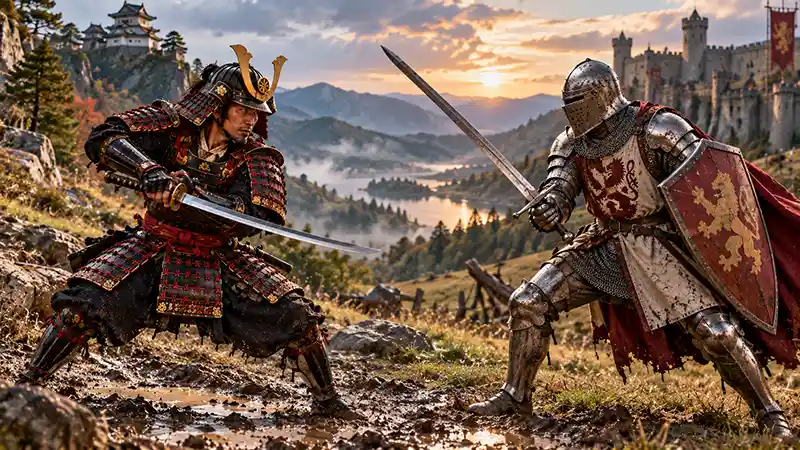
Imagine our two warriors meeting on a perfectly level field, with firm ground beneath their feet and nothing standing between them. It sounds like the fairest possible way to settle the argument. But now imagine moving that same fight into a muddy field after a heavy rainstorm. Or onto a steep mountainside covered in loose rocks. Or into the narrow streets of a medieval city, where walls, doorways, and uneven cobblestones make every movement more complicated. Suddenly, the question of who would win becomes considerably harder to answer. The battlefield itself might be just as important as the weapons and armor.
One of the most persistent myths about medieval knights is that their armor made them helpless whenever the terrain became difficult. According to this popular image, a knight who stumbled in the mud might as well have been a turtle flipped onto its back. There's a grain of truth buried beneath the exaggeration: armor adds weight, increases physical exertion, and can make certain movements more demanding. But a properly fitted suit of plate armor was designed to allow a remarkable range of motion. European men-at-arms regularly fought on foot, climbed obstacles, and navigated challenging terrain while wearing substantial protection.
Still, additional weight matters. A complete fifteenth-century field harness might weigh approximately 15 to 25 kilograms, depending on its design and components. That weight was distributed across the body, but it didn't magically disappear. Running, changing direction, and fighting for extended periods required additional energy. On unstable ground, where every step demanded careful balance, the physical demands could become especially noticeable.
Would that automatically favor the samurai? Not necessarily.
Japanese armor varied enormously across different historical periods. Some configurations were relatively flexible, while others incorporated substantial metal protection and could be surprisingly heavy. A samurai wearing a full set of battlefield armor wasn't necessarily an unencumbered acrobat. He, too, would have to contend with restricted movement, added weight, and the challenges of fighting while carrying military equipment.
The difference would depend on exactly which warriors and armor we were comparing. A lightly equipped Japanese swordsman might enjoy greater freedom of movement than a knight in full plate. But that advantage would come at the cost of protection. A heavily armored samurai might find himself facing many of the same physical challenges as his European opponent.
Now consider a fight on a narrow mountain path. With limited room to maneuver, neither warrior could rely on sweeping movements or elaborate footwork. The knight's armor might become particularly valuable if the encounter turned into a close-range struggle, where protection against cuts and accidental contact could make a significant difference. On the other hand, a fighter with better footing and familiarity with the terrain might be able to control the engagement regardless of his equipment.
Move the encounter into a dense forest, and the situation changes again. Tree trunks, branches, and uneven ground could interfere with weapon movement and visibility. A long weapon might become awkward in certain spaces, while a shorter blade could be easier to manage. But forests aren't uniformly cramped, and neither a katana nor a longsword becomes useless simply because there are trees nearby.
What about the open battlefield, where both warriors could maneuver freely?
Here, the knight's plate armor could offer an important advantage in a sword fight. If he could move effectively without exhausting himself, his superior protection against ordinary blade strikes would remain a serious obstacle for the samurai. The Japanese warrior might have opportunities to exploit distance, timing, or differences in mobility, but he would still need a way to overcome the knight's defenses.
There's another factor that rarely appears in these hypothetical comparisons: climate. A warrior accustomed to one environment might struggle when fighting somewhere entirely unfamiliar. Heat, humidity, rain, and cold could affect endurance, visibility, and the condition of equipment. Fighting under a blazing summer sun while wearing armor is a different experience from fighting on a cool autumn morning. Both Japanese and European armies had to contend with weather, and neither developed equipment that made its soldiers immune to exhaustion.
Perhaps the biggest environmental advantage would come from something less dramatic than armor or sword design: familiarity. A warrior who understands the ground beneath his feet can make better decisions about movement, positioning, and when to engage. A knight fighting in unfamiliar Japanese mountain terrain might be disadvantaged against an experienced local warrior. A samurai encountering the conditions of a European battlefield for the first time could face the same problem.
And then there's the possibility that our warriors wouldn't meet on foot at all. Both samurai and European knights had strong traditions of mounted warfare, although their tactics and equipment changed over time. A confrontation involving horses would introduce an entirely different set of considerations, including riding skill, weapon reach, the type of mount, and the surrounding terrain. A steep, wooded hillside and a broad, open plain would produce very different opportunities for mounted fighters.
The more closely we examine the environment, the less convincing it becomes to imagine one warrior possessing a universal advantage. A battlefield isn't a neutral backdrop. It shapes the fight, rewards certain decisions, and punishes mistakes. History is filled with battles in which terrain, weather, and positioning helped determine the outcome long before individual swordsmanship could make a difference.
So where should our imaginary duel take place? If we're trying to compare the warriors themselves, a reasonably open, level field would remove some environmental variables. But if we're trying to understand who would survive an actual historical encounter, we can't ignore the ground beneath their feet. Real warriors rarely had the luxury of choosing perfect conditions.
Battlefield Advantage: Depends on the Terrain. Open ground could allow the knight to make full use of his armor and fighting techniques, while difficult terrain might reward whichever warrior was better equipped and more familiar with the environment. Neither the samurai nor the knight possessed an automatic advantage in every setting.
The Forgotten Weapons: Why Spears and Polearms Could Change Everything
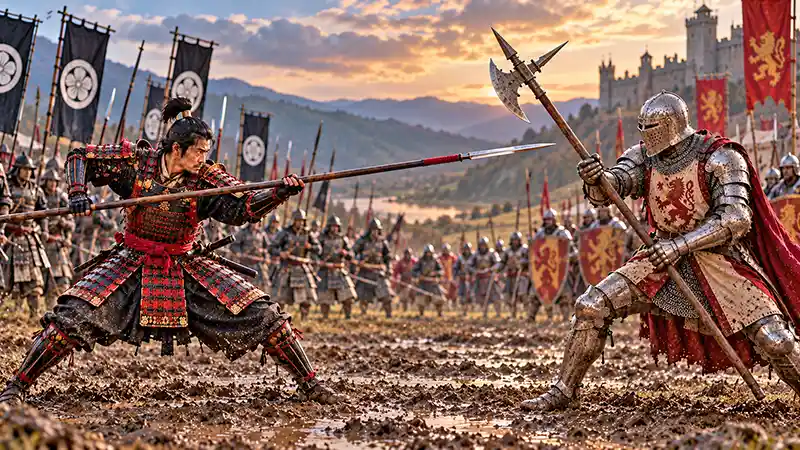
We've spent much of this comparison imagining a samurai armed with a katana facing a medieval knight carrying a longsword. It's the showdown everyone wants to see, and for good reason. Both swords have become powerful symbols of their respective warrior cultures. There's just one problem: if these men were preparing for an actual battlefield encounter, there's a very good chance neither would choose a sword as his primary weapon. The weapons that made samurai and knights so dangerous were often considerably longer, less glamorous, and far more practical than the blades that made them famous.
For much of their history, samurai were accomplished archers, particularly from horseback. The Japanese yumi, a distinctive asymmetrical bow, was an important weapon in early samurai warfare. Mounted warriors could engage enemies at a distance, making swordsmanship only one part of their military capabilities. As Japanese warfare evolved, however, the spear became increasingly important, especially during the enormous conflicts of the Sengoku period.
The Japanese yari was a formidable weapon that came in numerous shapes and sizes. Some had relatively short shafts, while others were exceptionally long and intended for use in organized infantry formations. Unlike a katana, which required a fighter to approach within sword range, a spear allowed its wielder to threaten an opponent from several feet farther away. That difference could be decisive when facing someone armed with a shorter weapon.
European knights understood this advantage just as well. On horseback, the lance became one of the defining weapons of medieval heavy cavalry. A properly delivered lance strike could concentrate tremendous force into a relatively small point, particularly when combined with the momentum of a charging horse. On foot, European men-at-arms also used spears, pollaxes, and other specialized weapons that were better suited to many battlefield situations than conventional swords.
This is where our hypothetical duel takes an interesting turn. What if the samurai arrived carrying a yari while the knight brought a longsword?
The samurai could potentially exploit the spear's reach, forcing the knight to overcome a dangerous distance before bringing his sword into effective range. The knight's plate armor would provide valuable protection, but that wouldn't make approaching a skilled spearman easy. A spear thrust delivered with sufficient force and accuracy could threaten vulnerable areas, particularly where armor components met.
Now reverse the situation. Give the knight a European pollaxe and leave the samurai armed with his katana. Suddenly, the European warrior possesses a weapon designed with armored combat in mind. Despite its name, a pollaxe wasn't necessarily just an axe mounted on a long handle. Historical examples could combine an axe blade or hammer face with a spike and a reinforced thrusting point, giving the wielder several options against a protected opponent.
The pollaxe was particularly associated with late medieval armored fighting. Its construction allowed powerful blows, controlled thrusts, and techniques for manipulating an opponent's weapon or balance. A knight trained in its use could present a serious challenge to a swordsman, especially one unfamiliar with the weapon's capabilities.
The history of the halberd offers another fascinating example of how European warriors developed specialized polearms. Combining features of a spear and an axe, the halberd became an important infantry weapon, particularly in the hands of soldiers fighting heavily equipped opponents. Although halberds and pollaxes weren't identical, both demonstrate how much attention European weaponmakers devoted to solving problems that ordinary swords couldn't easily overcome.
Japan had its own distinctive polearms, including the naginata, which featured a curved blade mounted on a long shaft. The naginata appeared in Japanese warfare long before the katana became the internationally recognized symbol of the samurai. Its extended reach and cutting capabilities made it useful in circumstances where a shorter sword would be less advantageous. Over time, its military role changed as battlefield tactics and equipment evolved.
And then there were the weapons that could end our imaginary duel before either warrior came within striking distance.
Japanese warriors used bows and, by the sixteenth century, increasingly relied on matchlock firearms. European armies likewise employed bows, crossbows, and various firearms across different periods. These weapons introduce a reality that sword-centered comparisons often ignore: historical warriors weren't obligated to approach an enemy for a dramatic one-on-one fight. If an opponent could be defeated from a distance, there was little practical reason to insist on crossing swords.
Of course, comparing these weapons fairly requires us to establish a historical period. A thirteenth-century samurai and a sixteenth-century samurai would have access to different equipment, just as a twelfth-century knight and a fifteenth-century knight would. Giving one warrior the most advanced weapons of his era while restricting the other to an earlier period would tell us very little about the relative effectiveness of their military traditions.
There's also the matter of individual expertise. A knight who had spent years training with a lance and pollaxe wouldn't necessarily perform equally well with every unfamiliar weapon. The same applies to a samurai whose experience emphasized archery, spear fighting, or swordsmanship. Possessing a weapon and knowing how to use it effectively are two very different things.
Perhaps the greatest irony of this entire debate is that the katana and longsword, the two weapons most people associate with these warriors, might be among the least revealing choices for comparing their battlefield effectiveness. Both cultures developed extensive arsenals because different combat situations demanded different solutions. A warrior who survived by adapting his equipment to the circumstances was demonstrating practical military intelligence, not a lack of loyalty to his favorite sword.
So if we allow our samurai and knight to select the weapons they believe will give them the best chance of survival, our dramatic sword duel might never happen. We could end up watching a contest between a yari and a pollaxe, two mounted warriors charging with long weapons, or even an exchange of projectiles before the combatants ever meet face-to-face.
Battlefield Weapon Advantage: Depends on the Equipment. The samurai's yari, yumi, and naginata were formidable weapons, while the knight's lance, pollaxe, and other European polearms offered equally serious capabilities. Once we move beyond swords, the outcome depends heavily on the specific weapons, armor, training, and circumstances of the encounter.
Did Samurai and European Knights Ever Actually Fight Each Other?
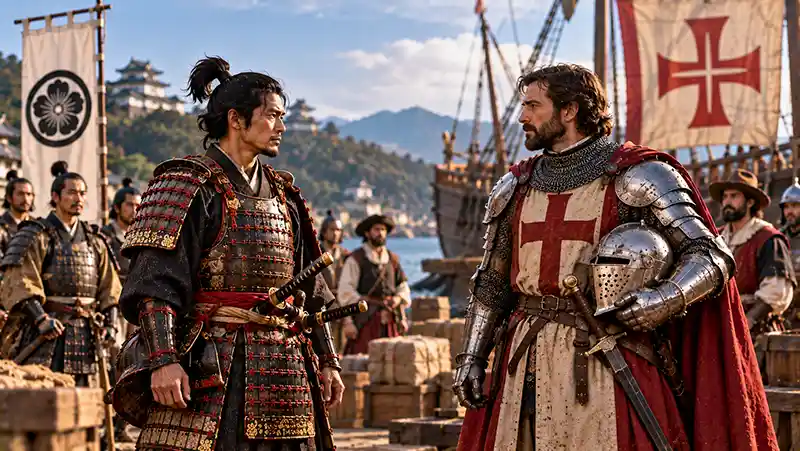
After comparing their armor, weapons, training, and fighting techniques, there's one question we haven't answered: did a samurai and a European knight ever actually meet on the battlefield? It sounds like the sort of encounter historians would have written about for centuries. Two legendary warrior traditions, separated by thousands of miles, finally testing their skills against one another. Surely, somewhere in the historical record, there's an account of a Japanese swordsman defeating a European knight, or perhaps a knight discovering firsthand just how dangerous a katana could be.
The surprising answer is that Europeans and Japanese warriors did encounter one another, but the evidence for the kind of medieval knight-versus-samurai duel we're imagining is remarkably thin.
For much of the Middle Ages, Japan and Western Europe existed in very different political and military worlds. The distance between them was enormous, and the trade networks connecting East Asia to Europe rarely brought their respective warrior elites into direct contact. Although Europeans knew of Japan through accounts such as those associated with Marco Polo, meaningful direct contact between Japan and European visitors didn't begin until the sixteenth century.
In 1543, Portuguese traders reached Japan, beginning a period of increasingly significant contact between Japanese society and European merchants, missionaries, and adventurers. This happened during Japan's Sengoku period, an era of intense civil warfare when powerful regional lords competed for territory and influence. European visitors encountered a country with experienced warriors, sophisticated weapons, and armies that were anything but technologically primitive.
One of the most important consequences of this contact was the introduction and rapid adoption of European-style matchlock firearms. Japanese gunsmiths learned to manufacture these weapons, and Japanese military leaders quickly recognized their battlefield potential. Within a few decades, firearms had become an important part of Japanese warfare, particularly when used alongside spears, bows, and other established weapons.
But there's an interesting historical complication. By the time Europeans began arriving in Japan, the classic image of the medieval knight was already changing. European warfare had undergone major transformations involving firearms, infantry formations, and evolving armor designs. The heavily armored mounted warrior hadn't disappeared overnight, but the military world that produced the familiar fifteenth-century knight was no longer quite the same.
In other words, the historical window in which a fully equipped medieval knight and a Sengoku-period samurai might plausibly have met was much narrower than most people imagine.
That doesn't mean Europeans never fought alongside or against Japanese warriors. By the late sixteenth and early seventeenth centuries, European soldiers, sailors, and mercenaries were active throughout parts of Asia. Japanese warriors also traveled abroad, sometimes serving as mercenaries or participating in conflicts beyond Japan's borders. In Southeast Asia, Japanese communities and armed groups became involved in local political and military struggles that occasionally intersected with European colonial ambitions.
One particularly fascinating example comes from the Spanish Philippines. In 1582, Spanish forces under Juan Pablo de Carrion fought against raiders near the Cagayan River in northern Luzon. Some accounts describe the opposing forces as including Japanese fighters, and the engagements have inspired modern stories about Spanish swordsmen defeating samurai in dramatic hand-to-hand combat.
Unfortunately, the popular version of this story is considerably more confident than the surviving evidence allows. The composition of the raiding forces, the precise identities of the combatants, and the details of individual fighting encounters are not established well enough to treat Cagayan as a definitive test of European versus Japanese swordsmanship. Spanish soldiers in the region also weren't necessarily equivalent to the fully armored medieval knights of our hypothetical duel.
The distinction matters because historical encounters are often transformed into much grander stories over time. A skirmish involving European soldiers and Japanese raiders becomes a legendary battle between knights and samurai. An account of unfamiliar warriors meeting in combat becomes proof that one civilization possessed superior weapons or fighting techniques. The actual evidence rarely supports such sweeping conclusions.
There's another fascinating connection worth mentioning. During the late sixteenth and early seventeenth centuries, Japanese armorers produced some equipment influenced by European designs. Certain Japanese breastplates, sometimes associated with the term nanban do, reflected foreign armor styles or incorporated imported components. This demonstrates that Japanese warriors weren't isolated from European military technology, and that they were perfectly willing to adopt useful ideas from abroad.
Europeans, meanwhile, developed a growing fascination with Japanese weapons and armor. Japanese swords became objects of interest to foreign visitors and collectors, although the romantic reputation of the katana would expand considerably in later centuries. These exchanges remind us that the two military traditions weren't locked in some timeless rivalry. When contact became possible, curiosity, trade, adaptation, and cooperation were often just as important as conflict.
Perhaps the closest thing to our imagined showdown would have involved a European soldier familiar with contemporary swordsmanship facing a Japanese warrior during the sixteenth or early seventeenth century. Such an encounter was certainly possible, and isolated fights may have occurred without leaving detailed records. But possibility isn't the same as documented evidence, and we shouldn't invent a famous duel simply because it would make an entertaining story.
This leaves us with a frustrating but important conclusion. History provides evidence of contact between Japanese and European fighting men, including episodes of armed conflict. What it doesn't provide is a reliable, well-documented contest between a representative medieval knight in full plate armor and an equally representative samurai that could settle the argument once and for all.
And even if such a duel were discovered tomorrow, would it really prove anything? One victory would tell us who won that particular encounter, not which warrior tradition was universally superior. A single fight can be influenced by experience, equipment, terrain, fatigue, and chance. History doesn't become a controlled experiment simply because two famous types of warriors happen to meet.
Historical Evidence Verdict: No Definitive Winner. Japanese and European warriors did come into contact, and some fought in overlapping conflicts. However, there is no well-established historical duel between a classic medieval knight and a samurai that conclusively answers our question. The ultimate showdown remains largely a matter of informed historical speculation.
The Final Showdown: Who Would Actually Win, a Samurai or a Medieval Knight?
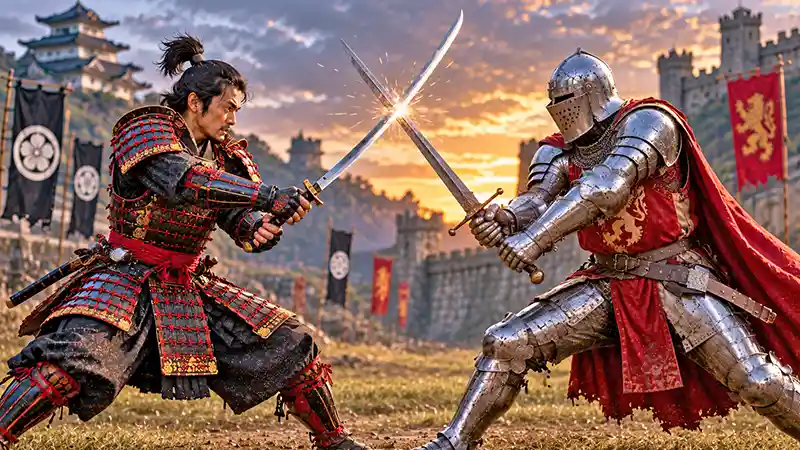
We've examined their swords, tested the limitations of their armor, compared their training, and explored the weapons that might give either warrior an advantage. Now it's time to answer the question that brought us here. If a Japanese samurai and a medieval European knight actually fought to the death, who would win? After everything we've learned, it might seem impossible to choose a winner. But if we establish some reasonable conditions for the encounter, one warrior does begin to emerge with a meaningful advantage.
For our final showdown, let's imagine two experienced warriors from the fifteenth century. Both are physically fit, accustomed to real combat, and equipped with high-quality armor appropriate to their respective traditions. The samurai carries a katana, while the knight wields a longsword. Neither has a horse, a shield, or access to additional weapons. They're fighting on relatively level ground, with enough space to maneuver freely. Most importantly, neither has encountered the other's fighting tradition before.
Under these conditions, the medieval knight has one advantage that is extremely difficult to ignore: his armor.
A well-made fifteenth-century European plate harness offers exceptional protection against conventional sword cuts. The knight doesn't have to fear every glancing blow in the same way an unarmored fighter would, and that protection could allow him to take risks that would otherwise be dangerous. The samurai's katana remains a formidable weapon, but its effectiveness against substantial steel plate is limited. A perfectly executed cut might accomplish very little if it strikes a heavily protected surface.
The samurai, meanwhile, would be wearing armor that could vary considerably in its construction and protective capabilities. Fifteenth-century Japanese armor often combined iron or steel elements with lacing and other materials, creating effective protection suited to the military conditions of the period. But it generally didn't provide the same continuous coverage of articulated steel plate associated with the finest contemporary European harnesses.
That difference could become particularly important as the fight progressed. The knight might be able to absorb certain strikes without suffering serious injury, while the samurai could face greater consequences from a successful attack against a less protected area. Over the course of a prolonged encounter, that imbalance could influence how aggressively each warrior was willing to fight.
The knight would also have experience with techniques developed specifically for fighting armored opponents. European martial traditions included half-swording, grappling, and methods for controlling an opponent at close range. These techniques weren't guaranteed to work against an unfamiliar Japanese warrior, but they would provide a useful foundation for dealing with a heavily equipped opponent.
However, anyone expecting the samurai to be helpless is making a serious mistake.
A veteran samurai would understand distance, timing, balance, and the importance of exploiting openings. Japanese martial traditions also included grappling and methods for fighting armored opponents. If the samurai recognized that ordinary cuts were ineffective against the knight's armor, he might adapt his approach rather than continuing to strike protected surfaces. A successful thrust against a vulnerable area, an effective grapple, or an unexpected counterattack could change the outcome immediately.
And despite his impressive protection, the knight would still be human. Armor couldn't eliminate fatigue, prevent every injury, or guarantee perfect balance. A stumble, an error in judgment, or a moment of overconfidence could prove disastrous. The samurai wouldn't need to demonstrate that his sword was superior to European steel. He would only need to find one opportunity that his opponent failed to defend.
Now let's change just one condition. Remove both warriors' armor and have them fight wearing ordinary clothing.
Suddenly, the knight's most significant advantage disappears. Both swords become extremely dangerous, and a single successful cut or thrust could end the encounter. The longsword might offer additional reach and versatility, while the katana remains a highly effective weapon in skilled hands. Under these conditions, there is little historical justification for declaring either warrior the obvious favorite. Individual skill and the circumstances of the encounter would become much more important.
What if we gave both men their preferred battlefield weapons instead? The outcome becomes even less predictable. A samurai carrying a yari might be able to exploit its reach against a sword-armed knight. A European man-at-arms equipped with a pollaxe could present an entirely different challenge. Add horses, bows, lances, or firearms, and we're no longer comparing two swordsmen. We're comparing complex military traditions that developed over centuries.
This is why the familiar argument about samurai versus knights is so difficult to settle. The answer changes depending on which century we choose, what equipment we allow, how experienced the fighters are, and where the confrontation takes place. A twelfth-century knight and a fifteenth-century knight aren't interchangeable, just as a samurai from the Kamakura period shouldn't automatically be treated as equivalent to one from the Sengoku era.
But we promised a verdict, and avoiding the question entirely wouldn't be particularly satisfying.
So, in our specific fifteenth-century scenario, with both warriors wearing representative high-quality armor and carrying swords, the medieval knight would probably have the advantage. His extensive plate protection would make him exceptionally difficult to injure with ordinary katana strikes, and his training could include techniques specifically intended for armored combat. That combination provides a practical advantage that is more convincing than arguments about which warrior possessed greater courage, discipline, or fighting spirit.
Does that mean the knight would win every time? Absolutely not. There is no reliable historical evidence that would allow us to calculate a meaningful victory percentage, and assigning one would create an illusion of scientific certainty. A skilled samurai could defeat a knight, just as a skilled knight could defeat a samurai. The point is that, under the conditions we've established, the knight's equipment gives him a defensible edge.
And perhaps that's the most interesting result of all. The deciding factor isn't some mysterious superiority in European swordsmanship or a fundamental weakness in Japanese martial arts. It's the interaction between weapons, armor, and the particular circumstances of the fight. Change those circumstances, and the advantage might change with them.
Final Verdict: Medieval Knight, Under These Conditions. In a fifteenth-century armored sword duel, the knight's plate armor gives him a substantial defensive advantage. But remove the armor, change the weapons, or introduce different battlefield conditions, and the outcome becomes far less certain. The samurai is absolutely capable of winning. He simply isn't guaranteed to overcome an opponent whose equipment was designed to resist the very attacks his sword delivers.
Beyond the Sword: Why Neither Warrior Was Truly Invincible
After everything we've examined, the medieval knight appears to have a legitimate advantage in our carefully defined armored duel. But before we declare European knights the ultimate warriors of history, there's something worth remembering: neither knights nor samurai were invincible, and neither warrior tradition developed in a world where individual fighting skill guaranteed survival. The battlefield was an unforgiving place where even the most experienced fighter could be defeated by an unexpected attack, an equipment failure, or an opponent who simply happened to be in the right position at the right moment.
Both cultures understood this reality better than their modern admirers sometimes do. Japanese warriors didn't rely exclusively on the legendary sharpness of their swords, and European knights didn't expect their armor to protect them from every conceivable threat. They developed elaborate systems of weapons, equipment, and battlefield tactics because survival demanded flexibility. A samurai might carry a sword as a symbol of status, but he could also fight with a spear, bow, or other weapon when circumstances required it. A European knight might be remembered for his longsword, yet his military effectiveness often depended on his horse, lance, armor, and the soldiers fighting alongside him.
Perhaps the greatest misconception surrounding these warriors is the idea that their cultures produced fundamentally different kinds of human beings. Popular entertainment frequently presents samurai as disciplined masters of precision and European knights as powerful but less sophisticated fighters. Other portrayals reverse the stereotype, suggesting that European metallurgy and armored combat made Japanese warriors hopelessly outmatched. Neither interpretation does justice to the historical evidence.
The truth is that both societies developed remarkably sophisticated approaches to warfare. Japanese swordsmiths refined techniques suited to their materials and military needs, while European armorers produced some of the most impressive protective equipment of the preindustrial world. Both traditions created complex systems of martial training, and both adapted when new weapons or battlefield conditions demanded change.
That willingness to adapt might be the most important similarity of all. The warrior who survived wasn't necessarily the one carrying the most famous sword or wearing the most impressive armor. He was the one who understood the limitations of his equipment, recognized the strengths of his opponent, and made effective decisions under extraordinary pressure.
And that's what makes this imaginary confrontation so fascinating. The samurai and the knight weren't competing to prove which civilization was superior. They were products of different historical circumstances, each equipped with weapons and skills developed to address the challenges of his own world. Asking which one would win is entertaining, but understanding why either might win reveals far more about the realities of historical combat.
So, could a samurai actually defeat a medieval knight? Absolutely. A skilled Japanese warrior could exploit an opening, overcome an opponent through grappling, or take advantage of circumstances that favored his equipment and experience. But if we're talking about a fifteenth-century duel involving swords and full armor, the knight's sophisticated plate protection makes him the more defensible favorite. That conclusion doesn't diminish the samurai's abilities. It simply acknowledges that equipment matters, and that even extraordinary skill cannot erase every physical disadvantage.
Of course, the debate is unlikely to end here. Samurai enthusiasts will point to the extraordinary refinement of Japanese swordsmanship, while medieval history enthusiasts will emphasize the knight's armor and the versatility of European fighting techniques. Both sides have legitimate arguments, and that's precisely why this hypothetical showdown has fascinated people for generations.
Now it's your turn: Do you agree that the medieval knight would have the advantage, or do you believe a skilled samurai could overcome European plate armor? And if you could change just one condition of the fight, whether it's the weapons, armor, terrain, or historical period, what would you change? Let us know which warrior you'd put your money on, and why.
You May Also Be Interested In:
- The History of the Medieval Flail Weapon
- New Weapons Alert: From Medieval Maces to Modern Batons!
- What Is a Wakizashi? The Samurai's Companion Sword
- Did Samurai Really Test Their Swords On People?
- Samurai Sword vs Katana: What's the Difference?
- The Biggest Myths About Samurai Swords
- Real vs. Decorative Samurai Swords: What You Need to Know
- Samurai Sword Buying Guide: Which Katana is Best?
- What Is an Odachi? The Giant Samurai Sword Explained
- The Real History of the Jutte (And Why Samurai Carried It)
Leave a Reply