


The Truth About Ninja Weapons: 7 Myths Debunked
June 2nd, 2026
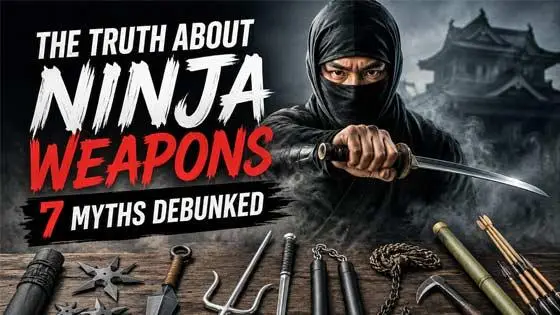
Ninja weapons have been surrounded by myths for decades. According to movies, comic books, and video games, ninjas carried endless throwing stars, perfectly straight swords strapped across their backs, and enough hidden gadgets to take down an army. Some stories make ninja weapons seem almost magical, turning them into symbols of mystery, stealth, and impossible skill. But how much of that is actually true?
The reality is that ninja weapons were often far more practical than Hollywood would have you believe. Real ninjas, or shinobi, likely relied on adaptability, stealth, and using whatever tools fit the situation rather than carrying one standard set of exotic weapons. Some famous ninja weapons were absolutely real, while others have been exaggerated, misunderstood, or heavily romanticized over time.
In this guide, we are breaking down some of the biggest myths about ninja weapons, where these ideas came from, and what history actually tells us about the tools ninjas may have used.
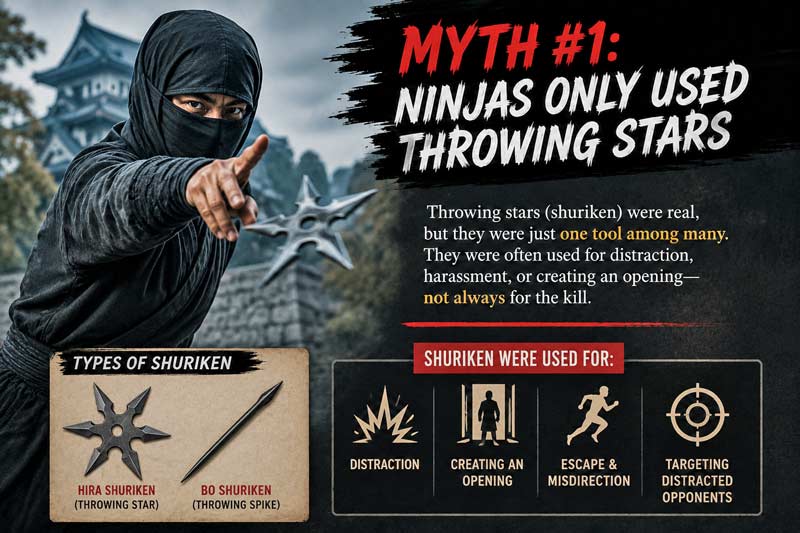
When most people think of ninja weapons, throwing stars are usually the first thing that comes to mind. They are one of the most recognizable symbols of the ninja, and movies often show them being thrown with perfect accuracy as if they were the main weapon every ninja carried. That image is dramatic, but it leaves out a lot of important context.
Throwing stars, also known as shuriken, were real, but they were only one part of a much larger toolbox. They were not usually meant to replace swords, staffs, blades, or other practical tools. In many cases, shuriken were more useful for distraction, harassment, or creating an opening than for ending a fight instantly.
There were also different styles of shuriken, including flat star-shaped blades and straight throwing spikes. If you want a deeper look at the different designs, we covered the different types of ninja stars in another guide. You can also browse our selection of ninja throwing stars if you want to see how much variety exists within the category.
The truth is that ninjas were not defined by one weapon. Throwing stars became famous because they look cool and are easy to recognize, but real ninja tools were probably chosen based on the mission, environment, and need for stealth rather than popularity.
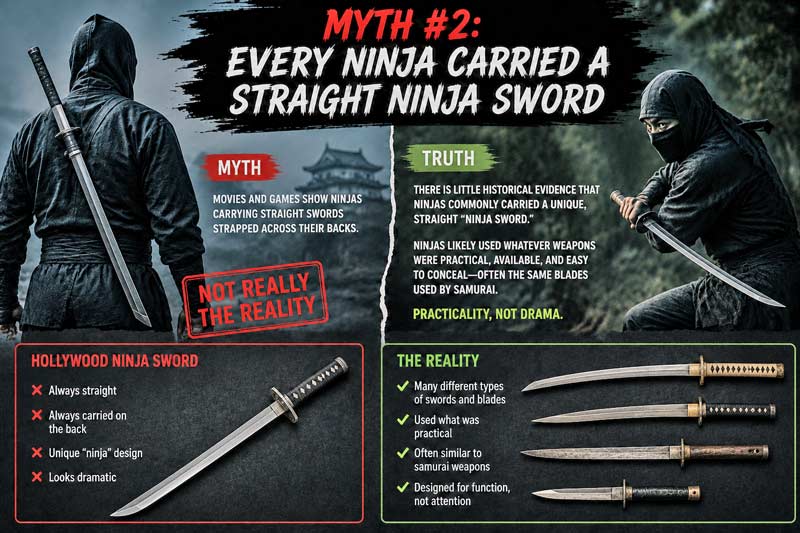
Thanks to movies and video games, many people imagine every ninja carrying a perfectly straight sword strapped across their back. It has become one of the most recognizable parts of the ninja image. The problem is that there is very little historical evidence suggesting real ninjas commonly carried a unique, standardized "ninja sword" that looked dramatically different from what samurai used.
In reality, ninjas likely used whatever weapons were practical and available. That may have included many of the same blades used by samurai, including curved Japanese swords. Since ninjas often relied on stealth and disguise, carrying an unusual-looking weapon that immediately stood out may not have been the smartest choice. A weapon that blended in with everyday life would have been far more useful than something overly dramatic.
The famous straight-bladed ninja sword most people recognize today was likely popularized through movies, television, and martial arts culture rather than historical records. That does not mean straight ninja swords never existed, but historians generally agree the Hollywood version has been heavily romanticized over time. If you want to explore different styles of ninja swords, it is interesting to compare modern interpretations with historical designs.
The truth is that ninjas were probably far more practical than pop culture gives them credit for. Like many parts of ninja history, the weapon myths are often more dramatic than reality.
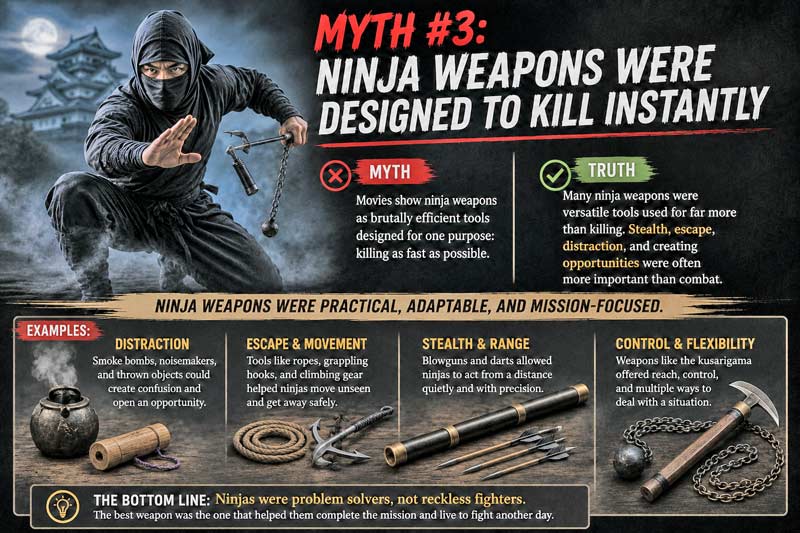
Movies often make ninja weapons seem brutally efficient, as if every tool was designed for one purpose: taking someone out as quickly as possible. From poison darts to razor-sharp blades, pop culture tends to portray ninjas as assassins carrying only deadly weapons. While some ninja tools were certainly dangerous, the reality was often much more practical.
Many ninja weapons likely served multiple purposes beyond combat. Some tools could be used for distraction, escape, climbing, intimidation, or creating opportunities rather than direct attacks. A smoke device, a thrown object, or even a simple distraction could sometimes be more useful than fighting at all. Since ninjas often relied on stealth and avoiding detection, escaping unnoticed may have been more valuable than confrontation.
For example, tools like blowguns could potentially be used quietly and from a distance, while chain weapons like the kusarigama offered flexibility in both combat and control. If you are curious about the history behind one of the stranger weapons associated with ninjas, we explored the history of the kusarigama in another article. You can also browse modern blowguns to see why lightweight, portable tools have remained fascinating for centuries.
The truth is that ninja weapons were probably chosen for usefulness rather than drama. Real ninjas were more likely to value flexibility, stealth, and adaptability than flashy, overpowered weapons designed for movie scenes.
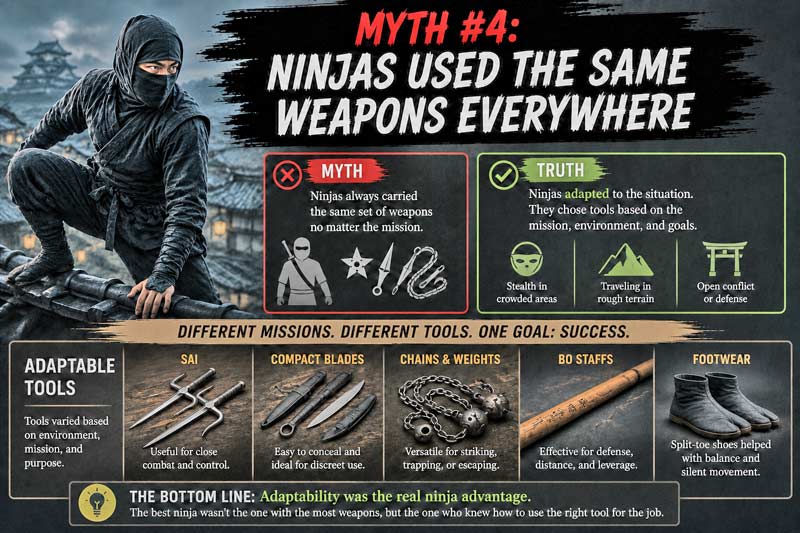
Movies often portray ninjas as carrying the exact same set of weapons no matter the mission. A sword on the back, throwing stars in every pocket, and a handful of secret gadgets ready for anything. It makes for an easy visual, but real ninjas were likely far more adaptable than that.
In reality, ninjas probably chose tools based on the situation. A stealth mission inside a crowded town may have called for smaller, concealable weapons or tools that helped someone blend in. Traveling through rough terrain or guarding against open conflict might have required something entirely different. Since ninjas were often associated with espionage, sabotage, and gathering information, avoiding attention was usually more important than carrying flashy weapons.
That adaptability may explain why so many different tools became associated with ninjas over time. Weapons such as sai weapons, compact blades, chains, and even longer-range tools like bo staffs could have been useful depending on the environment and goal. Even footwear may have changed depending on the mission, which is one reason we explored why ninjas wore split-toe shoes in another article.
The truth is that ninjas were probably less focused on having signature weapons and more focused on using whatever gave them the best chance of success. Adaptability was likely one of the most important skills a ninja could have, and that mindset probably mattered far more than carrying a fixed set of gear.
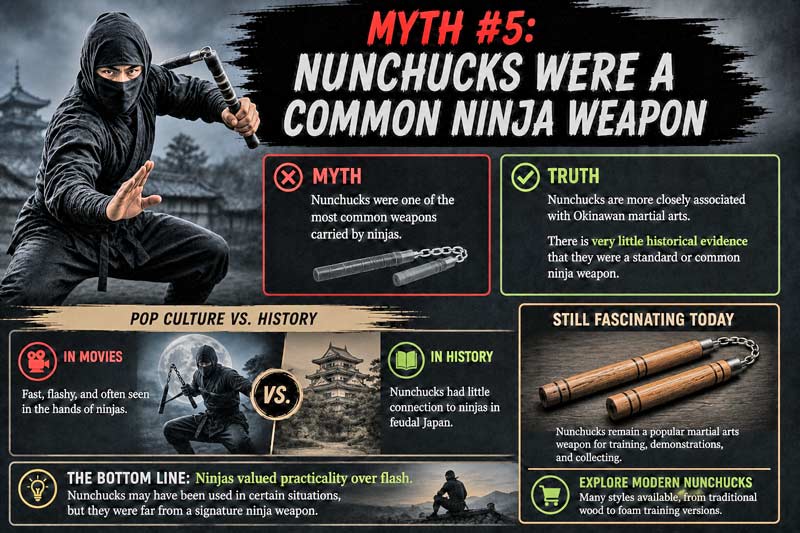
Thanks to martial arts movies and pop culture, many people assume nunchucks were one of the most common weapons carried by ninjas. It is easy to see why. They are fast, flashy, and instantly recognizable. But historically, the connection between ninjas and nunchucks is probably much weaker than most people realize.
Nunchucks are more closely associated with Okinawan martial arts than with feudal Japanese ninjas. While it is certainly possible that some ninjas may have used them at some point, there is very little historical evidence suggesting nunchaku were a standard or especially common ninja weapon. In fact, many of the weapons commonly linked to ninjas today became popular largely because of martial arts films and modern entertainment.
That does not make nunchucks any less fascinating. They remain one of the most recognizable martial arts weapons in the world and are still widely used for training, demonstrations, and collecting. If you want to explore modern nunchucks, there are many styles available today ranging from traditional wood designs to foam training versions.
The truth is that ninjas probably valued practicality over flashy weapons. If nunchucks served a purpose for a specific situation, they may have been used, but they were likely far from the signature ninja weapon movies often make them out to be.
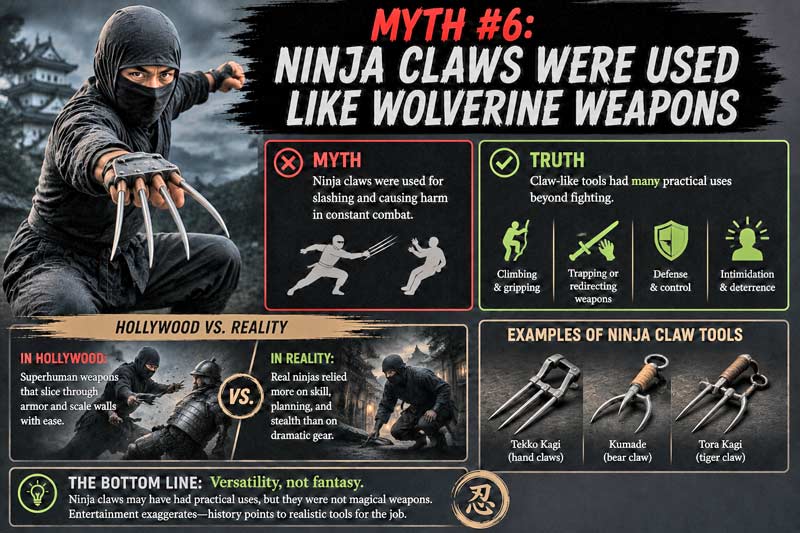
Thanks to movies, comics, and martial arts demonstrations, many people picture ninja claws as terrifying weapons used for slashing through enemies in dramatic fights. Tools like tekko kagi, sometimes called ninja hand claws, are often portrayed as deadly weapons used in nonstop combat. While they certainly looked intimidating, the reality was probably much more practical and far less cinematic.
Historically, claw-like tools may have served several purposes beyond fighting. Some designs could potentially help with gripping surfaces, climbing, or trapping and redirecting an opponent's weapon. Others may have been used for defense or intimidation rather than aggressive attacks. Like many tools associated with ninjas, their usefulness likely depended on the mission and environment rather than one dramatic purpose.
Hollywood often exaggerates ninja claws by turning them into superhuman weapons capable of slicing through armor or effortlessly scaling walls. In reality, real ninjas probably relied far more on skill, planning, and stealth than on dramatic gear. A useful tool was only valuable if it actually helped complete the mission.
The truth is that ninja claws were likely more about versatility than fantasy. They may have had practical uses, but they were not magical weapons that turned ninjas into unstoppable fighters. Like many parts of ninja history, entertainment tends to exaggerate what was probably a much more realistic tool.
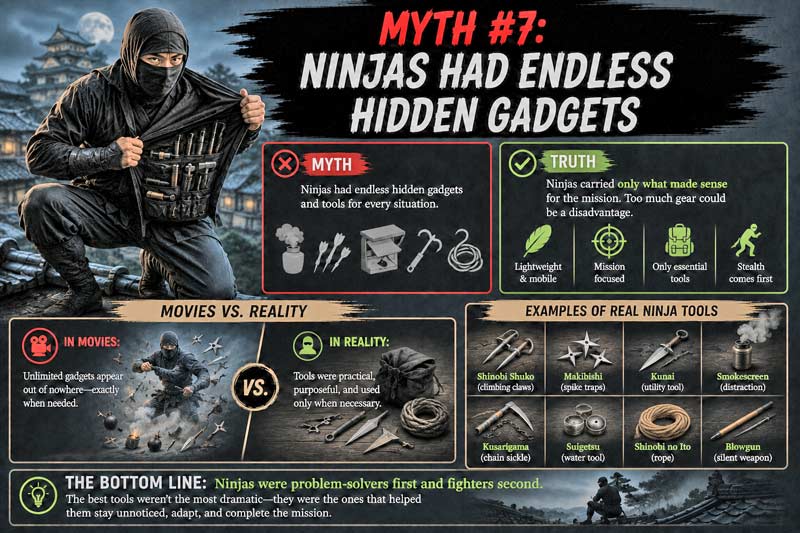
Movies love to portray ninjas as carrying an unlimited supply of hidden gadgets. Smoke bombs, tiny darts, concealed blades, grappling hooks, hidden compartments, and mysterious tools that somehow appear exactly when needed. While some specialized ninja tools absolutely existed, Hollywood often turns them into something closer to a superhero utility belt than historical reality.
Real ninjas likely carried only what made sense for the mission. Since stealth and mobility were important, carrying too much gear could actually become a disadvantage. Small, practical tools that helped with climbing, distraction, communication, escape, or self-defense were probably far more useful than hauling around an entire arsenal of dramatic gadgets.
That does not mean ninja equipment was boring. Historical records and legends mention all kinds of interesting tools, from climbing devices to hidden weapons and flexible chain weapons. Many unusual tools became associated with ninjas over time, which is part of why traditional ninja weapons remain so fascinating today. Even figures like female ninjas, known as kunoichi, were often associated more with intelligence gathering and subtle methods than flashy weapons.
The truth is that ninjas were probably problem-solvers first and fighters second. The best tools were not necessarily the most dramatic ones. They were the tools that helped someone stay unnoticed, adapt to the situation, and complete the mission successfully.
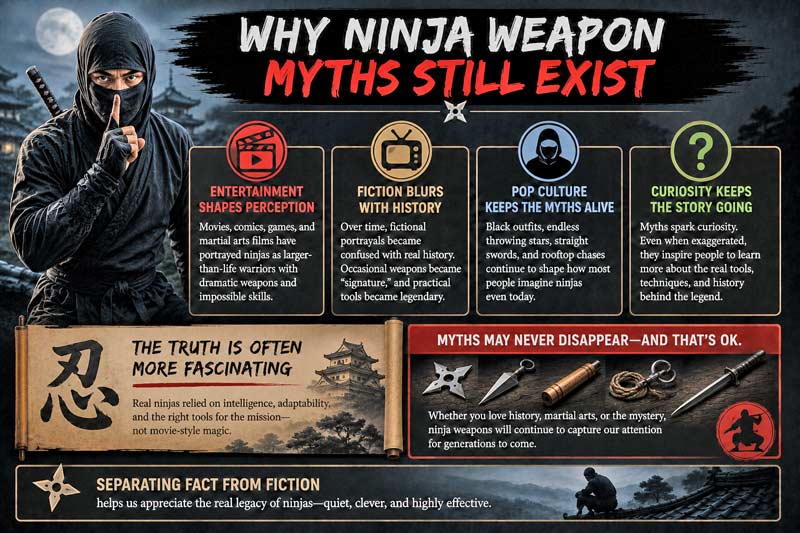
If many of the popular stories about ninja weapons are exaggerated, why do people still believe them? A big reason is entertainment. Movies, comic books, video games, and martial arts films have spent decades turning ninjas into larger-than-life characters with impossible skills and dramatic weapons. A ninja throwing endless stars or pulling hidden gadgets from nowhere makes for a much better action scene than someone quietly blending into a crowd and avoiding attention.
Over time, those fictional versions started to blur together with real history. A weapon that may have only been used occasionally suddenly became a ninja "signature weapon," while practical tools transformed into legendary devices with almost magical abilities. Even today, pop culture still shapes how most people imagine ninjas, from black outfits to straight swords and acrobatic rooftop chases.
That said, the myths are part of what makes ninja history so interesting. Even when Hollywood gets things wrong, it keeps people curious about what real ninjas may have actually carried and how they operated. The truth is often more practical than fiction, but it is also more fascinating once you understand how adaptable ninjas really were.
Whether you are interested in history, martial arts, or simply enjoy the mystery surrounding ninjas, there is no denying their weapons continue to capture attention centuries later. From unusual tools to iconic blades, ninja myths may never fully disappear, and honestly, that is part of the fun.
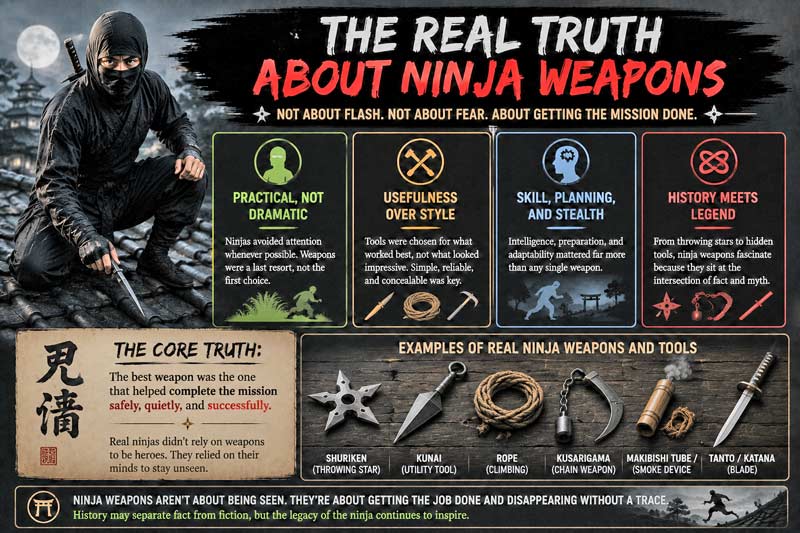
So what is the biggest myth of all when it comes to ninja weapons? Probably the idea that ninjas relied on dramatic, exotic tools to succeed. Movies often portray ninjas as unstoppable fighters armed with endless gadgets, signature weapons, and near-superhuman skills. In reality, real ninjas were likely much more practical, adaptable, and focused on avoiding attention whenever possible.
The truth is that ninja weapons were probably chosen based on usefulness rather than style. A simple blade, climbing tool, distraction device, or concealable weapon may have been far more valuable than something flashy or intimidating. The best tool was the one that helped complete the mission safely and quietly. Flexibility, planning, and stealth likely mattered far more than any single weapon.
That does not make ninja weapons any less fascinating. In many ways, understanding the real history makes them even more interesting. From throwing stars and swords to unusual chain weapons and hidden tools, ninja gear continues to capture people's imagination because it sits somewhere between history and legend.
Whether you are interested in collecting, martial arts, or simply learning more about Japanese history, ninja weapons still hold a unique place in pop culture. And while Hollywood may have gotten plenty wrong, the mystery surrounding ninjas is probably part of why we are still talking about them today.
Yes, throwing stars, also called shuriken, were real weapons associated with ninjas and some samurai. However, movies often exaggerate how they were used. Instead of being a ninja's primary weapon, shuriken were likely used more for distraction, slowing pursuers, creating openings, or forcing someone to react rather than ending fights instantly.
There were also different types of throwing weapons, including flat star-shaped designs and straight throwing spikes. Real ninjas probably viewed them as one useful tool among many rather than the signature weapon Hollywood often makes them out to be.
Probably not in the dramatic way movies often show. The image of a ninja carrying a perfectly straight sword across their back has become iconic, but there is very little historical evidence suggesting this was common practice. In reality, carrying a sword on the back could make it harder to draw quickly and might not have been the most practical option in tight spaces or crowded environments.
Real ninjas likely prioritized practicality and disguise over style. If a weapon stood out too much or slowed movement, it probably was not ideal for stealth missions. Like many ninja weapon myths, the famous back-carried sword became popular largely through movies, martial arts films, and video games rather than strong historical records.
Not necessarily, but it depended on the weapon, the time period, and who was carrying it. Many tools associated with ninjas were not unique "ninja weapons" at all. Swords, knives, staffs, farming tools, and even chains were commonly used throughout Japan in different ways. What mattered more was how the item was being used and whether someone attracted suspicion.
Since ninjas often relied on disguise and blending into everyday life, carrying ordinary-looking tools may have been more practical than carrying something exotic or obviously dangerous. A weapon or tool that could pass as something normal would likely attract less attention and be easier to explain if questioned. Like many parts of ninja history, practicality usually mattered more than drama.
Not at all. While ninjas are often associated with iconic weapons like throwing stars, swords, and chain weapons, real ninjas likely used whatever tools made sense for the mission. Practicality was probably far more important than tradition. If an ordinary tool worked well for climbing, self-defense, disguise, or escape, it may have been used regardless of whether it looked like a "ninja weapon."
Many tools associated with ninjas may have started as everyday items, farming equipment, or weapons already common in Japan. Since ninjas often relied on stealth and avoiding suspicion, carrying something that blended into daily life could be much smarter than carrying an unusual weapon that attracted attention. The image of ninjas carrying only exotic, specialized weapons is mostly a Hollywood simplification of what was likely a much more practical approach.
Possibly, although movies tend to exaggerate how common it was. Historical stories and legends sometimes mention poison being used in espionage, sabotage, or assassination attempts, which fits with the secretive reputation of ninjas. However, there is limited historical evidence showing that poisoned weapons were a standard or everyday part of ninja operations.
In reality, ninjas likely valued whatever gave them a practical advantage, and that may have included poisons in certain situations. But like many ninja myths, Hollywood often turns occasional tactics into something that happened all the time. The image of every ninja carrying poisoned blades or darts is probably far more dramatic than what actually happened in history.
In some cases, probably yes. Female ninjas, often referred to as kunoichi, were believed to have played different roles than male operatives, especially when it came to espionage, infiltration, and gathering information. Because women could sometimes move through certain social spaces more easily without attracting suspicion, they may have relied more on concealment, deception, and subtle tools rather than large or highly visible weapons.
Historical accounts and legends sometimes mention smaller concealed weapons, hidden blades, hairpin weapons, or ordinary-looking objects adapted for self-defense. However, like many parts of ninja history, separating fact from exaggeration can be difficult. Some stories have likely been romanticized over time, while others may contain elements of truth.
What seems most likely is that female ninjas, like male ninjas, adapted their tools based on the mission. Stealth and practicality probably mattered more than following a strict set of "official" ninja weapons. If you are curious about the role women may have played in espionage and covert operations, we explored the topic further in our article on female ninjas.
Something similar, possibly yes, although Hollywood tends to exaggerate how dramatic they were. The classic movie scene where a ninja instantly disappears in a giant cloud of smoke is probably more fiction than reality. However, historical accounts and legends do suggest that ninjas may have used powders, fire, or simple distraction devices to create confusion, hide movement, or help escape dangerous situations.
In practical terms, even a small distraction could be useful during stealth operations. A burst of smoke, loud noise, or temporary confusion might buy enough time to avoid detection or slip away unnoticed. Like many ninja tools, the goal was likely practicality rather than spectacle. Real ninjas were probably more interested in avoiding conflict than creating dramatic action scenes.
Possibly, although their role may have been more limited than movies suggest. Blowguns are often associated with silent attacks and poison darts in ninja stories, and there is some historical evidence that similar tools existed in parts of Asia. However, historians debate how commonly ninjas actually relied on blowguns during real missions.
What makes blowguns interesting is their simplicity. They are lightweight, quiet, and easy to carry, which fits the practical mindset often associated with ninjas. While Hollywood tends to portray them as perfect long-range assassination tools, they were likely far more limited in range and effectiveness than fiction suggests. Accuracy, distance, and the situation would have mattered a lot.
Today, many people still find them fascinating because of their stealthy reputation and unusual design. If you want to see modern versions, you can browse different styles of blowguns and accessories to get a better idea of how they work.
Some were, which was likely part of the appeal. Since ninjas often relied on stealth, disguise, and avoiding attention, smaller or concealable tools would have made a lot of sense. Compact blades, throwing spikes, hidden tools, rope devices, and ordinary-looking objects could be carried more discreetly than large, highly visible weapons.
That said, not every weapon associated with ninjas was small or easy to conceal. Longer weapons like staffs, chain weapons, or swords would have been harder to hide and may have only been practical in certain situations. Real ninjas likely chose weapons based on the environment and mission rather than carrying the same gear all the time. As with many ninja myths, the truth was probably much more practical than the Hollywood version.
Possibly, although probably not in the dramatic way movies often show. Grappling hooks are commonly associated with ninjas climbing castle walls or escaping across rooftops, and historical accounts do mention rope and climbing tools being used in feudal Japan. However, the idea of ninjas constantly swinging between buildings like action heroes is likely more fantasy than fact.
In reality, a grappling tool could have been useful for practical tasks such as climbing obstacles, scaling walls, crossing gaps, or moving equipment. Since ninjas often relied on stealth and avoiding direct conflict, any tool that helped them move quietly or escape danger may have been valuable. Like many ninja weapon myths, the truth was probably much more practical and less dramatic than Hollywood makes it seem.
Yes, probably far more often than dramatic weapons. One of the biggest misconceptions about ninjas is that they spent all their time dressed in black sneaking across rooftops. In reality, many historians believe ninjas relied heavily on disguise because blending in was often more valuable than standing out.
A ninja trying to gather information or move unnoticed through a town may have dressed like a merchant, traveler, farmer, monk, or laborer depending on the situation. Looking ordinary could make it easier to avoid suspicion and move through areas without attracting attention. In many cases, stealth likely depended more on acting normal than hiding in shadows.
That practical mindset probably influenced weapons too. Carrying simple or ordinary-looking tools may have made more sense than carrying dramatic gear that immediately identified someone as suspicious. Like many ninja myths, the truth is often more strategic and much less theatrical than what movies usually show.
Almost certainly, yes. Like any skilled fighter or operative, ninjas would have needed practice to use tools effectively. Movies sometimes make ninja weapons look effortless, as if someone could instantly master throwing stars, swords, or chain weapons without training. In reality, using even simple tools accurately and safely would have required repetition, coordination, and discipline.
That said, training was probably focused on practicality rather than flashy techniques. Since ninjas often relied on stealth, adaptability, and survival, weapon training may have included escaping danger, creating distractions, moving quietly, and using whatever tools were available rather than mastering dramatic combat styles alone. The goal was likely effectiveness, not showmanship.
Like many parts of ninja history, Hollywood tends to exaggerate the action while overlooking the preparation behind it. Real skill almost certainly came from patience, planning, and practice rather than movie-style acrobatics.
Probably not as often as people think. Movies sometimes portray ninjas as inventors of strange, one-of-a-kind weapons that nobody else used. In reality, many tools associated with ninjas were likely adapted from weapons, farming tools, or everyday objects that already existed in feudal Japan. Ninjas were probably more focused on practicality than inventing dramatic new gear.
For example, staffs, blades, chains, climbing tools, and throwing weapons were often already part of Japanese culture in one form or another. A ninja may have modified an item or used it creatively for stealth, disguise, or escape, but that does not necessarily mean the weapon was uniquely "ninja-made." In many cases, the smartest tool may have simply been one that blended in and did not attract attention.
Like many ninja myths, the truth is probably more about adaptation than invention. Real ninjas likely cared less about having unique weapons and more about using familiar tools in clever ways that helped complete the mission.
Possibly, although Hollywood usually exaggerates how common and effective they were. Poison darts are often shown in movies as silent, instant knockout weapons fired from blowguns with perfect accuracy. Historical stories and legends sometimes mention poison being used in espionage or covert operations, but there is limited evidence suggesting poison darts were an everyday ninja tool.
In reality, if poison was used, it was probably situational and far less dramatic than movies portray. Creating reliable poisons, delivering them effectively, and avoiding accidental exposure would have required planning and knowledge. Real ninjas likely relied more on stealth, timing, and avoiding conflict than on dramatic movie-style weapons.
Like many ninja myths, poison darts probably existed somewhere between fact and exaggeration. The idea fits the mysterious image of ninjas, but the Hollywood version tends to be much more dramatic than what history can actually confirm.
There probably was not one single "most common" ninja weapon because ninjas likely chose tools based on the mission, environment, and need for stealth. That said, practical weapons such as short blades, utility knives, staffs, swords, and throwing spikes may have been more useful than the dramatic weapons movies often focus on. A simple tool that blended in and worked reliably would likely have been more valuable than something flashy.
Many historians believe ninjas prioritized adaptability over carrying signature weapons. A sword may have been useful in one situation, while a staff, climbing tool, or concealable blade made more sense somewhere else. Since stealth and avoiding attention were often important, ordinary-looking tools may have been preferred over anything that immediately stood out as a "ninja weapon."
Probably, although Hollywood tends to exaggerate how dramatic they were. Since ninjas often relied on stealth, disguise, and blending into everyday life, concealable tools could have been useful in certain situations. Small blades, hidden compartments, disguised tools, or ordinary objects adapted for self-defense may have offered advantages without attracting attention.
That said, real ninjas were probably more practical than mysterious. The idea of someone carrying dozens of secret weapons hidden all over their clothing is likely more fiction than fact. A concealed tool only mattered if it was useful, reliable, and did not make someone stand out.
Sometimes, possibly, but probably not as often as movies suggest. Ninjas and samurai lived during overlapping periods of Japanese history, and their roles occasionally intersected. However, ninjas were often more focused on espionage, sabotage, gathering intelligence, and avoiding direct confrontation than engaging in dramatic one-on-one sword fights.
In some cases, samurai even hired ninjas for covert work, which makes the relationship more complicated than the classic "ninja versus samurai" rivalry shown in entertainment. Large cinematic battles between rival warriors may be fun to imagine, but real ninjas likely preferred strategy, stealth, and avoiding open combat whenever possible.
In many cases, yes, although probably not in the exaggerated way movies portray. Since ninjas often relied on secrecy, disguise, and avoiding attention, tools that were quiet, portable, easy to conceal, or useful in multiple situations would have made sense. Smaller blades, throwing spikes, ropes, climbing tools, and distraction devices may have been more practical than large or flashy weapons that attracted attention.
That said, stealth was not only about the weapon itself. Timing, patience, planning, and blending into the environment likely mattered far more. A quiet tool could still be useless if someone used it carelessly. Like many parts of ninja history, practicality probably mattered much more than dramatic gear.
The difference mostly comes down to purpose. Samurai were warriors who often fought openly in battles and served military or political roles, while ninjas were more commonly associated with espionage, infiltration, sabotage, and gathering information. Because of that, the tools associated with ninjas were often smaller, easier to conceal, or chosen for flexibility rather than battlefield combat.
That said, the difference is sometimes exaggerated. Ninjas and samurai lived during overlapping periods of Japanese history, and they likely used many of the same weapons depending on the situation. Swords, staffs, knives, and chain weapons were not exclusive to one group or the other. The biggest difference was probably how the tools were used rather than the weapons themselves.
Possibly, yes. Chain weapons are often associated with ninjas because of tools like the kusarigama, which combines a sickle with a weighted chain. These weapons could potentially offer flexibility in combat by allowing someone to strike, trap, or control distance in ways a simple blade could not.
However, Hollywood often exaggerates how common or easy they were to use. Chain weapons require timing, coordination, and training to handle effectively. Real ninjas were unlikely to carry complicated weapons unless they offered a clear advantage for the mission. Like many ninja tools, practicality probably mattered more than looking dramatic.
Possibly, although probably not as a signature ninja weapon in the way movies sometimes suggest. Staff weapons have been used throughout Japanese martial arts and everyday life for centuries, and a walking staff or wooden pole could be both practical and less suspicious than carrying a sword. That practicality may have made them useful in certain situations.
One advantage of a staff is versatility. It can be used for defense, distance control, balance, travel, or even disguised as an ordinary walking tool. Since ninjas often relied on blending in, carrying something that looked normal may have been smarter than carrying a dramatic or highly recognizable weapon.
Probably more accurately than the average person, but not with the superhuman precision movies often show. Throwing stars, or shuriken, take practice to use effectively. A trained person may have been able to throw them with decent control at short distances, but the idea of hitting tiny moving targets perfectly every time is mostly Hollywood fantasy.
In reality, ninja stars may have been more useful for distraction, creating hesitation, or forcing someone to react rather than acting as flawless precision weapons. Even skilled users would have been affected by distance, movement, lighting, and the environment. Like many ninja myths, the truth was likely more practical than cinematic.
In this guide, we are breaking down some of the biggest myths about ninja weapons, where these ideas came from, and what history actually tells us about the tools ninjas may have used.
Myth #1: Ninjas Only Used Throwing Stars
When most people think of ninja weapons, throwing stars are usually the first thing that comes to mind. They are one of the most recognizable symbols of the ninja, and movies often show them being thrown with perfect accuracy as if they were the main weapon every ninja carried. That image is dramatic, but it leaves out a lot of important context.
Throwing stars, also known as shuriken, were real, but they were only one part of a much larger toolbox. They were not usually meant to replace swords, staffs, blades, or other practical tools. In many cases, shuriken were more useful for distraction, harassment, or creating an opening than for ending a fight instantly.
There were also different styles of shuriken, including flat star-shaped blades and straight throwing spikes. If you want a deeper look at the different designs, we covered the different types of ninja stars in another guide. You can also browse our selection of ninja throwing stars if you want to see how much variety exists within the category.
The truth is that ninjas were not defined by one weapon. Throwing stars became famous because they look cool and are easy to recognize, but real ninja tools were probably chosen based on the mission, environment, and need for stealth rather than popularity.
Myth #2: Every Ninja Carried A Straight Ninja Sword
Thanks to movies and video games, many people imagine every ninja carrying a perfectly straight sword strapped across their back. It has become one of the most recognizable parts of the ninja image. The problem is that there is very little historical evidence suggesting real ninjas commonly carried a unique, standardized "ninja sword" that looked dramatically different from what samurai used.
In reality, ninjas likely used whatever weapons were practical and available. That may have included many of the same blades used by samurai, including curved Japanese swords. Since ninjas often relied on stealth and disguise, carrying an unusual-looking weapon that immediately stood out may not have been the smartest choice. A weapon that blended in with everyday life would have been far more useful than something overly dramatic.
The famous straight-bladed ninja sword most people recognize today was likely popularized through movies, television, and martial arts culture rather than historical records. That does not mean straight ninja swords never existed, but historians generally agree the Hollywood version has been heavily romanticized over time. If you want to explore different styles of ninja swords, it is interesting to compare modern interpretations with historical designs.
The truth is that ninjas were probably far more practical than pop culture gives them credit for. Like many parts of ninja history, the weapon myths are often more dramatic than reality.
Myth #3: Ninja Weapons Were Designed To Kill Instantly
Movies often make ninja weapons seem brutally efficient, as if every tool was designed for one purpose: taking someone out as quickly as possible. From poison darts to razor-sharp blades, pop culture tends to portray ninjas as assassins carrying only deadly weapons. While some ninja tools were certainly dangerous, the reality was often much more practical.
Many ninja weapons likely served multiple purposes beyond combat. Some tools could be used for distraction, escape, climbing, intimidation, or creating opportunities rather than direct attacks. A smoke device, a thrown object, or even a simple distraction could sometimes be more useful than fighting at all. Since ninjas often relied on stealth and avoiding detection, escaping unnoticed may have been more valuable than confrontation.
For example, tools like blowguns could potentially be used quietly and from a distance, while chain weapons like the kusarigama offered flexibility in both combat and control. If you are curious about the history behind one of the stranger weapons associated with ninjas, we explored the history of the kusarigama in another article. You can also browse modern blowguns to see why lightweight, portable tools have remained fascinating for centuries.
The truth is that ninja weapons were probably chosen for usefulness rather than drama. Real ninjas were more likely to value flexibility, stealth, and adaptability than flashy, overpowered weapons designed for movie scenes.
Myth #4: Ninjas Used The Same Weapons Everywhere
Movies often portray ninjas as carrying the exact same set of weapons no matter the mission. A sword on the back, throwing stars in every pocket, and a handful of secret gadgets ready for anything. It makes for an easy visual, but real ninjas were likely far more adaptable than that.
In reality, ninjas probably chose tools based on the situation. A stealth mission inside a crowded town may have called for smaller, concealable weapons or tools that helped someone blend in. Traveling through rough terrain or guarding against open conflict might have required something entirely different. Since ninjas were often associated with espionage, sabotage, and gathering information, avoiding attention was usually more important than carrying flashy weapons.
That adaptability may explain why so many different tools became associated with ninjas over time. Weapons such as sai weapons, compact blades, chains, and even longer-range tools like bo staffs could have been useful depending on the environment and goal. Even footwear may have changed depending on the mission, which is one reason we explored why ninjas wore split-toe shoes in another article.
The truth is that ninjas were probably less focused on having signature weapons and more focused on using whatever gave them the best chance of success. Adaptability was likely one of the most important skills a ninja could have, and that mindset probably mattered far more than carrying a fixed set of gear.
Myth #5: Nunchucks Were A Common Ninja Weapon
Thanks to martial arts movies and pop culture, many people assume nunchucks were one of the most common weapons carried by ninjas. It is easy to see why. They are fast, flashy, and instantly recognizable. But historically, the connection between ninjas and nunchucks is probably much weaker than most people realize.
Nunchucks are more closely associated with Okinawan martial arts than with feudal Japanese ninjas. While it is certainly possible that some ninjas may have used them at some point, there is very little historical evidence suggesting nunchaku were a standard or especially common ninja weapon. In fact, many of the weapons commonly linked to ninjas today became popular largely because of martial arts films and modern entertainment.
That does not make nunchucks any less fascinating. They remain one of the most recognizable martial arts weapons in the world and are still widely used for training, demonstrations, and collecting. If you want to explore modern nunchucks, there are many styles available today ranging from traditional wood designs to foam training versions.
The truth is that ninjas probably valued practicality over flashy weapons. If nunchucks served a purpose for a specific situation, they may have been used, but they were likely far from the signature ninja weapon movies often make them out to be.
Myth #6: Ninja Claws Were Used Like Wolverine Weapons
Thanks to movies, comics, and martial arts demonstrations, many people picture ninja claws as terrifying weapons used for slashing through enemies in dramatic fights. Tools like tekko kagi, sometimes called ninja hand claws, are often portrayed as deadly weapons used in nonstop combat. While they certainly looked intimidating, the reality was probably much more practical and far less cinematic.
Historically, claw-like tools may have served several purposes beyond fighting. Some designs could potentially help with gripping surfaces, climbing, or trapping and redirecting an opponent's weapon. Others may have been used for defense or intimidation rather than aggressive attacks. Like many tools associated with ninjas, their usefulness likely depended on the mission and environment rather than one dramatic purpose.
Hollywood often exaggerates ninja claws by turning them into superhuman weapons capable of slicing through armor or effortlessly scaling walls. In reality, real ninjas probably relied far more on skill, planning, and stealth than on dramatic gear. A useful tool was only valuable if it actually helped complete the mission.
The truth is that ninja claws were likely more about versatility than fantasy. They may have had practical uses, but they were not magical weapons that turned ninjas into unstoppable fighters. Like many parts of ninja history, entertainment tends to exaggerate what was probably a much more realistic tool.
Myth #7: Ninjas Had Endless Hidden Gadgets
Movies love to portray ninjas as carrying an unlimited supply of hidden gadgets. Smoke bombs, tiny darts, concealed blades, grappling hooks, hidden compartments, and mysterious tools that somehow appear exactly when needed. While some specialized ninja tools absolutely existed, Hollywood often turns them into something closer to a superhero utility belt than historical reality.
Real ninjas likely carried only what made sense for the mission. Since stealth and mobility were important, carrying too much gear could actually become a disadvantage. Small, practical tools that helped with climbing, distraction, communication, escape, or self-defense were probably far more useful than hauling around an entire arsenal of dramatic gadgets.
That does not mean ninja equipment was boring. Historical records and legends mention all kinds of interesting tools, from climbing devices to hidden weapons and flexible chain weapons. Many unusual tools became associated with ninjas over time, which is part of why traditional ninja weapons remain so fascinating today. Even figures like female ninjas, known as kunoichi, were often associated more with intelligence gathering and subtle methods than flashy weapons.
The truth is that ninjas were probably problem-solvers first and fighters second. The best tools were not necessarily the most dramatic ones. They were the tools that helped someone stay unnoticed, adapt to the situation, and complete the mission successfully.
Why Ninja Weapon Myths Still Exist
If many of the popular stories about ninja weapons are exaggerated, why do people still believe them? A big reason is entertainment. Movies, comic books, video games, and martial arts films have spent decades turning ninjas into larger-than-life characters with impossible skills and dramatic weapons. A ninja throwing endless stars or pulling hidden gadgets from nowhere makes for a much better action scene than someone quietly blending into a crowd and avoiding attention.
Over time, those fictional versions started to blur together with real history. A weapon that may have only been used occasionally suddenly became a ninja "signature weapon," while practical tools transformed into legendary devices with almost magical abilities. Even today, pop culture still shapes how most people imagine ninjas, from black outfits to straight swords and acrobatic rooftop chases.
That said, the myths are part of what makes ninja history so interesting. Even when Hollywood gets things wrong, it keeps people curious about what real ninjas may have actually carried and how they operated. The truth is often more practical than fiction, but it is also more fascinating once you understand how adaptable ninjas really were.
Whether you are interested in history, martial arts, or simply enjoy the mystery surrounding ninjas, there is no denying their weapons continue to capture attention centuries later. From unusual tools to iconic blades, ninja myths may never fully disappear, and honestly, that is part of the fun.
The Real Truth About Ninja Weapons
So what is the biggest myth of all when it comes to ninja weapons? Probably the idea that ninjas relied on dramatic, exotic tools to succeed. Movies often portray ninjas as unstoppable fighters armed with endless gadgets, signature weapons, and near-superhuman skills. In reality, real ninjas were likely much more practical, adaptable, and focused on avoiding attention whenever possible.
The truth is that ninja weapons were probably chosen based on usefulness rather than style. A simple blade, climbing tool, distraction device, or concealable weapon may have been far more valuable than something flashy or intimidating. The best tool was the one that helped complete the mission safely and quietly. Flexibility, planning, and stealth likely mattered far more than any single weapon.
That does not make ninja weapons any less fascinating. In many ways, understanding the real history makes them even more interesting. From throwing stars and swords to unusual chain weapons and hidden tools, ninja gear continues to capture people's imagination because it sits somewhere between history and legend.
Whether you are interested in collecting, martial arts, or simply learning more about Japanese history, ninja weapons still hold a unique place in pop culture. And while Hollywood may have gotten plenty wrong, the mystery surrounding ninjas is probably part of why we are still talking about them today.
Did Ninjas Really Use Throwing Stars?
Yes, throwing stars, also called shuriken, were real weapons associated with ninjas and some samurai. However, movies often exaggerate how they were used. Instead of being a ninja's primary weapon, shuriken were likely used more for distraction, slowing pursuers, creating openings, or forcing someone to react rather than ending fights instantly.
There were also different types of throwing weapons, including flat star-shaped designs and straight throwing spikes. Real ninjas probably viewed them as one useful tool among many rather than the signature weapon Hollywood often makes them out to be.
Did Ninjas Really Carry Swords On Their Backs?
Probably not in the dramatic way movies often show. The image of a ninja carrying a perfectly straight sword across their back has become iconic, but there is very little historical evidence suggesting this was common practice. In reality, carrying a sword on the back could make it harder to draw quickly and might not have been the most practical option in tight spaces or crowded environments.
Real ninjas likely prioritized practicality and disguise over style. If a weapon stood out too much or slowed movement, it probably was not ideal for stealth missions. Like many ninja weapon myths, the famous back-carried sword became popular largely through movies, martial arts films, and video games rather than strong historical records.
Were Ninja Weapons Illegal In Feudal Japan?
Not necessarily, but it depended on the weapon, the time period, and who was carrying it. Many tools associated with ninjas were not unique "ninja weapons" at all. Swords, knives, staffs, farming tools, and even chains were commonly used throughout Japan in different ways. What mattered more was how the item was being used and whether someone attracted suspicion.
Since ninjas often relied on disguise and blending into everyday life, carrying ordinary-looking tools may have been more practical than carrying something exotic or obviously dangerous. A weapon or tool that could pass as something normal would likely attract less attention and be easier to explain if questioned. Like many parts of ninja history, practicality usually mattered more than drama.
Did Ninjas Only Use Traditional Japanese Weapons?
Not at all. While ninjas are often associated with iconic weapons like throwing stars, swords, and chain weapons, real ninjas likely used whatever tools made sense for the mission. Practicality was probably far more important than tradition. If an ordinary tool worked well for climbing, self-defense, disguise, or escape, it may have been used regardless of whether it looked like a "ninja weapon."
Many tools associated with ninjas may have started as everyday items, farming equipment, or weapons already common in Japan. Since ninjas often relied on stealth and avoiding suspicion, carrying something that blended into daily life could be much smarter than carrying an unusual weapon that attracted attention. The image of ninjas carrying only exotic, specialized weapons is mostly a Hollywood simplification of what was likely a much more practical approach.
Did Ninjas Really Use Poisoned Weapons?
Possibly, although movies tend to exaggerate how common it was. Historical stories and legends sometimes mention poison being used in espionage, sabotage, or assassination attempts, which fits with the secretive reputation of ninjas. However, there is limited historical evidence showing that poisoned weapons were a standard or everyday part of ninja operations.
In reality, ninjas likely valued whatever gave them a practical advantage, and that may have included poisons in certain situations. But like many ninja myths, Hollywood often turns occasional tactics into something that happened all the time. The image of every ninja carrying poisoned blades or darts is probably far more dramatic than what actually happened in history.
Were Female Ninjas Trained To Use Different Weapons?
In some cases, probably yes. Female ninjas, often referred to as kunoichi, were believed to have played different roles than male operatives, especially when it came to espionage, infiltration, and gathering information. Because women could sometimes move through certain social spaces more easily without attracting suspicion, they may have relied more on concealment, deception, and subtle tools rather than large or highly visible weapons.
Historical accounts and legends sometimes mention smaller concealed weapons, hidden blades, hairpin weapons, or ordinary-looking objects adapted for self-defense. However, like many parts of ninja history, separating fact from exaggeration can be difficult. Some stories have likely been romanticized over time, while others may contain elements of truth.
What seems most likely is that female ninjas, like male ninjas, adapted their tools based on the mission. Stealth and practicality probably mattered more than following a strict set of "official" ninja weapons. If you are curious about the role women may have played in espionage and covert operations, we explored the topic further in our article on female ninjas.
Did Ninjas Really Use Smoke Bombs?
Something similar, possibly yes, although Hollywood tends to exaggerate how dramatic they were. The classic movie scene where a ninja instantly disappears in a giant cloud of smoke is probably more fiction than reality. However, historical accounts and legends do suggest that ninjas may have used powders, fire, or simple distraction devices to create confusion, hide movement, or help escape dangerous situations.
In practical terms, even a small distraction could be useful during stealth operations. A burst of smoke, loud noise, or temporary confusion might buy enough time to avoid detection or slip away unnoticed. Like many ninja tools, the goal was likely practicality rather than spectacle. Real ninjas were probably more interested in avoiding conflict than creating dramatic action scenes.
Did Ninjas Really Use Blowguns?
Possibly, although their role may have been more limited than movies suggest. Blowguns are often associated with silent attacks and poison darts in ninja stories, and there is some historical evidence that similar tools existed in parts of Asia. However, historians debate how commonly ninjas actually relied on blowguns during real missions.
What makes blowguns interesting is their simplicity. They are lightweight, quiet, and easy to carry, which fits the practical mindset often associated with ninjas. While Hollywood tends to portray them as perfect long-range assassination tools, they were likely far more limited in range and effectiveness than fiction suggests. Accuracy, distance, and the situation would have mattered a lot.
Today, many people still find them fascinating because of their stealthy reputation and unusual design. If you want to see modern versions, you can browse different styles of blowguns and accessories to get a better idea of how they work.
Were Ninja Weapons Easy To Hide?
Some were, which was likely part of the appeal. Since ninjas often relied on stealth, disguise, and avoiding attention, smaller or concealable tools would have made a lot of sense. Compact blades, throwing spikes, hidden tools, rope devices, and ordinary-looking objects could be carried more discreetly than large, highly visible weapons.
That said, not every weapon associated with ninjas was small or easy to conceal. Longer weapons like staffs, chain weapons, or swords would have been harder to hide and may have only been practical in certain situations. Real ninjas likely chose weapons based on the environment and mission rather than carrying the same gear all the time. As with many ninja myths, the truth was probably much more practical than the Hollywood version.
Did Ninjas Really Use Grappling Hooks?
Possibly, although probably not in the dramatic way movies often show. Grappling hooks are commonly associated with ninjas climbing castle walls or escaping across rooftops, and historical accounts do mention rope and climbing tools being used in feudal Japan. However, the idea of ninjas constantly swinging between buildings like action heroes is likely more fantasy than fact.
In reality, a grappling tool could have been useful for practical tasks such as climbing obstacles, scaling walls, crossing gaps, or moving equipment. Since ninjas often relied on stealth and avoiding direct conflict, any tool that helped them move quietly or escape danger may have been valuable. Like many ninja weapon myths, the truth was probably much more practical and less dramatic than Hollywood makes it seem.
Did Ninjas Really Use Disguises?
Yes, probably far more often than dramatic weapons. One of the biggest misconceptions about ninjas is that they spent all their time dressed in black sneaking across rooftops. In reality, many historians believe ninjas relied heavily on disguise because blending in was often more valuable than standing out.
A ninja trying to gather information or move unnoticed through a town may have dressed like a merchant, traveler, farmer, monk, or laborer depending on the situation. Looking ordinary could make it easier to avoid suspicion and move through areas without attracting attention. In many cases, stealth likely depended more on acting normal than hiding in shadows.
That practical mindset probably influenced weapons too. Carrying simple or ordinary-looking tools may have made more sense than carrying dramatic gear that immediately identified someone as suspicious. Like many ninja myths, the truth is often more strategic and much less theatrical than what movies usually show.
Did Ninjas Really Train With Their Weapons?
Almost certainly, yes. Like any skilled fighter or operative, ninjas would have needed practice to use tools effectively. Movies sometimes make ninja weapons look effortless, as if someone could instantly master throwing stars, swords, or chain weapons without training. In reality, using even simple tools accurately and safely would have required repetition, coordination, and discipline.
That said, training was probably focused on practicality rather than flashy techniques. Since ninjas often relied on stealth, adaptability, and survival, weapon training may have included escaping danger, creating distractions, moving quietly, and using whatever tools were available rather than mastering dramatic combat styles alone. The goal was likely effectiveness, not showmanship.
Like many parts of ninja history, Hollywood tends to exaggerate the action while overlooking the preparation behind it. Real skill almost certainly came from patience, planning, and practice rather than movie-style acrobatics.
Did Ninjas Really Invent Their Own Weapons?
Probably not as often as people think. Movies sometimes portray ninjas as inventors of strange, one-of-a-kind weapons that nobody else used. In reality, many tools associated with ninjas were likely adapted from weapons, farming tools, or everyday objects that already existed in feudal Japan. Ninjas were probably more focused on practicality than inventing dramatic new gear.
For example, staffs, blades, chains, climbing tools, and throwing weapons were often already part of Japanese culture in one form or another. A ninja may have modified an item or used it creatively for stealth, disguise, or escape, but that does not necessarily mean the weapon was uniquely "ninja-made." In many cases, the smartest tool may have simply been one that blended in and did not attract attention.
Like many ninja myths, the truth is probably more about adaptation than invention. Real ninjas likely cared less about having unique weapons and more about using familiar tools in clever ways that helped complete the mission.
Did Ninjas Really Use Poison Darts?
Possibly, although Hollywood usually exaggerates how common and effective they were. Poison darts are often shown in movies as silent, instant knockout weapons fired from blowguns with perfect accuracy. Historical stories and legends sometimes mention poison being used in espionage or covert operations, but there is limited evidence suggesting poison darts were an everyday ninja tool.
In reality, if poison was used, it was probably situational and far less dramatic than movies portray. Creating reliable poisons, delivering them effectively, and avoiding accidental exposure would have required planning and knowledge. Real ninjas likely relied more on stealth, timing, and avoiding conflict than on dramatic movie-style weapons.
Like many ninja myths, poison darts probably existed somewhere between fact and exaggeration. The idea fits the mysterious image of ninjas, but the Hollywood version tends to be much more dramatic than what history can actually confirm.
What Weapon Were Ninjas Actually Most Likely To Use?
There probably was not one single "most common" ninja weapon because ninjas likely chose tools based on the mission, environment, and need for stealth. That said, practical weapons such as short blades, utility knives, staffs, swords, and throwing spikes may have been more useful than the dramatic weapons movies often focus on. A simple tool that blended in and worked reliably would likely have been more valuable than something flashy.
Many historians believe ninjas prioritized adaptability over carrying signature weapons. A sword may have been useful in one situation, while a staff, climbing tool, or concealable blade made more sense somewhere else. Since stealth and avoiding attention were often important, ordinary-looking tools may have been preferred over anything that immediately stood out as a "ninja weapon."
Did Ninjas Really Carry Hidden Weapons?
Probably, although Hollywood tends to exaggerate how dramatic they were. Since ninjas often relied on stealth, disguise, and blending into everyday life, concealable tools could have been useful in certain situations. Small blades, hidden compartments, disguised tools, or ordinary objects adapted for self-defense may have offered advantages without attracting attention.
That said, real ninjas were probably more practical than mysterious. The idea of someone carrying dozens of secret weapons hidden all over their clothing is likely more fiction than fact. A concealed tool only mattered if it was useful, reliable, and did not make someone stand out.
Did Ninjas Really Fight Samurai?
Sometimes, possibly, but probably not as often as movies suggest. Ninjas and samurai lived during overlapping periods of Japanese history, and their roles occasionally intersected. However, ninjas were often more focused on espionage, sabotage, gathering intelligence, and avoiding direct confrontation than engaging in dramatic one-on-one sword fights.
In some cases, samurai even hired ninjas for covert work, which makes the relationship more complicated than the classic "ninja versus samurai" rivalry shown in entertainment. Large cinematic battles between rival warriors may be fun to imagine, but real ninjas likely preferred strategy, stealth, and avoiding open combat whenever possible.
Were Ninja Weapons Designed For Stealth?
In many cases, yes, although probably not in the exaggerated way movies portray. Since ninjas often relied on secrecy, disguise, and avoiding attention, tools that were quiet, portable, easy to conceal, or useful in multiple situations would have made sense. Smaller blades, throwing spikes, ropes, climbing tools, and distraction devices may have been more practical than large or flashy weapons that attracted attention.
That said, stealth was not only about the weapon itself. Timing, patience, planning, and blending into the environment likely mattered far more. A quiet tool could still be useless if someone used it carelessly. Like many parts of ninja history, practicality probably mattered much more than dramatic gear.
Why Are Ninja Weapons So Different From Samurai Weapons?
The difference mostly comes down to purpose. Samurai were warriors who often fought openly in battles and served military or political roles, while ninjas were more commonly associated with espionage, infiltration, sabotage, and gathering information. Because of that, the tools associated with ninjas were often smaller, easier to conceal, or chosen for flexibility rather than battlefield combat.
That said, the difference is sometimes exaggerated. Ninjas and samurai lived during overlapping periods of Japanese history, and they likely used many of the same weapons depending on the situation. Swords, staffs, knives, and chain weapons were not exclusive to one group or the other. The biggest difference was probably how the tools were used rather than the weapons themselves.
Did Ninjas Really Use Chain Weapons?
Possibly, yes. Chain weapons are often associated with ninjas because of tools like the kusarigama, which combines a sickle with a weighted chain. These weapons could potentially offer flexibility in combat by allowing someone to strike, trap, or control distance in ways a simple blade could not.
However, Hollywood often exaggerates how common or easy they were to use. Chain weapons require timing, coordination, and training to handle effectively. Real ninjas were unlikely to carry complicated weapons unless they offered a clear advantage for the mission. Like many ninja tools, practicality probably mattered more than looking dramatic.
Did Ninjas Really Use Bo Staffs?
Possibly, although probably not as a signature ninja weapon in the way movies sometimes suggest. Staff weapons have been used throughout Japanese martial arts and everyday life for centuries, and a walking staff or wooden pole could be both practical and less suspicious than carrying a sword. That practicality may have made them useful in certain situations.
One advantage of a staff is versatility. It can be used for defense, distance control, balance, travel, or even disguised as an ordinary walking tool. Since ninjas often relied on blending in, carrying something that looked normal may have been smarter than carrying a dramatic or highly recognizable weapon.
Did Ninjas Really Throw Ninja Stars Accurately?
Probably more accurately than the average person, but not with the superhuman precision movies often show. Throwing stars, or shuriken, take practice to use effectively. A trained person may have been able to throw them with decent control at short distances, but the idea of hitting tiny moving targets perfectly every time is mostly Hollywood fantasy.
In reality, ninja stars may have been more useful for distraction, creating hesitation, or forcing someone to react rather than acting as flawless precision weapons. Even skilled users would have been affected by distance, movement, lighting, and the environment. Like many ninja myths, the truth was likely more practical than cinematic.
You May Also Be Interested In:
- Could Ninjas Really Walk on Water? The Truth About Ninja Water Shoes
- The Biggest Myths About Samurai Swords
- The Biggest Martial Arts Myths That Refuse to Die
- 4 Weapons For A Modern-Day Ninja!
- Our Five Deadliest Ninja Weapons
- Unleash Your Inner Ninja: 4 Lethal Weapons You Need to See
- Top 5 Most Popular Weapons for the Modern Day Ninja
- New Ninja Gear And Other Lethal Weapons
- Mall Ninja Weapons Tested!
- Ninja Combat Knife and Other New Weapons!
Leave a Reply