



Why Is the Kukri Curved Forward?
August 12th, 2026
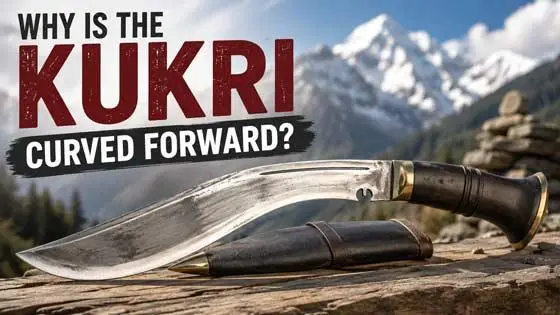
Few blades are as instantly recognizable as the kukri. Instead of sweeping backward like a saber or remaining straight like a typical utility knife, its edge bends conspicuously forward, placing the broadest part of the blade ahead of the user's hand. That strange profile has helped turn the kukri into an enduring symbol of Nepal and the Gurkhas, but it was not created simply to look intimidating. The forward curve changes how the blade's mass is distributed, how it meets a target, and how a relatively compact knife performs demanding cutting and chopping tasks. To understand why the kukri looks so different from almost every familiar blade, we have to examine what that curve actually does and why generations of Nepalese bladesmiths kept it.
The Curve Moves the Kukri's Power Forward
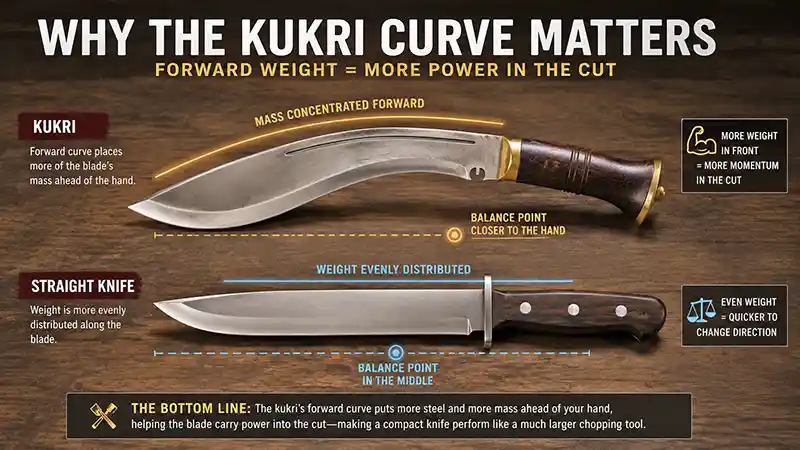
The most important thing about the kukri's shape is not simply that the blade curves. It is which direction it curves. Much of the blade projects forward of the handle, and traditional kukris often widen considerably toward the belly. That places a significant portion of the weapon's mass farther ahead of the hand than it would be on a straight knife of similar overall length.
The result is a blade that behaves partly like a knife and partly like a compact chopping tool. During a swing, the heavier forward section carries momentum into the cut. The broad belly also provides a substantial cutting area near the portion of the blade that can strike with considerable authority. This helps explain how a kukri can perform chopping jobs that might otherwise call for a longer blade or small hatchet.
That does not mean the curve somehow creates extra energy. The user's arm still supplies the motion. Instead, the geometry influences where the blade's mass is concentrated and how that mass is delivered. The tradeoff is immediately noticeable when handling different machetes and kukri knives: a forward-heavy kukri can feel eager to continue through a chopping motion, while a more evenly balanced straight blade may feel quicker to redirect.
This is the first clue to why the kukri retained such an unusual profile for generations. The forward curve is not merely decorative. It allows a relatively compact blade to put substantial weight where it matters during a powerful cut.
The Kukri Does Not Chop Like an Axe
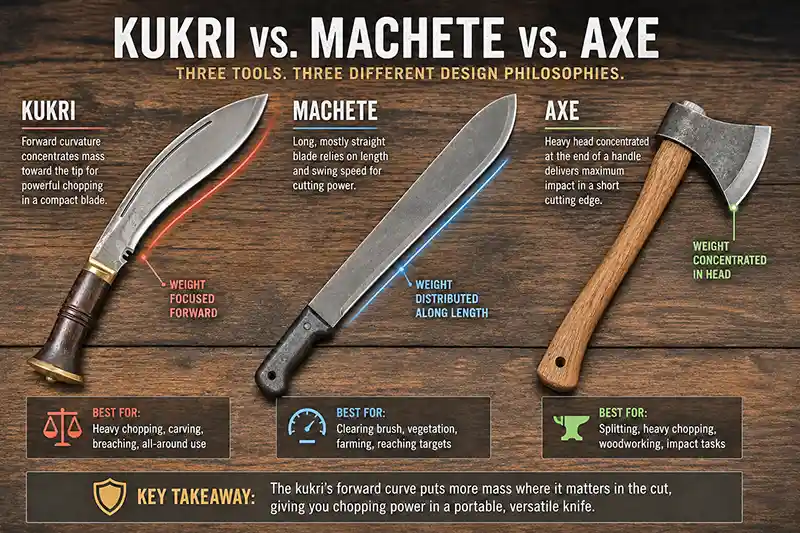
It is tempting to describe the kukri as an axe disguised as a knife, but that comparison only goes so far. An axe concentrates much of its weight in a separate head positioned at the end of a handle. A kukri achieves some of the same forward-heavy feeling while remaining a continuous blade, giving it a very different balance between chopping power and the control expected from a knife.
The forward curve also changes the relationship between the handle and cutting edge. On a typical straight knife, much of the edge runs roughly in line with the user's hand. On a kukri, the belly of the blade reaches forward and downward from that line. When swung, this prominent section naturally becomes an important part of the cutting stroke, combining the broad edge of a chopping tool with a form compact enough to carry at the waist.
This helps explain why comparing a kukri vs. machete reveals more than a cosmetic difference. Many machetes gain chopping ability from blade length and the speed generated by a long swing. A kukri can instead concentrate substantial mass into a shorter, strongly forward-weighted profile. Different examples vary considerably, but the underlying design philosophies are noticeably different.
The kukri's genius is therefore not that it somehow duplicates an axe. It occupies the useful territory between several tools. It can retain the portability and versatility of a large knife while borrowing some of the forward-weighted authority that makes dedicated chopping tools effective.
The Forward Curve Changes How the Edge Meets What It Cuts
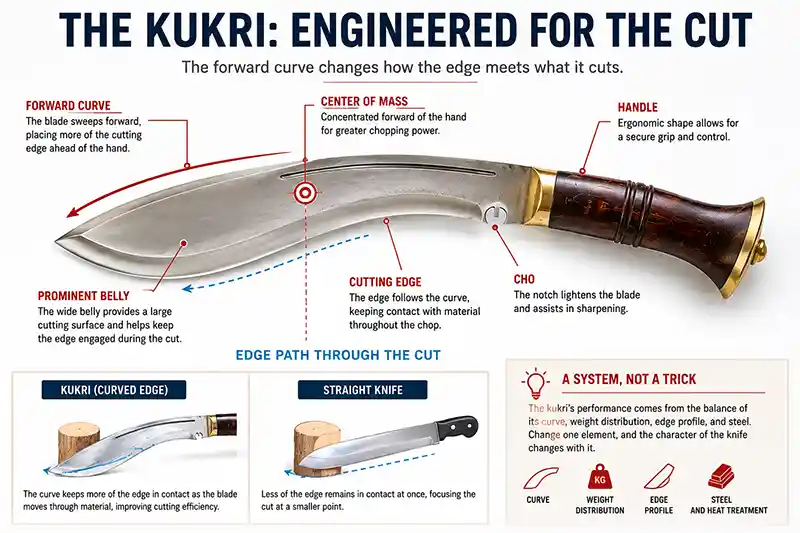
Weight distribution is only part of the kukri's unusual geometry. Because the blade bends forward, the cutting edge does not simply extend away from the handle in a straight line. The broad belly projects ahead of the user's hand, creating a cutting surface that meets material at a different orientation than the edge of a conventional straight knife.
During a chopping stroke, the kukri's prominent belly tends to become the working portion of the blade. Its curved profile can help keep the edge engaged as the blade moves through material rather than concentrating the entire action at a narrow point of contact. The exact behavior varies considerably with blade length, curvature, edge geometry, and the individual kukri's balance, which is why not every kukri performs identically.
This also explains why describing the kukri simply as a "bent knife" misses what makes the design interesting. Changing the curve changes the relationship between the hand, the center of mass, and the cutting edge simultaneously. Nepalese bladesmiths produced many different kukri profiles, suggesting there was no single perfect angle that every maker was attempting to reproduce.
The shape is therefore better understood as an entire system rather than one clever trick. The forward curve, widening blade, edge profile, and distribution of steel work together. Alter any one of those features significantly and the character of the knife changes with it.
The Kukri Was a Working Tool Long Before It Became a Military Icon
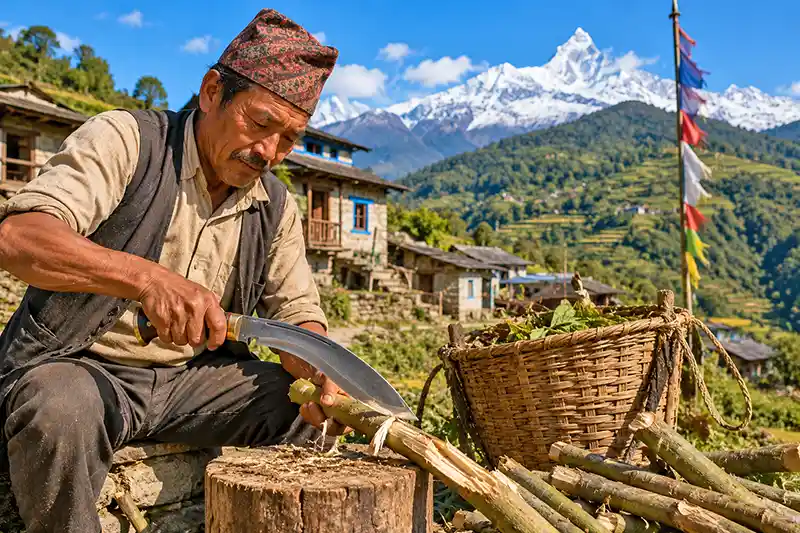
The kukri's shape makes even more sense when it is viewed as something broader than a weapon. In Nepal, kukris have traditionally served practical everyday purposes, including cutting vegetation, processing wood, preparing materials, and performing other demanding chores. A blade capable of delivering strong chopping cuts without requiring the length of a full machete was useful far beyond the battlefield.
This dual identity is important because it challenges the idea that the forward curve must have been invented specifically to make the kukri more dangerous in combat. Many enduring weapon designs developed alongside ordinary tools, and the boundary between the two was not always sharp. A sturdy blade that could clear vegetation or cut wood could also become an effective weapon when necessary.
Traditional kukris also varied according to region, maker, intended use, and period. Some were relatively slender, while others carried broad, heavy bellies. Blade length, curvature, thickness, handle construction, and overall weight could differ substantially. The familiar kukri silhouette represents a family of related designs rather than one rigid specification preserved unchanged for centuries.
That versatility may be one of the strongest explanations for the shape's longevity. The kukri did not survive simply because it became famous in the hands of soldiers. It survived because the forward-curved blade proved useful enough to remain part of everyday Nepalese life as well.
The Kukri Was Shaped by the Landscape of Nepal
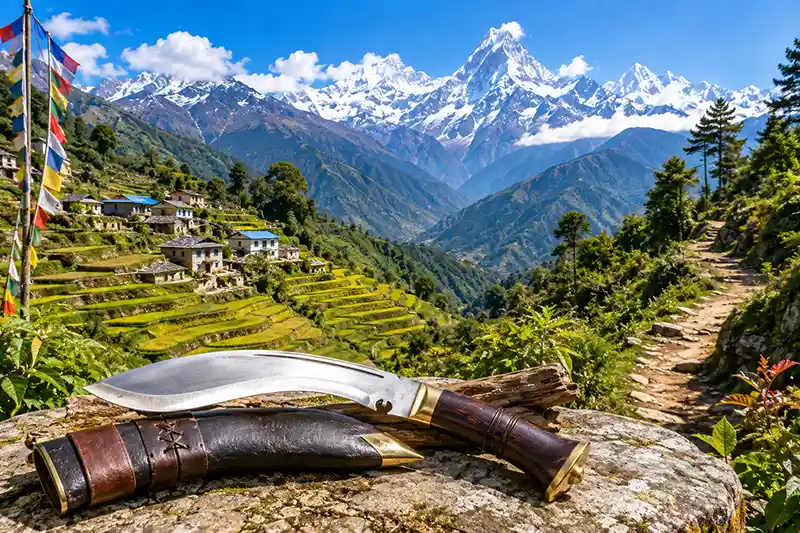
A weapon or tool rarely develops in isolation from the place where people use it. Nepal's terrain ranges from fertile lowlands and dense vegetation to steep forested hills and high mountain valleys. In many of those environments, a compact blade capable of handling vegetation, branches, wood, and other everyday materials would have been far more practical to carry than a dedicated axe or an exceptionally long cutting tool.
The kukri's forward-heavy design offered an unusually useful compromise. It could deliver substantial chopping force while remaining short enough to wear conveniently at the waist. For someone traveling on narrow trails, working on terraced land, tending animals, gathering firewood, or moving through vegetation, portability mattered just as much as raw cutting ability.
It would be too simplistic, however, to claim that Nepal's mountains alone "created" the kukri's curve. The precise origins of the form are difficult to reconstruct, and blade designs can develop through generations of craftsmanship, cultural exchange, and gradual refinement. What can be said more confidently is that the kukri proved exceptionally well suited to the practical demands of the region in which it became established.
That may help explain why the shape endured. A strange-looking blade can survive as a ceremonial object or military tradition, but a design that remains useful in ordinary life has another powerful force preserving it: people keep needing it.
The Gurkhas Turned the Kukri Into a Military Legend
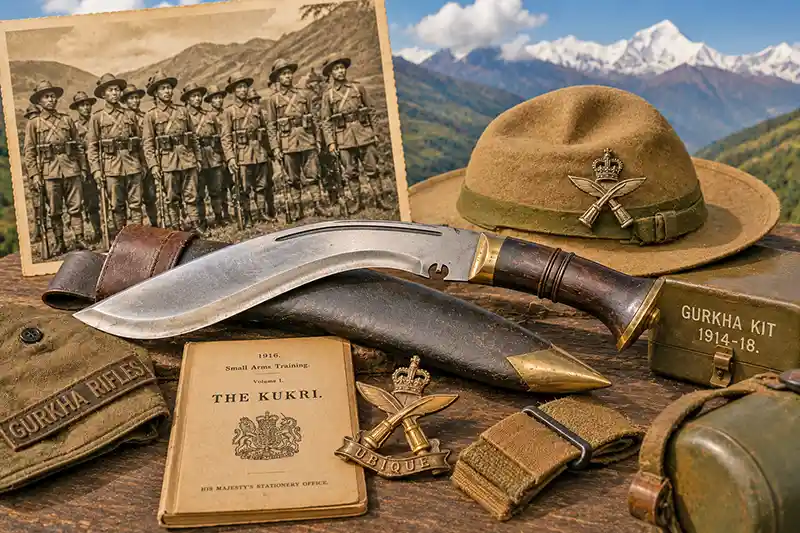
The kukri existed as a Nepalese tool and weapon before it became internationally famous, but the Gurkhas transformed its reputation. British forces encountered soldiers from the Himalayan region during the Anglo-Nepalese War of 1814 to 1816, and afterward began recruiting Nepalese soldiers into units that would eventually become famous for their discipline, endurance, and distinctive curved blades.
As Gurkha units served across the British Empire and later fought in both World Wars, the kukri traveled with them. It was useful for ordinary camp chores and field work, but it could also serve as a close-combat weapon. Photographs and surviving military examples helped make the blade increasingly recognizable outside Nepal, until its forward curve became almost inseparable from the Gurkha identity.
This history also produced a considerable amount of mythology. One of the most persistent stories claims that a Gurkha could never return a drawn kukri to its sheath without first drawing blood. There is no good historical basis for treating this as a genuine rule. Like many legends surrounding famous military units, the story seems to have survived because it reinforced an already formidable reputation.
The documented history is impressive enough without embellishment. The kukri became one of the world's most recognizable military combat knives because generations of Gurkha soldiers actually carried it across an extraordinary range of conflicts. Its unusual forward curve ensured that anyone who saw one was unlikely to mistake it for anything else.
The Kukri's Curve Was Probably Refined Over Generations, Not Invented at Once
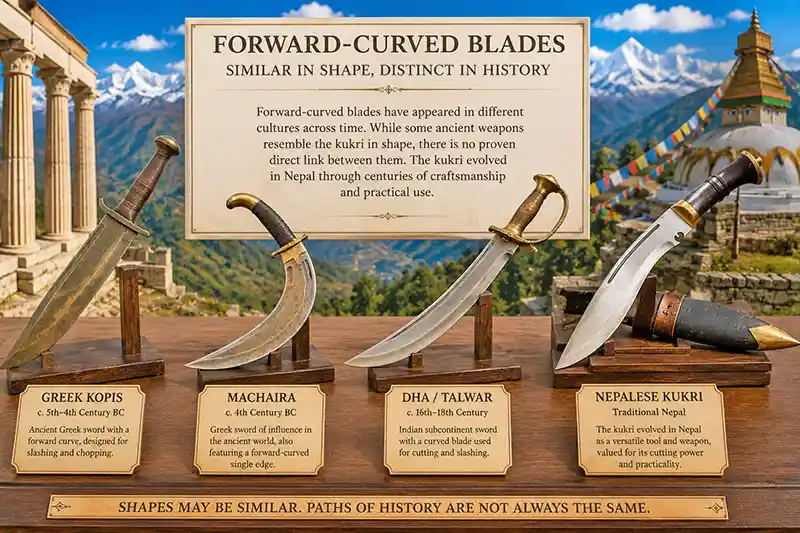
It is tempting to imagine that somewhere in Nepal's distant past, a bladesmith deliberately invented the forward-curved kukri after realizing the mechanical advantages of placing more steel ahead of the hand. History rarely gives us such a convenient origin story. There is no known individual inventor of the kukri, and the earliest development of its distinctive shape remains uncertain.
Several older weapons are sometimes proposed as ancestors or influences. The ancient Greek kopis and related forward-curving blades such as the machaira are frequently mentioned because their silhouettes can look remarkably kukri-like. Alexander the Great's campaigns reached into the northwestern Indian subcontinent, which has encouraged theories that Greek blade designs somehow traveled east and eventually influenced the kukri.
The resemblance is fascinating, but resemblance alone is not evidence of direct descent. Forward-curved blades appeared in multiple cultures because the basic geometry can be useful for chopping and cutting. Centuries separate many of the ancient examples from securely documented Nepalese kukris, leaving an enormous historical gap that cannot simply be filled by noticing that two blades share a similar curve.
A more cautious explanation is that the kukri's recognizable form emerged through a long process of regional craftsmanship and refinement. Bladesmiths could preserve features that worked, modify proportions for different purposes, and pass successful designs from one generation to another. The curve we recognize today may therefore represent accumulated practical experience rather than a single moment of invention.
The Notch Near the Handle Is Almost as Mysterious as the Curve
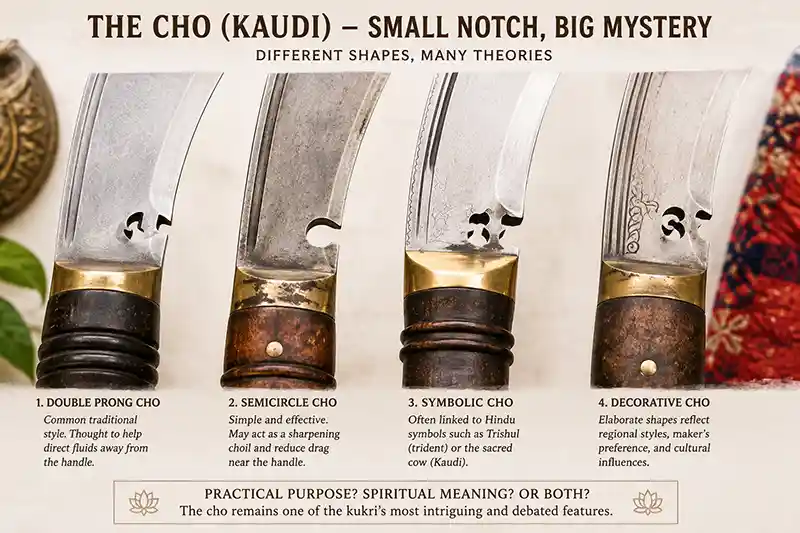
Look closely at many traditional kukris and you will find another unusual feature: a small notch cut into the blade immediately in front of the handle. Usually called the cho or kaudi, it can resemble a simple semicircle, a pair of small prongs, or a more elaborate symbolic shape depending on the kukri and its maker.
Its exact purpose is surprisingly difficult to pin down. One practical explanation is that the notch acts somewhat like a sharpening choil, creating a clear transition between the sharpened edge and the thicker area near the handle. Another common claim is that it helps prevent fluids from running along the edge toward the grip, although explanations of precisely how effectively it accomplishes this should be treated cautiously.
The cho also carries cultural and religious interpretations. Its shape has been associated with symbols important in Nepalese Hindu tradition, including representations connected with Shiva and the sacred cow. The difficulty is that kukris were produced across different periods and communities, and modern explanations do not always come with historical documentation showing exactly what earlier makers intended.
What makes the cho fascinating is that it demonstrates how easily practical design and cultural meaning can coexist in the same object. The kukri's forward curve has an obvious mechanical effect. Its tiny notch is far less straightforward, leaving one of the blade's most recognizable features open to several competing explanations.
Not Every Kukri Curves the Same Way
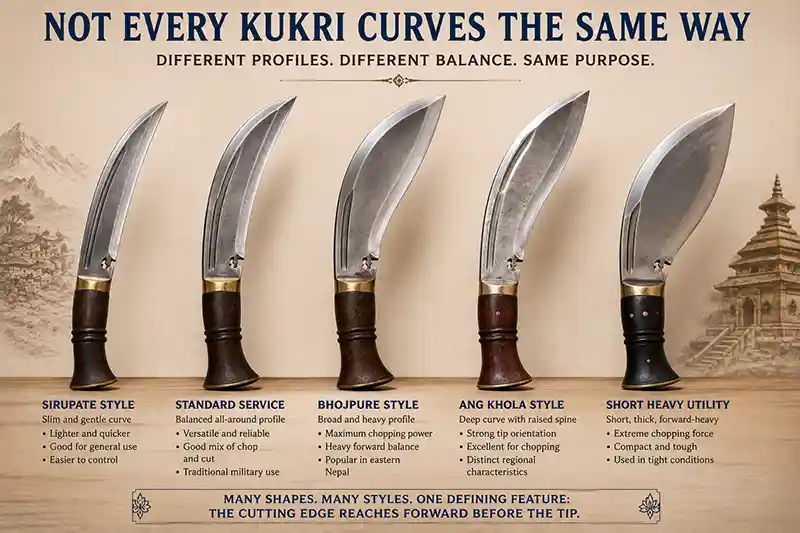
The word "kukri" can create the impression that there is one traditional blade shape, but surviving examples tell a much more interesting story. Some kukris have a relatively gentle forward sweep, while others bend dramatically downward before widening into an enormous belly. Some are long and slender. Others are short, thick, and extremely forward-heavy. Even the point can range from narrow and aggressive to broad and almost leaf-shaped.
These differences matter because changing the profile changes how the kukri feels and performs. A broad, heavy blade places more mass toward the working portion of the edge and favors powerful chopping. A lighter, narrower kukri can feel quicker and more manageable for general cutting tasks. Length, thickness, distal taper, handle construction, and the location of the widest part of the blade all contribute to the final balance.
Traditional styles are sometimes identified by names such as Sirupate, which is generally associated with a slimmer profile, and Bhojpure, often associated with broader, heavier examples. But kukri terminology is not always perfectly standardized, and handmade blades can resist the neat categories modern collectors would like to place them into.
This variation reveals something important about the question behind this entire article. There is no single ideal degree of forward curvature. The kukri's basic geometry proved useful enough that generations of smiths could modify it for different priorities while preserving the unmistakable feature that defines the blade: its cutting edge reaches forward before it ever reaches the tip.
Why the Kukri Feels Heavier Than Its Size Suggests
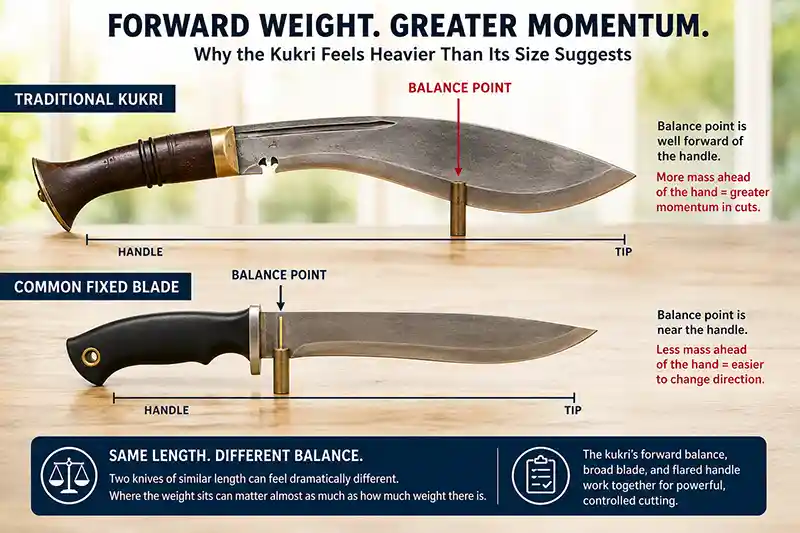
Pick up a traditional kukri after handling an ordinary knife of similar length and the difference can be immediate. The kukri often feels heavier than its dimensions suggest, not necessarily because it contains dramatically more steel, but because so much of that steel sits forward of the hand. The balance point can extend noticeably into the blade, giving the kukri a distinctive blade-heavy character.
That forward balance changes the sensation of swinging it. Once the blade begins moving, its mass resists changes in direction and encourages the motion to continue. This can be advantageous during chopping because momentum carries the broad working portion of the blade through the stroke. The same characteristic can make a particularly heavy kukri feel less nimble than a more neutrally balanced knife.
Handle shape helps compensate for this. Traditional kukri handles commonly flare near the pommel, creating a wider section behind the hand. That shape helps the grip remain secure when the forward-heavy blade is moving. The distinctive handle and distinctive curve therefore should not be viewed as completely unrelated features. Both contribute to how the tool behaves in the hand.
This is another reason judging a kukri solely by blade length can be misleading. Two knives of nearly identical overall length can feel dramatically different if one balances close to the handle and the other carries much of its mass several inches farther forward. With the kukri, where the weight sits can matter almost as much as how much weight there is.
The Curve Also Keeps a Long Cutting Edge in a Compact Package
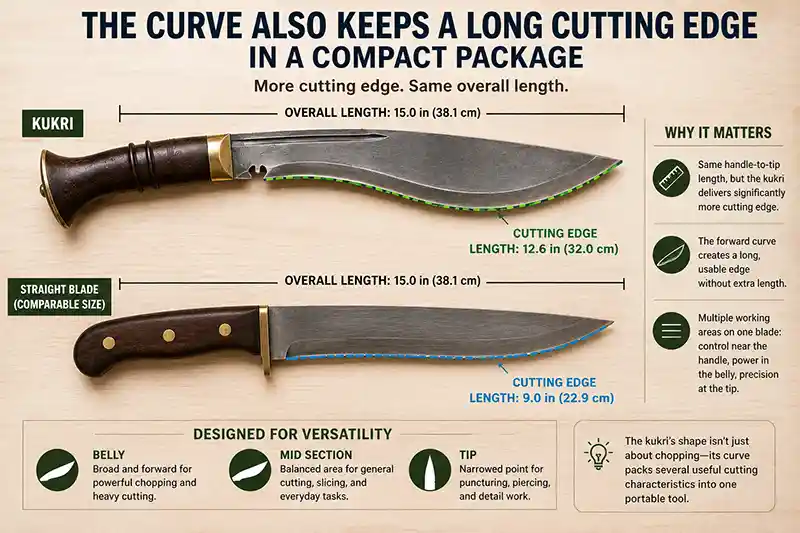
The kukri's forward bend does something that is easy to overlook when concentrating on weight and chopping power: it fits a surprisingly substantial cutting edge into a blade that remains relatively compact from handle to tip. Instead of taking the shortest path between those two points, the edge sweeps outward through the kukri's belly before turning back toward the point.
That means overall length does not tell the entire story. Two blades can measure similarly from handle to tip while offering noticeably different edge profiles. The kukri uses its pronounced belly to provide a broad working area without requiring the long, straight proportions of a conventional machete. For a tool intended to be carried regularly, that is a useful compromise.
The geometry also creates different working areas along the same blade. The section nearer the handle can offer more control for smaller cutting tasks, while the broad forward belly provides the mass and edge area associated with heavier work. The point remains available for jobs requiring a narrower part of the blade. Exactly how pronounced these zones are depends on the individual kukri, but the basic versatility is built into the shape.
This helps explain why reducing the kukri to "a knife designed for chopping" undersells it. Chopping is certainly one of the jobs its forward curve performs exceptionally well, but the enduring appeal of the design comes from packing several useful cutting characteristics into one relatively portable blade.
The Kukri's Shape Makes More Sense When You Stop Calling It a Knife
Technically, the kukri belongs comfortably within the broad world of knives, but that label can create the wrong expectations. Most people picture a knife as a relatively light cutting tool designed around control, slicing, and precision. The kukri was expected to handle jobs that overlap with knives, machetes, and small chopping tools, so its unusual geometry reflects a much broader set of demands.
That helps explain why several features that might seem excessive on an ordinary knife work so well together on a kukri. The blade projects forward to shift mass away from the hand. The belly expands the working portion of the edge. The handle often flares at the end to help secure the grip. The blade can remain compact enough to carry while still possessing enough authority for demanding outdoor work.
Seen this way, the forward curve stops looking like an eccentric feature added to an otherwise conventional knife. It becomes the defining element of a hybrid design. Straighten the blade, narrow the belly, and move the balance point backward, and you might produce something quicker and lighter, but you would also remove much of what allows a kukri to occupy the territory between a general-purpose knife and a dedicated chopping tool.
That may be the simplest answer to why the kukri curves forward. The shape survived because the people using it were not trying to create the world's strangest knife. They were refining a compact tool capable of doing jobs that ordinary knives were never designed to handle.
Does the Forward Curve Actually Make the Kukri Cut Harder?
This is where one of the most common explanations about the kukri needs a little restraint. You will sometimes hear that the forward curve somehow multiplies force or causes the blade to accelerate into whatever it strikes. The geometry does not create free energy. A kukri cannot deliver more energy than the motion of the blade and the person swinging it provide.
What the design can change is how effectively that energy is delivered. By placing substantial mass ahead of the hand and concentrating it around the broad working portion of the blade, a kukri can carry considerable momentum through a chopping stroke. Its balance encourages the blade to continue moving once the swing has begun, while the pronounced belly provides an effective area for the cut.
This distinction matters because the kukri's real engineering is more interesting than the exaggerated explanation. Its effectiveness does not come from some mysterious property of a forward-curved edge. It comes from the interaction of mass distribution, blade geometry, edge shape, balance, and the motion supplied by the user.
A poorly designed kukri would not automatically outperform a well-designed straight blade simply because it curves forward. Steel thickness, weight, edge geometry, heat treatment, handle design, and overall proportions all matter. The curve gives the bladesmith a particularly effective way to arrange those characteristics, but it is only one part of the finished tool.
That is ultimately why the kukri's shape has endured. The forward curve does not break the laws of physics. It takes advantage of them.
The Curve Survived Because It Solved More Than One Problem
The most successful tool designs rarely survive for centuries because of a single advantage. The kukri's forward curve shifts useful mass toward the front of the blade, creates a broad working belly, provides substantial cutting edge in a compact length, and allows the blade to perform demanding chopping tasks without becoming as cumbersome as many longer tools.
Just as importantly, those advantages were useful in very different circumstances. The same basic blade could accompany someone working around a village, traveling through difficult terrain, clearing vegetation, processing wood, or serving as a soldier. Individual kukris could then be made lighter, heavier, longer, broader, or more dramatically curved depending on what their owners needed them to do.
That adaptability helps explain why the design resisted being replaced by something simpler. A straight blade might be easier to manufacture in some circumstances. A machete could provide greater reach. An axe could concentrate even more weight into a chopping head. But replacing the kukri with any one of those tools would sacrifice some of the characteristics that made it valuable in the first place.
The forward curve therefore should not be thought of as one strange feature with one clever explanation. It is the foundation of a design built around compromise: power without excessive length, versatility without excessive bulk, and a working tool that could also serve as a formidable weapon when circumstances demanded it.
After generations of refinement, the strangest thing about the kukri may not be that its blade curves forward. It may be how many practical problems that one unusual shape manages to solve.
The Kukri Looks Strange Because It Was Built to Work
The kukri's forward curve is so distinctive that it is easy to assume the shape must hide some exotic secret. In reality, its effectiveness comes from something much more practical. Moving steel ahead of the hand changes the balance of the blade, the broad belly provides an effective working edge, and the compact overall length allows the kukri to deliver serious chopping performance without becoming an oversized tool.
That combination proved useful far beyond combat. The kukri could travel through the mountains with a soldier, hang at the waist of someone working around a village, process wood and vegetation, and perform countless ordinary cutting jobs. When Gurkha soldiers eventually carried it around the world, they transformed an already successful Nepalese tool into an international military icon.
There are still mysteries surrounding the kukri. Its earliest development is difficult to reconstruct, the meaning of the cho has accumulated competing explanations, and ancient forward-curved blades provide intriguing parallels without proving a simple line of descent. What requires far less speculation is why the basic shape endured once it became established. It worked.
The kukri is therefore a useful reminder that some of history's strangest-looking weapons did not become strange because their makers wanted to be different. Sometimes an unusual shape survives for generations because ordinary people keep finding reasons not to change it.
Why Does a Kukri Curve Forward Instead of Backward?
The kukri curves forward primarily because that shape places more of the blade and its mass ahead of the user's hand. Combined with the kukri's broad belly, this creates a forward-heavy balance that works particularly well for powerful cutting and chopping. A backward-curving blade can offer advantages of its own, but it would distribute the edge and mass differently and would fundamentally change the handling characteristics that make the kukri distinctive.
Is a Kukri a Knife or a Machete?
A kukri is traditionally considered a knife, but its size, forward-heavy balance, and chopping ability allow it to perform many jobs associated with a machete or small hatchet. Some kukris are compact enough to function comfortably as general-purpose knives, while larger examples are much closer to dedicated chopping tools. This versatility is one reason modern sellers sometimes group kukris with machetes even though the kukri has its own distinct Nepalese history and design tradition.
Is a Kukri Better at Chopping Than a Machete?
Neither design is automatically better because kukris and machetes vary enormously in size, weight, thickness, and intended use. A heavy kukri concentrates substantial mass toward its broad forward belly, allowing a relatively short blade to deliver powerful chops. Many machetes instead use greater blade length and swing speed while providing additional reach for clearing vegetation. The better tool depends on the job, which is why comparing blade geometry and weight is more useful than assuming one design will always outperform the other.
Why Do Kukris Have a Notch Near the Handle?
The small notch near the base of a traditional kukri is usually called the cho or kaudi, and its exact purpose is debated. Practical explanations include providing a clear termination point for the sharpened edge and helping with blade maintenance, while other interpretations give the notch religious or cultural significance. Claims that it was definitively designed to catch an opponent's blade or prevent blood from reaching the handle are often repeated, but the historical evidence does not support treating any one explanation as universally settled.
Are Kukris Only Used as Weapons?
No. Although the kukri became internationally famous through its association with Gurkha soldiers, it has a much broader history as a practical working blade in Nepal. Kukris have traditionally been used for everyday cutting chores, processing wood, clearing vegetation, preparing materials, and other tasks where a strong compact blade is useful. Its effectiveness as a weapon is only one part of the reason the design survived for generations.
Did the Gurkhas Invent the Kukri?
No individual Gurkha soldier or military unit is known to have invented the kukri. The blade was already part of Nepalese culture before Gurkha troops made it internationally famous during the 19th and 20th centuries. Its deeper origins are difficult to trace with certainty, and theories connecting it directly to ancient forward-curved weapons such as the Greek kopis remain speculative. The Gurkhas did not create the kukri, but their military service helped turn it into one of the most recognizable blades in the world.
Is the Kukri Based on the Ancient Greek Kopis?
The resemblance between the kukri and the ancient Greek kopis is striking, and theories sometimes connect the two through Greek campaigns into the Indian subcontinent. However, there is no continuous chain of archaeological or documentary evidence demonstrating that the Nepalese kukri directly descended from the kopis. Forward-curved blades appeared in several cultures because the geometry can be effective for cutting and chopping, so similar shapes do not necessarily indicate a shared origin. A Greek influence is an intriguing possibility, but it should not be presented as established history.
Why Are Kukri Handles Often Flared at the End?
Traditional kukri handles commonly widen or flare near the pommel, and the shape complements the blade's forward-heavy balance. Because substantial weight sits ahead of the hand, a secure grip becomes particularly important when the kukri is moving through a chopping stroke. The flared end helps resist the handle slipping forward through the user's hand without requiring an oversized guard. Handle designs vary considerably among kukris, but the distinctive flare is another example of how different parts of the weapon evolved to work with its unusual blade geometry.
Why Are Some Kukris Much Heavier Than Others?
Kukris were made for different owners and different jobs, so there was never one universal weight or blade profile. A broad, thick kukri with substantial steel concentrated toward the belly can favor powerful chopping, while a slimmer example may sacrifice some of that forward-heavy authority for quicker handling and easier everyday carry. Military, working, ceremonial, and presentation kukris could also have very different proportions. This variation is why two authentic-looking kukris of similar length can feel remarkably different once they are actually held.
What Is the Difference Between a Kukri and a Gurkha Kukri?
"Gurkha kukri" generally refers to the kukri's famous association with Gurkha soldiers rather than an entirely separate category of weapon. Kukris existed within Nepalese culture beyond military service and were made in numerous sizes and styles for practical, ceremonial, and martial purposes. Military kukris carried by Gurkha units could follow particular patterns or specifications, but calling a blade a Gurkha kukri does not mean that all other kukris belong to a fundamentally different weapon family.
Why Do Kukris Come With Two Small Knives?
Traditional kukri scabbards often include two much smaller implements called the karda and chakmak. The karda is a small utility knife intended for finer cutting jobs that would be awkward with the large kukri. The chakmak is typically an unsharpened steel implement traditionally associated with maintaining the kukri's edge and, when used with suitable material, striking sparks for fire making. Their presence reinforces an important point about the kukri: it developed as part of a practical working kit, not simply as a weapon.
How Old Is the Kukri?
The exact age of the kukri is difficult to establish because its early development is poorly documented. Surviving examples and written evidence make its history increasingly clear in the last several centuries, while claims that the design can be traced directly back thousands of years are much harder to prove. Ancient forward-curved blades such as the Greek kopis are sometimes proposed as ancestors, but no continuous historical record currently demonstrates that the kukri descended directly from them.
Why Is the Kukri So Closely Associated With Nepal?
The kukri developed into an important working blade and cultural symbol in Nepal, where it has been used for everyday tasks as well as military purposes. Its international reputation grew enormously through Gurkha soldiers, who carried kukris while serving in conflicts around the world. That military history made the blade famous overseas, but within Nepal its significance extends well beyond warfare, connecting the kukri with craftsmanship, tradition, practical work, ceremony, and national identity.
You May Also Be Interested In:
4 Comment(s)
"To the A.I.:
Spend a few years carefully examining hundreds of antique Nepalese Kukries."
Written By: Barry
8/13/26 - 7:11am
"I want one!"
Written By: Forrest
8/14/26 - 10:36am
"Along with the Bowie, the Kukrie is one the most battle tested knives of all time. As a working tool they are amazing. I have to cut down rotting banana trees every Fall. A large Kukrie machete make the job much easier."
Written By: Tom
8/14/26 - 12:26pm
"I have owned 2 of these in the past. But now as I am older I am looking for a light weighted kukrie.smaller but not too small that can handle like a bigger kukrie as i am getting older"
Written By: Alfred Lutzick
8/15/26 - 4:35am
Leave a Reply