



The Forgotten Combat Knives That Shaped Modern Warfare
June 29th, 2026
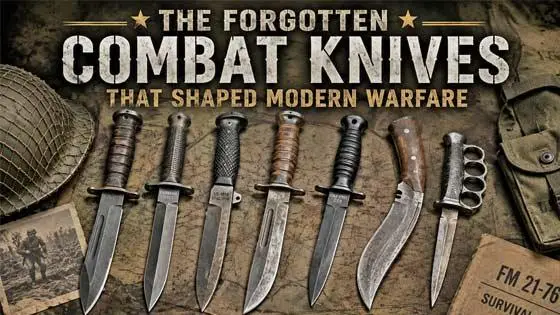
Some military knives become legends. Others quietly influence generations of soldiers without ever becoming household names. While iconic blades like the Bowie knife often steal the spotlight, countless lesser-known combat knives introduced new designs, solved battlefield problems, and changed the way militaries around the world thought about close-quarters combat. Their stories are woven into wars, special operations, and survival training, even if most people have never heard their names.
In this article, we'll look beyond the famous blades and explore the overlooked knives that left a lasting mark on military history. Some were carried by elite commandos. Others inspired modern tactical designs that are still used today. Together, they prove that history isn't always shaped by the most famous weapons, but often by the ones that quietly did their job when it mattered most.
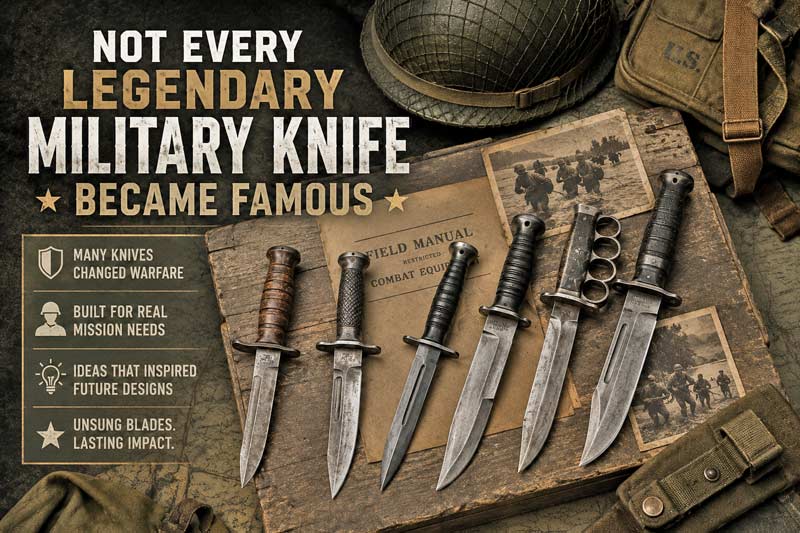
When people think of military knives, a handful of famous names usually come to mind. The Bowie knife, the KA-BAR, and a few modern tactical designs have earned their place in history books and Hollywood alike. Yet many of the blades that quietly changed military tactics, influenced future designs, or gave soldiers a critical advantage have faded into obscurity. Some were issued to elite commandos. Others were experimental tools that introduced ideas still found on modern knives decades later.
Military history is full of innovations that never became household names. A knife didn't have to be carried by millions of troops to leave a lasting mark. Sometimes a blade designed for one specialized mission would inspire generations of military equipment, while another earned a legendary reputation among the soldiers who depended on it, even if the general public never heard its story.
Today's collectors often focus on rarity or appearance, but battlefield success was measured very differently. Soldiers valued reliability, simplicity, and the ability to perform under impossible conditions. Many of these forgotten knives were designed as practical tools first and weapons second, an approach that continues to influence many of today's fixed blade knives and modern tactical knives.
In the sections ahead, we'll look at several overlooked combat knives whose influence reached far beyond the conflicts in which they served. While they may not enjoy the same recognition as history's most iconic blades, their impact on modern warfare is impossible to ignore.
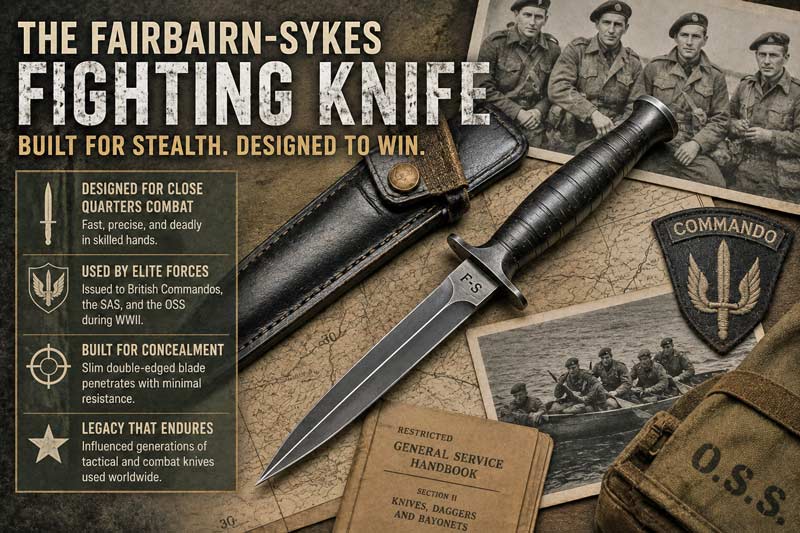
If one knife deserves far more recognition than it receives, it's the Fairbairn-Sykes fighting knife. Developed during the early years of World War II by British officers William E. Fairbairn and Eric A. Sykes, the slender double-edged dagger wasn't designed as a general-purpose tool. It had one purpose: giving commandos an advantage in close-quarters combat when stealth mattered more than brute force.
Unlike the larger military knives of its era, the Fairbairn-Sykes emphasized speed, precision, and concealment. Its narrow blade could slip through heavy clothing with minimal resistance, while its balanced design made it fast in the hand. British Commandos, the Special Air Service, and later the American Office of Strategic Services all issued versions of the knife to troops carrying out dangerous raids behind enemy lines.
Its greatest legacy wasn't measured by the number of knives produced, but by the philosophy it introduced. The Fairbairn-Sykes demonstrated that specialized missions required specialized equipment. That idea would eventually influence countless military blades, from covert fighting knives to modern tactical designs carried by special operations forces around the world.
Many of today's purpose-built combat knives still reflect lessons first popularized by the Fairbairn-Sykes. Even though modern soldiers often rely on more versatile field knives, its emphasis on mission-specific design continues to shape the evolution of military blades. It's one of the clearest examples of how an overlooked weapon quietly changed history without becoming a household name.
Readers interested in how military knife design continued to evolve into the modern era may also enjoy our look at the defining characteristics of military survival knives, where many of these battlefield lessons can still be seen today.
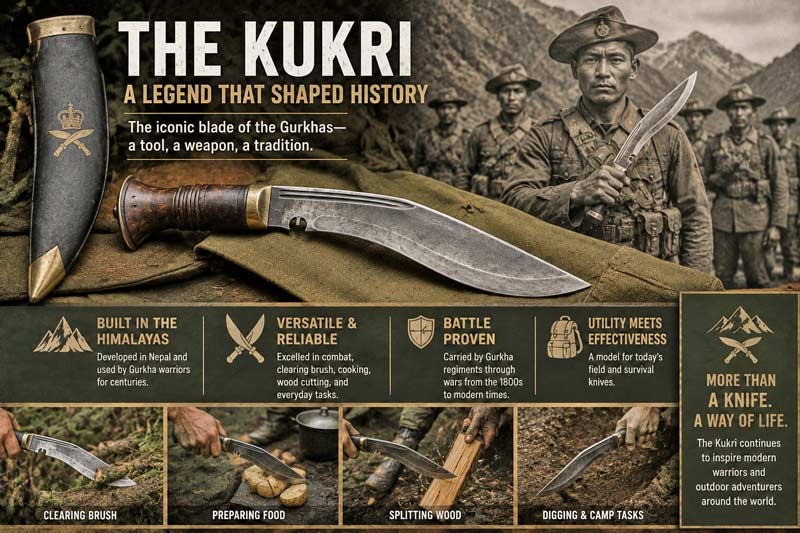
Few military knives have a history as remarkable as the kukri. Long before firearms dominated the battlefield, the distinctive forward-curving blade was already proving itself as both a practical tool and an effective weapon in the mountains of Nepal. When the British Army began recruiting Gurkha soldiers during the early 1800s, they quickly discovered that the kukri was far more than a cultural symbol. It was an indispensable part of a soldier's daily life.
Unlike many combat knives that were designed solely for fighting, the kukri excelled at almost everything. Soldiers used it to clear brush, prepare food, split firewood, dig defensive positions, and perform countless camp tasks before ever drawing it in combat. That versatility made it especially valuable in remote environments where carrying multiple specialized tools simply wasn't practical.
The blade's battlefield reputation grew during conflicts ranging from the World Wars to the Falklands and beyond. Stories of Gurkha bravery became legendary, and while some accounts were undoubtedly exaggerated over time, the kukri's effectiveness was never seriously questioned. Its weight-forward design delivered tremendous chopping power while remaining compact enough to carry comfortably throughout long campaigns.
Perhaps the kukri's greatest contribution to military history was demonstrating that a combat knife didn't have to sacrifice utility for effectiveness. Many of today's heavy-duty field and survival knives follow the same philosophy, blending rugged durability with the ability to handle demanding everyday tasks. If you're interested in modern blades built with that same practical mindset, explore our selection of fixed blade knives and dependable survival gear designed for challenging environments.
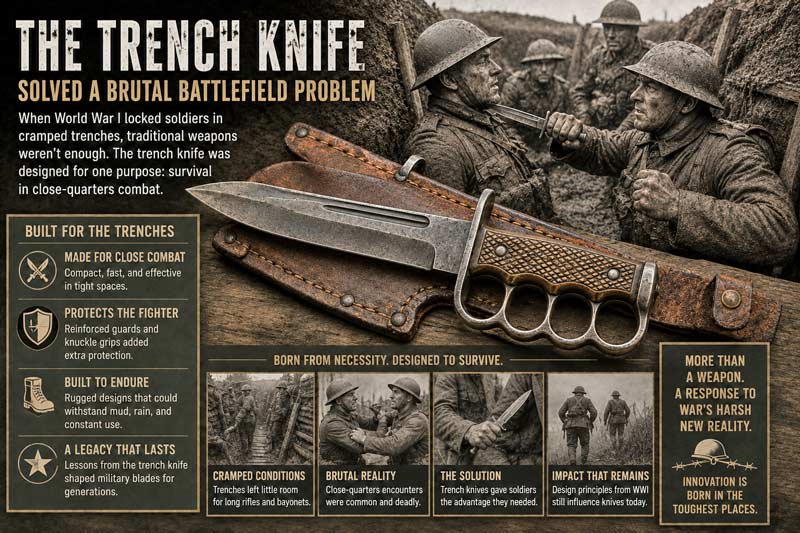
World War I introduced a kind of combat unlike anything armies had experienced before. Soldiers spent weeks or even months living in narrow trenches separated by only a few yards of mud, barbed wire, and constant danger. Long rifles with fixed bayonets were excellent for open battlefields, but they were awkward inside cramped trenches where every movement was restricted. Military planners quickly realized they needed a weapon designed specifically for brutal close-range encounters.
The answer came in the form of the trench knife. These compact fighting knives often featured reinforced guards, aggressive blade profiles, and, in some cases, distinctive knuckle-style grips that provided extra protection during hand-to-hand combat. They weren't elegant weapons. They were purpose-built for one of the harshest environments soldiers had ever faced.
Although trench warfare eventually faded, the lessons learned from these knives continued to influence military equipment for decades. Designers recognized the importance of compact, durable blades that could be drawn quickly and controlled in confined spaces. Many of those ideas carried over into later combat knives issued during World War II and beyond, helping shape the evolution of modern battlefield blades.
The trench knife also reminds us that military equipment often evolves in response to very specific challenges. Just as these specialized blades emerged from the realities of trench warfare, countless other weapons throughout history were created to solve unique battlefield problems. You can explore more examples in our article on the most famous combat weapons, which highlights many of the innovations that changed the course of military history.
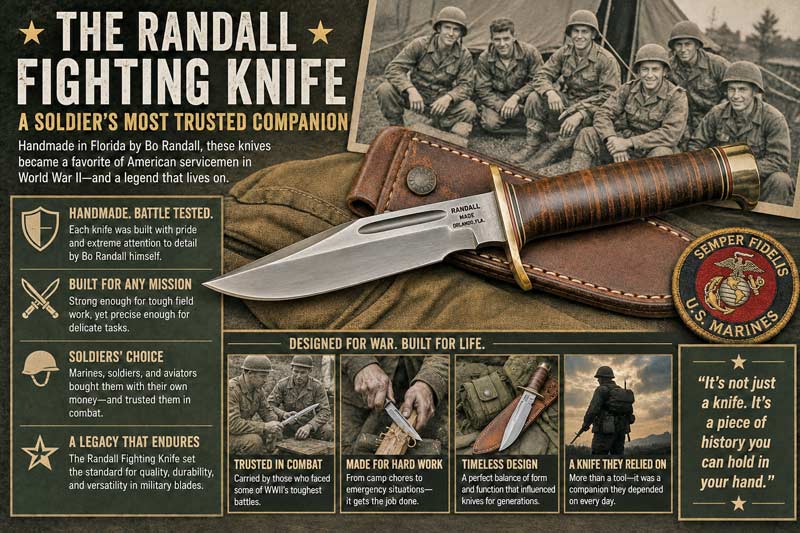
Unlike many military knives that were designed through government contracts, the Randall Fighting Knife earned its reputation the hard way. Handmade by Bo Randall in Florida, these knives became highly sought after by American servicemen during World War II because of their exceptional craftsmanship and reliability. Soldiers often purchased them with their own money before deploying, trusting them enough to carry them into some of the war's toughest battles.
Randall's designs struck a balance that many military-issued knives struggled to achieve. They were strong enough for demanding field work yet refined enough to perform delicate cutting tasks. Marines, soldiers, aviators, and special operations personnel all found uses for them, and stories of Randall knives surviving years of combat helped cement their legendary status among those who served.
Perhaps the knife's greatest influence was proving that durability and versatility could coexist in a single blade. Later generations of military and outdoor knives borrowed heavily from that philosophy, favoring practical designs capable of handling everything from camp chores to emergency survival situations. Many of today's premium field knives still follow principles that Randall popularized more than 80 years ago.
Even though the Randall Fighting Knife never became as universally recognized as the KA-BAR, its legacy continues to shape modern blade design. If you're interested in how these classic military patterns influenced today's outdoor and combat blades, our guide to everyday carry knives shows how many timeless design ideas continue to appear in the knives people rely on every day.
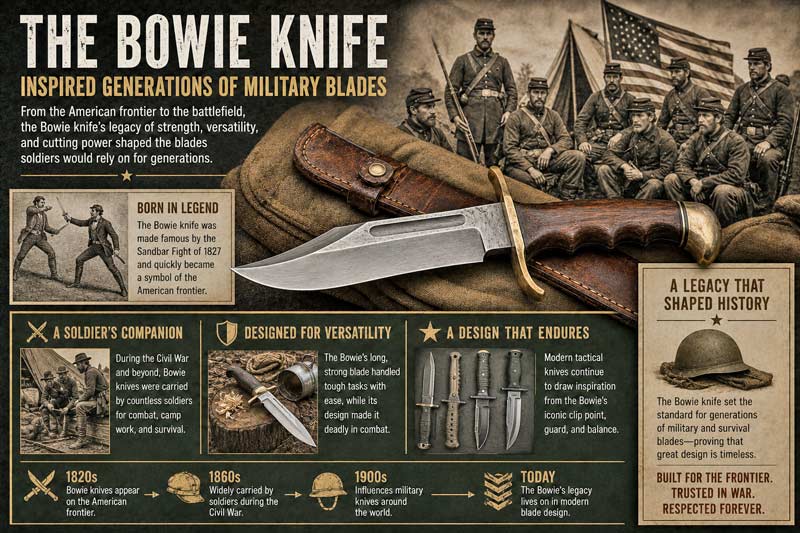
The Bowie knife wasn't created as military equipment, yet few blades have had a greater influence on combat knife design. Originally made famous by the legendary Sandbar Fight of 1827, the Bowie quickly earned a reputation for strength, reach, and versatility on the American frontier. By the time the United States entered the Civil War, countless soldiers were carrying Bowie-style knives alongside their standard weapons.
Its popularity continued well into the twentieth century. Military designers recognized that the Bowie offered something many smaller fighting knives could not: a blade capable of handling demanding camp chores while remaining formidable in combat. That balance between utility and fighting performance helped shape the philosophy behind many military field knives that followed, including some of the most respected survival and combat blades ever produced.
The Bowie also changed public expectations of what a military knife should look like. Long clip-point blades, sturdy crossguards, and substantial handles became defining characteristics that influenced generations of knife makers around the world. Even modern tactical knives often borrow elements first popularized by the Bowie nearly two centuries ago.
Its story serves as a reminder that not every influential military knife began life on a battlefield. Some of history's greatest designs earned their reputation through everyday use before proving themselves in war. If you'd like to learn more about how this iconic blade evolved into an American legend, read our article on the evolution of the Bowie knife, or browse our collection of classic Bowie knives inspired by that enduring design.
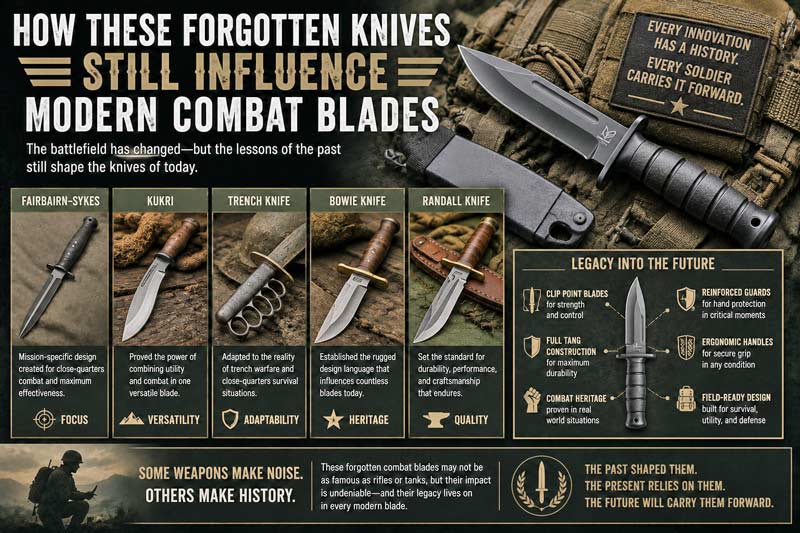
Although warfare has changed dramatically over the past century, many of the principles behind today's combat knives can be traced directly to these overlooked designs. Modern military blades are expected to serve as survival tools, utility knives, emergency rescue equipment, and last-resort defensive weapons all at once. That philosophy didn't appear overnight. It evolved through decades of lessons learned by soldiers carrying the very knives we've explored throughout this article.
The Fairbairn-Sykes proved that mission-specific equipment could dramatically improve a soldier's effectiveness. The kukri demonstrated the value of combining utility with fighting capability. Trench knives showed how equipment adapts to unique battlefield conditions, while the Bowie established a rugged design language that still appears in countless modern blades. Even premium custom knives like the Randall helped set expectations for durability and craftsmanship that manufacturers continue to pursue today.
Walk through almost any collection of modern knives and you'll notice echoes of these historic designs. Clip-point blades, full tang construction, reinforced guards, ergonomic handles, and versatile field-ready profiles all owe something to the innovations of the past. The names may have changed, but many of the ideas remain remarkably familiar.
History tends to celebrate the loudest weapons and the biggest battles, yet some of the most important military innovations arrived quietly, one knife at a time. These forgotten combat blades may never receive the recognition of famous rifles or tanks, but their influence continues to live on every time a modern soldier straps a dependable field knife to their gear.
History has a way of celebrating the loudest stories while overlooking the tools that quietly changed the world. Rifles, tanks, and aircraft often dominate discussions of military innovation, yet countless soldiers depended just as much on the knife hanging from their belt. Whether clearing obstacles, preparing food, surviving behind enemy lines, or serving as a last line of defense, these blades earned their place through reliability rather than publicity.
The Fairbairn-Sykes, kukri, trench knife, Randall Fighting Knife, and Bowie each solved different problems for different generations of warriors. Some introduced new design philosophies. Others proved that versatility could be just as valuable as fighting ability. Together, they laid the foundation for many of the combat and field knives still trusted by military personnel, outdoorsmen, and collectors today.
If there's one lesson these forgotten blades teach us, it's that true influence isn't always measured by fame. The most important military knives aren't necessarily the ones that appeared in the most movies or became the biggest collectors' items. They're the ones whose ideas lived on, quietly shaping the next generation of blades long after the original designs left the battlefield.
One of the longest-serving military knives in history is the kukri, which has been carried by Nepalese Gurkha soldiers for more than 200 years. First gaining international attention during the Anglo-Nepalese War in the early 1800s, the distinctive forward-curving blade became an official part of Gurkha military tradition after Britain began recruiting Gurkha regiments. Remarkably, the kukri remains in service today, making it one of the oldest military knife designs still actively carried by soldiers.
Its longevity comes down to versatility. The kukri functions as a combat weapon, camp tool, brush-clearing blade, and survival knife all in one. While countless military knife designs have appeared and disappeared over the centuries, the kukri has changed very little because its original design proved so effective. Few military tools can claim such a long and uninterrupted history of practical service.
Military knives are expected to perform in some of the harshest conditions imaginable, and that's where fixed blades have a clear advantage. Without a hinge or locking mechanism, they are generally stronger, more durable, and less likely to fail when used for demanding tasks like chopping, prying, digging, or cutting through thick materials. In combat or survival situations, reliability often matters more than convenience.
A fixed blade is also faster to deploy and easier to maintain in harsh environments. Mud, sand, ice, and debris can interfere with a folding knife's moving parts, while a solid one-piece design is easier to clean and ready for use at a moment's notice. Although folding knives are popular for everyday carry, militaries around the world continue to favor fixed blades whenever strength and dependability are the top priorities.
There isn't a single military knife that influenced every modern design, but a few stand above the rest. The Bowie knife popularized the versatile clip-point blade, the Fairbairn-Sykes fighting knife shaped the development of specialized combat daggers, and the kukri demonstrated how a field knife could excel as both a weapon and a practical tool. Each introduced ideas that knife makers continue to build upon today.
Modern combat knives often combine features borrowed from several historic designs rather than copying just one. A contemporary military knife may feature the strength and utility of a Bowie-inspired blade, the ergonomics of a Randall fighting knife, and the mission-focused philosophy pioneered by the Fairbairn-Sykes. That blending of proven concepts is one of the reasons today's military knives are more versatile than ever before.
Not Every Legendary Military Knife Became Famous
When people think of military knives, a handful of famous names usually come to mind. The Bowie knife, the KA-BAR, and a few modern tactical designs have earned their place in history books and Hollywood alike. Yet many of the blades that quietly changed military tactics, influenced future designs, or gave soldiers a critical advantage have faded into obscurity. Some were issued to elite commandos. Others were experimental tools that introduced ideas still found on modern knives decades later.
Military history is full of innovations that never became household names. A knife didn't have to be carried by millions of troops to leave a lasting mark. Sometimes a blade designed for one specialized mission would inspire generations of military equipment, while another earned a legendary reputation among the soldiers who depended on it, even if the general public never heard its story.
Today's collectors often focus on rarity or appearance, but battlefield success was measured very differently. Soldiers valued reliability, simplicity, and the ability to perform under impossible conditions. Many of these forgotten knives were designed as practical tools first and weapons second, an approach that continues to influence many of today's fixed blade knives and modern tactical knives.
In the sections ahead, we'll look at several overlooked combat knives whose influence reached far beyond the conflicts in which they served. While they may not enjoy the same recognition as history's most iconic blades, their impact on modern warfare is impossible to ignore.
The Fairbairn-Sykes Fighting Knife Changed Special Operations Forever
If one knife deserves far more recognition than it receives, it's the Fairbairn-Sykes fighting knife. Developed during the early years of World War II by British officers William E. Fairbairn and Eric A. Sykes, the slender double-edged dagger wasn't designed as a general-purpose tool. It had one purpose: giving commandos an advantage in close-quarters combat when stealth mattered more than brute force.
Unlike the larger military knives of its era, the Fairbairn-Sykes emphasized speed, precision, and concealment. Its narrow blade could slip through heavy clothing with minimal resistance, while its balanced design made it fast in the hand. British Commandos, the Special Air Service, and later the American Office of Strategic Services all issued versions of the knife to troops carrying out dangerous raids behind enemy lines.
Its greatest legacy wasn't measured by the number of knives produced, but by the philosophy it introduced. The Fairbairn-Sykes demonstrated that specialized missions required specialized equipment. That idea would eventually influence countless military blades, from covert fighting knives to modern tactical designs carried by special operations forces around the world.
Many of today's purpose-built combat knives still reflect lessons first popularized by the Fairbairn-Sykes. Even though modern soldiers often rely on more versatile field knives, its emphasis on mission-specific design continues to shape the evolution of military blades. It's one of the clearest examples of how an overlooked weapon quietly changed history without becoming a household name.
Readers interested in how military knife design continued to evolve into the modern era may also enjoy our look at the defining characteristics of military survival knives, where many of these battlefield lessons can still be seen today.
The Kukri Earned Its Reputation Long Before Modern Warfare
Few military knives have a history as remarkable as the kukri. Long before firearms dominated the battlefield, the distinctive forward-curving blade was already proving itself as both a practical tool and an effective weapon in the mountains of Nepal. When the British Army began recruiting Gurkha soldiers during the early 1800s, they quickly discovered that the kukri was far more than a cultural symbol. It was an indispensable part of a soldier's daily life.
Unlike many combat knives that were designed solely for fighting, the kukri excelled at almost everything. Soldiers used it to clear brush, prepare food, split firewood, dig defensive positions, and perform countless camp tasks before ever drawing it in combat. That versatility made it especially valuable in remote environments where carrying multiple specialized tools simply wasn't practical.
The blade's battlefield reputation grew during conflicts ranging from the World Wars to the Falklands and beyond. Stories of Gurkha bravery became legendary, and while some accounts were undoubtedly exaggerated over time, the kukri's effectiveness was never seriously questioned. Its weight-forward design delivered tremendous chopping power while remaining compact enough to carry comfortably throughout long campaigns.
Perhaps the kukri's greatest contribution to military history was demonstrating that a combat knife didn't have to sacrifice utility for effectiveness. Many of today's heavy-duty field and survival knives follow the same philosophy, blending rugged durability with the ability to handle demanding everyday tasks. If you're interested in modern blades built with that same practical mindset, explore our selection of fixed blade knives and dependable survival gear designed for challenging environments.
The Trench Knife Solved a Brutal Battlefield Problem
World War I introduced a kind of combat unlike anything armies had experienced before. Soldiers spent weeks or even months living in narrow trenches separated by only a few yards of mud, barbed wire, and constant danger. Long rifles with fixed bayonets were excellent for open battlefields, but they were awkward inside cramped trenches where every movement was restricted. Military planners quickly realized they needed a weapon designed specifically for brutal close-range encounters.
The answer came in the form of the trench knife. These compact fighting knives often featured reinforced guards, aggressive blade profiles, and, in some cases, distinctive knuckle-style grips that provided extra protection during hand-to-hand combat. They weren't elegant weapons. They were purpose-built for one of the harshest environments soldiers had ever faced.
Although trench warfare eventually faded, the lessons learned from these knives continued to influence military equipment for decades. Designers recognized the importance of compact, durable blades that could be drawn quickly and controlled in confined spaces. Many of those ideas carried over into later combat knives issued during World War II and beyond, helping shape the evolution of modern battlefield blades.
The trench knife also reminds us that military equipment often evolves in response to very specific challenges. Just as these specialized blades emerged from the realities of trench warfare, countless other weapons throughout history were created to solve unique battlefield problems. You can explore more examples in our article on the most famous combat weapons, which highlights many of the innovations that changed the course of military history.
The Randall Fighting Knife Became a Soldier's Most Trusted Companion
Unlike many military knives that were designed through government contracts, the Randall Fighting Knife earned its reputation the hard way. Handmade by Bo Randall in Florida, these knives became highly sought after by American servicemen during World War II because of their exceptional craftsmanship and reliability. Soldiers often purchased them with their own money before deploying, trusting them enough to carry them into some of the war's toughest battles.
Randall's designs struck a balance that many military-issued knives struggled to achieve. They were strong enough for demanding field work yet refined enough to perform delicate cutting tasks. Marines, soldiers, aviators, and special operations personnel all found uses for them, and stories of Randall knives surviving years of combat helped cement their legendary status among those who served.
Perhaps the knife's greatest influence was proving that durability and versatility could coexist in a single blade. Later generations of military and outdoor knives borrowed heavily from that philosophy, favoring practical designs capable of handling everything from camp chores to emergency survival situations. Many of today's premium field knives still follow principles that Randall popularized more than 80 years ago.
Even though the Randall Fighting Knife never became as universally recognized as the KA-BAR, its legacy continues to shape modern blade design. If you're interested in how these classic military patterns influenced today's outdoor and combat blades, our guide to everyday carry knives shows how many timeless design ideas continue to appear in the knives people rely on every day.
The Bowie Knife Inspired Generations of Military Blades
The Bowie knife wasn't created as military equipment, yet few blades have had a greater influence on combat knife design. Originally made famous by the legendary Sandbar Fight of 1827, the Bowie quickly earned a reputation for strength, reach, and versatility on the American frontier. By the time the United States entered the Civil War, countless soldiers were carrying Bowie-style knives alongside their standard weapons.
Its popularity continued well into the twentieth century. Military designers recognized that the Bowie offered something many smaller fighting knives could not: a blade capable of handling demanding camp chores while remaining formidable in combat. That balance between utility and fighting performance helped shape the philosophy behind many military field knives that followed, including some of the most respected survival and combat blades ever produced.
The Bowie also changed public expectations of what a military knife should look like. Long clip-point blades, sturdy crossguards, and substantial handles became defining characteristics that influenced generations of knife makers around the world. Even modern tactical knives often borrow elements first popularized by the Bowie nearly two centuries ago.
Its story serves as a reminder that not every influential military knife began life on a battlefield. Some of history's greatest designs earned their reputation through everyday use before proving themselves in war. If you'd like to learn more about how this iconic blade evolved into an American legend, read our article on the evolution of the Bowie knife, or browse our collection of classic Bowie knives inspired by that enduring design.
How These Forgotten Knives Still Influence Modern Combat Blades
Although warfare has changed dramatically over the past century, many of the principles behind today's combat knives can be traced directly to these overlooked designs. Modern military blades are expected to serve as survival tools, utility knives, emergency rescue equipment, and last-resort defensive weapons all at once. That philosophy didn't appear overnight. It evolved through decades of lessons learned by soldiers carrying the very knives we've explored throughout this article.
The Fairbairn-Sykes proved that mission-specific equipment could dramatically improve a soldier's effectiveness. The kukri demonstrated the value of combining utility with fighting capability. Trench knives showed how equipment adapts to unique battlefield conditions, while the Bowie established a rugged design language that still appears in countless modern blades. Even premium custom knives like the Randall helped set expectations for durability and craftsmanship that manufacturers continue to pursue today.
Walk through almost any collection of modern knives and you'll notice echoes of these historic designs. Clip-point blades, full tang construction, reinforced guards, ergonomic handles, and versatile field-ready profiles all owe something to the innovations of the past. The names may have changed, but many of the ideas remain remarkably familiar.
History tends to celebrate the loudest weapons and the biggest battles, yet some of the most important military innovations arrived quietly, one knife at a time. These forgotten combat blades may never receive the recognition of famous rifles or tanks, but their influence continues to live on every time a modern soldier straps a dependable field knife to their gear.
History Doesn't Always Remember the Most Important Knives
History has a way of celebrating the loudest stories while overlooking the tools that quietly changed the world. Rifles, tanks, and aircraft often dominate discussions of military innovation, yet countless soldiers depended just as much on the knife hanging from their belt. Whether clearing obstacles, preparing food, surviving behind enemy lines, or serving as a last line of defense, these blades earned their place through reliability rather than publicity.
The Fairbairn-Sykes, kukri, trench knife, Randall Fighting Knife, and Bowie each solved different problems for different generations of warriors. Some introduced new design philosophies. Others proved that versatility could be just as valuable as fighting ability. Together, they laid the foundation for many of the combat and field knives still trusted by military personnel, outdoorsmen, and collectors today.
If there's one lesson these forgotten blades teach us, it's that true influence isn't always measured by fame. The most important military knives aren't necessarily the ones that appeared in the most movies or became the biggest collectors' items. They're the ones whose ideas lived on, quietly shaping the next generation of blades long after the original designs left the battlefield.
What Military Knife Has Been Used the Longest?
One of the longest-serving military knives in history is the kukri, which has been carried by Nepalese Gurkha soldiers for more than 200 years. First gaining international attention during the Anglo-Nepalese War in the early 1800s, the distinctive forward-curving blade became an official part of Gurkha military tradition after Britain began recruiting Gurkha regiments. Remarkably, the kukri remains in service today, making it one of the oldest military knife designs still actively carried by soldiers.
Its longevity comes down to versatility. The kukri functions as a combat weapon, camp tool, brush-clearing blade, and survival knife all in one. While countless military knife designs have appeared and disappeared over the centuries, the kukri has changed very little because its original design proved so effective. Few military tools can claim such a long and uninterrupted history of practical service.
Why Are So Many Military Knives Fixed Blades Instead of Folding Knives?
Military knives are expected to perform in some of the harshest conditions imaginable, and that's where fixed blades have a clear advantage. Without a hinge or locking mechanism, they are generally stronger, more durable, and less likely to fail when used for demanding tasks like chopping, prying, digging, or cutting through thick materials. In combat or survival situations, reliability often matters more than convenience.
A fixed blade is also faster to deploy and easier to maintain in harsh environments. Mud, sand, ice, and debris can interfere with a folding knife's moving parts, while a solid one-piece design is easier to clean and ready for use at a moment's notice. Although folding knives are popular for everyday carry, militaries around the world continue to favor fixed blades whenever strength and dependability are the top priorities.
Which Military Knife Inspired the Most Modern Designs?
There isn't a single military knife that influenced every modern design, but a few stand above the rest. The Bowie knife popularized the versatile clip-point blade, the Fairbairn-Sykes fighting knife shaped the development of specialized combat daggers, and the kukri demonstrated how a field knife could excel as both a weapon and a practical tool. Each introduced ideas that knife makers continue to build upon today.
Modern combat knives often combine features borrowed from several historic designs rather than copying just one. A contemporary military knife may feature the strength and utility of a Bowie-inspired blade, the ergonomics of a Randall fighting knife, and the mission-focused philosophy pioneered by the Fairbairn-Sykes. That blending of proven concepts is one of the reasons today's military knives are more versatile than ever before.
You May Also Be Interested In:
- Modern Combat Knife and Other Deadly Blades
- Modern Combat Morning Star and Other Lethal Weapons
- Were Butterfly Knives Ever Actually Used in Combat?
- New Weapons Tested: Stun Gun, Bowie Knife, Wakizashi and Combat Knives
- Why Are Throwing Axes Shaped Differently from Fighting Axes?
- 5 Modern Weapons You Wish You Had!
- 5 Modern Weapons You Need To See!
- 4 Weapons For A Modern-Day Ninja!
- What Is a Fighting Fan and Was It Really Used in Combat?
- Modern Viking Axe and Other Lethal Weapons
1 Comment(s)
"So far I like my orders I just don't understand all the discounts and some of the descriptions for the items are missing"
Written By: Shawn Blake slayer
7/11/26 - 12:41am
Leave a Reply