




Why Is the Karambit Blade Curved?
August 24th, 2026
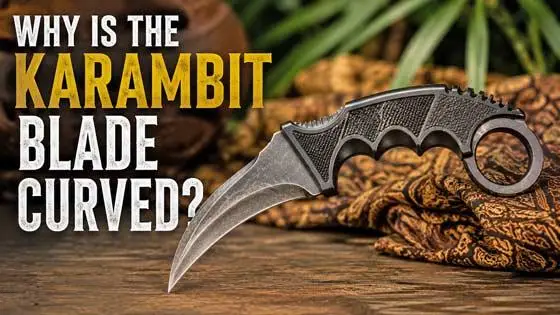
The karambit looks almost as if someone took an ordinary knife and deliberately bent the blade into a claw. That distinctive curve is so closely associated with the weapon that even a silhouette is usually enough to identify it. But the shape was not created simply to make the karambit look intimidating. Its hooked profile is connected to the tool traditions of Southeast Asia, and the geometry changes the way the blade interacts with whatever it contacts. Understanding why the karambit is curved means going back to the practical origins of the design and looking at what a hooked blade can do that a straight one cannot.
The Curve Came Before the Weapon
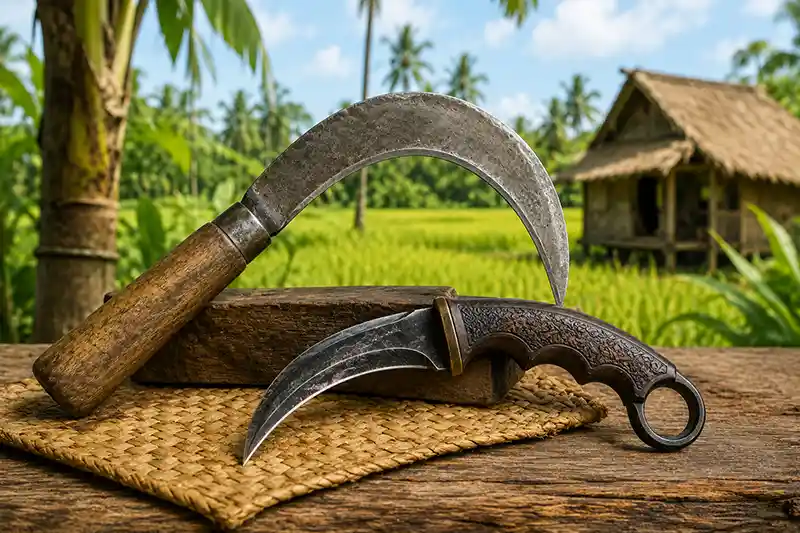
The karambit may be famous today as a martial arts weapon, but the basic idea behind its curved blade appears to have much more practical roots. Its ancestry is generally associated with Southeast Asian agricultural tools, particularly small hooked blades used for cutting plants, roots, and other fibrous material. Instead of pushing a straight edge across something, a curved blade could catch material and draw it toward the cutting edge as the tool moved.
That distinction helps explain why the karambit's shape feels so different from an ordinary knife. A straight blade tends to slide along the surface it contacts unless sufficient pressure and the proper angle are maintained. An inward-curving edge naturally encourages material to remain within the arc of the blade. Similar principles can be seen in sickles and other hooked cutting tools developed by agricultural cultures around the world.
Exactly how those tools evolved into the weapon now recognized as the karambit is harder to document neatly. The weapon is strongly associated with Indonesia and the broader Malay world, but simple stories about one particular farming implement suddenly becoming a fighting knife tend to make a complicated history sound more certain than the surviving evidence allows. We took a closer look at those origins in our article on the history of the karambit.
What matters for understanding the curve is that it was not an arbitrary flourish added to a conventional knife. Hooked blades already made practical sense. When that geometry became incorporated into fighting implements, the same basic curve acquired an entirely different set of possibilities.
A Curved Edge Wants to Pull Material Inward
The most important thing about the karambit's curve is not how dramatic it looks. It is what happens when the edge meets something. On a conventional straight blade, the cutting edge can travel across a surface and eventually slide away from it. The inward curve of a karambit creates a different relationship. As the blade moves, the material it contacts can be guided deeper into the concave portion of the edge rather than simply slipping toward the tip.
You can see the same basic geometric principle in other hooked cutting implements. A pruning hook catches a branch before cutting through it. A sickle gathers stalks into its curved edge during a pulling motion. The tools are different from a karambit, but their shapes demonstrate why an inward curve can be useful when the goal is to maintain contact while cutting.
This is also why describing the karambit as merely a strange-looking version of an ordinary knife misses what makes the design interesting. The curve fundamentally changes the blade's geometry. The cutting edge is wrapped around an arc, creating a pronounced hooked profile instead of placing most of the edge along a relatively straight line.
That geometry comes with tradeoffs. A curved blade is not automatically superior to a straight blade, and the same hook that helps maintain contact can make some ordinary cutting tasks less convenient. The karambit's shape is specialized rather than universally better. Its unusual reputation comes from what happens when that specialization is combined with an equally unusual handle.
The Curve Makes the Karambit Behave Like a Hook
There is another consequence of bending a blade inward: the tip no longer points in quite the same direction as the tip of a conventional knife. Instead, it curves back toward the user, giving the entire blade a claw-like profile. That makes the karambit capable of catching around objects in ways that a straighter blade generally cannot.
This hooking quality is one reason the shape is so recognizable. When something enters the open portion of the curve, the geometry can make it more difficult for that object to simply slide straight off the blade. The deeper the curve, the more pronounced this characteristic becomes. It is a very different design philosophy from a long straight edge intended primarily to slice across whatever passes in front of it.
There is an interesting compromise hidden in the design, however. Make the curve too shallow and much of the hooking effect disappears. Make it extremely deep and the blade becomes increasingly specialized and awkward for ordinary cutting. That helps explain why karambit knives can have noticeably different profiles while still sharing the same basic inward-curving geometry.
The result is a blade whose shape does more than determine where the sharpened edge sits. It influences how the entire knife engages with objects around it. And once the karambit's famous finger ring is added to the equation, the reason for its unusual overall shape becomes even more interesting.
The Finger Ring and the Curved Blade Work Together
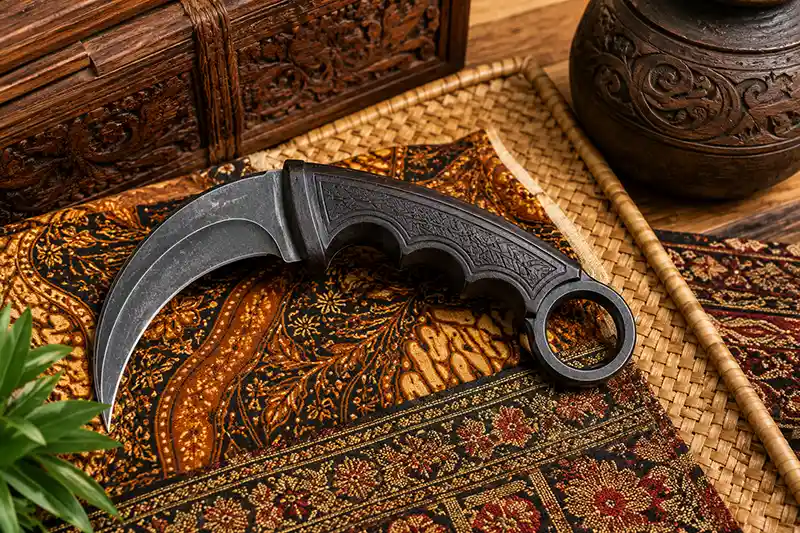
If the karambit consisted only of a hooked blade attached to an ordinary handle, it would still be unusual. The finger ring changes the design more fundamentally. Instead of treating the blade and handle as separate features, it makes more sense to look at the karambit as a complete system in which the curve, grip, and ring complement one another.
The ring provides an additional point of retention at the end of the handle. Depending on how a particular karambit is held, that can make the knife feel unusually anchored to the hand compared with a conventional handle. This becomes especially relevant because a strongly curved blade can encounter resistance differently from a straight blade. The ring helps explain how such specialized blade geometry could be paired with a compact handle without making the entire design feel unwieldy.
It also contributes to the karambit's unmistakable silhouette. Traditional examples varied considerably, and not every historical specimen resembles the aggressively sculpted modern versions seen today. But the combination of an inward-curving blade and a ringed handle became so strongly associated with the form that it now defines what most people picture when they hear the word karambit.
That relationship is important because it challenges the idea that the curve exists in isolation. The karambit developed as a collection of interconnected design choices. Change the blade to a straight edge or remove the distinctive handle geometry and you fundamentally change how the object looks, feels, and functions.
Why the Karambit Is Often Compared to an Animal Claw
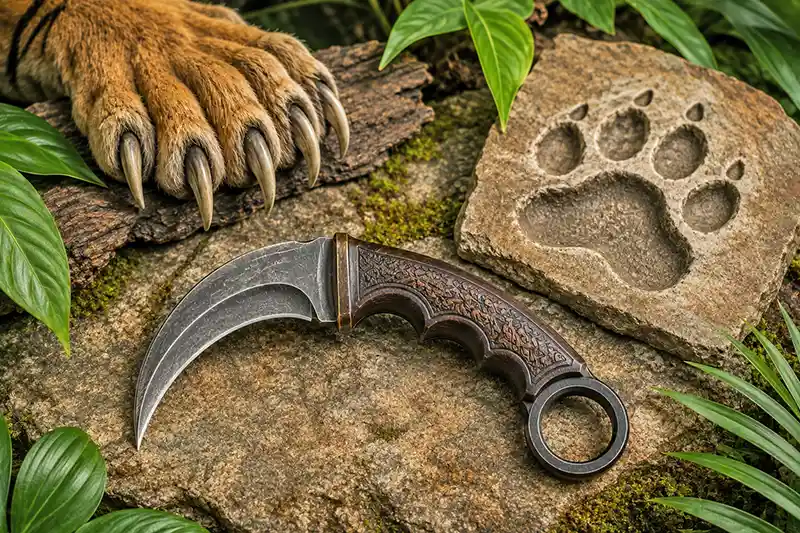
Spend enough time reading about karambits and one comparison appears again and again: the claw of a tiger. It is an appealing explanation because the resemblance is obvious. A karambit curves inward toward a sharp point much like the claw of a large cat, and some traditional accounts and modern retellings explicitly connect the weapon's shape with animal claws.
The problem comes when resemblance is turned into a tidy origin story. Claims that the karambit was deliberately designed to copy a tiger's claw are difficult to establish with certainty. The practical relationship between hooked blades and Southeast Asian agricultural tools provides another plausible influence, and the karambit's development occurred across cultures and periods that did not leave us a convenient blueprint explaining exactly why every feature took its final form.
That does not make the claw comparison meaningless. In fact, it helps explain something important about the finished geometry. A claw is curved because its function benefits from a shape that can catch and maintain contact rather than simply press against a surface. The karambit's inward-facing edge creates a superficially similar mechanical advantage. Whether that resemblance began as deliberate imitation, practical convergence, or some combination of influences is much harder to say.
This is a good example of why the karambit's history becomes more interesting when the legends are not automatically treated as facts. Its curve may remind us immediately of a tiger's claw, but the real story behind that curve is probably more complicated than a single moment of inspiration.
Not Every Karambit Has the Same Curve
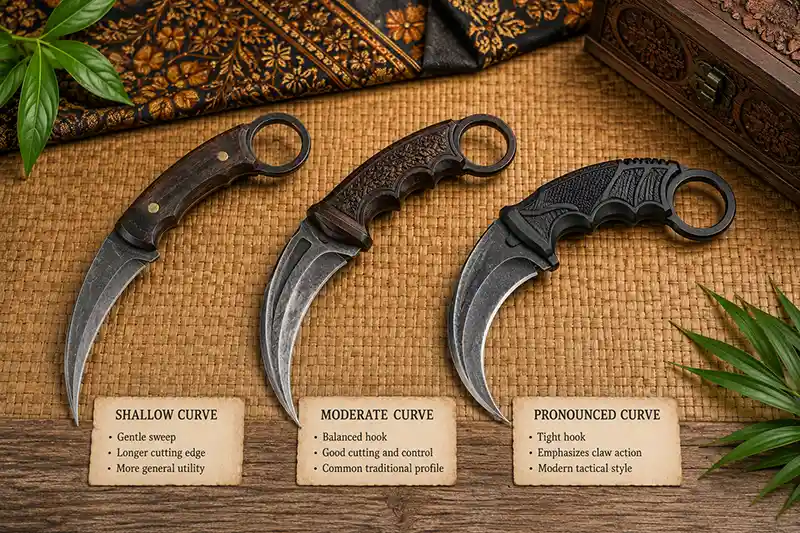
Once you start comparing karambits side by side, something becomes obvious: there is no single perfect curve that defines every example. Some blades sweep inward gradually, while others form a much tighter hook. Blade length, width, point position, handle angle, and the depth of the concave edge can all vary considerably.
Traditional karambits were especially diverse. They were produced across different regions, by different makers, and for different purposes rather than according to a universal specification. Some historical forms look surprisingly restrained compared with the dramatic hooked blades associated with modern tactical karambits. Even the finger ring, now one of the design's most recognizable features, was not identical across every regional or historical example.
Modern makers have pushed that variation even further. A contemporary Combat Claw Karambit, for example, can emphasize the claw-like silhouette much more aggressively than a simple traditional utility blade. Modern materials and manufacturing also allow designers to experiment with handle contours, blade thickness, serrations, coatings, and other features that would look distinctly out of place on an older handmade example.
That variety reveals something important about the original question. Asking why "the" karambit blade is curved makes the design sound more standardized than it really is. The inward curve is the recurring idea. Exactly how far that curve should go has never had just one answer.
The Curve Changes Where the Tip Points
One of the strangest consequences of the karambit's shape becomes obvious when you compare its point with that of a straight knife. On most conventional blades, the tip projects forward from the handle. On a strongly curved karambit, the tip can point noticeably inward, sometimes almost back toward the hand holding it.
That means the curve affects more than the cutting edge. It changes the orientation of the entire blade. A karambit's point follows the arc of the hook, so the relationship between the handle, edge, and tip is fundamentally different from that of a straight knife. Even a relatively short karambit can therefore have geometry that looks surprisingly complex when viewed from different angles.
This is also why two karambits of similar overall size can feel visually very different. Moving the tip only slightly inward or outward changes the apparent severity of the hook. A shallow curve retains more of the forward-pointing character of a conventional knife, while a deep curve produces the unmistakable claw profile most people associate with modern karambits.
There is no free advantage hidden in that geometry. Bringing the point inward makes the blade more specialized, and some tasks are naturally easier with a straighter, more forward-oriented tip. The karambit is interesting precisely because its designers accepted those compromises. Instead of trying to make a knife that performs every task reasonably well, the shape emphasizes a particular kind of hooked geometry so strongly that it became one of the most recognizable blade profiles in the world.
Why the Inside Edge Matters More Than the Outside Curve
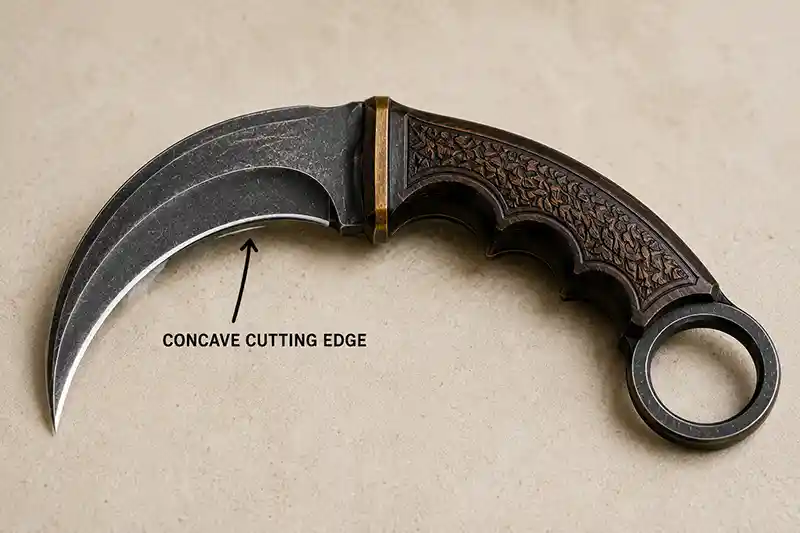
When people first see a karambit, their attention usually goes to the dramatic outer silhouette. But the more important part of the geometry is actually on the opposite side. The characteristic cutting edge normally follows the concave inside of the blade, turning the empty space beneath the hook into a functional part of the design.
That placement is what gives the curve its distinctive cutting behavior. As material moves along the inside edge, the blade's shape tends to guide it toward the deeper portion of the arc rather than immediately toward the tip. On a straight knife, there is no comparable pocket of curvature for material to move into.
This also explains why simply giving an ordinary knife a curved spine would not create the same effect. A blade can look dramatically curved while retaining a relatively conventional cutting edge. With a karambit, the concave edge itself is central to the design. The sharpened portion follows the hook.
It is a subtle distinction, but it gets to the heart of why the karambit looks the way it does. The outer curve creates the famous claw-like silhouette. The inner curve is where much of the geometry's practical significance actually comes from.
Why a Curved Blade Can Feel Longer Than It Looks
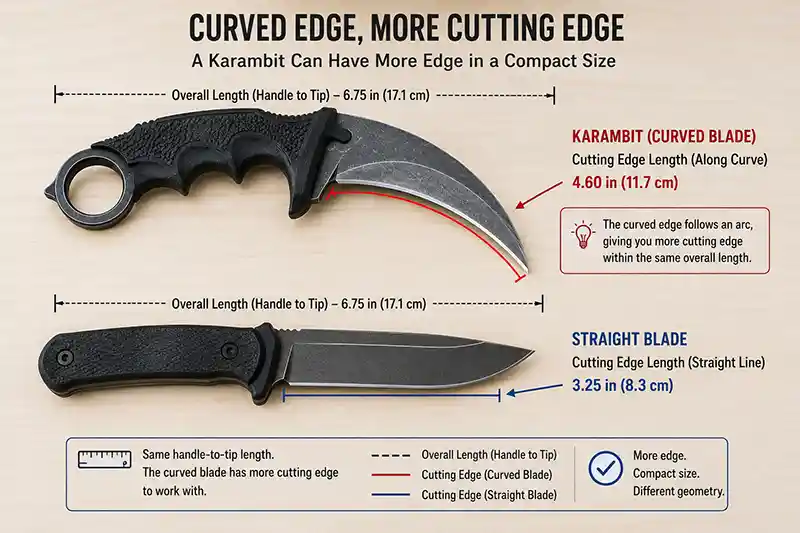
A karambit can be surprisingly compact when measured from handle to tip, yet the cutting edge does not necessarily feel as short as that measurement suggests. The reason is simple geometry. Instead of traveling directly from one end of the blade to the other, the edge follows an arc.
Imagine drawing two points on a piece of paper. The shortest path between them is a straight line. Bend that line into a curve and its total length increases even though the two endpoints may remain relatively close together. A karambit applies a similar principle to its cutting edge. The deeper the arc becomes, the more edge can potentially be contained within a compact overall footprint.
This does not mean that curving a blade somehow creates free reach. The physical distance from the user's hand to the tip remains limited by the dimensions of the knife. What changes is how much sharpened edge can exist between the base of the blade and its point, along with the direction that edge faces along different portions of the curve.
That distinction helps explain one of the karambit's most counterintuitive characteristics. It is a small knife built around geometry rather than simple length. A longer straight blade gains much of its capability by extending farther from the handle. The karambit takes a different approach, folding its cutting edge into an arc and creating an unusually compact silhouette in the process.
Why Karambits Are Usually Sharpened on the Inside of the Curve
Once the blade is curved inward, placing the primary cutting edge along that concave side becomes a logical extension of the design. Instead of asking the outer edge of the blade to push material away from the curve, the inner edge takes advantage of the hook and allows the geometry to guide material along the sharpened arc.
This is one reason the orientation of a karambit can initially look strange to someone accustomed to conventional knives. The most visually prominent part of the blade is often its sweeping outer spine, yet the working edge is tucked underneath it. The knife effectively places its cutting surface inside the hook rather than along the outside of the crescent.
Not every modern karambit follows exactly the same sharpening pattern. Some designs incorporate additional sharpened portions or double-edged configurations, while others retain a more traditional single concave cutting edge. Those variations can change the character of the knife considerably, but they do not change the basic reason the inward-facing edge became so strongly associated with the karambit.
In other words, the curve and the edge placement are not two unrelated features. They reinforce one another. The blade curves inward so that it can create a hooked geometry, and sharpening the inside of that hook allows the edge to take advantage of the very shape that makes the karambit distinctive.
The Karambit Is a Specialized Design, Not an Improved Straight Knife
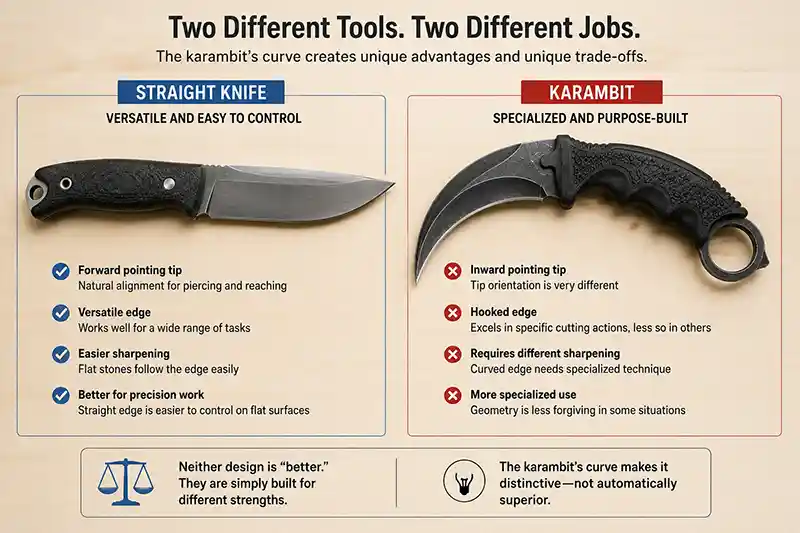
With so many unusual characteristics packed into one small blade, it is tempting to treat the karambit's curve as some kind of upgrade over conventional knife geometry. That is the wrong way to think about it. Straight and curved blades solve different problems, and the features that make a karambit distinctive also create limitations.
A straight or gently curved blade is remarkably versatile. Its edge is easy to position against flat surfaces, its point projects naturally forward, and sharpening it is generally straightforward. A deeply concave karambit edge sacrifices some of that simplicity in exchange for its hooked geometry. Even maintaining the edge can require different sharpening techniques because an ordinary flat sharpening stone cannot follow a tight inward curve as naturally.
The shape also becomes increasingly specialized as the hook grows more dramatic. That is one reason modern karambits range from relatively subtle curves to blades that look almost semicircular. There is no geometric point at which "more curve" automatically means "better karambit." Every additional degree of curvature changes the balance between compactness, edge geometry, tip orientation, and general usefulness.
That may be the most revealing thing about the karambit's design. Its makers did not stumble upon a universally superior knife shape that somehow escaped the rest of the world. They developed and refined a distinctive family of hooked blades whose strengths were closely connected to their unusual form. The curve is interesting precisely because it makes the karambit different, not because it makes every other blade obsolete.
Modern Karambits Often Exaggerate the Original Idea
Put a modest traditional karambit beside some modern versions and they can look like distant relatives. Contemporary designs often feature deeper hooks, wider blades, aggressively sculpted handles, dramatic points, and oversized finger rings. The basic karambit geometry remains recognizable, but designers have pushed nearly every feature farther than it needed to go on a simple working blade.
Part of that evolution comes from the karambit's transformation from a regional tool and weapon into an internationally recognizable knife style. Modern manufacturing gives designers tremendous freedom over blade profiles, while buyers often expect a karambit to have the unmistakable claw-like appearance that separates it visually from other knives. A subtle curve can be historically plausible, yet a dramatic hook immediately announces what the knife is.
This can distort the way people imagine the past. Someone familiar only with modern tactical karambits might assume that historical examples were equally aggressive in appearance. In reality, the karambit represents a broad family of forms that changed across place and time. The modern image is only one chapter in a much longer story.
Ironically, exaggerating the curve also makes the original design principle easier to see. Strip away the coatings, modern handle materials, and aggressive styling and the same idea remains underneath: a compact blade built around an inward-facing arc. The karambit has changed enormously, but the curve survived because without it, the knife would cease to be recognizably karambit-like.
The Curve Also Explains Why Karambits Are Difficult to Sharpen
The same concave edge that gives the karambit its distinctive geometry creates a practical maintenance problem. Most ordinary sharpening stones have flat surfaces. Press a deeply curved karambit edge against one and much of the cutting edge cannot make proper contact with the stone.
That is why curved blades are often maintained with sharpening tools that can fit inside the arc, such as narrow rods or other rounded sharpening surfaces. The tighter the curve becomes, the more important the shape of the sharpening tool can be. Maintaining a consistent angle along an edge that continuously changes direction also requires more care than running a relatively straight blade across a flat stone.
This is another example of the karambit's design refusing to provide something for nothing. The curve creates the compact hooked profile that defines the blade, but the owner inherits the inconveniences of that geometry as well. A dramatic curve may look impressive, yet it can make routine edge maintenance noticeably less straightforward.
In a way, sharpening reveals just how fundamental the curve really is. It is not decoration sitting on top of an otherwise conventional knife. The geometry affects nearly everything about the blade, right down to the tools needed to maintain its edge.
Why the Curve Survived for Centuries
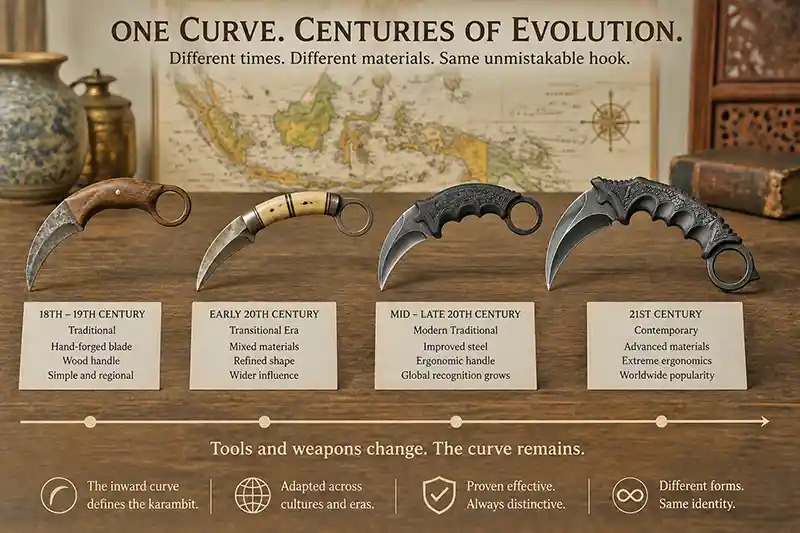
Weapon and tool designs do not remain recognizable for generations simply because they look unusual. Features tend to survive when they continue to serve the basic idea behind the object, and the karambit's inward curve proved remarkably persistent. Materials changed, handles changed, manufacturing changed, and eventually the karambit traveled far beyond the cultures in which it developed. The hooked blade remained.
That persistence becomes especially interesting when you look at how radically modern karambits can differ from older examples. A traditional handmade blade and a contemporary production karambit may share relatively few details, yet place them beside each other and the family resemblance is immediately apparent. The curve is the visual thread connecting them.
It also survived because the geometry gives the karambit an identity that is difficult to reproduce with a straight blade. Remove the ring from some examples and the knife may still be recognizable from its profile alone. Straighten the blade, however, and much of what makes the design distinctive disappears with it.
That longevity is part of what makes the karambit such an interesting case in weapon design. Its shape was never frozen in time. It was repeatedly adapted while preserving the one feature at the center of the concept. The karambit became famous around the world in forms its early makers could never have imagined, yet the blade still bends inward toward the same unmistakable hook.
So Why Is the Karambit Blade Curved?
The simplest answer is that the curve is the feature around which almost everything else about the karambit makes sense. Its likely connections to hooked agricultural blades help explain where the basic geometry may have come from, while the shape itself explains why the design endured after the karambit became associated with martial use.
An inward curve creates a concave cutting edge that tends to draw material into the arc rather than encouraging it to slide toward the tip. It also allows a relatively compact blade to carry its edge along a longer curved path, changes the orientation of the point, and gives the knife its characteristic hooking geometry. Combine that with the karambit's distinctive handle and finger ring and you get something fundamentally different from simply shortening or reshaping a conventional straight knife.
But there probably was never a single designer who sat down and calculated all of these advantages before inventing the karambit. Like many old tools and weapons, its form was shaped by generations of use, regional variation, craftsmanship, and adaptation. Some popular explanations, particularly the idea that the blade was specifically modeled after a tiger's claw, are much easier to repeat than they are to prove.
That uncertainty actually makes the karambit more interesting. The curve may be the most obvious thing about the knife, but it represents centuries of design evolution rather than a decorative flourish. Modern karambits can exaggerate it, reinterpret it, and surround it with materials their early makers never knew existed. Straighten that blade, however, and the defining idea behind the karambit largely disappears.
Are Karambits Always Curved?
Yes, some degree of inward blade curvature is one of the defining characteristics of a karambit. The amount of curvature can vary dramatically, however. Some traditional examples have relatively gentle arcs, while modern designs can form extremely pronounced hooks.
There is no universal angle or radius that a blade must have to qualify as a karambit. Historically, these knives developed in different regions and were made by individual craftspeople rather than according to a standardized blueprint. As a result, surviving designs show considerable variation in blade length, curvature, handle shape, and finger-ring construction.
At some point, though, straightening the blade changes the character of the design enough that calling it a karambit becomes questionable. The inward curve is not merely a stylistic detail. It is one of the features that distinguishes the karambit from other compact knives.
Is a Karambit More Effective Because the Blade Is Curved?
Not necessarily. The curved blade gives the karambit characteristics that a straight blade does not have, but that should not be confused with being universally more effective. Blade geometry always involves tradeoffs, and the karambit is an unusually specialized example.
Its concave edge can maintain contact differently than a straight edge, and the hook strongly influences how the blade interacts with material. At the same time, the inward curve makes some ordinary knife tasks less convenient, changes the orientation of the tip, and can make sharpening more complicated.
A better way to think about the karambit is that its curve makes it different rather than automatically better. Straight blades became enormously widespread for good reasons. The karambit survived alongside them because its unusual geometry offered its own distinct set of characteristics, not because the curved blade solved every problem better than a straight one.
Why Does a Karambit Curve Inward Instead of Outward?
The direction of the curve is what creates the karambit's characteristic hook. By placing the cutting edge along the concave side of the blade, the geometry can guide material farther into the arc as the edge moves across it. Reverse that curve and the interaction changes considerably.
An outward-curving edge is not inherently ineffective. Many successful blade designs use convex or belly-shaped edges because that geometry works well for slicing and other general cutting tasks. What it does not create is the same enclosed, hook-like area formed by the karambit's inward curve.
This distinction is why calling any strongly curved knife a karambit can be misleading. The direction of the curve matters. The inward-facing edge, hooked point, and compact profile work together to produce the geometry that has defined karambit-style blades for generations.
Are Traditional Karambits Less Curved Than Modern Karambits?
Some are, but it would be misleading to treat this as a universal rule. Traditional karambits existed in numerous regional forms, and their blade profiles could range from relatively restrained curves to much more pronounced hooks. There was never one standardized historical karambit against which every modern version can be measured.
What has changed is the freedom modern knife designers have to exaggerate the shape. Contemporary manufacturing makes it possible to produce highly sculpted blades consistently, and the karambit's international popularity has made its claw-like appearance part of its identity. A dramatic curve is instantly recognizable, which gives modern designers an additional reason to emphasize it.
As a result, some contemporary karambits look considerably more aggressive than surviving traditional forms. That does not mean the deep curve is a modern invention. It means today's karambits represent another stage in a design tradition that has always contained considerable variation.
Does a Deeper Curve Make a Karambit Better?
No. A deeper curve exaggerates the characteristics that make a karambit unusual, but there is a point where specialization becomes a limitation. Increasing the curvature changes the orientation of the tip, tightens the concave cutting edge, and creates a more pronounced hook. Those changes are not automatically improvements.
A moderately curved blade can preserve some of the versatility associated with more conventional knife geometry while still retaining the defining characteristics of a karambit. An extremely deep hook pushes the design farther toward one particular geometric concept, potentially making ordinary cutting and sharpening less convenient in the process.
This is why historical and modern karambits can have dramatically different curves without one necessarily being the "correct" version. Blade makers have been balancing curvature against practicality for generations. The ideal amount of curve depends on what the designer wants the knife to accomplish.
Sometimes the most dramatic karambit is simply the most dramatic karambit, not the most functional one.
Is the Karambit Curve Based on a Tigers Claw?
The resemblance is obvious enough that the explanation has become one of the most frequently repeated stories about the karambit. Both shapes curve inward toward a sharp point, and the word karambit is often discussed alongside Indonesian and Malay terms associated with claws. This has helped make the tiger-claw origin story especially appealing.
What is much harder to establish is whether historical makers deliberately copied the anatomy of a tiger when developing the blade. The karambit also belongs to a broader tradition of hooked cutting tools whose curves have straightforward practical advantages. Agricultural blades such as sickles provide an equally important piece of the story.
It is therefore safer to treat the tiger connection as part of the karambit's traditional imagery and popular history rather than as a conclusively documented moment of invention. The blade certainly resembles a claw, and that resemblance may have influenced how people understood and developed the weapon. Proving that a tiger's claw was the original blueprint is another matter.
Why Do Some Karambits Have Such Small Blades?
The karambit is a good reminder that blade length and cutting-edge length are not exactly the same thing. Because its edge follows an inward arc, a relatively compact blade can contain more sharpened edge than its straight-line dimensions might suggest. That allows some karambits to remain surprisingly small without abandoning the curved geometry that defines the design.
Its traditional origins also help explain why enormous size was never essential to the concept. The karambit developed from a family of compact hooked implements rather than from large swords or long fighting knives. Portability and control were part of the design long before modern manufacturers began producing extremely compact karambits.
Modern versions can take this idea even further, sometimes reducing the blade to a remarkably small hook while retaining the finger ring and unmistakable inward curve. At that point, however, the balance of the design changes considerably. Just as a deeper curve is not automatically better, making a karambit smaller does not automatically make it more effective.
The surprising thing is how little blade is required before the silhouette becomes recognizable. Give a compact knife the right inward curve and ringed handle, and it can still look unmistakably like a karambit.
Why Do Karambits Usually Have a Finger Ring?
The finger ring is almost as recognizable as the curved blade itself, and the two features make more sense when considered together. A hooked blade can encounter resistance differently from a straighter edge, so a handle that provides an additional point of retention complements the specialized geometry of the knife.
The ring also allows the handle to remain relatively compact while giving the user a secure connection to it. Traditional karambits varied considerably in their handle and ring designs, so the large, aggressively sculpted rings found on some modern versions should not be assumed to represent every historical example.
Interestingly, the ring is not what creates the karambit's characteristic cutting geometry. That comes from the blade. But combining the ring with an inward-curving edge produced such a distinctive overall form that the two features eventually became inseparable in the popular image of the karambit.
This is why removing either feature changes the knife so dramatically. Straighten the blade and it loses its characteristic hook. Remove the ring and it may still function as a curved knife, but much of the silhouette people immediately recognize as a karambit disappears.
Are Karambits Difficult to Sharpen Because of the Curve?
They can be. The concave edge that makes a karambit so distinctive also prevents much of the blade from sitting naturally against a conventional flat sharpening stone. The tighter the curve, the more noticeable this problem becomes.
For that reason, curved sharpening rods and other narrow or rounded sharpening tools are better suited to following a karambit's inward arc. The challenge is not simply reaching the edge. The sharpening angle also needs to remain reasonably consistent while the edge continuously changes direction along the curve.
This does not mean karambits are inherently impractical to maintain. It simply means the sharpening method needs to match the blade geometry. The same specialized shape that gives the karambit its unusual characteristics also requires specialized attention when the edge eventually becomes dull.
What Is the Difference Between a Karambit and a Hawkbill Knife?
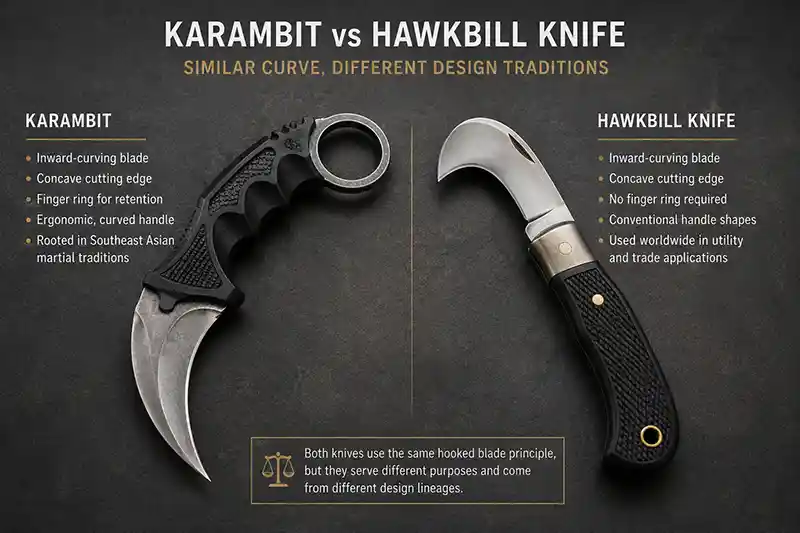
At first glance, a karambit and a hawkbill knife can look surprisingly similar. Both use an inward-curving blade with a concave cutting edge, and both take advantage of the way a hooked profile can maintain contact with material. Look beyond the blade, however, and the two designs come from different traditions.
The hawkbill is primarily a blade shape. Versions of it have appeared on utility knives designed for tasks involving rope, carpet, vegetation, and other materials where a hooked cutting edge can be useful. The handle itself can be fairly conventional, and a knife does not need a finger ring or karambit-style grip to qualify as a hawkbill.
The karambit is a broader historical design tradition. Its curved blade is combined with characteristic handle geometry and, in many examples, the distinctive finger ring. It is also closely associated with Southeast Asia and martial traditions in a way that the general hawkbill blade shape is not.
So while the two designs demonstrate similar principles of curved-blade geometry, a hawkbill is not simply another name for a karambit. They are better understood as separate knife forms that arrived at comparable hooked edges for different purposes and within different traditions.
Are Karambits Only Used as Weapons?
No. Although the karambit is now strongly associated with martial arts and modern tactical knives, reducing its entire history to fighting ignores the practical context from which the design emerged. Hooked blades have long been useful for agricultural and everyday cutting tasks, particularly when something needs to be caught by the edge rather than simply sliced across.
This practical ancestry is important because it helps make sense of the curve without relying on dramatic explanations. A hooked blade is useful even before anyone considers its potential as a weapon. Southeast Asian cultures already had good reasons to produce compact curved cutting tools, and forms of the karambit eventually became associated with martial traditions as well.
Modern karambits have moved even farther from any single purpose. Some are designed primarily as utility knives, some emphasize martial arts heritage, and others are created largely around the distinctive appearance that has made the karambit internationally recognizable.
The karambit's story is therefore not simply one of weapon development. It is an example of how practical tools, regional traditions, and martial applications can overlap until separating one neat origin from another becomes surprisingly difficult.
Do Karambits Have to Have a Finger Ring?
Not necessarily. The finger ring is one of the features most strongly associated with the karambit today, but historical examples were not produced according to a single standardized design. Handle construction varied across regions and makers, just as blade curvature and overall size did.
The blade is arguably the more fundamental feature. An inward-curving, claw-like edge establishes the basic geometry that separates the karambit from most conventional knives. The ring complements that geometry by providing additional retention, but it is not responsible for creating the distinctive hooked cutting edge.
Modern knife design has made the distinction even less clear. Some contemporary knives borrow the karambit's ring while using relatively conventional blades, while others use strongly karambit-inspired curved blades with modified handle designs. This has created a spectrum of knives that incorporate individual elements of the traditional form without reproducing every feature.
So the finger ring is best viewed as a characteristic feature rather than the sole requirement. If you are trying to identify what makes a karambit a karambit, the distinctive inward-curving blade remains at the center of the answer.
Why Is a Karambit Shaped Differently From Most Knives?
Most knives are designed around relatively straight or gently curved edges with points that project forward from the handle. That geometry works well for an enormous range of everyday cutting tasks, which helps explain why variations of it appear across so many cultures and periods.
The karambit follows a different design philosophy. Its edge bends inward, its point follows the hook, and many examples combine that geometry with a compact handle and finger ring. Rather than behaving like a conventional knife with an unusual decoration added to it, the entire design is organized around the curve.
That is why the karambit remains so visually distinctive. Plenty of knives have curved blades, but relatively few commit so completely to an inward-facing hook. Its unusual appearance is a consequence of its specialized geometry rather than simply an attempt to make the knife look exotic.
Is a Karambit Blade Inspired by a Sickle?
There are obvious similarities between karambits and sickles. Both can feature inward-curving cutting edges that catch material within an arc, and the karambit's history is commonly connected with agricultural cutting tools from Southeast Asia.
What should be treated cautiously is the claim that the karambit descended from one specific type of sickle through a simple, documented progression. Historical weapon development is rarely that tidy. Regional hooked tools existed in different forms, and the precise path by which practical cutting implements influenced what we now call the karambit is difficult to reconstruct with certainty.
It is reasonable to see agricultural blade geometry as an important part of the karambit's background. It is much harder to point to a particular sickle and confidently call it the single ancestor of every karambit.
Why Are Some Karambits Double Edged?
Some modern karambits add a sharpened portion to the outside of the curve, creating a partially or fully double-edged blade. This changes the geometry considerably because the outer arc, which would otherwise function primarily as the spine, becomes an additional cutting edge.
A double edge is not required for a knife to be a karambit. The defining geometry is much more closely associated with the inward curve and its concave edge. Modern designers have experimented extensively with the basic form, producing everything from restrained single-edged blades to highly stylized double-edged versions.
This is another reason modern karambits should not automatically be treated as exact representations of historical ones. Contemporary knife makers frequently reinterpret traditional forms according to modern materials, aesthetics, and intended uses.
What Is a Reverse Karambit?
The term "reverse karambit" can be confusing because it is not always used consistently. In modern knife terminology, it may describe a karambit-inspired design in which familiar elements of the blade geometry, edge orientation, or overall configuration have been rearranged or reversed.
It should not be confused with simply holding an ordinary karambit in a different grip. Karambits themselves can be discussed in connection with different grip orientations, while a knife marketed as a reverse karambit may actually have physical design differences.
Because manufacturers sometimes use the term differently, the blade itself is more informative than the name. Looking at which direction the edge faces, where the point sits, and how the blade relates to the finger ring usually tells you far more than the word "reverse" by itself.
Where Did the Karambit Originally Come From?
The karambit is most strongly associated with Indonesia and the wider cultures of maritime Southeast Asia. Sumatra is frequently mentioned in accounts of its early development, while related forms and traditions spread through areas including Java, the Malay Peninsula, and the Philippines.
Pinning down one exact birthplace and date is much more difficult. The karambit developed in a region with long traditions of agriculture, trade, metalworking, and martial culture, and historical examples varied rather than conforming to one standardized design.
That makes the karambit better understood as an evolving regional blade tradition than as an invention that appeared in one workshop at a known moment. Its modern worldwide popularity came much later, but the distinctive inward curve preserves a connection to its Southeast Asian roots.
You May Also Be Interested In:
- What Is a Karambit? A Complete Guide to This Curved Knife
- Why Is the Kukri Curved Forward?
- Top 5 Affordable Karambit Knives
- Automatic Switchblade vs Deadly Karambit Knife - Tested and Reviewed!
- The History of the Karambit: From Indonesian Farm Tool to Modern Tactical Icon
- Steampunk Gun Blade and Other Unusual Weapons
- Hidden Blade Knuckles and Other Dangerous Weapons!
- EDC Knives for Beginners: How to Choose Your First Everyday Carry Blade
- Bushcraft vs Survival Knives: Which Blade Would You Trust in the Wild?
- Hidden Blade Walking Stick and Other Dangerous Weapons
Leave a Reply