


A Beginner's Guide to Traditional Martial Arts Weapons
January 14th, 2026
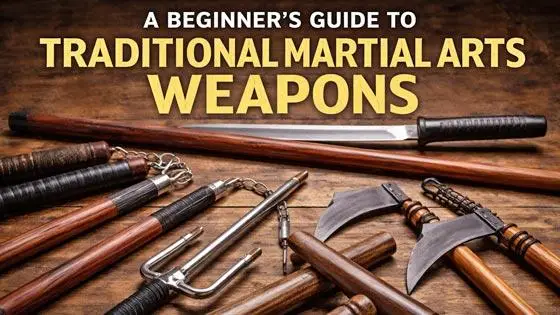
Walk into almost any dojo and you will eventually see more than just punches and kicks. Wooden staffs line the walls. Nunchaku hang from hooks. A pair of metal sai rests on a rack beside training swords and curved blades. These tools are not props or decorations. They are an extension of martial arts history, discipline, and movement. For beginners, traditional weapons can feel mysterious or even intimidating, but they are simply another way to learn balance, timing, coordination, and respect for the art. Whether you train in karate, kobudo, kung fu, or a related style, understanding these classic weapons gives you a deeper connection to where martial arts came from and how it is practiced today. This guide breaks down the most common traditional weapons, what they are used for, and why each one still matters in modern training.
The Bo Staff: Foundation of Weapon Training
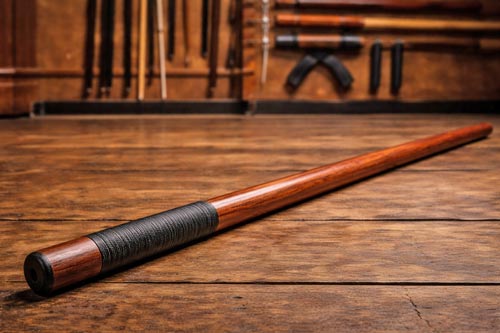
For most students, the bo staff is the first traditional weapon they encounter. It looks simple, just a long wooden pole, but it teaches fundamentals that carry over into everything else you will ever train with. A bo staff forces you to understand distance, leverage, and body alignment in a way empty-hand techniques never quite replicate. Every strike, block, and spin comes from your hips and shoulders, not just your arms. That makes it one of the best tools for learning how power is actually generated in martial arts.
Historically, the bo comes from Okinawan kobudo, where everyday tools were adapted for self-defense. Farmers and villagers did not have swords, but they had poles, oars, and walking staffs. Over time, those practical objects became refined into formal weapons with structured kata and techniques. Today, the bo is still central in karate and kobudo schools because it teaches movement patterns that mirror empty-hand forms. When you learn a bo kata, you are not just learning how to swing a stick. You are training footwork, posture, timing, and awareness.
For beginners, the bo is approachable. There are no blades, no chains, and no complicated mechanics. You can focus on grip, stance, and control without worrying about hurting yourself. Most schools start students with a wooden staff because it is forgiving and durable. You can practice strikes against the air, work through forms, or train basic partner drills without fear of damaging the weapon or the floor. This is why bo staffs remain one of the most common training tools in dojos around the world.
If you are just getting started, a standard wooden staff is the way to go. It gives you the right balance and weight to learn proper technique without being unwieldy. As you progress, you may experiment with different diameters, lengths, or materials, but the fundamentals stay the same. The bo teaches you how to move with a weapon as an extension of your body. That lesson carries into every other traditional weapon you will ever pick up.
From there, many students move on to shorter and more complex tools. The transition feels natural because the bo has already taught you how to manage reach, angle, and momentum. Whether your path leads you to paired weapons, bladed tools, or flexible weapons, the staff lays the foundation. It is simple, honest, and endlessly effective as a teacher, which is why it has survived for centuries and still earns its place in modern martial arts training. If you are ready to begin, explore our full range of bo staffs to find a size and style that fits your training goals.
Nunchaku: Control, Rhythm, and Precision
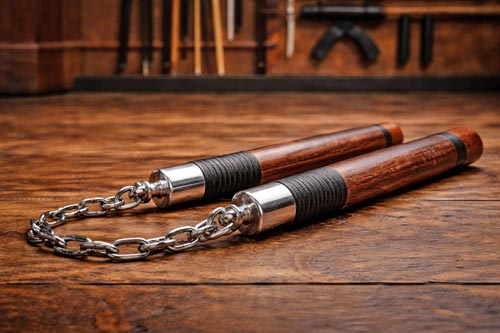
Few weapons are as instantly recognizable as the nunchaku. Popular culture made them famous, but in the dojo they serve a very practical purpose. Nunchaku teach control in motion. Unlike rigid weapons, they move independently once you set them in motion, which forces you to stay aware of momentum, spacing, and timing at all times. Every swing becomes a lesson in cause and effect. If your grip is off or your angle is wrong, the weapon tells you immediately.
Historically, nunchaku evolved from simple agricultural tools, much like many Okinawan weapons. What began as a flail for threshing grain became a highly refined training instrument. In martial arts, the goal is not flashy spinning. The real value comes from learning how to stop, redirect, and recover the weapon cleanly. This teaches wrist strength, hand coordination, and rhythm in a way few other tools can match. You learn to think ahead, anticipating where the weapon will be after each strike or block.
For beginners, nunchaku can feel intimidating. Everyone remembers the first accidental knuckle hit. That learning curve is part of the process. Most schools start students with corded nunchaku made from lightweight wood or foam so mistakes are forgiving. The goal is not speed, but control. Basic patterns build confidence and muscle memory before advancing to faster combinations or partner drills. Over time, what once felt chaotic becomes smooth and deliberate.
Training with nunchaku improves empty-hand skills as well. The constant switching between hands sharpens ambidexterity. The circular motion reinforces fluid transitions between techniques. Even students who never specialize in nunchaku benefit from the coordination and spatial awareness they develop. That is why nunchaku remain a staple in many karate and kobudo programs.
If you are ready to explore this weapon, starting with a well-balanced practice set makes a huge difference. The right length, weight, and connector style affect how easily you can control the swing. As your comfort grows, you may experiment with different materials and designs, but the foundation always begins with a simple training pair. You can find a full range of beginner-friendly options in our nunchaku selection, designed specifically for safe, effective practice in the dojo or at home.
Sai: Structure, Defense, and Control
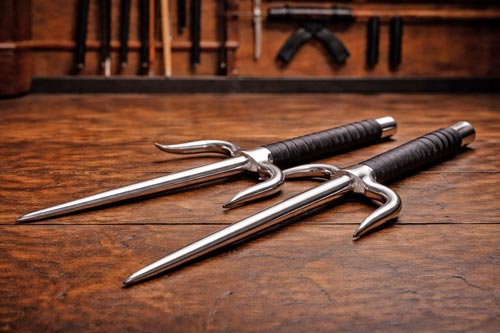
At first glance, the sai looks like a dagger with two curved prongs, but it is not a blade in the traditional sense. The sai is primarily a defensive weapon. Its shape is designed for blocking, trapping, and controlling an opponent's weapon. In training, it teaches precision and structure. Every movement is deliberate. You are not swinging wildly. You are learning how to intercept, redirect, and stabilize force.
The sai originated in Okinawa and was often carried by law enforcement or officials rather than warriors. It was a tool for subduing and controlling, not cutting. That heritage is reflected in how it is taught today. Most techniques focus on firm grips, strong wrist alignment, and tight movements that keep the weapon close to the body. When used in pairs, sai training emphasizes symmetry and coordination between both hands. It forces you to think in terms of angles and leverage rather than raw power.
For beginners, the sai introduces the concept of paired weapons in a controlled way. Unlike flexible tools, they respond exactly to your input. That makes them ideal for learning how to move two weapons in harmony without fighting their own momentum. Students quickly discover that proper grip and stance matter more than speed. A small error in alignment becomes obvious when a block feels weak or a strike lands off target.
Sai training also improves empty-hand technique. The motions mirror many traditional blocks and strikes, reinforcing proper arm paths and posture. Over time, students develop a stronger sense of structure through the shoulders and forearms. Even practitioners who do not specialize in kobudo benefit from the body mechanics that sai demand. They teach you how to be solid without becoming stiff.
When choosing your first set, weight and balance matter more than appearance. A well-made practice pair should feel stable in your hands and allow smooth transitions between grips. Most schools recommend unsharpened steel or aluminum sai for training. These provide realistic feedback without unnecessary risk. You can explore a range of beginner-friendly options in our sai selection, all suited for structured dojo practice and long-term training.
Tonfa: Power Through Structure and Rotation
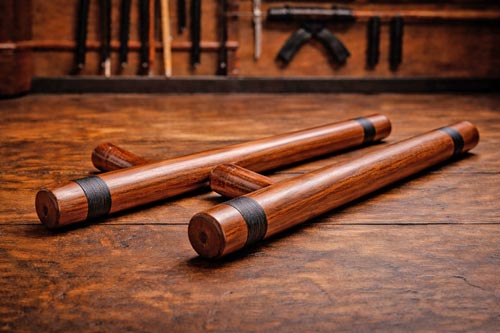
The tonfa is one of the most misunderstood traditional weapons. To someone seeing it for the first time, it can look awkward or even impractical. In reality, it is one of the most versatile tools in martial arts. The tonfa excels at turning natural arm movement into powerful strikes, blocks, and locks. Its design allows it to rotate around the forearm, transforming simple motions into fluid, high-impact techniques.
Historically, the tonfa traces back to Okinawan farming tools used for grinding grain. Like many traditional weapons, it was adapted out of necessity. Over time, it evolved into a refined training instrument. In modern martial arts, the tonfa teaches how to align the wrist, forearm, and shoulder into a single structural unit. When held correctly, it reinforces proper punching mechanics and defensive positioning at the same time.
For beginners, the tonfa is often the first weapon that feels like an extension of the arm rather than something separate. The side handle allows the weapon to rest along the forearm for blocks, then rotate outward for strikes. This dual nature makes it ideal for learning how offense and defense flow together. Students quickly realize that power does not come from muscling the weapon, but from smooth rotation and body alignment.
Tonfa training builds strong wrists, forearms, and shoulders while reinforcing compact, efficient movement. Many techniques mirror empty-hand blocks and punches, which makes the transition between armed and unarmed practice feel seamless. Even students who never specialize in tonfa benefit from the way it teaches structural integrity through the upper body. It encourages you to stay tight, balanced, and grounded.
When choosing a first pair, simplicity is best. Traditional wooden tonfa offer the right balance of weight and control for training. They are durable, forgiving, and ideal for learning rotation and grip transitions. As your skill grows, you may explore different shapes or materials, but the fundamentals remain the same. You can browse a full range of practice-ready options in our tonfa selection, all suited for structured dojo training and long-term use.
Kama: Edge Awareness and Flow
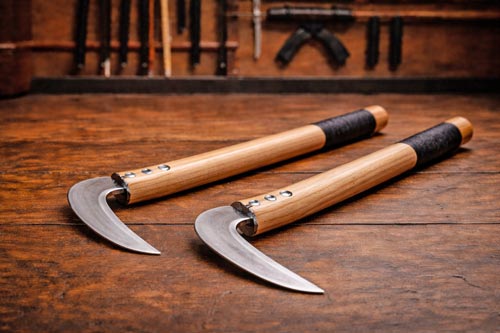
The kama stands apart from many other traditional weapons because it introduces the concept of a blade. Even in training form, its curved shape changes how you move. The kama teaches respect for edges and angles. Every motion carries intent. You cannot be sloppy or distracted when working with a bladed tool, even a wooden or unsharpened one. It sharpens focus in a very real way.
Originally adapted from farming sickles, the kama reflects the same practical roots shared by many Okinawan weapons. What once cut crops became a refined instrument of martial training. In the dojo, the kama is rarely about wild slashing. Techniques emphasize tight arcs, controlled hooks, and precise positioning. The weapon teaches how to manage distance in close quarters and how to use minimal motion for maximum effect.
For beginners, the kama introduces edge awareness without overwhelming complexity. Most students start with wooden or blunt practice kama so they can learn form and flow safely. The goal is not speed. It is understanding how the curve of the blade affects movement. Even simple drills reveal how small changes in wrist angle alter the path of the weapon. This builds a deep sense of spatial control that carries over into other weapons and empty-hand work.
Training with kama improves hand coordination and teaches you how to transition smoothly between offense and defense. Many techniques involve trapping, redirecting, and flowing into follow-up movements. This reinforces the idea that martial arts is not about isolated strikes, but continuous motion. Students often find that kama work improves their overall fluidity, even in non-weapon training.
When choosing a first pair, practice models are always the right starting point. Wooden or dull metal kama provide the correct weight and balance without unnecessary risk. They allow you to focus on form, grip, and body mechanics. As your confidence grows, you can explore more traditional materials, but the foundation is built with simple training tools. You can view a range of dojo-ready options in our kama selection, all suited for structured practice and long-term training.
Wooden Swords: Precision Without Risk
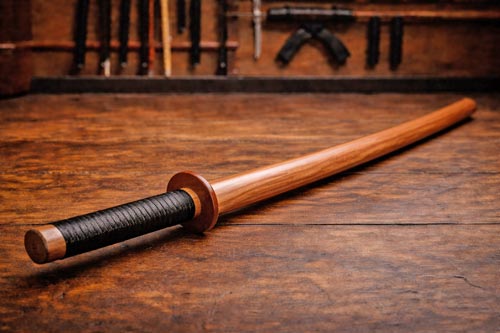
Wooden swords bridge the gap between traditional bladed weapons and safe, everyday training. Whether used in karate, kendo, aikido, or kung fu, they allow students to practice real sword movement without the danger of steel. A wooden sword teaches respect for line, distance, and timing. Every cut has a path. Every block has a consequence. You learn quickly that even a non-metal blade demands focus and discipline.
Historically, wooden swords were used as training tools for warriors who needed to practice daily without constant risk of injury. That tradition continues today. The bokken, shinai, and other wooden sword styles preserve authentic handling while removing the sharp edge. This makes them ideal for forms, drills, and controlled partner work. Students learn how to align their body behind a strike, how to recover from a miss, and how to maintain balance through transitions.
For beginners, wooden swords are often the first introduction to bladed-weapon mechanics. They teach how grip affects leverage, how footwork supports cutting power, and how posture influences control. Unlike flexible or impact-based weapons, swords demand clean lines. There is no hiding sloppy technique. A cut that drifts off angle is obvious. This clarity accelerates learning and builds strong fundamentals that carry into every other weapon.
Training with a wooden sword also sharpens mental discipline. Because the weapon represents a real blade, students approach practice with heightened awareness. Movements become intentional. Spacing becomes critical. Even simple drills reinforce the importance of distance and timing. Over time, practitioners develop a calm focus that improves both armed and unarmed work. The sword teaches you to be present in every motion.
When selecting a first wooden sword, balance and length matter more than decoration. A properly sized bokken or practice sword should feel natural in your hands and move smoothly through cuts and blocks. Hardwood construction provides durability for long-term training. You can explore a wide range of traditional options in our wooden swords selection, all designed for safe, effective practice in the dojo or at home.
Training Weapons: Building Skill Without Injury
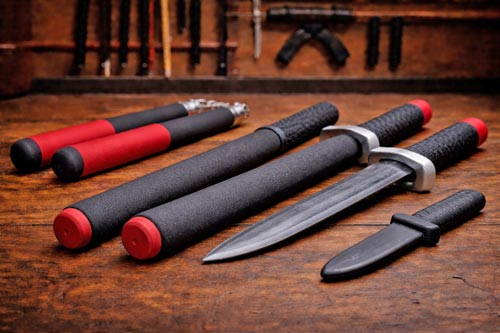
Every martial artist reaches a point where technique matters more than bravado. That is where training weapons become essential. These tools are designed to let students practice real movement, timing, and contact without unnecessary risk. Foam swords, rubber knives, padded staffs, and practice blades allow you to train with intensity while protecting yourself and your partners. They make it possible to move beyond theory and into applied skill.
Traditional weapons demand precision, but they also carry inherent danger. Training weapons bridge that gap. They let beginners learn spacing and targeting without fear, and they allow advanced students to work at higher speeds. Instructors rely on them to introduce partner drills, controlled sparring, and reaction-based training. Instead of stopping at choreography, students can explore how techniques behave under pressure.
For newcomers, training weapons remove hesitation. You can focus on posture, grip, and footwork without worrying about getting hurt. This accelerates learning and builds confidence. For experienced practitioners, these tools open the door to realistic drills that mirror real encounters. You can test distance, timing, and flow in ways that static forms cannot provide. The feedback is immediate and honest, but still safe.
Training weapons also reinforce good habits. Because they are forgiving, students are more willing to repeat movements and refine technique. Mistakes become lessons instead of injuries. Over time, this creates cleaner mechanics and sharper awareness. Whether you practice karate, kung fu, kobudo, or a hybrid style, these tools support growth at every level.
If you are building a home practice space or outfitting a class, starting with purpose-built training gear is one of the smartest choices you can make. These tools are designed for repeated use, durability, and safety. You can explore a full range of options in our training and practice weapons selection, all chosen to help students train harder, longer, and with confidence.
Choosing Your First Traditional Weapon
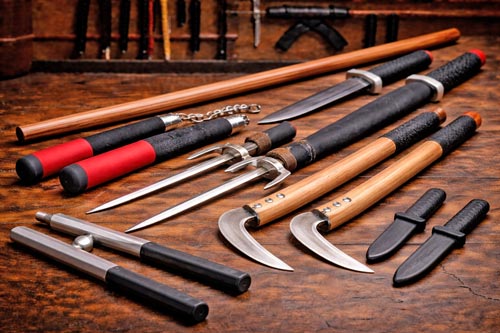
For beginners, the biggest mistake is thinking there is a "right" weapon to start with. The best first weapon is the one your instructor teaches and your school supports. Martial arts weapons are not meant to be learned in isolation. Each style has its own progression, emphasis, and philosophy. What matters most is choosing a tool that fits your training environment and skill level.
In most dojos, students begin with something simple and forgiving. The bo staff and wooden sword are common starting points because they teach distance, posture, and body alignment without unnecessary risk. These weapons help you understand how movement flows through your body and into an object. They also build confidence. You learn how to manage reach and momentum before moving on to more complex tools like nunchaku or kama.
Safety should always come first. Practice weapons exist for a reason. Foam swords, rubber blades, and padded tools let you train realistically while protecting yourself and others. Even traditional wooden weapons should be used with awareness and control. Starting with the right training version allows you to focus on technique rather than fear of injury. As your skill improves, you can gradually explore heavier or more traditional materials under guidance.
It is also important to choose equipment that matches your size and strength. A staff that is too long or a sword that feels unbalanced will slow your progress. Proper fit helps movements feel natural and reinforces correct mechanics. When a weapon moves the way your body expects, learning accelerates. Small details like weight, diameter, and length make a noticeable difference over time.
Traditional weapons are not about looking impressive. They are about developing coordination, discipline, and respect for the art. Each tool teaches a different lesson. The staff builds foundation. Nunchaku refine control. Sai develop structure. Tonfa teach rotation and alignment. Kama introduce edge awareness. Wooden swords sharpen precision. Together, they form a complete language of movement that deepens your understanding of martial arts as a whole.
Whether you are just stepping onto the mat or expanding your training, these weapons connect you to centuries of tradition. They remind you that martial arts is not only about self-defense, but about mastery of body and mind. With the right tools and guidance, each practice session becomes part of a much larger story, one that you now have the chance to carry forward.
Bringing It All Together
Traditional martial arts weapons are not separate from the art. They are part of it. Each one teaches a different way to move, think, and respond. The staff builds reach and foundation. Nunchaku sharpen timing and control. Sai reinforce structure and interception. Tonfa teach rotation and alignment. Kama introduce edge awareness and flow. Wooden swords demand precision and presence. Training weapons make all of it accessible and safe. Together, they form a complete system for developing coordination, discipline, and awareness.
What surprises many beginners is how quickly these tools change the way they move even without a weapon in hand. Footwork becomes cleaner. Posture improves. Hands return to guard more naturally. Distance feels intuitive. Weapons training exposes weaknesses and strengths in a way empty-hand practice sometimes hides. It gives you instant feedback. If your balance is off, the weapon shows it. If your timing is late, you feel it. That honesty accelerates growth.
This is why weapons remain a core part of traditional training. They are not relics or novelties. They are teachers. They demand focus, reward patience, and reveal the connection between mind and body. Every repetition becomes meaningful because there is weight and purpose in your hands. You learn to move with intent instead of habit.
Whether your goal is competition, self-improvement, or simply deeper understanding, traditional weapons offer a path that is both challenging and rewarding. They connect you to generations of practitioners who trained with the same shapes and movements. When you pick up a staff or a sword, you are stepping into a living tradition. Each session becomes part of that lineage.
The journey does not begin with mastery. It begins with curiosity. Choose a weapon that fits your training, respect it, and let it teach you. Over time, what once felt foreign becomes familiar. Movements become fluid. Awareness sharpens. And martial arts transforms from a collection of techniques into a language you can truly speak.
You May Also Be Interested In:
- A Visual Guide to Martial Arts Weapons Around the World
- Best Martial Arts Pants: Karate and Taekwondo Training Guide
- The Complete Parents Guide to Buying a Martial Arts Uniform
- What Size Bo Staff Should I Get? Beginner Guide
- What Is a Bokken? A Beginner Guide to Wooden Swords
- What Is Sparring Gear? A Complete Beginner Guide
- How to Use Focus Mitts for Training: Beginner Guide
- What Is a Shinai? Beginner Guide to Kendo Training Swords
- What Is Kendo? Beginner Guide to Japanese Sword Training
- What Is Kenjutsu? Traditional Japanese Swordsmanship Explained
Leave a Reply