


The Most Dangerous Chain Weapons in Martial Arts History
December 4th, 2025

Flexible weapons have always pushed the limits of martial skill. Instead of relying on a rigid shaft or blade, chain weapons use momentum to generate speed and unpredictable angles that are incredibly difficult to block. They can curve around shields, wrap limbs, or accelerate faster than an opponent can track. If you have ever seen a chain whip in motion or watched a kusarigama demonstration, you know how quickly a fight can change when the weapon itself keeps moving even after the hand stops. Because of their complexity and potential impact, chain weapons have earned a legendary reputation in martial arts history.
Why Chain Weapons Are So Dangerous in Combat
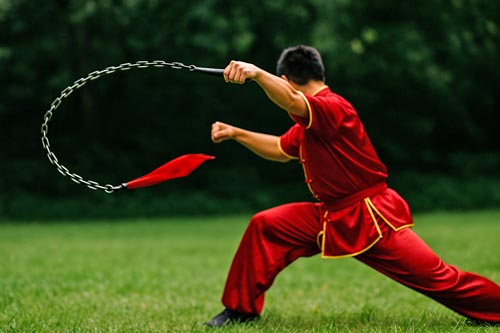
The unique danger of chain weapons comes from the fact that they never stop moving once they build momentum. A rigid weapon like a staff or sword follows exactly where the hand directs it. A flexible weapon adds a second stage of movement that can continue to accelerate even after the wielder changes direction. This creates unpredictable angles that are incredibly hard for opponents to read. A swing might start wide, then whip suddenly inside a guard to strike from a completely different line of attack.
Chain weapons also allow rapid transitions between ranges. A longer arc can create powerful strikes from a distance, but the chain can then wrap around a limb or weapon to pull the opponent off balance. Some chain weapons can even switch to grappling or trapping techniques once contact is made. For anyone facing them, the constant motion forces split-second reactions that are difficult to maintain under stress.
These abilities are part of what makes chain weapons so fascinating to martial artists, but they are also the same qualities that demand respect and proper training. They test your body mechanics, timing, and awareness in a way that feels completely different from traditional weapons. If you want to explore these skills firsthand, you can browse our selection of chain weapons to see everything from beginner-friendly training tools to advanced designs inspired by historical combat.
Kusarigama: The Deadly Chain and Sickle
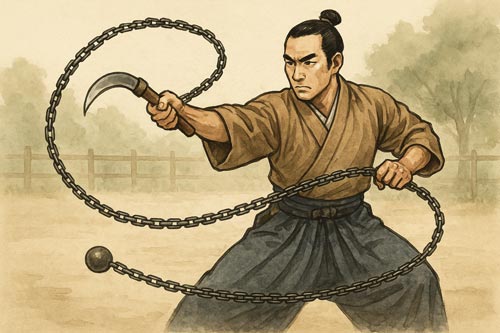
Among all chain weapons, the kusarigama holds a special reputation for being both elegant and terrifying. The weapon consists of a curved metal sickle paired with a long chain and a heavy iron weight. The chain gives the user control over distance and movement, while the sickle finishes the job once the opponent is off balance or entangled. With the right timing, it can strike from farther out than a sword and still transition instantly into close-quarters combat.
Historically, the kusarigama was studied in samurai martial arts systems where warriors learned how to intercept and trap an enemy's blade with the swinging weight. A single misread step could leave the opponent wrapped, disarmed, or pulled forward into the lethal arc of the sickle. Its combination of long-range disruption and sharp cutting power explains why it earned such a feared status in battlefield and dueling situations.
The weapon is also heavily connected to ninja legends due to its compact form and deceptive origins as a farming tool. Whether used for stealth operations or open combat, the kusarigama rewards precision, timing, and complete awareness of the chain's path. It is a weapon you do not simply swing. You must guide it, trust it, and stay ahead of its motion every second you hold it.
The Chain Whip: Speed, Precision, and Pure Momentum
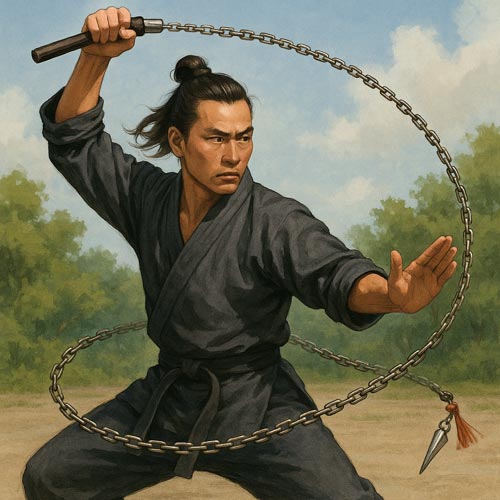
The chain whip is one of the fastest weapons in Chinese martial arts. Built from multiple metal segments linked together, it moves like liquid steel once it gains momentum. A skilled practitioner can launch strikes that seem to come from thin air, curving around blocks and landing from angles the opponent never sees coming. The whip's speed is its greatest advantage, and its flight path is constantly shifting.
Used in kung fu and modern wushu, the chain whip demands full-body coordination. Practitioners learn to wrap and unwind the chain around their arms, legs, and torso to redirect its energy. One second it may circle behind the back, and the next it flashes forward in a straight line that cracks through the air. This constant motion forces opponents into defensive mistakes, creating openings even at a distance.
The chain whip also tests discipline more than many other weapons. If timing or tracking is even slightly off, the whip may strike the user instead. That intensity is part of the appeal. When everything lines up correctly, it feels like you are guiding the force instead of forcing it. Mastery requires patience and respect, but the payoff is a weapon that delivers pure kinetic power with every rotation.
Manriki Chain: A Concealed Weapon With Big Impact
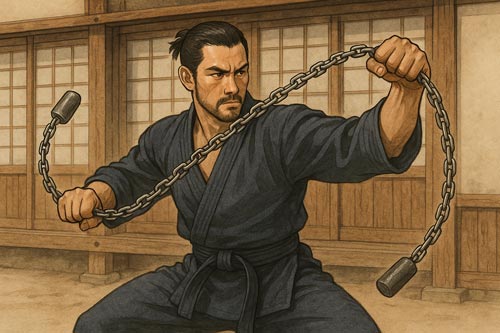
The manriki chain, often called the kusari fundo, proves that a weapon does not need to be large to be dangerous. At first glance, it looks like a short chain with weighted ends. In skilled hands, though, the swinging weights can target joints, hands, and pressure points faster than an opponent can react. The compact size makes the striking path tight and unexpected, especially during close-quarters encounters.
Historically, this was a favorite tool of law enforcement in Japan because it could subdue a suspect without relying on a blade. Wrapping the chain around a wrist, arm, or weapon can instantly neutralize a threat through leverage and control. The weights also deliver solid impact when speed and timing come together, allowing strikes that can disarm or stop aggression in a single motion.
Another important feature is the ability to conceal it easily. Unlike a sword or staff, a manriki chain can hide in a sleeve, belt, or pocket until the moment it is needed. Surprise alone gives it a major psychological advantage. Even today, martial artists appreciate how such a simple design can demand so much finesse and situational awareness.
Flail Weapons: Crushing Power With Every Swing
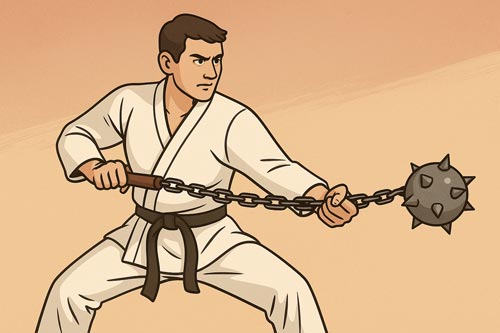
Flail-style weapons have been used for centuries to deliver powerful strikes that slip past ordinary defenses. The design is simple: a handle for control and a weighted head connected by a short length of chain. Once the weight begins to swing, it accelerates faster than a rigid club ever could. The chain also gives the flail its signature ability to curve around shields and guards, striking from angles that are difficult to anticipate.
The medieval version featured a spiked metal ball that could crush armor and cause devastating injuries on impact. However, variations of this design appear in many cultures, from farm-tool adaptations to self-defense weapons developed for everyday people. In training settings, modern flails showcase the same arcing motion and timing challenges but without the battlefield intent.
Because the head moves independently from the handle, controlling a flail requires constant awareness. Beginners quickly learn how easy it is to misjudge a swing and send the weight right back into their own arm or leg. When handled with skill though, this weapon hits with a force that few handheld weapons can match, proving that simple designs can still be incredibly effective.
Bolas: Taking the Fight to the Ground
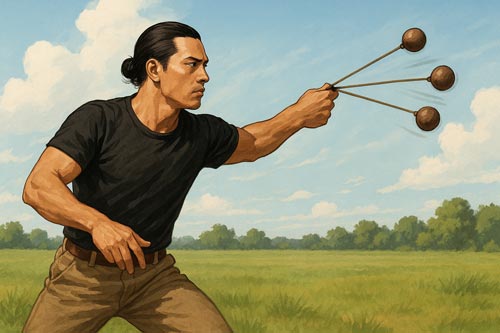
Unlike most chain weapons designed for close combat, bolas bring a completely different kind of threat. Originally used by South American gauchos for hunting, these weapons consist of multiple weights connected by cords or chains. When thrown, the spinning motion sends the bolas outward in a wide radius. At impact, the weights wrap around the target's legs or arms, trapping them in a tangle of momentum that is nearly impossible to escape without falling.
This ability to disable movement rather than strike directly makes bolas especially dangerous in the right hands. A skilled throw can take away an opponent's stability and control in a single moment, completely changing the direction of a fight. While not traditionally a hand-to-hand combat weapon, the core mechanics of bolas translate seamlessly into martial-style training: timing, precision, and understanding how the rotation of the weights will affect the target.
Today, bolas remain a unique choice for martial artists and collectors who enjoy using ranged entanglement techniques. Unlike chain whips or kusarigama, they rely less on continuous motion and more on a well-timed release. One perfectly placed throw is all it takes to send a much larger opponent straight to the ground.
The Real Danger: Lack of Control
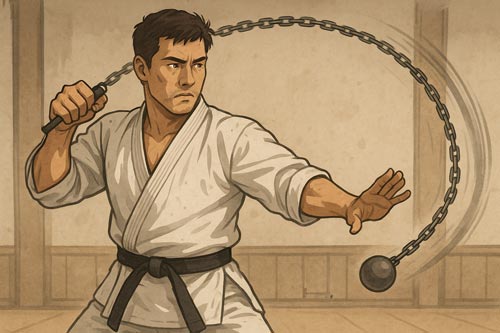
The greatest threat with chain weapons is not always the person wielding them. It is the motion of the weapon itself. Once a chain begins to swing, it develops its own direction and momentum. If your timing is even slightly off, the weight or blade can snap back toward you instead of your target. That is why proper training is essential for any flexible weapon, whether it is a chain whip, manriki chain, kusarigama, or bolas.
Beginners often discover that the hardest part is not striking with power but controlling what happens afterward. You must always know where the chain is traveling next. Martial artists learn to build that awareness slowly, starting with padded or practice-safe equipment before moving on to heavier or sharpened designs. As skill improves, the motions become smoother, faster, and far more precise.
Chain weapons reward patience. They teach body alignment, rhythm, and flow in a way that rigid tools cannot replicate. With good coaching and safe habits, these weapons become a powerful form of martial expression. Without control, they are simply dangerous to everyone involved. Respect is the real foundation that separates mastery from mayhem.
Conclusion: A Legacy of Precision, Power, and Practice
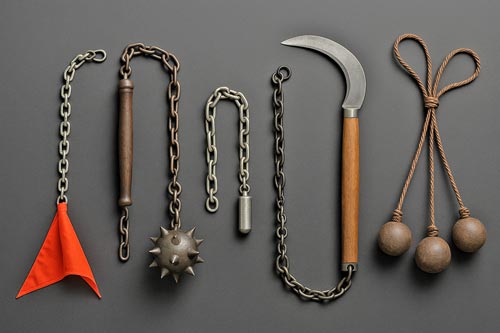
Whether it is the sweeping arcs of a chain whip, the hidden leverage of a manriki chain, the stealth and dual-range strikes of the kusarigama, the crushing momentum of a flail, or the perfect timing required to launch bolas, chain weapons demand a unique mix of finesse and courage. Each design evolved for a specific purpose, rooted in real combat challenges and refined through centuries of martial tradition.
That history is still alive today. Modern practitioners train not just for self-defense or competition, but for the discipline that comes from mastering a weapon that refuses to be controlled by brute strength alone. Flexible weapons teach awareness, patience, and respect for every motion your body creates.
If you are ready to explore the unpredictable world of chain weapons for yourself, the safest path forward is through proper instruction and high-quality gear. Start with training-friendly equipment, build your skills step by step, and always keep your focus sharp. Because when everything clicks, timing, distance, rotation, and intent, there is nothing quite like the flow of a chain weapon fully under your command.
You May Also Be Interested In:
- What Is a Chain Whip? History, Training, and Martial Arts Uses
- The History of the Dojo: Why Martial Arts Schools Look the Way They Do
- What Is a Rope Dart? History, Training, and Martial Arts Uses
- Why Is It Called a 'Gi'? The Strange History of Martial Arts Uniforms
- The Real History of Nunchaku: From Farm Tool to Martial Arts Icon
- What Are Flexible Weapons in Martial Arts?
- Top 5 Least Practical Martial Arts Weapons You Know You Want
- LED Weapons for Cosplay and Martial Arts
- 10 Weird Martial Arts Weapons That Actually Existed
- A Visual Guide to Martial Arts Weapons Around the World
Leave a Reply