




How Long Does It REALLY Take to Get a Black Belt? (The Answer Surprises Most People)
June 12th, 2026
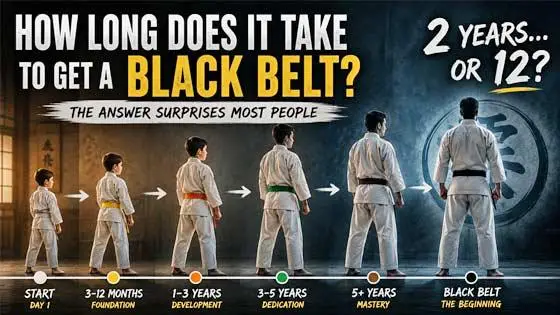
Ask ten people how long it takes to earn a black belt and you will probably get ten completely different answers.
Some people think it takes a year. Others assume a black belt means someone has spent decades mastering martial arts. Movies certainly have not helped, making it seem like a determined hero can go from beginner to expert after a dramatic training montage and a few motivational speeches.
Some people think it takes a year. Others assume a black belt means someone has spent decades mastering martial arts. Movies certainly have not helped, making it seem like a determined hero can go from beginner to expert after a dramatic training montage and a few motivational speeches.
Reality is much stranger.
Depending on the martial art, the school, your age, how often you train, and even where you live, earning a black belt might take two years, five years, ten years, or much longer. In some styles, black belt means mastery. In others, it is considered the moment real learning finally begins.
So how long does a black belt actually take? The answer is more complicated than most people expect, and it says a lot about how martial arts really work.
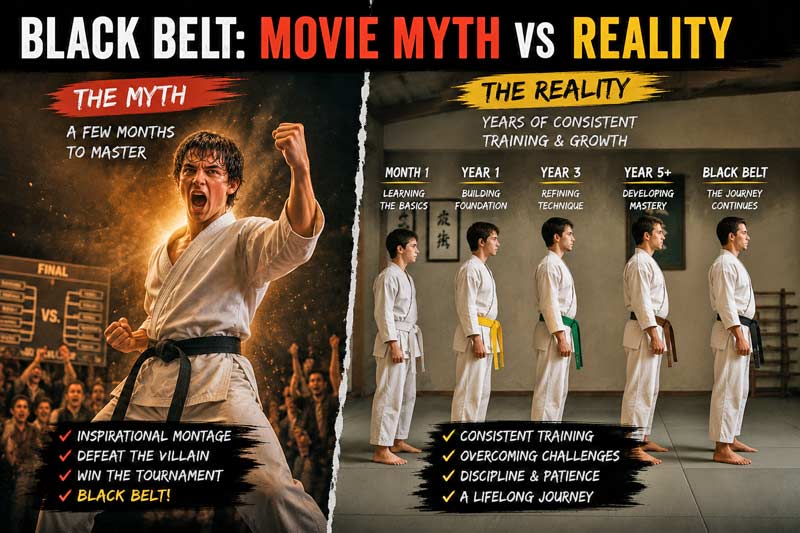
If you think a black belt takes a year or two to earn, there is a good chance Hollywood helped shape that idea.
For decades, martial arts movies have made black belts look almost mythical. A determined underdog trains for a few months, survives an inspirational montage, defeats the villain, and suddenly becomes a martial arts master. It makes for great entertainment. It just does not reflect reality very well.
In real martial arts schools, progress usually moves much slower. Learning techniques is only part of the process. Students also have to build timing, coordination, discipline, conditioning, muscle memory, and the ability to perform under pressure. That takes repetition. A lot of repetition.
And here is something many beginners do not realize: earning a black belt does not automatically mean someone is an expert fighter. In many martial arts, black belt simply means you have mastered the fundamentals well enough to move into more advanced learning. Some instructors even joke that black belt is "where real training finally begins."
Movies also tend to blur the differences between martial arts styles. A black belt in karate does not follow the same timeline as Brazilian jiu-jitsu. A taekwondo student may test differently than a judo practitioner. Even within the same martial art, schools can have wildly different expectations for rank progression and belt testing. If you are unfamiliar with how ranking works, it helps to understand the role of colored martial arts belts and how they mark progress over time.
That is one reason asking, "How long does it take to get a black belt?" can be surprisingly misleading. The better question is usually: "In which martial art, and under what kind of school?"
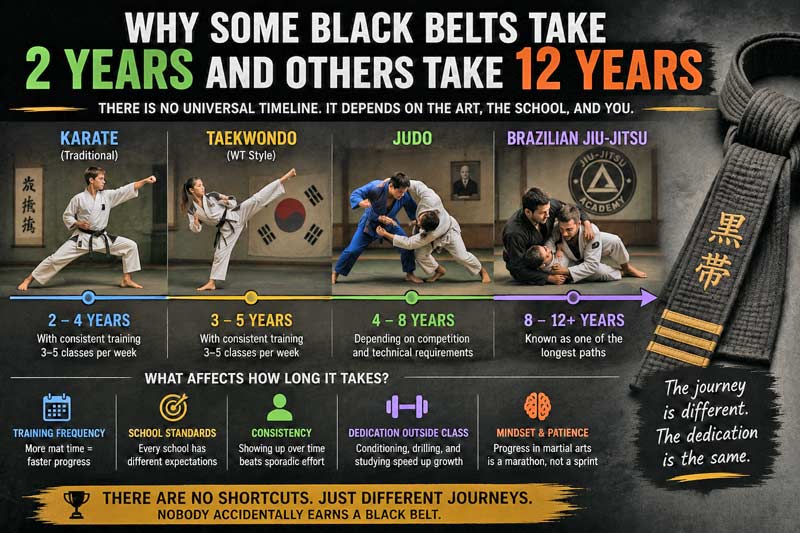
Here is where things get confusing fast: there is no universal black belt timeline.
A black belt in one martial art may take two or three years of consistent training. In another, it could realistically take ten years or more. Even within the same martial art, schools often have completely different expectations for promotion.
For example, many traditional karate and taekwondo schools often place black belt somewhere in the range of three to five years for dedicated students training consistently. Judo may take longer depending on competition requirements and technical standards. Brazilian jiu-jitsu is famous for being one of the slowest paths, with many students spending eight to twelve years earning a black belt.
But style is only part of the equation.
How often you train matters just as much. Someone attending class four or five times per week will usually progress much faster than someone training once every weekend. Consistency tends to beat talent over time, which surprises a lot of beginners who assume athletic ability alone determines rank.
School philosophy matters, too. Some schools move students through colored rank belts quickly to keep motivation high. Others intentionally slow things down, requiring strict technical standards, sparring ability, conditioning, and deep knowledge before promotion. Some martial artists even criticize overly fast programs as "belt factories."
That is why asking "How long does it take to get a black belt?" without naming the martial art is a little like asking, "How long does it take to become good at sports?" The answer depends entirely on what you are doing, how often you practice, and what standards you are being measured against.
One thing is consistent almost everywhere, though: nobody accidentally earns a black belt. It usually takes years of showing up, failing, improving, and coming back again.
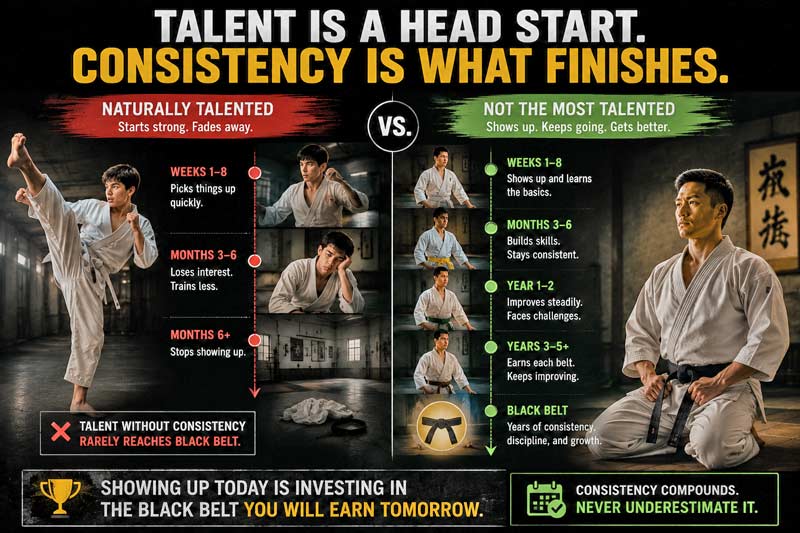
A lot of beginners assume black belts are mostly built through talent.
Maybe some people are naturally athletic. Maybe they learn techniques faster. Maybe they have great balance, flexibility, or coordination from day one. But ask enough instructors what predicts success long term, and you will hear the same answer over and over: consistency beats talent.
The student who shows up three or four times every week usually progresses much faster than the gifted student who disappears for weeks at a time. Martial arts are heavily based on repetition. Timing, reflexes, muscle memory, sparring instincts, and confidence all improve slowly through thousands of small corrections over time.
That is one reason training frequency matters so much when people ask how long a black belt takes. Someone training once a week may need years longer than someone practicing several days each week. Students who drill outside class, stay active, and work on conditioning often progress even faster.
There is also a mental side that people rarely talk about. Many students do not quit because they are bad at martial arts. They quit because progress feels slow. After the excitement of the first few belts fades, training becomes less about motivation and more about discipline.
That is where many future black belts quietly separate themselves from everyone else. They keep showing up.
Training outside class matters, too. Sparring, conditioning, and repetition all help build skills over time, which is one reason many students eventually invest in their own sparring gear to get more comfortable practicing consistently.
The uncomfortable truth? Most people who could have earned a black belt never do. Not because they lacked talent, but because they stopped before the long process finally paid off.

At some point in almost every black belt conversation, someone eventually brings up the phrase "belt factory."
If you have never heard the term before, it usually refers to schools that critics believe promote students too quickly. The idea is simple: if belts come too easily, the rank starts feeling less meaningful.
Now, to be fair, this topic gets controversial fast.
Some schools intentionally move students through ranks more quickly because they believe steady progress keeps beginners motivated, especially kids. Others follow stricter, more traditional systems where earning each belt may require months or even years of technical improvement, sparring, conditioning, and testing.
This is one reason two students in the same city can have completely different black belt timelines. One school may award a black belt in three years with consistent attendance. Another might require six years or more for the same rank level.
Parents sometimes notice this quickly when comparing schools. One child may test every few months, while another spends much longer preparing for each promotion. Neither approach is automatically right or wrong, but it does explain why the question "How long should a black belt take?" often turns into a debate.
What matters most is whether progress actually reflects growth. Are students improving? Learning discipline? Developing real skills? Training consistently? The color around someone's waist only tells part of the story.
Ironically, many experienced martial artists eventually care less about rank altogether. Belts matter, of course, and traditions around martial arts belts are important, but long-term practitioners often become more focused on improvement than promotion.
That is probably the biggest reason black belt timelines vary so much: some schools are measuring attendance, others are measuring technical mastery, and most are somewhere in the middle.
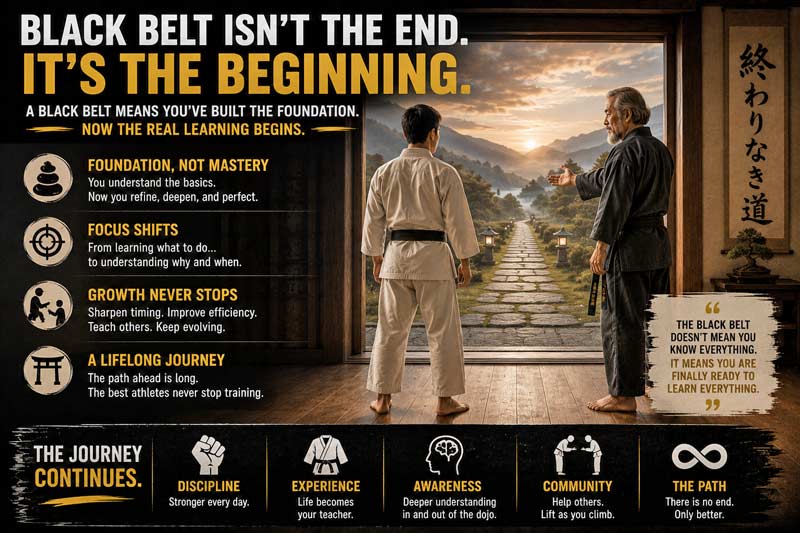
Here is one of the strangest things about martial arts: after years of hard work, many instructors will hand someone a black belt and basically say, "Congratulations. Now the real learning starts."
For beginners, that sounds completely backwards.
Isn't black belt supposed to mean mastery?
Sometimes, but not always.
In many martial arts systems, earning a black belt means you have finally built a strong foundation. You understand the basics. You know the techniques, terminology, etiquette, and core movements well enough to begin refining them at a much deeper level. Instead of learning what to do, training shifts toward understanding why techniques work and when to apply them.
That mindset surprises a lot of people because movies and pop culture turned black belts into the finish line. In reality, many long-term martial artists see it more like graduating from beginner school.
That is also one reason black belts often keep training for decades. The goal stops being promotion and becomes improvement. Timing gets sharper. Techniques become more efficient. Teaching opportunities open up. Students often start helping lower ranks, reinforcing what they have learned along the way.
Interestingly, this is often when people become more invested in the traditions of martial arts, too. Learning about ranking systems, belt meaning, etiquette, and even the history behind uniforms becomes more important. If you missed our article on why martial arts uniforms are called a gi, it is a surprisingly strange rabbit hole.
The funny part? Many experienced martial artists will quietly tell you they felt more nervous testing for black belt than any belt before it. Not because training was ending, but because expectations were suddenly getting much higher.
So yes, a black belt is a major accomplishment. But in many schools, it is also the moment training starts becoming much more serious.
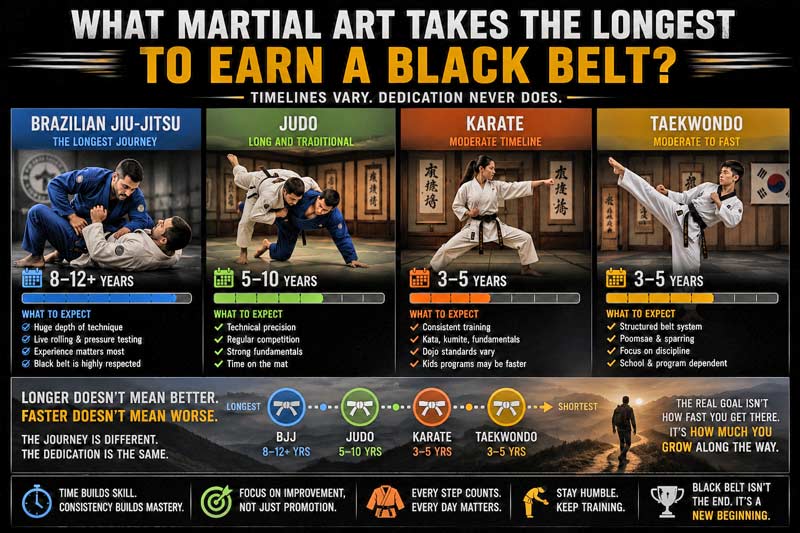
If your goal is earning a black belt as quickly as possible, some martial arts are definitely more patient than others.
Brazilian jiu-jitsu has become famous for having one of the longest black belt timelines in martial arts. While there are exceptions, many students spend somewhere between eight and twelve years earning a black belt. Some take even longer. That slow progression is one reason BJJ black belts tend to carry a certain reputation inside martial arts culture.
Judo can also take a long time depending on the school and competition expectations. In some programs, students are expected to compete regularly, demonstrate technical precision, and build deep experience before advancing to higher ranks.
Karate and taekwondo are often faster by comparison, but "fast" is relative. Dedicated students training consistently may earn a black belt in three to five years at many schools, though traditional dojos sometimes take much longer. Kids programs may also work differently than adult programs, with junior black belt systems designed around age and development.
The interesting part is that longer does not automatically mean "better." Faster does not automatically mean worse either. Different martial arts simply prioritize different things. Some emphasize technical repetition and competition. Others prioritize long-term refinement, discipline, or curriculum depth.
Ironically, the people who actually stay in martial arts long enough to earn a black belt usually stop worrying about speed at all. Somewhere along the way, the goal quietly shifts from "How fast can I get there?" to "How much can I improve?"
That shift is usually a pretty good sign someone is sticking around for the long haul.
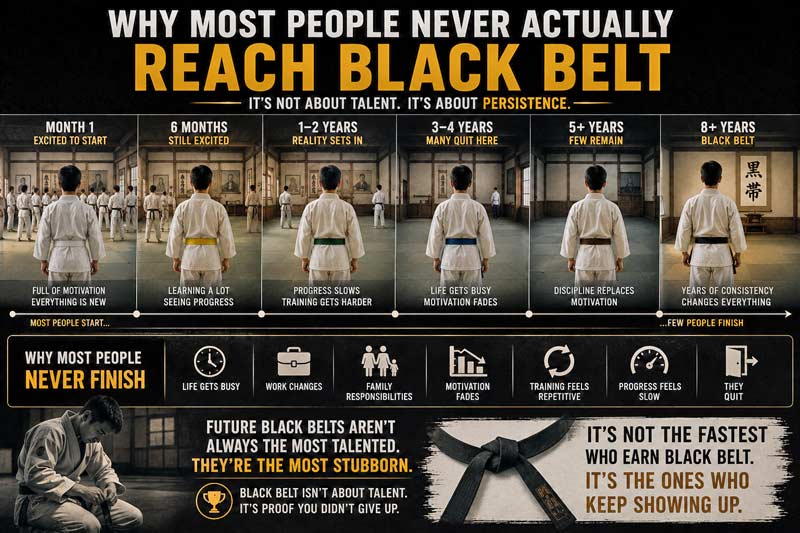
Here is an uncomfortable reality most martial arts schools quietly understand: far more people start martial arts than finish the journey to black belt.
And surprisingly, it usually has very little to do with talent.
Most people do not quit because they are terrible at martial arts. They quit because life gets busy. Work changes. Kids happen. Motivation fades. Training starts feeling repetitive. Progress slows down. The excitement of earning the first few colored belts eventually turns into something less exciting but much more important: consistency.
There is a phase in martial arts that many instructors quietly recognize. The beginner excitement wears off, improvement becomes harder to notice, and students start wondering if they are progressing at all. This is often where people disappear.
Ironically, future black belts usually do not look dramatically different from everyone else during this stage. They are not always the fastest, strongest, or naturally gifted students in the room. More often, they are simply the ones who kept showing up after everyone else stopped.
That is also why earning a black belt tends to feel so meaningful. It represents years of repetition, setbacks, awkward learning phases, failed tests, tough classes, sore muscles, and the decision to keep training anyway.
In many ways, black belt is less about talent and more about proof. Proof that someone stayed committed long enough to become something different than when they started.
That may be the biggest surprise of all: the people most likely to earn a black belt are often not the most talented students. They are the most stubborn.
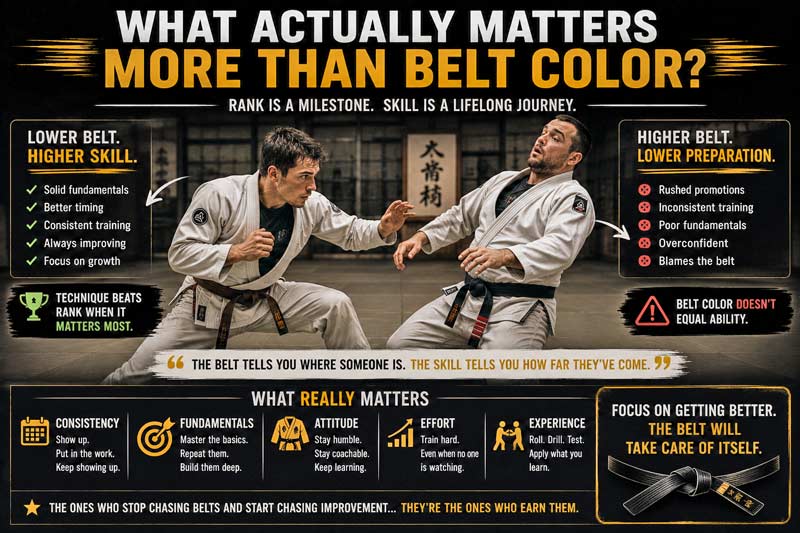
Martial arts beginners tend to obsess over belts. White belt. Yellow belt. Green belt. Brown belt. Black belt. The next promotion can start feeling like the entire point of training.
Then something funny happens after enough time in martial arts: many experienced students stop caring nearly as much about rank.
That does not mean belts are meaningless. Far from it. Belt systems help track progress, reward consistency, and give students milestones to work toward. They also create structure, especially for beginners learning unfamiliar techniques and traditions. If you have ever wondered how ranking systems evolved, even the history behind martial arts belts is stranger than most people realize.
But instructors often notice something important. The students who improve the most are not always the ones chasing promotions. They are the ones quietly getting better at the fundamentals. Better timing. Better balance. Better control. Better discipline.
Someone with incredible technique and years of sparring experience may outperform a higher-ranked student who rushed through promotions. That is part of why rank alone never tells the full story.
Training habits matter more. Consistency matters more. Attitude matters more. Even preparation matters more. Students who regularly train, practice outside class, and spend time sparring often improve faster over the long term, which is one reason many serious students eventually invest in their own sparring gear for extra practice and confidence.
The irony is hard to miss: the people most likely to earn a black belt are often the ones who stop obsessing about black belt altogether.
They focus on improving, and the belt eventually catches up.
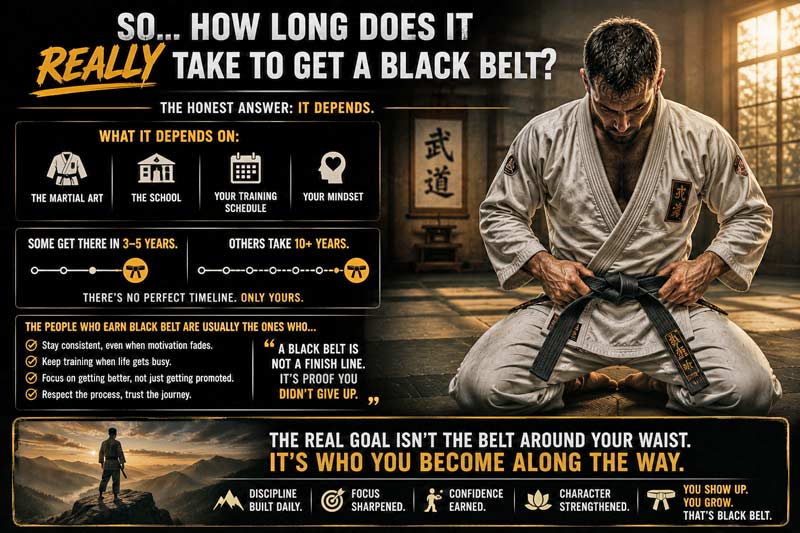
After all the myths, timelines, debates, and movie confusion, we can finally answer the question: how long does it actually take to get a black belt?
The honest answer is frustratingly simple: it depends.
For some martial artists, black belt may happen in three to five years of consistent training. Others spend a decade or more getting there. The martial art matters. The school matters. Your training schedule matters. Your mindset matters even more.
But there is one pattern that shows up almost everywhere.
The people who eventually earn a black belt are rarely the ones obsessing over how fast they can get there. They are usually the students who quietly keep showing up, even after progress slows down, life gets busy, or training stops feeling exciting.
That may be the biggest misconception of all. A black belt is not usually proof someone was naturally gifted. More often, it is proof they stayed committed long enough to become skilled.
Belts matter, traditions matter, and promotions matter. But long-term martial artists eventually realize something important: the real goal is not the color around your waist. It is who you become during the process.
Whether it takes three years or twelve, the people who reach black belt almost always share one thing in common: they kept showing up when most people stopped.
And strangely enough, that lesson may matter a lot more than the belt itself.

After everything we covered, the answer to the black belt question feels surprisingly simple.
Most people assume black belts belong to the most talented students in the room. The fastest learners. The strongest athletes. The people who seem naturally gifted from day one.
But martial arts schools quietly see something different happen over and over again.
The people who eventually earn black belts are usually not the most naturally talented. They are the people who kept showing up after motivation faded. After progress slowed. After life got busy. After training stopped feeling exciting and started feeling like work.
That is why asking, "How long does it take to get a black belt?" is only partly the right question.
A better question might be: "Can I stay consistent long enough to earn one?"
Because whether it takes three years or twelve, the biggest predictor of success is surprisingly boring: consistency.
The irony is hard to miss. Most future black belts stop chasing the belt itself somewhere along the way. They focus on improving, training, and showing up. Then one day, after enough repetitions, failures, and small victories, the belt quietly arrives.
And maybe that is the real lesson martial arts tries to teach in the first place.
Technically, yes. But whether it actually means much depends heavily on the school and the martial art.
In most traditional martial arts systems, earning a black belt in one year would be considered extremely unusual. Many schools expect years of consistent training, technical development, sparring, conditioning, and testing before promoting someone to black belt.
That said, there are exceptions. Some accelerated programs, private instruction systems, or highly intensive training environments can move students much faster. Certain schools also award junior black belts, provisional black belts, or beginner-level black belt ranks that represent a different standard than long-term advanced practitioners.
This is also where the "belt factory" debate usually starts. Critics argue that extremely fast promotions can weaken the meaning of rank if students have not developed enough skill or experience. Supporters argue that faster progress can keep students motivated and engaged.
The better question is probably not, "Can I get a black belt in one year?" It is: "Will I actually deserve the skills that come with it?"
Most experienced martial artists would rather train under someone who spent years building real ability than someone who rushed to the finish line.
There is no universal answer, but Brazilian jiu-jitsu is probably the martial art most people point to first.
In BJJ, earning a black belt commonly takes eight to twelve years, and sometimes much longer. Progress tends to move slowly because students are expected to apply techniques against resisting opponents through live sparring, often called "rolling." Many practitioners see the slow promotion system as part of what makes the rank so respected.
Judo can also be surprisingly demanding depending on the school. Some programs require competition experience, technical precision, and years of consistent mat time before advancing. Traditional karate schools can be very strict as well, especially those focused heavily on discipline, kata, sparring, and technical detail.
But "hardest" depends on what you mean.
Hardest physically? Some arts are brutally demanding on conditioning and endurance. Hardest mentally? Styles with long promotion timelines can test patience and consistency. Hardest technically? Grappling-heavy systems often require years of refinement before techniques become instinctive.
Ironically, most experienced martial artists eventually stop comparing timelines altogether. After enough training, many realize the hardest black belt to earn is simply the one you personally stick with long enough to finish.
Usually, no. In many martial arts schools, kids black belts and adult black belts follow different expectations.
Because children are still developing physically and emotionally, many schools use junior black belt systems or age-based black belt rankings. A child may earn a version of black belt that recognizes hard work, discipline, and technical progress, while still leaving room for more advanced requirements later in life.
That does not mean kids black belts are meaningless. Far from it. Earning any black belt as a child usually takes years of consistency, practice, and commitment. Most young students still have to learn techniques, memorize forms, attend classes regularly, and demonstrate focus under pressure.
The difference is usually about expectations. Adult black belt testing often includes higher standards for strength, sparring, endurance, technical detail, leadership, or teaching ability. Many schools eventually require junior black belts to re-test or continue progressing before transitioning into adult ranks.
This is one reason comparing black belts across different schools can get surprisingly complicated. Age, school philosophy, training standards, and testing requirements all matter more than people expect.
The bigger takeaway? Whether someone earns a black belt at 12 or 42, the accomplishment usually represents the same core thing: years of showing up and sticking with something difficult.
Depending on the martial art, the school, your age, how often you train, and even where you live, earning a black belt might take two years, five years, ten years, or much longer. In some styles, black belt means mastery. In others, it is considered the moment real learning finally begins.
So how long does a black belt actually take? The answer is more complicated than most people expect, and it says a lot about how martial arts really work.
Why Movies Completely Confused People About Black Belts
If you think a black belt takes a year or two to earn, there is a good chance Hollywood helped shape that idea.
For decades, martial arts movies have made black belts look almost mythical. A determined underdog trains for a few months, survives an inspirational montage, defeats the villain, and suddenly becomes a martial arts master. It makes for great entertainment. It just does not reflect reality very well.
In real martial arts schools, progress usually moves much slower. Learning techniques is only part of the process. Students also have to build timing, coordination, discipline, conditioning, muscle memory, and the ability to perform under pressure. That takes repetition. A lot of repetition.
And here is something many beginners do not realize: earning a black belt does not automatically mean someone is an expert fighter. In many martial arts, black belt simply means you have mastered the fundamentals well enough to move into more advanced learning. Some instructors even joke that black belt is "where real training finally begins."
Movies also tend to blur the differences between martial arts styles. A black belt in karate does not follow the same timeline as Brazilian jiu-jitsu. A taekwondo student may test differently than a judo practitioner. Even within the same martial art, schools can have wildly different expectations for rank progression and belt testing. If you are unfamiliar with how ranking works, it helps to understand the role of colored martial arts belts and how they mark progress over time.
That is one reason asking, "How long does it take to get a black belt?" can be surprisingly misleading. The better question is usually: "In which martial art, and under what kind of school?"
Why Some Black Belts Take 2 Years and Others Take 12
Here is where things get confusing fast: there is no universal black belt timeline.
A black belt in one martial art may take two or three years of consistent training. In another, it could realistically take ten years or more. Even within the same martial art, schools often have completely different expectations for promotion.
For example, many traditional karate and taekwondo schools often place black belt somewhere in the range of three to five years for dedicated students training consistently. Judo may take longer depending on competition requirements and technical standards. Brazilian jiu-jitsu is famous for being one of the slowest paths, with many students spending eight to twelve years earning a black belt.
But style is only part of the equation.
How often you train matters just as much. Someone attending class four or five times per week will usually progress much faster than someone training once every weekend. Consistency tends to beat talent over time, which surprises a lot of beginners who assume athletic ability alone determines rank.
School philosophy matters, too. Some schools move students through colored rank belts quickly to keep motivation high. Others intentionally slow things down, requiring strict technical standards, sparring ability, conditioning, and deep knowledge before promotion. Some martial artists even criticize overly fast programs as "belt factories."
That is why asking "How long does it take to get a black belt?" without naming the martial art is a little like asking, "How long does it take to become good at sports?" The answer depends entirely on what you are doing, how often you practice, and what standards you are being measured against.
One thing is consistent almost everywhere, though: nobody accidentally earns a black belt. It usually takes years of showing up, failing, improving, and coming back again.
Why Training Frequency Matters More Than Natural Talent
A lot of beginners assume black belts are mostly built through talent.
Maybe some people are naturally athletic. Maybe they learn techniques faster. Maybe they have great balance, flexibility, or coordination from day one. But ask enough instructors what predicts success long term, and you will hear the same answer over and over: consistency beats talent.
The student who shows up three or four times every week usually progresses much faster than the gifted student who disappears for weeks at a time. Martial arts are heavily based on repetition. Timing, reflexes, muscle memory, sparring instincts, and confidence all improve slowly through thousands of small corrections over time.
That is one reason training frequency matters so much when people ask how long a black belt takes. Someone training once a week may need years longer than someone practicing several days each week. Students who drill outside class, stay active, and work on conditioning often progress even faster.
There is also a mental side that people rarely talk about. Many students do not quit because they are bad at martial arts. They quit because progress feels slow. After the excitement of the first few belts fades, training becomes less about motivation and more about discipline.
That is where many future black belts quietly separate themselves from everyone else. They keep showing up.
Training outside class matters, too. Sparring, conditioning, and repetition all help build skills over time, which is one reason many students eventually invest in their own sparring gear to get more comfortable practicing consistently.
The uncomfortable truth? Most people who could have earned a black belt never do. Not because they lacked talent, but because they stopped before the long process finally paid off.
Why "Belt Factories" Make This Question So Complicated
At some point in almost every black belt conversation, someone eventually brings up the phrase "belt factory."
If you have never heard the term before, it usually refers to schools that critics believe promote students too quickly. The idea is simple: if belts come too easily, the rank starts feeling less meaningful.
Now, to be fair, this topic gets controversial fast.
Some schools intentionally move students through ranks more quickly because they believe steady progress keeps beginners motivated, especially kids. Others follow stricter, more traditional systems where earning each belt may require months or even years of technical improvement, sparring, conditioning, and testing.
This is one reason two students in the same city can have completely different black belt timelines. One school may award a black belt in three years with consistent attendance. Another might require six years or more for the same rank level.
Parents sometimes notice this quickly when comparing schools. One child may test every few months, while another spends much longer preparing for each promotion. Neither approach is automatically right or wrong, but it does explain why the question "How long should a black belt take?" often turns into a debate.
What matters most is whether progress actually reflects growth. Are students improving? Learning discipline? Developing real skills? Training consistently? The color around someone's waist only tells part of the story.
Ironically, many experienced martial artists eventually care less about rank altogether. Belts matter, of course, and traditions around martial arts belts are important, but long-term practitioners often become more focused on improvement than promotion.
That is probably the biggest reason black belt timelines vary so much: some schools are measuring attendance, others are measuring technical mastery, and most are somewhere in the middle.
Why Many Instructors Say Black Belt Is Actually the Beginning
Here is one of the strangest things about martial arts: after years of hard work, many instructors will hand someone a black belt and basically say, "Congratulations. Now the real learning starts."
For beginners, that sounds completely backwards.
Isn't black belt supposed to mean mastery?
Sometimes, but not always.
In many martial arts systems, earning a black belt means you have finally built a strong foundation. You understand the basics. You know the techniques, terminology, etiquette, and core movements well enough to begin refining them at a much deeper level. Instead of learning what to do, training shifts toward understanding why techniques work and when to apply them.
That mindset surprises a lot of people because movies and pop culture turned black belts into the finish line. In reality, many long-term martial artists see it more like graduating from beginner school.
That is also one reason black belts often keep training for decades. The goal stops being promotion and becomes improvement. Timing gets sharper. Techniques become more efficient. Teaching opportunities open up. Students often start helping lower ranks, reinforcing what they have learned along the way.
Interestingly, this is often when people become more invested in the traditions of martial arts, too. Learning about ranking systems, belt meaning, etiquette, and even the history behind uniforms becomes more important. If you missed our article on why martial arts uniforms are called a gi, it is a surprisingly strange rabbit hole.
The funny part? Many experienced martial artists will quietly tell you they felt more nervous testing for black belt than any belt before it. Not because training was ending, but because expectations were suddenly getting much higher.
So yes, a black belt is a major accomplishment. But in many schools, it is also the moment training starts becoming much more serious.
What Martial Art Takes the Longest to Earn a Black Belt?
If your goal is earning a black belt as quickly as possible, some martial arts are definitely more patient than others.
Brazilian jiu-jitsu has become famous for having one of the longest black belt timelines in martial arts. While there are exceptions, many students spend somewhere between eight and twelve years earning a black belt. Some take even longer. That slow progression is one reason BJJ black belts tend to carry a certain reputation inside martial arts culture.
Judo can also take a long time depending on the school and competition expectations. In some programs, students are expected to compete regularly, demonstrate technical precision, and build deep experience before advancing to higher ranks.
Karate and taekwondo are often faster by comparison, but "fast" is relative. Dedicated students training consistently may earn a black belt in three to five years at many schools, though traditional dojos sometimes take much longer. Kids programs may also work differently than adult programs, with junior black belt systems designed around age and development.
The interesting part is that longer does not automatically mean "better." Faster does not automatically mean worse either. Different martial arts simply prioritize different things. Some emphasize technical repetition and competition. Others prioritize long-term refinement, discipline, or curriculum depth.
Ironically, the people who actually stay in martial arts long enough to earn a black belt usually stop worrying about speed at all. Somewhere along the way, the goal quietly shifts from "How fast can I get there?" to "How much can I improve?"
That shift is usually a pretty good sign someone is sticking around for the long haul.
Why Most People Never Actually Reach Black Belt
Here is an uncomfortable reality most martial arts schools quietly understand: far more people start martial arts than finish the journey to black belt.
And surprisingly, it usually has very little to do with talent.
Most people do not quit because they are terrible at martial arts. They quit because life gets busy. Work changes. Kids happen. Motivation fades. Training starts feeling repetitive. Progress slows down. The excitement of earning the first few colored belts eventually turns into something less exciting but much more important: consistency.
There is a phase in martial arts that many instructors quietly recognize. The beginner excitement wears off, improvement becomes harder to notice, and students start wondering if they are progressing at all. This is often where people disappear.
Ironically, future black belts usually do not look dramatically different from everyone else during this stage. They are not always the fastest, strongest, or naturally gifted students in the room. More often, they are simply the ones who kept showing up after everyone else stopped.
That is also why earning a black belt tends to feel so meaningful. It represents years of repetition, setbacks, awkward learning phases, failed tests, tough classes, sore muscles, and the decision to keep training anyway.
In many ways, black belt is less about talent and more about proof. Proof that someone stayed committed long enough to become something different than when they started.
That may be the biggest surprise of all: the people most likely to earn a black belt are often not the most talented students. They are the most stubborn.
What Actually Matters More Than Belt Color?
Martial arts beginners tend to obsess over belts. White belt. Yellow belt. Green belt. Brown belt. Black belt. The next promotion can start feeling like the entire point of training.
Then something funny happens after enough time in martial arts: many experienced students stop caring nearly as much about rank.
That does not mean belts are meaningless. Far from it. Belt systems help track progress, reward consistency, and give students milestones to work toward. They also create structure, especially for beginners learning unfamiliar techniques and traditions. If you have ever wondered how ranking systems evolved, even the history behind martial arts belts is stranger than most people realize.
But instructors often notice something important. The students who improve the most are not always the ones chasing promotions. They are the ones quietly getting better at the fundamentals. Better timing. Better balance. Better control. Better discipline.
Someone with incredible technique and years of sparring experience may outperform a higher-ranked student who rushed through promotions. That is part of why rank alone never tells the full story.
Training habits matter more. Consistency matters more. Attitude matters more. Even preparation matters more. Students who regularly train, practice outside class, and spend time sparring often improve faster over the long term, which is one reason many serious students eventually invest in their own sparring gear for extra practice and confidence.
The irony is hard to miss: the people most likely to earn a black belt are often the ones who stop obsessing about black belt altogether.
They focus on improving, and the belt eventually catches up.
So... How Long Does It REALLY Take to Get a Black Belt?
After all the myths, timelines, debates, and movie confusion, we can finally answer the question: how long does it actually take to get a black belt?
The honest answer is frustratingly simple: it depends.
For some martial artists, black belt may happen in three to five years of consistent training. Others spend a decade or more getting there. The martial art matters. The school matters. Your training schedule matters. Your mindset matters even more.
But there is one pattern that shows up almost everywhere.
The people who eventually earn a black belt are rarely the ones obsessing over how fast they can get there. They are usually the students who quietly keep showing up, even after progress slows down, life gets busy, or training stops feeling exciting.
That may be the biggest misconception of all. A black belt is not usually proof someone was naturally gifted. More often, it is proof they stayed committed long enough to become skilled.
Belts matter, traditions matter, and promotions matter. But long-term martial artists eventually realize something important: the real goal is not the color around your waist. It is who you become during the process.
Whether it takes three years or twelve, the people who reach black belt almost always share one thing in common: they kept showing up when most people stopped.
And strangely enough, that lesson may matter a lot more than the belt itself.
The Real Secret to Earning a Black Belt
After everything we covered, the answer to the black belt question feels surprisingly simple.
Most people assume black belts belong to the most talented students in the room. The fastest learners. The strongest athletes. The people who seem naturally gifted from day one.
But martial arts schools quietly see something different happen over and over again.
The people who eventually earn black belts are usually not the most naturally talented. They are the people who kept showing up after motivation faded. After progress slowed. After life got busy. After training stopped feeling exciting and started feeling like work.
That is why asking, "How long does it take to get a black belt?" is only partly the right question.
A better question might be: "Can I stay consistent long enough to earn one?"
Because whether it takes three years or twelve, the biggest predictor of success is surprisingly boring: consistency.
The irony is hard to miss. Most future black belts stop chasing the belt itself somewhere along the way. They focus on improving, training, and showing up. Then one day, after enough repetitions, failures, and small victories, the belt quietly arrives.
And maybe that is the real lesson martial arts tries to teach in the first place.
FAQ: Can You Really Get a Black Belt in One Year?
Technically, yes. But whether it actually means much depends heavily on the school and the martial art.
In most traditional martial arts systems, earning a black belt in one year would be considered extremely unusual. Many schools expect years of consistent training, technical development, sparring, conditioning, and testing before promoting someone to black belt.
That said, there are exceptions. Some accelerated programs, private instruction systems, or highly intensive training environments can move students much faster. Certain schools also award junior black belts, provisional black belts, or beginner-level black belt ranks that represent a different standard than long-term advanced practitioners.
This is also where the "belt factory" debate usually starts. Critics argue that extremely fast promotions can weaken the meaning of rank if students have not developed enough skill or experience. Supporters argue that faster progress can keep students motivated and engaged.
The better question is probably not, "Can I get a black belt in one year?" It is: "Will I actually deserve the skills that come with it?"
Most experienced martial artists would rather train under someone who spent years building real ability than someone who rushed to the finish line.
FAQ: What Martial Art Is the Hardest to Earn a Black Belt In?
There is no universal answer, but Brazilian jiu-jitsu is probably the martial art most people point to first.
In BJJ, earning a black belt commonly takes eight to twelve years, and sometimes much longer. Progress tends to move slowly because students are expected to apply techniques against resisting opponents through live sparring, often called "rolling." Many practitioners see the slow promotion system as part of what makes the rank so respected.
Judo can also be surprisingly demanding depending on the school. Some programs require competition experience, technical precision, and years of consistent mat time before advancing. Traditional karate schools can be very strict as well, especially those focused heavily on discipline, kata, sparring, and technical detail.
But "hardest" depends on what you mean.
Hardest physically? Some arts are brutally demanding on conditioning and endurance. Hardest mentally? Styles with long promotion timelines can test patience and consistency. Hardest technically? Grappling-heavy systems often require years of refinement before techniques become instinctive.
Ironically, most experienced martial artists eventually stop comparing timelines altogether. After enough training, many realize the hardest black belt to earn is simply the one you personally stick with long enough to finish.
FAQ: Is a Kids Black Belt the Same as an Adult Black Belt?
Usually, no. In many martial arts schools, kids black belts and adult black belts follow different expectations.
Because children are still developing physically and emotionally, many schools use junior black belt systems or age-based black belt rankings. A child may earn a version of black belt that recognizes hard work, discipline, and technical progress, while still leaving room for more advanced requirements later in life.
That does not mean kids black belts are meaningless. Far from it. Earning any black belt as a child usually takes years of consistency, practice, and commitment. Most young students still have to learn techniques, memorize forms, attend classes regularly, and demonstrate focus under pressure.
The difference is usually about expectations. Adult black belt testing often includes higher standards for strength, sparring, endurance, technical detail, leadership, or teaching ability. Many schools eventually require junior black belts to re-test or continue progressing before transitioning into adult ranks.
This is one reason comparing black belts across different schools can get surprisingly complicated. Age, school philosophy, training standards, and testing requirements all matter more than people expect.
The bigger takeaway? Whether someone earns a black belt at 12 or 42, the accomplishment usually represents the same core thing: years of showing up and sticking with something difficult.
You May Also Be Interested In:
Leave a Reply