



Did Samurai Really Test Their Swords On People?
June 2nd, 2026
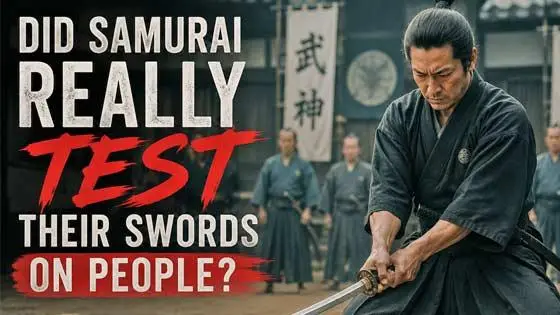
Few samurai stories are as disturbing, controversial, or fascinating as the claim that warriors once tested their swords on real people. You may have heard stories about samurai slicing through criminals to prove a blade's sharpness or testing a sword's quality in ways that sound almost impossible to believe. It is one of those pieces of history that feels too brutal to be true, which raises an obvious question: did samurai really do this, or is it just another exaggerated legend?
The answer is more complicated than most people expect. While Hollywood often dramatizes samurai history, there is real historical evidence behind some of these stories. However, the truth is usually more nuanced and far less sensational than the myths make it seem. In this guide, we are looking at where these stories came from, what tameshigiri actually was, and how samurai really tested the quality of their blades.
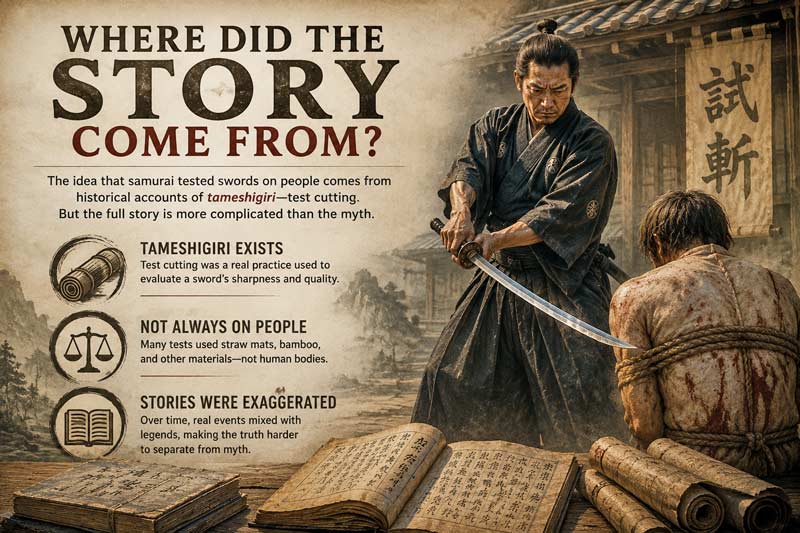
The idea that samurai tested swords on people usually comes from the historical practice of tameshigiri, which means test cutting. Today, that term is often associated with cutting rolled straw mats or other safe practice targets, but historically, sword testing could involve much darker methods. In some periods, blades were tested on bodies to judge how well they cut.
That does not mean every samurai was casually testing swords on people, and it does not mean every Japanese sword was proven this way. Like many parts of samurai history, the truth depends on the time period, the person involved, and the specific situation. Some sword testing was formalized, while other stories have likely been exaggerated over time.
Part of the confusion comes from the way samurai history gets retold. Movies and legends often focus on the most shocking details because they are memorable. A sword being tested on a criminal sounds far more dramatic than a blade being evaluated for balance, craftsmanship, or cutting ability. That is why the story has lasted so long, even when the full reality is more complicated.
This is similar to many other myths about samurai swords. There is often a real historical detail at the center, but the version people repeat today is usually simplified, exaggerated, or missing important context.
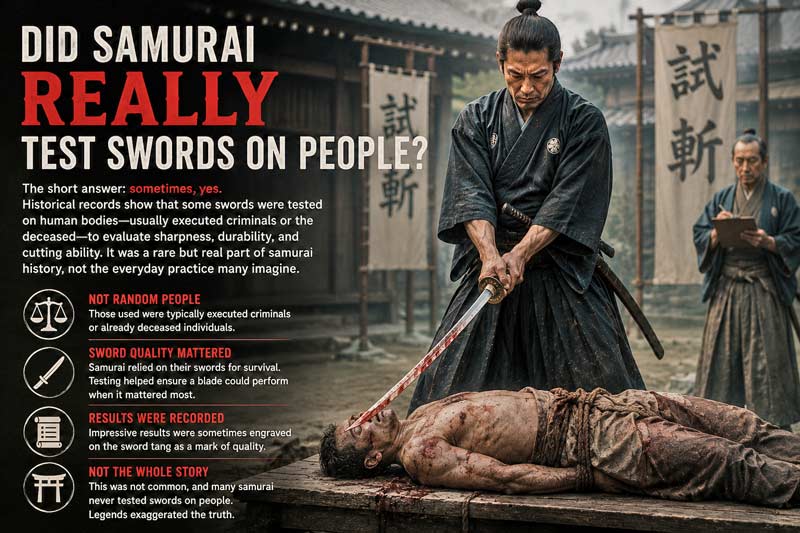
The uncomfortable answer is: sometimes, yes. Historical evidence suggests that certain swords were tested on human bodies during parts of feudal Japanese history. This practice is usually connected to tameshigiri, or test cutting, where blades were evaluated for sharpness, durability, and cutting ability. However, the reality was much more structured and limited than the shocking stories people often imagine.
In many cases, the bodies used for testing were reportedly those of executed criminals or deceased individuals rather than random people chosen by samurai. Historical records even describe official testers whose job was to evaluate sword performance. Some blades were carefully documented based on how many bodies they could cut through in a single strike, and particularly impressive results were sometimes engraved onto the sword tang, the hidden part of the blade inside the handle.
That said, not every samurai participated in this practice, and not every sword was tested this way. Much of what people imagine today comes from dramatic retellings that blur the line between rare historical practices and exaggerated legend. The idea of samurai casually testing swords on innocent people walking down the road is far closer to fiction than reality.
If anything, these stories reveal how seriously sword quality was taken in feudal Japan. Samurai depended heavily on their weapons, and a poorly made blade could have life-or-death consequences. Understanding that historical context helps explain why sword testing became part of samurai history, even if some of the darker stories have grown more dramatic over time.
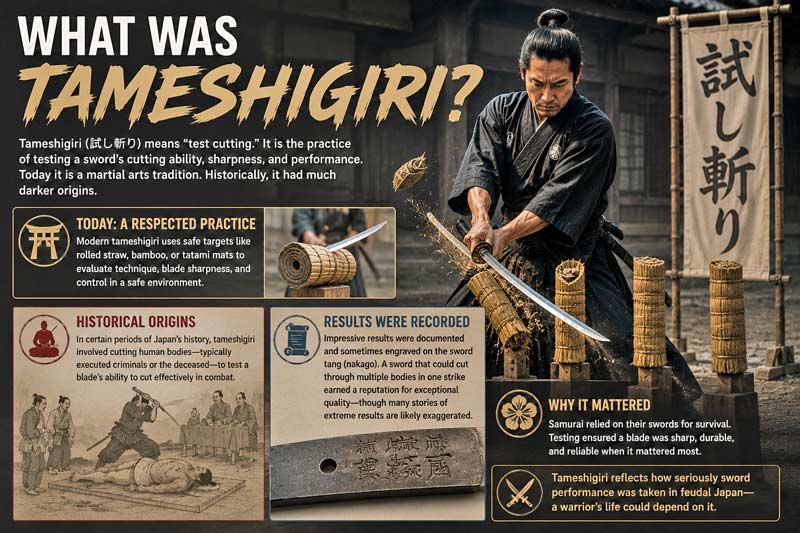
The practice most often connected to samurai sword testing is called tameshigiri, which roughly translates to "test cutting." Today, tameshigiri is a respected martial arts practice where practitioners test cutting ability on rolled straw mats, bamboo, or specially designed targets. It is often used to evaluate technique, blade sharpness, and control in a safe environment. But historically, the practice had much darker origins.
During certain periods of feudal Japan, tameshigiri could involve testing swords on human bodies, usually those of executed criminals or the deceased. The goal was to evaluate how effectively a blade cut and whether it could perform reliably in combat. Swordsmiths, samurai, and official testers sometimes treated this process seriously because a poorly made weapon could fail when someone's life depended on it.
Some historical records even describe formal testing methods. Particularly impressive cuts might be documented and engraved onto the sword tang, the hidden metal portion inside the handle. A sword that could reportedly cut through multiple bodies with a single strike might earn a reputation for exceptional craftsmanship, although stories about extreme results have likely been exaggerated over time.
Understanding tameshigiri helps explain why samurai swords gained such legendary reputations. Samurai placed enormous value on reliable weapons, especially high-quality blades like traditional samurai swords, because failure in battle could mean death. The testing methods may feel shocking today, but in historical context, they reflected how seriously sword performance was taken.
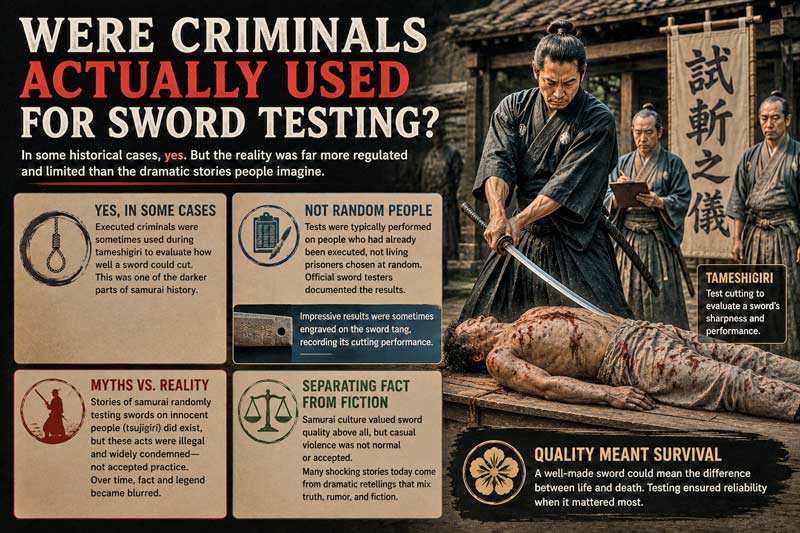
In some historical cases, yes. Records suggest that executed criminals were sometimes used during tameshigiri to evaluate how effectively a sword could cut. This is one of the darker parts of samurai history and a major reason the topic still sparks so much curiosity today. However, the reality was far more regulated and limited than the dramatic stories people often imagine.
Importantly, historians generally believe these tests were performed on people who had already been executed rather than living prisoners chosen at random. Official sword testers, known for evaluating blade performance, sometimes documented how well a sword cut through different parts of the body. In some cases, especially impressive results were engraved onto the sword tang, almost like a historical performance record.
That said, many of the more extreme stories have likely grown through retelling. Tales of samurai randomly testing swords on innocent people, sometimes called tsujigiri, did exist in historical accounts, but these actions were illegal and widely condemned rather than accepted practice. Over time, the line between rare crimes, formal sword testing, and legend became blurred.
Understanding this distinction matters because it separates historical reality from sensational myth. Samurai culture placed enormous value on sword quality, but that does not mean casual violence was normal or accepted. Much of what people picture today comes from dramatic retellings that combine fact, rumor, and Hollywood storytelling into one shocking narrative.
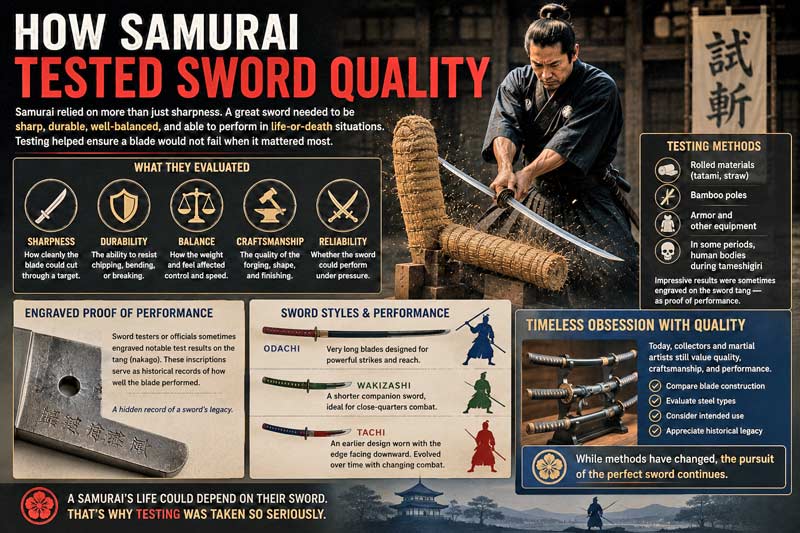
Sword testing in feudal Japan was not only about sharpness. Samurai and sword testers cared about durability, balance, craftsmanship, and whether a blade could perform reliably under pressure. A sword that chipped, bent, or failed during combat could cost someone their life, so quality mattered enormously. This is one reason Japanese swordsmithing became so respected and why certain blades gained legendary reputations.
In some cases, formal testers evaluated how cleanly a sword cut through specific targets. Historically, this might include rolled materials, bamboo, armor, or, in certain periods, human bodies during tameshigiri. Particularly impressive results were sometimes engraved onto the sword tang as proof of performance, almost like a historical quality certification hidden inside the handle.
Different sword styles may also have influenced performance depending on the situation. Longer blades such as the odachi were designed differently than shorter companion swords like the wakizashi. Even earlier designs such as the tachi sword evolved over time as combat styles changed.
Today, people are still fascinated by sword quality, although for very different reasons. Collectors and martial artists often compare blade construction, steel types, and intended use when looking at real vs decorative samurai swords. While modern buyers are obviously not testing swords the way feudal Japan sometimes did, the obsession with performance and craftsmanship has never fully disappeared.
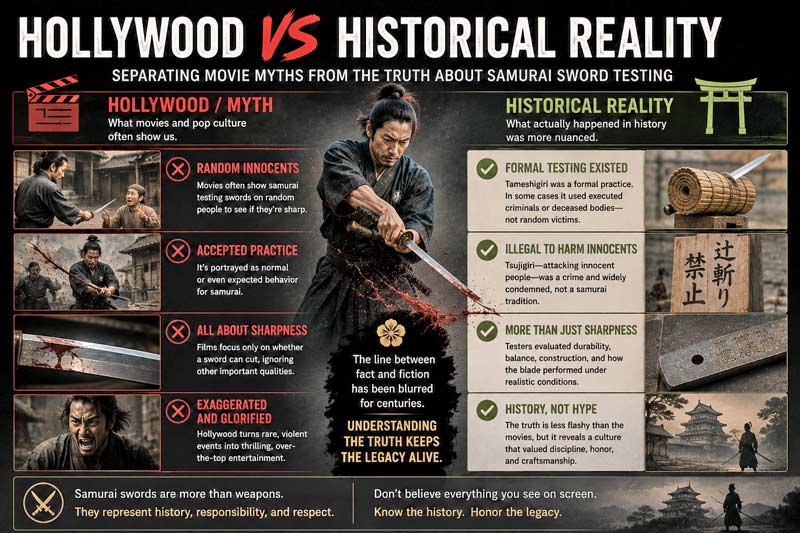
When most people picture samurai sword testing, they imagine something brutal and dramatic straight out of a movie. A wandering samurai pulls out a newly forged blade and tests it on an unlucky stranger to see if the sword is sharp enough. Scenes like this have appeared in films, video games, and television for decades, which is a big reason the story still feels believable today. But Hollywood tends to blur together very different parts of samurai history.
The reality is more complicated. Formal sword testing, or tameshigiri, did exist and in some historical cases involved executed criminals or deceased bodies. However, stories about samurai randomly attacking innocent people are often tied to a separate concept called tsujigiri, which referred to violent acts that were illegal and widely condemned. Over time, these very different ideas became mixed together, making the historical truth harder to separate from legend.
This is similar to many misconceptions surrounding Japanese swords in general. Pop culture often exaggerates how swords were made, used, and tested, which is one reason we previously explored some of the biggest myths about samurai swords. The real history is often less dramatic than the movies, but far more interesting once you understand the details.
Even today, movies continue shaping how people think about Japanese swords. Questions about blade quality, craftsmanship, and performance still fascinate collectors and martial artists, whether someone is comparing a samurai sword vs katana or simply learning more about how these legendary weapons were used.
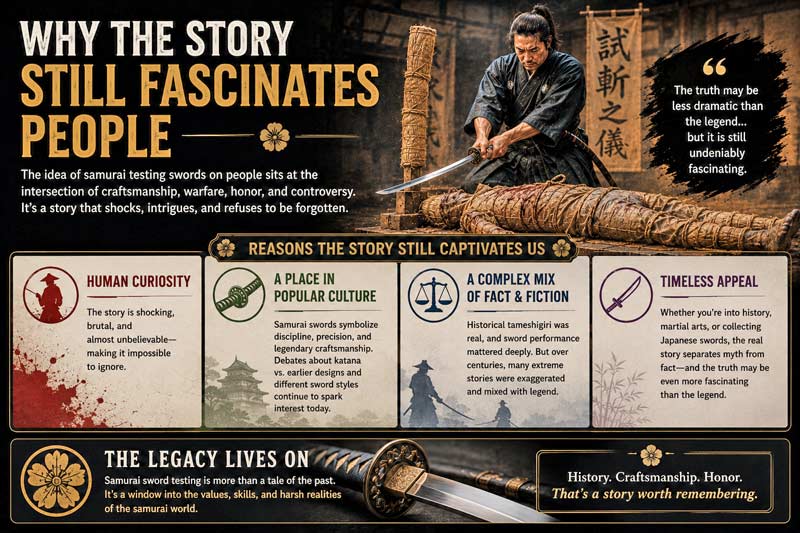
So why are people still so fascinated by the idea of samurai testing swords on people? Part of it is simple curiosity. The story feels shocking, brutal, and almost unbelievable, which makes it hard to ignore. Few historical topics sit at the intersection of craftsmanship, warfare, honor, and controversy quite like samurai swords.
Another reason is that samurai weapons continue to hold a special place in popular culture. Japanese swords are often seen as symbols of discipline, precision, and legendary craftsmanship. Whether someone is learning about ancient sword testing or simply comparing different blade styles, the mystery surrounding these weapons keeps drawing people in. Even debates about the difference between a katana and earlier designs still spark interest today, which is why topics like the samurai sword vs katana continue to fascinate collectors and history fans alike.
The truth behind sword testing may be less dramatic than Hollywood suggests, but it is still undeniably interesting. Historical tameshigiri was real, sword performance mattered deeply, and some dark practices did exist. At the same time, many of the most extreme stories have been exaggerated over centuries of retelling.
Whether you are interested in history, martial arts, or collecting modern swords, understanding the real story helps separate historical fact from myth. And in many ways, the truth about samurai sword testing may be even more fascinating than the legend itself.
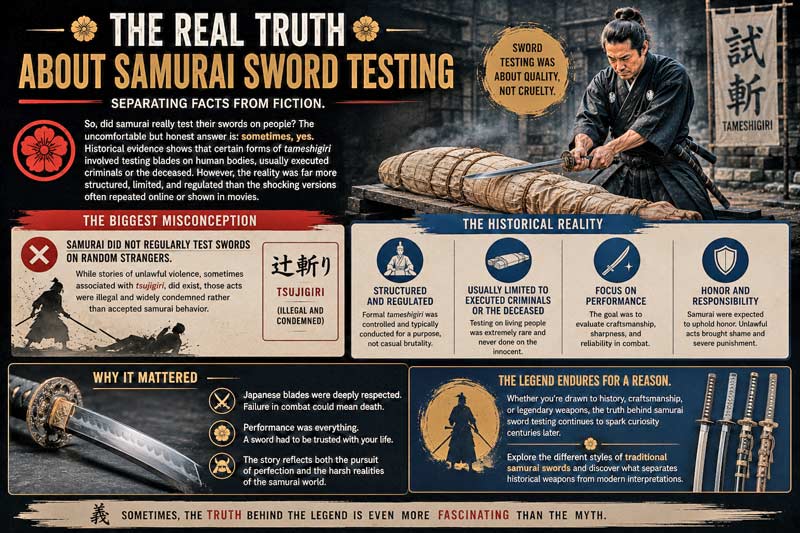
So, did samurai really test their swords on people? The uncomfortable but honest answer is: sometimes, yes. Historical evidence shows that certain forms of tameshigiri involved testing blades on human bodies, usually executed criminals or the deceased. However, the reality was far more structured, limited, and regulated than the shocking versions often repeated online or shown in movies.
The biggest misconception is that samurai regularly walked around testing new swords on random strangers. While stories of unlawful violence, sometimes associated with tsujigiri, did exist, those acts were illegal and widely condemned rather than accepted samurai behavior. Formal sword testing was more about evaluating craftsmanship, sharpness, and reliability than casual brutality.
In many ways, the story says just as much about sword craftsmanship as it does about samurai culture. Japanese blades were deeply respected, and performance mattered because failure in combat could mean death. Whether someone is fascinated by history, craftsmanship, or simply enjoys learning about legendary weapons, the story of samurai sword testing continues to spark curiosity centuries later.
If this topic has made you more curious about Japanese blades, it is worth exploring the different styles of traditional samurai swords and learning what separates historical weapons from modern interpretations. Sometimes, the truth behind the legend turns out to be even more interesting than the myth itself.
Usually no, at least not in the way movies often portray. Historical tameshigiri most commonly involved executed criminals or deceased bodies rather than random living people. The goal was to evaluate how well a blade performed, not casual violence. Sword testing was typically formal, documented, and tied to craftsmanship rather than cruelty.
That said, historical accounts of unlawful violence, sometimes associated with tsujigiri, do exist. These stories involved individuals reportedly attacking people to test a weapon, but such actions were illegal and widely condemned rather than accepted samurai behavior. Over time, movies and legends blurred together formal sword testing and criminal acts, which is why the myth remains so confusing today.
Sometimes, yes. In certain historical cases, especially impressive sword-testing results were engraved onto the sword tang, also called the nakago, which is the hidden metal portion inside the handle. These inscriptions could describe how well a blade performed during tameshigiri, including claims about how many bodies a sword reportedly cut through in a single strike.
These engravings were often treated almost like historical proof of performance and craftsmanship. A blade with documented cutting results could gain prestige and be seen as especially reliable or valuable. However, historians also caution that some inscriptions and stories may have been exaggerated over time, especially as legendary swords became more famous.
Today, surviving examples of engraved sword tangs remain fascinating to historians and collectors because they offer a rare glimpse into how seriously sword quality was taken in feudal Japan. They are also one reason samurai swords continue to carry such an air of mystery and reputation centuries later.
Mostly, but not exclusively. Tameshigiri is most closely associated with Japanese swords used by samurai, especially blades designed for combat where reliability mattered greatly. Since samurai depended heavily on their weapons, testing a blade's sharpness, durability, and cutting ability made practical sense. A sword that failed in battle could have deadly consequences.
That said, not every samurai sword was tested this way, and different sword styles may have been evaluated differently depending on their intended use. Longer weapons, companion swords, and earlier blade designs all served different purposes throughout Japanese history. Even the debate around what separates a katana from earlier sword styles still sparks interest today, which is one reason topics like the samurai sword vs katana continue to fascinate collectors and history enthusiasts.
Modern tameshigiri, of course, looks very different. Today it is primarily a martial arts practice focused on precision, technique, and control using safe cutting targets such as rolled tatami mats or bamboo rather than historical methods.
In some historical accounts, yes, although the stories are often exaggerated. Certain tameshigiri records describe swords reportedly cutting through multiple bodies in a single strike, and some of those results were even engraved onto the sword tang. These stories helped build the legendary reputation of Japanese blades and reinforced the idea that certain swords were exceptionally well made.
However, context matters. These tests were highly specific, involved controlled conditions, and often used deceased bodies placed in certain positions. The idea of samurai effortlessly slicing through multiple armored opponents in battle like a movie scene is far less realistic. Even excellent swords had limits, and real combat was unpredictable.
What these stories do show is how seriously sword performance was taken in feudal Japan. Samurai valued blades that were reliable, durable, and capable of cutting effectively because their lives could depend on them. While some legends have almost certainly grown over time, the craftsmanship behind high-quality Japanese swords was very real.
Sometimes, yes. A sword with documented tameshigiri results could gain prestige because it offered proof, or at least historical claims, about how well the blade performed. In some cases, successful cutting results were engraved onto the sword tang, which could increase a blade's reputation and make it more desirable to samurai, collectors, or wealthy owners of the time.
That said, value was not based only on cutting performance. Craftsmanship, the reputation of the swordsmith, materials, historical significance, and the condition of the blade all played major roles in determining worth. A beautifully made sword from a respected smith could still be highly prized even without documented testing results.
Today, collectors are often fascinated by swords connected to historical testing because they offer a glimpse into how seriously sword performance was taken in feudal Japan. However, authenticated history and provenance usually matter far more than dramatic legends alone.
Yes, in some cases. While tameshigiri is most famously associated with cutting bodies, swords could also be tested against armor, bamboo, rolled materials, or other tough targets to evaluate durability and cutting performance. Samurai needed weapons that could withstand real combat conditions, so understanding how a blade handled resistance mattered.
That said, there is a common misconception that samurai swords were designed to slice effortlessly through armor. In reality, Japanese armor was specifically made to offer protection, and even high-quality blades had limits. Combat was usually more about targeting vulnerable areas, technique, and timing rather than simply cutting through metal or armor plating.
Testing against difficult materials helped swordsmiths and warriors better understand a blade's strengths and weaknesses. Like many parts of samurai history, the reality was practical rather than magical, even if movies sometimes make legendary swords seem unstoppable.
Not exactly. Modern tameshigiri is very different from historical sword testing. Today, martial artists typically practice cutting using rolled tatami mats, bamboo, or specially designed targets to improve precision, technique, control, and understanding of blade movement. The focus is on skill development and safe training rather than evaluating a sword through harsh real-world conditions.
Historically, sword testing was often more focused on the blade itself. Samurai and official testers wanted to know whether a weapon could cut effectively and hold up under pressure because combat reliability mattered enormously. In some periods, that included much darker testing methods that would obviously be unacceptable today.
Modern practitioners still value sharpness and proper cutting technique, but the purpose has changed dramatically. Today, tameshigiri is generally about discipline, craftsmanship, and martial arts practice rather than proving whether a sword could survive battlefield use.
Sometimes, yes, especially if the sword was newly made, recently repaired, or particularly valuable. Samurai depended heavily on reliable weapons, so making sure a blade was sharp, balanced, and structurally sound could be extremely important. A sword failure during combat could have life-or-death consequences, which is one reason Japanese sword craftsmanship became so respected.
That said, formal tameshigiri was not something every samurai necessarily performed before every battle. Much depended on the sword, the owner, and the time period. Experienced warriors were likely already familiar with how their weapon handled through training and regular use.
In many cases, swordsmith reputation, prior testing, and battlefield experience probably mattered just as much as fresh testing. Like many parts of samurai history, practicality played a major role. Samurai needed weapons they trusted, not just weapons with dramatic stories attached to them.
There are historical stories suggesting this happened, but it was not considered normal or acceptable behavior. Some accounts describe acts called tsujigiri, where a person reportedly attacked strangers to test a newly acquired weapon. However, these incidents were illegal and widely condemned, not an accepted samurai tradition.
This is one reason the topic gets so confusing. Over time, people began blending together criminal acts, formal tameshigiri, and dramatic legends into one story. Historical sword testing did sometimes happen, but the idea of samurai casually killing random people to break in a new sword is far more myth than accepted reality.
One of the most famous examples involves blades tested during formal tameshigiri that reportedly cut through multiple bodies in a single strike. In some cases, the results were engraved directly onto the sword tang, creating a lasting historical record of how the blade supposedly performed. These inscriptions helped build the legendary reputation of certain swords and swordsmiths.
Among collectors and historians, swords connected to famous smiths such as Masamune or Muramasa often inspire the most discussion, although separating historical fact from legend can be difficult. Many famous stories surrounding sword performance have likely grown more dramatic through centuries of retelling.
In some cases, yes. Certain swords developed reputations for being cursed, unlucky, or connected to violence. One of the most famous examples involves blades made by the legendary swordsmith Muramasa, whose weapons became associated with bloodshed and misfortune in Japanese folklore. Stories claimed that Muramasa swords somehow encouraged violence or brought tragedy to their owners.
Whether people genuinely believed the swords were cursed depended on the time period and the individual. Some stories were likely shaped by politics, superstition, and reputation as much as reality. Still, the idea of cursed samurai swords remains one of the most fascinating parts of Japanese sword history and continues to inspire movies, books, and collectors today.
In certain circumstances, yes. High-quality Japanese swords were designed to cut efficiently, and historical tameshigiri records suggest some blades were capable of making extremely clean cuts. A sharp sword, skilled user, and favorable conditions could potentially result in a devastating strike.
However, movies often exaggerate what that looked like. Real combat was unpredictable, and cutting performance depended on technique, blade condition, resistance, and the situation. The idea of effortlessly slicing through multiple armored enemies with no resistance is much more fantasy than history. Like many samurai stories, the truth is impressive enough without Hollywood exaggeration.
Sometimes, at least according to legend. Certain blades became feared because of their reputation for sharpness, violence, or bad luck. Muramasa swords, in particular, developed a reputation for being dangerous, with stories claiming they encouraged reckless behavior or brought tragedy to the people who carried them.
In reality, a sword being "too dangerous" often had more to do with reputation than the blade itself. A weapon known for exceptional sharpness or connected to violent historical events could earn an almost mythical status over time. Whether the danger came from superstition or genuine fear, some swords clearly inspired more caution and fascination than others.
Sometimes, yes, especially famous or highly respected blades. Certain swords earned names because of their craftsmanship, battlefield history, unusual characteristics, or legendary stories connected to them. A sword might become known for surviving famous battles, belonging to an important samurai, or achieving an impressive reputation during testing.
That said, not every samurai walked around carrying a dramatically named weapon like something from a movie or anime. Many swords were practical tools used for combat and everyday life. The idea that every blade had a legendary personality or title is mostly a modern exaggeration, although some named swords truly became part of Japanese history.
There is no single, universally accepted answer, but several legendary swords are often mentioned. Blades made by famous swordsmiths such as Masamune and Muramasa are among the most discussed in Japanese history. Masamune swords are often praised for craftsmanship and balance, while Muramasa blades gained a darker reputation tied to violence and bloodshed.
In reality, the "deadliest" sword usually depended more on the person using it than the weapon itself. Training, skill, timing, and circumstance mattered far more than simply owning a famous blade. Still, the legends surrounding certain swords continue to fascinate collectors and history fans centuries later.
Where Did The Story Come From?
The idea that samurai tested swords on people usually comes from the historical practice of tameshigiri, which means test cutting. Today, that term is often associated with cutting rolled straw mats or other safe practice targets, but historically, sword testing could involve much darker methods. In some periods, blades were tested on bodies to judge how well they cut.
That does not mean every samurai was casually testing swords on people, and it does not mean every Japanese sword was proven this way. Like many parts of samurai history, the truth depends on the time period, the person involved, and the specific situation. Some sword testing was formalized, while other stories have likely been exaggerated over time.
Part of the confusion comes from the way samurai history gets retold. Movies and legends often focus on the most shocking details because they are memorable. A sword being tested on a criminal sounds far more dramatic than a blade being evaluated for balance, craftsmanship, or cutting ability. That is why the story has lasted so long, even when the full reality is more complicated.
This is similar to many other myths about samurai swords. There is often a real historical detail at the center, but the version people repeat today is usually simplified, exaggerated, or missing important context.
Did Samurai Really Test Swords On People?
The uncomfortable answer is: sometimes, yes. Historical evidence suggests that certain swords were tested on human bodies during parts of feudal Japanese history. This practice is usually connected to tameshigiri, or test cutting, where blades were evaluated for sharpness, durability, and cutting ability. However, the reality was much more structured and limited than the shocking stories people often imagine.
In many cases, the bodies used for testing were reportedly those of executed criminals or deceased individuals rather than random people chosen by samurai. Historical records even describe official testers whose job was to evaluate sword performance. Some blades were carefully documented based on how many bodies they could cut through in a single strike, and particularly impressive results were sometimes engraved onto the sword tang, the hidden part of the blade inside the handle.
That said, not every samurai participated in this practice, and not every sword was tested this way. Much of what people imagine today comes from dramatic retellings that blur the line between rare historical practices and exaggerated legend. The idea of samurai casually testing swords on innocent people walking down the road is far closer to fiction than reality.
If anything, these stories reveal how seriously sword quality was taken in feudal Japan. Samurai depended heavily on their weapons, and a poorly made blade could have life-or-death consequences. Understanding that historical context helps explain why sword testing became part of samurai history, even if some of the darker stories have grown more dramatic over time.
What Was Tameshigiri?
The practice most often connected to samurai sword testing is called tameshigiri, which roughly translates to "test cutting." Today, tameshigiri is a respected martial arts practice where practitioners test cutting ability on rolled straw mats, bamboo, or specially designed targets. It is often used to evaluate technique, blade sharpness, and control in a safe environment. But historically, the practice had much darker origins.
During certain periods of feudal Japan, tameshigiri could involve testing swords on human bodies, usually those of executed criminals or the deceased. The goal was to evaluate how effectively a blade cut and whether it could perform reliably in combat. Swordsmiths, samurai, and official testers sometimes treated this process seriously because a poorly made weapon could fail when someone's life depended on it.
Some historical records even describe formal testing methods. Particularly impressive cuts might be documented and engraved onto the sword tang, the hidden metal portion inside the handle. A sword that could reportedly cut through multiple bodies with a single strike might earn a reputation for exceptional craftsmanship, although stories about extreme results have likely been exaggerated over time.
Understanding tameshigiri helps explain why samurai swords gained such legendary reputations. Samurai placed enormous value on reliable weapons, especially high-quality blades like traditional samurai swords, because failure in battle could mean death. The testing methods may feel shocking today, but in historical context, they reflected how seriously sword performance was taken.
Were Criminals Actually Used For Sword Testing?
In some historical cases, yes. Records suggest that executed criminals were sometimes used during tameshigiri to evaluate how effectively a sword could cut. This is one of the darker parts of samurai history and a major reason the topic still sparks so much curiosity today. However, the reality was far more regulated and limited than the dramatic stories people often imagine.
Importantly, historians generally believe these tests were performed on people who had already been executed rather than living prisoners chosen at random. Official sword testers, known for evaluating blade performance, sometimes documented how well a sword cut through different parts of the body. In some cases, especially impressive results were engraved onto the sword tang, almost like a historical performance record.
That said, many of the more extreme stories have likely grown through retelling. Tales of samurai randomly testing swords on innocent people, sometimes called tsujigiri, did exist in historical accounts, but these actions were illegal and widely condemned rather than accepted practice. Over time, the line between rare crimes, formal sword testing, and legend became blurred.
Understanding this distinction matters because it separates historical reality from sensational myth. Samurai culture placed enormous value on sword quality, but that does not mean casual violence was normal or accepted. Much of what people picture today comes from dramatic retellings that combine fact, rumor, and Hollywood storytelling into one shocking narrative.
How Samurai Tested Sword Quality
Sword testing in feudal Japan was not only about sharpness. Samurai and sword testers cared about durability, balance, craftsmanship, and whether a blade could perform reliably under pressure. A sword that chipped, bent, or failed during combat could cost someone their life, so quality mattered enormously. This is one reason Japanese swordsmithing became so respected and why certain blades gained legendary reputations.
In some cases, formal testers evaluated how cleanly a sword cut through specific targets. Historically, this might include rolled materials, bamboo, armor, or, in certain periods, human bodies during tameshigiri. Particularly impressive results were sometimes engraved onto the sword tang as proof of performance, almost like a historical quality certification hidden inside the handle.
Different sword styles may also have influenced performance depending on the situation. Longer blades such as the odachi were designed differently than shorter companion swords like the wakizashi. Even earlier designs such as the tachi sword evolved over time as combat styles changed.
Today, people are still fascinated by sword quality, although for very different reasons. Collectors and martial artists often compare blade construction, steel types, and intended use when looking at real vs decorative samurai swords. While modern buyers are obviously not testing swords the way feudal Japan sometimes did, the obsession with performance and craftsmanship has never fully disappeared.
Hollywood Vs Historical Reality
When most people picture samurai sword testing, they imagine something brutal and dramatic straight out of a movie. A wandering samurai pulls out a newly forged blade and tests it on an unlucky stranger to see if the sword is sharp enough. Scenes like this have appeared in films, video games, and television for decades, which is a big reason the story still feels believable today. But Hollywood tends to blur together very different parts of samurai history.
The reality is more complicated. Formal sword testing, or tameshigiri, did exist and in some historical cases involved executed criminals or deceased bodies. However, stories about samurai randomly attacking innocent people are often tied to a separate concept called tsujigiri, which referred to violent acts that were illegal and widely condemned. Over time, these very different ideas became mixed together, making the historical truth harder to separate from legend.
This is similar to many misconceptions surrounding Japanese swords in general. Pop culture often exaggerates how swords were made, used, and tested, which is one reason we previously explored some of the biggest myths about samurai swords. The real history is often less dramatic than the movies, but far more interesting once you understand the details.
Even today, movies continue shaping how people think about Japanese swords. Questions about blade quality, craftsmanship, and performance still fascinate collectors and martial artists, whether someone is comparing a samurai sword vs katana or simply learning more about how these legendary weapons were used.
Why The Story Still Fascinates People
So why are people still so fascinated by the idea of samurai testing swords on people? Part of it is simple curiosity. The story feels shocking, brutal, and almost unbelievable, which makes it hard to ignore. Few historical topics sit at the intersection of craftsmanship, warfare, honor, and controversy quite like samurai swords.
Another reason is that samurai weapons continue to hold a special place in popular culture. Japanese swords are often seen as symbols of discipline, precision, and legendary craftsmanship. Whether someone is learning about ancient sword testing or simply comparing different blade styles, the mystery surrounding these weapons keeps drawing people in. Even debates about the difference between a katana and earlier designs still spark interest today, which is why topics like the samurai sword vs katana continue to fascinate collectors and history fans alike.
The truth behind sword testing may be less dramatic than Hollywood suggests, but it is still undeniably interesting. Historical tameshigiri was real, sword performance mattered deeply, and some dark practices did exist. At the same time, many of the most extreme stories have been exaggerated over centuries of retelling.
Whether you are interested in history, martial arts, or collecting modern swords, understanding the real story helps separate historical fact from myth. And in many ways, the truth about samurai sword testing may be even more fascinating than the legend itself.
The Real Truth About Samurai Sword Testing
So, did samurai really test their swords on people? The uncomfortable but honest answer is: sometimes, yes. Historical evidence shows that certain forms of tameshigiri involved testing blades on human bodies, usually executed criminals or the deceased. However, the reality was far more structured, limited, and regulated than the shocking versions often repeated online or shown in movies.
The biggest misconception is that samurai regularly walked around testing new swords on random strangers. While stories of unlawful violence, sometimes associated with tsujigiri, did exist, those acts were illegal and widely condemned rather than accepted samurai behavior. Formal sword testing was more about evaluating craftsmanship, sharpness, and reliability than casual brutality.
In many ways, the story says just as much about sword craftsmanship as it does about samurai culture. Japanese blades were deeply respected, and performance mattered because failure in combat could mean death. Whether someone is fascinated by history, craftsmanship, or simply enjoys learning about legendary weapons, the story of samurai sword testing continues to spark curiosity centuries later.
If this topic has made you more curious about Japanese blades, it is worth exploring the different styles of traditional samurai swords and learning what separates historical weapons from modern interpretations. Sometimes, the truth behind the legend turns out to be even more interesting than the myth itself.
Did Samurai Really Test Swords On Living People?
Usually no, at least not in the way movies often portray. Historical tameshigiri most commonly involved executed criminals or deceased bodies rather than random living people. The goal was to evaluate how well a blade performed, not casual violence. Sword testing was typically formal, documented, and tied to craftsmanship rather than cruelty.
That said, historical accounts of unlawful violence, sometimes associated with tsujigiri, do exist. These stories involved individuals reportedly attacking people to test a weapon, but such actions were illegal and widely condemned rather than accepted samurai behavior. Over time, movies and legends blurred together formal sword testing and criminal acts, which is why the myth remains so confusing today.
Did Samurai Really Engrave Test Results On Their Swords?
Sometimes, yes. In certain historical cases, especially impressive sword-testing results were engraved onto the sword tang, also called the nakago, which is the hidden metal portion inside the handle. These inscriptions could describe how well a blade performed during tameshigiri, including claims about how many bodies a sword reportedly cut through in a single strike.
These engravings were often treated almost like historical proof of performance and craftsmanship. A blade with documented cutting results could gain prestige and be seen as especially reliable or valuable. However, historians also caution that some inscriptions and stories may have been exaggerated over time, especially as legendary swords became more famous.
Today, surviving examples of engraved sword tangs remain fascinating to historians and collectors because they offer a rare glimpse into how seriously sword quality was taken in feudal Japan. They are also one reason samurai swords continue to carry such an air of mystery and reputation centuries later.
Was Tameshigiri Only Used For Samurai Swords?
Mostly, but not exclusively. Tameshigiri is most closely associated with Japanese swords used by samurai, especially blades designed for combat where reliability mattered greatly. Since samurai depended heavily on their weapons, testing a blade's sharpness, durability, and cutting ability made practical sense. A sword that failed in battle could have deadly consequences.
That said, not every samurai sword was tested this way, and different sword styles may have been evaluated differently depending on their intended use. Longer weapons, companion swords, and earlier blade designs all served different purposes throughout Japanese history. Even the debate around what separates a katana from earlier sword styles still sparks interest today, which is one reason topics like the samurai sword vs katana continue to fascinate collectors and history enthusiasts.
Modern tameshigiri, of course, looks very different. Today it is primarily a martial arts practice focused on precision, technique, and control using safe cutting targets such as rolled tatami mats or bamboo rather than historical methods.
Were Samurai Swords Really Sharp Enough To Cut Through Multiple People?
In some historical accounts, yes, although the stories are often exaggerated. Certain tameshigiri records describe swords reportedly cutting through multiple bodies in a single strike, and some of those results were even engraved onto the sword tang. These stories helped build the legendary reputation of Japanese blades and reinforced the idea that certain swords were exceptionally well made.
However, context matters. These tests were highly specific, involved controlled conditions, and often used deceased bodies placed in certain positions. The idea of samurai effortlessly slicing through multiple armored opponents in battle like a movie scene is far less realistic. Even excellent swords had limits, and real combat was unpredictable.
What these stories do show is how seriously sword performance was taken in feudal Japan. Samurai valued blades that were reliable, durable, and capable of cutting effectively because their lives could depend on them. While some legends have almost certainly grown over time, the craftsmanship behind high-quality Japanese swords was very real.
Did Samurai Sword Testing Make A Blade More Valuable?
Sometimes, yes. A sword with documented tameshigiri results could gain prestige because it offered proof, or at least historical claims, about how well the blade performed. In some cases, successful cutting results were engraved onto the sword tang, which could increase a blade's reputation and make it more desirable to samurai, collectors, or wealthy owners of the time.
That said, value was not based only on cutting performance. Craftsmanship, the reputation of the swordsmith, materials, historical significance, and the condition of the blade all played major roles in determining worth. A beautifully made sword from a respected smith could still be highly prized even without documented testing results.
Today, collectors are often fascinated by swords connected to historical testing because they offer a glimpse into how seriously sword performance was taken in feudal Japan. However, authenticated history and provenance usually matter far more than dramatic legends alone.
Did Samurai Ever Test Swords On Armor?
Yes, in some cases. While tameshigiri is most famously associated with cutting bodies, swords could also be tested against armor, bamboo, rolled materials, or other tough targets to evaluate durability and cutting performance. Samurai needed weapons that could withstand real combat conditions, so understanding how a blade handled resistance mattered.
That said, there is a common misconception that samurai swords were designed to slice effortlessly through armor. In reality, Japanese armor was specifically made to offer protection, and even high-quality blades had limits. Combat was usually more about targeting vulnerable areas, technique, and timing rather than simply cutting through metal or armor plating.
Testing against difficult materials helped swordsmiths and warriors better understand a blade's strengths and weaknesses. Like many parts of samurai history, the reality was practical rather than magical, even if movies sometimes make legendary swords seem unstoppable.
Did Samurai Practice Sword Testing The Way Martial Artists Do Today?
Not exactly. Modern tameshigiri is very different from historical sword testing. Today, martial artists typically practice cutting using rolled tatami mats, bamboo, or specially designed targets to improve precision, technique, control, and understanding of blade movement. The focus is on skill development and safe training rather than evaluating a sword through harsh real-world conditions.
Historically, sword testing was often more focused on the blade itself. Samurai and official testers wanted to know whether a weapon could cut effectively and hold up under pressure because combat reliability mattered enormously. In some periods, that included much darker testing methods that would obviously be unacceptable today.
Modern practitioners still value sharpness and proper cutting technique, but the purpose has changed dramatically. Today, tameshigiri is generally about discipline, craftsmanship, and martial arts practice rather than proving whether a sword could survive battlefield use.
Were Samurai Swords Tested Before Battle?
Sometimes, yes, especially if the sword was newly made, recently repaired, or particularly valuable. Samurai depended heavily on reliable weapons, so making sure a blade was sharp, balanced, and structurally sound could be extremely important. A sword failure during combat could have life-or-death consequences, which is one reason Japanese sword craftsmanship became so respected.
That said, formal tameshigiri was not something every samurai necessarily performed before every battle. Much depended on the sword, the owner, and the time period. Experienced warriors were likely already familiar with how their weapon handled through training and regular use.
In many cases, swordsmith reputation, prior testing, and battlefield experience probably mattered just as much as fresh testing. Like many parts of samurai history, practicality played a major role. Samurai needed weapons they trusted, not just weapons with dramatic stories attached to them.
Did Samurai Ever Kill Someone Just To Test A New Sword?
There are historical stories suggesting this happened, but it was not considered normal or acceptable behavior. Some accounts describe acts called tsujigiri, where a person reportedly attacked strangers to test a newly acquired weapon. However, these incidents were illegal and widely condemned, not an accepted samurai tradition.
This is one reason the topic gets so confusing. Over time, people began blending together criminal acts, formal tameshigiri, and dramatic legends into one story. Historical sword testing did sometimes happen, but the idea of samurai casually killing random people to break in a new sword is far more myth than accepted reality.
What Was The Most Famous Sword Test In Samurai History?
One of the most famous examples involves blades tested during formal tameshigiri that reportedly cut through multiple bodies in a single strike. In some cases, the results were engraved directly onto the sword tang, creating a lasting historical record of how the blade supposedly performed. These inscriptions helped build the legendary reputation of certain swords and swordsmiths.
Among collectors and historians, swords connected to famous smiths such as Masamune or Muramasa often inspire the most discussion, although separating historical fact from legend can be difficult. Many famous stories surrounding sword performance have likely grown more dramatic through centuries of retelling.
Did Samurai Really Believe Some Swords Were Cursed?
In some cases, yes. Certain swords developed reputations for being cursed, unlucky, or connected to violence. One of the most famous examples involves blades made by the legendary swordsmith Muramasa, whose weapons became associated with bloodshed and misfortune in Japanese folklore. Stories claimed that Muramasa swords somehow encouraged violence or brought tragedy to their owners.
Whether people genuinely believed the swords were cursed depended on the time period and the individual. Some stories were likely shaped by politics, superstition, and reputation as much as reality. Still, the idea of cursed samurai swords remains one of the most fascinating parts of Japanese sword history and continues to inspire movies, books, and collectors today.
Could A Samurai Sword Really Cut Through A Body In One Strike?
In certain circumstances, yes. High-quality Japanese swords were designed to cut efficiently, and historical tameshigiri records suggest some blades were capable of making extremely clean cuts. A sharp sword, skilled user, and favorable conditions could potentially result in a devastating strike.
However, movies often exaggerate what that looked like. Real combat was unpredictable, and cutting performance depended on technique, blade condition, resistance, and the situation. The idea of effortlessly slicing through multiple armored enemies with no resistance is much more fantasy than history. Like many samurai stories, the truth is impressive enough without Hollywood exaggeration.
Were Some Samurai Swords Considered Too Dangerous To Use?
Sometimes, at least according to legend. Certain blades became feared because of their reputation for sharpness, violence, or bad luck. Muramasa swords, in particular, developed a reputation for being dangerous, with stories claiming they encouraged reckless behavior or brought tragedy to the people who carried them.
In reality, a sword being "too dangerous" often had more to do with reputation than the blade itself. A weapon known for exceptional sharpness or connected to violent historical events could earn an almost mythical status over time. Whether the danger came from superstition or genuine fear, some swords clearly inspired more caution and fascination than others.
Did Samurai Really Name Their Swords?
Sometimes, yes, especially famous or highly respected blades. Certain swords earned names because of their craftsmanship, battlefield history, unusual characteristics, or legendary stories connected to them. A sword might become known for surviving famous battles, belonging to an important samurai, or achieving an impressive reputation during testing.
That said, not every samurai walked around carrying a dramatically named weapon like something from a movie or anime. Many swords were practical tools used for combat and everyday life. The idea that every blade had a legendary personality or title is mostly a modern exaggeration, although some named swords truly became part of Japanese history.
What Was The Deadliest Samurai Sword Ever Made?
There is no single, universally accepted answer, but several legendary swords are often mentioned. Blades made by famous swordsmiths such as Masamune and Muramasa are among the most discussed in Japanese history. Masamune swords are often praised for craftsmanship and balance, while Muramasa blades gained a darker reputation tied to violence and bloodshed.
In reality, the "deadliest" sword usually depended more on the person using it than the weapon itself. Training, skill, timing, and circumstance mattered far more than simply owning a famous blade. Still, the legends surrounding certain swords continue to fascinate collectors and history fans centuries later.
You May Also Be Interested In:
- Real vs. Decorative Samurai Swords: What You Need to Know
- The Biggest Myths About Samurai Swords
- A Visual Guide to Japanese Swords: The Blades of the Samurai Era
- How Long Does It REALLY Take to Get a Black Belt? (The Answer Surprises Most People)
- Foam Practice Swords vs Wooden Swords: Which Is Better?
- Expandable Bo Staff Review & Strength Test
- Spring-Loaded Baton Review & Strength Test
- Unique Weapons Put to the Test: From Mall Ninja to Modern Tactical!
- Samurai Sword vs Katana: What's the Difference?
- Could a Samurai Actually Defeat a Medieval Knight?
Leave a Reply