



The Meteor Hammer: The Deadliest Weapon Almost Nobody Could Master
July 22nd, 2026
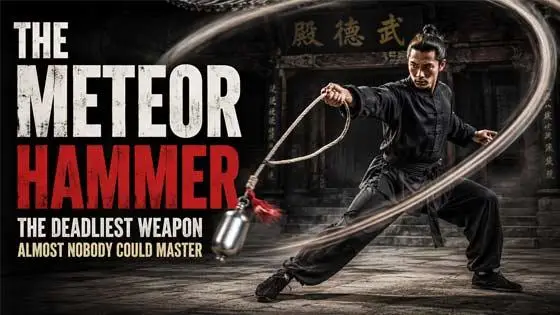
Some weapons became legendary because they were easy to use. Others earned a fearsome reputation because they could cut through armor or dominate a battlefield. The meteor hammer became famous for a completely different reason. It was one of the few weapons that was so incredibly difficult to master that even experienced martial artists often avoided it. A simple length of rope with a heavy metal weight on the end doesn't look particularly intimidating, but in the hands of a skilled practitioner, it could strike from impossible angles, wrap around defenses, and generate tremendous force. Even today, the meteor hammer remains one of the most mesmerizing and misunderstood martial arts weapons ever created.
What Is a Meteor Hammer?
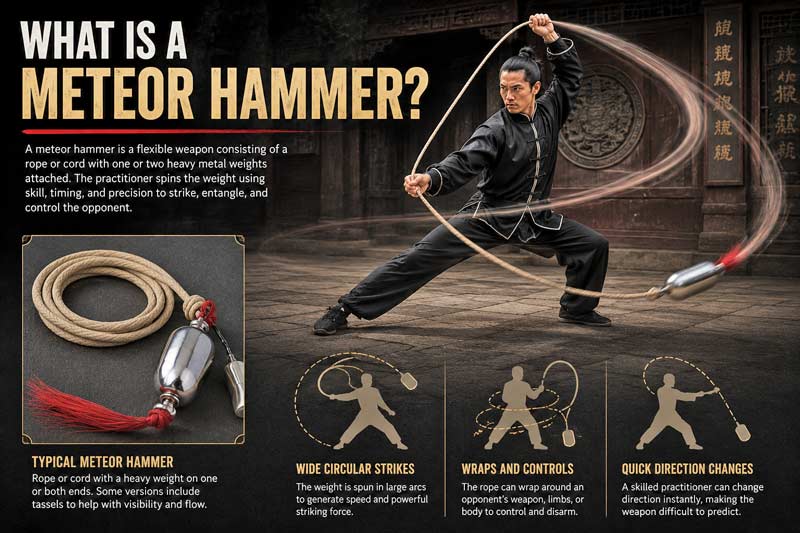
At first glance, a meteor hammer doesn't look like much. Unlike a sword, spear, or staff, it has no rigid frame or cutting edge. In its simplest form, it consists of a long rope or cord with one or two heavy metal weights attached to the ends. Some versions feature polished steel weights, while others use decorative brass or iron weights with colorful tassels that help the user track the weapon's movement during practice.
What makes the meteor hammer unique is that the rope itself is part of the weapon. Instead of gripping a handle, the practitioner controls the spinning weight by manipulating the cord with both hands, allowing the weapon to accelerate through wide circles, wrap around the body, and change direction in an instant. A skilled user can strike from surprising angles, redirect the weapon after a miss, or even use the rope to entangle an opponent's weapon or limbs before launching another attack.
The weapon traces its origins to China, where it became part of traditional martial arts rather than a standard battlefield weapon. While stories often exaggerate its use in warfare, the meteor hammer found a lasting home in kung fu systems that emphasized coordination, timing, and fluid movement. Because it demands exceptional precision, it has long been regarded as one of the most difficult flexible weapons to master.
Today, the meteor hammer is most often seen in martial arts demonstrations and advanced weapons training. Watching an expert perform with one is unforgettable. The heavy weight blurs through the air in continuous circles, wraps effortlessly around the body without causing injury, and seems to defy physics as it changes direction at full speed. That combination of beauty and danger is exactly why the meteor hammer continues to fascinate martial artists centuries after it first appeared.
Why the Meteor Hammer Was So Difficult to Master
Most weapons become safer and more predictable once the user develops proper technique. The meteor hammer presents a different problem. The moment its weight begins moving, it stores momentum that must be controlled continuously. A small mistake does not simply cause the strike to miss. It can send the weight rebounding toward the person swinging it.
This danger is built into the weapon's design. A sword stops when the wielder stops moving the blade, but a meteor hammer keeps traveling until its momentum is redirected or absorbed. The practitioner must anticipate where the weight will be a moment later, guide the rope without tangling it, and remain aware of the weapon even when it disappears behind the body. Hesitation at the wrong moment can be just as dangerous as moving too quickly.
Advanced techniques make that challenge even greater. Practitioners may guide the rope across the arms, shoulders, waist, or legs to change the weapon's direction without stopping its motion. These movements can make the meteor hammer appear almost weightless, but every transition depends on exact timing. If the rope catches in the wrong place or the weight follows an unexpected path, the user has very little time to recover.
The weapon also demands an unusual combination of strength and sensitivity. The user must generate enough speed to make the weight effective while still feeling subtle changes in tension through the rope. Too little force makes the weapon sluggish. Too much force makes it difficult to control. Mastery comes from finding the narrow balance between those extremes.
That is why the meteor hammer was never a practical beginner's weapon. It required patience, spatial awareness, coordination, and countless hours of repetition before its most impressive techniques could be attempted safely. The same difficulty that kept most people from mastering it is also what made a genuine expert so mesmerizing to watch.
Did the Meteor Hammer Actually Work in Combat?
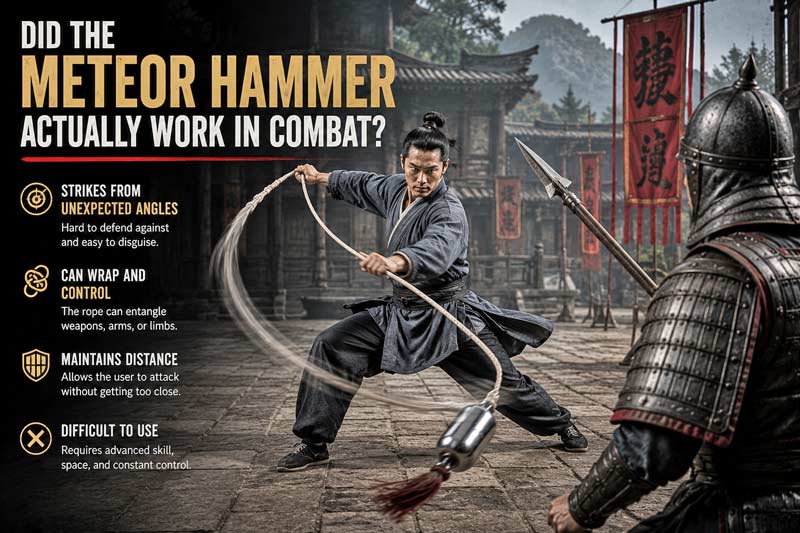
This is where the meteor hammer's reputation often grows larger than its historical record. Movies and martial arts demonstrations sometimes portray it as an unstoppable battlefield weapon capable of defeating multiple opponents with ease. While it was certainly dangerous in skilled hands, there is little evidence that it was ever widely used as a primary weapon by organized armies.
That doesn't mean it was ineffective. The meteor hammer offered several advantages that conventional weapons did not. Its flexible design allowed it to strike around shields, attack from unexpected angles, and maintain distance from an opponent. A skilled practitioner could also use the rope to wrap around an enemy's weapon or limbs, creating opportunities that a rigid weapon simply couldn't provide.
Its greatest weakness was the same thing that made it so fascinating. The weapon required constant movement and precise control. In the chaos of a battlefield filled with spears, arrows, and tightly packed soldiers, there was very little room to swing a long rope with a heavy weight attached. One mistake could leave the user vulnerable or even result in striking themselves or an ally nearby.
Because of those limitations, the meteor hammer found a more natural home in martial arts training, individual combat techniques, and performance traditions than in large-scale warfare. It became a weapon that showcased extraordinary skill rather than one issued to ordinary soldiers. That distinction has helped preserve its mystique. Even today, watching an expert wield a meteor hammer feels less like watching someone use a weapon and more like watching someone perform an impossible feat of coordination.
How the Meteor Hammer Could Strike from Impossible Angles
A conventional weapon usually attacks along a path the opponent can see. A sword cuts from the direction of the wielder's arms. A spear thrusts forward from the shaft. The meteor hammer was far less predictable because the weighted end could continue traveling even while the user changed position, redirected the rope, or turned away from the target.
Experienced practitioners could guide the rope around the shoulders, waist, arms, or legs to alter the hammer's path without bringing it to a complete stop. This allowed the weapon to reverse direction suddenly, rise from below, or curve around the edge of a shield. To an opponent unfamiliar with flexible weapons, the strike could appear to come from nowhere.
The rope also gave the meteor hammer a deceptive rhythm. A fighter might begin with wide, obvious circles before shortening the rope and accelerating the weight into a much tighter attack. The apparent distance between the two fighters could change in an instant, making it difficult to judge when the weapon was truly within striking range.
Some techniques used the ground as part of the attack. The weighted end could be bounced, dragged, or redirected after striking a hard surface, creating a second path that was even harder to anticipate. These movements were extremely risky and demanded precise timing, but they reveal why the weapon became so closely associated with surprise and misdirection.
The meteor hammer was not dangerous because it was stronger than every sword or spear. It was dangerous because it did not behave like them. Its ability to attack from changing angles forced an opponent to defend against the path of the weight, the position of the rope, and the movements of the person controlling both.
Why the Meteor Hammer Nearly Disappeared
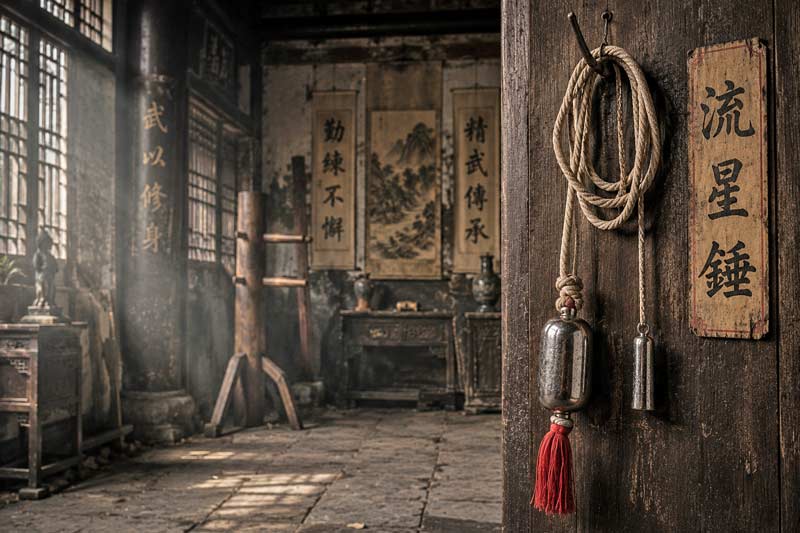
Many ancient weapons gradually faded away as warfare evolved, but the meteor hammer faced an even greater obstacle. It wasn't replaced simply because better weapons existed. It disappeared because almost nobody was willing to invest the years of practice required to use it effectively.
As firearms became more common and organized armies standardized their equipment, there was little reason to train soldiers on an exceptionally difficult flexible weapon. Spears, swords, and later rifles could be taught more quickly and used more consistently by large numbers of people. The meteor hammer offered impressive possibilities, but only after an enormous investment of time.
Its survival depended largely on martial arts schools, where preserving traditional skills became just as important as preparing for combat. Over time, the weapon evolved from something that might have practical applications into one that demonstrated discipline, coordination, and technical mastery. Public demonstrations and martial arts competitions helped keep its techniques alive long after its military value had faded.
Today, the meteor hammer remains one of the rarest traditional Chinese weapons to encounter outside of specialized martial arts communities. Most people will never see one used in person, and even many experienced martial artists have never trained with one. That rarity only adds to its mystique. When someone demonstrates genuine control over a meteor hammer, audiences quickly understand they are watching a skill that few people in the world have ever developed.
In a way, the meteor hammer's greatest legacy isn't the battles it may have fought. It's the incredible level of dedication required to master it. Centuries after its practical use declined, it continues to captivate people for the same reason it always has: it looks almost impossible to control until someone proves otherwise.
Why the Meteor Hammer Still Fascinates Martial Artists Today
Despite centuries of changing weapons and military technology, the meteor hammer refuses to disappear. While it is rarely seen outside traditional kung fu schools, demonstrations featuring skilled practitioners continue to attract millions of views online because the weapon simply doesn't look real. Its fluid movements blur the line between combat, athleticism, and performance in a way that few other weapons can match.
Part of that fascination comes from how different it is from almost every other traditional weapon. Most people instinctively understand how a sword, spear, or staff works after watching it for a few seconds. The meteor hammer is different. The weight seems to move independently of the person controlling it, changing speed and direction so quickly that it almost appears to have a mind of its own.
Modern practitioners value the weapon for more than its visual appeal. Training with a meteor hammer develops coordination, timing, body awareness, and precision that carry over into many other areas of martial arts. Even students who never intend to use the weapon in combat often practice it because few training tools demand such complete control over movement.
If you're curious to experience one yourself, modern meteor hammers are still available for martial arts practice and demonstrations. They're also part of a much larger tradition of kung fu weapons that have been preserved through generations of dedicated practitioners. While mastering a meteor hammer still requires patience and countless hours of training, that's exactly what has made it one of the most respected and unforgettable weapons in martial arts history.
In the end, the meteor hammer isn't remembered because it conquered battlefields. It's remembered because it challenged the limits of human coordination. Hundreds of years after it first appeared, it remains one of the few weapons that can leave experienced martial artists just as impressed as complete beginners.
FAQ: Was the Meteor Hammer Actually Used in War?
Historical evidence suggests that the meteor hammer was used far less often on the battlefield than movies and martial arts legends might imply. While it almost certainly saw use in individual combat and may have been carried by some highly skilled fighters, there is little evidence that it was ever widely issued to soldiers or adopted as a standard military weapon.
The weapon's greatest strength, its unpredictable movement, was also its greatest weakness in large formations. Swinging a weighted rope required space, concentration, and exceptional skill, making it far less practical than spears, swords, or polearms in the chaos of organized warfare.
Today, the meteor hammer is remembered less as a battlefield weapon and more as one of the most technically demanding traditional Chinese martial arts weapons ever created. Its rarity and difficulty are part of what continue to make it so fascinating.
FAQ: Is the Meteor Hammer the Hardest Martial Arts Weapon to Learn?
Many martial artists consider the meteor hammer to be one of the most difficult traditional weapons to master, although calling it the single hardest is a matter of opinion. Unlike rigid weapons that move exactly where you direct them, a meteor hammer has its own momentum. Once the weight is in motion, you have to guide it rather than simply swing it.
Beginners often struggle with timing, distance, and keeping the weight from striking themselves. Learning basic spins can take weeks, while advanced techniques involving wraps, rebounds, and rapid direction changes may require years of dedicated practice.
That challenge is precisely why the weapon has earned so much respect within the martial arts community. Successfully controlling a meteor hammer demonstrates exceptional coordination, precision, and body awareness, making it one of the most rewarding weapons for practitioners willing to invest the time to learn it.
FAQ: What's the Difference Between a Meteor Hammer and a Rope Dart?
Although they're often confused, the meteor hammer and the rope dart are two distinct Chinese martial arts weapons. A traditional meteor hammer typically uses one or two heavy metal weights attached to a rope or chain, relying on momentum to deliver powerful strikes and wraps. A rope dart, on the other hand, features a single pointed metal dart designed for thrusting and piercing techniques as well as long-range attacks.
Their training methods are also different. Meteor hammer techniques emphasize circular motion, continuous momentum, and controlling the weight through spins, rebounds, and wraps. Rope dart practitioners focus more on precision, accuracy, and extending the dart toward specific targets before quickly retracting it.
Both weapons require exceptional coordination and years of practice, but they create very different fighting styles. The meteor hammer overwhelms opponents with unpredictable swinging attacks, while the rope dart relies on speed, reach, and precise point control. Although they share some similarities as flexible weapons, they are separate disciplines with their own techniques and traditions.
FAQ: Is It Legal to Own a Meteor Hammer?
In most places, yes. A meteor hammer is generally legal to own because it is considered a martial arts training weapon or collectible rather than a prohibited weapon. However, laws can vary significantly depending on your country, state, or even local municipality, so it's always wise to check the regulations where you live before purchasing or carrying one.
Even where ownership is legal, carrying a meteor hammer in public is a different matter. Because it can be viewed as a weapon, bringing one into public spaces, schools, government buildings, or other restricted areas may violate local laws. Responsible owners typically use meteor hammers only for martial arts practice, demonstrations, or display.
If you're interested in learning this unique weapon, the safest approach is to purchase a training-quality meteor hammer, practice in an appropriate setting, and become familiar with the laws that apply in your area before transporting or using it outside your home or martial arts school.
FAQ: Do Any Martial Arts Schools Still Teach the Meteor Hammer?
Yes, although they're relatively uncommon. The meteor hammer is still taught in some traditional Chinese kung fu schools, particularly those that preserve classical weapons training. Because it is one of the most advanced flexible weapons, students are usually expected to master more basic weapons, such as the staff, broadsword, or spear, before learning the meteor hammer.
Outside of traditional schools, the weapon has also found a following among martial arts performers and practitioners who enjoy its dramatic, flowing movements. Demonstrations at tournaments and cultural exhibitions have helped introduce the meteor hammer to new audiences, even if relatively few people ever attempt to master it themselves.
For most martial artists, learning the meteor hammer isn't about preparing for combat. It's about preserving an extraordinary piece of martial arts history while developing coordination, timing, and control that few other weapons can teach. That combination of history, skill, and visual spectacle is why the meteor hammer continues to captivate practitioners around the world.
You May Also Be Interested In:
- Deadliest Kung Fu Weapon Challenge
- The Mental Game: Master Your Training Time
- Bo Staff Techniques for Beginners: How to Master Balance and Control
- Our Five Deadliest Ninja Weapons
- Why the War Hammer Was More Dangerous Than the Sword
- Combat War Hammer and Other Lethal Weapons!
- We Tested the Deadliest Ninja Stars!
- Tactical War Hammer and Other Deadly Weapons!
- Tactical War Hammer and Other Dangerous Weapons | Ian's Top Picks
- Deadliest Throwing Weapons for Your Ninja Arsenal
Leave a Reply