



The Strange History of the Blowgun
July 24th, 2026
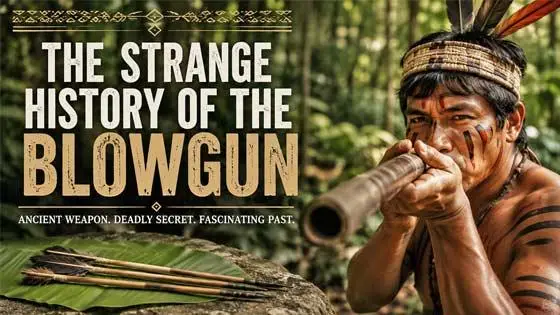
Long before rifles, bows, or even crossbows dominated the battlefield, one of the world's most surprisingly effective weapons was little more than a hollow tube and a carefully crafted dart. Silent, lightweight, and remarkably accurate in skilled hands, the blowgun allowed hunters to strike prey without revealing their location, making it one of history's most ingenious projectile weapons. Although it's often portrayed in movies as an exotic weapon that fired poisoned darts with supernatural precision, the real story of the blowgun is even more fascinating.
Used by indigenous cultures across South America, Southeast Asia, and beyond, blowguns were developed independently by different civilizations that recognized the advantages of a weapon powered entirely by human breath. Some were used primarily for hunting, while others became formidable defensive weapons when paired with potent natural toxins. From dense tropical rainforests to modern target competitions, the blowgun has survived for centuries as a testament to human ingenuity. Its history is filled with myths, surprising science, and remarkable craftsmanship that most people have never heard about.
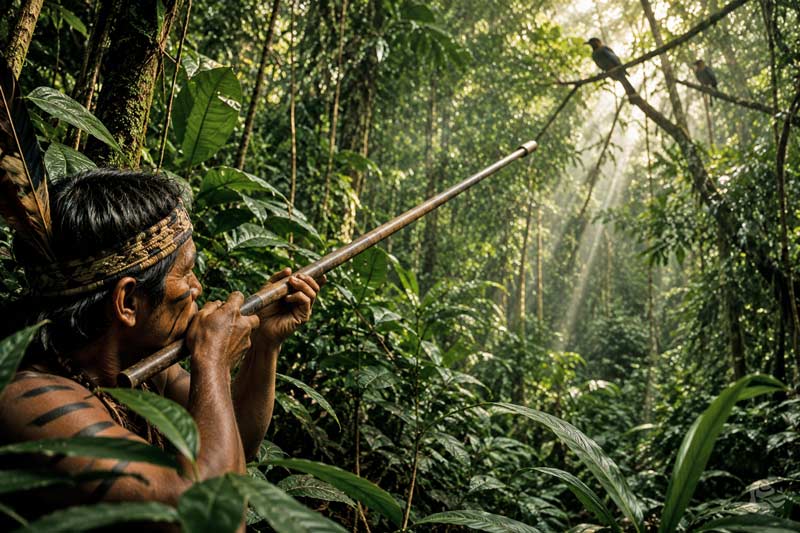
In dense tropical rainforests, survival often depended on moving quietly. Thick vegetation limited visibility, loud noises frightened away game, and carrying large weapons through tangled undergrowth was both tiring and impractical. For hunters living in these environments, the blowgun offered an elegant solution. It was lightweight, silent, and capable of launching a dart with surprising accuracy over short distances, making it ideal for hunting birds, monkeys, squirrels, and other small animals high in the forest canopy.
Unlike bows, which required space to draw the string, a blowgun could be fired from a crouched position or beneath thick branches without revealing the hunter's location. There was no loud report, no visible flash, and very little movement. A skilled hunter could remain almost invisible while waiting patiently for the perfect shot. This combination of stealth and precision made the blowgun one of the most specialized hunting weapons ever developed, and many indigenous communities refined its design over countless generations.
Blowguns varied greatly from region to region. Some were carved from a single piece of hardwood, while others were constructed by joining split sections of wood before sealing them together. Bamboo became a popular material in parts of Southeast Asia because its naturally hollow interior required far less work to create a smooth barrel. Regardless of the construction method, craftsmen invested tremendous effort into making the inside of the tube as straight and polished as possible because even small imperfections could affect a dart's flight.
Although blowguns are often associated with Hollywood depictions of mysterious assassins, their primary purpose throughout history was far more practical. They helped families put food on the table with remarkable efficiency. Many of the blowguns available today are inspired by these traditional designs, preserving a weapon whose greatest strength was never brute force, but the ability to strike silently when every sound mattered.
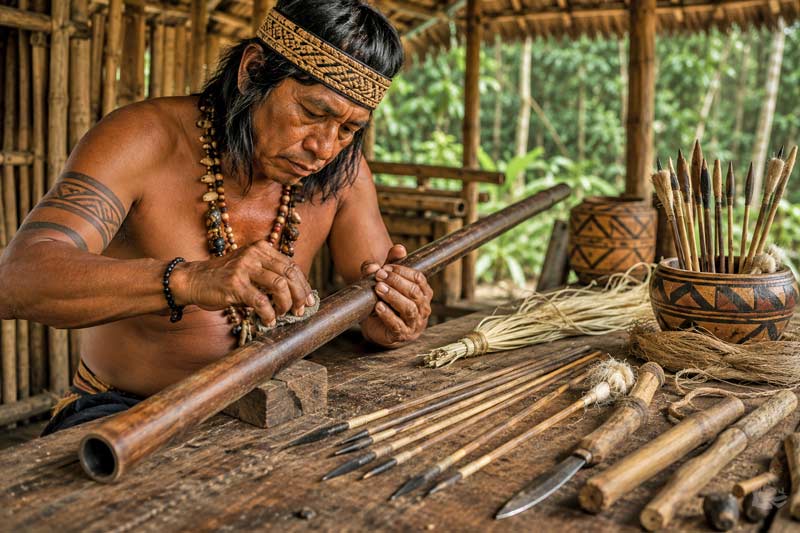
The basic idea behind a blowgun seems almost too simple to be effective. A narrow tube directs a burst of air behind a lightweight dart, sending it forward with far more speed and stability than someone could achieve by throwing it by hand. There are no moving parts, no string to draw, and no mechanical trigger. The weapon depends entirely on the shooter's breath, the quality of the barrel, and the fit of the dart inside it.
That simplicity is exactly what made the blowgun so remarkable. It could be built from materials found in the surrounding environment, repaired without specialized tools, and carried for long distances without adding much weight. In places where metal was scarce or large weapons were impractical, a carefully made blowgun offered hunters an efficient way to reach animals perched high above the forest floor.
The most important part of the weapon was the barrel. A long, straight tube allowed air pressure to build behind the dart for a greater distance, increasing its speed before it left the muzzle. Traditional craftsmen sometimes spent days shaping, smoothing, and polishing the interior to reduce friction. Even a slight bend or rough spot could cause the dart to wobble, lose power, or strike far from its intended target.
Dart design mattered just as much. The projectile needed to be light enough to accelerate quickly but rigid enough to remain stable in flight. A small plug of fiber, down, or plant material was often wrapped around the rear of the shaft to create an airtight seal inside the barrel. This functioned much like the fletching on an arrow, helping the dart stay centered while allowing the shooter's breath to transfer as much energy as possible.
Modern target darts use different materials, but the same principles still apply. The better the seal, balance, and consistency of the dart, the more accurately it will fly. What looked like a primitive tube was actually a finely tuned system in which small changes in length, weight, and craftsmanship could determine whether a shot succeeded or failed.
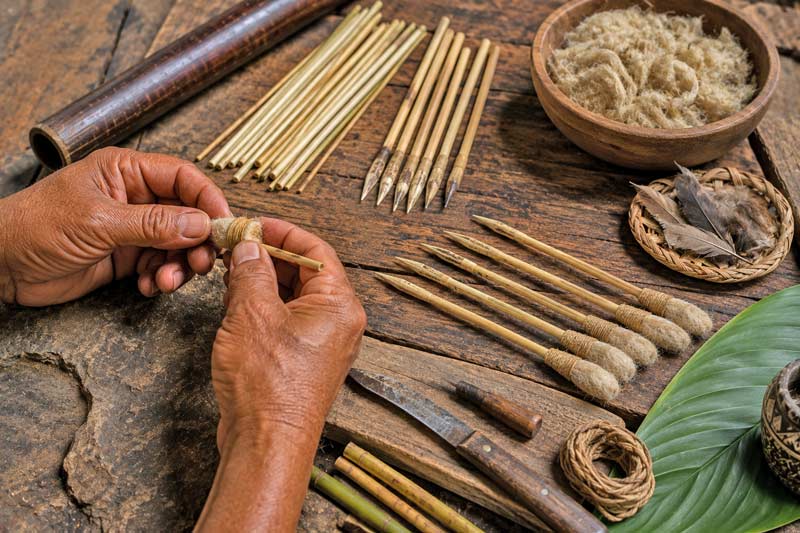
A blowgun is only as good as the dart it fires. While the tube provided the power and direction, the dart determined whether the shot flew true or drifted harmlessly off course. For that reason, many indigenous cultures devoted just as much attention to crafting their darts as they did to building the blowgun itself. Every detail, from the shaft's straightness to the material wrapped around its base, influenced how accurately it would fly.
Traditional darts were often made from lightweight reeds, palm spines, bamboo splinters, or other naturally straight plant materials. The tip was sharpened to a fine point, while the opposite end was fitted with a soft cone of plant fiber, cotton-like seed fluff, or feathers. This cone created an airtight seal inside the blowgun's barrel, allowing nearly all of the shooter's breath to propel the dart forward instead of escaping around it.
Crafting a reliable dart required patience. If the shaft was too heavy, it lost speed. If it was too light, it became unstable in flight. Even the fiber cone had to be carefully sized. Too loose, and the dart lacked power. Too tight, and friction slowed it before it ever left the barrel. Experienced craftsmen learned these small details through years of practice, producing darts that were remarkably consistent despite being made entirely by hand.
Many surviving historical darts appear deceptively simple, but they represent an impressive understanding of balance and aerodynamics. Long before modern engineering explained concepts like air resistance and stability, skilled artisans had already discovered them through careful observation and generations of trial and error. Their designs changed little over centuries because they simply worked.
Today's target darts are manufactured with modern materials and tighter tolerances, but they still rely on the same principles that made traditional blowgun darts effective hundreds of years ago. It's a reminder that some of history's greatest innovations weren't the result of advanced technology, but of craftsmen who perfected simple ideas through experience.

Poison darts are the most famous part of blowgun history, but they were never universal. Many blowguns fired ordinary sharpened darts and relied on accuracy alone to bring down small prey. Poison became especially valuable when hunters pursued animals that were too large, fast, or high in the canopy for a lightweight dart to stop immediately. In those situations, the dart only needed to break the skin and deliver a carefully prepared toxin into the bloodstream.
In parts of South America, hunters coated their darts with plant-based mixtures commonly grouped under the name curare. These preparations could interfere with the muscles needed for movement and breathing, allowing a struck animal to be tracked after it fled. Curare was particularly suited to hunting because its effects depended on entering a wound rather than simply being swallowed, which meant properly prepared game could still be eaten. The exact recipes varied among communities and could involve several different plants rather than one universal formula.
The familiar image of every jungle hunter rubbing darts across a brightly colored frog is far less representative than movies suggest. Certain cultures did use animal-derived toxins, but plant poisons were also widely documented, and many blowgun traditions used no poison at all. Knowledge of which plants to gather, how to prepare them, and how much to apply was specialized information passed down through generations. A mistake could endanger the hunter just as easily as the intended prey.
Poison also changed the role of the blowgun. Without it, the weapon was best suited to small animals and target shooting. With it, even a very slender dart could become far more consequential than its size suggested. That contrast is part of what makes the blowgun one of the strangest weapons that actually existed: its real power sometimes came not from the force of the projectile, but from what the projectile carried.
Hollywood turned poison darts into instant, silent knockout devices, but the historical reality was slower, less predictable, and closely tied to hunting rather than assassination. The blowgun was already an ingenious weapon on its own. Poison simply allowed some cultures to overcome the physical limits of a dart propelled by human breath.
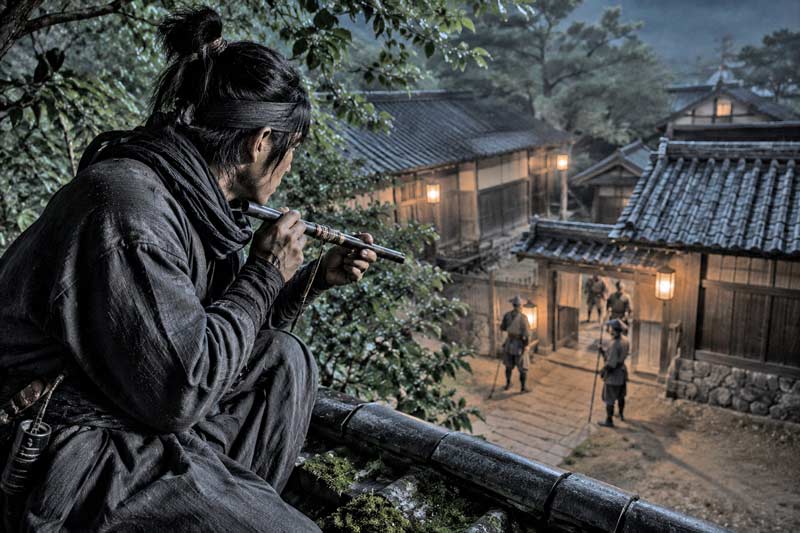
Few weapons are as closely tied to fictional ninjas as the blowgun. Movies, cartoons, and video games often show masked assassins firing poisoned darts through hidden tubes, striking guards without making a sound. The image is dramatic, but the historical evidence is far less clear. Blowguns were known in parts of Asia, and stealth specialists may have understood their value, but they were never among the most important or widely documented weapons associated with Japanese espionage.
Some historical accounts describe compact tubes called fukiya being used to launch small darts. These devices could potentially be concealed inside walking sticks, flutes, or other ordinary-looking objects, which made them well suited to the secrecy later associated with ninjas. However, much of what people believe about ninja blowguns comes from later folklore, theatrical stories, and modern entertainment rather than detailed records from feudal Japan.
There were also practical limitations. A breath-powered dart had relatively little stopping force, especially against an alert or armored opponent. Its usefulness would have depended on close range, precise aim, and possibly a substance applied to the dart. Even then, the instant and perfectly silent knockout shown in movies would have been extremely unlikely. In real life, a blowgun was better suited to distraction, hunting, or harassment than to reliably defeating a trained warrior.
This fits a broader pattern surrounding how ninja weapons were really used. Many objects now marketed as specialized assassination tools were actually common implements, adapted equipment, or later additions to ninja mythology. Historical operatives valued information gathering, disguise, escape, and deception far more than flashy weapons that might expose their presence.
So did ninjas use blowguns? They may have, at least occasionally, but the weapon's importance has almost certainly been exaggerated. The blowgun became a perfect symbol of the ninja because it was quiet, mysterious, and easy for storytellers to dramatize. Its place in popular culture may be larger than its role in actual Japanese history, but that mythology remains one of the reasons people still find it so fascinating today.
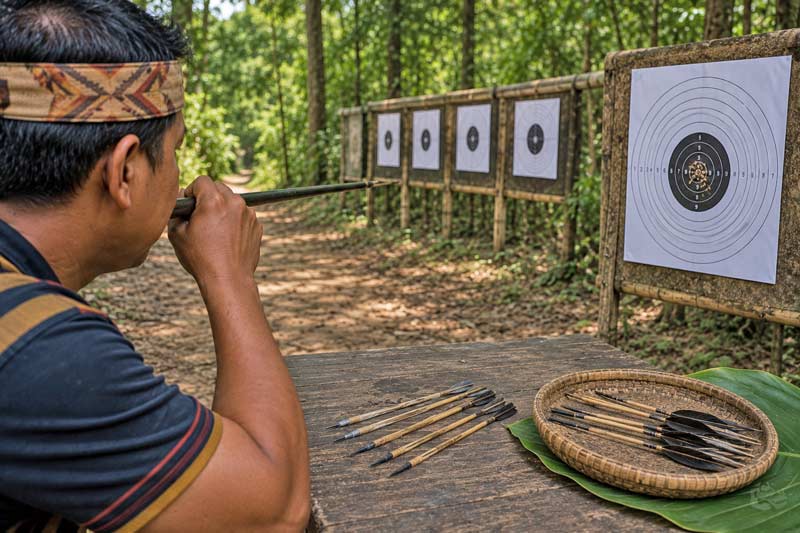
At first glance, a blowgun seems far too simple to be accurate. After all, it has no sights, no trigger, and no mechanical power source beyond the shooter's lungs. Yet experienced users can achieve an impressive degree of precision. For centuries, hunters depended on blowguns to hit small birds, squirrels, and monkeys hidden among dense jungle branches, where a missed shot often meant losing the opportunity entirely.
Accuracy comes from consistency. A straight barrel, a properly balanced dart, and a smooth, controlled breath all work together to produce a predictable flight path. Unlike firearms or bows, there is very little recoil to disturb the shot, allowing skilled users to develop remarkable control through repetition. Traditional hunters often spent years perfecting their technique, learning exactly how much breath was needed for different distances and targets.
Even so, blowguns have practical limits. Most are most effective at relatively short ranges, where the lightweight dart still carries enough speed to reach its target accurately. As distance increases, air resistance, wind, and the dart's low weight begin to affect its trajectory much more than heavier projectiles like arrows or bullets. That is why blowguns were historically favored for close-range hunting rather than long-distance combat.
Today, competitive blowgun target shooting continues in many parts of the world. Modern enthusiasts compete using standardized targets and carefully matched equipment, demonstrating just how precise these deceptively simple weapons can be in trained hands. Like slingshots, blowguns reward patience, consistency, and practice far more than raw strength.
The blowgun may never rival modern projectile weapons in range or power, but that was never its purpose. It was designed for stealth, efficiency, and precision at close distances. Judged by those standards, it remains one of the most elegant projectile weapons ever created, proving that simplicity and skill can sometimes outperform brute force.
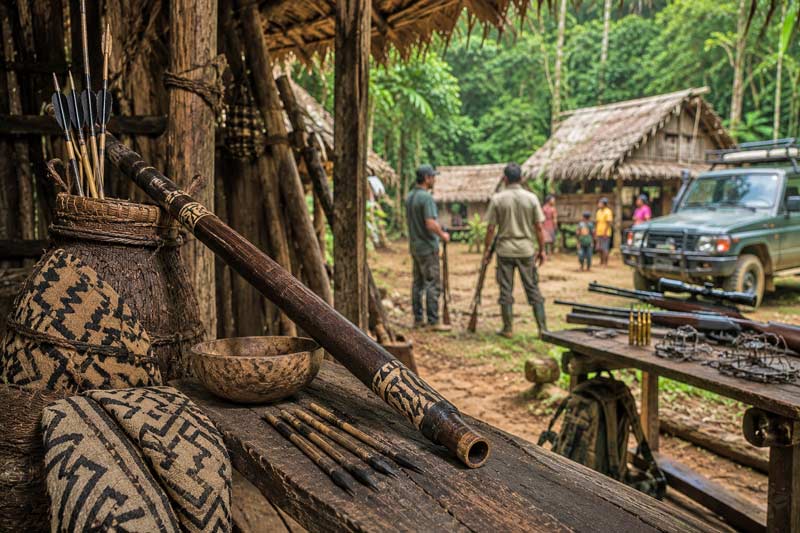
For centuries, the blowgun remained perfectly suited to the environments where it developed. It was quiet, easy to carry, and made from materials that were readily available. But as firearms, metal traps, and other modern hunting tools spread into remote regions, the blowgun began to lose its practical advantage. Newer weapons offered greater range, more power, and less dependence on specialized craftsmanship.
Colonial expansion also disrupted many of the cultures that had preserved blowgun traditions for generations. Indigenous communities were displaced, local hunting practices changed, and knowledge that had once been passed from parent to child became harder to maintain. In some places, missionaries and government authorities discouraged or restricted traditional weapons, treating them as symbols of an older way of life that they wanted to replace.
The blowgun also suffered from its association with poison. Even though many historical blowguns were used with ordinary darts, stories about toxic projectiles made the weapon seem especially dangerous and mysterious to outsiders. Laws in some regions eventually limited blowgun ownership, hunting use, or the possession of certain darts, pushing the weapon even farther from everyday life.
At the same time, popular culture was transforming the blowgun into something almost unrecognizable. It became grouped with exotic ninja weapons, secret assassins, and instant knockout darts. Those images kept the blowgun in the public imagination, but they often overshadowed its real history as a practical hunting tool developed by skilled communities around the world.
By the twentieth century, traditional blowgun use had declined sharply in many places, but it never vanished completely. Some indigenous hunters continued using it, craftsmen preserved old construction techniques, and collectors began taking an interest in its history. What nearly disappeared from daily life survived as a cultural tradition, a sporting tool, and one of the clearest examples of how much ingenuity can be hidden inside a simple design.
Although the blowgun faded from everyday hunting in many parts of the world, it never truly disappeared. Over the past several decades, interest in this ancient weapon has steadily grown among sportsmen, martial arts enthusiasts, historians, and collectors who appreciate both its simplicity and the remarkable skill required to master it. Rather than being remembered only as a relic of the past, the blowgun has found a new purpose as a recreational and competitive sport.
Modern blowgun competitions are held in several countries, where participants test their accuracy against paper targets at carefully measured distances. Success depends on consistent breathing, proper body alignment, and smooth technique instead of physical strength. In many ways, the discipline shares similarities with traditional archery or darts, rewarding patience, concentration, and precision over raw power.
Collectors have also developed a growing appreciation for historical blowguns and the craftsmanship behind them. Antique examples showcase remarkable woodworking, carefully balanced darts, and regional designs that reflect the cultures that created them. Museums and cultural organizations continue to preserve these artifacts, helping ensure that the history of the blowgun is remembered as more than just a movie prop or fictional assassin's weapon.
The growing popularity of historical weapons has also introduced many people to other unusual projectile weapons. Whether someone is interested in throwing stars, traditional archery, or blowguns, the appeal often comes from learning the techniques and history behind these remarkably specialized designs rather than simply collecting them.
Today, the blowgun stands as one of history's most enduring examples of elegant engineering. Built from little more than a straight tube and a carefully crafted dart, it continues to impress people centuries after its invention. Its survival isn't just proof that the design worked. It's a reminder that some of humanity's most ingenious inventions never needed complicated machinery to stand the test of time.
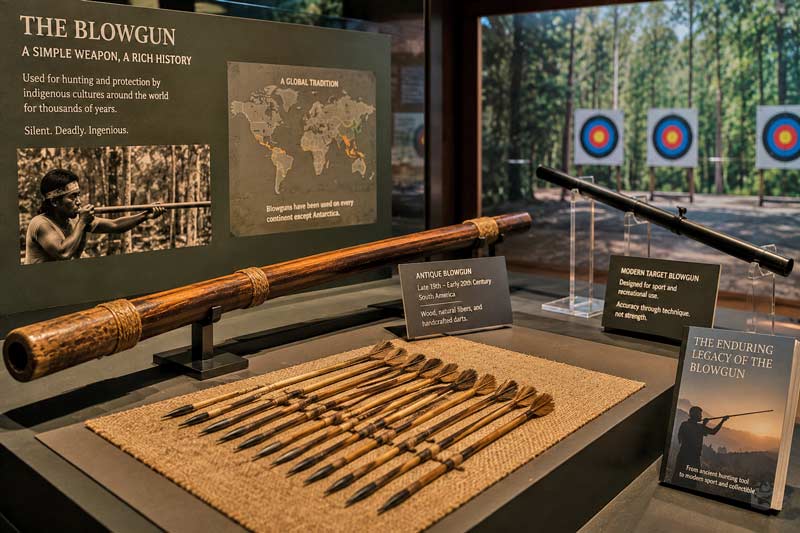
Few ancient weapons have remained as mysterious as the blowgun. It doesn't rely on brute force, expensive materials, or complicated engineering. Instead, it demonstrates how observation, patience, and craftsmanship can produce something remarkably effective from the simplest of ideas. That contrast is part of what continues to capture people's imagination centuries after the blowgun first appeared.
The blowgun also reminds us that history isn't filled only with massive swords and towering spears. Many cultures developed highly specialized weapons that were perfectly adapted to their surroundings. A silent dart traveling through the rainforest could be every bit as useful as a much larger weapon, proving that success often depended on using the right tool for the environment rather than the most intimidating one.
Its enduring popularity is also fueled by curiosity. People who discover blowguns often find themselves exploring other unusual historical weapons, from the many different types of ninja stars to lesser-known martial arts tools from around the world. The deeper they look, the more they realize that history is filled with ingenious designs that rarely appear in school textbooks.
Today, whether someone picks up a blowgun for target shooting, historical collecting, or simply to appreciate its unique design, they're connecting with a tradition that stretches back thousands of years. It's a weapon that quietly crossed continents, adapted to different cultures, and survived countless technological advances without losing the qualities that made it special in the first place.
For all its simplicity, the blowgun remains one of history's greatest examples of human ingenuity. It transformed nothing more than a hollow tube and a carefully crafted dart into a precise hunting instrument that served generations of people around the world. Long after its practical importance declined, its remarkable history continues to inspire collectors, historians, and martial arts enthusiasts who appreciate the elegance behind one of the world's most underrated weapons.
While blowguns were occasionally used for defense or small-scale conflicts, they were rarely battlefield weapons. Their greatest advantage was stealth, making them far more effective for hunting or ambushes than open combat. Against armored soldiers or large military formations, weapons like bows, spears, and swords were generally much more practical.
No. While poisoned darts are the most famous part of blowgun history, many cultures used ordinary sharpened darts without any toxins at all. Hunters often relied on precision rather than poison, especially when targeting small game. Poisoned darts were typically reserved for specific environments, traditions, or larger prey where a small wound alone might not be immediately effective.
That depends on the length of the blowgun, the weight of the dart, and the shooter's skill. For hunting, traditional blowguns were generally used at relatively short distances, often within 20 to 50 feet, where accuracy was far more important than maximum range. Experienced users could consistently hit small targets at those distances, especially after years of practice.
Modern target shooters can sometimes achieve impressive accuracy at longer ranges, but hitting a distant target requires exceptional breath control, consistent technique, and well-balanced darts. Like archery, mastering a blowgun is less about strength and more about repetition and precision.
In many places, yes. Blowguns are legal to own and use for recreational target shooting or collecting, but laws vary depending on the country, state, or local jurisdiction. Some areas regulate or prohibit blowguns because they can be used as hunting weapons, while others place few or no restrictions on them.
Before purchasing or carrying a blowgun, it's always a good idea to check your local laws. Even where ownership is legal, there may be rules about where they can be used or transported. Responsible use and safe handling are just as important with a blowgun as they are with any other projectile weapon.
While it's possible to build a simple blowgun from common materials, doing so isn't recommended. Homemade blowguns often lack the straightness, durability, and safety features found in commercially manufactured models, making them less accurate and potentially more dangerous to use.
If you're interested in learning the sport of blowgun target shooting, it's far safer to use a properly made blowgun designed for recreational use and to practice with appropriate targets in a safe environment. As with any projectile weapon, responsible handling and following local laws should always come first.
Blowguns offer a unique combination of history, skill, and simplicity that's hard to find with modern sporting equipment. Because they rely entirely on breath control and technique, they provide a rewarding challenge that appeals to target shooters, martial artists, survival enthusiasts, and history buffs alike.
Many people are also drawn to blowguns because of their rich cultural history. From indigenous rainforest hunters to modern competitive shooters, the blowgun has remained remarkably unchanged for centuries. That rare combination of historical significance and practical skill continues to make it one of the world's most fascinating projectile weapons.
Blowguns were primarily used to hunt small game that lived high in the trees or moved quietly through dense forests. Depending on the region, hunters targeted birds, squirrels, monkeys, and other small mammals that would have been difficult to approach with louder weapons. The blowgun's silent operation allowed hunters to take a shot without frightening away nearby animals.
Because the darts were lightweight, blowguns were generally not intended for large game. Their effectiveness came from precision, patience, and an intimate knowledge of the surrounding environment rather than raw power. In the hands of experienced hunters, they provided a reliable source of food while causing minimal disturbance to the forest around them.
The terms are often used interchangeably, but there can be a subtle difference. Historically, a blowpipe usually referred to the simple tube itself, while blowgun became the more common name when describing the complete hunting weapon, including the darts. Today, most people use "blowgun" regardless of the design or intended purpose.
Regional traditions also influenced the terminology. Different cultures developed their own versions using bamboo, hardwood, palm stems, or other natural materials, each with unique dart designs and construction techniques. Despite these variations, they all relied on the same surprisingly effective principle of using compressed breath to launch a lightweight projectile with remarkable accuracy.
Instead of feathers, traditional blowgun darts use a cone-shaped tuft made from plant fibers, cotton, or other lightweight materials. This creates an airtight seal inside the tube, allowing the shooter's breath to propel the dart efficiently while also helping keep it centered as it travels down the barrel.
Without that seal, much of the air would simply escape around the dart, dramatically reducing both speed and accuracy. It's a simple but ingenious design that has remained largely unchanged for centuries.
Some traditional blowguns measured well over eight feet long, with a few historical examples approaching ten feet. Longer tubes allowed more time for the expanding air to accelerate the dart, giving skilled hunters greater velocity and improved accuracy.
The downside was portability. Carrying an exceptionally long blowgun through dense jungle required experience, which is why many cultures settled on a length that balanced performance with practicality.
Why the Blowgun Was the Perfect Jungle Weapon
In dense tropical rainforests, survival often depended on moving quietly. Thick vegetation limited visibility, loud noises frightened away game, and carrying large weapons through tangled undergrowth was both tiring and impractical. For hunters living in these environments, the blowgun offered an elegant solution. It was lightweight, silent, and capable of launching a dart with surprising accuracy over short distances, making it ideal for hunting birds, monkeys, squirrels, and other small animals high in the forest canopy.
Unlike bows, which required space to draw the string, a blowgun could be fired from a crouched position or beneath thick branches without revealing the hunter's location. There was no loud report, no visible flash, and very little movement. A skilled hunter could remain almost invisible while waiting patiently for the perfect shot. This combination of stealth and precision made the blowgun one of the most specialized hunting weapons ever developed, and many indigenous communities refined its design over countless generations.
Blowguns varied greatly from region to region. Some were carved from a single piece of hardwood, while others were constructed by joining split sections of wood before sealing them together. Bamboo became a popular material in parts of Southeast Asia because its naturally hollow interior required far less work to create a smooth barrel. Regardless of the construction method, craftsmen invested tremendous effort into making the inside of the tube as straight and polished as possible because even small imperfections could affect a dart's flight.
Although blowguns are often associated with Hollywood depictions of mysterious assassins, their primary purpose throughout history was far more practical. They helped families put food on the table with remarkable efficiency. Many of the blowguns available today are inspired by these traditional designs, preserving a weapon whose greatest strength was never brute force, but the ability to strike silently when every sound mattered.
How a Simple Tube Became a Deadly Hunting Weapon
The basic idea behind a blowgun seems almost too simple to be effective. A narrow tube directs a burst of air behind a lightweight dart, sending it forward with far more speed and stability than someone could achieve by throwing it by hand. There are no moving parts, no string to draw, and no mechanical trigger. The weapon depends entirely on the shooter's breath, the quality of the barrel, and the fit of the dart inside it.
That simplicity is exactly what made the blowgun so remarkable. It could be built from materials found in the surrounding environment, repaired without specialized tools, and carried for long distances without adding much weight. In places where metal was scarce or large weapons were impractical, a carefully made blowgun offered hunters an efficient way to reach animals perched high above the forest floor.
The most important part of the weapon was the barrel. A long, straight tube allowed air pressure to build behind the dart for a greater distance, increasing its speed before it left the muzzle. Traditional craftsmen sometimes spent days shaping, smoothing, and polishing the interior to reduce friction. Even a slight bend or rough spot could cause the dart to wobble, lose power, or strike far from its intended target.
Dart design mattered just as much. The projectile needed to be light enough to accelerate quickly but rigid enough to remain stable in flight. A small plug of fiber, down, or plant material was often wrapped around the rear of the shaft to create an airtight seal inside the barrel. This functioned much like the fletching on an arrow, helping the dart stay centered while allowing the shooter's breath to transfer as much energy as possible.
Modern target darts use different materials, but the same principles still apply. The better the seal, balance, and consistency of the dart, the more accurately it will fly. What looked like a primitive tube was actually a finely tuned system in which small changes in length, weight, and craftsmanship could determine whether a shot succeeded or failed.
The Art of Making Blowgun Darts
A blowgun is only as good as the dart it fires. While the tube provided the power and direction, the dart determined whether the shot flew true or drifted harmlessly off course. For that reason, many indigenous cultures devoted just as much attention to crafting their darts as they did to building the blowgun itself. Every detail, from the shaft's straightness to the material wrapped around its base, influenced how accurately it would fly.
Traditional darts were often made from lightweight reeds, palm spines, bamboo splinters, or other naturally straight plant materials. The tip was sharpened to a fine point, while the opposite end was fitted with a soft cone of plant fiber, cotton-like seed fluff, or feathers. This cone created an airtight seal inside the blowgun's barrel, allowing nearly all of the shooter's breath to propel the dart forward instead of escaping around it.
Crafting a reliable dart required patience. If the shaft was too heavy, it lost speed. If it was too light, it became unstable in flight. Even the fiber cone had to be carefully sized. Too loose, and the dart lacked power. Too tight, and friction slowed it before it ever left the barrel. Experienced craftsmen learned these small details through years of practice, producing darts that were remarkably consistent despite being made entirely by hand.
Many surviving historical darts appear deceptively simple, but they represent an impressive understanding of balance and aerodynamics. Long before modern engineering explained concepts like air resistance and stability, skilled artisans had already discovered them through careful observation and generations of trial and error. Their designs changed little over centuries because they simply worked.
Today's target darts are manufactured with modern materials and tighter tolerances, but they still rely on the same principles that made traditional blowgun darts effective hundreds of years ago. It's a reminder that some of history's greatest innovations weren't the result of advanced technology, but of craftsmen who perfected simple ideas through experience.
The Truth About Poison Darts
Poison darts are the most famous part of blowgun history, but they were never universal. Many blowguns fired ordinary sharpened darts and relied on accuracy alone to bring down small prey. Poison became especially valuable when hunters pursued animals that were too large, fast, or high in the canopy for a lightweight dart to stop immediately. In those situations, the dart only needed to break the skin and deliver a carefully prepared toxin into the bloodstream.
In parts of South America, hunters coated their darts with plant-based mixtures commonly grouped under the name curare. These preparations could interfere with the muscles needed for movement and breathing, allowing a struck animal to be tracked after it fled. Curare was particularly suited to hunting because its effects depended on entering a wound rather than simply being swallowed, which meant properly prepared game could still be eaten. The exact recipes varied among communities and could involve several different plants rather than one universal formula.
The familiar image of every jungle hunter rubbing darts across a brightly colored frog is far less representative than movies suggest. Certain cultures did use animal-derived toxins, but plant poisons were also widely documented, and many blowgun traditions used no poison at all. Knowledge of which plants to gather, how to prepare them, and how much to apply was specialized information passed down through generations. A mistake could endanger the hunter just as easily as the intended prey.
Poison also changed the role of the blowgun. Without it, the weapon was best suited to small animals and target shooting. With it, even a very slender dart could become far more consequential than its size suggested. That contrast is part of what makes the blowgun one of the strangest weapons that actually existed: its real power sometimes came not from the force of the projectile, but from what the projectile carried.
Hollywood turned poison darts into instant, silent knockout devices, but the historical reality was slower, less predictable, and closely tied to hunting rather than assassination. The blowgun was already an ingenious weapon on its own. Poison simply allowed some cultures to overcome the physical limits of a dart propelled by human breath.
Did Ninjas Actually Use Blowguns?
Few weapons are as closely tied to fictional ninjas as the blowgun. Movies, cartoons, and video games often show masked assassins firing poisoned darts through hidden tubes, striking guards without making a sound. The image is dramatic, but the historical evidence is far less clear. Blowguns were known in parts of Asia, and stealth specialists may have understood their value, but they were never among the most important or widely documented weapons associated with Japanese espionage.
Some historical accounts describe compact tubes called fukiya being used to launch small darts. These devices could potentially be concealed inside walking sticks, flutes, or other ordinary-looking objects, which made them well suited to the secrecy later associated with ninjas. However, much of what people believe about ninja blowguns comes from later folklore, theatrical stories, and modern entertainment rather than detailed records from feudal Japan.
There were also practical limitations. A breath-powered dart had relatively little stopping force, especially against an alert or armored opponent. Its usefulness would have depended on close range, precise aim, and possibly a substance applied to the dart. Even then, the instant and perfectly silent knockout shown in movies would have been extremely unlikely. In real life, a blowgun was better suited to distraction, hunting, or harassment than to reliably defeating a trained warrior.
This fits a broader pattern surrounding how ninja weapons were really used. Many objects now marketed as specialized assassination tools were actually common implements, adapted equipment, or later additions to ninja mythology. Historical operatives valued information gathering, disguise, escape, and deception far more than flashy weapons that might expose their presence.
So did ninjas use blowguns? They may have, at least occasionally, but the weapon's importance has almost certainly been exaggerated. The blowgun became a perfect symbol of the ninja because it was quiet, mysterious, and easy for storytellers to dramatize. Its place in popular culture may be larger than its role in actual Japanese history, but that mythology remains one of the reasons people still find it so fascinating today.
How Accurate Is a Blowgun?
At first glance, a blowgun seems far too simple to be accurate. After all, it has no sights, no trigger, and no mechanical power source beyond the shooter's lungs. Yet experienced users can achieve an impressive degree of precision. For centuries, hunters depended on blowguns to hit small birds, squirrels, and monkeys hidden among dense jungle branches, where a missed shot often meant losing the opportunity entirely.
Accuracy comes from consistency. A straight barrel, a properly balanced dart, and a smooth, controlled breath all work together to produce a predictable flight path. Unlike firearms or bows, there is very little recoil to disturb the shot, allowing skilled users to develop remarkable control through repetition. Traditional hunters often spent years perfecting their technique, learning exactly how much breath was needed for different distances and targets.
Even so, blowguns have practical limits. Most are most effective at relatively short ranges, where the lightweight dart still carries enough speed to reach its target accurately. As distance increases, air resistance, wind, and the dart's low weight begin to affect its trajectory much more than heavier projectiles like arrows or bullets. That is why blowguns were historically favored for close-range hunting rather than long-distance combat.
Today, competitive blowgun target shooting continues in many parts of the world. Modern enthusiasts compete using standardized targets and carefully matched equipment, demonstrating just how precise these deceptively simple weapons can be in trained hands. Like slingshots, blowguns reward patience, consistency, and practice far more than raw strength.
The blowgun may never rival modern projectile weapons in range or power, but that was never its purpose. It was designed for stealth, efficiency, and precision at close distances. Judged by those standards, it remains one of the most elegant projectile weapons ever created, proving that simplicity and skill can sometimes outperform brute force.
Why Blowguns Nearly Disappeared
For centuries, the blowgun remained perfectly suited to the environments where it developed. It was quiet, easy to carry, and made from materials that were readily available. But as firearms, metal traps, and other modern hunting tools spread into remote regions, the blowgun began to lose its practical advantage. Newer weapons offered greater range, more power, and less dependence on specialized craftsmanship.
Colonial expansion also disrupted many of the cultures that had preserved blowgun traditions for generations. Indigenous communities were displaced, local hunting practices changed, and knowledge that had once been passed from parent to child became harder to maintain. In some places, missionaries and government authorities discouraged or restricted traditional weapons, treating them as symbols of an older way of life that they wanted to replace.
The blowgun also suffered from its association with poison. Even though many historical blowguns were used with ordinary darts, stories about toxic projectiles made the weapon seem especially dangerous and mysterious to outsiders. Laws in some regions eventually limited blowgun ownership, hunting use, or the possession of certain darts, pushing the weapon even farther from everyday life.
At the same time, popular culture was transforming the blowgun into something almost unrecognizable. It became grouped with exotic ninja weapons, secret assassins, and instant knockout darts. Those images kept the blowgun in the public imagination, but they often overshadowed its real history as a practical hunting tool developed by skilled communities around the world.
By the twentieth century, traditional blowgun use had declined sharply in many places, but it never vanished completely. Some indigenous hunters continued using it, craftsmen preserved old construction techniques, and collectors began taking an interest in its history. What nearly disappeared from daily life survived as a cultural tradition, a sporting tool, and one of the clearest examples of how much ingenuity can be hidden inside a simple design.
The Blowgun's Modern Comeback
Although the blowgun faded from everyday hunting in many parts of the world, it never truly disappeared. Over the past several decades, interest in this ancient weapon has steadily grown among sportsmen, martial arts enthusiasts, historians, and collectors who appreciate both its simplicity and the remarkable skill required to master it. Rather than being remembered only as a relic of the past, the blowgun has found a new purpose as a recreational and competitive sport.
Modern blowgun competitions are held in several countries, where participants test their accuracy against paper targets at carefully measured distances. Success depends on consistent breathing, proper body alignment, and smooth technique instead of physical strength. In many ways, the discipline shares similarities with traditional archery or darts, rewarding patience, concentration, and precision over raw power.
Collectors have also developed a growing appreciation for historical blowguns and the craftsmanship behind them. Antique examples showcase remarkable woodworking, carefully balanced darts, and regional designs that reflect the cultures that created them. Museums and cultural organizations continue to preserve these artifacts, helping ensure that the history of the blowgun is remembered as more than just a movie prop or fictional assassin's weapon.
The growing popularity of historical weapons has also introduced many people to other unusual projectile weapons. Whether someone is interested in throwing stars, traditional archery, or blowguns, the appeal often comes from learning the techniques and history behind these remarkably specialized designs rather than simply collecting them.
Today, the blowgun stands as one of history's most enduring examples of elegant engineering. Built from little more than a straight tube and a carefully crafted dart, it continues to impress people centuries after its invention. Its survival isn't just proof that the design worked. It's a reminder that some of humanity's most ingenious inventions never needed complicated machinery to stand the test of time.
Why the Blowgun Still Fascinates Us Today
Few ancient weapons have remained as mysterious as the blowgun. It doesn't rely on brute force, expensive materials, or complicated engineering. Instead, it demonstrates how observation, patience, and craftsmanship can produce something remarkably effective from the simplest of ideas. That contrast is part of what continues to capture people's imagination centuries after the blowgun first appeared.
The blowgun also reminds us that history isn't filled only with massive swords and towering spears. Many cultures developed highly specialized weapons that were perfectly adapted to their surroundings. A silent dart traveling through the rainforest could be every bit as useful as a much larger weapon, proving that success often depended on using the right tool for the environment rather than the most intimidating one.
Its enduring popularity is also fueled by curiosity. People who discover blowguns often find themselves exploring other unusual historical weapons, from the many different types of ninja stars to lesser-known martial arts tools from around the world. The deeper they look, the more they realize that history is filled with ingenious designs that rarely appear in school textbooks.
Today, whether someone picks up a blowgun for target shooting, historical collecting, or simply to appreciate its unique design, they're connecting with a tradition that stretches back thousands of years. It's a weapon that quietly crossed continents, adapted to different cultures, and survived countless technological advances without losing the qualities that made it special in the first place.
For all its simplicity, the blowgun remains one of history's greatest examples of human ingenuity. It transformed nothing more than a hollow tube and a carefully crafted dart into a precise hunting instrument that served generations of people around the world. Long after its practical importance declined, its remarkable history continues to inspire collectors, historians, and martial arts enthusiasts who appreciate the elegance behind one of the world's most underrated weapons.
Were blowguns actually used in war?
While blowguns were occasionally used for defense or small-scale conflicts, they were rarely battlefield weapons. Their greatest advantage was stealth, making them far more effective for hunting or ambushes than open combat. Against armored soldiers or large military formations, weapons like bows, spears, and swords were generally much more practical.
Did blowgun darts always use poison?
No. While poisoned darts are the most famous part of blowgun history, many cultures used ordinary sharpened darts without any toxins at all. Hunters often relied on precision rather than poison, especially when targeting small game. Poisoned darts were typically reserved for specific environments, traditions, or larger prey where a small wound alone might not be immediately effective.
How far can a blowgun shoot accurately?
That depends on the length of the blowgun, the weight of the dart, and the shooter's skill. For hunting, traditional blowguns were generally used at relatively short distances, often within 20 to 50 feet, where accuracy was far more important than maximum range. Experienced users could consistently hit small targets at those distances, especially after years of practice.
Modern target shooters can sometimes achieve impressive accuracy at longer ranges, but hitting a distant target requires exceptional breath control, consistent technique, and well-balanced darts. Like archery, mastering a blowgun is less about strength and more about repetition and precision.
Are blowguns legal to own?
In many places, yes. Blowguns are legal to own and use for recreational target shooting or collecting, but laws vary depending on the country, state, or local jurisdiction. Some areas regulate or prohibit blowguns because they can be used as hunting weapons, while others place few or no restrictions on them.
Before purchasing or carrying a blowgun, it's always a good idea to check your local laws. Even where ownership is legal, there may be rules about where they can be used or transported. Responsible use and safe handling are just as important with a blowgun as they are with any other projectile weapon.
Can you make a blowgun at home?
While it's possible to build a simple blowgun from common materials, doing so isn't recommended. Homemade blowguns often lack the straightness, durability, and safety features found in commercially manufactured models, making them less accurate and potentially more dangerous to use.
If you're interested in learning the sport of blowgun target shooting, it's far safer to use a properly made blowgun designed for recreational use and to practice with appropriate targets in a safe environment. As with any projectile weapon, responsible handling and following local laws should always come first.
Why are blowguns still popular today?
Blowguns offer a unique combination of history, skill, and simplicity that's hard to find with modern sporting equipment. Because they rely entirely on breath control and technique, they provide a rewarding challenge that appeals to target shooters, martial artists, survival enthusiasts, and history buffs alike.
Many people are also drawn to blowguns because of their rich cultural history. From indigenous rainforest hunters to modern competitive shooters, the blowgun has remained remarkably unchanged for centuries. That rare combination of historical significance and practical skill continues to make it one of the world's most fascinating projectile weapons.
What animals were traditionally hunted with blowguns?
Blowguns were primarily used to hunt small game that lived high in the trees or moved quietly through dense forests. Depending on the region, hunters targeted birds, squirrels, monkeys, and other small mammals that would have been difficult to approach with louder weapons. The blowgun's silent operation allowed hunters to take a shot without frightening away nearby animals.
Because the darts were lightweight, blowguns were generally not intended for large game. Their effectiveness came from precision, patience, and an intimate knowledge of the surrounding environment rather than raw power. In the hands of experienced hunters, they provided a reliable source of food while causing minimal disturbance to the forest around them.
What's the difference between a blowgun and a blowpipe?
The terms are often used interchangeably, but there can be a subtle difference. Historically, a blowpipe usually referred to the simple tube itself, while blowgun became the more common name when describing the complete hunting weapon, including the darts. Today, most people use "blowgun" regardless of the design or intended purpose.
Regional traditions also influenced the terminology. Different cultures developed their own versions using bamboo, hardwood, palm stems, or other natural materials, each with unique dart designs and construction techniques. Despite these variations, they all relied on the same surprisingly effective principle of using compressed breath to launch a lightweight projectile with remarkable accuracy.
Why don't blowguns use feathers like arrows?
Instead of feathers, traditional blowgun darts use a cone-shaped tuft made from plant fibers, cotton, or other lightweight materials. This creates an airtight seal inside the tube, allowing the shooter's breath to propel the dart efficiently while also helping keep it centered as it travels down the barrel.
Without that seal, much of the air would simply escape around the dart, dramatically reducing both speed and accuracy. It's a simple but ingenious design that has remained largely unchanged for centuries.
What is the longest blowgun ever made?
Some traditional blowguns measured well over eight feet long, with a few historical examples approaching ten feet. Longer tubes allowed more time for the expanding air to accelerate the dart, giving skilled hunters greater velocity and improved accuracy.
The downside was portability. Carrying an exceptionally long blowgun through dense jungle required experience, which is why many cultures settled on a length that balanced performance with practicality.
You May Also Be Interested In:
- Why Is It Called a 'Gi'? The Strange History of Martial Arts Uniforms
- Why Did Seax Knives Have Such Strange Blades?
- A Brief History of Kung Fu
- The History of the Halberd
- A Brief History of Judo
- What Is a Kusarigama? History, Uses, and Training Basics
- The History of the Medieval Flail Weapon
- What Is a Three Section Staff? History, Uses & How It Works
- The Real History of the Jutte (And Why Samurai Carried It)
- The History of the Dojo: Why Martial Arts Schools Look the Way They Do
Leave a Reply