




Why Is It Called a 'Gi'? The Strange History of Martial Arts Uniforms
June 12th, 2026
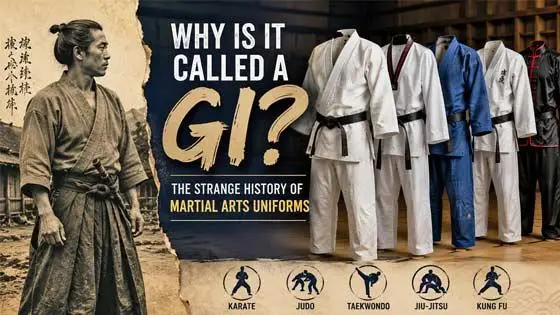
From karate and judo to taekwondo and jiu-jitsu, martial arts uniforms have evolved in surprisingly different ways, and the word "gi" itself has become one of the most misunderstood terms in martial arts culture. Why are some uniforms thick while others are lightweight? Why do some wrap across the body while others pull over the head? And why do traditional martial artists sometimes argue over what counts as a "real" gi?
The answer takes us through samurai history, Okinawan training culture, post-war Japan, and a surprising amount of martial arts controversy. Before you buy your next martial arts uniform, it helps to understand where these uniforms actually came from and why they look so different today.
Here is where things start getting weird: the word "gi" is not actually the full name of the uniform.
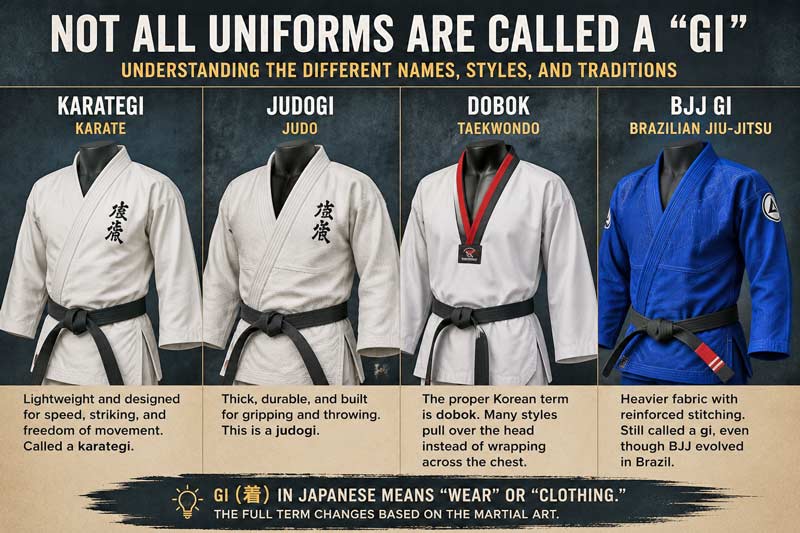
In Japanese, gi simply means "wear" or "clothing." The full term is usually based on the martial art itself. A karate uniform is technically called a karategi. A judo uniform is a judogi. In Brazilian jiu-jitsu, practitioners often still call it a gi, even though the sport evolved in Brazil rather than Japan.
Some martial artists use the word "gi" as a catch-all term for nearly every training uniform, but traditionalists sometimes cringe at that idea. Why? Because not every martial art uniform is built the same, and some styles do not technically wear a gi at all.
For example, many karate uniforms use lighter fabrics designed for speed and snapping techniques, while judo uniforms are famously thick and reinforced because they need to survive constant grabbing and throwing. Brazilian jiu-jitsu uniforms are often even heavier, which is one reason people constantly compare the differences between a judo gi and a BJJ gi.
Then things get even more confusing with taekwondo. Many practitioners call their uniform a "gi," but the proper Korean term is actually dobok. If you have ever wondered why some taekwondo uniforms pull over the head instead of wrapping across the chest, there is a reason for that. We covered some of those differences in our guide to TKD uniforms vs karate gis.
In other words, calling everything a "gi" is a little like calling every soft drink "Coke." Plenty of people do it, but it is not always technically correct.
This is where martial arts history starts to get surprisingly messy.
A lot of people assume the modern gi came directly from samurai armor or ancient Japanese warriors. That sounds cool, but it is not exactly true. Samurai did influence martial arts culture, especially in Japan, but the uniform most people recognize today is actually much newer than many expect.
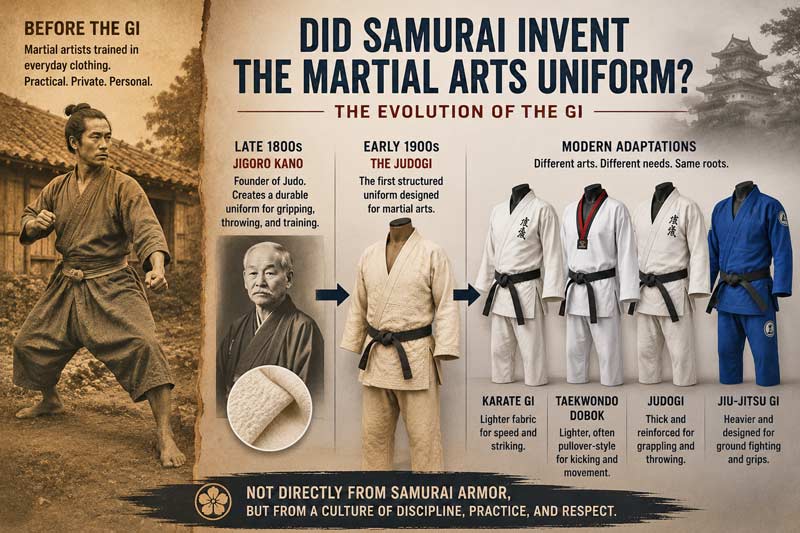
Before modern uniforms existed, martial artists often trained in everyday clothing. Okinawan karate practitioners sometimes trained in simple work clothes, loose garments, or whatever they happened to own. Training was usually practical and private, not something designed for spectators or tournaments.
The uniform started becoming more standardized in the late 1800s and early 1900s, largely because of judo founder Jigoro Kano. Kano wanted a durable outfit that could survive throwing, grabbing, and constant training. He adapted elements of traditional Japanese clothing and created a thicker practice uniform that eventually became known as the judogi.
That design quietly changed martial arts history. As karate spread from Okinawa to mainland Japan, many schools adopted a similar style uniform because it looked disciplined, unified, and practical for training. Over time, different arts modified the formula. Karate uniforms became lighter for speed and striking. Taekwondo uniforms evolved into lighter, often pullover-style tops. Judo uniforms stayed heavy and reinforced for grappling, while jiu-jitsu uniforms became even more specialized for ground fighting.
So, did samurai invent the gi? Not really. But they definitely helped shape the culture of discipline, ritual, and appearance that made martial arts uniforms feel important in the first place.
Once you know that not every uniform is technically the same kind of gi, another question naturally comes up: why do they look so different in the first place?
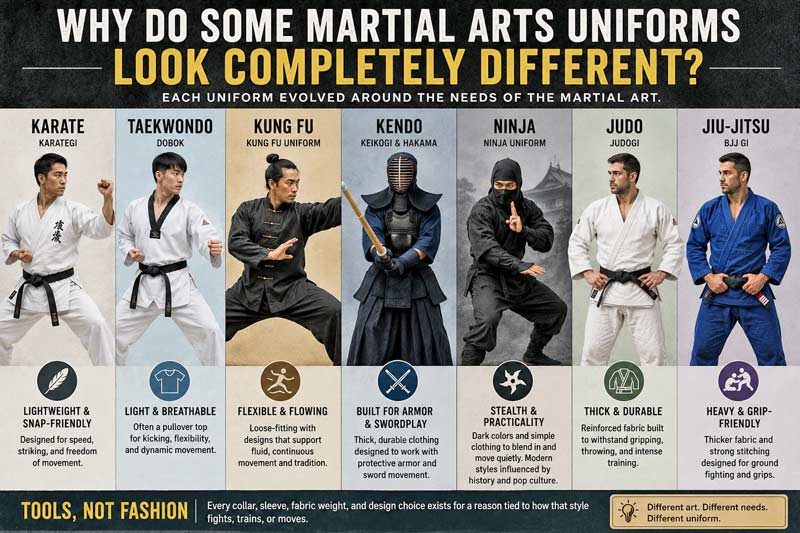
If you line up martial artists from different styles, the differences become obvious fast. A karate practitioner may wear a lightweight uniform with shorter sleeves for speed and snapping movements. A judoka usually trains in a thick, reinforced jacket designed to survive endless grabbing and throwing. A taekwondo student may wear a V-neck pullover top, while kung fu practitioners often train in uniforms with frog-button closures that look completely different from Japanese styles.
The reason is surprisingly simple: uniforms evolved around the needs of the martial art.
For example, kung fu uniforms prioritize flowing movement and flexibility, often reflecting centuries of Chinese tradition. kendo uniforms are designed around armor and sword movement, which is why they look dramatically different from what most people picture when they hear the word "gi." Even within Japanese arts, differences matter. We recently broke down some of the biggest contrasts in our guide to the difference between a judo gi and a jiu-jitsu gi.
Then there are ninja uniforms, which may be the most misunderstood of all. The all-black "movie ninja" look is mostly Hollywood mythology. Historically, many covert fighters blended into ordinary clothing instead of dressing like someone trying very hard to look like a ninja. Modern ninja uniforms are largely inspired by pop culture, stage performances, and martial arts schools rather than historical battlefield clothing.
In other words, martial arts uniforms are not random fashion choices. They are tools. Every collar, sleeve, fabric weight, and design choice usually exists for a reason tied to how that style actually fights, trains, or moves.
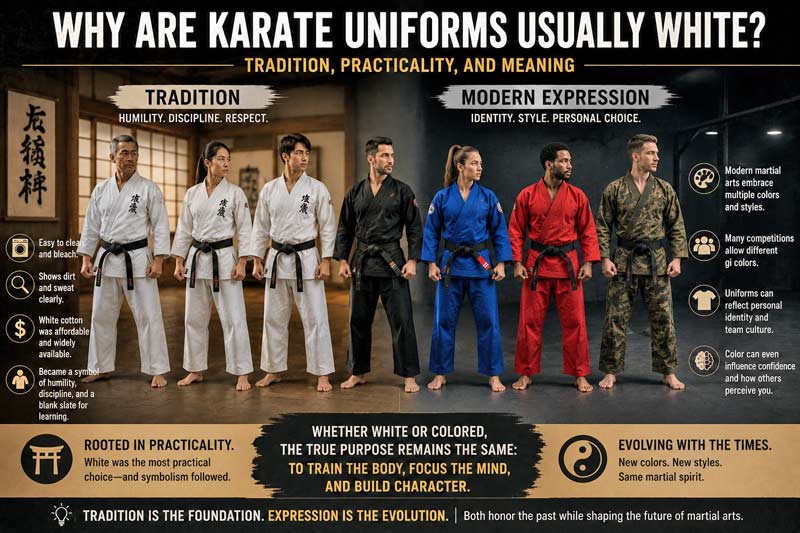
If martial arts uniforms evolved for practical reasons, another question naturally comes up: why are so many of them white?
Most people assume white uniforms symbolize peace, discipline, or purity. That explanation gets repeated constantly in martial arts schools, and while there is some truth to it, the real reason is actually much more practical.
When early judo and karate uniforms became standardized in Japan, white cotton was simply affordable, easy to clean, and widely available. White fabric also made it obvious when a uniform was dirty, which mattered in dojo culture where cleanliness and presentation were considered signs of discipline and respect.
Over time, the color picked up symbolic meaning. A crisp white uniform started representing humility, dedication, and the idea that students entered training as beginners ready to learn. That symbolism stuck, especially in traditional schools where ritual and etiquette became deeply tied to martial arts culture.
Of course, modern martial arts changed the rules a bit. Today, you can find black, blue, red, camouflage, and even custom-colored uniforms depending on the style or school. Some Brazilian jiu-jitsu competitions allow multiple colors, and many modern schools embrace personal expression. Still, traditional practitioners sometimes push back, arguing that flashy uniforms miss the point of martial arts training.
If you have ever wondered why some schools are strict about uniform color while others encourage variety, a lot of it comes down to tradition versus modern identity. We explored some of that history in our article about why karate uniforms are white.
Interestingly, uniform color can also affect confidence and perception. Studies in sports psychology have suggested that clothing can influence how people feel and even how intimidating they appear to others. Maybe that helps explain why black uniforms suddenly became so popular in martial arts movies and commercial schools.
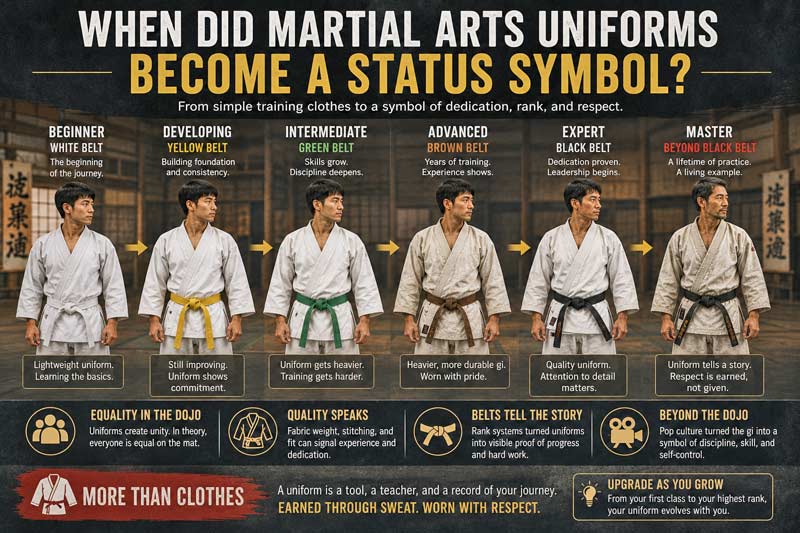
Today, most people think of a martial arts uniform as standard equipment. You show up, put it on, tie your belt, and train. But for a long time, simply owning a proper uniform said something important about who you were and how serious you were about martial arts.
In the early days of organized training, uniforms helped create a sense of equality inside the dojo. Rich or poor, beginner or advanced student, everyone trained in roughly the same clothing. At least in theory. In reality, the quality of your uniform could quietly signal experience, commitment, or status.
A heavily worn uniform with faded stitching often meant years of training. A crisp, heavyweight gi suggested serious dedication. Even today, experienced martial artists sometimes notice details beginners overlook, like reinforced collars, sleeve length, fabric weight, or how a belt is tied. If you have ever struggled with that last part, our guide on how to tie a karate belt breaks it down step by step.
Belts also changed everything. Once ranking systems became standardized, uniforms stopped being just clothing and started becoming visual proof of progress. Suddenly, the same white uniform looked completely different depending on the color wrapped around the waist. A white belt represented the beginning. A black belt represented years of consistency, discipline, and repetition. At least, ideally.
That idea became so powerful that uniforms eventually turned into symbols far outside the dojo. Movies, television, and pop culture transformed the gi into instant visual shorthand for discipline, skill, and self-control. Put someone in a martial arts uniform and most people immediately assume they know how to fight, even if they have only taken three classes.
And yes, uniform quality still matters. Students often upgrade as they progress, moving from lightweight beginner uniforms to heavier options built for harder training. If you are trying to figure out where to start, our guide on choosing your first martial arts uniform can help make sense of the options.
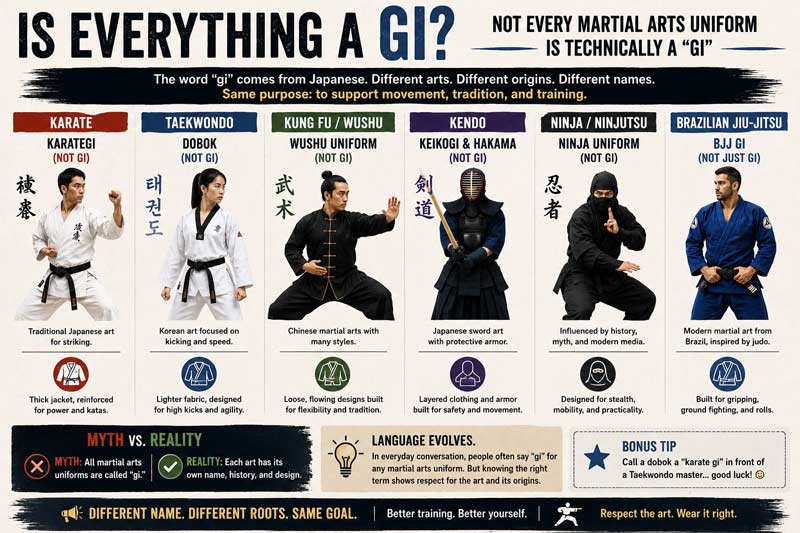
By this point, you may have noticed something strange: people casually call almost every martial arts uniform a "gi," even when that is not technically correct.
That confusion mostly comes from how martial arts spread around the world. Japanese martial arts had a massive influence on early Western martial arts culture, so terms like dojo, sensei, and gi stuck, even when students trained in styles from completely different countries.
Take taekwondo, for example. Many students still say "TKD gi," but the correct Korean term is dobok. The same thing happens in kendo, where practitioners wear a very different uniform built around armor and sword movement. Chinese martial arts often use completely different styles of training clothing altogether, which is why many kung fu uniforms look dramatically different from Japanese martial arts attire.
Even within Japanese arts, the word can get surprisingly specific. A judo practitioner wears a judogi. A karate practitioner wears a karategi. Brazilian jiu-jitsu borrowed much of its early structure from judo, which is why practitioners still commonly say "BJJ gi," even though the sport developed in Brazil.
Then there are arts that barely resemble the classic image most people picture. Modern kendo uniforms involve layered garments and protective armor. Ninja uniforms are heavily shaped by modern media and martial arts schools. Some schools even train in athletic wear or compression gear rather than traditional uniforms at all.
So, is every martial arts uniform a gi? Not exactly. But language evolves, and in everyday conversation, most people still understand what you mean when you say it.
That said, if you ever call a taekwondo instructor's dobok a karate gi, there is at least a small chance they will correct you immediately.
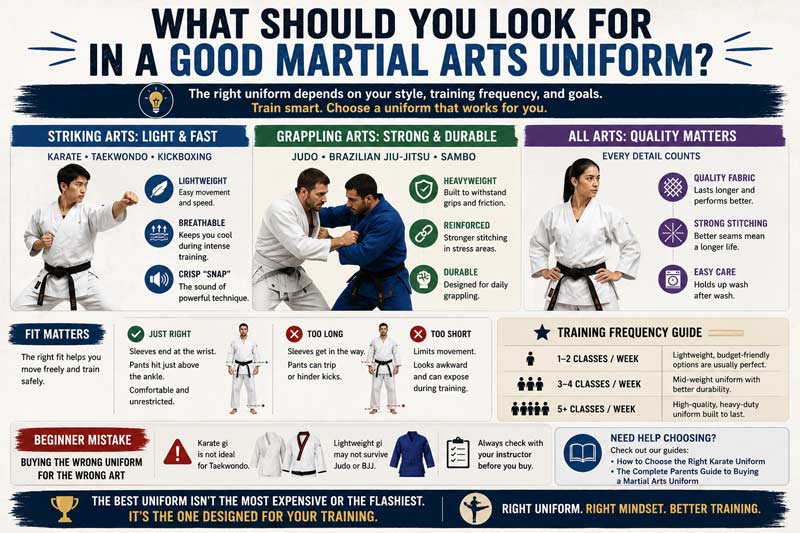
Once people learn that martial arts uniforms evolved for different purposes, another question usually follows: what actually makes a good one?
The answer depends heavily on what style you train and how often you practice. A beginner taking one or two classes a week probably does not need the same heavyweight uniform as someone training four or five days a week or preparing for competition.
For striking arts like karate and taekwondo, many students prefer lighter uniforms that breathe well and allow fast movement. Lightweight fabric creates that sharp "snap" sound during techniques, which many practitioners love. Grappling arts are the opposite. Judo and jiu-jitsu uniforms tend to be thicker and more reinforced because they need to survive constant pulling, gripping, and friction.
Fit matters more than most beginners expect, too. Sleeves that are too long can get in the way. Pants that are too short can feel awkward during kicks or stances. Some students prefer traditional cuts, while others want athletic fits or extra room for comfort. That is one reason plus-size martial arts uniforms and style-specific options have become more popular over time.
Then there is the beginner mistake almost everyone makes: buying the wrong uniform for the wrong art. A karate gi is not necessarily ideal for taekwondo. A lightweight karate uniform may not survive judo training for very long. If you are still figuring out what makes sense, our guides on choosing the right karate uniform and buying a martial arts uniform for beginners can help narrow things down.
In other words, the "best" martial arts uniform is usually the one designed for your actual training, not just the one that looks coolest online.
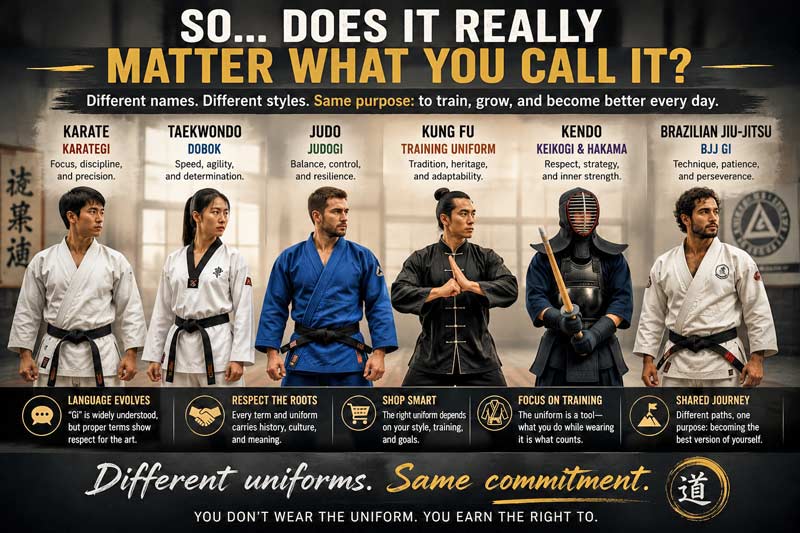
After all this history, terminology, and martial arts debate, you might be wondering something completely reasonable: does it actually matter whether you call it a gi, dobok, or something else?
For most people, not really.
If you walk into a martial arts school and say, "I need a gi," chances are everyone will know what you mean. Language changes over time, and martial arts culture is no exception. The word "gi" has become a kind of universal shorthand in many places, especially outside Asia.
That said, learning the proper terminology can still show respect for the art you practice. Calling a taekwondo uniform a dobok, understanding the difference between a judogi and a karategi, or recognizing why a kung fu uniform looks completely different can help you appreciate the history behind what you are wearing.
It also helps you avoid beginner mistakes when shopping. Someone training in karate will usually want something very different from a judo student or a kung fu practitioner. If you are still trying to figure out what works best for your style, browsing different martial arts uniforms side-by-side can make those differences a lot easier to spot.
In the end, the uniform matters less than what happens while wearing it. Whether you call it a gi, dobok, or training uniform, the real purpose stays the same: showing up, learning, improving, and putting in the work.
Maybe that is why martial arts uniforms have survived for so long. They are not just clothes. They quietly remind people that training starts the moment you put one on.
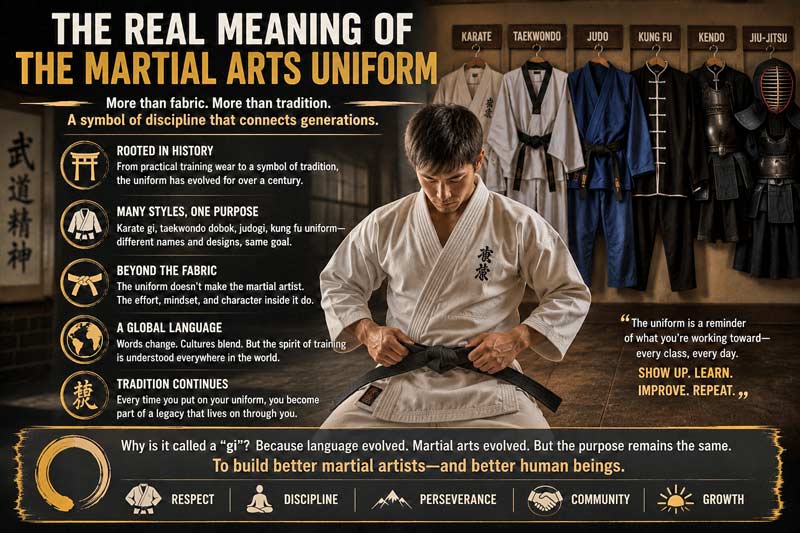
For something that seems so simple, the martial arts uniform carries a surprising amount of history.
What started as practical training clothing slowly evolved into something much bigger. A karate gi, taekwondo dobok, judo uniform, or kung fu outfit is not just fabric stitched together for movement. It reflects tradition, discipline, identity, and sometimes even a little controversy.
And despite all the debates about terminology, color, fit, or tradition, most martial artists eventually discover the same thing: the uniform matters far less than the effort inside it.
You can train in a heavyweight gi, a lightweight dobok, a kung fu uniform, or something more modern, but the purpose stays remarkably consistent. Show up. Learn. Improve. Repeat.
So, why is it called a "gi"? The short answer is because language evolved and martial arts evolved with it. The longer answer is much stranger, tied to Japanese history, dojo culture, changing traditions, and how martial arts spread around the world.
The next time you tie your belt or put on your uniform, you may see it a little differently. Not just as training gear, but as part of a tradition that has quietly connected generations of martial artists for more than a century.
Technically, no. The proper Korean term for a taekwondo uniform is a dobok, not a gi.
That said, many people casually call it a "TKD gi," especially outside Korea. The confusion mostly comes from the fact that Japanese martial arts terms became widely popular in Western martial arts culture, so words like dojo, sensei, and gi often get used as catch-all terms.
There are also real design differences. Many taekwondo uniforms use a pullover V-neck design instead of the wraparound jacket common in karate. They are also usually lighter and designed to support speed, flexibility, and high kicking movements.
So, if you call a taekwondo uniform a gi, most people will understand what you mean. But if you want to be technically correct, dobok is the right term.
Black martial arts uniforms are mostly a modern trend, but there are a few different reasons they became popular.
For some schools, black uniforms are about identity and rank. Instructors or advanced students may wear them to stand out from beginners. Certain arts and organizations also use black uniforms to create a stronger visual style or team culture.
Pop culture played a huge role, too. Movies, martial arts demonstrations, and ninja mythology helped make black uniforms look more intimidating and dramatic. Over time, many schools adopted them simply because students liked the look.
Traditional schools sometimes prefer white uniforms because they emphasize humility, discipline, and uniformity. White also makes it easier to spot dirt and wear, which historically reinforced the idea that a clean uniform reflected respect for training.
In the end, neither color automatically makes someone more skilled. A black uniform may look impressive, but most instructors would probably agree that consistency in training matters a lot more than what color you wear.
At first glance, they can look pretty similar. Both are usually white, both use belts, and both trace part of their history back to Japan. But once you put them side-by-side, the differences become obvious fast.
A karate gi is usually lighter and designed for speed, striking, and freedom of movement. Many karate students prefer lighter fabrics because they allow fast kicks and punches and often create that satisfying "snap" sound during techniques.
A judo gi, on the other hand, is built to take punishment. Because judo involves constant gripping, throwing, and pulling, the fabric is usually much thicker with reinforced collars and stronger stitching to survive intense grappling.
Brazilian jiu-jitsu uniforms took things even further, often adding heavier fabric and tighter fits designed for ground fighting and grip battles. If you want a deeper breakdown, we compared the details in our guide to judo gi vs jiu-jitsu gi.
The short version? Karate uniforms are generally built for movement and striking. Judo uniforms are built for grabbing and durability. Choosing the wrong one for your art can make training a lot less comfortable.
What Does "Gi" Actually Mean?
Here is where things start getting weird: the word "gi" is not actually the full name of the uniform.
In Japanese, gi simply means "wear" or "clothing." The full term is usually based on the martial art itself. A karate uniform is technically called a karategi. A judo uniform is a judogi. In Brazilian jiu-jitsu, practitioners often still call it a gi, even though the sport evolved in Brazil rather than Japan.
Some martial artists use the word "gi" as a catch-all term for nearly every training uniform, but traditionalists sometimes cringe at that idea. Why? Because not every martial art uniform is built the same, and some styles do not technically wear a gi at all.
For example, many karate uniforms use lighter fabrics designed for speed and snapping techniques, while judo uniforms are famously thick and reinforced because they need to survive constant grabbing and throwing. Brazilian jiu-jitsu uniforms are often even heavier, which is one reason people constantly compare the differences between a judo gi and a BJJ gi.
Then things get even more confusing with taekwondo. Many practitioners call their uniform a "gi," but the proper Korean term is actually dobok. If you have ever wondered why some taekwondo uniforms pull over the head instead of wrapping across the chest, there is a reason for that. We covered some of those differences in our guide to TKD uniforms vs karate gis.
In other words, calling everything a "gi" is a little like calling every soft drink "Coke." Plenty of people do it, but it is not always technically correct.
Did Samurai Invent the Martial Arts Uniform?
This is where martial arts history starts to get surprisingly messy.
A lot of people assume the modern gi came directly from samurai armor or ancient Japanese warriors. That sounds cool, but it is not exactly true. Samurai did influence martial arts culture, especially in Japan, but the uniform most people recognize today is actually much newer than many expect.
Before modern uniforms existed, martial artists often trained in everyday clothing. Okinawan karate practitioners sometimes trained in simple work clothes, loose garments, or whatever they happened to own. Training was usually practical and private, not something designed for spectators or tournaments.
The uniform started becoming more standardized in the late 1800s and early 1900s, largely because of judo founder Jigoro Kano. Kano wanted a durable outfit that could survive throwing, grabbing, and constant training. He adapted elements of traditional Japanese clothing and created a thicker practice uniform that eventually became known as the judogi.
That design quietly changed martial arts history. As karate spread from Okinawa to mainland Japan, many schools adopted a similar style uniform because it looked disciplined, unified, and practical for training. Over time, different arts modified the formula. Karate uniforms became lighter for speed and striking. Taekwondo uniforms evolved into lighter, often pullover-style tops. Judo uniforms stayed heavy and reinforced for grappling, while jiu-jitsu uniforms became even more specialized for ground fighting.
So, did samurai invent the gi? Not really. But they definitely helped shape the culture of discipline, ritual, and appearance that made martial arts uniforms feel important in the first place.
Why Do Some Martial Arts Uniforms Look Completely Different?
Once you know that not every uniform is technically the same kind of gi, another question naturally comes up: why do they look so different in the first place?
If you line up martial artists from different styles, the differences become obvious fast. A karate practitioner may wear a lightweight uniform with shorter sleeves for speed and snapping movements. A judoka usually trains in a thick, reinforced jacket designed to survive endless grabbing and throwing. A taekwondo student may wear a V-neck pullover top, while kung fu practitioners often train in uniforms with frog-button closures that look completely different from Japanese styles.
The reason is surprisingly simple: uniforms evolved around the needs of the martial art.
For example, kung fu uniforms prioritize flowing movement and flexibility, often reflecting centuries of Chinese tradition. kendo uniforms are designed around armor and sword movement, which is why they look dramatically different from what most people picture when they hear the word "gi." Even within Japanese arts, differences matter. We recently broke down some of the biggest contrasts in our guide to the difference between a judo gi and a jiu-jitsu gi.
Then there are ninja uniforms, which may be the most misunderstood of all. The all-black "movie ninja" look is mostly Hollywood mythology. Historically, many covert fighters blended into ordinary clothing instead of dressing like someone trying very hard to look like a ninja. Modern ninja uniforms are largely inspired by pop culture, stage performances, and martial arts schools rather than historical battlefield clothing.
In other words, martial arts uniforms are not random fashion choices. They are tools. Every collar, sleeve, fabric weight, and design choice usually exists for a reason tied to how that style actually fights, trains, or moves.
Why Are Karate Uniforms Usually White?
If martial arts uniforms evolved for practical reasons, another question naturally comes up: why are so many of them white?
Most people assume white uniforms symbolize peace, discipline, or purity. That explanation gets repeated constantly in martial arts schools, and while there is some truth to it, the real reason is actually much more practical.
When early judo and karate uniforms became standardized in Japan, white cotton was simply affordable, easy to clean, and widely available. White fabric also made it obvious when a uniform was dirty, which mattered in dojo culture where cleanliness and presentation were considered signs of discipline and respect.
Over time, the color picked up symbolic meaning. A crisp white uniform started representing humility, dedication, and the idea that students entered training as beginners ready to learn. That symbolism stuck, especially in traditional schools where ritual and etiquette became deeply tied to martial arts culture.
Of course, modern martial arts changed the rules a bit. Today, you can find black, blue, red, camouflage, and even custom-colored uniforms depending on the style or school. Some Brazilian jiu-jitsu competitions allow multiple colors, and many modern schools embrace personal expression. Still, traditional practitioners sometimes push back, arguing that flashy uniforms miss the point of martial arts training.
If you have ever wondered why some schools are strict about uniform color while others encourage variety, a lot of it comes down to tradition versus modern identity. We explored some of that history in our article about why karate uniforms are white.
Interestingly, uniform color can also affect confidence and perception. Studies in sports psychology have suggested that clothing can influence how people feel and even how intimidating they appear to others. Maybe that helps explain why black uniforms suddenly became so popular in martial arts movies and commercial schools.
When Did Martial Arts Uniforms Become a Status Symbol?
Today, most people think of a martial arts uniform as standard equipment. You show up, put it on, tie your belt, and train. But for a long time, simply owning a proper uniform said something important about who you were and how serious you were about martial arts.
In the early days of organized training, uniforms helped create a sense of equality inside the dojo. Rich or poor, beginner or advanced student, everyone trained in roughly the same clothing. At least in theory. In reality, the quality of your uniform could quietly signal experience, commitment, or status.
A heavily worn uniform with faded stitching often meant years of training. A crisp, heavyweight gi suggested serious dedication. Even today, experienced martial artists sometimes notice details beginners overlook, like reinforced collars, sleeve length, fabric weight, or how a belt is tied. If you have ever struggled with that last part, our guide on how to tie a karate belt breaks it down step by step.
Belts also changed everything. Once ranking systems became standardized, uniforms stopped being just clothing and started becoming visual proof of progress. Suddenly, the same white uniform looked completely different depending on the color wrapped around the waist. A white belt represented the beginning. A black belt represented years of consistency, discipline, and repetition. At least, ideally.
That idea became so powerful that uniforms eventually turned into symbols far outside the dojo. Movies, television, and pop culture transformed the gi into instant visual shorthand for discipline, skill, and self-control. Put someone in a martial arts uniform and most people immediately assume they know how to fight, even if they have only taken three classes.
And yes, uniform quality still matters. Students often upgrade as they progress, moving from lightweight beginner uniforms to heavier options built for harder training. If you are trying to figure out where to start, our guide on choosing your first martial arts uniform can help make sense of the options.
Not Every Martial Arts Uniform Is Technically a "Gi"
By this point, you may have noticed something strange: people casually call almost every martial arts uniform a "gi," even when that is not technically correct.
That confusion mostly comes from how martial arts spread around the world. Japanese martial arts had a massive influence on early Western martial arts culture, so terms like dojo, sensei, and gi stuck, even when students trained in styles from completely different countries.
Take taekwondo, for example. Many students still say "TKD gi," but the correct Korean term is dobok. The same thing happens in kendo, where practitioners wear a very different uniform built around armor and sword movement. Chinese martial arts often use completely different styles of training clothing altogether, which is why many kung fu uniforms look dramatically different from Japanese martial arts attire.
Even within Japanese arts, the word can get surprisingly specific. A judo practitioner wears a judogi. A karate practitioner wears a karategi. Brazilian jiu-jitsu borrowed much of its early structure from judo, which is why practitioners still commonly say "BJJ gi," even though the sport developed in Brazil.
Then there are arts that barely resemble the classic image most people picture. Modern kendo uniforms involve layered garments and protective armor. Ninja uniforms are heavily shaped by modern media and martial arts schools. Some schools even train in athletic wear or compression gear rather than traditional uniforms at all.
So, is every martial arts uniform a gi? Not exactly. But language evolves, and in everyday conversation, most people still understand what you mean when you say it.
That said, if you ever call a taekwondo instructor's dobok a karate gi, there is at least a small chance they will correct you immediately.
What Should You Look for in a Good Martial Arts Uniform?
Once people learn that martial arts uniforms evolved for different purposes, another question usually follows: what actually makes a good one?
The answer depends heavily on what style you train and how often you practice. A beginner taking one or two classes a week probably does not need the same heavyweight uniform as someone training four or five days a week or preparing for competition.
For striking arts like karate and taekwondo, many students prefer lighter uniforms that breathe well and allow fast movement. Lightweight fabric creates that sharp "snap" sound during techniques, which many practitioners love. Grappling arts are the opposite. Judo and jiu-jitsu uniforms tend to be thicker and more reinforced because they need to survive constant pulling, gripping, and friction.
Fit matters more than most beginners expect, too. Sleeves that are too long can get in the way. Pants that are too short can feel awkward during kicks or stances. Some students prefer traditional cuts, while others want athletic fits or extra room for comfort. That is one reason plus-size martial arts uniforms and style-specific options have become more popular over time.
Then there is the beginner mistake almost everyone makes: buying the wrong uniform for the wrong art. A karate gi is not necessarily ideal for taekwondo. A lightweight karate uniform may not survive judo training for very long. If you are still figuring out what makes sense, our guides on choosing the right karate uniform and buying a martial arts uniform for beginners can help narrow things down.
In other words, the "best" martial arts uniform is usually the one designed for your actual training, not just the one that looks coolest online.
So... Does It Really Matter What You Call It?
After all this history, terminology, and martial arts debate, you might be wondering something completely reasonable: does it actually matter whether you call it a gi, dobok, or something else?
For most people, not really.
If you walk into a martial arts school and say, "I need a gi," chances are everyone will know what you mean. Language changes over time, and martial arts culture is no exception. The word "gi" has become a kind of universal shorthand in many places, especially outside Asia.
That said, learning the proper terminology can still show respect for the art you practice. Calling a taekwondo uniform a dobok, understanding the difference between a judogi and a karategi, or recognizing why a kung fu uniform looks completely different can help you appreciate the history behind what you are wearing.
It also helps you avoid beginner mistakes when shopping. Someone training in karate will usually want something very different from a judo student or a kung fu practitioner. If you are still trying to figure out what works best for your style, browsing different martial arts uniforms side-by-side can make those differences a lot easier to spot.
In the end, the uniform matters less than what happens while wearing it. Whether you call it a gi, dobok, or training uniform, the real purpose stays the same: showing up, learning, improving, and putting in the work.
Maybe that is why martial arts uniforms have survived for so long. They are not just clothes. They quietly remind people that training starts the moment you put one on.
The Real Meaning of the Martial Arts Uniform
For something that seems so simple, the martial arts uniform carries a surprising amount of history.
What started as practical training clothing slowly evolved into something much bigger. A karate gi, taekwondo dobok, judo uniform, or kung fu outfit is not just fabric stitched together for movement. It reflects tradition, discipline, identity, and sometimes even a little controversy.
And despite all the debates about terminology, color, fit, or tradition, most martial artists eventually discover the same thing: the uniform matters far less than the effort inside it.
You can train in a heavyweight gi, a lightweight dobok, a kung fu uniform, or something more modern, but the purpose stays remarkably consistent. Show up. Learn. Improve. Repeat.
So, why is it called a "gi"? The short answer is because language evolved and martial arts evolved with it. The longer answer is much stranger, tied to Japanese history, dojo culture, changing traditions, and how martial arts spread around the world.
The next time you tie your belt or put on your uniform, you may see it a little differently. Not just as training gear, but as part of a tradition that has quietly connected generations of martial artists for more than a century.
FAQ: Is a Taekwondo Uniform Called a Gi?
Technically, no. The proper Korean term for a taekwondo uniform is a dobok, not a gi.
That said, many people casually call it a "TKD gi," especially outside Korea. The confusion mostly comes from the fact that Japanese martial arts terms became widely popular in Western martial arts culture, so words like dojo, sensei, and gi often get used as catch-all terms.
There are also real design differences. Many taekwondo uniforms use a pullover V-neck design instead of the wraparound jacket common in karate. They are also usually lighter and designed to support speed, flexibility, and high kicking movements.
So, if you call a taekwondo uniform a gi, most people will understand what you mean. But if you want to be technically correct, dobok is the right term.
FAQ: Why Are Some Martial Arts Uniforms Black Instead of White?
Black martial arts uniforms are mostly a modern trend, but there are a few different reasons they became popular.
For some schools, black uniforms are about identity and rank. Instructors or advanced students may wear them to stand out from beginners. Certain arts and organizations also use black uniforms to create a stronger visual style or team culture.
Pop culture played a huge role, too. Movies, martial arts demonstrations, and ninja mythology helped make black uniforms look more intimidating and dramatic. Over time, many schools adopted them simply because students liked the look.
Traditional schools sometimes prefer white uniforms because they emphasize humility, discipline, and uniformity. White also makes it easier to spot dirt and wear, which historically reinforced the idea that a clean uniform reflected respect for training.
In the end, neither color automatically makes someone more skilled. A black uniform may look impressive, but most instructors would probably agree that consistency in training matters a lot more than what color you wear.
FAQ: What Is the Difference Between a Karate Gi and a Judo Gi?
At first glance, they can look pretty similar. Both are usually white, both use belts, and both trace part of their history back to Japan. But once you put them side-by-side, the differences become obvious fast.
A karate gi is usually lighter and designed for speed, striking, and freedom of movement. Many karate students prefer lighter fabrics because they allow fast kicks and punches and often create that satisfying "snap" sound during techniques.
A judo gi, on the other hand, is built to take punishment. Because judo involves constant gripping, throwing, and pulling, the fabric is usually much thicker with reinforced collars and stronger stitching to survive intense grappling.
Brazilian jiu-jitsu uniforms took things even further, often adding heavier fabric and tighter fits designed for ground fighting and grip battles. If you want a deeper breakdown, we compared the details in our guide to judo gi vs jiu-jitsu gi.
The short version? Karate uniforms are generally built for movement and striking. Judo uniforms are built for grabbing and durability. Choosing the wrong one for your art can make training a lot less comfortable.
You May Also Be Interested In:
- The Strange History of the Blowgun
- The History of the Dojo: Why Martial Arts Schools Look the Way They Do
- What Is a Rope Dart? History, Training, and Martial Arts Uses
- The Most Dangerous Chain Weapons in Martial Arts History
- What Is a Chain Whip? History, Training, and Martial Arts Uses
- The Real History of Nunchaku: From Farm Tool to Martial Arts Icon
- Why Are Karate Uniforms White? The Real Meaning Explained
- Why Did Seax Knives Have Such Strange Blades?
- What is the Best Bo Staff for Martial Arts?
- 10 Reasons Why You Should Try Martial Arts
Leave a Reply