



What Are Rebreakable Boards and How Do They Work?
May 16th, 2026

If you have ever watched a martial arts demonstration or belt test, chances are you have seen someone break a board with a punch, kick, elbow, or strike. While traditional wooden boards are still common, many martial arts schools now use rebreakable boards for training because they can be used over and over again. Instead of splintering into pieces after one break, these boards snap apart and lock back together for repeated practice.
For beginners, rebreakable boards can feel a lot less intimidating than wood, and for instructors, they offer a more consistent way to teach proper technique without constantly replacing broken materials. But how exactly do they work, and are they actually better than wooden boards? In this guide, we will break down what rebreakable boards are, how they function, and why so many martial artists use them for training and belt testing.
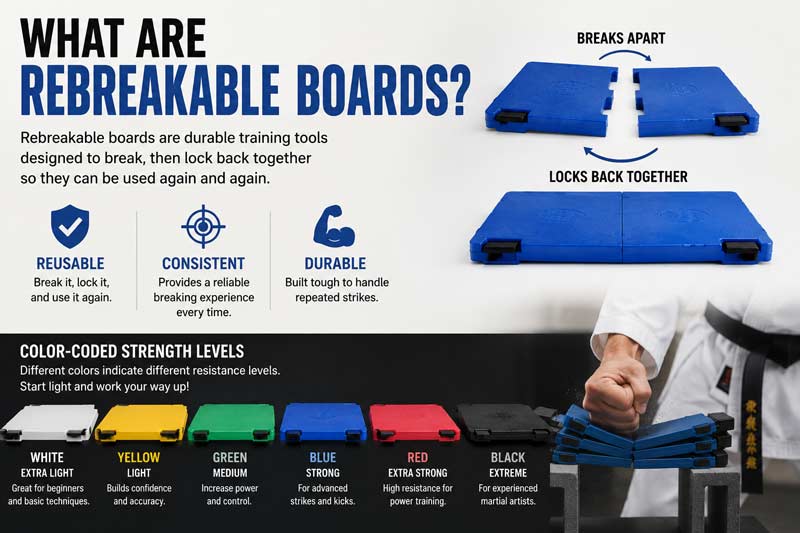
Rebreakable boards are training tools designed to simulate the experience of breaking traditional wooden boards without needing to replace them after every attempt. Instead of splintering into pieces, these boards are made to snap apart at the center and then lock back together so they can be used again and again. That makes them especially popular in martial arts schools, demonstrations, belt tests, and home training setups.
Most rebreakable boards are made from durable molded plastic and come in different resistance levels based on thickness or color. Some are designed for beginners practicing basic strikes, while others are made strong enough for advanced martial artists training powerful kicks, punches, elbows, or hand techniques. The color system varies by brand, but schools often use different strengths to help students gradually build confidence and technique over time.
One reason rebreakable boards have become so popular is consistency. Unlike wood, which can vary in grain, moisture, and difficulty from board to board, rebreakable boards provide a more predictable training experience. That consistency helps students focus on proper form, accuracy, and follow-through instead of worrying whether the board itself is unusually hard or weak.
If you are curious about different styles of martial arts breaking boards, you will notice there are options designed for different skill levels, training goals, and types of strikes. Choosing the right board strength can make a big difference in both safety and confidence during practice.
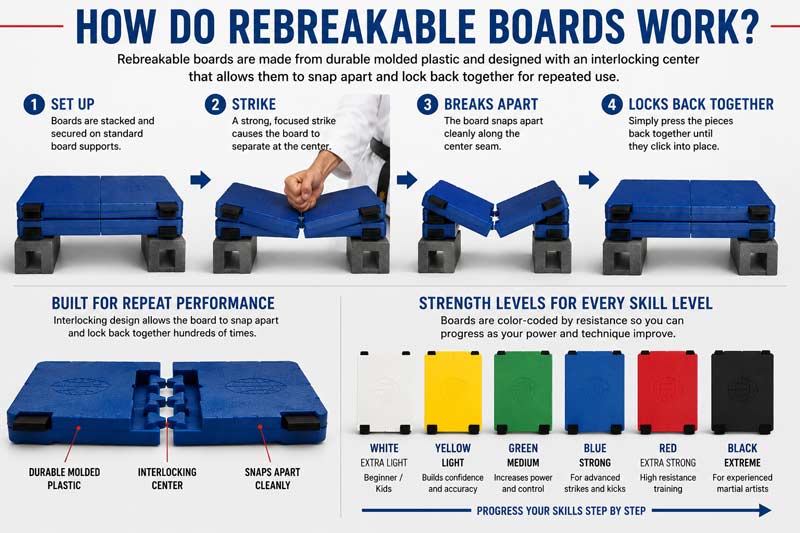
At first glance, rebreakable boards can seem a little confusing. They look solid like regular breaking boards, yet somehow they can be used over and over again without splintering. The secret is in the way they are built. Most rebreakable boards are made from strong molded plastic and designed with an interlocking center that allows the board to snap apart under enough force and then click back together afterward.
When struck correctly, the board separates at the center seam rather than cracking unpredictably like wood. This gives students immediate feedback on whether they used proper technique, speed, and follow-through. A weak strike often will not separate the board cleanly, while good form and committed movement make successful breaks much more consistent.
Different rebreakable boards are designed with varying resistance levels, which is why you often see them color-coded by difficulty. Beginner boards usually separate more easily, while advanced boards require significantly more power and precision. This progression makes it possible for martial artists to gradually build confidence and improve technique without jumping straight into difficult board breaks.
If you want a closer look at the mechanics behind how these boards are constructed, our article on how rebreakable boards are designed takes a deeper look at what is happening inside the board and why they work so consistently during training.
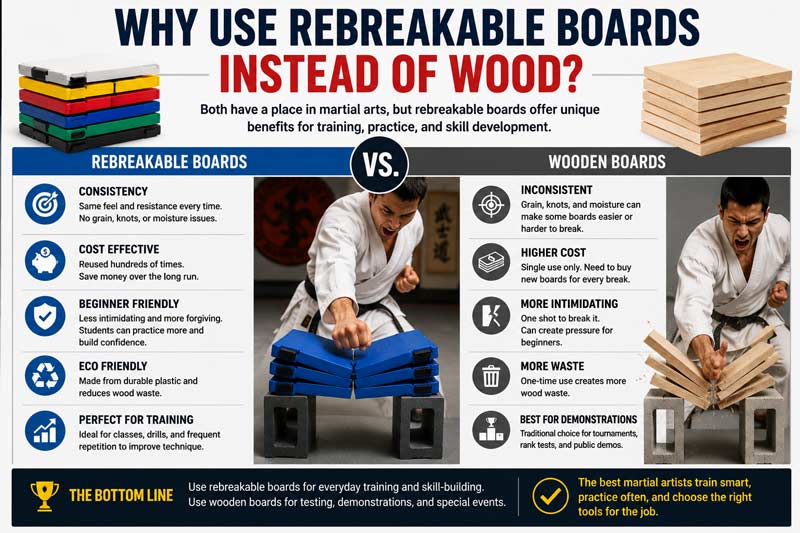
Traditional wooden boards still have their place in martial arts, especially for demonstrations, tournaments, and certain belt tests, but rebreakable boards offer several advantages for regular training. One of the biggest benefits is consistency. Wooden boards can vary depending on grain, moisture, thickness, and even small imperfections in the wood, which means one board may feel much easier or harder to break than another. Rebreakable boards provide a more predictable experience every time.
Another major advantage is cost. Since rebreakable boards can be snapped back together and reused repeatedly, schools and students do not have to constantly replace broken wood after every practice session. Over time, that can save a surprising amount of money, especially for dojos that train large groups of students or frequently practice board breaking techniques.
Rebreakable boards can also feel less intimidating for beginners. Knowing the board can be reused often gives students more opportunities to practice without the pressure of "getting one shot" at a successful break. That repeated practice helps students build confidence, improve form, and better understand follow-through before moving on to harder breaking challenges.
That said, there are still reasons some martial artists prefer wood. If you want a deeper comparison between the two, our guide on rebreakable boards vs wooden boards takes a closer look at the pros and cons of each training method.
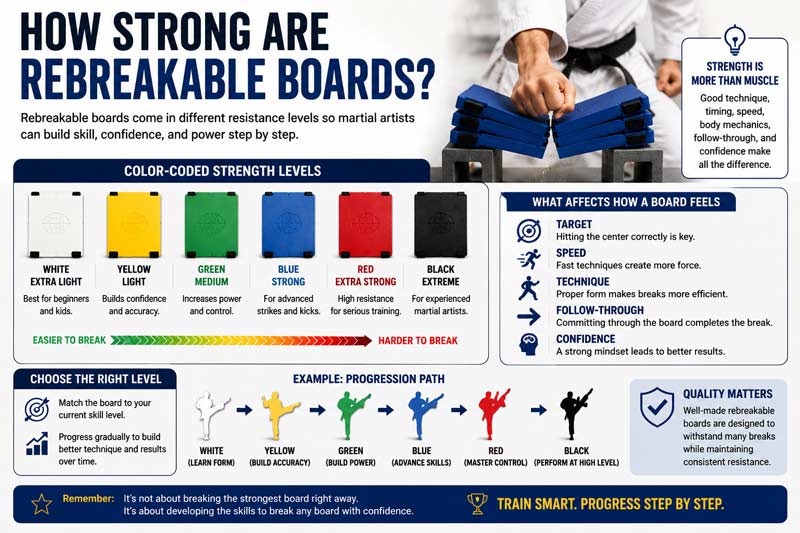
One of the most common questions beginners ask is how strong rebreakable boards actually are. The answer depends on the board's resistance level. Most rebreakable boards come in different strengths, often identified by color, so martial artists can gradually work their way up as technique, confidence, and power improve. A beginner board designed for kids or first-time students will feel very different from an advanced board made for experienced martial artists.
The color system is not always identical across brands, but lighter boards are generally easier to break while darker or thicker boards tend to require more force. Many schools start students with lower resistance levels so they can focus on proper form and follow-through instead of trying to overpower the board with brute strength. As skill improves, students can gradually progress to more difficult boards without sacrificing technique.
It is important to remember that successful board breaking is not only about strength. Proper targeting, speed, body mechanics, follow-through, and confidence all play a major role. Someone with good technique can often break a board more effectively than someone trying to rely only on raw power.
If you are comparing different rebreakable board strengths, it helps to choose a resistance level that matches your current experience rather than jumping straight to the hardest option. Starting too difficult can lead to frustration and poor habits, while progressing gradually tends to build much better results over time.
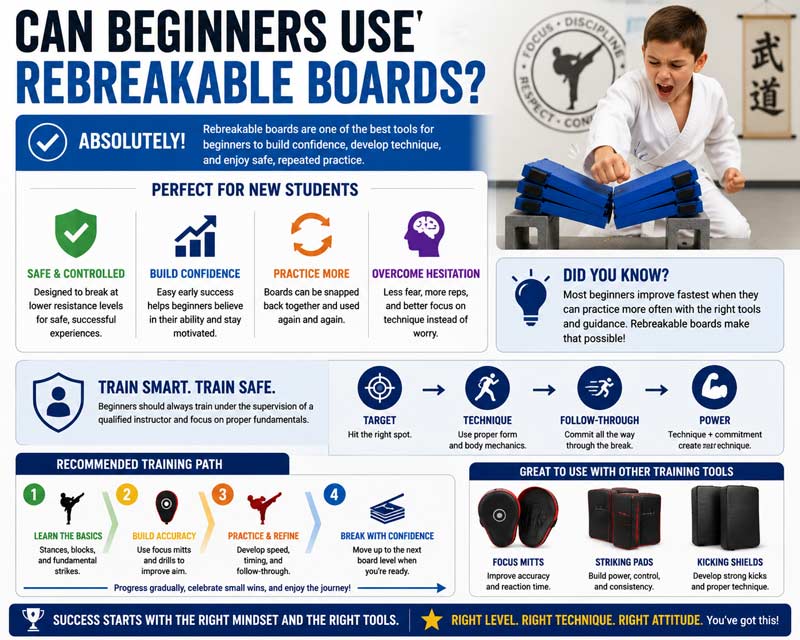
Absolutely. In fact, rebreakable boards are often one of the best ways for beginners to safely build confidence with breaking techniques. Since the boards come in different resistance levels, instructors can start students with easier boards that match their age, experience level, and striking ability. This gradual progression helps beginners focus on technique instead of feeling overwhelmed by trying to break something too difficult right away.
For many students, one of the biggest challenges with board breaking is mental hesitation. It is common for beginners to pull back at the last second or worry about hurting their hand or foot. Rebreakable boards help reduce some of that fear because students know they can practice repeatedly without wasting materials or feeling pressured to succeed on a single attempt.
That said, beginners should still train with supervision and proper instruction, especially when practicing strikes for the first time. Good body mechanics, targeting, and follow-through matter just as much as power. Many martial arts schools pair board training with drills using focus mitt practice or other martial arts training equipment so students can safely improve accuracy and technique before attempting more difficult breaks.
The key is starting at the right level and building gradually. Most students gain confidence surprisingly fast once they realize successful breaking depends more on proper technique and commitment than pure strength.
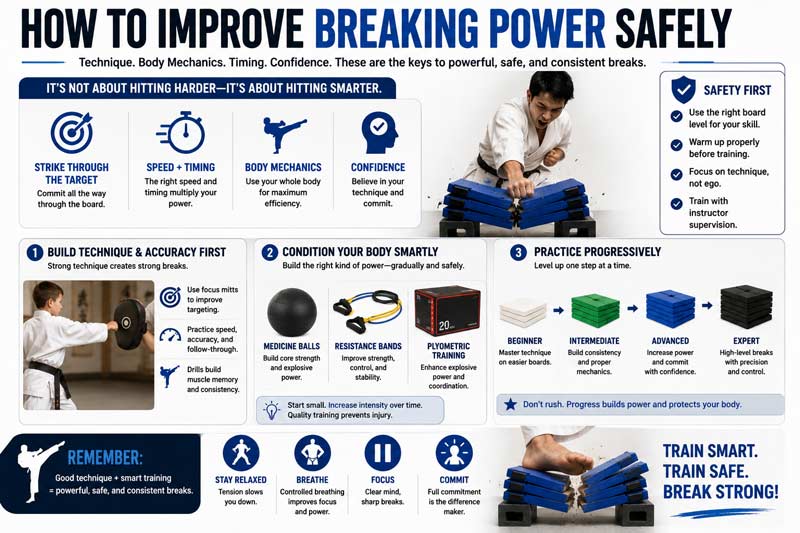
Getting better at board breaking is not just about hitting harder. In fact, trying to muscle through a break with pure strength is one of the most common mistakes beginners make. Proper technique, timing, body mechanics, and confidence usually matter much more than raw power. The goal is to strike through the target with control and commitment instead of stopping at the surface of the board.
One of the safest ways to improve breaking ability is by building accuracy and technique first. Many martial artists spend time practicing strikes on focus mitt training targets to improve targeting, speed, and follow-through before attempting harder breaks. Drills that reinforce proper hand positioning, kicking form, and balance often translate directly into more successful board breaking later on.
Conditioning can also play a role, but it should always be approached gradually and carefully. Light impact training, controlled repetitions, and progressive resistance are usually safer than trying to rush into advanced breaking practice too quickly. Many martial artists also use different types of conditioning equipment to safely develop coordination, timing, and controlled power over time.
Most importantly, do not rush the process. Good breaking technique is something built over time through repetition and proper instruction. A student with clean form and confidence will often break more consistently than someone trying to rely only on force.
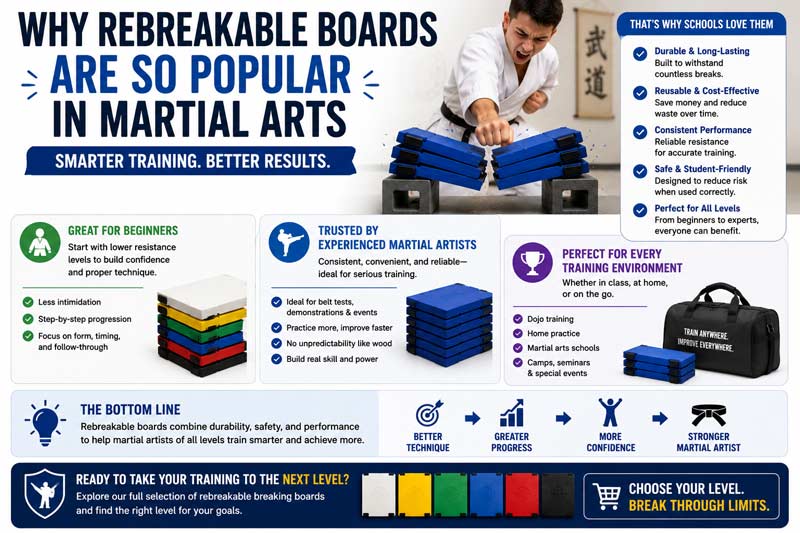
There is a reason so many martial arts schools have switched to rebreakable boards over the years. They are durable, reusable, consistent, and practical for everyday training. Instead of constantly buying replacement wood, instructors can use the same boards repeatedly while still giving students a realistic way to practice breaking technique and build confidence.
Rebreakable boards also make training more approachable for beginners. Since students can start with easier resistance levels and gradually progress, there is less pressure and less intimidation compared to traditional wood breaking. That progression helps students focus on form, timing, and follow-through while building confidence step by step.
At the same time, experienced martial artists appreciate the consistency and convenience. Whether training for belt tests, demonstrations, or personal improvement, rebreakable boards offer a reliable way to practice without the unpredictability of wood. Combined with proper drills, martial arts training tools, and consistent practice, they can become an important part of long-term skill development.
If you are thinking about trying board breaking for yourself, exploring different rebreakable breaking boards can help you find the right resistance level for your current experience and goals.
Rebreakable boards have earned a permanent place in many martial arts schools because they make breaking practice more practical, consistent, and approachable. For beginners, they reduce intimidation and create more opportunities to practice without wasting materials. For instructors, they offer a reliable training tool that can be used repeatedly while helping students focus on proper form and confidence.
Experienced martial artists appreciate them for different reasons. The consistent resistance makes it easier to track progress, refine technique, and prepare for demonstrations or testing. Since the boards can be used again and again, students can practice follow-through, targeting, and timing without worrying about constantly replacing broken wood.
Of course, traditional wood still has its place, especially for formal demonstrations and certain rank tests. But for regular skill-building, it is easy to see why so many schools prefer rebreakable boards as part of everyday training. When combined with proper instruction, consistent practice, and the right martial arts training equipment, they can help students improve faster and train with more confidence.
If you are interested in getting started, exploring different rebreakable board options can help you find the right strength level for your current experience and goals.
What Are Rebreakable Boards?
Rebreakable boards are training tools designed to simulate the experience of breaking traditional wooden boards without needing to replace them after every attempt. Instead of splintering into pieces, these boards are made to snap apart at the center and then lock back together so they can be used again and again. That makes them especially popular in martial arts schools, demonstrations, belt tests, and home training setups.
Most rebreakable boards are made from durable molded plastic and come in different resistance levels based on thickness or color. Some are designed for beginners practicing basic strikes, while others are made strong enough for advanced martial artists training powerful kicks, punches, elbows, or hand techniques. The color system varies by brand, but schools often use different strengths to help students gradually build confidence and technique over time.
One reason rebreakable boards have become so popular is consistency. Unlike wood, which can vary in grain, moisture, and difficulty from board to board, rebreakable boards provide a more predictable training experience. That consistency helps students focus on proper form, accuracy, and follow-through instead of worrying whether the board itself is unusually hard or weak.
If you are curious about different styles of martial arts breaking boards, you will notice there are options designed for different skill levels, training goals, and types of strikes. Choosing the right board strength can make a big difference in both safety and confidence during practice.
How Do Rebreakable Boards Work?
At first glance, rebreakable boards can seem a little confusing. They look solid like regular breaking boards, yet somehow they can be used over and over again without splintering. The secret is in the way they are built. Most rebreakable boards are made from strong molded plastic and designed with an interlocking center that allows the board to snap apart under enough force and then click back together afterward.
When struck correctly, the board separates at the center seam rather than cracking unpredictably like wood. This gives students immediate feedback on whether they used proper technique, speed, and follow-through. A weak strike often will not separate the board cleanly, while good form and committed movement make successful breaks much more consistent.
Different rebreakable boards are designed with varying resistance levels, which is why you often see them color-coded by difficulty. Beginner boards usually separate more easily, while advanced boards require significantly more power and precision. This progression makes it possible for martial artists to gradually build confidence and improve technique without jumping straight into difficult board breaks.
If you want a closer look at the mechanics behind how these boards are constructed, our article on how rebreakable boards are designed takes a deeper look at what is happening inside the board and why they work so consistently during training.
Why Use Rebreakable Boards Instead of Wood?
Traditional wooden boards still have their place in martial arts, especially for demonstrations, tournaments, and certain belt tests, but rebreakable boards offer several advantages for regular training. One of the biggest benefits is consistency. Wooden boards can vary depending on grain, moisture, thickness, and even small imperfections in the wood, which means one board may feel much easier or harder to break than another. Rebreakable boards provide a more predictable experience every time.
Another major advantage is cost. Since rebreakable boards can be snapped back together and reused repeatedly, schools and students do not have to constantly replace broken wood after every practice session. Over time, that can save a surprising amount of money, especially for dojos that train large groups of students or frequently practice board breaking techniques.
Rebreakable boards can also feel less intimidating for beginners. Knowing the board can be reused often gives students more opportunities to practice without the pressure of "getting one shot" at a successful break. That repeated practice helps students build confidence, improve form, and better understand follow-through before moving on to harder breaking challenges.
That said, there are still reasons some martial artists prefer wood. If you want a deeper comparison between the two, our guide on rebreakable boards vs wooden boards takes a closer look at the pros and cons of each training method.
How Strong Are Rebreakable Boards?
One of the most common questions beginners ask is how strong rebreakable boards actually are. The answer depends on the board's resistance level. Most rebreakable boards come in different strengths, often identified by color, so martial artists can gradually work their way up as technique, confidence, and power improve. A beginner board designed for kids or first-time students will feel very different from an advanced board made for experienced martial artists.
The color system is not always identical across brands, but lighter boards are generally easier to break while darker or thicker boards tend to require more force. Many schools start students with lower resistance levels so they can focus on proper form and follow-through instead of trying to overpower the board with brute strength. As skill improves, students can gradually progress to more difficult boards without sacrificing technique.
It is important to remember that successful board breaking is not only about strength. Proper targeting, speed, body mechanics, follow-through, and confidence all play a major role. Someone with good technique can often break a board more effectively than someone trying to rely only on raw power.
If you are comparing different rebreakable board strengths, it helps to choose a resistance level that matches your current experience rather than jumping straight to the hardest option. Starting too difficult can lead to frustration and poor habits, while progressing gradually tends to build much better results over time.
Can Beginners Use Rebreakable Boards?
Absolutely. In fact, rebreakable boards are often one of the best ways for beginners to safely build confidence with breaking techniques. Since the boards come in different resistance levels, instructors can start students with easier boards that match their age, experience level, and striking ability. This gradual progression helps beginners focus on technique instead of feeling overwhelmed by trying to break something too difficult right away.
For many students, one of the biggest challenges with board breaking is mental hesitation. It is common for beginners to pull back at the last second or worry about hurting their hand or foot. Rebreakable boards help reduce some of that fear because students know they can practice repeatedly without wasting materials or feeling pressured to succeed on a single attempt.
That said, beginners should still train with supervision and proper instruction, especially when practicing strikes for the first time. Good body mechanics, targeting, and follow-through matter just as much as power. Many martial arts schools pair board training with drills using focus mitt practice or other martial arts training equipment so students can safely improve accuracy and technique before attempting more difficult breaks.
The key is starting at the right level and building gradually. Most students gain confidence surprisingly fast once they realize successful breaking depends more on proper technique and commitment than pure strength.
How to Improve Breaking Power Safely
Getting better at board breaking is not just about hitting harder. In fact, trying to muscle through a break with pure strength is one of the most common mistakes beginners make. Proper technique, timing, body mechanics, and confidence usually matter much more than raw power. The goal is to strike through the target with control and commitment instead of stopping at the surface of the board.
One of the safest ways to improve breaking ability is by building accuracy and technique first. Many martial artists spend time practicing strikes on focus mitt training targets to improve targeting, speed, and follow-through before attempting harder breaks. Drills that reinforce proper hand positioning, kicking form, and balance often translate directly into more successful board breaking later on.
Conditioning can also play a role, but it should always be approached gradually and carefully. Light impact training, controlled repetitions, and progressive resistance are usually safer than trying to rush into advanced breaking practice too quickly. Many martial artists also use different types of conditioning equipment to safely develop coordination, timing, and controlled power over time.
Most importantly, do not rush the process. Good breaking technique is something built over time through repetition and proper instruction. A student with clean form and confidence will often break more consistently than someone trying to rely only on force.
Why Rebreakable Boards Are So Popular in Martial Arts
There is a reason so many martial arts schools have switched to rebreakable boards over the years. They are durable, reusable, consistent, and practical for everyday training. Instead of constantly buying replacement wood, instructors can use the same boards repeatedly while still giving students a realistic way to practice breaking technique and build confidence.
Rebreakable boards also make training more approachable for beginners. Since students can start with easier resistance levels and gradually progress, there is less pressure and less intimidation compared to traditional wood breaking. That progression helps students focus on form, timing, and follow-through while building confidence step by step.
At the same time, experienced martial artists appreciate the consistency and convenience. Whether training for belt tests, demonstrations, or personal improvement, rebreakable boards offer a reliable way to practice without the unpredictability of wood. Combined with proper drills, martial arts training tools, and consistent practice, they can become an important part of long-term skill development.
If you are thinking about trying board breaking for yourself, exploring different rebreakable breaking boards can help you find the right resistance level for your current experience and goals.
Why Martial Artists Keep Coming Back to Rebreakable Boards
Rebreakable boards have earned a permanent place in many martial arts schools because they make breaking practice more practical, consistent, and approachable. For beginners, they reduce intimidation and create more opportunities to practice without wasting materials. For instructors, they offer a reliable training tool that can be used repeatedly while helping students focus on proper form and confidence.
Experienced martial artists appreciate them for different reasons. The consistent resistance makes it easier to track progress, refine technique, and prepare for demonstrations or testing. Since the boards can be used again and again, students can practice follow-through, targeting, and timing without worrying about constantly replacing broken wood.
Of course, traditional wood still has its place, especially for formal demonstrations and certain rank tests. But for regular skill-building, it is easy to see why so many schools prefer rebreakable boards as part of everyday training. When combined with proper instruction, consistent practice, and the right martial arts training equipment, they can help students improve faster and train with more confidence.
If you are interested in getting started, exploring different rebreakable board options can help you find the right strength level for your current experience and goals.
You May Also Be Interested In:
Leave a Reply