



What Is Iaido? The Japanese Art of Drawing the Sword
May 12th, 2026
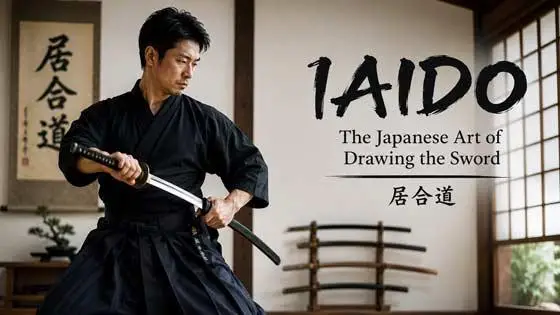
Iaido is a traditional Japanese martial art that focuses on the smooth, controlled drawing and handling of the sword. Unlike martial arts that emphasize sparring or competitive fighting, iaido centers around precision, timing, posture, awareness, and disciplined movement through carefully practiced forms. The art is deeply connected to historical samurai swordsmanship and teaches practitioners how to draw, cut, and return the sword to its scabbard with efficiency and control.
Many practitioners study iaido not only for technical skill development, but also for mental focus, discipline, patience, and self-control. Training often emphasizes calmness, precision, breathing, posture, and consistent repetition rather than speed or physical aggression. Because of this, iaido is often viewed as both a martial art and a form of moving meditation rooted in traditional Japanese culture.
Modern iaido training typically involves forms practice using wooden training swords or unsharpened metal practice blades while wearing traditional uniforms such as hakama and keikogi. Many martial artists interested in traditional Japanese swordsmanship appreciate iaido because it preserves many classical sword-handling concepts while emphasizing discipline, precision, and technical refinement.
In this guide, we'll explain what iaido is, how it differs from kendo and kenjutsu, what equipment is commonly used during training, and why this traditional Japanese sword art continues to attract practitioners around the world today.
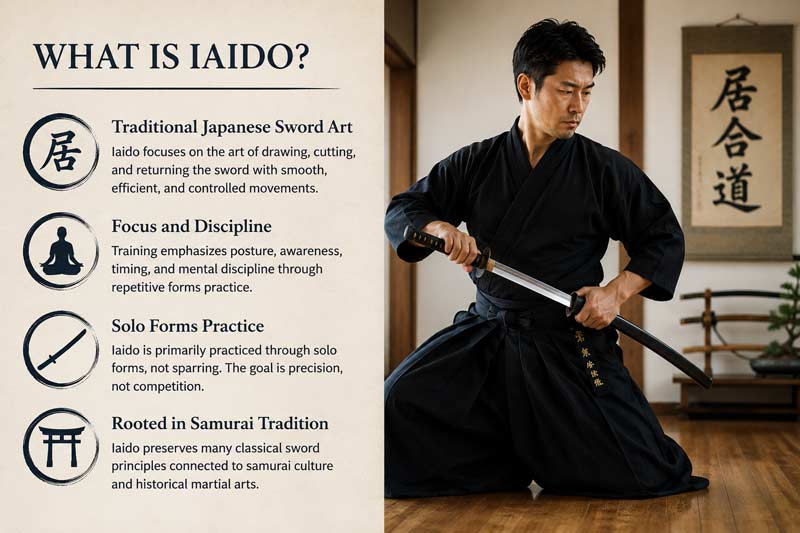
Iaido is a traditional Japanese martial art focused on the smooth, controlled drawing and handling of the sword. The art emphasizes precision, timing, posture, awareness, and disciplined movement through carefully practiced forms rather than sparring or competition. Practitioners train to draw the sword, perform controlled cutting motions, and safely return the blade to its scabbard with efficiency and focus.
The word "iaido" is often translated as "the way of harmonious being" or "the way of mental presence," reflecting the strong emphasis on awareness, concentration, and self-control during training. Unlike martial arts built around speed or aggressive exchanges, iaido focuses heavily on calmness, precision, and technical refinement. Every movement is practiced repeatedly to improve posture, coordination, breathing, and sword-handling mechanics.
Many martial artists interested in traditional Japanese swordsmanship systems appreciate iaido because it preserves many classical sword-handling principles connected to samurai culture and historical martial arts training. Although iaido shares roots with other Japanese sword arts, its primary focus is on solo forms practice and disciplined technical execution rather than sparring-based training.
Modern practitioners often train while wearing traditional uniforms and using wooden or unsharpened practice swords during repetitive forms training. The goal is not simply learning how to handle a sword, but also developing focus, patience, control, posture, and mental discipline through consistent practice over time.
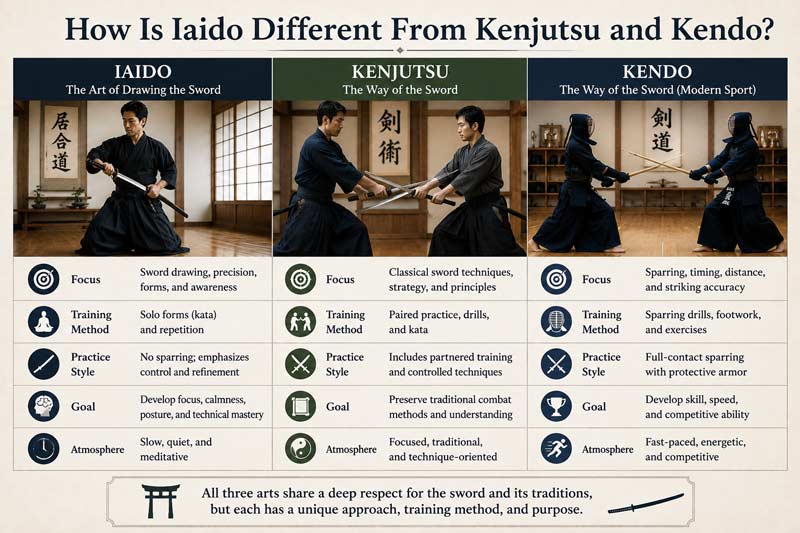
Although iaido, kenjutsu, and kendo all originate from Japanese swordsmanship traditions, each martial art focuses on different training methods and goals. Iaido centers primarily on precise sword drawing, controlled forms practice, posture, awareness, and disciplined movement, while kenjutsu focuses more on classical combat-oriented sword techniques and kendo emphasizes sparring, timing, and competitive training using protective armor and bamboo swords.
Iaido training is usually practiced through solo forms called kata. Practitioners repeatedly perform carefully structured sequences that involve drawing the sword, executing controlled cutting motions, maintaining posture and awareness, and safely returning the blade to its scabbard. Many martial artists who study traditional kenjutsu systems appreciate how iaido preserves historical sword-handling mechanics while placing a stronger emphasis on precision, calmness, and technical refinement.
Modern kendo training, on the other hand, is built around sparring drills, reaction speed, striking accuracy, and competitive practice using shinai and protective armor. Kendo practitioners focus heavily on movement, timing, distancing, and controlled contact training with partners. Iaido generally avoids sparring and instead emphasizes controlled repetition and technical mastery through solo practice.
Another major difference is the overall training atmosphere. Iaido is often slower, quieter, and more meditative compared to the fast-paced movement and sparring found in kendo. Although all three arts share roots in Japanese swordsmanship, they developed into very different training systems with their own philosophies, methods, and goals over time.
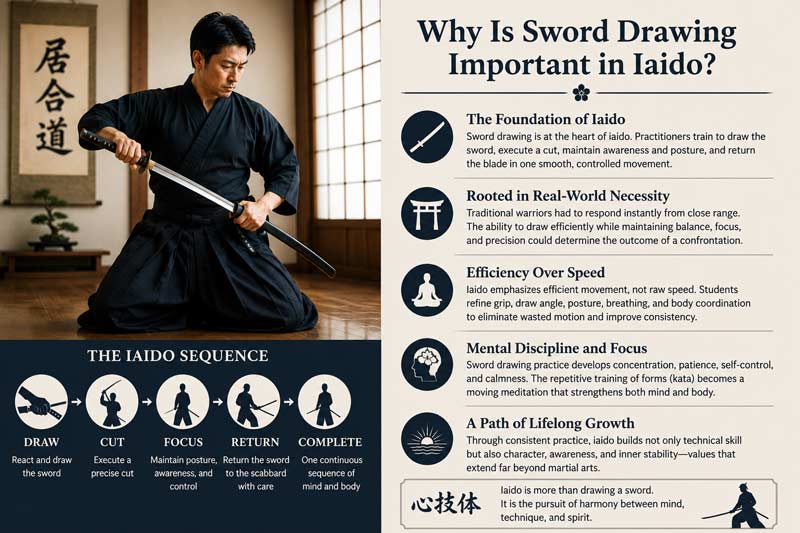
Sword drawing is one of the central skills practiced in iaido because the art focuses heavily on reacting smoothly, efficiently, and with complete control from the very moment the sword leaves the scabbard. Practitioners train to draw the sword, execute precise cutting motions, maintain posture and awareness, and safely return the blade in one continuous sequence of disciplined movement.
In traditional Japanese swordsmanship, the draw itself was considered extremely important because many real confrontations could begin suddenly at very close range. Rather than assuming the sword was already in hand, practitioners trained to respond quickly while maintaining balance, focus, positioning, and technical precision. Many martial artists who study classical Japanese sword arts appreciate how iaido preserves these historical movement concepts through repetitive forms practice.
Modern iaido training emphasizes efficiency rather than raw speed. Students repeatedly practice how to grip the sword, control the draw angle, maintain proper posture, coordinate breathing, and move smoothly throughout the entire sequence. The goal is to eliminate wasted motion while improving focus, precision, calmness, and technical consistency over time.
Many practitioners also view sword drawing practice as a form of mental discipline and moving meditation. Because the movements require concentration, balance, awareness, and self-control, iaido often helps students develop patience and focus alongside technical sword-handling skills. This combination of precision and mindfulness is one of the reasons iaido continues to attract martial artists around the world today.
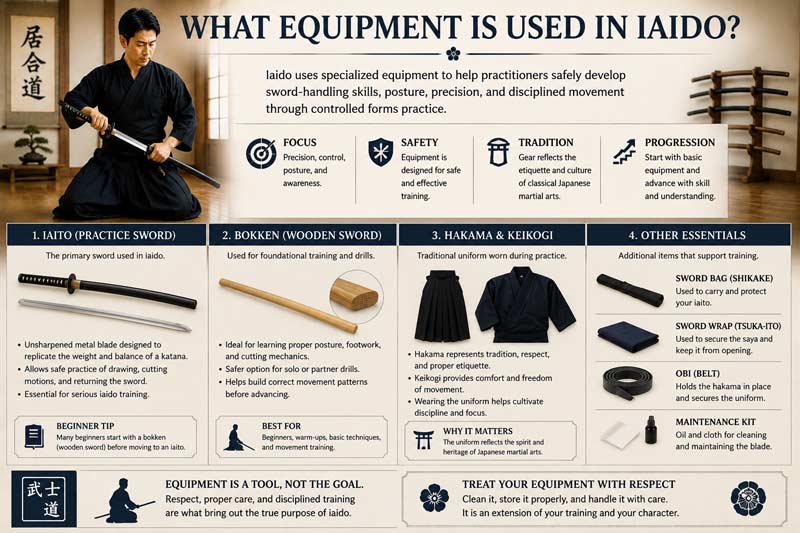
Iaido training uses specialized equipment designed to help practitioners safely develop sword-handling skills, posture, precision, and disciplined movement. Because iaido focuses heavily on controlled forms practice rather than sparring, the equipment is selected to support smooth sword drawing, cutting motions, balance, and technical refinement during repetitive training sequences.
Many beginners start training with wooden practice swords before transitioning to metal training blades called iaito. These unsharpened practice swords are designed to replicate the balance and feel of a traditional katana while allowing students to safely practice drawing and returning the blade to the scabbard. Many martial artists interested in traditional Japanese swords appreciate how iaido training preserves classical sword-handling mechanics through repetitive forms practice.
Traditional uniforms are also an important part of iaido training. Practitioners commonly wear hakama pants and martial arts jackets during practice to preserve the etiquette, appearance, and discipline associated with classical Japanese martial arts. Many students training in traditional hakama uniforms or a Japanese keikogi jacket appreciate the connection these garments have to historical dojo culture and formal martial arts instruction.
Some practitioners also train with wooden swords during drills focused on posture, movement, and cutting mechanics. Many martial artists who study traditional wooden practice swords value them as safe tools for developing control, precision, and proper movement patterns before progressing to more advanced training equipment.
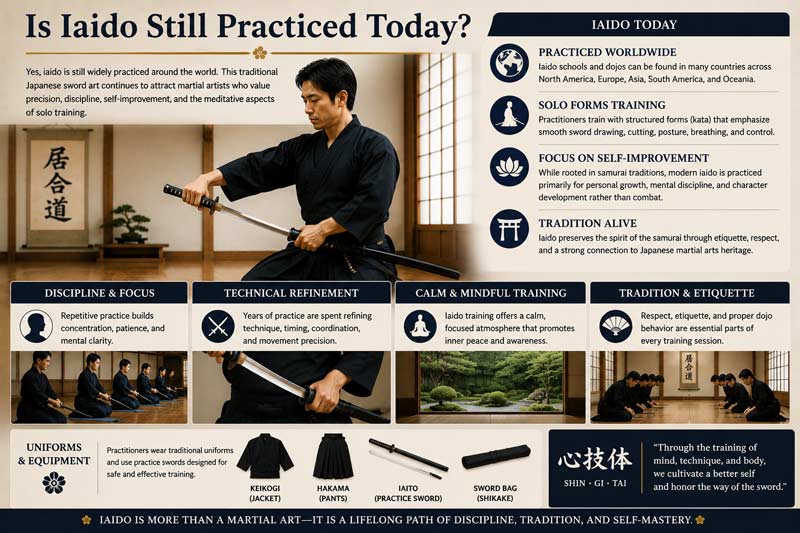
Yes, iaido is still widely practiced today by martial artists around the world who are interested in traditional Japanese swordsmanship, disciplined forms training, and technical sword-handling skills. Although iaido is not as competition-focused as many modern martial arts, it continues to attract practitioners who appreciate precision, focus, posture, awareness, and the meditative aspects of repetitive forms practice.
Modern iaido schools can be found in dojos, martial arts academies, universities, and cultural organizations throughout many countries. Practitioners often train using structured solo forms that emphasize smooth sword drawing, controlled cutting motions, breathing, posture, and disciplined movement. Many martial artists who study traditional Japanese sword arts appreciate how iaido preserves classical swordsmanship concepts while adapting them to modern training environments.
Although the art remains rooted in historical samurai traditions, modern iaido training is often practiced as a method of self-improvement and mental discipline rather than combat preparation. Students spend years refining technique, awareness, timing, coordination, and movement precision through careful repetition and technical refinement. Many practitioners also value the calm, focused atmosphere found in iaido training compared to more sparring-oriented martial arts systems.
Traditional uniforms, etiquette, and disciplined dojo culture also remain important parts of iaido practice today. Students commonly train while wearing Japanese martial arts uniforms along with hakama pants and practice swords designed for safe technical training. This strong connection to historical martial arts traditions is one reason iaido continues to attract practitioners around the world today.
Iaido remains one of the most disciplined and technically refined forms of traditional Japanese swordsmanship practiced today. Through controlled sword drawing, precise forms practice, posture training, and focused repetition, practitioners develop not only technical skill, but also patience, awareness, discipline, and self-control. Although the movements may appear simple at first glance, iaido requires years of careful practice to master even the smallest details.
Many martial artists who study classical Japanese sword arts appreciate iaido because it preserves historical sword-handling concepts while emphasizing calmness, efficiency, and technical precision rather than sparring or competition. The art offers a unique training experience that blends martial arts discipline with focused movement and mental refinement.
Traditional equipment and uniforms also remain important parts of iaido culture. Practitioners commonly train with practice swords while wearing traditional Japanese martial arts uniforms, hakama pants, and keikogi jackets that help preserve the etiquette and atmosphere associated with historical dojo training. Many students interested in Japanese sword traditions are drawn to iaido because of its strong connection to samurai-era martial arts and disciplined technical practice.
Whether someone studies iaido for martial arts development, historical interest, mental focus, technical precision, or personal growth, the art continues to offer a unique and rewarding path rooted in centuries of Japanese swordsmanship tradition.
Modern iaido training typically involves forms practice using wooden training swords or unsharpened metal practice blades while wearing traditional uniforms such as hakama and keikogi. Many martial artists interested in traditional Japanese swordsmanship appreciate iaido because it preserves many classical sword-handling concepts while emphasizing discipline, precision, and technical refinement.
In this guide, we'll explain what iaido is, how it differs from kendo and kenjutsu, what equipment is commonly used during training, and why this traditional Japanese sword art continues to attract practitioners around the world today.
What Is Iaido?
Iaido is a traditional Japanese martial art focused on the smooth, controlled drawing and handling of the sword. The art emphasizes precision, timing, posture, awareness, and disciplined movement through carefully practiced forms rather than sparring or competition. Practitioners train to draw the sword, perform controlled cutting motions, and safely return the blade to its scabbard with efficiency and focus.
The word "iaido" is often translated as "the way of harmonious being" or "the way of mental presence," reflecting the strong emphasis on awareness, concentration, and self-control during training. Unlike martial arts built around speed or aggressive exchanges, iaido focuses heavily on calmness, precision, and technical refinement. Every movement is practiced repeatedly to improve posture, coordination, breathing, and sword-handling mechanics.
Many martial artists interested in traditional Japanese swordsmanship systems appreciate iaido because it preserves many classical sword-handling principles connected to samurai culture and historical martial arts training. Although iaido shares roots with other Japanese sword arts, its primary focus is on solo forms practice and disciplined technical execution rather than sparring-based training.
Modern practitioners often train while wearing traditional uniforms and using wooden or unsharpened practice swords during repetitive forms training. The goal is not simply learning how to handle a sword, but also developing focus, patience, control, posture, and mental discipline through consistent practice over time.
How Is Iaido Different From Kenjutsu and Kendo?
Although iaido, kenjutsu, and kendo all originate from Japanese swordsmanship traditions, each martial art focuses on different training methods and goals. Iaido centers primarily on precise sword drawing, controlled forms practice, posture, awareness, and disciplined movement, while kenjutsu focuses more on classical combat-oriented sword techniques and kendo emphasizes sparring, timing, and competitive training using protective armor and bamboo swords.
Iaido training is usually practiced through solo forms called kata. Practitioners repeatedly perform carefully structured sequences that involve drawing the sword, executing controlled cutting motions, maintaining posture and awareness, and safely returning the blade to its scabbard. Many martial artists who study traditional kenjutsu systems appreciate how iaido preserves historical sword-handling mechanics while placing a stronger emphasis on precision, calmness, and technical refinement.
Modern kendo training, on the other hand, is built around sparring drills, reaction speed, striking accuracy, and competitive practice using shinai and protective armor. Kendo practitioners focus heavily on movement, timing, distancing, and controlled contact training with partners. Iaido generally avoids sparring and instead emphasizes controlled repetition and technical mastery through solo practice.
Another major difference is the overall training atmosphere. Iaido is often slower, quieter, and more meditative compared to the fast-paced movement and sparring found in kendo. Although all three arts share roots in Japanese swordsmanship, they developed into very different training systems with their own philosophies, methods, and goals over time.
Why Is Sword Drawing Important in Iaido?
Sword drawing is one of the central skills practiced in iaido because the art focuses heavily on reacting smoothly, efficiently, and with complete control from the very moment the sword leaves the scabbard. Practitioners train to draw the sword, execute precise cutting motions, maintain posture and awareness, and safely return the blade in one continuous sequence of disciplined movement.
In traditional Japanese swordsmanship, the draw itself was considered extremely important because many real confrontations could begin suddenly at very close range. Rather than assuming the sword was already in hand, practitioners trained to respond quickly while maintaining balance, focus, positioning, and technical precision. Many martial artists who study classical Japanese sword arts appreciate how iaido preserves these historical movement concepts through repetitive forms practice.
Modern iaido training emphasizes efficiency rather than raw speed. Students repeatedly practice how to grip the sword, control the draw angle, maintain proper posture, coordinate breathing, and move smoothly throughout the entire sequence. The goal is to eliminate wasted motion while improving focus, precision, calmness, and technical consistency over time.
Many practitioners also view sword drawing practice as a form of mental discipline and moving meditation. Because the movements require concentration, balance, awareness, and self-control, iaido often helps students develop patience and focus alongside technical sword-handling skills. This combination of precision and mindfulness is one of the reasons iaido continues to attract martial artists around the world today.
What Equipment Is Used in Iaido?
Iaido training uses specialized equipment designed to help practitioners safely develop sword-handling skills, posture, precision, and disciplined movement. Because iaido focuses heavily on controlled forms practice rather than sparring, the equipment is selected to support smooth sword drawing, cutting motions, balance, and technical refinement during repetitive training sequences.
Many beginners start training with wooden practice swords before transitioning to metal training blades called iaito. These unsharpened practice swords are designed to replicate the balance and feel of a traditional katana while allowing students to safely practice drawing and returning the blade to the scabbard. Many martial artists interested in traditional Japanese swords appreciate how iaido training preserves classical sword-handling mechanics through repetitive forms practice.
Traditional uniforms are also an important part of iaido training. Practitioners commonly wear hakama pants and martial arts jackets during practice to preserve the etiquette, appearance, and discipline associated with classical Japanese martial arts. Many students training in traditional hakama uniforms or a Japanese keikogi jacket appreciate the connection these garments have to historical dojo culture and formal martial arts instruction.
Some practitioners also train with wooden swords during drills focused on posture, movement, and cutting mechanics. Many martial artists who study traditional wooden practice swords value them as safe tools for developing control, precision, and proper movement patterns before progressing to more advanced training equipment.
Is Iaido Still Practiced Today?
Yes, iaido is still widely practiced today by martial artists around the world who are interested in traditional Japanese swordsmanship, disciplined forms training, and technical sword-handling skills. Although iaido is not as competition-focused as many modern martial arts, it continues to attract practitioners who appreciate precision, focus, posture, awareness, and the meditative aspects of repetitive forms practice.
Modern iaido schools can be found in dojos, martial arts academies, universities, and cultural organizations throughout many countries. Practitioners often train using structured solo forms that emphasize smooth sword drawing, controlled cutting motions, breathing, posture, and disciplined movement. Many martial artists who study traditional Japanese sword arts appreciate how iaido preserves classical swordsmanship concepts while adapting them to modern training environments.
Although the art remains rooted in historical samurai traditions, modern iaido training is often practiced as a method of self-improvement and mental discipline rather than combat preparation. Students spend years refining technique, awareness, timing, coordination, and movement precision through careful repetition and technical refinement. Many practitioners also value the calm, focused atmosphere found in iaido training compared to more sparring-oriented martial arts systems.
Traditional uniforms, etiquette, and disciplined dojo culture also remain important parts of iaido practice today. Students commonly train while wearing Japanese martial arts uniforms along with hakama pants and practice swords designed for safe technical training. This strong connection to historical martial arts traditions is one reason iaido continues to attract practitioners around the world today.
Final Thoughts on Iaido
Iaido remains one of the most disciplined and technically refined forms of traditional Japanese swordsmanship practiced today. Through controlled sword drawing, precise forms practice, posture training, and focused repetition, practitioners develop not only technical skill, but also patience, awareness, discipline, and self-control. Although the movements may appear simple at first glance, iaido requires years of careful practice to master even the smallest details.
Many martial artists who study classical Japanese sword arts appreciate iaido because it preserves historical sword-handling concepts while emphasizing calmness, efficiency, and technical precision rather than sparring or competition. The art offers a unique training experience that blends martial arts discipline with focused movement and mental refinement.
Traditional equipment and uniforms also remain important parts of iaido culture. Practitioners commonly train with practice swords while wearing traditional Japanese martial arts uniforms, hakama pants, and keikogi jackets that help preserve the etiquette and atmosphere associated with historical dojo training. Many students interested in Japanese sword traditions are drawn to iaido because of its strong connection to samurai-era martial arts and disciplined technical practice.
Whether someone studies iaido for martial arts development, historical interest, mental focus, technical precision, or personal growth, the art continues to offer a unique and rewarding path rooted in centuries of Japanese swordsmanship tradition.
You May Also Be Interested In:
- What Is Kendo? Beginner Guide to Japanese Sword Training
- Five Types of Deadly Japanese Swords
- What Is Kenjutsu? Traditional Japanese Swordsmanship Explained
- A Visual Guide to Japanese Swords: The Blades of the Samurai Era
- Sword Buyers Guide: What To Look For When Buying a Sword
- $20 Sword vs $200 Sword: We Put Them to the Test!
- Could This Be My New Favorite Sword?!
- Why the War Hammer Was More Dangerous Than the Sword
- Longsword or Roman Sword? Which Would You Choose?
- What Is a Tachi Sword? How It Differs From a Katana
Leave a Reply