



Samurai Sword vs Katana: What's the Difference?
May 16th, 2026
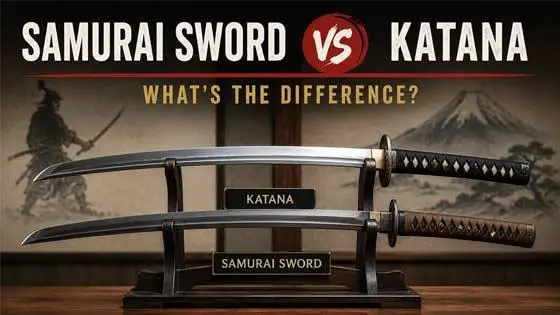
A lot of people use the terms samurai sword and katana interchangeably, but they are not always exactly the same thing. If you have ever wondered whether every samurai sword is a katana or if there is actually a difference between the two, you are definitely not alone. Movies, video games, and pop culture often blur the lines, which has led to plenty of confusion about what these swords are actually called.
The short answer is that a katana is a specific type of samurai sword, but not every samurai sword is technically a katana. Japanese warriors used several different sword styles throughout history, each designed for different purposes and time periods. In this guide, we will break down what makes a katana unique, what "samurai sword" really means, and how different Japanese swords compare.
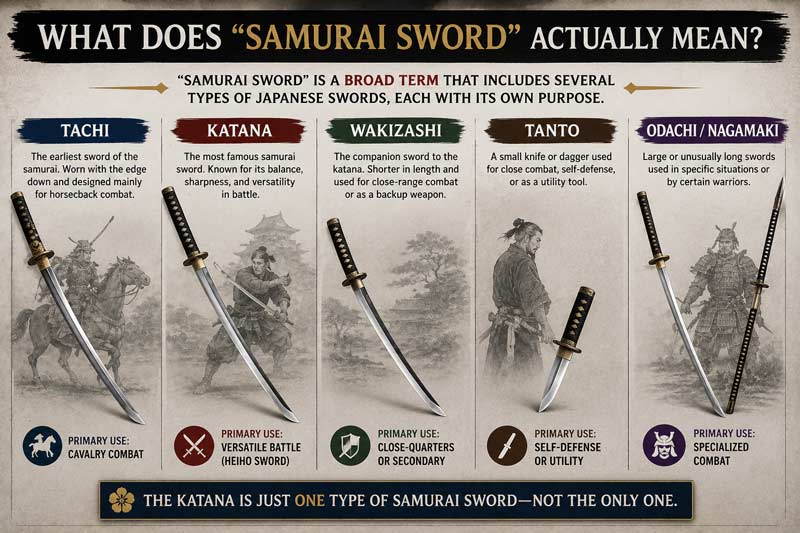
The term samurai sword is often used as a catch-all phrase for the weapons traditionally carried by Japan's samurai warriors. While many people immediately picture a katana, samurai actually used several different types of swords throughout history depending on the time period, purpose, and fighting style. In other words, "samurai sword" is a broad category, while a katana is one specific type within that category.
Over the centuries, samurai carried a variety of blades, including the tachi, wakizashi, tanto, and katana. Some swords were designed for horseback combat, while others worked better for close-range fighting or everyday carry. Different eras of Japanese history also influenced sword design, which is one reason why there are so many variations in shape, blade length, and curvature.
Today, many people use the term "samurai sword" when referring to any traditional Japanese sword with a curved blade. That is not necessarily wrong in casual conversation, but technically speaking, a katana is only one member of a much larger family of Japanese weapons. If you browse different Japanese samurai swords, you will notice there are many styles that fall under the broader samurai sword category.
This is part of the reason the terms get confused so often. Movies, anime, and video games usually simplify things by calling nearly every Japanese sword a katana, even when the design may actually resemble another historical blade style.
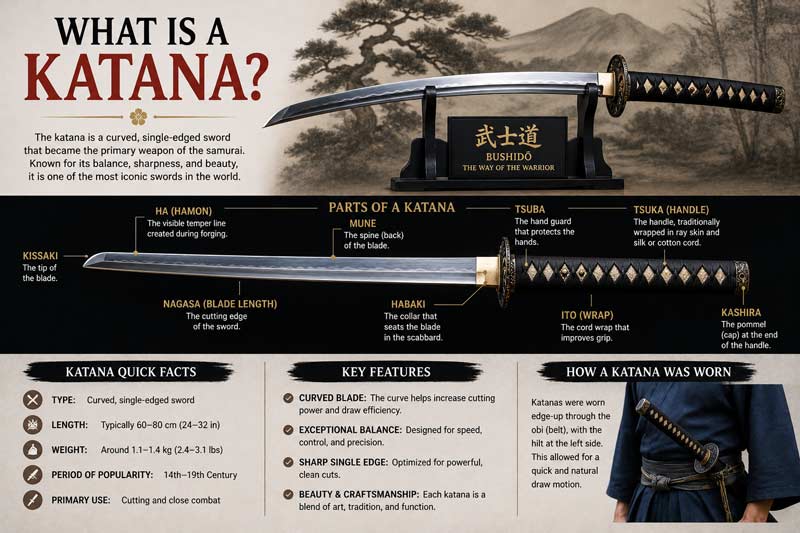
The katana is the sword most people picture when they hear the words "samurai sword." It is known for its slightly curved blade, long two-handed grip, and distinctive circular or rounded hand guard called a tsuba. Traditionally, katanas were worn edge-up through the belt, allowing samurai to quickly draw the sword when needed. Over time, the katana became one of the most recognizable symbols of Japanese warrior culture.
One reason the katana became so famous is because of its balance between cutting ability, speed, and versatility. Compared to some earlier Japanese swords, the katana was designed to work well in close combat and allowed for smoother, faster drawing techniques. This helped make it practical for samurai during changing styles of warfare and eventually contributed to its legendary reputation.
Although the katana is often treated as the "main" samurai sword, it was not the only blade samurai carried. Many warriors also carried a shorter companion sword called a wakizashi, and some used larger or differently shaped blades depending on the situation. That is why saying every samurai sword is a katana is not technically accurate, even though the katana is the best-known example.
Today, katanas remain extremely popular with collectors, martial artists, and history enthusiasts. Whether displayed as collectibles or used in traditional practice, many people are drawn to their craftsmanship and history. If you are exploring different styles of traditional Japanese swords, the katana is usually where most people begin.
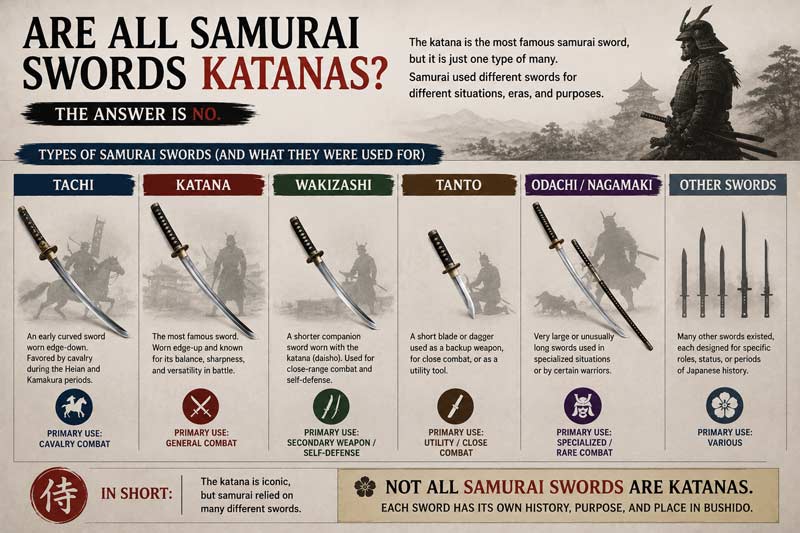
The simple answer is no. While the katana is the most famous type of samurai sword, it is only one style among several different Japanese blades used throughout history. Calling every samurai sword a katana is a little like calling every martial arts weapon a nunchaku. It is a recognizable example, but it does not represent the entire category.
Samurai used different swords depending on the time period, fighting style, and purpose. For example, the tachi was an earlier curved sword often carried by mounted warriors and worn edge-down. The wakizashi was a shorter companion sword commonly paired with a katana, while the tanto functioned more like a dagger or utility blade. Larger swords such as the odachi also existed, though they were less common and often used for specialized situations.
Part of the confusion comes from the fact that the katana eventually became the most iconic Japanese sword in popular culture. Movies, anime, and television often use the word "katana" to describe nearly every Japanese blade, even when another term might be technically more accurate. Because of this, many people assume samurai carried only katanas, when in reality Japanese sword history is much more varied.
If you enjoy learning about historical Japanese weapons, there are many different Japanese-style swords to explore beyond the traditional katana. Understanding the differences between them can make Japanese sword history much more interesting and easier to appreciate.
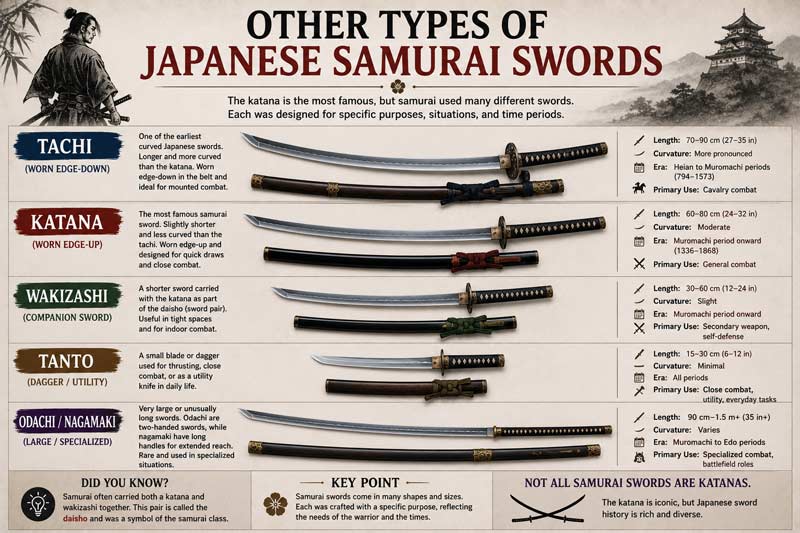
While the katana gets most of the attention, it was far from the only sword used by samurai throughout Japanese history. Different blades were designed for different situations, combat styles, and time periods. Understanding some of the other sword types can make it much easier to see why the term "samurai sword" covers more than just one weapon.
The tachi is one of the earliest curved Japanese swords and is often considered a predecessor to the katana. It was generally longer, more curved, and worn edge-down, making it especially useful for mounted combat. Many historians believe the katana gradually evolved from the tachi as battlefield needs changed.
The wakizashi was a shorter companion sword commonly carried alongside a katana. Together, the pair was known as the daisho, which symbolized the samurai class. The wakizashi was often used indoors or in tighter spaces where a full-length sword was less practical.
The tanto was a smaller blade that functioned more like a dagger or utility knife. Samurai sometimes carried one for close-range situations or everyday practical use. Larger blades such as the odachi and nagamaki also existed, though they were much less common and often used for specialized combat roles.
If you are interested in seeing how different samurai sword styles compare, it can be interesting to look at the variations in blade length, curve, and design. Some collectors prefer traditional katanas, while others are drawn to the uniqueness of lesser-known Japanese sword types.
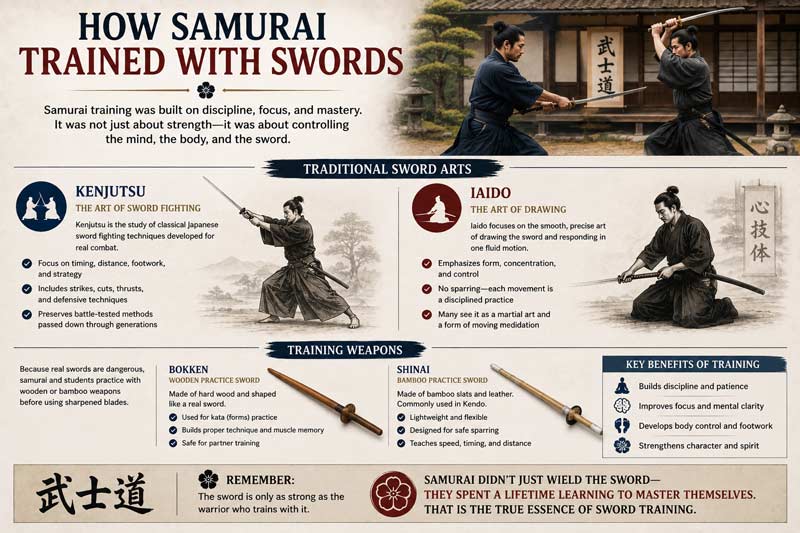
Samurai training involved much more than simply learning how to swing a sword. Traditional Japanese swordsmanship focused heavily on discipline, precision, timing, and controlled movement. Different schools developed their own techniques over time, and many forms of training emphasized repetition and mastery rather than raw strength. For samurai, swordsmanship was considered both a practical skill and an important part of personal discipline.
One traditional style of training is kenjutsu, which focuses on classical Japanese sword fighting techniques developed for combat. These methods often emphasized timing, distance, footwork, and strategy. While modern practitioners study kenjutsu for historical preservation and skill development, its roots go back to techniques used by warriors centuries ago.
Another well-known sword art is iaido, which focuses on smooth, controlled drawing techniques and precise movement. Rather than sparring, iaido places strong emphasis on form, concentration, and the fluid motion of drawing and returning the sword to the scabbard. Many practitioners view it as both a martial art and a form of moving meditation.
Because training with sharp blades can be dangerous, many students practice with wooden or bamboo training weapons instead. A bokken is a solid wooden practice sword, while a shinai is a bamboo sword commonly used in kendo. If you are curious about traditional practice weapons, browsing different wooden training swords can help show how Japanese sword training has evolved over time.
Understanding how samurai trained helps explain why Japanese swords became so respected. It was not just the weapon itself that mattered, but the years of discipline and repetition that went into learning how to use it properly.
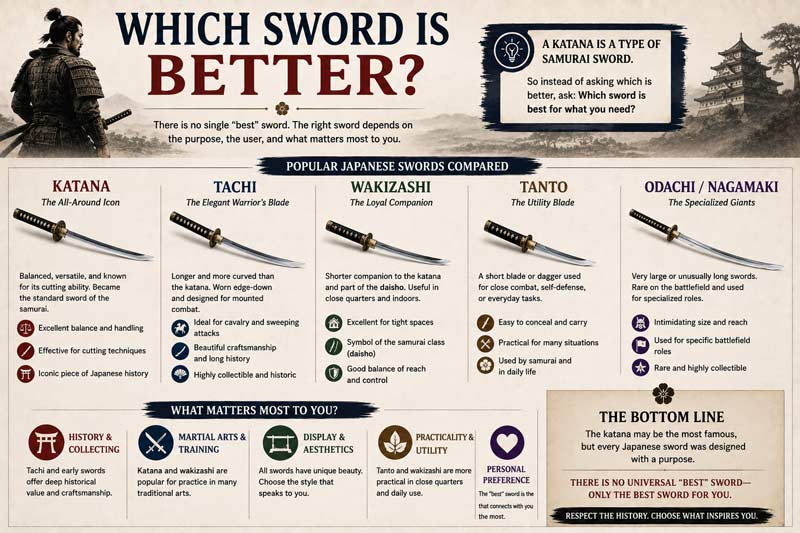
When people ask whether a samurai sword or a katana is "better," the question is a little tricky because a katana is already a type of samurai sword. A more accurate question would be: which Japanese sword style is best for a particular purpose? The answer depends on what someone values most, whether that is history, collecting, training, display, or personal preference.
For many people, the katana stands out because of its balance, curved blade, and iconic place in Japanese history. It became famous for a reason and remains one of the most recognizable swords in the world. At the same time, other Japanese blades offer their own unique appeal. Some collectors are drawn to the longer curve of the tachi, while others appreciate the compact size of a wakizashi or the unusual look of an odachi.
Martial artists and traditional practitioners often have different preferences as well. Some arts focus more on drawing techniques, while others emphasize movement, timing, or controlled partner practice. If you are interested in how Japanese swords compare to other legendary weapons throughout history, you may enjoy reading our article on what is considered the best sword of all time.
In the end, there is no universal "best" Japanese sword. The katana may be the most famous, but part of what makes samurai sword history so interesting is the variety of designs and how each blade served a different role over time.
The difference between a samurai sword and a katana is simpler than it first sounds. A katana is one specific type of samurai sword, but it is not the only one. Throughout Japanese history, samurai used many different blades depending on the time period, purpose, and fighting style. Understanding that distinction makes it much easier to appreciate why Japanese sword history is so rich and varied.
The katana may be the most famous Japanese sword in the world, but other blades like the tachi, wakizashi, tanto, and odachi all played important roles in samurai culture. Each sword was designed with a specific purpose in mind, whether for mounted combat, close-range defense, training, or everyday carry. That variety is part of what makes learning about samurai weapons so interesting.
If this guide sparked your interest, browsing different traditional samurai swords can help you see how different Japanese blade styles compare. Whether you appreciate swords for history, collecting, martial arts, or craftsmanship, there is always more to learn about the weapons that shaped Japan's warrior culture.
What Does "Samurai Sword" Actually Mean?
The term samurai sword is often used as a catch-all phrase for the weapons traditionally carried by Japan's samurai warriors. While many people immediately picture a katana, samurai actually used several different types of swords throughout history depending on the time period, purpose, and fighting style. In other words, "samurai sword" is a broad category, while a katana is one specific type within that category.
Over the centuries, samurai carried a variety of blades, including the tachi, wakizashi, tanto, and katana. Some swords were designed for horseback combat, while others worked better for close-range fighting or everyday carry. Different eras of Japanese history also influenced sword design, which is one reason why there are so many variations in shape, blade length, and curvature.
Today, many people use the term "samurai sword" when referring to any traditional Japanese sword with a curved blade. That is not necessarily wrong in casual conversation, but technically speaking, a katana is only one member of a much larger family of Japanese weapons. If you browse different Japanese samurai swords, you will notice there are many styles that fall under the broader samurai sword category.
This is part of the reason the terms get confused so often. Movies, anime, and video games usually simplify things by calling nearly every Japanese sword a katana, even when the design may actually resemble another historical blade style.
What Is a Katana?
The katana is the sword most people picture when they hear the words "samurai sword." It is known for its slightly curved blade, long two-handed grip, and distinctive circular or rounded hand guard called a tsuba. Traditionally, katanas were worn edge-up through the belt, allowing samurai to quickly draw the sword when needed. Over time, the katana became one of the most recognizable symbols of Japanese warrior culture.
One reason the katana became so famous is because of its balance between cutting ability, speed, and versatility. Compared to some earlier Japanese swords, the katana was designed to work well in close combat and allowed for smoother, faster drawing techniques. This helped make it practical for samurai during changing styles of warfare and eventually contributed to its legendary reputation.
Although the katana is often treated as the "main" samurai sword, it was not the only blade samurai carried. Many warriors also carried a shorter companion sword called a wakizashi, and some used larger or differently shaped blades depending on the situation. That is why saying every samurai sword is a katana is not technically accurate, even though the katana is the best-known example.
Today, katanas remain extremely popular with collectors, martial artists, and history enthusiasts. Whether displayed as collectibles or used in traditional practice, many people are drawn to their craftsmanship and history. If you are exploring different styles of traditional Japanese swords, the katana is usually where most people begin.
Are All Samurai Swords Katanas?
The simple answer is no. While the katana is the most famous type of samurai sword, it is only one style among several different Japanese blades used throughout history. Calling every samurai sword a katana is a little like calling every martial arts weapon a nunchaku. It is a recognizable example, but it does not represent the entire category.
Samurai used different swords depending on the time period, fighting style, and purpose. For example, the tachi was an earlier curved sword often carried by mounted warriors and worn edge-down. The wakizashi was a shorter companion sword commonly paired with a katana, while the tanto functioned more like a dagger or utility blade. Larger swords such as the odachi also existed, though they were less common and often used for specialized situations.
Part of the confusion comes from the fact that the katana eventually became the most iconic Japanese sword in popular culture. Movies, anime, and television often use the word "katana" to describe nearly every Japanese blade, even when another term might be technically more accurate. Because of this, many people assume samurai carried only katanas, when in reality Japanese sword history is much more varied.
If you enjoy learning about historical Japanese weapons, there are many different Japanese-style swords to explore beyond the traditional katana. Understanding the differences between them can make Japanese sword history much more interesting and easier to appreciate.
Other Types of Japanese Samurai Swords
While the katana gets most of the attention, it was far from the only sword used by samurai throughout Japanese history. Different blades were designed for different situations, combat styles, and time periods. Understanding some of the other sword types can make it much easier to see why the term "samurai sword" covers more than just one weapon.
The tachi is one of the earliest curved Japanese swords and is often considered a predecessor to the katana. It was generally longer, more curved, and worn edge-down, making it especially useful for mounted combat. Many historians believe the katana gradually evolved from the tachi as battlefield needs changed.
The wakizashi was a shorter companion sword commonly carried alongside a katana. Together, the pair was known as the daisho, which symbolized the samurai class. The wakizashi was often used indoors or in tighter spaces where a full-length sword was less practical.
The tanto was a smaller blade that functioned more like a dagger or utility knife. Samurai sometimes carried one for close-range situations or everyday practical use. Larger blades such as the odachi and nagamaki also existed, though they were much less common and often used for specialized combat roles.
If you are interested in seeing how different samurai sword styles compare, it can be interesting to look at the variations in blade length, curve, and design. Some collectors prefer traditional katanas, while others are drawn to the uniqueness of lesser-known Japanese sword types.
How Samurai Trained With Swords
Samurai training involved much more than simply learning how to swing a sword. Traditional Japanese swordsmanship focused heavily on discipline, precision, timing, and controlled movement. Different schools developed their own techniques over time, and many forms of training emphasized repetition and mastery rather than raw strength. For samurai, swordsmanship was considered both a practical skill and an important part of personal discipline.
One traditional style of training is kenjutsu, which focuses on classical Japanese sword fighting techniques developed for combat. These methods often emphasized timing, distance, footwork, and strategy. While modern practitioners study kenjutsu for historical preservation and skill development, its roots go back to techniques used by warriors centuries ago.
Another well-known sword art is iaido, which focuses on smooth, controlled drawing techniques and precise movement. Rather than sparring, iaido places strong emphasis on form, concentration, and the fluid motion of drawing and returning the sword to the scabbard. Many practitioners view it as both a martial art and a form of moving meditation.
Because training with sharp blades can be dangerous, many students practice with wooden or bamboo training weapons instead. A bokken is a solid wooden practice sword, while a shinai is a bamboo sword commonly used in kendo. If you are curious about traditional practice weapons, browsing different wooden training swords can help show how Japanese sword training has evolved over time.
Understanding how samurai trained helps explain why Japanese swords became so respected. It was not just the weapon itself that mattered, but the years of discipline and repetition that went into learning how to use it properly.
Which Sword Is Better?
When people ask whether a samurai sword or a katana is "better," the question is a little tricky because a katana is already a type of samurai sword. A more accurate question would be: which Japanese sword style is best for a particular purpose? The answer depends on what someone values most, whether that is history, collecting, training, display, or personal preference.
For many people, the katana stands out because of its balance, curved blade, and iconic place in Japanese history. It became famous for a reason and remains one of the most recognizable swords in the world. At the same time, other Japanese blades offer their own unique appeal. Some collectors are drawn to the longer curve of the tachi, while others appreciate the compact size of a wakizashi or the unusual look of an odachi.
Martial artists and traditional practitioners often have different preferences as well. Some arts focus more on drawing techniques, while others emphasize movement, timing, or controlled partner practice. If you are interested in how Japanese swords compare to other legendary weapons throughout history, you may enjoy reading our article on what is considered the best sword of all time.
In the end, there is no universal "best" Japanese sword. The katana may be the most famous, but part of what makes samurai sword history so interesting is the variety of designs and how each blade served a different role over time.
Understanding the Difference Between Samurai Swords and Katanas
The difference between a samurai sword and a katana is simpler than it first sounds. A katana is one specific type of samurai sword, but it is not the only one. Throughout Japanese history, samurai used many different blades depending on the time period, purpose, and fighting style. Understanding that distinction makes it much easier to appreciate why Japanese sword history is so rich and varied.
The katana may be the most famous Japanese sword in the world, but other blades like the tachi, wakizashi, tanto, and odachi all played important roles in samurai culture. Each sword was designed with a specific purpose in mind, whether for mounted combat, close-range defense, training, or everyday carry. That variety is part of what makes learning about samurai weapons so interesting.
If this guide sparked your interest, browsing different traditional samurai swords can help you see how different Japanese blade styles compare. Whether you appreciate swords for history, collecting, martial arts, or craftsmanship, there is always more to learn about the weapons that shaped Japan's warrior culture.
You May Also Be Interested In:
- Samurai Sword Buying Guide: Which Katana is Best?
- Katana Buying Guide: What is Important When Buying a Katana Sword
- What Is a Tachi Sword? How It Differs From a Katana
- What Is a Wakizashi? The Samurai's Companion Sword
- What Is an Odachi? The Giant Samurai Sword Explained
- How Indestructible is the Indestructible Plastic Samurai Sword?
- Why the Yumi Was More Important Than the Katana
- Sword Buyers Guide: What To Look For When Buying a Sword
- New Damascus Steel Katana Demonstration
- TKD Uniform vs Karate Gi: What's the Difference?
Leave a Reply