




What Is a Rope Dart? History, Training, and Martial Arts Uses
May 12th, 2026
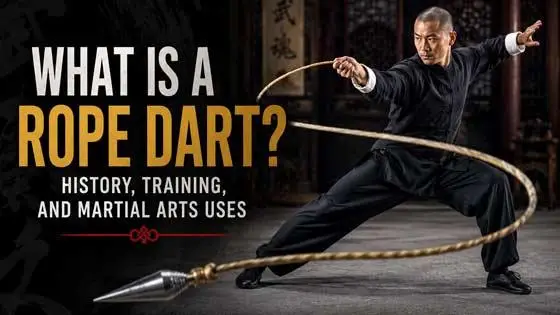
The rope dart is one of the most unusual and visually impressive weapons found in traditional Chinese martial arts. Unlike rigid weapons such as swords, staffs, or spears, the rope dart uses a long rope or cord attached to a weighted dart-shaped end that moves fluidly through the air. Skilled practitioners use spinning motions, wraps, throws, and flowing body movement to control the weapon, creating fast and unpredictable movement patterns that require timing, coordination, and precision.
Because of its dramatic movement style, the rope dart has become closely associated with kung fu demonstrations, martial arts performances, and advanced flexible weapon training. Its flowing motion and long-range techniques make it one of the most recognizable flexible weapons in martial arts culture, even among people who have never formally studied traditional Chinese martial arts. The weapon has also appeared in movies, stage performances, anime, and video games for decades, helping introduce it to audiences around the world.
In this guide, we'll explain what a rope dart is, how it was traditionally used, why flexible weapons are so difficult to master, and how modern martial artists safely train with this classic kung fu weapon today.
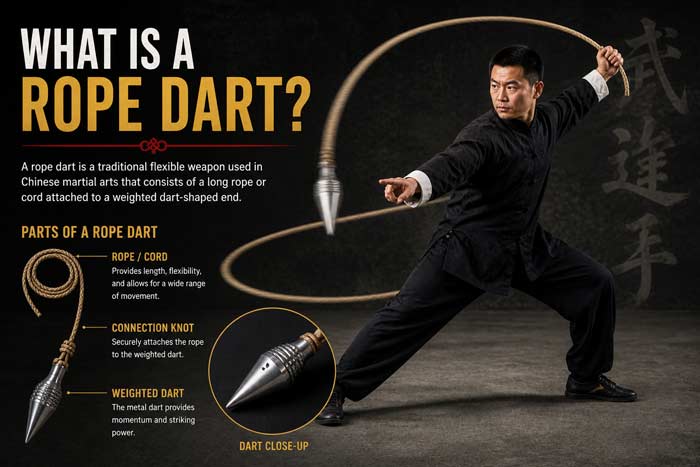
A rope dart is a traditional flexible weapon used in Chinese martial arts that consists of a long rope or cord attached to a weighted dart-shaped end. Unlike rigid weapons that maintain a fixed structure during movement, the rope dart relies on flowing motion, momentum, timing, and body coordination to stay under control. Skilled practitioners use circular patterns, wraps, swings, and directional changes to keep the rope moving continuously while guiding the weighted end through controlled movement sequences.
The rope dart is most commonly associated with kung fu and other traditional Chinese martial arts systems that emphasize fluid movement and advanced weapon coordination. Because the rope can move in nearly any direction, the weapon requires constant awareness of spacing, rhythm, and body positioning. Even small timing mistakes can interrupt the weapon's flow or make it difficult to control properly.
One reason the rope dart attracts so much attention is its dramatic visual style. When practiced correctly, the weapon appears to move almost like an extension of the practitioner's body. That flowing movement has helped make it one of the most recognizable flexible systems in martial arts demonstrations, movies, stage performances, and modern martial arts competitions.
Many practitioners who study traditional Chinese martial arts weapons consider the rope dart to be an advanced training system because it develops coordination, rhythm, timing, flexibility, and movement control all at once. Beginners usually start slowly with basic patterns before attempting faster combinations or more complicated movement sequences.
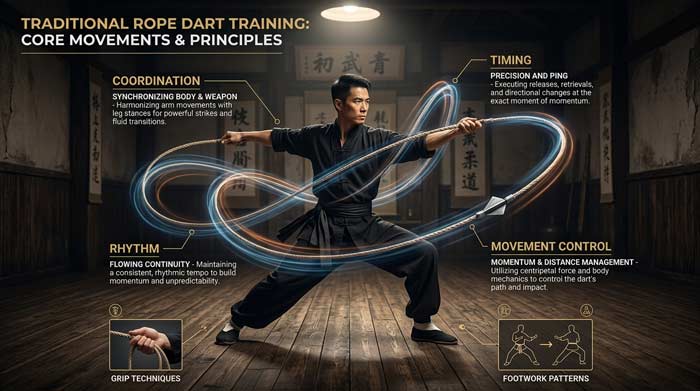
The rope dart was traditionally used as a flexible martial arts training system that relied on flowing movement, timing, coordination, and momentum rather than rigid striking patterns. Skilled practitioners learned how to keep the rope moving continuously through circular motions, wraps, swings, and directional changes while controlling the weighted end with precision and rhythm.
Unlike rigid weapons that move in more predictable paths, the rope dart could travel through large circular patterns and quickly change direction based on body movement and rope tension. Practitioners used footwork, torso rotation, shoulder movement, and timing together to maintain smooth control while guiding the rope through extended flowing techniques.
Many martial artists who study traditional kung fu training systems consider the rope dart one of the more difficult flexible weapons to learn because the rope itself constantly changes shape during movement. Maintaining proper tension and rhythm becomes extremely important, especially during faster combinations or advanced practice sequences.
The rope dart is also closely connected to other flexible martial arts systems such as the chain whip and related coordination-based training tools. While each system moves differently, they all require strong body awareness, timing, rhythm, and movement control to practice effectively.
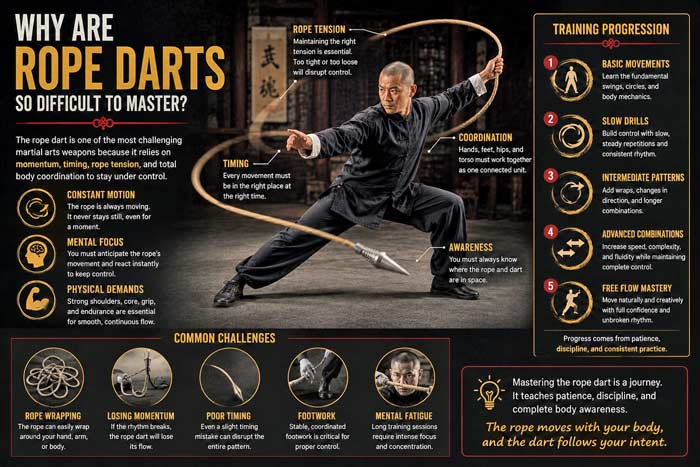
The rope dart is considered one of the most difficult flexible martial arts systems to learn because the weapon is constantly changing position, speed, and direction during movement. Unlike rigid weapons that maintain a fixed shape, the rope dart depends entirely on momentum, timing, rope tension, and body coordination to stay under control. Even small mistakes can interrupt the weapon's flow or cause the movement pattern to collapse completely.
One of the biggest challenges comes from managing the rope itself. The practitioner must constantly maintain awareness of the rope's position while coordinating footwork, hand movement, torso rotation, and timing at the same time. Because the rope can wrap, loosen, tighten, or shift direction quickly, maintaining smooth movement requires a high level of concentration and repetition.
Many practitioners who study advanced Chinese martial arts equipment spend years developing the coordination and rhythm needed for flexible weapon systems like the rope dart. Training often begins with slow movement drills before progressing into faster wraps, extended circular patterns, directional changes, and more advanced combinations.
Flexible systems such as the rope dart and chain dart training tools are also mentally demanding because the user must constantly react to the weapon's movement in real time. That combination of physical coordination and mental focus is one reason rope dart training continues to attract martial artists looking for highly challenging movement-based systems.
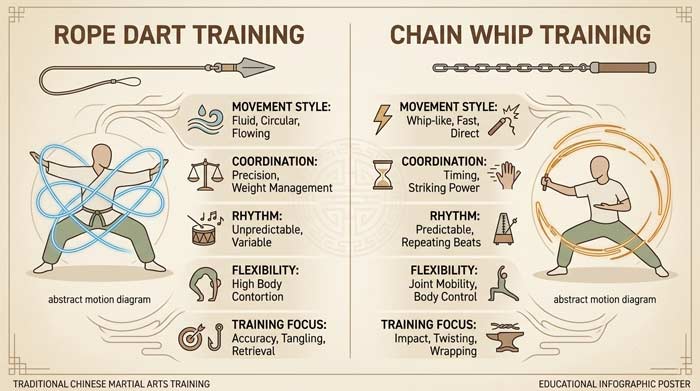
Although the rope dart and chain whip are both considered flexible martial arts systems, they move very differently and require separate training methods. A rope dart uses a long rope or cord attached to a weighted dart-shaped end, while a chain whip is made from connected metal sections linked together by rings. Because of these construction differences, each system creates its own unique movement patterns, timing, rhythm, and handling characteristics.
The rope dart typically relies on larger circular movement patterns, extended wraps, and flowing full-body motion that uses the entire length of the rope. The chain whip weapon, on the other hand, often creates tighter movement patterns with quicker directional changes and more compact control. Many practitioners describe the rope dart as more fluid and expansive, while the chain whip feels more structured and rhythmic during movement.
Both systems require advanced coordination, timing, and body awareness, but the rope dart can be especially difficult because the rope itself constantly changes shape and tension throughout movement. Maintaining proper flow and spacing becomes extremely important during training. The chain whip still requires significant control, but the connected sections create a more predictable movement pattern compared to the softer movement of a rope-based system.
Practitioners who study advanced traditional kung fu weapon systems sometimes train in both styles because they develop different types of movement control and coordination. Alongside other flexible systems like the chain dart training system, both the rope dart and chain whip remain some of the most visually impressive martial arts systems practiced today.
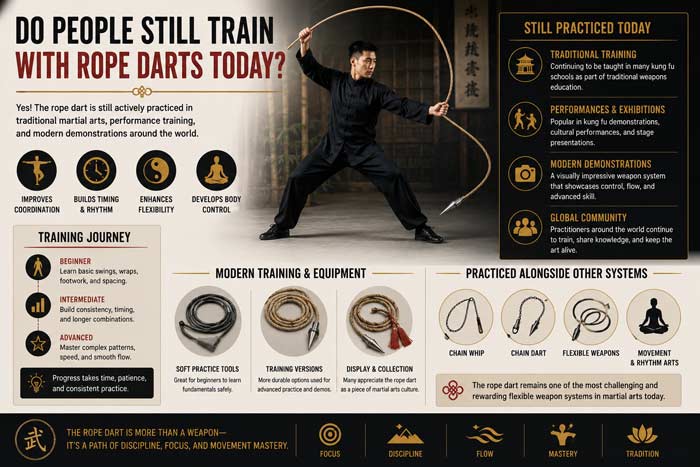
Although the rope dart is no longer used in real combat, it is still actively practiced today in traditional martial arts systems, performance training, and modern demonstrations. Many practitioners study the rope dart to improve coordination, rhythm, timing, flexibility, and overall body control. Because of its flowing movement and visually impressive techniques, the system remains popular in kung fu exhibitions, stage performances, and advanced martial arts forms training.
Many martial artists who study advanced Chinese martial arts training systems consider the rope dart one of the more difficult flexible disciplines to learn. Beginners often spend significant time developing basic movement patterns, wraps, footwork, and spacing before attempting faster combinations or more advanced movement sequences.
Modern training equipment is also often designed with safety in mind. Some practitioners begin with softer or lighter practice tools before eventually progressing to heavier training versions used for demonstrations or advanced routines. Others collect display versions of the traditional rope dart system because of its unique appearance and strong connection to martial arts culture.
Today, the rope dart is frequently practiced alongside chain whips, chain darts, and other movement-based flexible systems that emphasize coordination and rhythm. While these disciplines require patience and consistent practice, they continue to attract martial artists who enjoy highly technical systems focused on movement and control.
The rope dart remains one of the most visually impressive and technically demanding systems in traditional Chinese martial arts. Its flowing movement, flexible design, and reliance on timing and momentum make it very different from rigid weapons like staffs, swords, or spears. Because of that, many practitioners consider it one of the more advanced movement-based disciplines in martial arts training.
Over the years, the rope dart has continued to gain popularity through martial arts demonstrations, movies, stage performances, and modern forms competitions. Even people with little martial arts experience often recognize the system because of its dramatic movement style and fluid motion. That visual appeal has helped keep interest in rope dart training alive for generations.
Practitioners who study advanced traditional Chinese martial arts systems often appreciate the rope dart because it develops coordination, rhythm, flexibility, timing, and body awareness all at once. Alongside related systems like the chain whip and other flexible training methods, the rope dart continues to play an important role in movement-focused martial arts practice today.
Whether someone studies the rope dart for martial arts training, demonstrations, cultural appreciation, or collection purposes, it remains one of the most fascinating and challenging flexible systems in martial arts history.
In this guide, we'll explain what a rope dart is, how it was traditionally used, why flexible weapons are so difficult to master, and how modern martial artists safely train with this classic kung fu weapon today.
What Is a Rope Dart?
A rope dart is a traditional flexible weapon used in Chinese martial arts that consists of a long rope or cord attached to a weighted dart-shaped end. Unlike rigid weapons that maintain a fixed structure during movement, the rope dart relies on flowing motion, momentum, timing, and body coordination to stay under control. Skilled practitioners use circular patterns, wraps, swings, and directional changes to keep the rope moving continuously while guiding the weighted end through controlled movement sequences.
The rope dart is most commonly associated with kung fu and other traditional Chinese martial arts systems that emphasize fluid movement and advanced weapon coordination. Because the rope can move in nearly any direction, the weapon requires constant awareness of spacing, rhythm, and body positioning. Even small timing mistakes can interrupt the weapon's flow or make it difficult to control properly.
One reason the rope dart attracts so much attention is its dramatic visual style. When practiced correctly, the weapon appears to move almost like an extension of the practitioner's body. That flowing movement has helped make it one of the most recognizable flexible systems in martial arts demonstrations, movies, stage performances, and modern martial arts competitions.
Many practitioners who study traditional Chinese martial arts weapons consider the rope dart to be an advanced training system because it develops coordination, rhythm, timing, flexibility, and movement control all at once. Beginners usually start slowly with basic patterns before attempting faster combinations or more complicated movement sequences.
How Was the Rope Dart Used in Martial Arts?
The rope dart was traditionally used as a flexible martial arts training system that relied on flowing movement, timing, coordination, and momentum rather than rigid striking patterns. Skilled practitioners learned how to keep the rope moving continuously through circular motions, wraps, swings, and directional changes while controlling the weighted end with precision and rhythm.
Unlike rigid weapons that move in more predictable paths, the rope dart could travel through large circular patterns and quickly change direction based on body movement and rope tension. Practitioners used footwork, torso rotation, shoulder movement, and timing together to maintain smooth control while guiding the rope through extended flowing techniques.
Many martial artists who study traditional kung fu training systems consider the rope dart one of the more difficult flexible weapons to learn because the rope itself constantly changes shape during movement. Maintaining proper tension and rhythm becomes extremely important, especially during faster combinations or advanced practice sequences.
The rope dart is also closely connected to other flexible martial arts systems such as the chain whip and related coordination-based training tools. While each system moves differently, they all require strong body awareness, timing, rhythm, and movement control to practice effectively.
Why Are Rope Darts So Difficult to Master?
The rope dart is considered one of the most difficult flexible martial arts systems to learn because the weapon is constantly changing position, speed, and direction during movement. Unlike rigid weapons that maintain a fixed shape, the rope dart depends entirely on momentum, timing, rope tension, and body coordination to stay under control. Even small mistakes can interrupt the weapon's flow or cause the movement pattern to collapse completely.
One of the biggest challenges comes from managing the rope itself. The practitioner must constantly maintain awareness of the rope's position while coordinating footwork, hand movement, torso rotation, and timing at the same time. Because the rope can wrap, loosen, tighten, or shift direction quickly, maintaining smooth movement requires a high level of concentration and repetition.
Many practitioners who study advanced Chinese martial arts equipment spend years developing the coordination and rhythm needed for flexible weapon systems like the rope dart. Training often begins with slow movement drills before progressing into faster wraps, extended circular patterns, directional changes, and more advanced combinations.
Flexible systems such as the rope dart and chain dart training tools are also mentally demanding because the user must constantly react to the weapon's movement in real time. That combination of physical coordination and mental focus is one reason rope dart training continues to attract martial artists looking for highly challenging movement-based systems.
Rope Dart vs Chain Whip: What's the Difference?
Although the rope dart and chain whip are both considered flexible martial arts systems, they move very differently and require separate training methods. A rope dart uses a long rope or cord attached to a weighted dart-shaped end, while a chain whip is made from connected metal sections linked together by rings. Because of these construction differences, each system creates its own unique movement patterns, timing, rhythm, and handling characteristics.
The rope dart typically relies on larger circular movement patterns, extended wraps, and flowing full-body motion that uses the entire length of the rope. The chain whip weapon, on the other hand, often creates tighter movement patterns with quicker directional changes and more compact control. Many practitioners describe the rope dart as more fluid and expansive, while the chain whip feels more structured and rhythmic during movement.
Both systems require advanced coordination, timing, and body awareness, but the rope dart can be especially difficult because the rope itself constantly changes shape and tension throughout movement. Maintaining proper flow and spacing becomes extremely important during training. The chain whip still requires significant control, but the connected sections create a more predictable movement pattern compared to the softer movement of a rope-based system.
Practitioners who study advanced traditional kung fu weapon systems sometimes train in both styles because they develop different types of movement control and coordination. Alongside other flexible systems like the chain dart training system, both the rope dart and chain whip remain some of the most visually impressive martial arts systems practiced today.
Do People Still Train With Rope Darts Today?
Although the rope dart is no longer used in real combat, it is still actively practiced today in traditional martial arts systems, performance training, and modern demonstrations. Many practitioners study the rope dart to improve coordination, rhythm, timing, flexibility, and overall body control. Because of its flowing movement and visually impressive techniques, the system remains popular in kung fu exhibitions, stage performances, and advanced martial arts forms training.
Many martial artists who study advanced Chinese martial arts training systems consider the rope dart one of the more difficult flexible disciplines to learn. Beginners often spend significant time developing basic movement patterns, wraps, footwork, and spacing before attempting faster combinations or more advanced movement sequences.
Modern training equipment is also often designed with safety in mind. Some practitioners begin with softer or lighter practice tools before eventually progressing to heavier training versions used for demonstrations or advanced routines. Others collect display versions of the traditional rope dart system because of its unique appearance and strong connection to martial arts culture.
Today, the rope dart is frequently practiced alongside chain whips, chain darts, and other movement-based flexible systems that emphasize coordination and rhythm. While these disciplines require patience and consistent practice, they continue to attract martial artists who enjoy highly technical systems focused on movement and control.
Final Thoughts on the Rope Dart
The rope dart remains one of the most visually impressive and technically demanding systems in traditional Chinese martial arts. Its flowing movement, flexible design, and reliance on timing and momentum make it very different from rigid weapons like staffs, swords, or spears. Because of that, many practitioners consider it one of the more advanced movement-based disciplines in martial arts training.
Over the years, the rope dart has continued to gain popularity through martial arts demonstrations, movies, stage performances, and modern forms competitions. Even people with little martial arts experience often recognize the system because of its dramatic movement style and fluid motion. That visual appeal has helped keep interest in rope dart training alive for generations.
Practitioners who study advanced traditional Chinese martial arts systems often appreciate the rope dart because it develops coordination, rhythm, flexibility, timing, and body awareness all at once. Alongside related systems like the chain whip and other flexible training methods, the rope dart continues to play an important role in movement-focused martial arts practice today.
Whether someone studies the rope dart for martial arts training, demonstrations, cultural appreciation, or collection purposes, it remains one of the most fascinating and challenging flexible systems in martial arts history.
You May Also Be Interested In:
- What Is a Chain Whip? History, Training, and Martial Arts Uses
- The Martial Arts Training Methods That Seem Insane Today
- Best Martial Arts Pants: Karate and Taekwondo Training Guide
- The History of the Dojo: Why Martial Arts Schools Look the Way They Do
- Why Is It Called a 'Gi'? The Strange History of Martial Arts Uniforms
- The Most Dangerous Chain Weapons in Martial Arts History
- The Real History of Nunchaku: From Farm Tool to Martial Arts Icon
- What Is a Kusarigama? History, Uses, and Training Basics
- The History of the Kendo Uniform: From Samurai Armor to Modern Training
- The Scorpion Chain Dart and Other Wild Chained Weapons
Leave a Reply