



What Are Flexible Weapons in Martial Arts?
May 12th, 2026
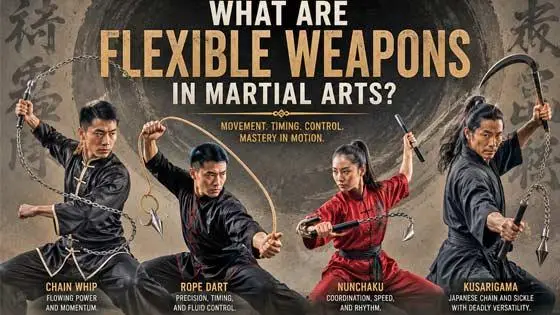
Flexible weapons are some of the most difficult and visually impressive tools found in martial arts training. Unlike rigid weapons such as swords, staffs, or spears, flexible weapons move fluidly and continue reacting after the initial motion begins. That creates movement patterns that rely heavily on momentum, timing, coordination, rhythm, and body control. Because of that, these systems often require far more precision and awareness than traditional rigid weapons.
Many flexible weapons are closely associated with kung fu, traditional Chinese martial arts, and certain historical Japanese weapon systems. Weapons such as rope darts, chain whips, nunchaku, and kusarigama all use movement in very different ways, but they share one thing in common: the practitioner must constantly manage motion, spacing, and control while the weapon remains active.
Over the years, flexible martial arts systems have become extremely popular in demonstrations, movies, competitions, anime, and martial arts performances because of their fast movement and dramatic visual style. Even people who have never studied martial arts often recognize these weapons because of the way they flow through the air and create unpredictable movement patterns.
In this guide, we'll explain what flexible weapons are, how they differ from rigid weapons, why they are so difficult to master, and which traditional martial arts systems still practice them today.
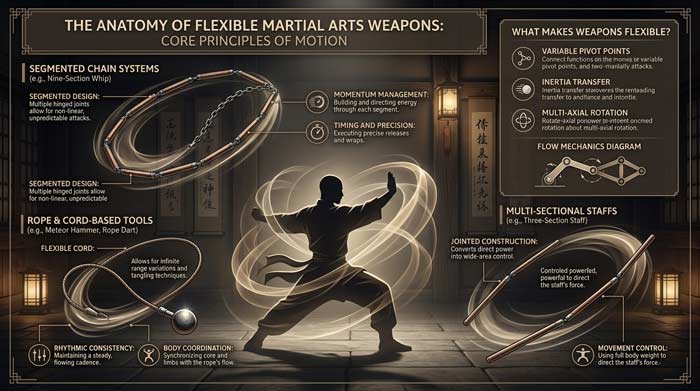
A flexible weapon is any martial arts weapon that does not maintain a completely rigid shape during movement. Unlike solid weapons such as staffs, swords, or spears, flexible systems continue moving after the initial motion begins. That ongoing movement creates unique patterns that depend heavily on timing, momentum, rhythm, spacing, and body coordination to stay under control.
Rigid weapons generally move as one connected solid object, making their path easier to predict and control. Flexible systems behave very differently because separate sections, chains, ropes, or weighted ends continue reacting independently while the practitioner moves. That means the user must constantly adjust body positioning, movement speed, and timing while tracking where the weapon is moving in real time.
Many practitioners who study traditional Chinese martial arts systems consider flexible weapons some of the most advanced training tools in martial arts because they require coordination between the hands, shoulders, hips, footwork, and overall body movement all at once. Even small timing mistakes can disrupt the weapon's flow or cause the movement pattern to break down.
Flexible systems can include rope-based weapons, segmented chain weapons, chain-and-sickle systems, and multi-section training tools that rely on flowing movement rather than rigid structure. Although these systems differ in design, they all require strong rhythm, body awareness, and movement control to use effectively.
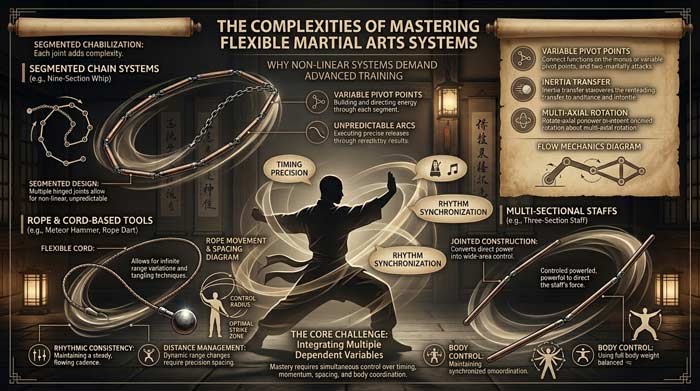
Flexible martial arts systems are difficult to master because the weapon continues moving independently after the initial motion begins. Unlike rigid tools that maintain a predictable structure, flexible systems constantly shift direction, speed, tension, and momentum throughout movement. That means the practitioner must continuously react and adjust in real time while maintaining control over spacing, rhythm, timing, and body positioning.
One of the biggest challenges comes from managing momentum. Flexible systems rely heavily on continuous movement to stay active and controlled. If the timing becomes inconsistent or the movement loses rhythm, the entire flow of the system can break down quickly. Because of that, practitioners spend significant time practicing foundational movement patterns before progressing into faster combinations or more advanced sequences.
Many martial artists who study advanced movement-based chain systems or rope-based disciplines develop strong coordination between the hands, shoulders, hips, torso rotation, footwork, and overall body movement. Maintaining that level of control while tracking the weapon's movement requires both physical coordination and intense mental focus.
Systems such as the rope dart, chain whip, nunchaku, and other flexible training methods are often considered advanced because they demand constant awareness of movement and spacing. That combination of rhythm, timing, flexibility, and body control is one reason flexible martial arts systems continue to fascinate practitioners around the world.
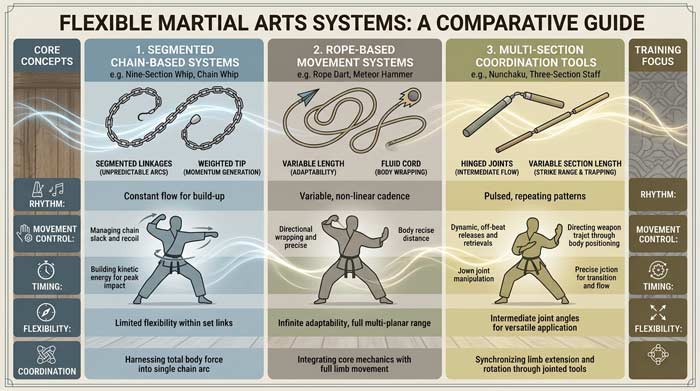
Flexible martial arts systems come in many different forms, and each one uses movement, momentum, and coordination in its own unique way. Some systems rely on ropes or cords, while others use connected metal sections, chains, or multiple linked pieces that continue moving after the initial motion begins. Although these systems differ in design, they all require timing, rhythm, body awareness, and movement control to use effectively.
One of the most recognizable flexible systems is the traditional chain whip, which uses connected metal sections that move fluidly through circular patterns and directional changes. Another well-known system is the rope dart training system, which relies on flowing rope movement, wraps, and extended circular motion to maintain control and momentum.
Traditional Japanese martial arts also feature flexible systems such as the historical kusarigama weapon, which combines a sickle-style blade with an attached chain and weighted end. Other systems, including nunchaku and segmented training tools, use connected sections that create fast directional changes and movement patterns requiring strong coordination and timing.
Many practitioners who study advanced traditional martial arts equipment appreciate flexible systems because they develop movement control, rhythm, timing, flexibility, and body awareness in ways that rigid weapons often do not. That combination of technical difficulty and flowing movement is one reason flexible martial arts systems remain so popular in demonstrations, competitions, and traditional training today.
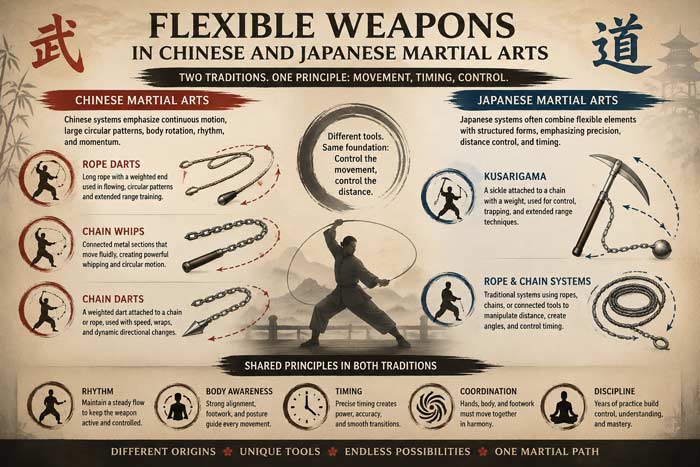
Flexible systems appear in several traditional martial arts styles, but they are especially associated with Chinese kung fu and certain historical Japanese weapon disciplines. Although both traditions use movement-based systems that rely on timing, momentum, and coordination, the overall design and training methods often differ depending on the style and cultural background of the weapon.
Chinese martial arts are particularly well known for flowing flexible systems such as rope darts, chain whips, chain darts, and other movement-focused training methods. Many of these systems emphasize large circular movement patterns, body rotation, wraps, rhythm, and continuous motion. Practitioners who study traditional Chinese martial arts equipment often spend years developing the coordination and movement control required for these advanced systems.
Japanese martial arts feature flexible systems as well, although they are often structured differently. One of the most recognizable examples is the Japanese chain-and-sickle system, which combines a rigid blade with an attached chain and weighted end. Other historical Japanese systems used ropes, chains, or connected movement tools that emphasized distance control, timing, and directional changes.
Although Chinese and Japanese flexible systems evolved differently over time, both traditions require strong rhythm, body awareness, coordination, and movement precision. Today, these systems continue to attract martial artists interested in highly technical training methods that challenge both physical and mental control.
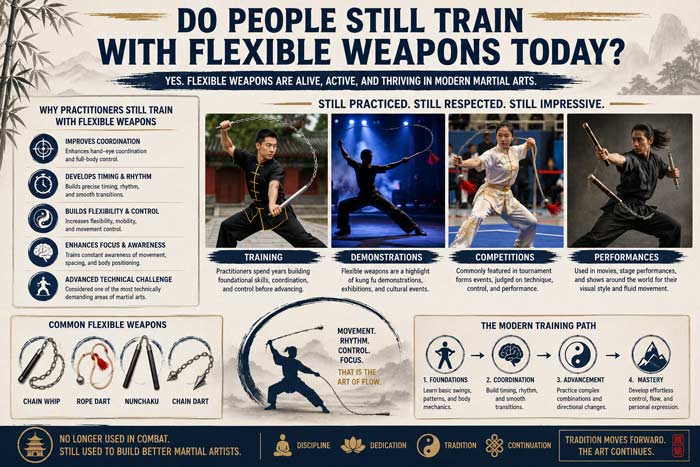
Although flexible weapons are no longer used in real combat, they are still actively practiced today in many traditional martial arts systems, demonstration teams, performance groups, and competitive forms training. Modern practitioners often study these systems to improve coordination, timing, rhythm, flexibility, movement control, and overall body awareness.
Many martial artists who study advanced traditional martial arts training equipment consider flexible systems some of the most technically demanding disciplines in martial arts. Beginners usually spend significant time practicing foundational movement patterns and coordination drills before progressing into faster combinations or more advanced movement sequences.
Systems such as the chain whip, rope dart, nunchaku, and other movement-based training tools remain popular because of their flowing visual style and technical challenge. These systems are commonly featured in kung fu demonstrations, martial arts exhibitions, movies, stage performances, and tournament forms competitions around the world.
Today, many practitioners are drawn to flexible systems because they provide a different type of challenge than rigid weapons. Instead of focusing only on direct technique, flexible systems require continuous awareness of movement, spacing, rhythm, momentum, and body positioning. That combination of physical coordination and mental focus continues to make flexible martial arts systems highly respected among experienced practitioners.
Flexible martial arts systems remain some of the most visually impressive and technically demanding disciplines in martial arts training. Unlike rigid weapons that rely on fixed structure and direct movement, flexible systems require constant control over momentum, timing, rhythm, spacing, and body coordination. That unique combination of movement and precision is what makes these systems both challenging and rewarding to practice.
Over the years, flexible systems have continued to gain popularity through martial arts demonstrations, competitions, movies, stage performances, anime, and modern martial arts culture. Even people who have never formally trained in martial arts often recognize systems like rope darts, chain whips, nunchaku, and chain-and-sickle weapons because of their flowing movement and dramatic visual style.
Practitioners who study advanced traditional chain-based training systems or other movement-focused disciplines often appreciate the level of coordination and awareness these systems develop. Alongside systems like the rope dart, chain whip, and kusarigama, flexible martial arts systems continue to play an important role in traditional training and martial arts demonstrations around the world.
Whether someone studies flexible systems for martial arts training, performance, cultural appreciation, or personal challenge, these disciplines remain some of the most fascinating movement-based systems ever developed in martial arts history.
Over the years, flexible martial arts systems have become extremely popular in demonstrations, movies, competitions, anime, and martial arts performances because of their fast movement and dramatic visual style. Even people who have never studied martial arts often recognize these weapons because of the way they flow through the air and create unpredictable movement patterns.
In this guide, we'll explain what flexible weapons are, how they differ from rigid weapons, why they are so difficult to master, and which traditional martial arts systems still practice them today.
What Makes a Weapon "Flexible"?
A flexible weapon is any martial arts weapon that does not maintain a completely rigid shape during movement. Unlike solid weapons such as staffs, swords, or spears, flexible systems continue moving after the initial motion begins. That ongoing movement creates unique patterns that depend heavily on timing, momentum, rhythm, spacing, and body coordination to stay under control.
Rigid weapons generally move as one connected solid object, making their path easier to predict and control. Flexible systems behave very differently because separate sections, chains, ropes, or weighted ends continue reacting independently while the practitioner moves. That means the user must constantly adjust body positioning, movement speed, and timing while tracking where the weapon is moving in real time.
Many practitioners who study traditional Chinese martial arts systems consider flexible weapons some of the most advanced training tools in martial arts because they require coordination between the hands, shoulders, hips, footwork, and overall body movement all at once. Even small timing mistakes can disrupt the weapon's flow or cause the movement pattern to break down.
Flexible systems can include rope-based weapons, segmented chain weapons, chain-and-sickle systems, and multi-section training tools that rely on flowing movement rather than rigid structure. Although these systems differ in design, they all require strong rhythm, body awareness, and movement control to use effectively.
Why Are Flexible Weapons So Difficult to Master?
Flexible martial arts systems are difficult to master because the weapon continues moving independently after the initial motion begins. Unlike rigid tools that maintain a predictable structure, flexible systems constantly shift direction, speed, tension, and momentum throughout movement. That means the practitioner must continuously react and adjust in real time while maintaining control over spacing, rhythm, timing, and body positioning.
One of the biggest challenges comes from managing momentum. Flexible systems rely heavily on continuous movement to stay active and controlled. If the timing becomes inconsistent or the movement loses rhythm, the entire flow of the system can break down quickly. Because of that, practitioners spend significant time practicing foundational movement patterns before progressing into faster combinations or more advanced sequences.
Many martial artists who study advanced movement-based chain systems or rope-based disciplines develop strong coordination between the hands, shoulders, hips, torso rotation, footwork, and overall body movement. Maintaining that level of control while tracking the weapon's movement requires both physical coordination and intense mental focus.
Systems such as the rope dart, chain whip, nunchaku, and other flexible training methods are often considered advanced because they demand constant awareness of movement and spacing. That combination of rhythm, timing, flexibility, and body control is one reason flexible martial arts systems continue to fascinate practitioners around the world.
Common Types of Flexible Martial Arts Weapons
Flexible martial arts systems come in many different forms, and each one uses movement, momentum, and coordination in its own unique way. Some systems rely on ropes or cords, while others use connected metal sections, chains, or multiple linked pieces that continue moving after the initial motion begins. Although these systems differ in design, they all require timing, rhythm, body awareness, and movement control to use effectively.
One of the most recognizable flexible systems is the traditional chain whip, which uses connected metal sections that move fluidly through circular patterns and directional changes. Another well-known system is the rope dart training system, which relies on flowing rope movement, wraps, and extended circular motion to maintain control and momentum.
Traditional Japanese martial arts also feature flexible systems such as the historical kusarigama weapon, which combines a sickle-style blade with an attached chain and weighted end. Other systems, including nunchaku and segmented training tools, use connected sections that create fast directional changes and movement patterns requiring strong coordination and timing.
Many practitioners who study advanced traditional martial arts equipment appreciate flexible systems because they develop movement control, rhythm, timing, flexibility, and body awareness in ways that rigid weapons often do not. That combination of technical difficulty and flowing movement is one reason flexible martial arts systems remain so popular in demonstrations, competitions, and traditional training today.
Flexible Weapons in Chinese and Japanese Martial Arts
Flexible systems appear in several traditional martial arts styles, but they are especially associated with Chinese kung fu and certain historical Japanese weapon disciplines. Although both traditions use movement-based systems that rely on timing, momentum, and coordination, the overall design and training methods often differ depending on the style and cultural background of the weapon.
Chinese martial arts are particularly well known for flowing flexible systems such as rope darts, chain whips, chain darts, and other movement-focused training methods. Many of these systems emphasize large circular movement patterns, body rotation, wraps, rhythm, and continuous motion. Practitioners who study traditional Chinese martial arts equipment often spend years developing the coordination and movement control required for these advanced systems.
Japanese martial arts feature flexible systems as well, although they are often structured differently. One of the most recognizable examples is the Japanese chain-and-sickle system, which combines a rigid blade with an attached chain and weighted end. Other historical Japanese systems used ropes, chains, or connected movement tools that emphasized distance control, timing, and directional changes.
Although Chinese and Japanese flexible systems evolved differently over time, both traditions require strong rhythm, body awareness, coordination, and movement precision. Today, these systems continue to attract martial artists interested in highly technical training methods that challenge both physical and mental control.
Do People Still Train With Flexible Weapons Today?
Although flexible weapons are no longer used in real combat, they are still actively practiced today in many traditional martial arts systems, demonstration teams, performance groups, and competitive forms training. Modern practitioners often study these systems to improve coordination, timing, rhythm, flexibility, movement control, and overall body awareness.
Many martial artists who study advanced traditional martial arts training equipment consider flexible systems some of the most technically demanding disciplines in martial arts. Beginners usually spend significant time practicing foundational movement patterns and coordination drills before progressing into faster combinations or more advanced movement sequences.
Systems such as the chain whip, rope dart, nunchaku, and other movement-based training tools remain popular because of their flowing visual style and technical challenge. These systems are commonly featured in kung fu demonstrations, martial arts exhibitions, movies, stage performances, and tournament forms competitions around the world.
Today, many practitioners are drawn to flexible systems because they provide a different type of challenge than rigid weapons. Instead of focusing only on direct technique, flexible systems require continuous awareness of movement, spacing, rhythm, momentum, and body positioning. That combination of physical coordination and mental focus continues to make flexible martial arts systems highly respected among experienced practitioners.
Final Thoughts on Flexible Martial Arts Weapons
Flexible martial arts systems remain some of the most visually impressive and technically demanding disciplines in martial arts training. Unlike rigid weapons that rely on fixed structure and direct movement, flexible systems require constant control over momentum, timing, rhythm, spacing, and body coordination. That unique combination of movement and precision is what makes these systems both challenging and rewarding to practice.
Over the years, flexible systems have continued to gain popularity through martial arts demonstrations, competitions, movies, stage performances, anime, and modern martial arts culture. Even people who have never formally trained in martial arts often recognize systems like rope darts, chain whips, nunchaku, and chain-and-sickle weapons because of their flowing movement and dramatic visual style.
Practitioners who study advanced traditional chain-based training systems or other movement-focused disciplines often appreciate the level of coordination and awareness these systems develop. Alongside systems like the rope dart, chain whip, and kusarigama, flexible martial arts systems continue to play an important role in traditional training and martial arts demonstrations around the world.
Whether someone studies flexible systems for martial arts training, performance, cultural appreciation, or personal challenge, these disciplines remain some of the most fascinating movement-based systems ever developed in martial arts history.
You May Also Be Interested In:
- Why Are Some Chinese Swords So Flexible?
- LED Weapons for Cosplay and Martial Arts
- Top 5 Least Practical Martial Arts Weapons You Know You Want
- 10 Weird Martial Arts Weapons That Actually Existed
- A Visual Guide to Martial Arts Weapons Around the World
- A Beginner's Guide to Traditional Martial Arts Weapons
- The Most Dangerous Chain Weapons in Martial Arts History
- Popular Martial Arts Weapons that Started as Farm Tools
- Whatever Happened to These Martial Arts?
- What is the Best Bo Staff for Martial Arts?
Leave a Reply