



Why Were Bolas So Effective at Bringing Down Moving Targets?
August 24th, 2026
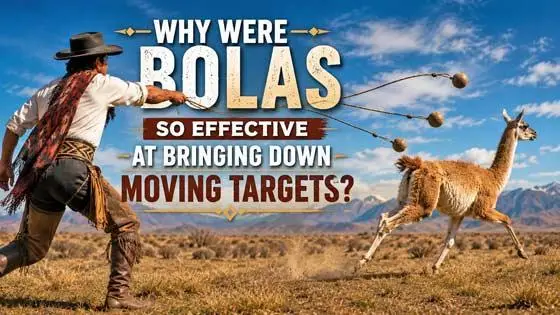
At first glance, bolas seem almost too simple to be effective: a few weighted balls connected by cords and thrown toward a target. Yet in the hands of an experienced hunter, that simplicity concealed an ingenious advantage. Unlike a spear or arrow, which generally had to strike a relatively small target directly, a spinning set of bolas could spread across a much wider area before the cords wrapped around an animal's legs. Suddenly, speed could become a liability. The faster the animal ran, the more disastrous an entanglement could be. But bolas did not work like the perfectly choreographed throws we often see in movies. Their real effectiveness came from a clever combination of rotation, momentum, timing, and a surprisingly forgiving way of intercepting something that refused to stand still.
Bolas Turned One Difficult Target Into a Much Bigger One
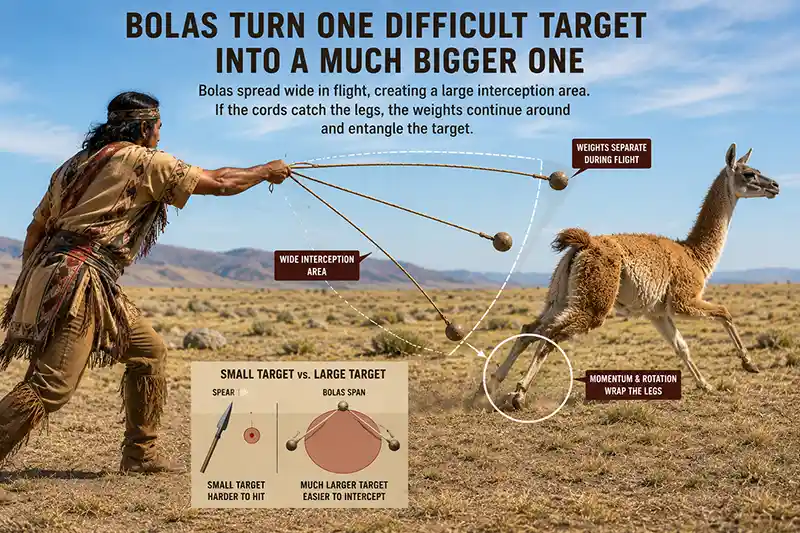
Hitting a running animal with a conventional projectile requires remarkably precise timing. The hunter has to predict where the animal will be when the projectile arrives, account for its speed and direction, and place the shot within a relatively small effective area. Bolas approached that problem in a completely different way. Instead of relying on one narrow point of impact, the weapon could spread outward during flight.
Once released, the weighted ends separated while continuing to rotate around one another. This created an effective striking area much wider than any individual weight. A throw did not necessarily require one ball to hit a tiny anatomical target. If the moving cords intercepted the animal's legs, the weights could continue traveling around them and begin the entanglement that made the weapon so unusual.
That gave bolas an important advantage against something moving quickly across open ground. The hunter still needed considerable skill, but the weapon effectively exchanged pinpoint accuracy for interception. Rather than asking, "Can I hit exactly this spot?" the thrower could attempt to place the expanding pattern of weights and cords across the path the animal was about to occupy.
This is part of what makes bolas such unusual throwing weapons. Their effectiveness did not depend entirely on what happened at the instant of impact. The real action could begin immediately afterward, as the remaining momentum of the weights caused the cords to wrap around whatever they had intercepted.
In other words, bolas did not make a fast-moving target easier to hit by making the hunter impossibly accurate. They made the problem easier by making the effective projectile much larger.
The Real Trick Was What Happened After the First Contact
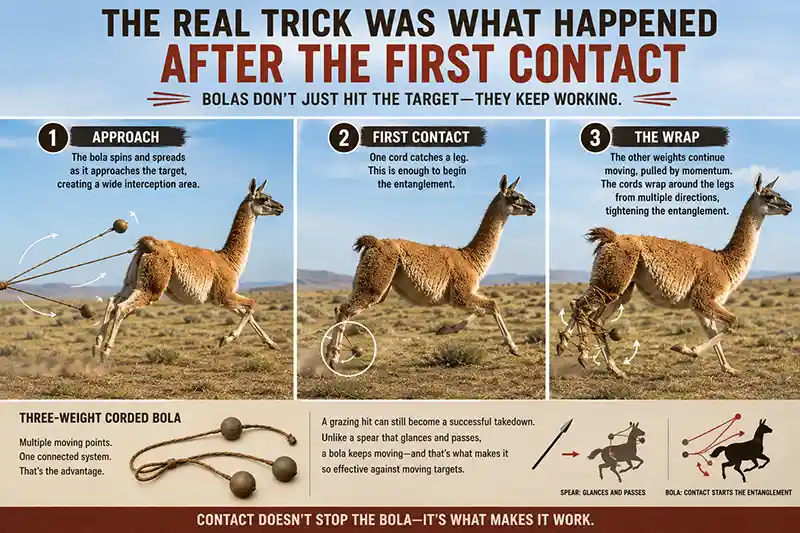
A bola did not need to smash into a target with the concentrated force of a stone or penetrate like an arrow. Its more unusual advantage appeared when one part of the weapon made contact while the other weights were still moving. Instead of ending the throw, that first collision could begin the entanglement.
Imagine one cord catching against a running animal's leg. The weight attached to another cord still possesses momentum and wants to continue along its path. Because the weights are connected, that continued motion can pull the cord around the obstacle rather than simply allowing the entire weapon to bounce away. Additional weights can then travel around the legs from different directions, tightening and complicating the wrap.
This is why the spinning motion was so important. The separate weights gave the weapon multiple moving points capable of carrying the cords around whatever they encountered. A design such as a three-weight corded bola illustrates the basic principle particularly well: several weighted ends are connected into one flexible system rather than behaving as independent projectiles.
The result could turn an imperfect hit into a successful entanglement. A spear that clips the outside of a target may simply continue past it. With bolas, grazing contact between the cords and the legs could potentially give the remaining weights an opportunity to wrap around them.
That is the mechanical trick at the heart of the weapon. Bolas were dangerous to moving targets not simply because they struck them, but because contact did not necessarily stop the projectile from doing its job.
Rotation Made the Bolas Behave Like a Flying Net
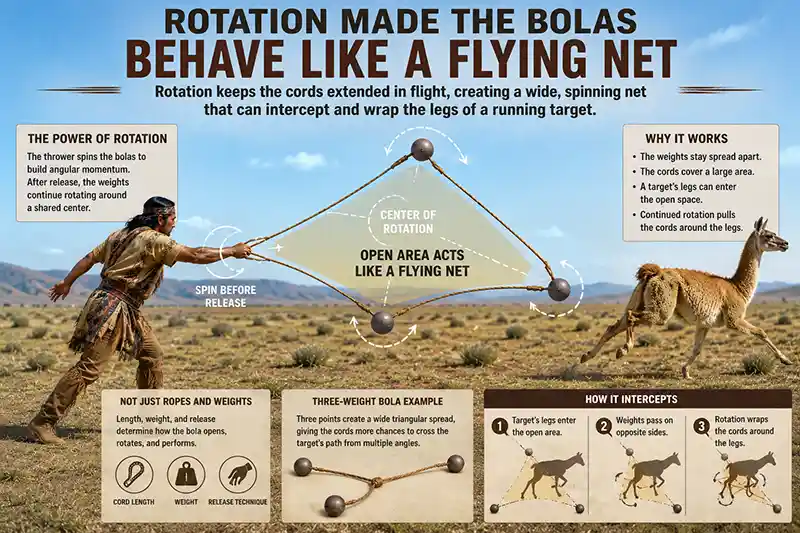
The weights were only part of what made bolas effective. The weapon also depended on rotation. Before release, a thrower could build angular momentum by swinging the bolas, and after release the separated weights continued moving around the weapon's shared center of motion. That spinning action helped keep the cords extended rather than allowing the entire weapon to collapse into one tangled bundle in flight.
The result was something that behaved less like a conventional projectile and more like a crude flying net. There was no fabric between the weights, of course, but the cords occupied the open space between them. If a target's legs entered that space at the right moment, the rotating weights could pass on opposite sides and pull those cords around the limbs.
This helps explain why simply tying weights to ropes would not automatically produce an effective bola. The placement of the weights, the lengths of the cords, and the way the weapon was released all influenced how it opened and rotated. Poorly controlled bolas could twist together, fly unevenly, or arrive at the target in an ineffective configuration.
The principle becomes especially easy to see with a three-ball bola. Three separate weighted ends can create a triangular spread in flight, giving the cords several opportunities to cross the path of a moving target. The thrower is effectively sending an entire rotating system through the air rather than aiming one isolated projectile.
That distinction is crucial. Bolas were not remarkable because the individual weights were unusually sophisticated. They were remarkable because several simple weights and cords could work together as one expanding, rotating entanglement device.
A Running Target Could Actually Help Tighten the Entanglement
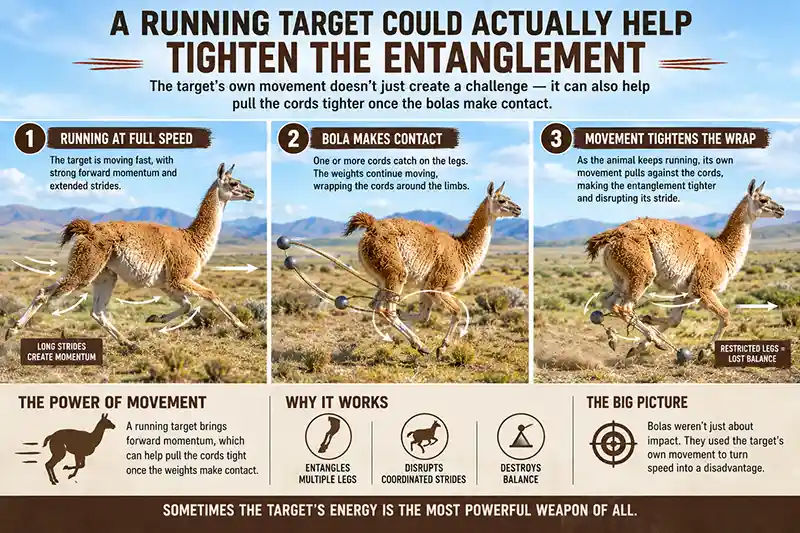
Movement made a target harder to intercept, but once the cords caught, that same movement could work against it. A running animal already had considerable forward momentum. If bolas began wrapping around two or more legs, those limbs could suddenly be restricted while the rest of the body was still trying to continue forward.
This is fundamentally different from relying on the projectile to provide all of the force. The weights brought their own momentum into the collision, but the target also contributed energy through its movement. As the animal continued running, changing leg positions could pull against the cords, alter the position of the weights, and make coordinated strides increasingly difficult.
That helps explain why bolas were so well suited to animals that depended on long, rapid strides across open terrain. The weapon did not necessarily have to overpower the entire animal. It only had to interfere with the synchronized movement of its legs enough to disrupt balance and locomotion. Once that happened, speed could become a disadvantage.
This principle also separates bolas from many other weapons designed to capture instead of kill. The goal was not necessarily to defeat the target through impact trauma. Entanglement could transform the target's own attempts to keep moving into part of the mechanism that stopped it.
Of course, this was never guaranteed. Bolas might catch only one leg, wrap poorly, loosen, or miss entirely. But when the cords intercepted multiple moving limbs at the right moment, the physics of running could suddenly favor the hunter rather than the animal.
Different-Sized Weights Could Make the Flight More Useful
Not every historical bola was built with identical weights. Some traditional South American forms used stones or other weights that differed in size, and this asymmetry could influence how the weapon was handled and how the cords behaved after release. The apparent imbalance was not necessarily a flaw.
In some configurations, a lighter weight could be held while the heavier weights were swung before release. Other designs distributed mass differently among two or three weighted ends. Because bolas developed across different peoples, regions, and hunting traditions, there was never one universal formula dictating that every cord had to terminate in an identical ball.
Weight mattered because each mass carried momentum into the entanglement. Heavier weights could help pull cords around a target once contact occurred, while the overall arrangement still had to remain controllable enough to throw effectively. Simply making every ball as heavy as possible would have introduced its own problems, including greater effort during the swing and a more difficult release.
The contrast is easy to appreciate when comparing different modern constructions. A compact two-weight steel bola, for example, behaves as a simpler flexible system than a three-weight version. Adding another weighted cord changes the geometry of the weapon and creates additional opportunities for cords to intercept a target.
This is another reason bolas are more sophisticated than their appearance suggests. Their performance depended not just on throwing strength, but on the relationship between weight, cord length, rotation, and release. Change one part of that system and you change the behavior of the entire weapon.
Open Ground Was Where Bolas Made the Most Sense
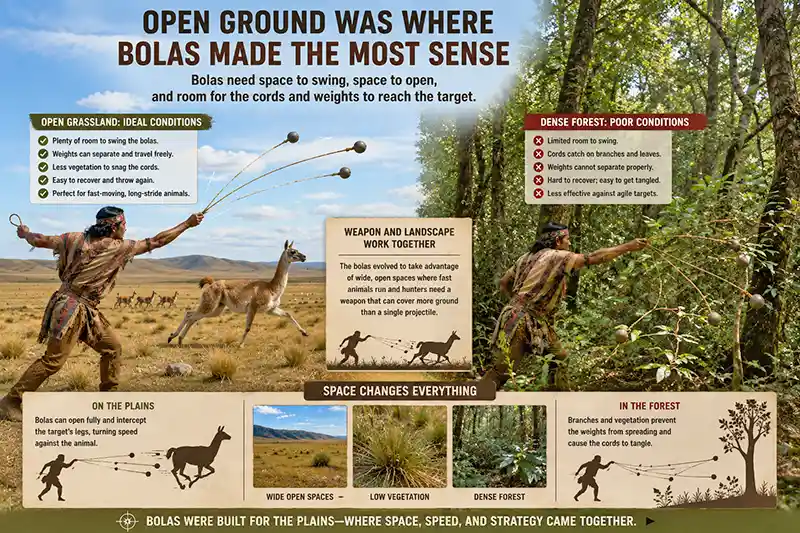
A weapon can be mechanically clever and still be useless in the wrong environment. Bolas needed room. Before the throw, the weighted cords had to be swung without striking nearby obstacles. After release, the weights needed enough open space to separate and travel toward the target without the cords immediately catching on vegetation, branches, or terrain.
That made broad grasslands particularly well suited to the weapon. Across the open landscapes of southern South America, hunters could encounter fast-running animals such as guanacos and rheas with relatively little dense vegetation between themselves and their quarry. These were exactly the kinds of targets for which an expanding entanglement weapon could offer an unusual advantage.
The environment also affected what happened after a miss. In thick woodland, several cords ending in weights would have countless opportunities to snag on branches and undergrowth. On comparatively open ground, the weapon could be thrown, recovered, and used again without fighting through dense vegetation every time it failed to connect.
This relationship between weapon and landscape is an important part of the history of the bolas. The design was not simply an ingenious object considered in isolation. It was particularly well adapted to a world where hunters needed to intercept animals capable of escaping rapidly across enormous stretches of open terrain.
In a forest, the cords could become a liability. On the plains, those same cords became the feature that allowed the weapon to cover far more space than a single projectile ever could.
The Legs Were the Real Target
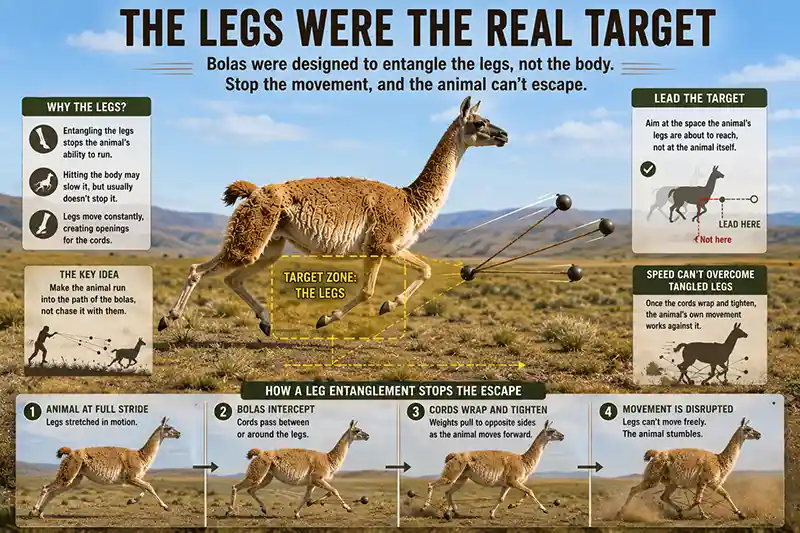
Bolas are often depicted flying toward the center of an animal's body, but that misses the mechanical advantage that made the weapon so effective. The most useful target was lower. Intercepting the legs gave the cords something they could wrap around while simultaneously interfering with the movement the animal needed to escape.
A hit higher on the body might still allow the weights to wrap, but entangling the torso did not necessarily stop an animal from running. Catching the legs attacked locomotion itself. Even a powerful animal becomes vulnerable when its limbs can no longer move independently through a normal stride.
There was another advantage to aiming low. A running animal's legs repeatedly changed position, opening and closing spaces between them. A spreading bola arriving at the right moment could have cords pass between or around different limbs. Once the weights traveled to opposite sides, continued rotation and forward movement could begin drawing those cords together.
This required judgment rather than simply throwing directly at wherever the animal happened to be. A skilled hunter had to anticipate its path and lead the moving target, sending the bolas toward the space its legs were about to occupy. That makes the weapon's effectiveness much easier to understand. The hunter was not trying to chase the animal through the air with the projectile. He was trying to make the animal run into the projectile's path.
The bolas therefore exploited one of the unavoidable weaknesses of a fast-running target. Speed could help an animal escape almost anything behind it, but every stride still required its legs to repeatedly pass through a predictable zone close to the ground.
More Weights Meant More Chances to Catch Something
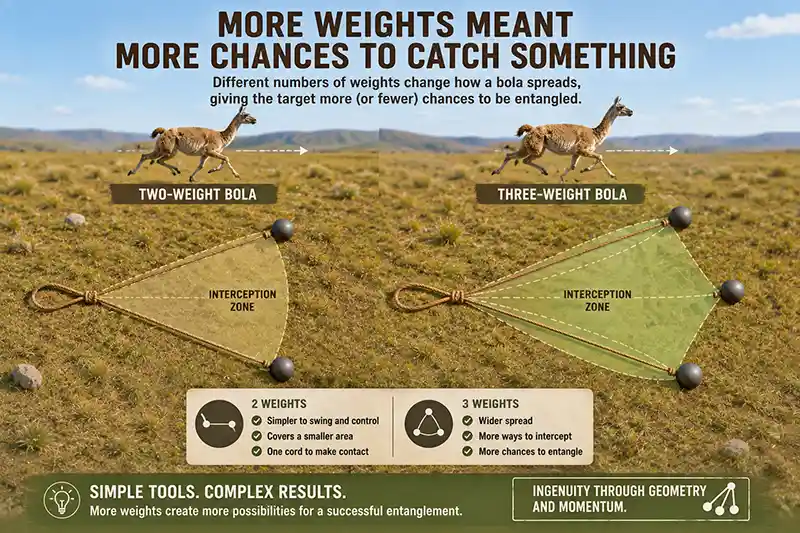
The number of weights changed the geometry of a bola in a surprisingly important way. A two-weight design creates a single cord stretched between two moving masses. Add a third weighted cord and the weapon can spread across a broader, more complex area, giving the target additional opportunities to encounter a cord rather than simply passing between the weights.
That did not automatically make three-weight bolas superior in every situation. Simpler configurations could be easier to manage, while different hunting traditions developed their own solutions based on the animals being pursued and the materials available. What mattered was finding a balance between creating a useful spread and keeping the entire weapon controllable during the swing and release.
Three weights also changed what could happen after contact. If one portion of the bola caught a leg, two other weighted ends could still possess momentum and continue traveling around the target. Those multiple directions of movement increased the possibilities for a complicated wrap rather than a single cord merely striking and falling away.
This is one reason bolas belong among history's more ingenious unusual weapons. Their effectiveness came from combining extremely simple components in a way that produced surprisingly complex behavior. There were no springs, triggers, blades, or elaborate mechanisms. Geometry and momentum did nearly all of the work.
The clever part was not simply adding more balls. Each additional weighted cord altered the spread, rotation, and potential wrapping pattern of the whole system. What looked like a handful of weights tied to cords was really a projectile whose shape continuously changed while it was flying.
Bolas Did Not Need to Knock the Target Down Immediately
One of the easiest misconceptions about bolas is that a successful throw had to produce an instant, dramatic fall. In reality, complete immobilization did not necessarily happen the moment the cords reached the target. Simply interfering with an animal's stride could already give the hunter an enormous advantage.
Imagine a fast-running animal suddenly forced to shorten one stride because a cord has begun wrapping around a hind leg. Even if it remains upright, its rhythm has been disrupted. If another leg becomes involved, the animal may have to slow dramatically, stumble, change direction, or stop long enough to deal with the obstruction.
That distinction matters because hunters did not necessarily need bolas to perform like a magical off switch. They needed the weapon to change the chase. An animal capable of outrunning a person across open ground became much easier to approach once its normal gait was compromised.
The weighted ends could make that problem worse. Even a wrap that did not completely bind the legs could leave cords and weights dragging behind the animal, interfering with subsequent strides and creating additional opportunities for the entanglement to shift or tighten. The weapon could therefore remain troublesome after the initial interception rather than requiring one perfect instant of success.
This helps explain why bolas occupy such an unusual position among historical capture weapons. Their effectiveness could exist on a spectrum. A perfect entanglement might bring a target down quickly, while a less complete hit could still reduce the very advantage the animal depended upon most: its ability to escape at speed.
Why Hunters Had to Lead the Target
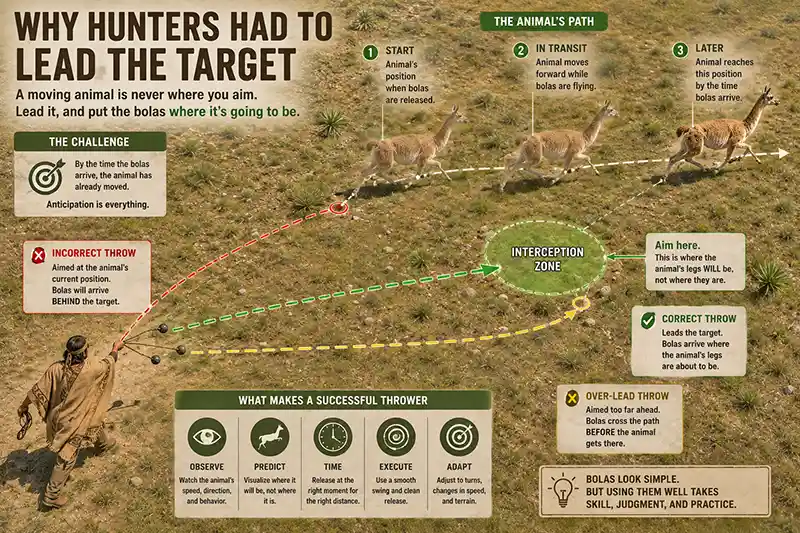
The wider spread of bolas made them more forgiving than a single narrow projectile in some respects, but they did not eliminate one of the oldest problems in hunting: a moving target does not stay where you aim. By the time the bolas crossed the distance between hunter and animal, the animal could already have traveled several feet from where it was when the weapon left the hand.
A successful throw therefore depended on anticipation. Instead of aiming directly at the animal's legs, an experienced thrower could send the bolas toward the space those legs were about to enter. The faster the target moved and the greater the throwing distance, the more important this judgment became.
The expanding spread of the cords provided some margin for error, but timing remained crucial. Throw too far behind and the weights would arrive after the animal had passed. Lead too aggressively and the bolas could cross its path before the legs reached the interception zone. A sudden turn or change in speed could ruin an otherwise excellent throw.
This is where the simplicity of bolas becomes deceptive. Watching someone swing a few weights on cords makes the weapon look almost primitive, but using them against a running target demanded coordination, distance judgment, timing, and an intuitive understanding of movement. Strength alone could not solve those problems.
The most effective thrower was not necessarily the person who could launch bolas the farthest. It was the person who could predict where a moving animal was going to be and put the rotating cords there first.
The Bola Was a Capture Weapon Before It Was a Combat Weapon
Modern weapon collections can make bolas look like they belong naturally beside throwing knives, axes, and other weapons intended to injure an opponent. Historically, however, their most important advantage was different. Bolas could stop a target without depending on a penetrating blade or a devastating direct impact.
That made them particularly valuable for hunting. An animal that could outrun a person did not necessarily need to be killed from a distance if it could first be prevented from escaping. Entangling the legs gave hunters an opportunity to close the distance after the target had been slowed, immobilized, or brought to the ground.
The same principle could potentially make bolas useful against people, and historical accounts have helped give them a reputation as weapons as well as hunting tools. But their fundamental mechanics remained the same. The cords attacked mobility. Against a moving target, preventing normal movement could sometimes accomplish more than simply delivering a hard blow.
This helps distinguish bolas from more conventional impact-oriented flexible weapons. Even though both may involve cords, chains, or weighted ends, bolas were designed around entanglement at a distance rather than repeatedly striking a nearby target. That makes comparisons with historical chain weapons especially interesting because similar-looking components could be used according to completely different mechanical principles.
The genius of the bola was therefore not how much damage its weights could inflict. Its defining trick was taking away the one thing a fleeing target needed most: the ability to keep moving freely.
There Was No Single Standard Bola Design
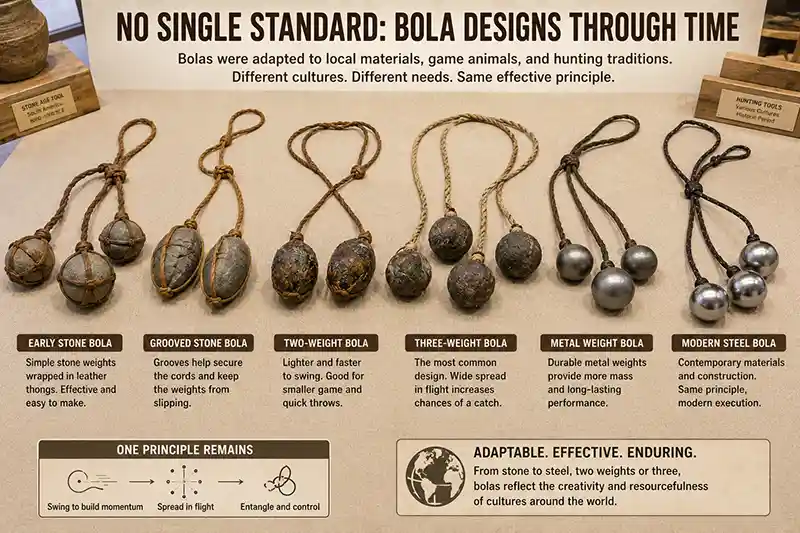
The familiar image of bolas as three identical balls attached to equal-length cords is useful, but history was considerably messier. Different peoples constructed bolas from the materials available to them and adapted their designs to particular animals, landscapes, and hunting traditions. The basic idea remained recognizable even when the finished weapons looked surprisingly different.
Some bolas used two weights, while others used three or more. Stone was an obvious material for early weights, sometimes shaped or grooved so that a cord or leather covering could hold it securely. Later examples could incorporate materials such as metal, while cords might be made from leather or other available fibers. The weights themselves did not always have to be perfectly spherical.
Even the relationship between the cords and weights could vary. Differences in cord length, weight distribution, and construction changed how the weapon felt during the swing and how it opened after release. A design intended for one type of quarry was not necessarily optimized for another.
That long history of experimentation helps explain why modern versions can look so different from archaeological examples. A contemporary steel-weighted bola can preserve the same fundamental idea while using materials and construction methods that would look unfamiliar to the people who developed earlier forms of the weapon.
What survived across those variations was the underlying principle. Several connected components could spread in flight, intercept a moving target, and then use their remaining momentum to transform contact into entanglement. The bola was less a single standardized object than an exceptionally adaptable idea.
The Materials Changed, but the Physics Stayed the Same
A bola made from carefully machined steel looks dramatically different from one built with stones, leather, and natural cordage, yet both rely on essentially the same mechanical idea. The weights provide mass, the cords connect their movement, and rotation spreads the system across a much larger area than any one weight could cover by itself.
That is remarkable because bolas did not require sophisticated manufacturing to work. A hunter did not need forged blades, precision mechanisms, or complicated moving parts. Suitable stones could provide the weights, while leather or strong fibers could form the connections. What mattered most was getting the proportions and construction right enough for the weapon to survive repeated swinging and throwing.
Later materials could change certain characteristics without changing the underlying principle. Dense metal weights could pack substantial mass into a relatively compact size. Manufactured cordage could offer more consistent dimensions. A modern steel bola may therefore look much more uniform than an archaeological stone example while still operating according to the same basic relationship between mass, rotation, and flexible connections.
That continuity is one reason the bola is such an interesting piece of weapon engineering. Many historical weapons became obsolete when armor, metallurgy, or warfare changed. The fundamental mechanics of bolas never depended on any particular technological era. If weighted cords can spread through the air and wrap around something, the basic concept still works.
Thousands of years of technological development can change what a bola is made from. They cannot change the physics that made the idea clever in the first place.
The Hardest Part Was Learning the Release
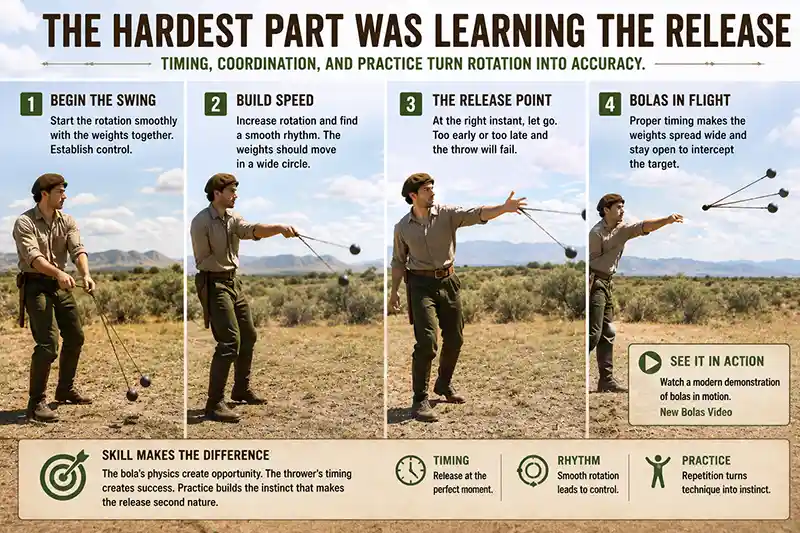
Bolas look deceptively intuitive. Swing the weights, point them toward the target, and let go. But releasing several rotating weights connected by flexible cords is far less forgiving than throwing an ordinary object. A small mistake in timing could completely change the direction, spread, and orientation of the weapon in flight.
During the swing, the thrower had to establish enough rotation to keep the weights moving predictably. Then came the critical instant when the weapon transitioned from something being controlled by the hand to something flying freely through space. Release too early or too late and the entire pattern could travel away from the intended path.
The cords added another complication. An effective throw required the weights to separate rather than immediately collapsing together or interfering with one another. The thrower therefore had to develop a feel not merely for where the bolas were going, but for what the individual weighted ends were doing throughout the rotation.
That kind of coordination could only become reliable through repetition. Experienced users would have developed an intuitive sense of timing, much as skilled practitioners learn the peculiar rhythm of other flexible equipment. For anyone curious about how unusual the motion looks in practice, this bolas demonstration video offers a modern look at the weapon in motion.
This may be the biggest reason the bolas never represented an easy shortcut to hunting success. Their design created a wider opportunity to intercept a moving target, but the weapon still demanded considerable skill to exploit that advantage. The ingenious physics only mattered if the person holding the cords could release them at exactly the right moment.
Why Bolas Worked Better Against Some Animals Than Others
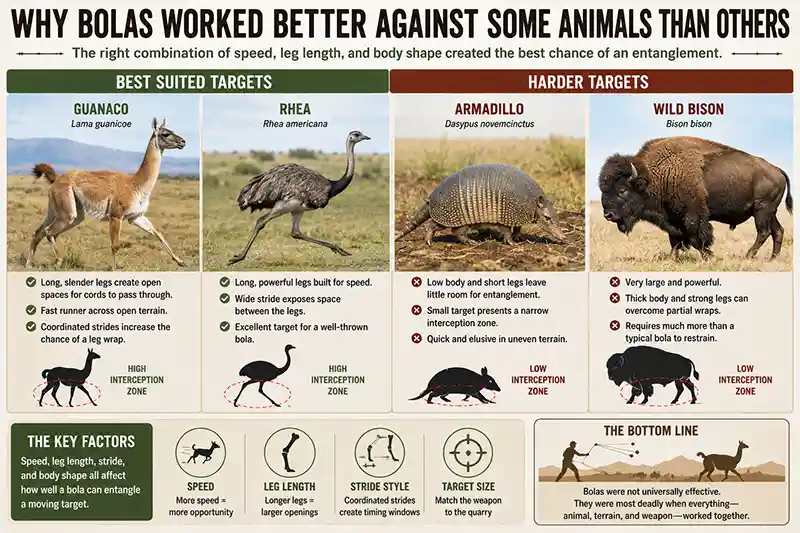
The basic mechanics of bolas could work against many moving targets, but some animals were much better suited to the weapon than others. The ideal target combined speed with long, exposed legs and a running style that depended on coordinated strides. Guanacos and rheas are excellent examples because both could move quickly across open South American landscapes while presenting exactly the kind of lower-body target bolas were designed to disrupt.
Body shape mattered enormously. An animal with relatively long legs creates more open space for cords to pass between and around its limbs. Once those legs become connected by even a partial wrap, the animal's normal gait can become difficult to maintain. A compact, low-to-the-ground animal presents a much smaller interception zone and may give the cords fewer opportunities to create a useful entanglement.
Running style mattered too. A fast animal repeatedly extends and gathers its legs as it moves, constantly changing the gaps between them. That motion creates opportunities for different parts of a spreading bola to pass on opposite sides of the limbs. If the timing is right, the target effectively carries itself deeper into the entanglement with its next few strides.
Size introduced another tradeoff. A very small target could be difficult to intercept at all, while an extremely large or powerful animal might require much more than a partial wrap to meaningfully restrict its movement. Bolas were most advantageous when their spread, cord length, and weight were appropriate for the quarry being pursued.
This is why asking whether bolas were "effective" needs a qualifier. They were not universally effective against anything that moved. Their remarkable reputation came from situations where the weapon, the landscape, and the anatomy of the target all happened to complement one another.
The Bola Could Turn a Near Miss Into a Successful Catch
Most thrown weapons are unforgiving. If an arrow passes a few inches beside its target or a spear glances away, the opportunity is usually over. Bolas had a peculiar advantage because an imperfect initial contact did not always mean the throw had failed.
One weight could pass harmlessly beside the target while a cord encountered a leg. Another weight might travel around the opposite side. Because all of those components remained connected, the continuing movement of the weights could transform what initially looked like a grazing hit into a developing entanglement.
This made the effective interception area much more complicated than the physical size of the individual weights. The cords mattered just as much as the balls themselves. A target could potentially pass through part of the spread and still encounter enough of the system for the remaining weights to begin wrapping around it.
That did not make bolas magically accurate. A throw that was too high, too low, too far ahead, or too far behind would still fail. The advantage was subtler: within a certain margin, the flexible construction allowed the weapon to react to contact rather than requiring one precise collision to accomplish everything.
This may be the single best explanation for why such a simple-looking weapon could be effective against something as difficult as a running animal. Bolas did not eliminate the need for accuracy. They created more ways for an accurate-enough throw to succeed.
Why Bolas Were Especially Dangerous to Herd Animals
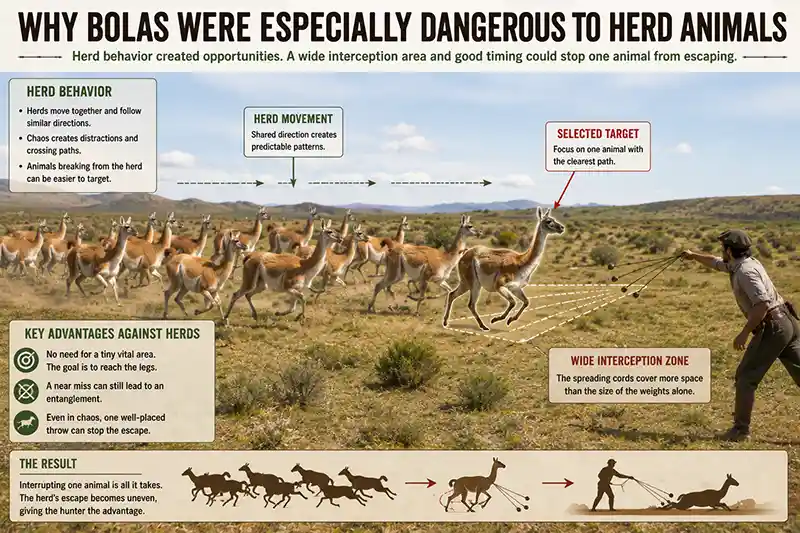
Animals that lived and moved in groups created a different kind of opportunity for hunters. Herds offered more potential targets, but they also created confusion. Once startled, multiple animals could accelerate, change direction, and cross one another's paths, making it difficult to concentrate on a single moving body.
Bolas were unusually compatible with that chaos because the hunter did not necessarily need to strike a tiny vital area. The goal could be to select one animal, anticipate its direction, and place the spreading cords across the path of its legs. Against a dense group of fleeing animals, that comparatively broad interception area offered an advantage that a narrow projectile did not.
Herd behavior could also create moments when individual animals became more predictable. Animals running together often follow similar directions until one breaks away from the group. A hunter watching those patterns could focus on an animal whose path offered the clearest opportunity rather than simply throwing into the herd.
There was an important limitation, however. Bolas were not some indiscriminate net capable of sweeping several animals off their feet at once. A successful throw still depended on choosing a target, judging its movement, and placing the weapon correctly. The wider spread increased the opportunity for contact, but skill remained essential.
This is another reason the bola fit its historical environment so well. It paired an entangling design with the behavior of fast-moving animals on open terrain. The weapon did not need to be faster than the entire herd. It only needed to interrupt the escape of one carefully chosen animal.
Why the Weights Did Not Have to Hit the Target
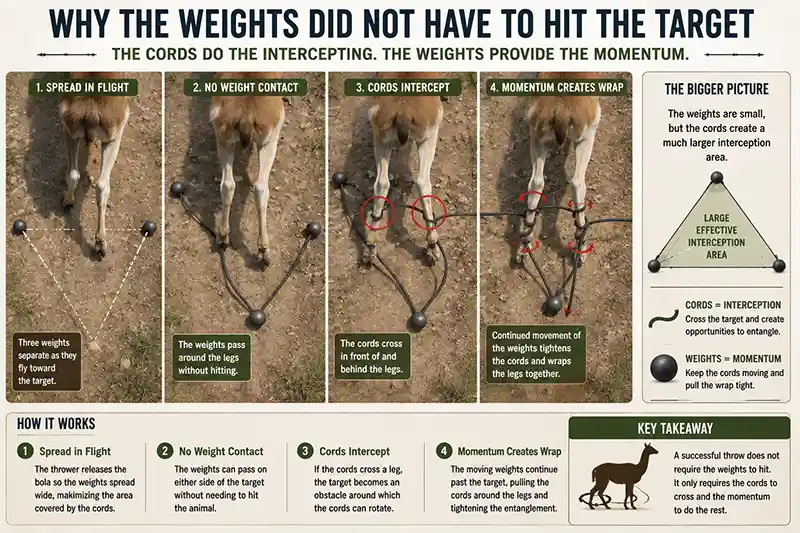
When people first see bolas, they naturally focus on the weighted ends. Those are the most obvious parts of the weapon, so it is easy to assume that a successful throw depended on smashing one of the weights directly into the target. In reality, the cords could be just as important.
Imagine a running animal passing through the spread of a three-weight bola. One weight might pass in front of its legs while another passes behind them. Neither ball necessarily needs to make a direct hit. If the cord connecting those moving weights crosses a leg, the target has already become an obstacle around which the rest of the weapon can begin to rotate.
That dramatically increased the useful area of the projectile. Three relatively small weights might occupy only a tiny amount of physical space, but several feet of cord stretched between them could sweep across a much larger zone. In that sense, much of the bola's effective "surface area" was almost invisible.
The weights still played a crucial role. Their momentum kept the cords moving after contact and helped carry them around the limbs. But the balls and cords performed different jobs. The cords created opportunities for interception, while the weights supplied the momentum that could transform that interception into a wrap.
This is why judging bolas by the size of their weights completely misses what made them clever. The target did not necessarily have to collide with the most obvious part of the weapon. Sometimes it only had to cross the space between the weights.
Weather Could Change How Effective Bolas Were
Even on ideal open terrain, conditions were not always ideal for throwing. Wind, rain, and wet ground could all introduce complications for a weapon whose success depended on several weights and cords behaving predictably in flight.
Strong crosswinds could affect the lighter cords and alter the spread of the bolas, especially over longer throws. The weights themselves carried considerably more momentum than the cordage, but the weapon functioned as one connected system. Anything that disturbed its orientation or timing could reduce the chance of the cords reaching the target in a useful configuration.
Moisture created a different problem. Traditional bolas made with leather components or natural fibers could change in feel when wet, while slippery hands made controlling the swing and release more difficult. Muddy or uneven footing could also interfere with the thrower's balance during the rotational movement leading up to release.
Weather could influence the quarry as well. Animals might move differently across wet, slippery, or uneven terrain, making their speed and direction harder to anticipate. Since a successful throw depended partly on predicting where the target's legs would be when the bolas arrived, an unexpected change of pace could turn a carefully judged throw into a miss.
This reinforces an important point about bolas. Their effectiveness was never created by the weapon alone. The thrower, target, terrain, distance, and conditions all had to cooperate. The physics were ingenious, but the real world could make those physics considerably less predictable.
Bolas Were Most Effective at Surprisingly Short Distances
The image of a hunter launching bolas across an enormous stretch of grassland is dramatic, but extreme range was not necessarily where the weapon had its greatest advantage. As distance increased, every small error in release angle, timing, target prediction, and flight behavior had more time to become a large miss.
A closer target gave the animal less time to change direction after the throw. It also reduced the amount of prediction required from the hunter. Instead of calculating where an animal would be several moments later, the thrower could intercept a path that was much easier to judge.
Shorter distances also helped preserve the useful spread and momentum of the weights. The objective was not simply to throw the bolas as far as possible. They had to arrive while the cords were positioned well enough to cross the target's legs and the weights still had enough movement to continue around them.
This creates an interesting contradiction. Bolas gave hunters a way to stop animals they could never catch on foot, yet using them effectively could still require getting reasonably close first. The weapon solved the final escape problem rather than eliminating the entire challenge of approaching wary prey.
That may be one of the most overlooked reasons bolas required genuine hunting skill. Success began long before the throw. The hunter still had to approach the quarry, read its behavior, choose an opportunity, and resist throwing until the odds favored a clean interception.
The Best Throw Was Often About Timing, Not Power
It is tempting to imagine that the most effective bola throw was simply the hardest one. More speed meant more momentum, so throwing harder should have produced better results. In practice, raw power was only one part of the equation. A perfectly timed moderate throw could be far more useful than an extremely powerful one that arrived in the wrong place or with the cords poorly positioned.
The thrower had to coordinate several things almost simultaneously. The target was moving, the weights were rotating, the cords were changing orientation, and the entire system had to be released so that it crossed the animal's path at roughly the right height and moment. Adding more force did nothing to correct a badly judged interception point.
Too much emphasis on power could even work against control. A faster swing gave the thrower less room for error during the release, while excessive effort could make smooth, repeatable motion more difficult. What mattered was generating enough momentum for the weights to carry the cords through the interception and continue moving after contact.
That helps explain why bolas rewarded experience so heavily. An accomplished user could develop a sense for distance, target speed, rotation, and release timing that would be difficult to learn from instructions alone. The throw became less about consciously calculating every variable and more about recognizing the right moment.
The bola therefore turns one of our assumptions about primitive weapons upside down. Its effectiveness was not primarily a contest of strength. The weapon worked because a skilled thrower could make several moving parts arrive in the right place at precisely the right time.
What Happened When the Bolas Missed?
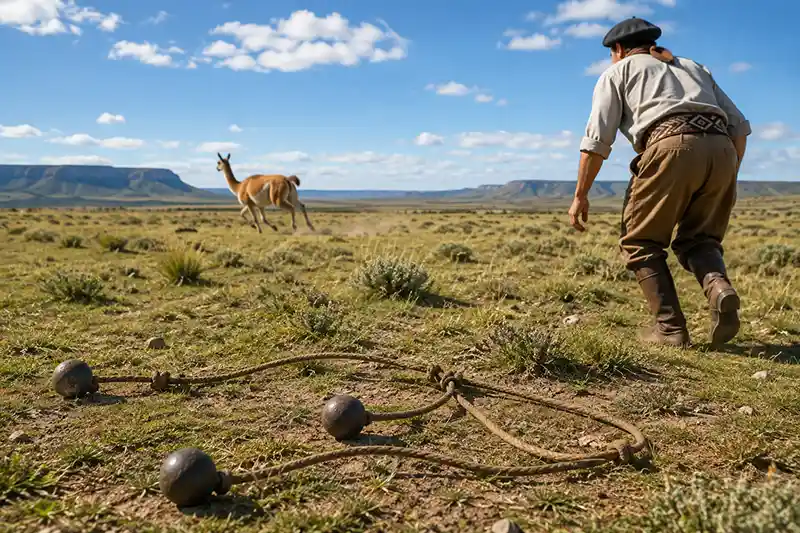
For all their clever mechanics, bolas had one obvious weakness: a miss could leave the hunter with several weighted cords lying somewhere out on the landscape. Unlike a bow, where another arrow could be nocked almost immediately, a hunter carrying only one set of bolas could not simply repeat the throw without recovering the weapon first.
This made choosing the right opportunity especially important. A reckless throw at the edge of effective range might accomplish nothing while temporarily depriving the hunter of the very tool needed to stop the animal. If the quarry continued fleeing across open ground, recovering the bolas could effectively end that particular pursuit.
The terrain could make recovery easier or harder. Open grassland provided relatively few obstacles for the cords to catch on, which was another advantage of using bolas in the environments where they became famous. Rocks, shrubs, water, and dense vegetation could turn a simple miss into a frustrating search for tangled cordage.
Hunters could also carry more than one set, and bolas became famously associated with mounted gauchos who could transport additional equipment far more easily than someone traveling entirely on foot. But historically, bolas existed in many different cultures and circumstances, so there was never one universal method of carrying or recovering them.
This limitation helps put their effectiveness into perspective. Bolas increased the chances that an accurately placed throw could entangle a moving target, but they did not make misses irrelevant. Every failed throw still had a cost, which made patience and target selection just as important as the physics of the weapon itself.
The Bola Worked Because It Attacked Movement Instead of Armor
Many historical weapons became locked in an endless contest with protection. Thicker hides, shields, padded clothing, and eventually armor encouraged weapons capable of cutting deeper, striking harder, or concentrating more force into a smaller area. Bolas approached the problem from an entirely different direction.
They did not necessarily need to penetrate anything. If the cords successfully wrapped around the legs, the target's ability to move could be compromised regardless of whether the weights caused serious injury. Against an animal, that meant the weapon could interfere with escape without relying on a lethal wound.
This helps explain why the bola's simple construction should not be mistaken for crude engineering. The weapon bypassed a problem that dominated the development of countless other weapons. Instead of asking how to damage a protected target more effectively, bolas asked whether the target could simply be prevented from getting away.
That principle also helps explain why bolas fit so naturally within the broader category of unconventional weapons. Their defining advantage was not an unusually sharp edge, devastating point, or tremendous striking surface. It was the ability to transform a moving target's legs into the weak point.
Against the right quarry, mobility was effectively its greatest defense. Bolas turned that defense into something that could be attacked directly.
The Same Weapon Eventually Became a Tool of the Gaucho
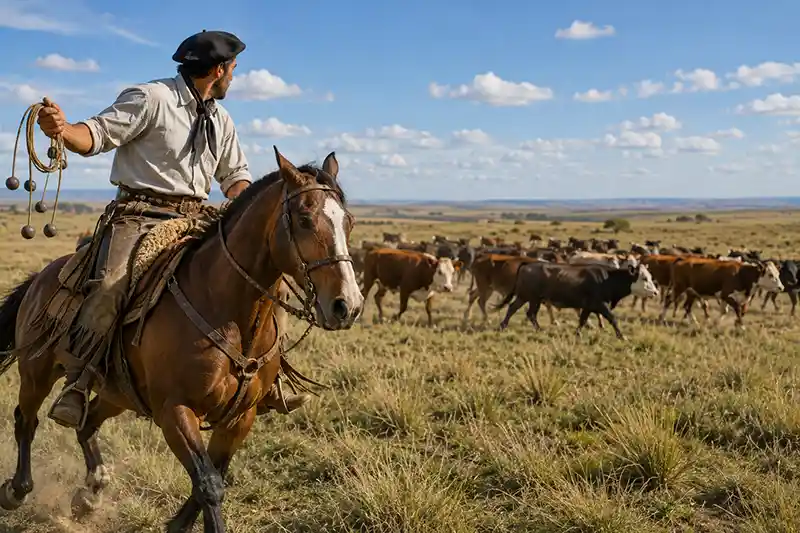
Long after bolas had become established as hunting tools in South America, they remained useful in a very different world. On the vast grasslands of the Pampas, mounted gauchos adopted bolas for work involving livestock and for situations where controlling a moving animal mattered more than striking it with a conventional weapon.
Horses changed the equation dramatically. A mounted rider could pursue animals at speeds impossible for a hunter on foot, carry multiple pieces of equipment, and maneuver into a better position before making a throw. Yet the fundamental advantage of the bolas remained exactly the same: interfere with the legs and take away the target's ability to keep running normally.
Different forms of bolas became associated with gaucho culture, including versions intended for capturing cattle or other animals. The weapon's continued usefulness is revealing. This was not simply an ancient hunting technology that survived as a curiosity. Its basic mechanics remained practical even after horses, metal tools, and entirely different ways of life transformed the South American grasslands.
The gaucho connection also helps explain why bolas remain so recognizable today. Indigenous peoples of South America had used forms of the weapon long before the famous mounted cattle culture of the Pampas developed, but later gaucho use gave bolas another highly visible chapter in their history.
From prehistoric stone weights to mounted riders on the Pampas, the details changed enormously. The central idea did not. When the problem was stopping something faster than you, a few weights connected by cords remained an extraordinarily clever solution.
The Bola Survived Because Its Basic Idea Was Hard to Improve
Many ancient weapons disappeared when better materials or new technologies replaced them. The bola is different. Its core concept was so simple that there was surprisingly little technology could add without changing what made the weapon effective in the first place.
Better cordage could make bolas stronger and more consistent. Metal could replace stone in the weighted ends. Manufacturing could make those weights more uniform. Yet none of those improvements altered the fundamental mechanism. The weapon still depended on several masses spreading apart in flight, cords crossing a moving target, and momentum carrying those cords into an entanglement.
That simplicity also made bolas remarkably accessible. They did not require sophisticated metallurgy or a specialized workshop. Earlier versions could be assembled from materials available in the surrounding environment, which helps explain why variations on the basic concept appeared in different places and survived across long periods of technological change.
Modern versions may look cleaner and more standardized, but they still demonstrate an idea that is fundamentally ancient. Even the bolas found among today's more unusual weapons would be mechanically recognizable to people who understood the principle centuries ago.
The bola endured because there was no complicated mechanism waiting to become obsolete. Its mechanism was physics itself. As long as a moving weight can carry a flexible cord around an obstacle, the central idea continues to work exactly as it always has.
Why Bolas Were So Effective Against Moving Targets
The real genius of bolas was that they did not try to solve the problem of a moving target in the same way as most projectile weapons. An arrow, spear, or thrown stone depended heavily on placing a relatively small object at exactly the right point. Bolas could send an entire spreading network of weights and cords across the target's path.
Once contact occurred, the weapon's flexible construction took over. The weights could continue traveling while the cords encountered the legs, converting forward and rotational momentum into a developing wrap. If the animal continued running, its own movement could further disrupt its stride and complicate the entanglement.
None of this made bolas easy to use. A hunter still had to judge distance, anticipate movement, control the rotation, choose the right moment, and release the weapon accurately. Targets could turn unexpectedly, cords could wrap poorly, and even an experienced thrower could miss completely.
But under the right conditions, bolas offered something extraordinary. They increased the effective interception area of the throw, did not require the weights themselves to score a direct hit, and attacked the very thing that made the target difficult to catch in the first place: its ability to run.
That is ultimately why such a simple collection of weights and cords survived for so long. Bolas did not need to outrun an animal, overpower it, or strike a tiny vulnerable point. They only needed to cross its path at the right moment. Once the cords found the legs, the target's speed could begin working against it.
Were Bolas Mainly Used for Hunting?
Yes. Although bolas could be used as weapons, their strongest historical association is with hunting and animal capture. Their design was particularly useful against fast-moving quarry because they attacked mobility rather than depending entirely on penetration or blunt-force impact.
Bolas became especially important in South America, where Indigenous peoples used variations of the weapon to hunt animals including guanacos and rheas. These animals could move quickly across open terrain, making them difficult to approach or catch once they began running.
The weapon later became closely associated with gauchos of the South American Pampas, who also used bolas in connection with livestock. That later tradition helped cement the familiar image of a mounted rider swinging weighted cords overhead before releasing them toward a moving animal.
Bolas therefore occupied an unusual space between hunting equipment, capture tool, and weapon. Their defining purpose was not necessarily to deliver a lethal blow. It was to make something that could run faster than a person suddenly unable to use that speed effectively.
How Far Could Bolas Be Thrown?
There was no single maximum throwing distance for bolas. Range depended on the construction of the weapon, the weight of its ends, the length of the cords, the strength and experience of the thrower, and whether the goal was simply to throw far or actually entangle a moving target.
That last distinction is important. A person might be capable of throwing bolas considerably farther than the distance at which they could reliably place the cords across an animal's legs. Every additional foot gave the target more time to accelerate, turn, slow down, or otherwise move away from the predicted interception point.
Longer throws also magnified small mistakes during release. A slight error in direction might be relatively insignificant at close range but become a complete miss after the bolas traveled much farther. The thrower also needed the weights and cords to arrive in a useful orientation rather than merely reaching the target's general location.
For that reason, historical effectiveness should not be reduced to a dramatic maximum-range number. Bolas were fundamentally an interception weapon. The useful distance was whatever allowed a skilled thrower to accurately judge the target's movement and send the spreading cords through the path of its legs.
In other words, the most impressive bola throw was not necessarily the longest one. It was the one that arrived in exactly the right place.
How Many Weights Did Traditional Bolas Have?
There was no universal number. Historical bolas were made in several configurations, with two-weight and three-weight designs among the most familiar. Different Indigenous traditions, regions, types of quarry, and later gaucho practices produced considerable variation in how the weapon was constructed.
Three-weight bolas are especially recognizable today. With three weighted ends spreading away from a central connection, the weapon could create a broad interception area while providing multiple cords and weights capable of becoming involved in an entanglement.
Two-weight versions worked somewhat differently. With a cord connecting two masses, the design was mechanically simpler but could still wrap around whatever crossed between the moving weights. Other historical variations demonstrate why bolas are better understood as a family of related capture tools rather than one standardized design.
Even within the same number of weights, construction could vary. The weights might differ in size or mass, and the cords did not necessarily have to be identical. Materials ranged from stone and leather to later metal components.
So the familiar three-ball arrangement is historically meaningful, but it should not be treated as the only "correct" bola. The underlying principle mattered more than the exact number of weights: use connected masses to spread flexible cords through the path of a moving target.
What Were Traditional Bola Weights Made From?
Stone was one of the most important materials used for traditional bola weights, particularly before metal became readily available. Archaeological examples include carefully shaped stones that could be secured to cords or enclosed within leather coverings. Some were grooved or otherwise modified to help keep the attachment from slipping free.
Leather played an important role as well. A stone could be wrapped inside a leather covering attached to a thong, creating a durable weighted end without requiring sophisticated metalworking. The cords themselves could also be made from leather or other strong natural materials available to the people constructing the weapon.
Later bolas could incorporate metal weights, especially as the weapon continued to be used in the era of mounted gauchos. Metal offered a convenient way to concentrate considerable mass into a compact, durable weight, but it did not fundamentally change how the weapon functioned.
The simplicity of these materials was one of the bola's great advantages. The weapon did not require an expert bladesmith, furnace, or complex mechanism. What mattered was having sufficiently durable cords attached to weights with enough mass to maintain momentum during the throw.
That is why ancient stone bolas and modern metal versions can look radically different while remaining immediately recognizable as the same basic idea. The materials evolved. The physics barely needed to.
Did Bolas Always Wrap Perfectly Around the Legs?
No. The beautifully symmetrical wrap often shown in illustrations is an idealized version of what could happen, not a guarantee. Bolas were flexible objects interacting with targets that were running, turning, accelerating, and moving their legs independently. Real entanglements could be messy.
One cord might catch while another passed completely clear. The weights could wrap around only one leg, become tangled unevenly, or strike the ground before completing a useful rotation. In other cases, the cords might briefly interfere with the animal's stride without creating a lasting entanglement at all.
Importantly, an imperfect wrap did not necessarily make the throw useless. Bolas did not always need to bind multiple legs tightly together to affect the chase. A dragging weight, partially wrapped cord, or momentary restriction could disrupt the animal's rhythm enough to slow it or force it to change direction.
This is why bolas should not be imagined as mechanical devices that performed the same sequence every time they touched a target. Their effectiveness was probabilistic. The spreading cords created several opportunities for contact, and the moving weights created several opportunities for that contact to develop into something more restrictive.
The spectacular full wrap certainly represents what bolas were capable of doing. Their real advantage, however, was that a throw could still cause trouble even when the entanglement was far from perfect.
Could Bolas Be Used From Horseback?
Yes. Bolas became famously associated with the mounted gauchos of South America, and horseback use gave the weapon some obvious advantages. A rider could keep pace with fleeing livestock or wild animals far more effectively than a person pursuing them on foot, creating opportunities to move into a favorable position before making a throw.
The horse also solved part of the distance problem. Instead of relying on an exceptionally long throw, a rider could reduce the gap by pursuing the target first. That allowed the bolas to be released from a range where judging speed and direction became considerably easier.
Using bolas from horseback still demanded considerable coordination. The rider had to control the horse, follow a moving target, manage the weighted cords, and choose the release moment while both hunter and quarry were in motion. The horse's own movement added another variable to an already complicated throw.
This later gaucho tradition should not obscure the weapon's much older history. Indigenous peoples of South America used forms of bolas long before horses arrived in the Americas. Mounted use was an adaptation of an existing technology rather than the origin of the weapon itself.
In some ways, however, horse and bola were remarkably complementary technologies. One gave the hunter enough speed to stay with a fleeing animal. The other provided a way to take that speed away from the target.
Were Bolas Used in Warfare?
Yes, although hunting and animal capture remain the roles most strongly associated with bolas. Historical accounts describe bolas being used in conflicts in South America, where a weapon capable of interfering with movement could have obvious value beyond hunting.
Mounted opponents presented an especially interesting possibility because the horse itself depended on coordinated leg movement. A flexible entangling weapon did not need to function like an arrow or spear to create a serious problem for a rider. Even so, historical accounts of battlefield use should not be exaggerated into the idea that bolas were a universal or dominant military weapon.
Their limitations did not disappear simply because the target was human. Bolas still required room to swing, careful timing, appropriate distance, and an unobstructed path. A missed throw could also leave the user temporarily without the weapon while opponents continued moving.
This is another example of how difficult it is to force bolas into a single category. The same basic object could serve as hunting equipment, a livestock-control tool, or a weapon depending on who carried it and why.
So bolas genuinely have a place in the history of warfare, but that is only one chapter of a much larger story. Their enduring importance came from a broader idea: sometimes stopping movement can be more useful than simply delivering an impact.
What Is the Difference Between Bolas and a Lasso?
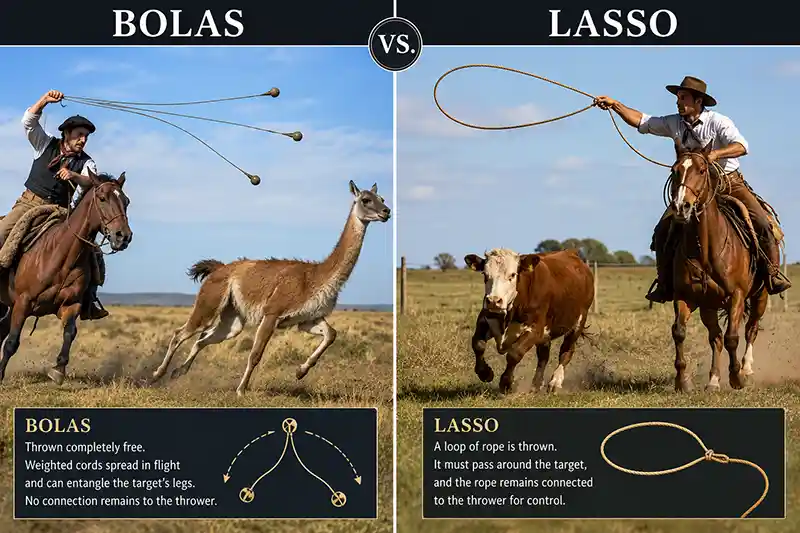
Bolas and lassos can both be used to stop moving animals, but they solve the problem in very different ways. A lasso uses a loop of rope that must pass around part of the target, after which the rope remains connected to the person or rider controlling it. Bolas are thrown completely free and rely on weighted cords to create an entanglement on their own.
That difference changes everything about how the two tools behave. With a lasso, success depends on placing the loop correctly and then maintaining control of the rope after the catch. With bolas, the thrower relinquishes control at release. The weights, cords, rotation, and movement of the target determine what happens next.
Bolas also attack the problem from multiple directions. Their weighted ends can spread apart during flight, allowing cords to cross the path of the legs and potentially wrap as the remaining weights continue moving. A lasso instead presents a single loop that must surround its intended target area.
Both eventually became strongly associated with mounted livestock cultures, which can make them seem like variations on the same idea. Mechanically, however, they are remarkably different. The lasso captures by enclosing and remaining connected to the target. Bolas capture by becoming entangled with it.
Could Bolas Be Used to Catch Birds?
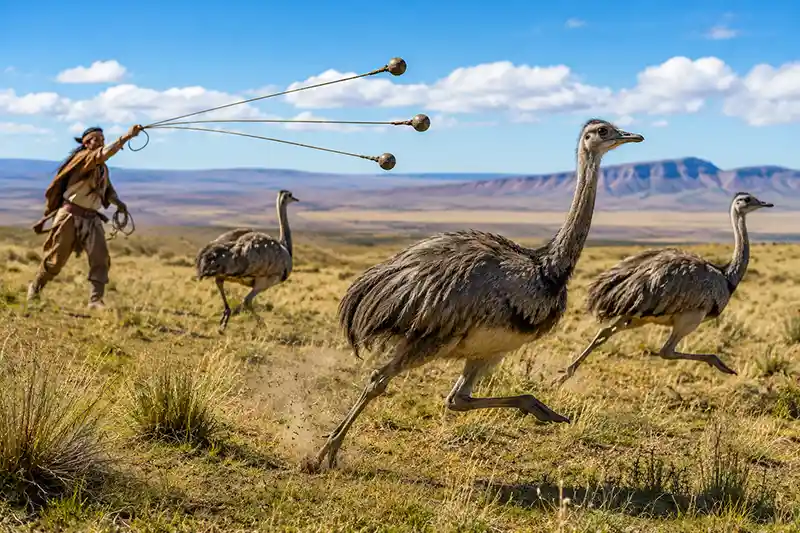
Yes, and this is one of the more fascinating parts of the weapon's history. Bolas were associated not only with hunting four-legged animals such as guanacos, but also with pursuing large flightless birds such as rheas on the open plains of South America.
Rheas presented many of the characteristics that made bolas useful. They were fast, had long exposed legs, and relied on rapid running to escape danger. Instead of trying to strike a small vital area on a bird moving at high speed, a hunter could attempt to send the spreading cords across the path of its legs.
The rhea's anatomy made that strategy particularly interesting. Its long legs created substantial open space beneath the body, giving the cords opportunities to pass between or around the limbs. If the rotating weights traveled to opposite sides, the bird's continued running could help turn that initial interception into a more restrictive entanglement.
This does not mean bolas were effective against birds generally. Trying to entangle a small flying bird would present an entirely different problem. The weapon was especially well matched to large terrestrial birds whose escape strategy depended on powerful legs and speed across open ground.
The rhea is therefore a nearly perfect example of why bolas were so specialized. The weapon was at its best when the target was fast enough to be difficult to catch, but built in exactly the way needed for weighted cords to interfere with that speed.
What Is the Difference Between Bolas and Boleadoras?
The terms are closely related and are often used to describe the same basic type of weighted entangling weapon. "Bolas" is the term most English-speaking readers encounter, while "boleadoras" is commonly associated with the South American and particularly Argentine tradition of the weapon.
Boleadoras could be constructed in several configurations rather than following one standardized pattern. Some had two weighted ends, while others used three. Materials, cord lengths, and the sizes of the weights could also vary according to region, purpose, and tradition.
So when historical sources mention boleadoras, they are not describing an entirely different weapon from bolas. The terminology reflects language and cultural context more than a fundamental difference in the underlying mechanical principle.
Who Invented the Bolas?
There is no known individual inventor of the bolas. The weapon is ancient enough that its development reaches far beyond written records, making it impossible to credit the idea to one particular person.
Bolas are especially associated with Indigenous peoples of southern South America, who developed sophisticated forms of the weapon for hunting animals across open terrain. Similar principles involving cords and weights have also appeared elsewhere, suggesting that the basic idea was simple enough to be developed independently.
That makes the invention of bolas more like the development of the spear or sling than the creation of a modern mechanical device. It was probably refined gradually as generations of hunters experimented with different weights, materials, cord lengths, and throwing methods.
How Old Are Bolas?
Bolas are extremely old. Archaeologists have discovered stone objects interpreted as bola weights at prehistoric sites, showing that the basic concept of using weighted cords for hunting reaches back thousands of years.
Determining the age of bolas can be difficult because the most recognizable parts of the weapon were often made from perishable materials. Leather thongs and natural fibers can disappear while the stone weights survive, leaving archaeologists to determine how unusual stones may originally have been used.
What is clear is that bolas existed long before the famous gaucho culture with which they later became associated. By the time mounted riders were using boleadoras on the South American plains, they were employing a principle with a far deeper history.
Why Did Some Bolas Have Different-Sized Weights?
Historical bolas did not always use perfectly matched weights. Differences in size and mass could affect how the weapon was held, swung, released, and how the individual weighted ends behaved after release.
Some traditional configurations included a smaller or differently shaped weight that could serve a distinct role during handling, while the larger weights supplied much of the momentum during the throw. Designs varied considerably, however, so there was no universal rule requiring every bola to have one particular arrangement.
The asymmetry can look strange to modern eyes because manufactured bolas tend to appear extremely uniform. Traditional users were more concerned with how the entire system behaved than whether every component looked identical.
Did Indigenous Peoples Use Bolas Before the Gauchos?
Yes. The association between bolas and gauchos is so strong that it can create the mistaken impression that mounted cattlemen invented the weapon. Indigenous peoples of South America were using bolas long before gaucho culture developed.
For Indigenous hunters, bolas were particularly well suited to the open landscapes and fast-moving animals of southern South America. Quarry such as guanacos and rheas could be extraordinarily difficult to pursue, while weighted cords offered a way to interfere directly with their ability to escape.
Gauchos later incorporated bolas into a horse-centered culture involving livestock and life on the Pampas. Their use represents an important later chapter in the weapon's history, but not its beginning.
Are Bolas Still Used Today?
Yes, although their role has changed considerably. Bolas and boleadoras remain culturally significant in parts of South America, particularly because of their connections to Indigenous traditions and gaucho heritage. Modern examples are also produced as historical reproductions, sporting equipment, collectibles, and unusual weapons.
Contemporary versions may substitute manufactured cordage and metal weights for the stone, leather, and natural materials found in older examples. Despite those changes, the recognizable architecture of the weapon has survived: multiple weighted ends connected by flexible cords.
That longevity is part of what makes bolas so fascinating. A modern example can use completely different materials from a prehistoric version while still relying on the same basic combination of rotation, momentum, spreading cords, and entanglement that made the original concept effective.
You May Also Be Interested In:
Leave a Reply