



The Weapons That Were Far More Effective Than Swords (And Why History Forgot)
June 15th, 2026
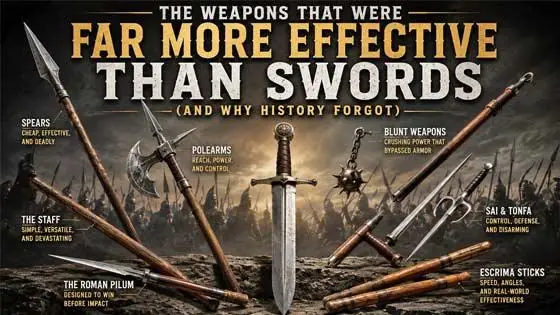
Swords have a reputation problem, or maybe more accurately, everyone else does. Movies, games, and history books have spent centuries turning swords into symbols of power, honor, and elite warriors. When people imagine legendary battles, they picture flashing blades, dramatic duels, and heroes carrying swords into impossible odds.
History tells a much stranger story.
For much of human warfare, swords were often backup weapons rather than battlefield superstars. The weapons that actually dominated combat were frequently longer, cheaper, faster, harder to defend against, or simply more practical in real fighting. Spears stopped cavalry. Polearms shattered armor. Staves controlled distance. Even simple blunt weapons sometimes proved deadlier than beautifully crafted blades.
That does not mean swords were ineffective. Far from it. A good sword was versatile, reliable, and devastating in the right hands. But if survival was the only thing that mattered, many warriors throughout history would have chosen something else entirely.
In this guide, we are looking at the weapons that often outperformed swords in real combat, why they worked so well, and how history somehow convinced us that swords were always the ultimate weapon anyway.
Before we start ranking weapons against swords, it is worth asking an uncomfortable question: if swords were not always the most effective battlefield weapon, why did they become so legendary?
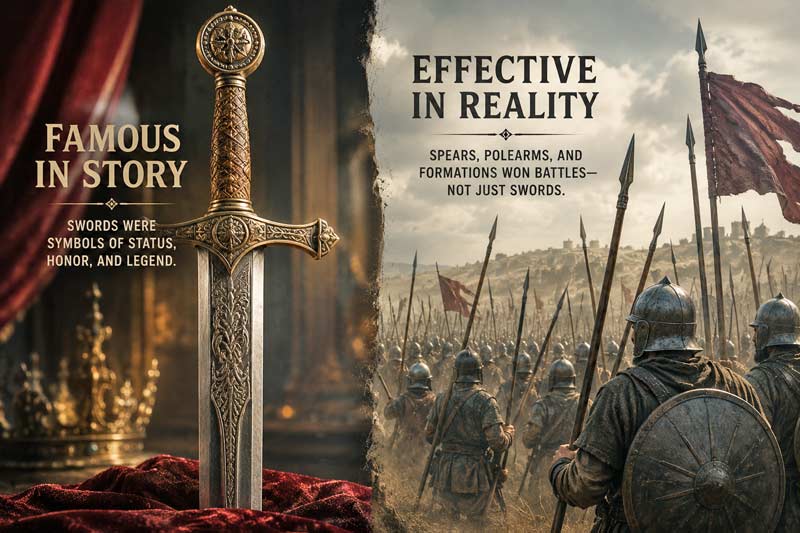
Part of the answer comes down to status. In many cultures, swords were expensive to produce and often carried by nobles, officers, or elite warriors. A spear could be handed to thousands of soldiers. A sword, by contrast, often became a symbol of rank, wealth, and prestige. Over time, people started associating swords with heroes rather than practicality.
Storytelling also played a huge role. A duel between two sword fighters is dramatic. It feels personal. Spears, polearms, and formations may have won wars, but they do not always create the same kind of cinematic moment. That is one reason movies and games often exaggerate sword combat while downplaying weapons that were arguably more effective in real life.
Even historically, swords were frequently secondary weapons. Many warriors carried them only after their primary weapon failed, broke, or became impractical in close quarters. Knights carried swords alongside lances and polearms. Roman soldiers relied on spears before drawing blades. Samurai often fought with polearms or bows long before reaching for swords.
That does not mean swords were overrated. A good sword was versatile, portable, and deadly. But history tends to remember symbols more than practicality, and swords became one of the most powerful symbols warfare ever produced.
If you look through collections of traditional swords and bladed weapons, it is easy to see why people became fascinated with them. Few weapons carry the same mix of craftsmanship, mythology, and visual appeal, even if battlefield history was often more complicated.
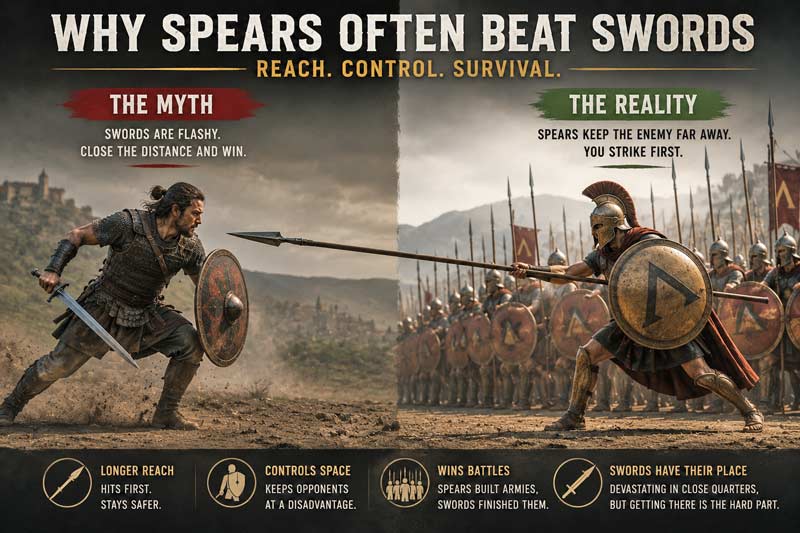
If there is one weapon that repeatedly outperformed swords throughout history, it was the spear. That may sound surprising considering how legendary swords became, but on actual battlefields, reach mattered more than style. And few weapons gave fighters a bigger advantage than putting a sharp point several feet farther away from danger.
A spear fighter usually got the first opportunity to strike. Before a swordsman could even get close enough to attack, they first had to survive the dangerous process of getting past the spear tip. In practical terms, that often meant facing multiple thrusts while trying to close distance against someone who could hit you first.
This advantage is one reason so many civilizations independently arrived at nearly the same conclusion. Greeks built phalanxes around spears. Vikings carried them more often than swords. Samurai armies relied heavily on yari. Medieval infantry used long pole weapons to stop cavalry and control space. Entire military systems repeatedly prioritized reach over prestige.
Even modern martial arts experiments and historical combat demonstrations often show how difficult it can be for shorter weapons to consistently overcome longer ones when skill levels are comparable. That does not mean swords were useless, but they frequently worked best as secondary weapons once the spear had broken, been dropped, or combat moved into tighter spaces.
We recently explored this idea in more depth in our guide to the different types of spears used throughout history, where one thing became clear very quickly: civilizations kept reinventing spears because they worked astonishingly well.
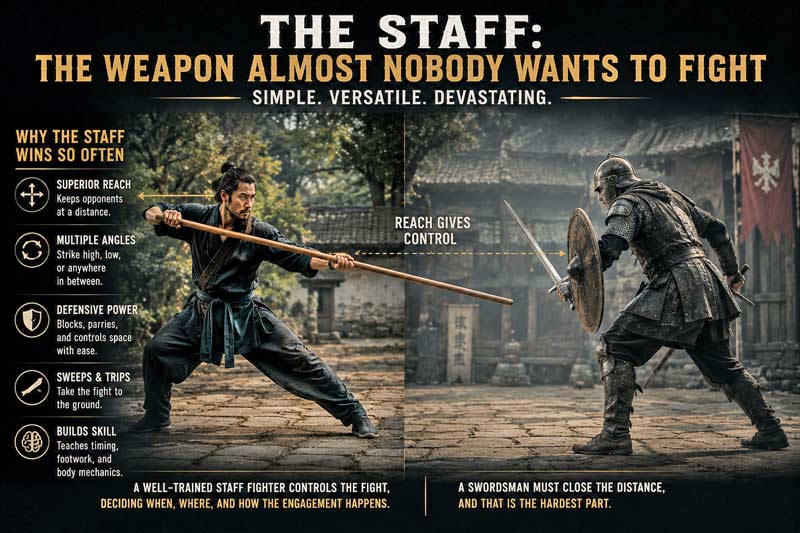
If swords had a quiet rival throughout history, it might be the humble staff. Simple, inexpensive, and found in cultures all over the world, the staff earned a reputation for something many flashy weapons struggled to deliver consistently: control.
A good staff fighter could strike from multiple angles, control distance, sweep legs, jab, block, and generate enormous power through leverage and momentum. Unlike swords, staffs also carried far less risk of becoming damaged in combat, and because of their reach, opponents often struggled to get close enough to attack effectively.
That reach advantage mattered more than many people realize. A trained fighter with a long staff could pressure an opponent constantly, forcing them to react instead of attack. Even heavily armed opponents sometimes found themselves struggling against someone wielding what looked like "just a stick." History repeatedly reminds us that simple does not mean ineffective.
Many martial arts systems turned staff fighting into highly refined disciplines. Japanese bojutsu, Chinese gun techniques, and Filipino long-weapon systems all recognized the same reality: controlling range often matters more than carrying the sharpest weapon. In some traditions, staff training even became the foundation for learning other weapons because it teaches timing, body mechanics, and positioning so effectively.
Modern martial artists still explore long-range fighting through collections of bo staffs and traditional staff weapons, many of which preserve training methods rooted in centuries of martial history.
Interestingly, staff weapons also evolved into stranger and more specialized designs over time. Flexible and segmented weapons like the three-section staff pushed range and unpredictability even further, though they required dramatically more skill to control.
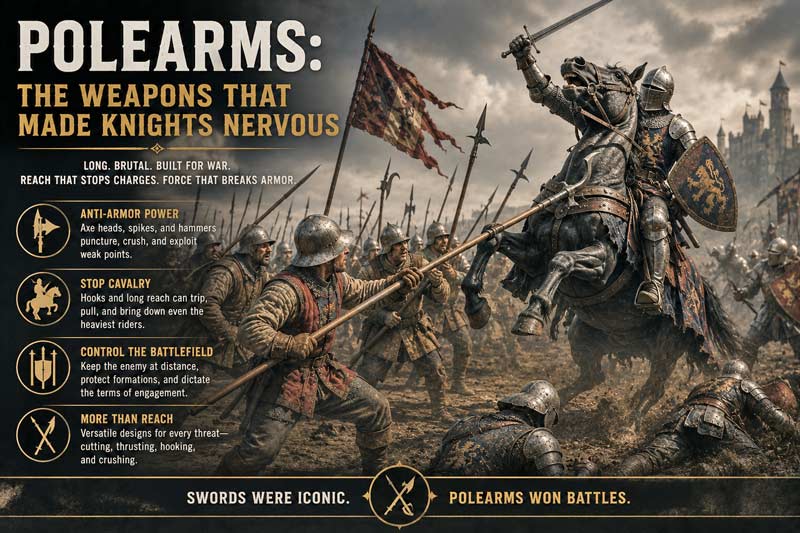
If swords had one category of weapon that consistently caused problems on battlefields, it was polearms. Long, brutal, and purpose-built for war, polearms combined the reach of a spear with heavier striking power, making them some of the most feared anti-armor weapons in history.
Weapons like halberds, glaives, bills, and poleaxes were designed to solve a very specific battlefield problem: heavily armored opponents. Swords could struggle against plate armor, especially when facing mounted knights or disciplined infantry. Polearms, however, attacked from farther away and often included axe heads, hooks, spikes, or hammer-like striking surfaces capable of pulling riders from horses, piercing weak points, or delivering crushing force.
In many medieval battles, infantry carrying polearms became one of the biggest threats to mounted warriors. A charging knight looked terrifying, but long weapons gave soldiers ways to stop cavalry before impact or drag armored fighters into vulnerable positions. Reach mattered, but versatility mattered too.
This is also where swords began losing one of their biggest advantages. A sword is adaptable, but many polearms were specialized for battlefield dominance. Against armor, range, and formations, the fighter holding a longer weapon often dictated the terms of the engagement.
Ironically, some of the deadliest battlefield weapons in history looked awkward compared to elegant swords. But history has a funny habit of rewarding effectiveness over aesthetics.
For people fascinated by unusual historical designs, collections of rare and exotic weapons offer a glimpse into how strange, creative, and specialized combat tools became across different cultures.
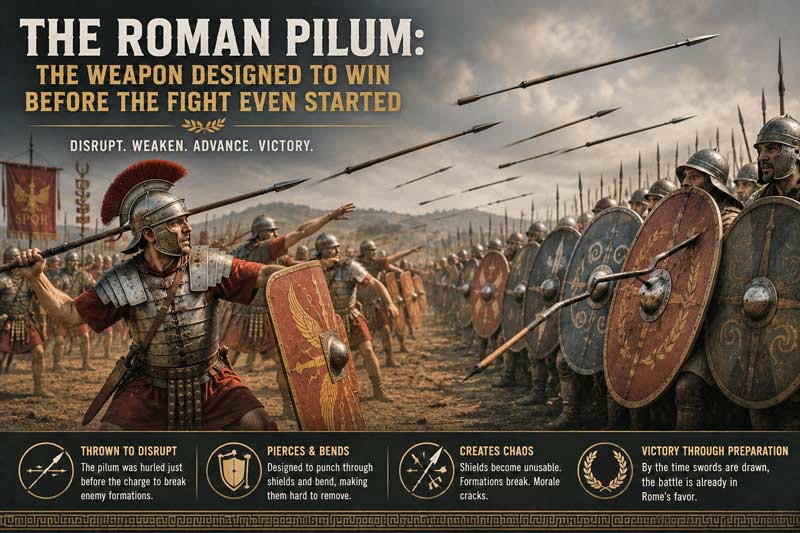
Most people picture Roman soldiers fighting with short swords, but that image leaves out one of the smartest battlefield weapons Rome ever created. Before swords came into play, Roman legionaries often relied on the pilum, a heavy throwing spear designed to make enemy soldiers miserable seconds before close combat even began.
Unlike a traditional spear built for repeated thrusting, the pilum was designed for disruption. Roman soldiers hurled them just before charging, aiming directly at enemy shield walls. The long metal shank could punch through shields, and in many cases, bend after impact. Suddenly, an enemy fighter was stuck carrying a heavy shield with a spear dangling awkwardly from it, or forced to throw the shield away entirely.
That small tactical advantage created chaos. Formations broke apart. Defenses weakened. Panic spread. By the time Roman soldiers closed distance with swords, opponents were often already disorganized and vulnerable. In many battles, the real damage had already started before the sword fighting even began.
This is one reason weapons comparisons become more complicated than "which one wins in a duel?" Battlefield effectiveness often came down to teamwork, timing, and strategy. A sword might look more impressive, but weapons like the pilum solved bigger military problems.
History is full of examples where preparation mattered more than flash. Even among collections of historical martial arts weapons, many of the most effective designs were created to control the fight before an opponent even had a chance to react.
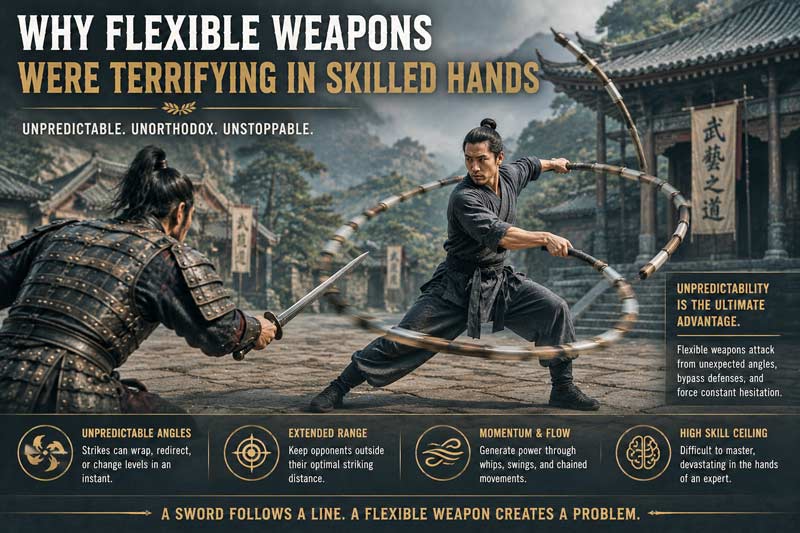
Some weapons beat swords through reach. Others won through armor-breaking power. Flexible weapons created problems in a completely different way: unpredictability. Against a skilled user, they could attack from strange angles, bypass defenses, and force opponents into constant hesitation.
Weapons like chain whips, rope darts, flails, and segmented staffs often looked chaotic to inexperienced fighters, but that unpredictability was part of the danger. A sword swings in fairly predictable lines. Flexible weapons could wrap, rebound, redirect, or strike around guards in ways that made conventional defenses far less reliable.
The three-section staff is one of the best examples. Combining aspects of both a staff and a flexible weapon, it could strike at long range, shift directions quickly, and generate enormous momentum. In the hands of a beginner, it could feel almost impossible to control. In the hands of an expert, it became something opponents struggled to predict.
Of course, these weapons came with tradeoffs. They were often harder to master than swords and carried a steeper learning curve. Timing mistakes could punish the user just as much as an opponent. That complexity is probably one reason many flexible weapons became associated with highly trained martial artists rather than ordinary soldiers.
We explored this idea more deeply in our guide to how the three-section staff actually works, because few historical weapons better demonstrate how range, momentum, and unpredictability can completely change a fight.
For people interested in unusual martial arts designs, training with a three-section staff offers a glimpse into one of history's most demanding weapon systems.
Not every weapon tried to overpower a sword through reach or brute force. Some were designed to make swords less useful altogether. Weapons like the sai and tonfa approached combat differently by emphasizing control, defense, and redirection rather than pure cutting power.
The sai is a perfect example of a weapon people often misunderstand. Thanks to movies and pop culture, many assume it was mainly a stabbing weapon. In reality, one of its biggest strengths came from trapping and controlling an opponent's blade. The side prongs could help catch weapons, redirect attacks, and create openings without needing a long blade of its own.
Tonfa worked differently but solved a similar problem. Their unique side handles allowed users to shift quickly between defensive blocking and close-range strikes. Against bladed weapons, they offered protection while remaining fast enough to counterattack almost immediately. In close quarters, that balance of defense and offense could become incredibly difficult to deal with.
These weapons also highlight an important truth about historical combat: "better" depended on the situation. A sword may dominate in open space, but in tight environments or defensive encounters, weapons designed around control and speed could become surprisingly effective.
Many traditional martial arts still preserve these systems today. Training with traditional sai weapons or practicing with martial arts tonfa offers a glimpse into combat philosophies built around timing, control, and precision rather than raw force alone.
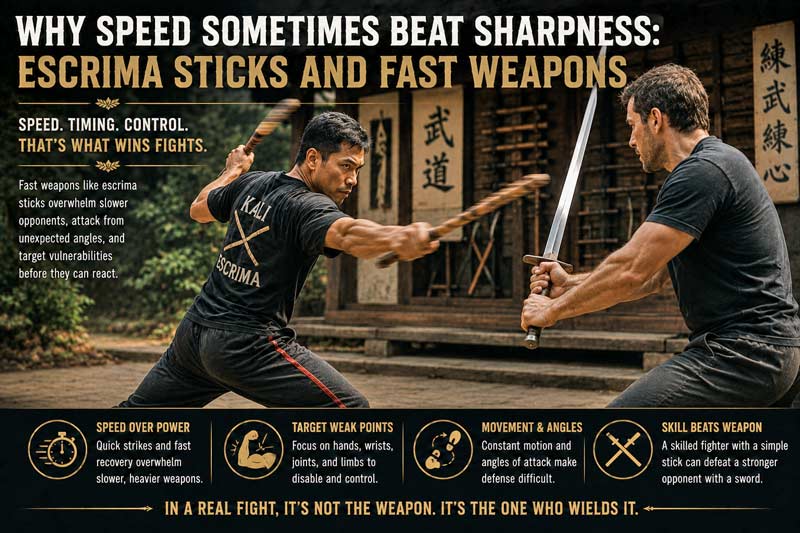
One of the biggest myths about combat is that sharper automatically means deadlier. In reality, speed, timing, and control often mattered just as much. That is one reason fast impact weapons like escrima sticks earned such a serious reputation in martial arts systems built around real-world fighting.
Unlike swords, sticks could move incredibly quickly, recover faster between strikes, and attack from angles that overwhelmed slower opponents. A skilled practitioner could target hands, wrists, joints, and limbs before an opponent had time to react. In practical terms, disabling someone's ability to hold a weapon could end a fight long before a decisive strike became necessary.
Filipino martial arts systems such as Kali and Escrima built entire combat philosophies around movement, timing, and adaptability. Practitioners often trained with sticks first because the mechanics translated naturally to knives, blades, and improvised weapons. Instead of relying on brute force, the emphasis stayed on precision and speed.
This also highlights an uncomfortable truth about swords: carrying a blade does not automatically guarantee an advantage. A slower fighter with a longer or sharper weapon can still struggle against someone faster, more mobile, and better at controlling angles and distance.
Training with escrima sticks and Filipino martial arts weapons offers a glimpse into combat systems where speed and reaction time often mattered more than intimidation or size alone.
Interestingly, many of these same principles show up in other underestimated martial arts weapons too. We touched on that in our guide to some of Asia's most famous historical weapons, where effectiveness often came from skill and adaptability rather than appearance.
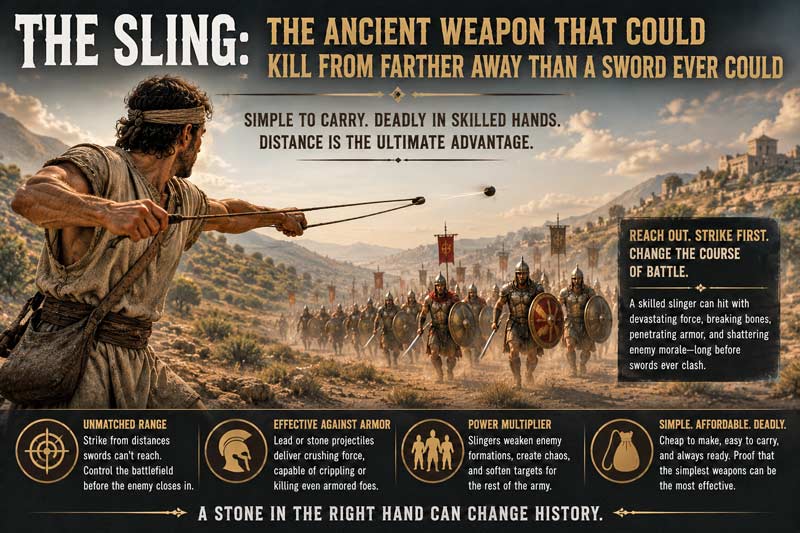
If this list proves anything, it is that effectiveness and popularity are not always the same thing. Few weapons show that better than the humble sling, a weapon many people dismiss because it looks too simple to be dangerous. History strongly disagrees.
Long before firearms existed, skilled sling users could hurl stones or lead projectiles at frightening speeds from distances swords could never hope to reach. Ancient armies trained slingers to disrupt formations, injure armored opponents, and weaken enemy morale before close combat even started. In some cases, sling bullets hit with enough force to fracture bones or penetrate vulnerable areas of armor.
The biggest advantage was obvious: distance. A sword becomes incredibly effective once someone gets close. The sling tried to make sure that never happened. Against a disciplined ranged unit, heavily armed soldiers often found themselves taking damage long before they had a chance to fight back.
The sling also reminds us of an important historical truth: expensive did not always mean better. A beautifully crafted sword could symbolize status, but a simple weapon made from cord and stone sometimes proved more useful on an actual battlefield. Effectiveness often came down to context, training, and tactics rather than appearance.
History is full of overlooked weapons that quietly changed combat while flashier weapons stole the spotlight. That same pattern appears throughout our breakdown of history's most famous combat weapons, where battlefield reality and pop culture rarely tell the same story.
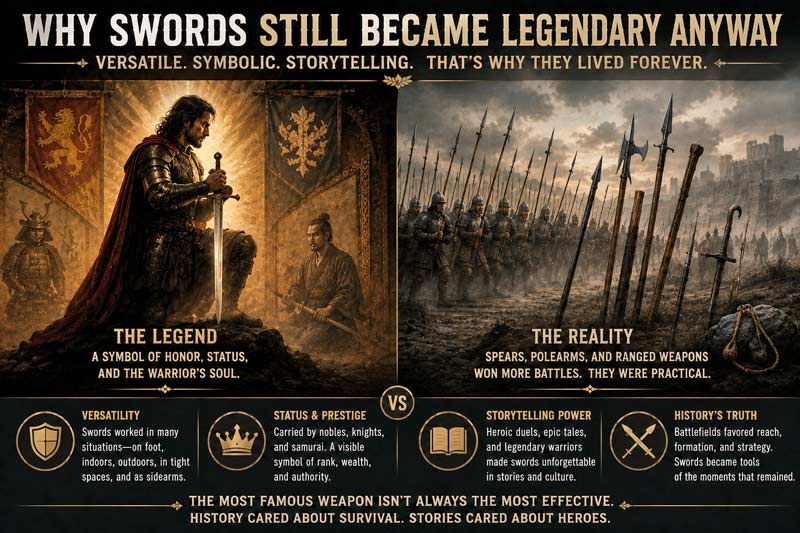
By now, it probably sounds like swords never deserved their reputation. That is not really the lesson history teaches. Swords absolutely earned their place. The interesting part is understanding why they became legendary even when many other weapons often performed better in real combat.
Part of the answer is versatility. Unlike spears, polearms, or ranged weapons that excelled in specific situations, swords adapted well to many environments. They worked indoors, outdoors, on foot, in close quarters, and as reliable sidearms once formations broke apart. When battles became messy and chaotic, versatility mattered.
There was also the status factor. Across many civilizations, swords became symbols of wealth, discipline, and military prestige. Knights carried them. Samurai elevated them into cultural icons. Nobles wore them publicly as signs of authority. A spear may have won battles, but a sword often represented the warrior class itself.
Storytelling pushed things even further. A hero standing alone with a sword feels dramatic. It is personal. A duel creates tension in ways formations and battlefield tactics rarely do. Over time, books, legends, films, and games helped turn swords into symbols of courage and mastery while quieter battlefield weapons faded into the background.
That disconnect between myth and reality shows up repeatedly throughout martial arts history. We explored some of those misconceptions in our breakdown of the biggest myths about samurai swords, where popular culture and historical practicality do not always align.
If there is one takeaway from this entire discussion, it is probably this: the most famous weapon is not always the most effective weapon. History cared about survival. Stories cared about heroes. Those are not always the same thing.
History has a funny way of simplifying things. Over time, we remember the dramatic duel, the legendary sword, and the heroic warrior standing alone against impossible odds. What we forget is that real combat rarely cared about symbolism. Survival usually belonged to whatever weapon solved the problem most effectively.
Sometimes that meant reach. Spears and polearms controlled distance and punished opponents before they could get close. Sometimes it meant speed, as seen with escrima systems and fast impact weapons. Other times it meant disruption, defense, unpredictability, or simply attacking from farther away than a sword ever could.
That does not make swords overrated. If anything, their reputation survived because they were adaptable enough to stay useful almost everywhere. But battlefield dominance and cultural fame are not always the same thing. The weapons that shaped history most often were practical, efficient, and sometimes surprisingly unglamorous.
The bigger lesson may be this: humans have always been obsessed with finding better ways to control distance, gain leverage, and survive dangerous situations. Whether it was a spear wall, a sling stone, a three-section staff, or a pair of sai, the most effective weapons were usually designed around solving specific problems rather than looking impressive.
That is also what makes martial arts history so fascinating. Once you stop viewing swords as the automatic answer to every fight, you start noticing how creative civilizations became in designing tools for completely different situations. History gets a lot more interesting once the "best weapon" debate becomes more complicated.
And maybe that is the real takeaway here: the most legendary weapon is not always the one people feared most.
In many cases, yes. If both fighters had similar skill levels and enough room to move, a spear often held a major advantage over a sword for one simple reason: reach. The spear user could attack first while forcing the swordsman to survive the dangerous process of closing distance.
That does not mean swords automatically lost. Tight spaces, broken formations, obstacles, or an opponent successfully getting past the spear point could completely change the fight. Once combat moved into close quarters, swords often became much more effective.
This is one reason so many warriors historically carried both. A spear or polearm controlled the battlefield at range, while a sword worked as a reliable backup once things became chaotic. Real combat rarely depended on a single "best" weapon.
If historical accounts are any indication, many soldiers feared formations and reach-based weapons far more than swords. A sword fight might feel dramatic, but standing in front of a wall of spears, pikes, or polearms was often far more terrifying in real combat.
Why? Because those weapons made it incredibly difficult to even reach the enemy. Cavalry charges could collapse against disciplined spear formations. Infantry advancing toward polearms had to survive multiple attack angles before getting close enough to fight back. In many battles, fear came from helplessness as much as danger.
Ranged weapons also earned serious respect. Skilled archers and slingers could injure or kill from distances where swords were completely useless. By the time close combat started, entire formations could already be weakened, exhausted, or demoralized.
The interesting thing is that history repeatedly rewarded whatever weapon controlled distance best. Sometimes that meant a spear. Sometimes a bow. Sometimes a polearm. The weapon soldiers feared most was usually the one that prevented them from fighting on equal terms.
That depends on the time period and what problem the weapon needed to solve. If we are talking about battlefield effectiveness across all of history, firearms probably deserve the top spot. Once guns became reliable, they dramatically changed warfare by allowing soldiers to injure or kill from greater distances with less training than many traditional weapons required. Entire military systems built around swords, cavalry, and armor eventually became obsolete because of firearms.
Before firearms dominated battlefields, however, spears and polearms have a very strong argument for being history's most effective weapons. They controlled distance, stopped cavalry, worked in formations, and remained relevant across thousands of years and countless civilizations. Few weapons matched their combination of reach, practicality, and battlefield influence.
If armor penetration mattered most, weapons like war hammers, maces, and poleaxes became incredibly effective against heavily protected opponents. Against plate armor, blunt force often mattered more than cutting power.
Swords still deserve credit for versatility. They adapted to many environments and remained useful long after primary weapons became impractical. But history repeatedly shows that the most famous weapon was not always the one armies relied on most.
The real answer is that effectiveness depended on context. A spear on an open battlefield, a sling at range, a firearm in organized warfare, or a sword in close quarters could each become the "best" weapon depending on the situation.
For much of human warfare, swords were often backup weapons rather than battlefield superstars. The weapons that actually dominated combat were frequently longer, cheaper, faster, harder to defend against, or simply more practical in real fighting. Spears stopped cavalry. Polearms shattered armor. Staves controlled distance. Even simple blunt weapons sometimes proved deadlier than beautifully crafted blades.
That does not mean swords were ineffective. Far from it. A good sword was versatile, reliable, and devastating in the right hands. But if survival was the only thing that mattered, many warriors throughout history would have chosen something else entirely.
In this guide, we are looking at the weapons that often outperformed swords in real combat, why they worked so well, and how history somehow convinced us that swords were always the ultimate weapon anyway.
Why Swords Became Famous Even When They Were Not Always the Best Weapon
Before we start ranking weapons against swords, it is worth asking an uncomfortable question: if swords were not always the most effective battlefield weapon, why did they become so legendary?
Part of the answer comes down to status. In many cultures, swords were expensive to produce and often carried by nobles, officers, or elite warriors. A spear could be handed to thousands of soldiers. A sword, by contrast, often became a symbol of rank, wealth, and prestige. Over time, people started associating swords with heroes rather than practicality.
Storytelling also played a huge role. A duel between two sword fighters is dramatic. It feels personal. Spears, polearms, and formations may have won wars, but they do not always create the same kind of cinematic moment. That is one reason movies and games often exaggerate sword combat while downplaying weapons that were arguably more effective in real life.
Even historically, swords were frequently secondary weapons. Many warriors carried them only after their primary weapon failed, broke, or became impractical in close quarters. Knights carried swords alongside lances and polearms. Roman soldiers relied on spears before drawing blades. Samurai often fought with polearms or bows long before reaching for swords.
That does not mean swords were overrated. A good sword was versatile, portable, and deadly. But history tends to remember symbols more than practicality, and swords became one of the most powerful symbols warfare ever produced.
If you look through collections of traditional swords and bladed weapons, it is easy to see why people became fascinated with them. Few weapons carry the same mix of craftsmanship, mythology, and visual appeal, even if battlefield history was often more complicated.
Why Spears Often Beat Swords in Real Combat
If there is one weapon that repeatedly outperformed swords throughout history, it was the spear. That may sound surprising considering how legendary swords became, but on actual battlefields, reach mattered more than style. And few weapons gave fighters a bigger advantage than putting a sharp point several feet farther away from danger.
A spear fighter usually got the first opportunity to strike. Before a swordsman could even get close enough to attack, they first had to survive the dangerous process of getting past the spear tip. In practical terms, that often meant facing multiple thrusts while trying to close distance against someone who could hit you first.
This advantage is one reason so many civilizations independently arrived at nearly the same conclusion. Greeks built phalanxes around spears. Vikings carried them more often than swords. Samurai armies relied heavily on yari. Medieval infantry used long pole weapons to stop cavalry and control space. Entire military systems repeatedly prioritized reach over prestige.
Even modern martial arts experiments and historical combat demonstrations often show how difficult it can be for shorter weapons to consistently overcome longer ones when skill levels are comparable. That does not mean swords were useless, but they frequently worked best as secondary weapons once the spear had broken, been dropped, or combat moved into tighter spaces.
We recently explored this idea in more depth in our guide to the different types of spears used throughout history, where one thing became clear very quickly: civilizations kept reinventing spears because they worked astonishingly well.
The Staff: The Weapon Almost Nobody Wants to Fight
If swords had a quiet rival throughout history, it might be the humble staff. Simple, inexpensive, and found in cultures all over the world, the staff earned a reputation for something many flashy weapons struggled to deliver consistently: control.
A good staff fighter could strike from multiple angles, control distance, sweep legs, jab, block, and generate enormous power through leverage and momentum. Unlike swords, staffs also carried far less risk of becoming damaged in combat, and because of their reach, opponents often struggled to get close enough to attack effectively.
That reach advantage mattered more than many people realize. A trained fighter with a long staff could pressure an opponent constantly, forcing them to react instead of attack. Even heavily armed opponents sometimes found themselves struggling against someone wielding what looked like "just a stick." History repeatedly reminds us that simple does not mean ineffective.
Many martial arts systems turned staff fighting into highly refined disciplines. Japanese bojutsu, Chinese gun techniques, and Filipino long-weapon systems all recognized the same reality: controlling range often matters more than carrying the sharpest weapon. In some traditions, staff training even became the foundation for learning other weapons because it teaches timing, body mechanics, and positioning so effectively.
Modern martial artists still explore long-range fighting through collections of bo staffs and traditional staff weapons, many of which preserve training methods rooted in centuries of martial history.
Interestingly, staff weapons also evolved into stranger and more specialized designs over time. Flexible and segmented weapons like the three-section staff pushed range and unpredictability even further, though they required dramatically more skill to control.
Polearms: The Weapons That Made Knights Nervous
If swords had one category of weapon that consistently caused problems on battlefields, it was polearms. Long, brutal, and purpose-built for war, polearms combined the reach of a spear with heavier striking power, making them some of the most feared anti-armor weapons in history.
Weapons like halberds, glaives, bills, and poleaxes were designed to solve a very specific battlefield problem: heavily armored opponents. Swords could struggle against plate armor, especially when facing mounted knights or disciplined infantry. Polearms, however, attacked from farther away and often included axe heads, hooks, spikes, or hammer-like striking surfaces capable of pulling riders from horses, piercing weak points, or delivering crushing force.
In many medieval battles, infantry carrying polearms became one of the biggest threats to mounted warriors. A charging knight looked terrifying, but long weapons gave soldiers ways to stop cavalry before impact or drag armored fighters into vulnerable positions. Reach mattered, but versatility mattered too.
This is also where swords began losing one of their biggest advantages. A sword is adaptable, but many polearms were specialized for battlefield dominance. Against armor, range, and formations, the fighter holding a longer weapon often dictated the terms of the engagement.
Ironically, some of the deadliest battlefield weapons in history looked awkward compared to elegant swords. But history has a funny habit of rewarding effectiveness over aesthetics.
For people fascinated by unusual historical designs, collections of rare and exotic weapons offer a glimpse into how strange, creative, and specialized combat tools became across different cultures.
The Roman Pilum: The Weapon Designed to Win Before the Fight Even Started
Most people picture Roman soldiers fighting with short swords, but that image leaves out one of the smartest battlefield weapons Rome ever created. Before swords came into play, Roman legionaries often relied on the pilum, a heavy throwing spear designed to make enemy soldiers miserable seconds before close combat even began.
Unlike a traditional spear built for repeated thrusting, the pilum was designed for disruption. Roman soldiers hurled them just before charging, aiming directly at enemy shield walls. The long metal shank could punch through shields, and in many cases, bend after impact. Suddenly, an enemy fighter was stuck carrying a heavy shield with a spear dangling awkwardly from it, or forced to throw the shield away entirely.
That small tactical advantage created chaos. Formations broke apart. Defenses weakened. Panic spread. By the time Roman soldiers closed distance with swords, opponents were often already disorganized and vulnerable. In many battles, the real damage had already started before the sword fighting even began.
This is one reason weapons comparisons become more complicated than "which one wins in a duel?" Battlefield effectiveness often came down to teamwork, timing, and strategy. A sword might look more impressive, but weapons like the pilum solved bigger military problems.
History is full of examples where preparation mattered more than flash. Even among collections of historical martial arts weapons, many of the most effective designs were created to control the fight before an opponent even had a chance to react.
Why Flexible Weapons Were Terrifying in Skilled Hands
Some weapons beat swords through reach. Others won through armor-breaking power. Flexible weapons created problems in a completely different way: unpredictability. Against a skilled user, they could attack from strange angles, bypass defenses, and force opponents into constant hesitation.
Weapons like chain whips, rope darts, flails, and segmented staffs often looked chaotic to inexperienced fighters, but that unpredictability was part of the danger. A sword swings in fairly predictable lines. Flexible weapons could wrap, rebound, redirect, or strike around guards in ways that made conventional defenses far less reliable.
The three-section staff is one of the best examples. Combining aspects of both a staff and a flexible weapon, it could strike at long range, shift directions quickly, and generate enormous momentum. In the hands of a beginner, it could feel almost impossible to control. In the hands of an expert, it became something opponents struggled to predict.
Of course, these weapons came with tradeoffs. They were often harder to master than swords and carried a steeper learning curve. Timing mistakes could punish the user just as much as an opponent. That complexity is probably one reason many flexible weapons became associated with highly trained martial artists rather than ordinary soldiers.
We explored this idea more deeply in our guide to how the three-section staff actually works, because few historical weapons better demonstrate how range, momentum, and unpredictability can completely change a fight.
For people interested in unusual martial arts designs, training with a three-section staff offers a glimpse into one of history's most demanding weapon systems.
Sai and Tonfa: The Weapons Built to Control, Trap, and Disarm
Not every weapon tried to overpower a sword through reach or brute force. Some were designed to make swords less useful altogether. Weapons like the sai and tonfa approached combat differently by emphasizing control, defense, and redirection rather than pure cutting power.
The sai is a perfect example of a weapon people often misunderstand. Thanks to movies and pop culture, many assume it was mainly a stabbing weapon. In reality, one of its biggest strengths came from trapping and controlling an opponent's blade. The side prongs could help catch weapons, redirect attacks, and create openings without needing a long blade of its own.
Tonfa worked differently but solved a similar problem. Their unique side handles allowed users to shift quickly between defensive blocking and close-range strikes. Against bladed weapons, they offered protection while remaining fast enough to counterattack almost immediately. In close quarters, that balance of defense and offense could become incredibly difficult to deal with.
These weapons also highlight an important truth about historical combat: "better" depended on the situation. A sword may dominate in open space, but in tight environments or defensive encounters, weapons designed around control and speed could become surprisingly effective.
Many traditional martial arts still preserve these systems today. Training with traditional sai weapons or practicing with martial arts tonfa offers a glimpse into combat philosophies built around timing, control, and precision rather than raw force alone.
Why Speed Sometimes Beat Sharpness: Escrima Sticks and Fast Weapons
One of the biggest myths about combat is that sharper automatically means deadlier. In reality, speed, timing, and control often mattered just as much. That is one reason fast impact weapons like escrima sticks earned such a serious reputation in martial arts systems built around real-world fighting.
Unlike swords, sticks could move incredibly quickly, recover faster between strikes, and attack from angles that overwhelmed slower opponents. A skilled practitioner could target hands, wrists, joints, and limbs before an opponent had time to react. In practical terms, disabling someone's ability to hold a weapon could end a fight long before a decisive strike became necessary.
Filipino martial arts systems such as Kali and Escrima built entire combat philosophies around movement, timing, and adaptability. Practitioners often trained with sticks first because the mechanics translated naturally to knives, blades, and improvised weapons. Instead of relying on brute force, the emphasis stayed on precision and speed.
This also highlights an uncomfortable truth about swords: carrying a blade does not automatically guarantee an advantage. A slower fighter with a longer or sharper weapon can still struggle against someone faster, more mobile, and better at controlling angles and distance.
Training with escrima sticks and Filipino martial arts weapons offers a glimpse into combat systems where speed and reaction time often mattered more than intimidation or size alone.
Interestingly, many of these same principles show up in other underestimated martial arts weapons too. We touched on that in our guide to some of Asia's most famous historical weapons, where effectiveness often came from skill and adaptability rather than appearance.
The Sling: The Ancient Weapon That Could Kill From Farther Away Than a Sword Ever Could
If this list proves anything, it is that effectiveness and popularity are not always the same thing. Few weapons show that better than the humble sling, a weapon many people dismiss because it looks too simple to be dangerous. History strongly disagrees.
Long before firearms existed, skilled sling users could hurl stones or lead projectiles at frightening speeds from distances swords could never hope to reach. Ancient armies trained slingers to disrupt formations, injure armored opponents, and weaken enemy morale before close combat even started. In some cases, sling bullets hit with enough force to fracture bones or penetrate vulnerable areas of armor.
The biggest advantage was obvious: distance. A sword becomes incredibly effective once someone gets close. The sling tried to make sure that never happened. Against a disciplined ranged unit, heavily armed soldiers often found themselves taking damage long before they had a chance to fight back.
The sling also reminds us of an important historical truth: expensive did not always mean better. A beautifully crafted sword could symbolize status, but a simple weapon made from cord and stone sometimes proved more useful on an actual battlefield. Effectiveness often came down to context, training, and tactics rather than appearance.
History is full of overlooked weapons that quietly changed combat while flashier weapons stole the spotlight. That same pattern appears throughout our breakdown of history's most famous combat weapons, where battlefield reality and pop culture rarely tell the same story.
Why Swords Still Became Legendary Anyway
By now, it probably sounds like swords never deserved their reputation. That is not really the lesson history teaches. Swords absolutely earned their place. The interesting part is understanding why they became legendary even when many other weapons often performed better in real combat.
Part of the answer is versatility. Unlike spears, polearms, or ranged weapons that excelled in specific situations, swords adapted well to many environments. They worked indoors, outdoors, on foot, in close quarters, and as reliable sidearms once formations broke apart. When battles became messy and chaotic, versatility mattered.
There was also the status factor. Across many civilizations, swords became symbols of wealth, discipline, and military prestige. Knights carried them. Samurai elevated them into cultural icons. Nobles wore them publicly as signs of authority. A spear may have won battles, but a sword often represented the warrior class itself.
Storytelling pushed things even further. A hero standing alone with a sword feels dramatic. It is personal. A duel creates tension in ways formations and battlefield tactics rarely do. Over time, books, legends, films, and games helped turn swords into symbols of courage and mastery while quieter battlefield weapons faded into the background.
That disconnect between myth and reality shows up repeatedly throughout martial arts history. We explored some of those misconceptions in our breakdown of the biggest myths about samurai swords, where popular culture and historical practicality do not always align.
If there is one takeaway from this entire discussion, it is probably this: the most famous weapon is not always the most effective weapon. History cared about survival. Stories cared about heroes. Those are not always the same thing.
The Best Weapon Was Usually the One That Solved the Right Problem
History has a funny way of simplifying things. Over time, we remember the dramatic duel, the legendary sword, and the heroic warrior standing alone against impossible odds. What we forget is that real combat rarely cared about symbolism. Survival usually belonged to whatever weapon solved the problem most effectively.
Sometimes that meant reach. Spears and polearms controlled distance and punished opponents before they could get close. Sometimes it meant speed, as seen with escrima systems and fast impact weapons. Other times it meant disruption, defense, unpredictability, or simply attacking from farther away than a sword ever could.
That does not make swords overrated. If anything, their reputation survived because they were adaptable enough to stay useful almost everywhere. But battlefield dominance and cultural fame are not always the same thing. The weapons that shaped history most often were practical, efficient, and sometimes surprisingly unglamorous.
The bigger lesson may be this: humans have always been obsessed with finding better ways to control distance, gain leverage, and survive dangerous situations. Whether it was a spear wall, a sling stone, a three-section staff, or a pair of sai, the most effective weapons were usually designed around solving specific problems rather than looking impressive.
That is also what makes martial arts history so fascinating. Once you stop viewing swords as the automatic answer to every fight, you start noticing how creative civilizations became in designing tools for completely different situations. History gets a lot more interesting once the "best weapon" debate becomes more complicated.
And maybe that is the real takeaway here: the most legendary weapon is not always the one people feared most.
Could a Spear Really Beat a Sword in a Fair Fight?
In many cases, yes. If both fighters had similar skill levels and enough room to move, a spear often held a major advantage over a sword for one simple reason: reach. The spear user could attack first while forcing the swordsman to survive the dangerous process of closing distance.
That does not mean swords automatically lost. Tight spaces, broken formations, obstacles, or an opponent successfully getting past the spear point could completely change the fight. Once combat moved into close quarters, swords often became much more effective.
This is one reason so many warriors historically carried both. A spear or polearm controlled the battlefield at range, while a sword worked as a reliable backup once things became chaotic. Real combat rarely depended on a single "best" weapon.
What Weapon Did Soldiers Fear More Than Swords?
If historical accounts are any indication, many soldiers feared formations and reach-based weapons far more than swords. A sword fight might feel dramatic, but standing in front of a wall of spears, pikes, or polearms was often far more terrifying in real combat.
Why? Because those weapons made it incredibly difficult to even reach the enemy. Cavalry charges could collapse against disciplined spear formations. Infantry advancing toward polearms had to survive multiple attack angles before getting close enough to fight back. In many battles, fear came from helplessness as much as danger.
Ranged weapons also earned serious respect. Skilled archers and slingers could injure or kill from distances where swords were completely useless. By the time close combat started, entire formations could already be weakened, exhausted, or demoralized.
The interesting thing is that history repeatedly rewarded whatever weapon controlled distance best. Sometimes that meant a spear. Sometimes a bow. Sometimes a polearm. The weapon soldiers feared most was usually the one that prevented them from fighting on equal terms.
What Was the Most Effective Weapon in History?
That depends on the time period and what problem the weapon needed to solve. If we are talking about battlefield effectiveness across all of history, firearms probably deserve the top spot. Once guns became reliable, they dramatically changed warfare by allowing soldiers to injure or kill from greater distances with less training than many traditional weapons required. Entire military systems built around swords, cavalry, and armor eventually became obsolete because of firearms.
Before firearms dominated battlefields, however, spears and polearms have a very strong argument for being history's most effective weapons. They controlled distance, stopped cavalry, worked in formations, and remained relevant across thousands of years and countless civilizations. Few weapons matched their combination of reach, practicality, and battlefield influence.
If armor penetration mattered most, weapons like war hammers, maces, and poleaxes became incredibly effective against heavily protected opponents. Against plate armor, blunt force often mattered more than cutting power.
Swords still deserve credit for versatility. They adapted to many environments and remained useful long after primary weapons became impractical. But history repeatedly shows that the most famous weapon was not always the one armies relied on most.
The real answer is that effectiveness depended on context. A spear on an open battlefield, a sling at range, a firearm in organized warfare, or a sword in close quarters could each become the "best" weapon depending on the situation.
You May Also Be Interested In:
- Are Stun Guns Effective? We Tested Some Out!
- Why Were Bolas So Effective at Bringing Down Moving Targets?
- Foam Practice Swords vs Wooden Swords: Which Is Better?
- Chinese Hook Swords and Other Deadly Weapons!
- New Weapons for 2023: Knives, Swords and Knuckles!
- New Weapons This Week! Swords, Blades & Batons!
- New Weapons This Week! Stun Guns, Swords & Knives!
- The Most Intimidating Weapons in History (And Whether They Deserved Their Reputation)
- The Most Dangerous Chain Weapons in Martial Arts History
- Why Are Some Chinese Swords So Flexible?
Leave a Reply