



The Different Types of Spears Used in History (And What Made Each One Deadly)
June 15th, 2026
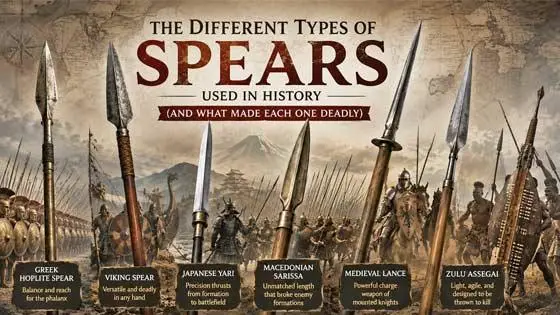
For thousands of years, no weapon shaped warfare more consistently than the spear. Long before firearms, tanks, or even reliable steel swords, civilizations across the world kept arriving at the same conclusion: putting a sharp point on the end of a long stick was brutally effective.
But not all spears were built the same. Some were designed to punch through armor. Others excelled at horseback combat. Some could be thrown from incredible distances, while others were so long they turned entire armies into moving walls of spikes. From the elegant Japanese yari to the terrifying Macedonian sarissa, different cultures evolved dramatically different spear designs to solve very different battlefield problems.
What makes spears especially fascinating is how universal they became. Nearly every civilization developed its own version, often independently, because the basic concept worked so well. Spears were cheaper to make than swords, easier to train with, and surprisingly versatile in combat. In many cases, they were the weapon that actually won wars while swords got most of the glory in stories and movies.
In this guide, we're exploring the different types of spears used throughout history, what made each one unique, and why certain designs proved so deadly that they changed warfare itself.
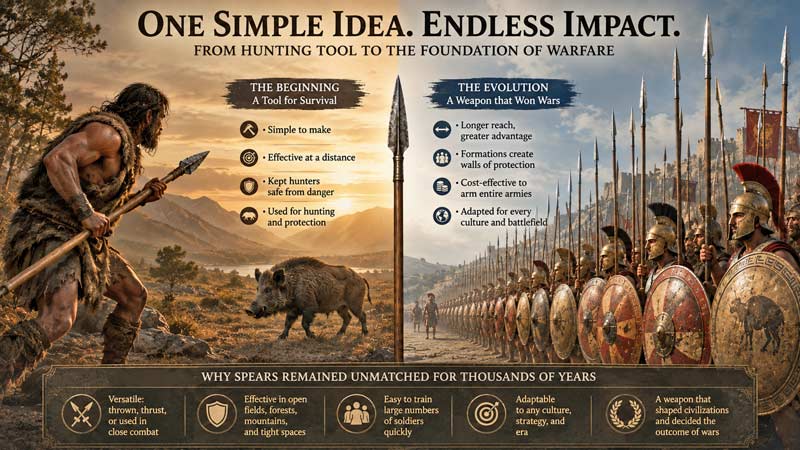
The spear may not look complicated, but that simplicity is exactly why it became one of the most successful weapons in human history. A spear gave the person holding it something every fighter wanted: distance. Before armor, training, or brute strength mattered, reach could decide who survived the first few seconds of a fight.
That advantage made spears useful almost everywhere. Hunters used them to keep dangerous animals away from their bodies. Guards used them to control narrow entrances. Soldiers used them in tight formations where one person's weapon protected the man beside him. Even in cultures famous for swords, axes, or bows, the spear was often the practical battlefield workhorse.
Spears were also easier to produce than many other weapons. A good sword required skilled metalwork, careful balance, and a lot of material. A spear could be made with a smaller metal head attached to a long wooden shaft, making it more affordable for armies that needed to equip thousands of fighters. That is one reason spears show up again and again across ancient, medieval, and tribal warfare.
What changed from culture to culture was not the basic idea, but the problem each spear was designed to solve. Some were built for throwing. Some were built for stopping cavalry. Some were built for fighting in dense formations. Others were made short, fast, and brutal for close-range encounters. Once you understand that, the different types of spears start to look less like random variations and more like specialized tools shaped by battlefield pressure.
For readers interested in the broader world of martial arts and historical weapon designs, KarateMart's weapons collection shows how many traditional weapon concepts still survive today in training, display, and martial arts culture.
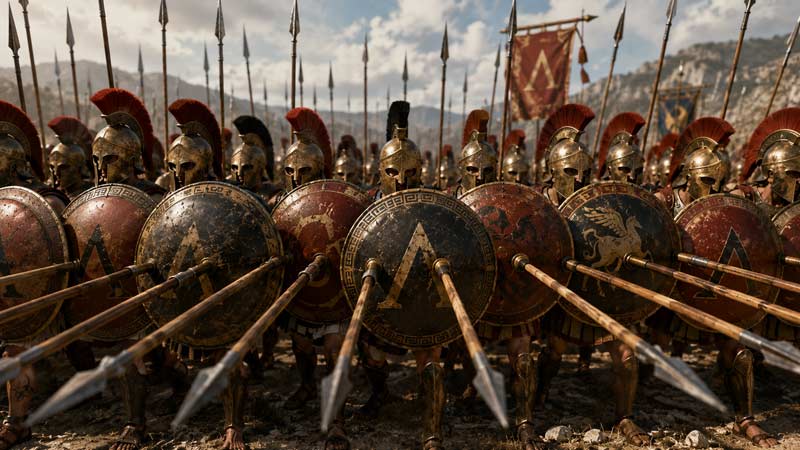
When people think about ancient warfare, they often imagine swords clashing in dramatic one-on-one duels. In reality, much of the ancient world was controlled by disciplined groups of soldiers carrying spears. One of the most influential examples was the Greek dory, the primary weapon of the hoplite soldier.
The dory was not especially flashy. It typically measured between seven and nine feet long and featured a leaf-shaped spearhead designed for thrusting. What made it dangerous was how it was used. Greek hoplites fought shoulder to shoulder in tightly packed formations called phalanxes, creating rows of overlapping shields and spear points that were incredibly difficult to break through.
This formation turned individual fighters into something much more intimidating: a moving wall of sharp points. Enemies often had to survive multiple spear thrusts before they could even reach the front line. In many battles, organization mattered more than individual fighting skill, and the dory helped make Greek armies some of the most feared military forces of their time.
The influence of Greek spear combat spread far beyond Greece itself. Variations of long battlefield spears would later shape military tactics across Europe, Asia, and the Middle East. In many ways, the spear established the blueprint for organized warfare long before swords became symbols of status and heroism.
Many traditional martial systems still preserve the idea of long-range weapon control. Some modern practitioners interested in historical or long-reach weapon styles explore related training tools through collections of kung fu weapons, where staff-based training still plays an important role.
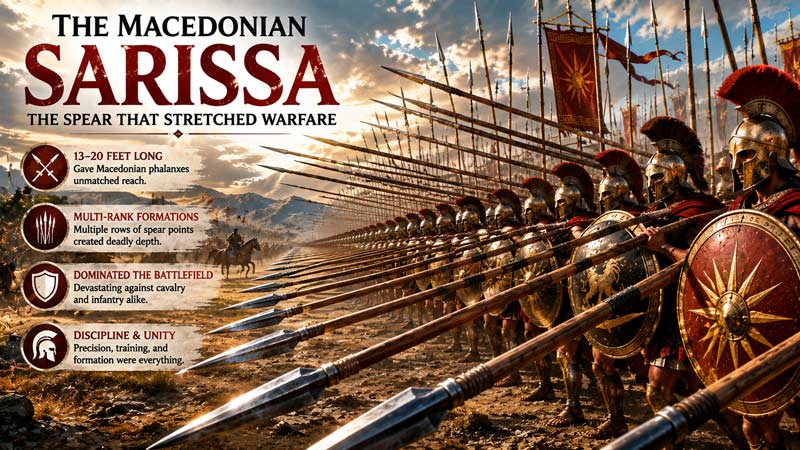
If the Greek dory helped define organized spear combat, the Macedonian sarissa took the idea to an entirely different level. Used by the armies of Alexander the Great, the sarissa was not just long. It was enormous. Some versions stretched between 13 and 20 feet, making it one of the most intimidating battlefield weapons of the ancient world.
Unlike shorter spears designed for flexibility, the sarissa existed for one purpose: domination through reach. Macedonian soldiers stood in massive formations called phalanxes, often several ranks deep, with multiple rows of spear points extending far beyond the front line. Enemies were sometimes forced to deal with five layers of spear tips before they could even reach a soldier.
The psychological effect alone was brutal. Imagine charging toward what looked like a moving forest of sharpened poles, all aimed directly at you. Cavalry struggled against it. Infantry struggled against it. Entire armies found themselves overwhelmed before they could get close enough to fight effectively.
The tradeoff, however, was mobility. Sarissa formations worked best on open terrain and required extraordinary discipline to maintain. If formations broke apart or enemies attacked from the sides, these giant spears became much harder to manage. Even so, the weapon helped Alexander build one of the largest empires the ancient world had ever seen.
The sarissa also shows something important about spear evolution: sometimes bigger really was better. While many civilizations focused on versatility, Macedonian military strategy doubled down on overwhelming range and battlefield control.
For martial artists fascinated by unusual or historically inspired weapon designs, collections of exotic weapons can offer a glimpse into how dramatically weapon styles evolved across cultures and eras.
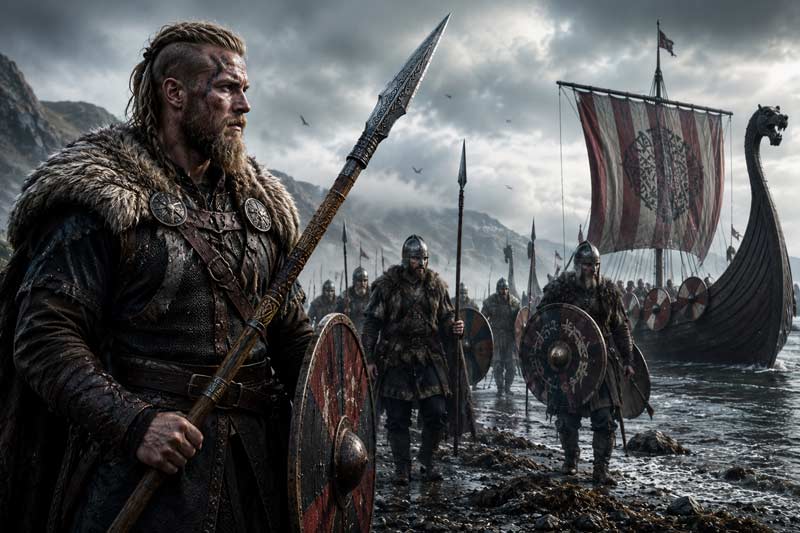
Ask someone to picture a Viking weapon and they will probably imagine a massive axe or a legendary sword. In reality, the spear was often the weapon Vikings trusted most. It was cheaper than a sword, easier to carry, and deadly in both close combat and at a distance.
Viking spears came in many forms, ranging from simple battlefield tools to highly decorated weapons carried by elite warriors. Some featured broad cutting blades designed to slash, while others had narrow points made for deep thrusting. Many could also be thrown, giving fighters a dangerous ranged option before hand-to-hand combat even began.
Part of what made the Viking spear so effective was its versatility. A warrior could stab from behind a shield, strike at enemies on foot, defend against cavalry, or hurl the weapon when the timing felt right. Unlike giant battlefield spears such as the sarissa, Viking spears balanced reach with mobility, making them practical for raids, ship combat, and chaotic skirmishes.
The spear also held symbolic value in Norse culture. According to mythology, the god Odin carried a legendary spear called Gungnir, said to never miss its target. That cultural importance helped make spears feel like more than just battlefield tools. They became symbols of status, skill, and warrior identity.
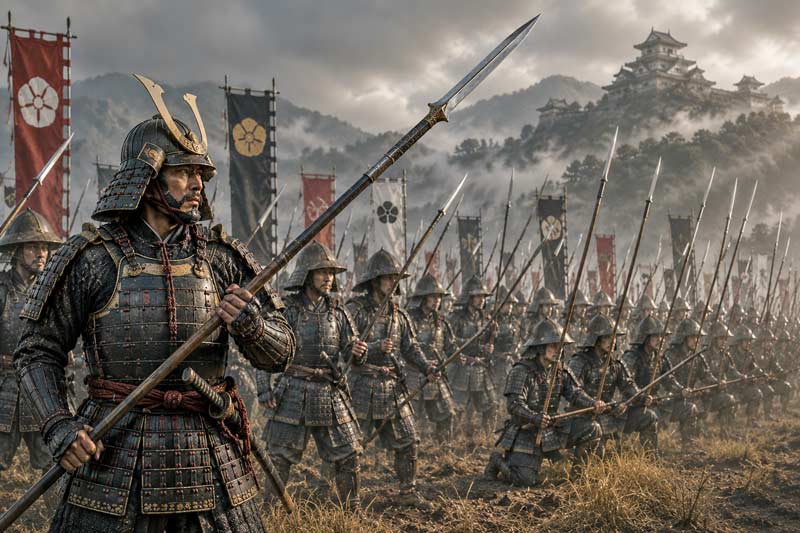
When most people think of samurai weapons, they picture the katana. Yet for long stretches of Japanese history, one of the most important battlefield weapons was not the sword at all. It was the yari, a spear that transformed how samurai armies fought and helped shape warfare in feudal Japan.
Unlike many European spears, the yari often featured a straight, symmetrical blade designed for precise thrusting. Some yari were relatively simple, while others developed elaborate side blades or specialized shapes for hooking, cutting, or disarming opponents. Lengths varied dramatically depending on battlefield role, ranging from shorter personal fighting weapons to extremely long versions used in mass formations.
As warfare in Japan evolved, samurai armies increasingly relied on disciplined groups of spear fighters called ashigaru. During major battles, long yari formations could overwhelm charging enemies and disrupt cavalry attacks in ways that looked surprisingly similar to ancient Greek and Macedonian spear tactics. In some eras, spears became even more important than swords on the battlefield.
The katana may have earned the fame, but the yari often did the real military work. That pattern appears repeatedly throughout history. The weapon celebrated in stories is not always the one soldiers relied on most when survival mattered.
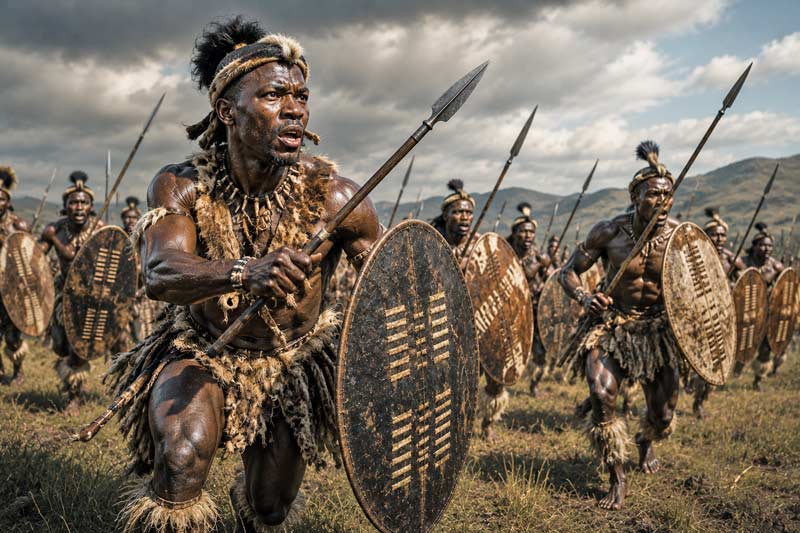
Not every civilization believed bigger was better when it came to spears. In southern Africa, the Zulu kingdom developed a weapon that moved in the exact opposite direction. Instead of relying on long reach, the Zulu assegai evolved into a shorter, faster spear designed for brutal close-range fighting.
Originally, many African spears were lightweight throwing weapons meant to wound enemies from a distance. But in the early 1800s, the Zulu king Shaka revolutionized warfare by redesigning the spear into something far more aggressive. His version featured a shorter shaft and a broader blade built for stabbing rather than throwing. Warriors closed distance quickly and fought hand-to-hand with terrifying speed.
This shift completely changed Zulu battlefield tactics. Rather than standing back and exchanging thrown weapons, warriors used disciplined formations to surround enemies and force close combat. One famous strategy became known as the "horns of the buffalo," where flanking groups swept around opponents while central fighters locked them into direct engagement.
The assegai proves an important point about spear evolution: effectiveness depended on context. While Macedonians dominated through overwhelming reach, the Zulu military prioritized mobility, aggression, and speed. Two spear cultures arrived at completely different solutions, and both changed history.
The story of the assegai is also a reminder that military innovation is not always about building bigger weapons. Sometimes the most effective change comes from making a weapon faster, simpler, and better suited to the realities of how people actually fight.
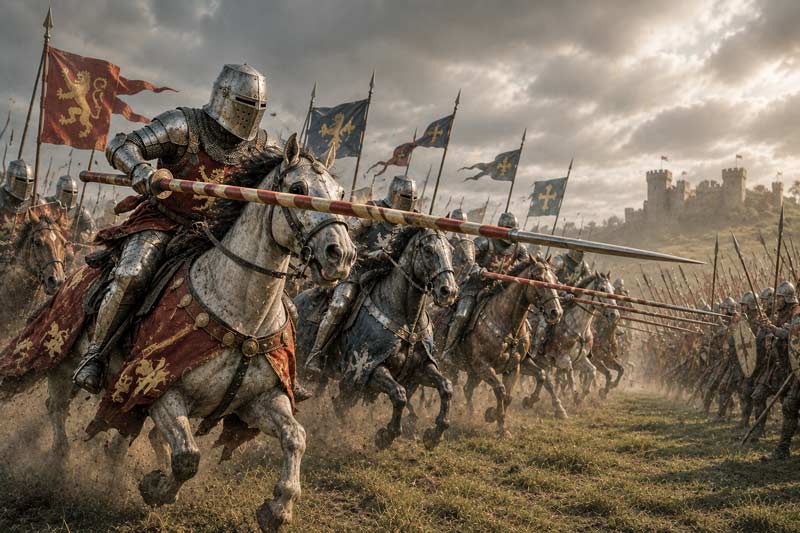
Some spears were designed for infantry formations. Others were built to strike with overwhelming force from horseback. That is where the medieval lance enters the story. While technically a type of spear, the lance evolved into a specialized battlefield weapon made for mounted warriors who could turn speed and momentum into devastating power.
Unlike shorter combat spears, lances were typically longer and heavier, allowing mounted knights to attack enemies from farther away while staying protected by armor and shields. During a cavalry charge, the rider often tucked the lance under the arm and aimed straight ahead, transforming horse and rider into what was essentially a moving missile.
The effect could be terrifying. A disciplined cavalry charge with lowered lances had enormous psychological power before impact even happened. Rows of mounted soldiers thundered across open ground toward infantry lines, forcing enemies to either stand firm or panic. Battles were often decided by who broke formation first.
Of course, the lance had limitations. Dense spear formations, rough terrain, and disciplined infantry could neutralize cavalry advantages. Weapons like the Macedonian sarissa or tightly packed pike formations later proved that long infantry spears could sometimes stop mounted charges cold. Warfare constantly became a contest between offense and countermeasure.
The lance also highlights how adaptable spear concepts became across history. One civilization used spears to create immovable defensive formations, while another reshaped them into high-speed offensive weapons capable of crashing into enemy lines with shocking force.
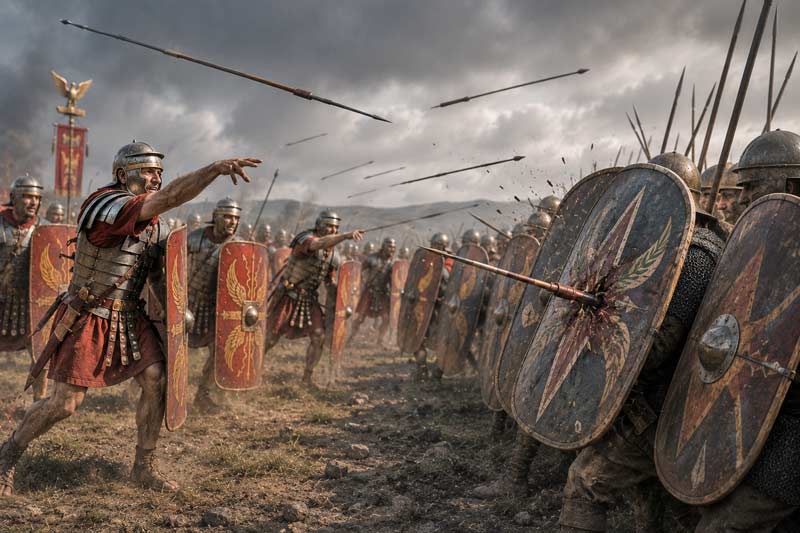
The Romans approached spear design differently from many civilizations. Instead of focusing entirely on long-range fighting or formation dominance, they created a weapon specifically designed to disrupt enemy defenses before close combat even began. That weapon was the pilum, a heavy throwing spear used by Roman legionaries.
At first glance, the pilum looked unusual. It featured a long, narrow metal shank attached to a wooden shaft, ending in a hardened point built to punch through shields. Roman soldiers typically carried one or two pila and hurled them just before engaging the enemy with swords.
What made the pilum especially clever was its destructive design. After piercing a shield, the long metal shaft often bent or became difficult to remove, leaving enemies burdened with heavy, awkward shields they could no longer use effectively. In some cases, soldiers abandoned their shields entirely, suddenly becoming far more vulnerable in combat.
This gave Roman infantry an enormous tactical advantage. Enemy formations could fall apart seconds before the Romans closed distance. By the time swords came out, opponents were often already disorganized, exposed, and struggling to recover from the disruption.
The pilum is a great example of how spears evolved beyond simple stabbing weapons. Some civilizations used them for reach. Others prioritized speed or cavalry warfare. The Romans turned the spear into a battlefield problem-solving tool designed to weaken enemies before the real fighting even started.
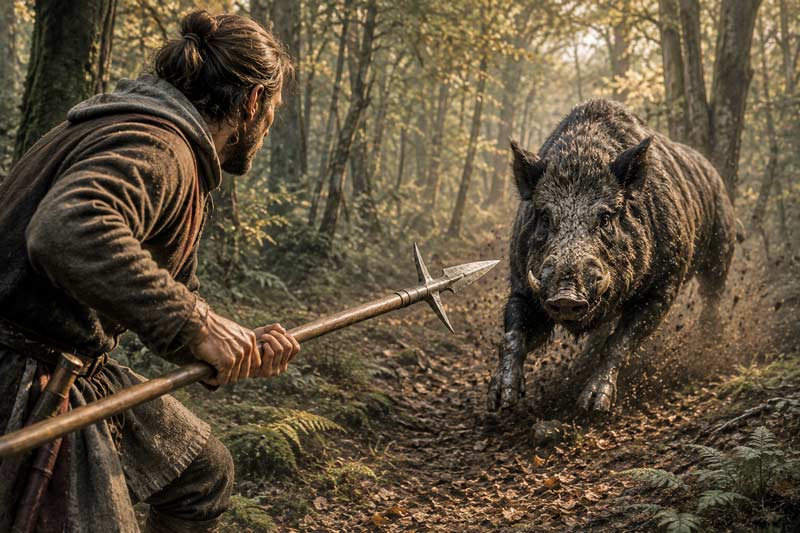
Not all spears were designed for war. Some evolved to solve a very different problem: surviving an encounter with an animal powerful enough to kill a human in seconds. Few examples show this better than the boar spear, a specialized weapon designed for hunting wild boars across medieval Europe and parts of Asia.
At first glance, a boar spear looked similar to a battlefield spear, but one unusual feature immediately stood out. Many versions included a pair of metal lugs or crossbars just below the blade. These were not decorative. They served a very specific purpose: stopping an enraged boar from continuing to charge up the shaft after being struck.
Wild boars were incredibly dangerous prey. Large males could weigh hundreds of pounds, move surprisingly fast, and slash with razor-sharp tusks capable of causing devastating injuries. Hunters often had only one chance to brace their spear and absorb the impact. Without the crossbar design, the animal could continue driving forward and reach the person holding the weapon.
Boar spears reveal something fascinating about weapon evolution. Spears were not just battlefield tools. They adapted to completely different threats depending on environment and survival needs. A weapon built for cavalry charges would make little sense in a dense forest facing an aggressive animal at close range.
In many ways, the boar spear reflects a broader truth about spear history: these weapons survived for thousands of years because they were endlessly adaptable. Whether used against armies, mounted knights, or dangerous animals, people kept reshaping the same basic concept to solve entirely different problems.
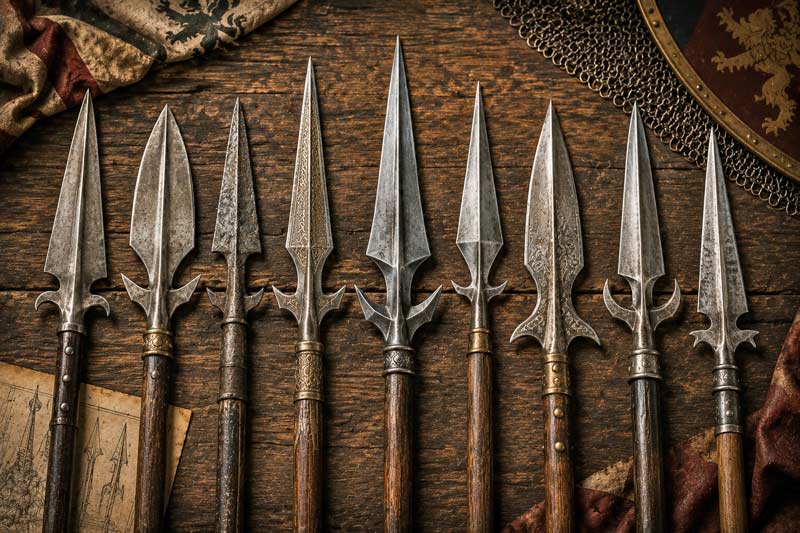
As spears evolved, many cultures started experimenting with designs that could do more than simply stab. One of the most interesting examples appeared across medieval Europe in the form of winged spearheads, weapons featuring small protruding lugs or "wings" near the base of the blade.
At first glance, the wings look decorative, but they served several practical purposes. In battle, they could help trap or deflect an opponent's weapon, making it harder for enemies to push past the spear's reach advantage. Some historians also believe they prevented the spear from penetrating too deeply, allowing soldiers to pull the weapon back more quickly in crowded combat situations.
These designs blurred the line between spear and polearm. Over time, many long weapons began evolving into highly specialized battlefield tools with hooks, blades, spikes, and reinforced shafts tailored for specific enemies or tactics. Armored knights, cavalry, and tighter battlefield formations all pushed weapon makers to keep adapting.
This period highlights something fascinating about spear history: once people realized how effective long weapons could be, innovation exploded. Spears stopped being simple sharpened sticks and became increasingly sophisticated tools built for survival in constantly changing warfare.
Even though swords dominate movies and fantasy stories, many historians argue that long weapons like spears and polearms were often far more important in actual combat. They were practical, adaptable, and brutally effective in the hands of disciplined fighters.
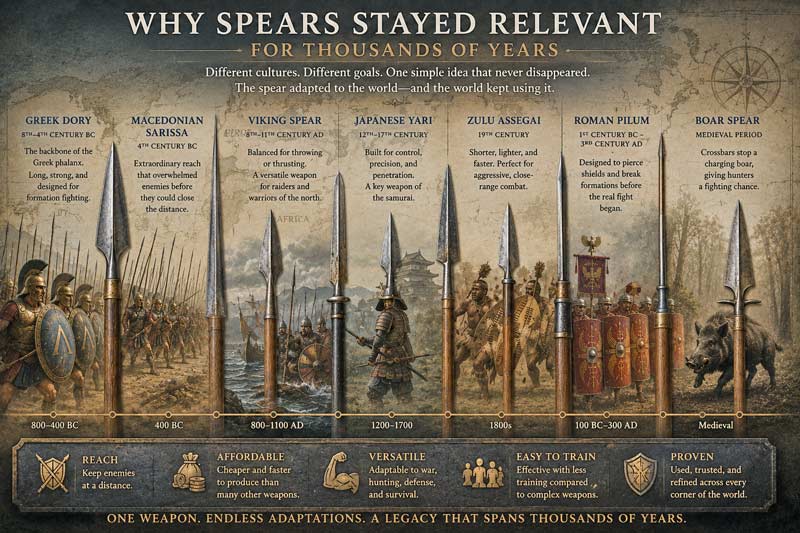
By this point, a pattern probably stands out: civilizations kept inventing wildly different kinds of spears, yet the basic idea almost never disappeared. While swords changed dramatically, armor evolved, and military tactics shifted, the spear somehow kept surviving. There is a simple reason for that. It worked.
Spears offered something few weapons could match: reach, versatility, and efficiency. A trained fighter with a spear could often keep opponents at a distance, strike first, and fight effectively without years of expensive training. For armies trying to equip thousands of soldiers, that mattered. A spear was usually cheaper and faster to produce than a sword while remaining brutally effective in battle.
Different cultures simply adapted the same idea to fit their needs. The Greeks built disciplined walls of spear points. Macedonians stretched reach to extremes. Vikings prioritized mobility. Samurai refined precision. Zulu warriors shortened spears for speed and aggression. Roman soldiers transformed them into battlefield disruption tools. Even hunters redesigned spears to survive dangerous encounters with wild animals.
That flexibility is probably why the spear became humanity's most universal weapon. Nearly every civilization developed some version of it independently, often arriving at similar solutions despite being separated by oceans and centuries. Few tools in history adapted so successfully to so many completely different problems.
Ironically, the spear rarely gets the same attention as swords in movies, games, or pop culture. Yet if history teaches us anything, it is that the most famous weapon is not always the one that mattered most. Again and again, when survival was on the line, people trusted the spear.
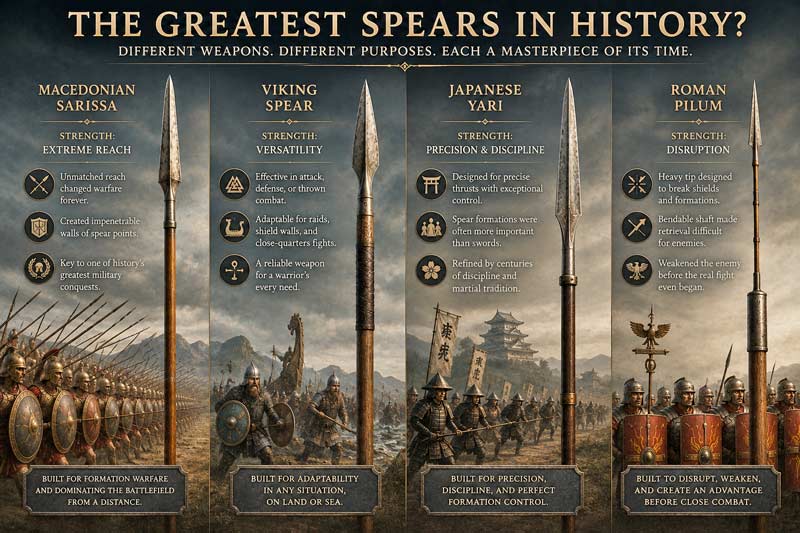
Choosing the "best" spear in history is a little like arguing over the greatest military strategy ever invented. The answer depends entirely on what problem the weapon was designed to solve. A spear that dominated cavalry combat might fail in a dense forest. A weapon perfect for hunting could be nearly useless against armored soldiers.
If the goal was battlefield reach and formation warfare, many historians point to the Macedonian sarissa. Few weapons reshaped military tactics so dramatically or helped fuel conquest on such a massive scale. Entire armies struggled to deal with walls of spear points extending impossibly far into the battlefield.
If versatility mattered most, the Viking spear deserves serious consideration. It worked in raids, ship combat, skirmishes, shield walls, and even as a thrown weapon. For cultures that needed adaptability more than specialization, it offered remarkable balance.
For precision and military discipline, the Japanese yari stands out. During key periods of Japanese warfare, disciplined spear formations often mattered far more than the legendary swords most people associate with samurai combat.
And if innovation is the deciding factor, the Roman pilum deserves recognition for turning a spear into something closer to battlefield sabotage. Few weapons were designed so specifically to disrupt enemy defenses before the real fighting even started.
The reality is that the "greatest" spear may simply be the one that best matched the battlefield it was created for. That adaptability is probably why humanity kept reinventing the spear for thousands of years instead of abandoning it for something else.
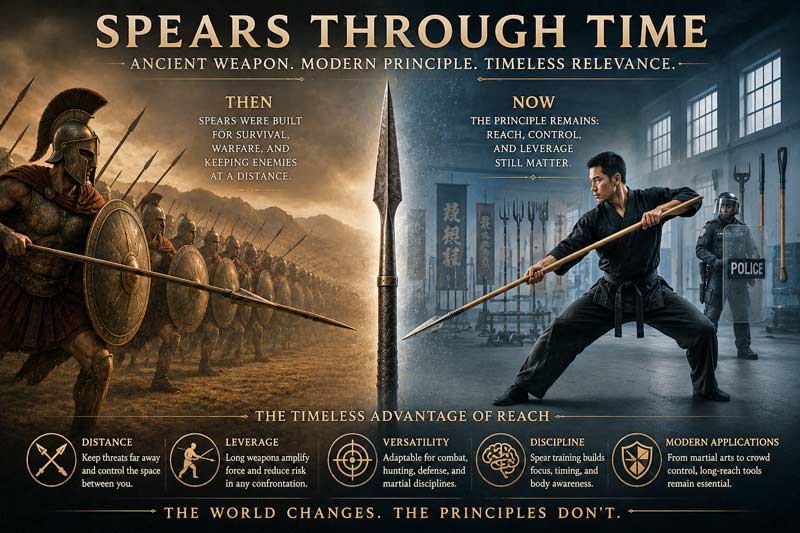
It sounds like a strange question in a world of firearms, drones, and advanced military technology, but spears have never completely disappeared. In fact, many of the principles that made them effective thousands of years ago still show up in modern tools, military tactics, and self-defense concepts.
At the most basic level, the spear solved a timeless problem: how do you create distance between yourself and danger? Reach still matters. Whether it is riot-control equipment, long-handled defensive tools, hunting gear, or martial arts weapons, the idea of keeping threats farther away remains surprisingly relevant.
Spears also continue to survive in martial arts traditions around the world. Systems rooted in Chinese kung fu, Japanese martial arts, and other historical disciplines still teach spear and polearm techniques to develop timing, range control, coordination, and body mechanics. Many practitioners consider spear training one of the most difficult and rewarding weapon disciplines to learn.
Of course, no one is marching into modern combat carrying a Macedonian sarissa or Viking spear. Technology changed warfare too dramatically for that. But the underlying concept behind the spear never really vanished. Humans still build tools that prioritize reach, leverage, control, and force multiplication. The shape changes, but the idea survives.
That may be the most impressive thing about spear history. Across thousands of years, countless civilizations independently arrived at nearly the same conclusion: putting distance between yourself and danger is usually a very good idea.
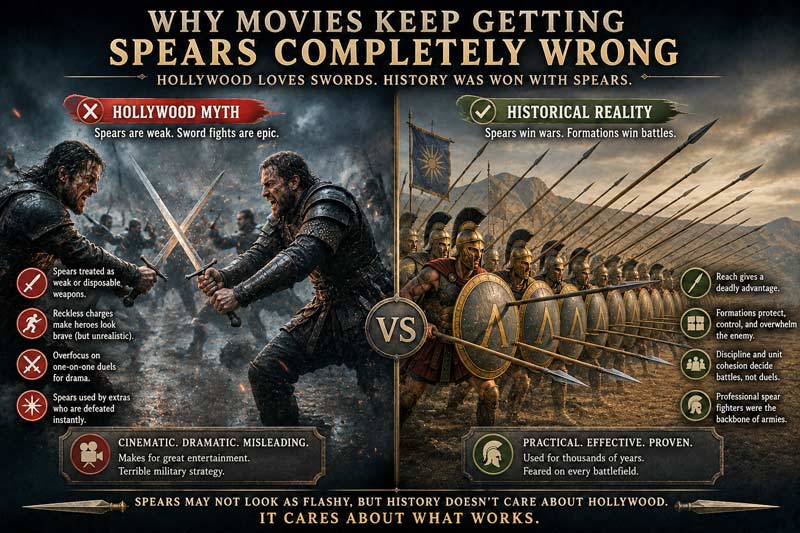
For a weapon that dominated battlefields for thousands of years, spears get surprisingly little respect in movies and television. Heroes almost always grab swords, villains swing giant axes, and spear fighters somehow end up losing despite holding one of history's most practical weapons.
Hollywood tends to treat spears like disposable background weapons. Soldiers carrying them are often defeated within seconds so the camera can focus on flashy sword fights. In reality, charging recklessly toward a trained spear fighter would have been an extremely dangerous decision. Reach matters, and history repeatedly showed that people holding sharp objects from farther away usually had an advantage.
Movies also tend to ignore formations. Greek phalanxes, Macedonian sarissa lines, Roman tactics, and disciplined spear units worked because fighters stayed organized. Battlefields were rarely a series of dramatic one-on-one duels. More often, survival depended on teamwork, positioning, and discipline.
That is probably one reason swords became more legendary in storytelling. A duel between two fighters looks dramatic. A wall of soldiers standing in formation with long spears looks effective, but not always cinematic. History and entertainment often reward very different things.
Ironically, if someone from the ancient world had to bet on surviving a battle, they may have trusted the soldier carrying a spear more than the hero carrying an expensive sword. Spears were practical, deadly, and proven. They just never got the same marketing department.
Across thousands of years of warfare, hunting, survival, and martial training, civilizations kept reinventing the spear for one simple reason: it solved problems better than almost anything else. Whether it was the impossible reach of the Macedonian sarissa, the versatility of a Viking spear, the discipline of the Japanese yari, or the brutal efficiency of the Zulu assegai, every culture shaped the same basic idea to fit its own needs.
That adaptability may be the spear's greatest achievement. Few weapons worked effectively in so many different environments for so long. Spears defended cities, stopped cavalry, hunted dangerous animals, protected soldiers in formation, and gave ordinary fighters a better chance of survival against stronger opponents.
Modern pop culture may continue giving swords most of the attention, but history tells a very different story. If you trace the weapons that actually shaped civilizations, controlled battlefields, and repeatedly proved themselves under pressure, the spear keeps showing up again and again.
In many ways, the spear might be the closest thing humanity ever created to a universal weapon. Different shapes, different lengths, different purposes, yet always solving the same ancient problem: how to stay alive while keeping danger just far enough away.
And perhaps that is what makes spear history so fascinating. Long before modern engineering, countless civilizations independently arrived at almost the exact same conclusion. Sometimes the simplest idea really is the hardest to improve upon.
In real history, spears often mattered more than swords. So why do swords get all the glory? A big reason is storytelling. Swords are easier to romanticize. They feel personal, heroic, and dramatic in one-on-one fights, which makes them perfect for books, movies, and legends.
Spears, on the other hand, were usually weapons of formations and teamwork. They worked best in disciplined groups rather than flashy duels. A wall of soldiers holding long spears may have been terrifying in real life, but it is harder to turn into a dramatic hero moment on screen.
There is also the status factor. In many cultures, swords were expensive and often associated with nobility, officers, or elite warriors. Spears were practical tools used by ordinary soldiers, even though those soldiers frequently decided the outcome of battles.
Ironically, the weapon that history relied on most became overshadowed by the weapon that simply looked cooler in stories.
In many situations, yes. If skill levels were relatively equal and space allowed for movement, a spear often had a major advantage over a sword. The reason is simple: reach. A spear fighter could strike from farther away, forcing a swordsman to survive the dangerous process of getting inside striking distance first.
Historical fighting manuals, military records, and even modern sparring experiments repeatedly show how difficult it can be for shorter weapons to overcome a trained opponent with longer reach. That is one reason so many armies trusted spears for thousands of years instead of handing everyone swords.
Of course, context mattered. Tight spaces, broken formations, rough terrain, or close-quarters fighting could reduce a spear's advantages. Once someone got past the spear point, swords, daggers, or shorter weapons often became more practical.
That is why many cultures paired spears with backup weapons rather than replacing one with the other entirely. Spears often started the fight. Swords helped finish it.
That depends entirely on how you define "deadliest." If you mean battlefield impact, many historians point to the Macedonian sarissa because it helped transform warfare and supported one of the largest military expansions in the ancient world under Alexander the Great.
If versatility matters most, the Viking spear deserves serious consideration. It worked in shield walls, raids, ship combat, and could even be thrown when needed. For everyday survival and warfare, it may have been one of the most practical spear designs ever created.
Some military historians also argue for the Roman pilum because it disrupted enemy formations before combat even began. A weapon that could disable shields and throw armies into chaos had enormous tactical value.
The interesting thing is that no single spear dominated every situation. Spears evolved to solve different problems, which is exactly why so many civilizations independently invented their own versions. The "deadliest" spear was usually the one perfectly matched to the battlefield where it was used.
What makes spears especially fascinating is how universal they became. Nearly every civilization developed its own version, often independently, because the basic concept worked so well. Spears were cheaper to make than swords, easier to train with, and surprisingly versatile in combat. In many cases, they were the weapon that actually won wars while swords got most of the glory in stories and movies.
In this guide, we're exploring the different types of spears used throughout history, what made each one unique, and why certain designs proved so deadly that they changed warfare itself.
Why the Spear Became the World's Most Universal Weapon
The spear may not look complicated, but that simplicity is exactly why it became one of the most successful weapons in human history. A spear gave the person holding it something every fighter wanted: distance. Before armor, training, or brute strength mattered, reach could decide who survived the first few seconds of a fight.
That advantage made spears useful almost everywhere. Hunters used them to keep dangerous animals away from their bodies. Guards used them to control narrow entrances. Soldiers used them in tight formations where one person's weapon protected the man beside him. Even in cultures famous for swords, axes, or bows, the spear was often the practical battlefield workhorse.
Spears were also easier to produce than many other weapons. A good sword required skilled metalwork, careful balance, and a lot of material. A spear could be made with a smaller metal head attached to a long wooden shaft, making it more affordable for armies that needed to equip thousands of fighters. That is one reason spears show up again and again across ancient, medieval, and tribal warfare.
What changed from culture to culture was not the basic idea, but the problem each spear was designed to solve. Some were built for throwing. Some were built for stopping cavalry. Some were built for fighting in dense formations. Others were made short, fast, and brutal for close-range encounters. Once you understand that, the different types of spears start to look less like random variations and more like specialized tools shaped by battlefield pressure.
For readers interested in the broader world of martial arts and historical weapon designs, KarateMart's weapons collection shows how many traditional weapon concepts still survive today in training, display, and martial arts culture.
The Spear That Dominated the Ancient World: The Greek Dory
When people think about ancient warfare, they often imagine swords clashing in dramatic one-on-one duels. In reality, much of the ancient world was controlled by disciplined groups of soldiers carrying spears. One of the most influential examples was the Greek dory, the primary weapon of the hoplite soldier.
The dory was not especially flashy. It typically measured between seven and nine feet long and featured a leaf-shaped spearhead designed for thrusting. What made it dangerous was how it was used. Greek hoplites fought shoulder to shoulder in tightly packed formations called phalanxes, creating rows of overlapping shields and spear points that were incredibly difficult to break through.
This formation turned individual fighters into something much more intimidating: a moving wall of sharp points. Enemies often had to survive multiple spear thrusts before they could even reach the front line. In many battles, organization mattered more than individual fighting skill, and the dory helped make Greek armies some of the most feared military forces of their time.
The influence of Greek spear combat spread far beyond Greece itself. Variations of long battlefield spears would later shape military tactics across Europe, Asia, and the Middle East. In many ways, the spear established the blueprint for organized warfare long before swords became symbols of status and heroism.
Many traditional martial systems still preserve the idea of long-range weapon control. Some modern practitioners interested in historical or long-reach weapon styles explore related training tools through collections of kung fu weapons, where staff-based training still plays an important role.
The Spear That Stretched Warfare: The Macedonian Sarissa
If the Greek dory helped define organized spear combat, the Macedonian sarissa took the idea to an entirely different level. Used by the armies of Alexander the Great, the sarissa was not just long. It was enormous. Some versions stretched between 13 and 20 feet, making it one of the most intimidating battlefield weapons of the ancient world.
Unlike shorter spears designed for flexibility, the sarissa existed for one purpose: domination through reach. Macedonian soldiers stood in massive formations called phalanxes, often several ranks deep, with multiple rows of spear points extending far beyond the front line. Enemies were sometimes forced to deal with five layers of spear tips before they could even reach a soldier.
The psychological effect alone was brutal. Imagine charging toward what looked like a moving forest of sharpened poles, all aimed directly at you. Cavalry struggled against it. Infantry struggled against it. Entire armies found themselves overwhelmed before they could get close enough to fight effectively.
The tradeoff, however, was mobility. Sarissa formations worked best on open terrain and required extraordinary discipline to maintain. If formations broke apart or enemies attacked from the sides, these giant spears became much harder to manage. Even so, the weapon helped Alexander build one of the largest empires the ancient world had ever seen.
The sarissa also shows something important about spear evolution: sometimes bigger really was better. While many civilizations focused on versatility, Macedonian military strategy doubled down on overwhelming range and battlefield control.
For martial artists fascinated by unusual or historically inspired weapon designs, collections of exotic weapons can offer a glimpse into how dramatically weapon styles evolved across cultures and eras.
The Viking Spear: The Weapon Warriors Actually Relied On
Ask someone to picture a Viking weapon and they will probably imagine a massive axe or a legendary sword. In reality, the spear was often the weapon Vikings trusted most. It was cheaper than a sword, easier to carry, and deadly in both close combat and at a distance.
Viking spears came in many forms, ranging from simple battlefield tools to highly decorated weapons carried by elite warriors. Some featured broad cutting blades designed to slash, while others had narrow points made for deep thrusting. Many could also be thrown, giving fighters a dangerous ranged option before hand-to-hand combat even began.
Part of what made the Viking spear so effective was its versatility. A warrior could stab from behind a shield, strike at enemies on foot, defend against cavalry, or hurl the weapon when the timing felt right. Unlike giant battlefield spears such as the sarissa, Viking spears balanced reach with mobility, making them practical for raids, ship combat, and chaotic skirmishes.
The spear also held symbolic value in Norse culture. According to mythology, the god Odin carried a legendary spear called Gungnir, said to never miss its target. That cultural importance helped make spears feel like more than just battlefield tools. They became symbols of status, skill, and warrior identity.
The Japanese Yari: The Spear That Changed Samurai Warfare
When most people think of samurai weapons, they picture the katana. Yet for long stretches of Japanese history, one of the most important battlefield weapons was not the sword at all. It was the yari, a spear that transformed how samurai armies fought and helped shape warfare in feudal Japan.
Unlike many European spears, the yari often featured a straight, symmetrical blade designed for precise thrusting. Some yari were relatively simple, while others developed elaborate side blades or specialized shapes for hooking, cutting, or disarming opponents. Lengths varied dramatically depending on battlefield role, ranging from shorter personal fighting weapons to extremely long versions used in mass formations.
As warfare in Japan evolved, samurai armies increasingly relied on disciplined groups of spear fighters called ashigaru. During major battles, long yari formations could overwhelm charging enemies and disrupt cavalry attacks in ways that looked surprisingly similar to ancient Greek and Macedonian spear tactics. In some eras, spears became even more important than swords on the battlefield.
The katana may have earned the fame, but the yari often did the real military work. That pattern appears repeatedly throughout history. The weapon celebrated in stories is not always the one soldiers relied on most when survival mattered.
The Zulu Assegai: The Short Spear That Changed Combat
Not every civilization believed bigger was better when it came to spears. In southern Africa, the Zulu kingdom developed a weapon that moved in the exact opposite direction. Instead of relying on long reach, the Zulu assegai evolved into a shorter, faster spear designed for brutal close-range fighting.
Originally, many African spears were lightweight throwing weapons meant to wound enemies from a distance. But in the early 1800s, the Zulu king Shaka revolutionized warfare by redesigning the spear into something far more aggressive. His version featured a shorter shaft and a broader blade built for stabbing rather than throwing. Warriors closed distance quickly and fought hand-to-hand with terrifying speed.
This shift completely changed Zulu battlefield tactics. Rather than standing back and exchanging thrown weapons, warriors used disciplined formations to surround enemies and force close combat. One famous strategy became known as the "horns of the buffalo," where flanking groups swept around opponents while central fighters locked them into direct engagement.
The assegai proves an important point about spear evolution: effectiveness depended on context. While Macedonians dominated through overwhelming reach, the Zulu military prioritized mobility, aggression, and speed. Two spear cultures arrived at completely different solutions, and both changed history.
The story of the assegai is also a reminder that military innovation is not always about building bigger weapons. Sometimes the most effective change comes from making a weapon faster, simpler, and better suited to the realities of how people actually fight.
The Medieval Lance: The Spear Built for Horseback Warfare
Some spears were designed for infantry formations. Others were built to strike with overwhelming force from horseback. That is where the medieval lance enters the story. While technically a type of spear, the lance evolved into a specialized battlefield weapon made for mounted warriors who could turn speed and momentum into devastating power.
Unlike shorter combat spears, lances were typically longer and heavier, allowing mounted knights to attack enemies from farther away while staying protected by armor and shields. During a cavalry charge, the rider often tucked the lance under the arm and aimed straight ahead, transforming horse and rider into what was essentially a moving missile.
The effect could be terrifying. A disciplined cavalry charge with lowered lances had enormous psychological power before impact even happened. Rows of mounted soldiers thundered across open ground toward infantry lines, forcing enemies to either stand firm or panic. Battles were often decided by who broke formation first.
Of course, the lance had limitations. Dense spear formations, rough terrain, and disciplined infantry could neutralize cavalry advantages. Weapons like the Macedonian sarissa or tightly packed pike formations later proved that long infantry spears could sometimes stop mounted charges cold. Warfare constantly became a contest between offense and countermeasure.
The lance also highlights how adaptable spear concepts became across history. One civilization used spears to create immovable defensive formations, while another reshaped them into high-speed offensive weapons capable of crashing into enemy lines with shocking force.
The Roman Pilum: The Spear Designed to Ruin Your Day
The Romans approached spear design differently from many civilizations. Instead of focusing entirely on long-range fighting or formation dominance, they created a weapon specifically designed to disrupt enemy defenses before close combat even began. That weapon was the pilum, a heavy throwing spear used by Roman legionaries.
At first glance, the pilum looked unusual. It featured a long, narrow metal shank attached to a wooden shaft, ending in a hardened point built to punch through shields. Roman soldiers typically carried one or two pila and hurled them just before engaging the enemy with swords.
What made the pilum especially clever was its destructive design. After piercing a shield, the long metal shaft often bent or became difficult to remove, leaving enemies burdened with heavy, awkward shields they could no longer use effectively. In some cases, soldiers abandoned their shields entirely, suddenly becoming far more vulnerable in combat.
This gave Roman infantry an enormous tactical advantage. Enemy formations could fall apart seconds before the Romans closed distance. By the time swords came out, opponents were often already disorganized, exposed, and struggling to recover from the disruption.
The pilum is a great example of how spears evolved beyond simple stabbing weapons. Some civilizations used them for reach. Others prioritized speed or cavalry warfare. The Romans turned the spear into a battlefield problem-solving tool designed to weaken enemies before the real fighting even started.
The Boar Spear: Built for One of History's Most Dangerous Hunts
Not all spears were designed for war. Some evolved to solve a very different problem: surviving an encounter with an animal powerful enough to kill a human in seconds. Few examples show this better than the boar spear, a specialized weapon designed for hunting wild boars across medieval Europe and parts of Asia.
At first glance, a boar spear looked similar to a battlefield spear, but one unusual feature immediately stood out. Many versions included a pair of metal lugs or crossbars just below the blade. These were not decorative. They served a very specific purpose: stopping an enraged boar from continuing to charge up the shaft after being struck.
Wild boars were incredibly dangerous prey. Large males could weigh hundreds of pounds, move surprisingly fast, and slash with razor-sharp tusks capable of causing devastating injuries. Hunters often had only one chance to brace their spear and absorb the impact. Without the crossbar design, the animal could continue driving forward and reach the person holding the weapon.
Boar spears reveal something fascinating about weapon evolution. Spears were not just battlefield tools. They adapted to completely different threats depending on environment and survival needs. A weapon built for cavalry charges would make little sense in a dense forest facing an aggressive animal at close range.
In many ways, the boar spear reflects a broader truth about spear history: these weapons survived for thousands of years because they were endlessly adaptable. Whether used against armies, mounted knights, or dangerous animals, people kept reshaping the same basic concept to solve entirely different problems.
The Winged Spearheads of Europe: When Spears Became Multi-Purpose Weapons
As spears evolved, many cultures started experimenting with designs that could do more than simply stab. One of the most interesting examples appeared across medieval Europe in the form of winged spearheads, weapons featuring small protruding lugs or "wings" near the base of the blade.
At first glance, the wings look decorative, but they served several practical purposes. In battle, they could help trap or deflect an opponent's weapon, making it harder for enemies to push past the spear's reach advantage. Some historians also believe they prevented the spear from penetrating too deeply, allowing soldiers to pull the weapon back more quickly in crowded combat situations.
These designs blurred the line between spear and polearm. Over time, many long weapons began evolving into highly specialized battlefield tools with hooks, blades, spikes, and reinforced shafts tailored for specific enemies or tactics. Armored knights, cavalry, and tighter battlefield formations all pushed weapon makers to keep adapting.
This period highlights something fascinating about spear history: once people realized how effective long weapons could be, innovation exploded. Spears stopped being simple sharpened sticks and became increasingly sophisticated tools built for survival in constantly changing warfare.
Even though swords dominate movies and fantasy stories, many historians argue that long weapons like spears and polearms were often far more important in actual combat. They were practical, adaptable, and brutally effective in the hands of disciplined fighters.
Why Spears Stayed Relevant for Thousands of Years
By this point, a pattern probably stands out: civilizations kept inventing wildly different kinds of spears, yet the basic idea almost never disappeared. While swords changed dramatically, armor evolved, and military tactics shifted, the spear somehow kept surviving. There is a simple reason for that. It worked.
Spears offered something few weapons could match: reach, versatility, and efficiency. A trained fighter with a spear could often keep opponents at a distance, strike first, and fight effectively without years of expensive training. For armies trying to equip thousands of soldiers, that mattered. A spear was usually cheaper and faster to produce than a sword while remaining brutally effective in battle.
Different cultures simply adapted the same idea to fit their needs. The Greeks built disciplined walls of spear points. Macedonians stretched reach to extremes. Vikings prioritized mobility. Samurai refined precision. Zulu warriors shortened spears for speed and aggression. Roman soldiers transformed them into battlefield disruption tools. Even hunters redesigned spears to survive dangerous encounters with wild animals.
That flexibility is probably why the spear became humanity's most universal weapon. Nearly every civilization developed some version of it independently, often arriving at similar solutions despite being separated by oceans and centuries. Few tools in history adapted so successfully to so many completely different problems.
Ironically, the spear rarely gets the same attention as swords in movies, games, or pop culture. Yet if history teaches us anything, it is that the most famous weapon is not always the one that mattered most. Again and again, when survival was on the line, people trusted the spear.
What Weapon Do Historians Consider the Greatest Spear Ever Made?
Choosing the "best" spear in history is a little like arguing over the greatest military strategy ever invented. The answer depends entirely on what problem the weapon was designed to solve. A spear that dominated cavalry combat might fail in a dense forest. A weapon perfect for hunting could be nearly useless against armored soldiers.
If the goal was battlefield reach and formation warfare, many historians point to the Macedonian sarissa. Few weapons reshaped military tactics so dramatically or helped fuel conquest on such a massive scale. Entire armies struggled to deal with walls of spear points extending impossibly far into the battlefield.
If versatility mattered most, the Viking spear deserves serious consideration. It worked in raids, ship combat, skirmishes, shield walls, and even as a thrown weapon. For cultures that needed adaptability more than specialization, it offered remarkable balance.
For precision and military discipline, the Japanese yari stands out. During key periods of Japanese warfare, disciplined spear formations often mattered far more than the legendary swords most people associate with samurai combat.
And if innovation is the deciding factor, the Roman pilum deserves recognition for turning a spear into something closer to battlefield sabotage. Few weapons were designed so specifically to disrupt enemy defenses before the real fighting even started.
The reality is that the "greatest" spear may simply be the one that best matched the battlefield it was created for. That adaptability is probably why humanity kept reinventing the spear for thousands of years instead of abandoning it for something else.
Could Spears Still Be Effective Today?
It sounds like a strange question in a world of firearms, drones, and advanced military technology, but spears have never completely disappeared. In fact, many of the principles that made them effective thousands of years ago still show up in modern tools, military tactics, and self-defense concepts.
At the most basic level, the spear solved a timeless problem: how do you create distance between yourself and danger? Reach still matters. Whether it is riot-control equipment, long-handled defensive tools, hunting gear, or martial arts weapons, the idea of keeping threats farther away remains surprisingly relevant.
Spears also continue to survive in martial arts traditions around the world. Systems rooted in Chinese kung fu, Japanese martial arts, and other historical disciplines still teach spear and polearm techniques to develop timing, range control, coordination, and body mechanics. Many practitioners consider spear training one of the most difficult and rewarding weapon disciplines to learn.
Of course, no one is marching into modern combat carrying a Macedonian sarissa or Viking spear. Technology changed warfare too dramatically for that. But the underlying concept behind the spear never really vanished. Humans still build tools that prioritize reach, leverage, control, and force multiplication. The shape changes, but the idea survives.
That may be the most impressive thing about spear history. Across thousands of years, countless civilizations independently arrived at nearly the same conclusion: putting distance between yourself and danger is usually a very good idea.
Why Movies Keep Getting Spears Completely Wrong
For a weapon that dominated battlefields for thousands of years, spears get surprisingly little respect in movies and television. Heroes almost always grab swords, villains swing giant axes, and spear fighters somehow end up losing despite holding one of history's most practical weapons.
Hollywood tends to treat spears like disposable background weapons. Soldiers carrying them are often defeated within seconds so the camera can focus on flashy sword fights. In reality, charging recklessly toward a trained spear fighter would have been an extremely dangerous decision. Reach matters, and history repeatedly showed that people holding sharp objects from farther away usually had an advantage.
Movies also tend to ignore formations. Greek phalanxes, Macedonian sarissa lines, Roman tactics, and disciplined spear units worked because fighters stayed organized. Battlefields were rarely a series of dramatic one-on-one duels. More often, survival depended on teamwork, positioning, and discipline.
That is probably one reason swords became more legendary in storytelling. A duel between two fighters looks dramatic. A wall of soldiers standing in formation with long spears looks effective, but not always cinematic. History and entertainment often reward very different things.
Ironically, if someone from the ancient world had to bet on surviving a battle, they may have trusted the soldier carrying a spear more than the hero carrying an expensive sword. Spears were practical, deadly, and proven. They just never got the same marketing department.
The Weapon Humanity Could Never Quite Replace
Across thousands of years of warfare, hunting, survival, and martial training, civilizations kept reinventing the spear for one simple reason: it solved problems better than almost anything else. Whether it was the impossible reach of the Macedonian sarissa, the versatility of a Viking spear, the discipline of the Japanese yari, or the brutal efficiency of the Zulu assegai, every culture shaped the same basic idea to fit its own needs.
That adaptability may be the spear's greatest achievement. Few weapons worked effectively in so many different environments for so long. Spears defended cities, stopped cavalry, hunted dangerous animals, protected soldiers in formation, and gave ordinary fighters a better chance of survival against stronger opponents.
Modern pop culture may continue giving swords most of the attention, but history tells a very different story. If you trace the weapons that actually shaped civilizations, controlled battlefields, and repeatedly proved themselves under pressure, the spear keeps showing up again and again.
In many ways, the spear might be the closest thing humanity ever created to a universal weapon. Different shapes, different lengths, different purposes, yet always solving the same ancient problem: how to stay alive while keeping danger just far enough away.
And perhaps that is what makes spear history so fascinating. Long before modern engineering, countless civilizations independently arrived at almost the exact same conclusion. Sometimes the simplest idea really is the hardest to improve upon.
Why Did Spears Eventually Lose to Swords in Popular Culture?
In real history, spears often mattered more than swords. So why do swords get all the glory? A big reason is storytelling. Swords are easier to romanticize. They feel personal, heroic, and dramatic in one-on-one fights, which makes them perfect for books, movies, and legends.
Spears, on the other hand, were usually weapons of formations and teamwork. They worked best in disciplined groups rather than flashy duels. A wall of soldiers holding long spears may have been terrifying in real life, but it is harder to turn into a dramatic hero moment on screen.
There is also the status factor. In many cultures, swords were expensive and often associated with nobility, officers, or elite warriors. Spears were practical tools used by ordinary soldiers, even though those soldiers frequently decided the outcome of battles.
Ironically, the weapon that history relied on most became overshadowed by the weapon that simply looked cooler in stories.
Did Spears Really Beat Swords in Actual Combat?
In many situations, yes. If skill levels were relatively equal and space allowed for movement, a spear often had a major advantage over a sword. The reason is simple: reach. A spear fighter could strike from farther away, forcing a swordsman to survive the dangerous process of getting inside striking distance first.
Historical fighting manuals, military records, and even modern sparring experiments repeatedly show how difficult it can be for shorter weapons to overcome a trained opponent with longer reach. That is one reason so many armies trusted spears for thousands of years instead of handing everyone swords.
Of course, context mattered. Tight spaces, broken formations, rough terrain, or close-quarters fighting could reduce a spear's advantages. Once someone got past the spear point, swords, daggers, or shorter weapons often became more practical.
That is why many cultures paired spears with backup weapons rather than replacing one with the other entirely. Spears often started the fight. Swords helped finish it.
What Was the Deadliest Spear in History?
That depends entirely on how you define "deadliest." If you mean battlefield impact, many historians point to the Macedonian sarissa because it helped transform warfare and supported one of the largest military expansions in the ancient world under Alexander the Great.
If versatility matters most, the Viking spear deserves serious consideration. It worked in shield walls, raids, ship combat, and could even be thrown when needed. For everyday survival and warfare, it may have been one of the most practical spear designs ever created.
Some military historians also argue for the Roman pilum because it disrupted enemy formations before combat even began. A weapon that could disable shields and throw armies into chaos had enormous tactical value.
The interesting thing is that no single spear dominated every situation. Spears evolved to solve different problems, which is exactly why so many civilizations independently invented their own versions. The "deadliest" spear was usually the one perfectly matched to the battlefield where it was used.
You May Also Be Interested In:
- 5 Deadly Sai Weapon Types
- Five Types of Deadly Japanese Swords
- Bruce Lee's Favorite Weapon: What Made His Nunchucks So Deadly?
- New Weapons This Week! Claws, Whips & Spears!
- What Are the Different Types of Ninja Stars?
- I Made a Hidden Marker Spike Weapon!
- A Complete Guide to the Different Types of Throwing Knives
- I Made a Metal Bounty Hunter Spear!
- Unusual Weapons Made for a Superhero! Slashing, Piercing and Bludgeoning Weapons!
- 5 Deadly Weapons You Wish You Had!
Leave a Reply