



The Real History of the Sai (It Wasn't Originally a Weapon)
July 29th, 2026
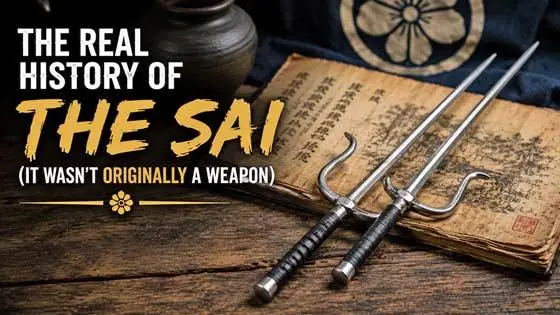
Most people recognize the sai instantly. It's one of the most iconic martial arts weapons ever created, often portrayed in movies, comic books, and video games as the signature weapon of stealthy ninjas or fearless warriors. But almost everything people think they know about the sai is either exaggerated, misunderstood, or completely wrong.
Contrary to popular belief, the sai was never designed to slice like a sword or stab like a spear. In fact, historians still debate its original purpose, and some of the most common stories about its origins simply don't hold up under scrutiny. From its surprising role in law enforcement on the Ryukyu Islands to its transformation into a symbol of Okinawan martial arts, the sai has a history that's every bit as fascinating as the weapon itself. If you've ever wondered where the sai really came from, you're about to discover a story that's far more interesting than the myths.
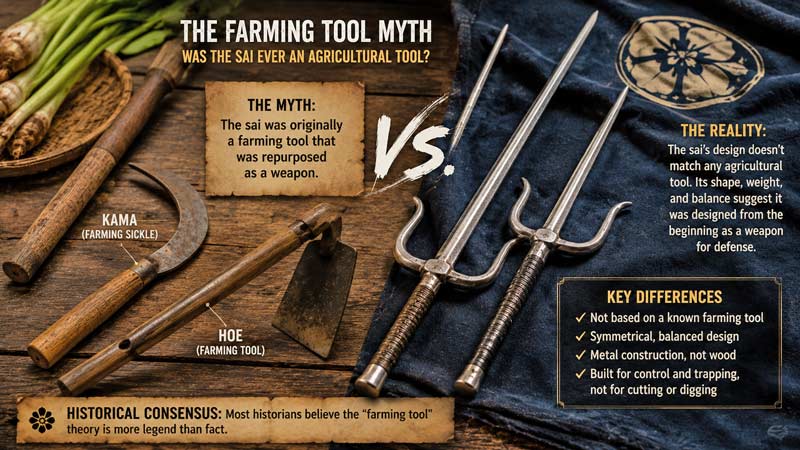
If you've ever taken a martial arts class or watched a documentary about Okinawa, you've probably heard the story that the sai started life as a simple farming tool. According to the popular version of the tale, Okinawan farmers secretly sharpened everyday implements into weapons after rulers banned swords. It's a compelling story, but historians have found surprisingly little evidence to support it.
Unlike tools such as the kama, which clearly evolved from a farming sickle, the sai doesn't closely resemble any common agricultural implement from Okinawa or neighboring regions. Its symmetrical design, heavy metal construction, and distinctive side prongs would have made it awkward for farming but remarkably effective for controlling another person's weapon. That has led many researchers to believe the sai was designed with defense in mind from the very beginning.
The confusion likely comes from the broader history of Okinawan martial arts, where several genuine farming tools were adapted into weapons over time. Because people often lump traditional martial arts weapons together, the sai inherited the same origin story even though its design tells a different story. Today, historians generally consider the "farming tool" explanation to be more legend than fact.
That doesn't make the sai any less fascinating. In fact, its true origins are arguably more interesting because they suggest the weapon may have been created for a very specific purpose that had little to do with farming and everything to do with maintaining order. As you'll see, the people most closely associated with the sai weren't farmers at all.
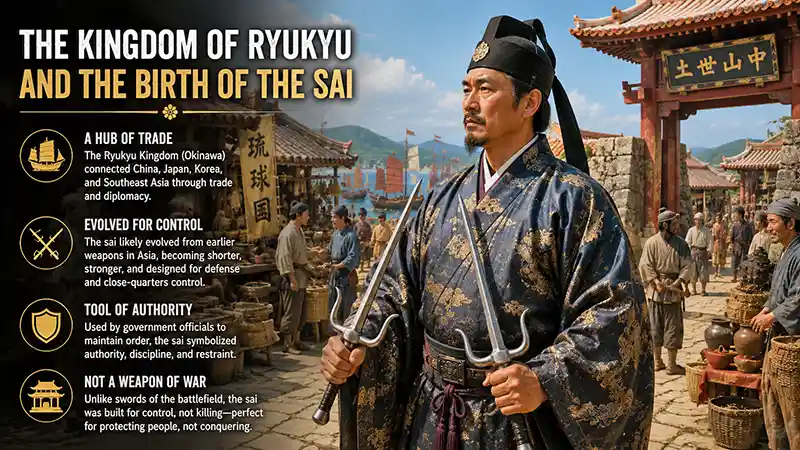
To understand where the sai really came from, you have to travel to the Ryukyu Kingdom, an island nation that once occupied what is now Okinawa, Japan. Long before Okinawa became part of Japan in the late 1800s, the Ryukyu Kingdom was a thriving center of trade that connected China, Japan, Korea, and Southeast Asia. As merchants, diplomats, and travelers moved through the islands, they brought with them new ideas, cultures, and weapons. The sai likely developed during this period of cultural exchange rather than appearing suddenly from a single invention.
Although no one can say with complete certainty where the sai originated, historians have found similar three-pronged metal weapons in parts of China, India, and Southeast Asia that predate the Okinawan version. Rather than being copied directly, the Okinawan sai appears to have evolved into its own distinct design, becoming shorter, sturdier, and better suited for close-quarters control. Over time, it became closely associated with the Ryukyu Kingdom's local officials rather than its soldiers or farmers.
Unlike a sword, the sai wasn't intended to deliver devastating cuts. Its thick central shaft could strike with tremendous force, while its curved side prongs allowed the user to trap, redirect, or even disarm an opponent wielding a blade. That defensive design made it especially valuable in crowded streets where lethal force wasn't always the best solution.
As the weapon became more closely tied to public officials, it developed a reputation as a symbol of authority. While swords remained the weapon of warriors, the sai increasingly found a different role, one that emphasized restraint and control instead of battlefield combat. That distinction would eventually make it one of the most recognizable weapons in Okinawan history and set it apart from many of the other traditional martial arts weapons that evolved for war.
One of the biggest clues to the sai's true purpose is who carried it. Rather than being issued to soldiers marching into battle, the weapon was most commonly associated with law enforcement officials in the Ryukyu Kingdom. These officials were responsible for keeping the peace, settling disputes, and apprehending suspects, making a weapon built for control far more practical than one designed solely to kill.
The sai's unique shape made it ideal for that job. Its sturdy center shaft could deliver powerful strikes when necessary, but the curved side prongs gave the wielder another advantage. They could catch, pin, or redirect an opponent's weapon, creating an opportunity to disarm them without relying on a fatal blow. Against a sword, spear, or staff, a skilled user could manipulate the attack instead of simply trying to overpower it.
That defensive role helps explain why the sai never developed a sharpened blade. Unlike a samurai sword, which was designed to cut through an opponent, the sai emphasized restraint. It reflected the responsibilities of someone tasked with enforcing the law rather than fighting wars. In many situations, capturing a suspect alive was far more valuable than defeating one on the battlefield.
Historical records describing exactly how Ryukyuan officials carried or trained with the sai are limited, but martial arts traditions have preserved many of the techniques that highlight its intended use. Blocks, traps, locks, and disarms remain central to modern sai training, reinforcing the idea that this remarkable weapon was designed as much for control as for combat. That practical philosophy is one of the reasons the sai continues to stand out among the most famous Asian weapons still practiced today.
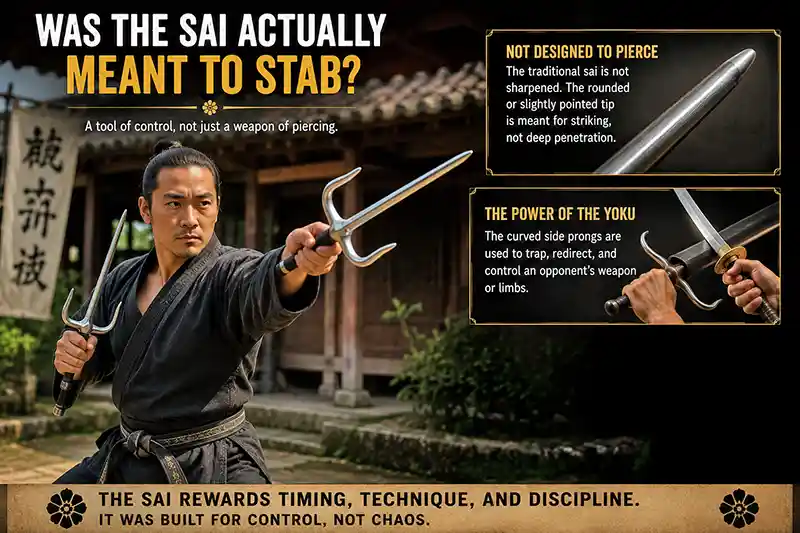
At first glance, the sai certainly looks like a stabbing weapon. Its long center prong resembles the blade of a short spear, leading many people to assume it was designed to pierce armor or deliver deadly thrusts. While a powerful strike with a sai could certainly injure an opponent, that's probably not what the weapon was originally intended to do.
Unlike a knife or sword, the traditional sai wasn't sharpened. The central shaft usually ended in a rounded or slightly pointed tip rather than a razor-sharp edge. This allowed it to strike with tremendous force without relying on cutting power. A blow from a heavy steel sai could break bones or disable an attacker, but it was far less likely to produce the deep slashing wounds associated with bladed weapons.
Its greatest strength came from the curved side prongs, known as the yoku. Skilled practitioners could use them to catch an incoming sword, twist it off line, or pin it long enough to create an opening. The sai could also hook behind an opponent's wrist, arm, or even another weapon, giving the user exceptional control during close-range encounters. These techniques remain central to modern training with the traditional sai, where precision and leverage are valued more than brute force.
That emphasis on trapping and controlling opponents is one reason the sai has remained such a respected martial arts weapon. Rather than overwhelming an enemy with cutting power, it rewarded timing, technique, and discipline. It's a philosophy shared by several classic Okinawan weapons, including the tonfa, where mastery depends as much on skill as on strength.
Ask someone to picture a sai, and there's a good chance they'll imagine a ninja dressed in black slipping through the shadows. It's one of the strongest associations in popular culture, but historically, there's very little evidence that the sai was ever a standard ninja weapon. Its reputation owes far more to movies, television, comic books, and martial arts demonstrations than to documented history.
The confusion is understandable. Ninjas have long been credited with using almost every unusual weapon imaginable, from blowguns to hidden blades and throwing stars. As those legends grew, the sai was eventually added to the list. In reality, historical accounts of ninja equipment rarely mention the weapon, and when they do, it isn't portrayed as a defining part of their arsenal. If you're interested in separating fact from fiction, our article on how ninja weapons were really used explores many of these misconceptions in greater detail.
Much of the sai's modern popularity can be traced to the explosion of martial arts films during the 1960s and 1970s, followed by comic books and television in the decades that followed. The weapon's distinctive silhouette made it instantly recognizable on screen, and performers loved the dramatic spinning techniques that showcased speed and precision. Those eye-catching demonstrations cemented the idea that the sai belonged in every ninja's hands, even if history told a different story.
Ironically, the real history of the sai is arguably more fascinating than the myth. Rather than being the secret weapon of covert assassins, it was a practical tool carried by officials responsible for keeping order. That blend of historical significance and martial arts elegance is one reason the sai continues to rank among today's most popular ninja weapons, even though its true story began far from the world of legendary spies.
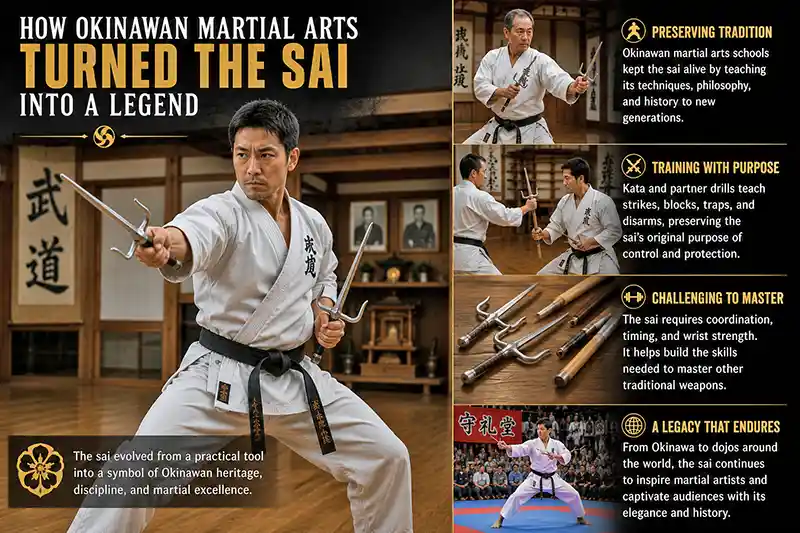
Even after the sai faded from everyday use, it found a new life inside Okinawan martial arts. Schools dedicated to preserving traditional weapons recognized that the sai offered far more than impressive spinning techniques. It taught timing, coordination, precision, and the ability to control an opponent without relying on a sharpened blade. As generations of practitioners passed those skills to their students, the weapon evolved from a practical tool into a respected symbol of martial arts tradition.
Modern sai training focuses on structured forms known as kata, where practitioners practice strikes, blocks, traps, and fluid transitions with a matched pair of weapons. These carefully choreographed movements preserve techniques that might otherwise have disappeared. Many students also train with partner drills that demonstrate how the sai can intercept attacks from swords, staffs, and other traditional weapons, reinforcing the principles that made it so effective centuries ago.
Because the sai requires both hands to work together independently, many instructors consider it one of the more challenging traditional weapons to master. Success depends on balance, wrist strength, and precise timing rather than raw power. Students who become comfortable with the sai often find it easier to transition to other classic Okinawan weapons, including the bo staff and the three-section staff, both of which emphasize coordination and body control in different ways.
Today, demonstrations featuring the sai remain a highlight at martial arts tournaments and cultural festivals around the world. Although few people carry the weapon for its original purpose, its elegant movements and rich history continue to inspire new generations of martial artists, ensuring that one of Okinawa's most distinctive weapons will never be forgotten.
For much of its history, the sai was known primarily within Okinawa and among martial artists who studied traditional weapons. That changed dramatically during the second half of the twentieth century, when martial arts films introduced audiences around the world to a wide variety of Asian weapons. The sai's unusual shape and flashy spinning techniques made it an instant favorite with filmmakers looking for something visually distinctive.
Unlike swords or staffs, the sai could be twirled, flipped, and manipulated with incredible speed, creating exciting action scenes that stood out on screen. Choreographers often exaggerated its offensive capabilities, portraying it as a weapon capable of effortlessly blocking blades, piercing armor, or defeating multiple opponents at once. While entertaining, these scenes blurred the line between historical fact and cinematic fiction.
The weapon's popularity only grew as comic books, cartoons, and video games embraced the same imagery. For many people, their very first introduction to the sai came through popular entertainment rather than history books or martial arts schools. As a result, generations of fans came to associate the weapon with fearless heroes, mysterious warriors, and legendary ninjas instead of the Ryukyuan officials who likely carried it centuries earlier.
Ironically, this pop culture explosion helped preserve interest in the sai. Many students first discovered the weapon through movies or television before seeking out authentic instruction in traditional Okinawan martial arts. In that way, fiction played an unexpected role in keeping the sai alive, encouraging countless martial artists to explore the weapon's genuine history and appreciate why it remains one of the most distinctive entries among history's strangest real weapons.
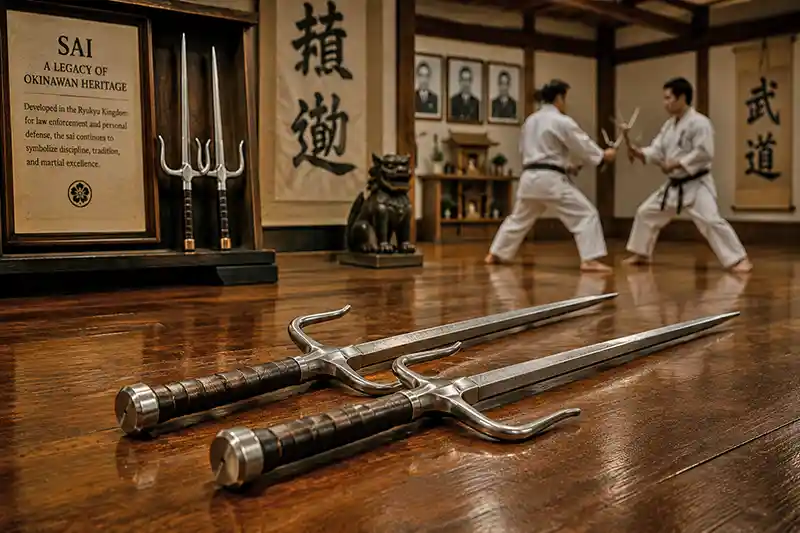
Few traditional weapons are as instantly recognizable as the sai. Even people with little knowledge of martial arts can usually identify its distinctive shape, a testament to the lasting impression it has made over centuries of history and decades of popular culture. Unlike many historical weapons that have faded into obscurity, the sai continues to thrive in martial arts schools, demonstrations, museums, and private collections around the world.
Part of that enduring appeal comes from its unique blend of elegance and practicality. The sai isn't the largest or deadliest weapon ever created, but its clever design rewards precision, discipline, and technical skill. Every movement has a purpose, whether it's trapping an opponent's weapon, delivering a controlled strike, or transitioning smoothly into a defensive position. That combination of beauty and function continues to attract students looking to expand their understanding of traditional martial arts.
The sai also serves as a reminder that history is often more interesting than legend. While countless stories have linked it to ninjas, secret assassins, and mythical origins, the evidence points toward a weapon that was developed for maintaining order rather than creating chaos. Understanding that history gives modern practitioners an even greater appreciation for what the sai represents and how it earned its place alongside other classic weapons like the escrima stick and the nunchaku.
Whether you're fascinated by Okinawan history, collecting traditional weapons, or simply curious about the stories behind martial arts equipment, the sai continues to stand out as one of history's most remarkable designs. Its journey from the streets of the Ryukyu Kingdom to dojos across the globe proves that a weapon doesn't have to dominate the battlefield to leave a lasting mark on history.
The sai could be used to trap or control a bladed weapon between its central shaft and side prongs, but the idea that it routinely snapped swords in half is largely exaggerated. A skilled practitioner could redirect a blade, limit an opponent's movement, or create an opening for a counterattack, but breaking a well-made sword would have been extremely difficult.
Its real advantage was control. Rather than relying on raw power, the sai gave trained users a way to manipulate an opponent's weapon while staying close enough to strike, restrain, or disarm them. That made it especially useful for law enforcement and self-defense, where stopping a threat could matter more than delivering a lethal blow.
In most places, carrying a traditional sai for self-defense is not practical and may not even be legal. Because it is designed as a martial arts weapon, many jurisdictions regulate or prohibit carrying it in public. Laws vary widely depending on your country, state, or local government, so it's important to check the regulations where you live before purchasing or transporting one.
Today, the vast majority of sai are owned for martial arts training, demonstrations, collecting, or historical appreciation rather than personal protection. In traditional Okinawan systems, students use them to develop coordination, precision, and an understanding of classical weapons techniques under qualified instruction.
If your goal is everyday personal protection, there are more practical tools designed specifically for modern self-defense. The sai's true value lies in its rich history, elegant design, and enduring role in traditional martial arts, making it far more significant as a cultural artifact than as an everyday defensive weapon.
Sai are traditionally sized to match the height and arm length of the person using them. A common guideline is that the tip of the center prong should reach roughly to the user's elbow when the handle is held in the hand. This provides a balance between reach, control, and maneuverability during kata and training exercises.
Shorter sai are generally quicker to manipulate and easier to spin, while longer versions offer greater reach but can be more difficult to control. Experienced practitioners often choose a size based on their training style and personal preference, but beginners are usually encouraged to start with a properly fitted pair rather than simply buying the longest model available.
You'll also find training sai made from lightweight aluminum alongside traditional steel versions. Aluminum sai are popular for practicing forms because they reduce fatigue, while steel sai more closely match the weight and feel of the historical weapons. Regardless of the material, proper sizing and technique have a much greater impact on performance than simply choosing the heaviest pair available.
Absolutely. The sai is still taught in many traditional Okinawan martial arts, particularly in kobudo, where it is considered one of the core classical weapons. Students typically begin by learning how to hold, carry, and strike with the weapon before progressing to more advanced techniques such as trapping, blocking, and spinning. Training also includes kata, which are choreographed forms that preserve centuries-old techniques and principles.
Modern instruction places a strong emphasis on control and safety. Beginners often practice with lightweight training sai before advancing to heavier steel versions, allowing them to develop proper mechanics without unnecessary strain. Instructors focus on precision and discipline rather than speed, helping students build confidence while respecting the weapon's historical purpose.
Although very few people will ever use a sai outside of the dojo, learning the weapon provides valuable insight into Okinawan martial arts and the ingenuity behind traditional self-defense systems. For many practitioners, mastering the sai is less about combat and more about preserving a fascinating piece of martial arts history that continues to inspire students around the world.
Not all sai are made for the same purpose. Traditional training sai are designed with proper balance, weight, and durability so they can withstand years of practice. They typically feature solid steel construction, symmetrical proportions, and carefully shaped prongs that reflect the designs used in Okinawan martial arts.
Decorative sai, on the other hand, are often intended for display rather than training. They may use lightweight materials, ornamental finishes, or exaggerated designs that look impressive on a wall but don't provide the balance or strength needed for regular practice. Some decorative versions even include oversized guards or fantasy-inspired styling that has little connection to historical examples.
If you're interested in learning kobudo or practicing kata, choosing a quality training pair is far more important than selecting the flashiest design. A well-made sai should feel balanced and comfortable in the hands, allowing you to develop proper technique while appreciating the craftsmanship of one of Okinawa's most iconic traditional weapons.
The sai's distinctive three-pronged design wasn't created simply to make the weapon look unique. The long center shaft served as the primary striking surface, while the two curved side prongs, known as yoku, gave the weapon several defensive advantages. They could help protect the user's hand, catch or redirect an opponent's weapon, and provide additional leverage when controlling or disarming an attacker.
The shape also made the sai surprisingly versatile. Practitioners could hold it in different positions depending on the situation, allowing for quick transitions between defensive blocks, strikes, and weapon-retention techniques. This flexibility is one reason the sai remains a staple of traditional Okinawan kobudo training today.
Although the three-pronged design has inspired countless myths over the years, its purpose was rooted in practicality rather than mystery. Every part of the weapon serves a function, reflecting the thoughtful engineering that helped make the sai one of history's most recognizable martial arts weapons.
Despite the frequent comparisons between the two, there is little historical evidence that samurai commonly carried or trained with the sai. The weapon is closely associated with Okinawa and its indigenous martial traditions, while samurai primarily relied on weapons such as the katana, spear, bow, and naginata. The two cultures developed along different paths, even though Okinawa and mainland Japan eventually became politically connected.
The confusion often comes from movies and television, where martial arts weapons from different regions are mixed together without much concern for historical accuracy. It's common to see a samurai character carrying a sai or using one alongside a katana, even though that combination would have been highly unusual in real life.
Understanding the distinction helps highlight the sai's true origins. Rather than being another weapon in the samurai arsenal, it stands as a unique symbol of Okinawan martial arts and the rich traditions that developed independently from those of feudal Japan.
Unlike many traditional weapons, the sai was almost always intended to be used as a pair. Carrying one in each hand gave the user a significant advantage by allowing them to defend and attack simultaneously. One sai could block or trap an incoming weapon while the other was positioned to strike, making the fighting style highly adaptable and fluid.
Using two sai also improved balance and versatility. Practitioners could switch between offensive and defensive movements without needing to change grips or reposition a single weapon. This dual-weapon approach became a defining characteristic of sai techniques and remains an important part of traditional kobudo training today.
Although skilled martial artists sometimes practice forms using a single sai to develop specific techniques, the weapon was designed to function as a matched set. That is why authentic training and demonstrations almost always feature two identical sai rather than just one.
While steel is the material most people associate with the sai today, not every version is made from solid metal. Modern martial arts schools often use lightweight aluminum sai for beginners because they are easier to handle during long practice sessions and reduce fatigue while students learn proper technique.
More experienced practitioners frequently train with steel sai that more closely replicate the weight and balance of traditional designs. These heavier versions help develop strength, control, and realistic handling, making them the preferred choice for advanced kata and demonstrations.
You'll also find decorative sai made from stainless steel, zinc alloys, wood, or even plastic for display or costume purposes. Although these versions may resemble authentic weapons, they are generally not intended for serious martial arts training. For anyone interested in learning traditional Okinawan kobudo, a properly balanced training sai is far more important than the material or decorative finish.
The Farming Tool Myth: Was the Sai Ever an Agricultural Tool?
If you've ever taken a martial arts class or watched a documentary about Okinawa, you've probably heard the story that the sai started life as a simple farming tool. According to the popular version of the tale, Okinawan farmers secretly sharpened everyday implements into weapons after rulers banned swords. It's a compelling story, but historians have found surprisingly little evidence to support it.
Unlike tools such as the kama, which clearly evolved from a farming sickle, the sai doesn't closely resemble any common agricultural implement from Okinawa or neighboring regions. Its symmetrical design, heavy metal construction, and distinctive side prongs would have made it awkward for farming but remarkably effective for controlling another person's weapon. That has led many researchers to believe the sai was designed with defense in mind from the very beginning.
The confusion likely comes from the broader history of Okinawan martial arts, where several genuine farming tools were adapted into weapons over time. Because people often lump traditional martial arts weapons together, the sai inherited the same origin story even though its design tells a different story. Today, historians generally consider the "farming tool" explanation to be more legend than fact.
That doesn't make the sai any less fascinating. In fact, its true origins are arguably more interesting because they suggest the weapon may have been created for a very specific purpose that had little to do with farming and everything to do with maintaining order. As you'll see, the people most closely associated with the sai weren't farmers at all.
The Kingdom of Ryukyu and the Birth of the Sai
To understand where the sai really came from, you have to travel to the Ryukyu Kingdom, an island nation that once occupied what is now Okinawa, Japan. Long before Okinawa became part of Japan in the late 1800s, the Ryukyu Kingdom was a thriving center of trade that connected China, Japan, Korea, and Southeast Asia. As merchants, diplomats, and travelers moved through the islands, they brought with them new ideas, cultures, and weapons. The sai likely developed during this period of cultural exchange rather than appearing suddenly from a single invention.
Although no one can say with complete certainty where the sai originated, historians have found similar three-pronged metal weapons in parts of China, India, and Southeast Asia that predate the Okinawan version. Rather than being copied directly, the Okinawan sai appears to have evolved into its own distinct design, becoming shorter, sturdier, and better suited for close-quarters control. Over time, it became closely associated with the Ryukyu Kingdom's local officials rather than its soldiers or farmers.
Unlike a sword, the sai wasn't intended to deliver devastating cuts. Its thick central shaft could strike with tremendous force, while its curved side prongs allowed the user to trap, redirect, or even disarm an opponent wielding a blade. That defensive design made it especially valuable in crowded streets where lethal force wasn't always the best solution.
As the weapon became more closely tied to public officials, it developed a reputation as a symbol of authority. While swords remained the weapon of warriors, the sai increasingly found a different role, one that emphasized restraint and control instead of battlefield combat. That distinction would eventually make it one of the most recognizable weapons in Okinawan history and set it apart from many of the other traditional martial arts weapons that evolved for war.
How Law Enforcement Used the Sai
One of the biggest clues to the sai's true purpose is who carried it. Rather than being issued to soldiers marching into battle, the weapon was most commonly associated with law enforcement officials in the Ryukyu Kingdom. These officials were responsible for keeping the peace, settling disputes, and apprehending suspects, making a weapon built for control far more practical than one designed solely to kill.
The sai's unique shape made it ideal for that job. Its sturdy center shaft could deliver powerful strikes when necessary, but the curved side prongs gave the wielder another advantage. They could catch, pin, or redirect an opponent's weapon, creating an opportunity to disarm them without relying on a fatal blow. Against a sword, spear, or staff, a skilled user could manipulate the attack instead of simply trying to overpower it.
That defensive role helps explain why the sai never developed a sharpened blade. Unlike a samurai sword, which was designed to cut through an opponent, the sai emphasized restraint. It reflected the responsibilities of someone tasked with enforcing the law rather than fighting wars. In many situations, capturing a suspect alive was far more valuable than defeating one on the battlefield.
Historical records describing exactly how Ryukyuan officials carried or trained with the sai are limited, but martial arts traditions have preserved many of the techniques that highlight its intended use. Blocks, traps, locks, and disarms remain central to modern sai training, reinforcing the idea that this remarkable weapon was designed as much for control as for combat. That practical philosophy is one of the reasons the sai continues to stand out among the most famous Asian weapons still practiced today.
Was the Sai Actually Meant to Stab?
At first glance, the sai certainly looks like a stabbing weapon. Its long center prong resembles the blade of a short spear, leading many people to assume it was designed to pierce armor or deliver deadly thrusts. While a powerful strike with a sai could certainly injure an opponent, that's probably not what the weapon was originally intended to do.
Unlike a knife or sword, the traditional sai wasn't sharpened. The central shaft usually ended in a rounded or slightly pointed tip rather than a razor-sharp edge. This allowed it to strike with tremendous force without relying on cutting power. A blow from a heavy steel sai could break bones or disable an attacker, but it was far less likely to produce the deep slashing wounds associated with bladed weapons.
Its greatest strength came from the curved side prongs, known as the yoku. Skilled practitioners could use them to catch an incoming sword, twist it off line, or pin it long enough to create an opening. The sai could also hook behind an opponent's wrist, arm, or even another weapon, giving the user exceptional control during close-range encounters. These techniques remain central to modern training with the traditional sai, where precision and leverage are valued more than brute force.
That emphasis on trapping and controlling opponents is one reason the sai has remained such a respected martial arts weapon. Rather than overwhelming an enemy with cutting power, it rewarded timing, technique, and discipline. It's a philosophy shared by several classic Okinawan weapons, including the tonfa, where mastery depends as much on skill as on strength.
Why the Sai Became Associated with Ninjas
Ask someone to picture a sai, and there's a good chance they'll imagine a ninja dressed in black slipping through the shadows. It's one of the strongest associations in popular culture, but historically, there's very little evidence that the sai was ever a standard ninja weapon. Its reputation owes far more to movies, television, comic books, and martial arts demonstrations than to documented history.
The confusion is understandable. Ninjas have long been credited with using almost every unusual weapon imaginable, from blowguns to hidden blades and throwing stars. As those legends grew, the sai was eventually added to the list. In reality, historical accounts of ninja equipment rarely mention the weapon, and when they do, it isn't portrayed as a defining part of their arsenal. If you're interested in separating fact from fiction, our article on how ninja weapons were really used explores many of these misconceptions in greater detail.
Much of the sai's modern popularity can be traced to the explosion of martial arts films during the 1960s and 1970s, followed by comic books and television in the decades that followed. The weapon's distinctive silhouette made it instantly recognizable on screen, and performers loved the dramatic spinning techniques that showcased speed and precision. Those eye-catching demonstrations cemented the idea that the sai belonged in every ninja's hands, even if history told a different story.
Ironically, the real history of the sai is arguably more fascinating than the myth. Rather than being the secret weapon of covert assassins, it was a practical tool carried by officials responsible for keeping order. That blend of historical significance and martial arts elegance is one reason the sai continues to rank among today's most popular ninja weapons, even though its true story began far from the world of legendary spies.
How Okinawan Martial Arts Turned the Sai into a Legend
Even after the sai faded from everyday use, it found a new life inside Okinawan martial arts. Schools dedicated to preserving traditional weapons recognized that the sai offered far more than impressive spinning techniques. It taught timing, coordination, precision, and the ability to control an opponent without relying on a sharpened blade. As generations of practitioners passed those skills to their students, the weapon evolved from a practical tool into a respected symbol of martial arts tradition.
Modern sai training focuses on structured forms known as kata, where practitioners practice strikes, blocks, traps, and fluid transitions with a matched pair of weapons. These carefully choreographed movements preserve techniques that might otherwise have disappeared. Many students also train with partner drills that demonstrate how the sai can intercept attacks from swords, staffs, and other traditional weapons, reinforcing the principles that made it so effective centuries ago.
Because the sai requires both hands to work together independently, many instructors consider it one of the more challenging traditional weapons to master. Success depends on balance, wrist strength, and precise timing rather than raw power. Students who become comfortable with the sai often find it easier to transition to other classic Okinawan weapons, including the bo staff and the three-section staff, both of which emphasize coordination and body control in different ways.
Today, demonstrations featuring the sai remain a highlight at martial arts tournaments and cultural festivals around the world. Although few people carry the weapon for its original purpose, its elegant movements and rich history continue to inspire new generations of martial artists, ensuring that one of Okinawa's most distinctive weapons will never be forgotten.
The Sai in Movies, TV, and Pop Culture
For much of its history, the sai was known primarily within Okinawa and among martial artists who studied traditional weapons. That changed dramatically during the second half of the twentieth century, when martial arts films introduced audiences around the world to a wide variety of Asian weapons. The sai's unusual shape and flashy spinning techniques made it an instant favorite with filmmakers looking for something visually distinctive.
Unlike swords or staffs, the sai could be twirled, flipped, and manipulated with incredible speed, creating exciting action scenes that stood out on screen. Choreographers often exaggerated its offensive capabilities, portraying it as a weapon capable of effortlessly blocking blades, piercing armor, or defeating multiple opponents at once. While entertaining, these scenes blurred the line between historical fact and cinematic fiction.
The weapon's popularity only grew as comic books, cartoons, and video games embraced the same imagery. For many people, their very first introduction to the sai came through popular entertainment rather than history books or martial arts schools. As a result, generations of fans came to associate the weapon with fearless heroes, mysterious warriors, and legendary ninjas instead of the Ryukyuan officials who likely carried it centuries earlier.
Ironically, this pop culture explosion helped preserve interest in the sai. Many students first discovered the weapon through movies or television before seeking out authentic instruction in traditional Okinawan martial arts. In that way, fiction played an unexpected role in keeping the sai alive, encouraging countless martial artists to explore the weapon's genuine history and appreciate why it remains one of the most distinctive entries among history's strangest real weapons.
Why the Sai Remains One of the World's Most Recognizable Martial Arts Weapons
Few traditional weapons are as instantly recognizable as the sai. Even people with little knowledge of martial arts can usually identify its distinctive shape, a testament to the lasting impression it has made over centuries of history and decades of popular culture. Unlike many historical weapons that have faded into obscurity, the sai continues to thrive in martial arts schools, demonstrations, museums, and private collections around the world.
Part of that enduring appeal comes from its unique blend of elegance and practicality. The sai isn't the largest or deadliest weapon ever created, but its clever design rewards precision, discipline, and technical skill. Every movement has a purpose, whether it's trapping an opponent's weapon, delivering a controlled strike, or transitioning smoothly into a defensive position. That combination of beauty and function continues to attract students looking to expand their understanding of traditional martial arts.
The sai also serves as a reminder that history is often more interesting than legend. While countless stories have linked it to ninjas, secret assassins, and mythical origins, the evidence points toward a weapon that was developed for maintaining order rather than creating chaos. Understanding that history gives modern practitioners an even greater appreciation for what the sai represents and how it earned its place alongside other classic weapons like the escrima stick and the nunchaku.
Whether you're fascinated by Okinawan history, collecting traditional weapons, or simply curious about the stories behind martial arts equipment, the sai continues to stand out as one of history's most remarkable designs. Its journey from the streets of the Ryukyu Kingdom to dojos across the globe proves that a weapon doesn't have to dominate the battlefield to leave a lasting mark on history.
Frequently Asked Questions About the Sai
Was the sai really used to catch and break swords?
The sai could be used to trap or control a bladed weapon between its central shaft and side prongs, but the idea that it routinely snapped swords in half is largely exaggerated. A skilled practitioner could redirect a blade, limit an opponent's movement, or create an opening for a counterattack, but breaking a well-made sword would have been extremely difficult.
Its real advantage was control. Rather than relying on raw power, the sai gave trained users a way to manipulate an opponent's weapon while staying close enough to strike, restrain, or disarm them. That made it especially useful for law enforcement and self-defense, where stopping a threat could matter more than delivering a lethal blow.
Can You Carry a Sai for Self-Defense Today?
In most places, carrying a traditional sai for self-defense is not practical and may not even be legal. Because it is designed as a martial arts weapon, many jurisdictions regulate or prohibit carrying it in public. Laws vary widely depending on your country, state, or local government, so it's important to check the regulations where you live before purchasing or transporting one.
Today, the vast majority of sai are owned for martial arts training, demonstrations, collecting, or historical appreciation rather than personal protection. In traditional Okinawan systems, students use them to develop coordination, precision, and an understanding of classical weapons techniques under qualified instruction.
If your goal is everyday personal protection, there are more practical tools designed specifically for modern self-defense. The sai's true value lies in its rich history, elegant design, and enduring role in traditional martial arts, making it far more significant as a cultural artifact than as an everyday defensive weapon.
Why Do Sai Come in Different Sizes?
Sai are traditionally sized to match the height and arm length of the person using them. A common guideline is that the tip of the center prong should reach roughly to the user's elbow when the handle is held in the hand. This provides a balance between reach, control, and maneuverability during kata and training exercises.
Shorter sai are generally quicker to manipulate and easier to spin, while longer versions offer greater reach but can be more difficult to control. Experienced practitioners often choose a size based on their training style and personal preference, but beginners are usually encouraged to start with a properly fitted pair rather than simply buying the longest model available.
You'll also find training sai made from lightweight aluminum alongside traditional steel versions. Aluminum sai are popular for practicing forms because they reduce fatigue, while steel sai more closely match the weight and feel of the historical weapons. Regardless of the material, proper sizing and technique have a much greater impact on performance than simply choosing the heaviest pair available.
Do Martial Artists Still Learn to Use the Sai?
Absolutely. The sai is still taught in many traditional Okinawan martial arts, particularly in kobudo, where it is considered one of the core classical weapons. Students typically begin by learning how to hold, carry, and strike with the weapon before progressing to more advanced techniques such as trapping, blocking, and spinning. Training also includes kata, which are choreographed forms that preserve centuries-old techniques and principles.
Modern instruction places a strong emphasis on control and safety. Beginners often practice with lightweight training sai before advancing to heavier steel versions, allowing them to develop proper mechanics without unnecessary strain. Instructors focus on precision and discipline rather than speed, helping students build confidence while respecting the weapon's historical purpose.
Although very few people will ever use a sai outside of the dojo, learning the weapon provides valuable insight into Okinawan martial arts and the ingenuity behind traditional self-defense systems. For many practitioners, mastering the sai is less about combat and more about preserving a fascinating piece of martial arts history that continues to inspire students around the world.
What's the Difference Between Okinawan Sai and Decorative Sai?
Not all sai are made for the same purpose. Traditional training sai are designed with proper balance, weight, and durability so they can withstand years of practice. They typically feature solid steel construction, symmetrical proportions, and carefully shaped prongs that reflect the designs used in Okinawan martial arts.
Decorative sai, on the other hand, are often intended for display rather than training. They may use lightweight materials, ornamental finishes, or exaggerated designs that look impressive on a wall but don't provide the balance or strength needed for regular practice. Some decorative versions even include oversized guards or fantasy-inspired styling that has little connection to historical examples.
If you're interested in learning kobudo or practicing kata, choosing a quality training pair is far more important than selecting the flashiest design. A well-made sai should feel balanced and comfortable in the hands, allowing you to develop proper technique while appreciating the craftsmanship of one of Okinawa's most iconic traditional weapons.
Why Does the Sai Have Three Prongs?
The sai's distinctive three-pronged design wasn't created simply to make the weapon look unique. The long center shaft served as the primary striking surface, while the two curved side prongs, known as yoku, gave the weapon several defensive advantages. They could help protect the user's hand, catch or redirect an opponent's weapon, and provide additional leverage when controlling or disarming an attacker.
The shape also made the sai surprisingly versatile. Practitioners could hold it in different positions depending on the situation, allowing for quick transitions between defensive blocks, strikes, and weapon-retention techniques. This flexibility is one reason the sai remains a staple of traditional Okinawan kobudo training today.
Although the three-pronged design has inspired countless myths over the years, its purpose was rooted in practicality rather than mystery. Every part of the weapon serves a function, reflecting the thoughtful engineering that helped make the sai one of history's most recognizable martial arts weapons.
Did Samurai Ever Use the Sai?
Despite the frequent comparisons between the two, there is little historical evidence that samurai commonly carried or trained with the sai. The weapon is closely associated with Okinawa and its indigenous martial traditions, while samurai primarily relied on weapons such as the katana, spear, bow, and naginata. The two cultures developed along different paths, even though Okinawa and mainland Japan eventually became politically connected.
The confusion often comes from movies and television, where martial arts weapons from different regions are mixed together without much concern for historical accuracy. It's common to see a samurai character carrying a sai or using one alongside a katana, even though that combination would have been highly unusual in real life.
Understanding the distinction helps highlight the sai's true origins. Rather than being another weapon in the samurai arsenal, it stands as a unique symbol of Okinawan martial arts and the rich traditions that developed independently from those of feudal Japan.
Why Is the Sai Usually Carried in Pairs?
Unlike many traditional weapons, the sai was almost always intended to be used as a pair. Carrying one in each hand gave the user a significant advantage by allowing them to defend and attack simultaneously. One sai could block or trap an incoming weapon while the other was positioned to strike, making the fighting style highly adaptable and fluid.
Using two sai also improved balance and versatility. Practitioners could switch between offensive and defensive movements without needing to change grips or reposition a single weapon. This dual-weapon approach became a defining characteristic of sai techniques and remains an important part of traditional kobudo training today.
Although skilled martial artists sometimes practice forms using a single sai to develop specific techniques, the weapon was designed to function as a matched set. That is why authentic training and demonstrations almost always feature two identical sai rather than just one.
Are All Sai Made of Metal?
While steel is the material most people associate with the sai today, not every version is made from solid metal. Modern martial arts schools often use lightweight aluminum sai for beginners because they are easier to handle during long practice sessions and reduce fatigue while students learn proper technique.
More experienced practitioners frequently train with steel sai that more closely replicate the weight and balance of traditional designs. These heavier versions help develop strength, control, and realistic handling, making them the preferred choice for advanced kata and demonstrations.
You'll also find decorative sai made from stainless steel, zinc alloys, wood, or even plastic for display or costume purposes. Although these versions may resemble authentic weapons, they are generally not intended for serious martial arts training. For anyone interested in learning traditional Okinawan kobudo, a properly balanced training sai is far more important than the material or decorative finish.
You May Also Be Interested In:
- The Real History of the Jutte (And Why Samurai Carried It)
- The Real History of Nunchaku: From Farm Tool to Martial Arts Icon
- The History of the Medieval Flail Weapon
- The Hidden History of the Bolas: The Ancient Weapon That Could Stop You in Your Tracks
- The History of the Poleaxe: The Weapon That Gave Knights an Edge Against Armor
- Kukri vs Machete: What's the Real Difference?
- Real vs. Decorative Samurai Swords: What You Need to Know
- Our Top Superhero Inspired Weapons In Real Life!
- The Strangest Weapons Ever Carried Into Real Battles
- Why Are Karate Uniforms White? The Real Meaning Explained
Leave a Reply