



Does Breaking Boards Actually Prove Striking Power?
August 13th, 2026
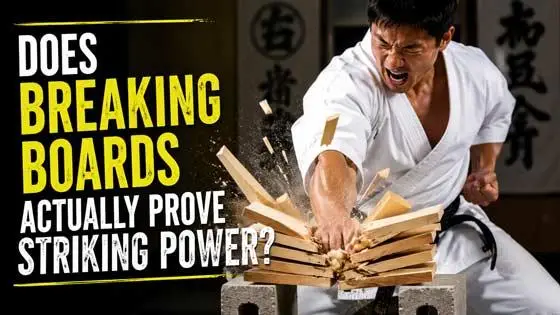
Breaking wooden boards has become one of the most recognizable demonstrations in martial arts. A practitioner lines up a punch, palm strike, elbow, or kick, explodes through the target, and sends pieces of wood flying while everyone watching immediately assumes they have just witnessed tremendous striking power. But does breaking a board actually prove that someone can hit hard? The answer is more complicated than it looks. Board breaking involves speed, technique, accuracy, commitment, material strength, grain direction, and even the way the board is supported. A successful break can demonstrate real martial arts skills, but it is not a simple measurement of raw power, and some impressive-looking breaks are far easier than others. Understanding why reveals much more about striking than the shattered wood itself.
Breaking a Board Is More About Technique Than Raw Strength
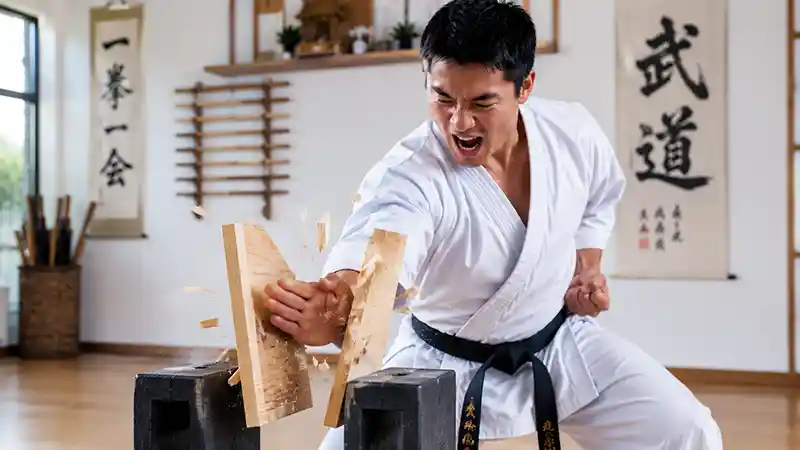
Watching someone smash through a wooden board makes the explanation seem obvious: they must have hit it incredibly hard. Striking force certainly matters, but raw strength alone does not explain why an experienced martial artist can break a board that an equally strong beginner may struggle to get through.
A successful break requires the practitioner to deliver force efficiently into a very specific target. The strike needs sufficient speed, proper body mechanics, accurate placement, and enough commitment to continue through the board rather than stopping at its surface. Poor alignment can waste energy, while hesitation can cause the striker to slow down at exactly the wrong moment.
This is one reason martial artists are often taught to aim beyond the board. The idea is not that the hand or foot literally needs to travel some enormous distance through the target. Instead, focusing beyond the surface encourages acceleration and follow-through rather than subconsciously treating the board as the stopping point.
The striking surface matters too. A palm heel, fist, knife hand, elbow, or foot concentrates force differently, and each requires proper alignment to transfer energy without unnecessarily increasing the chance of injury. Board breaking therefore tests whether several elements of a strike can come together at the same instant.
That makes breaking boards useful as a martial arts exercise, but it also explains why a successful break should not be interpreted as a direct measurement of someone's overall fighting ability. The board tells us that a particular strike delivered enough stress in the right place to fracture a particular piece of wood. That is real skill, but it is only one small piece of striking power.
The Board Is Designed to Break Along Its Weakest Direction
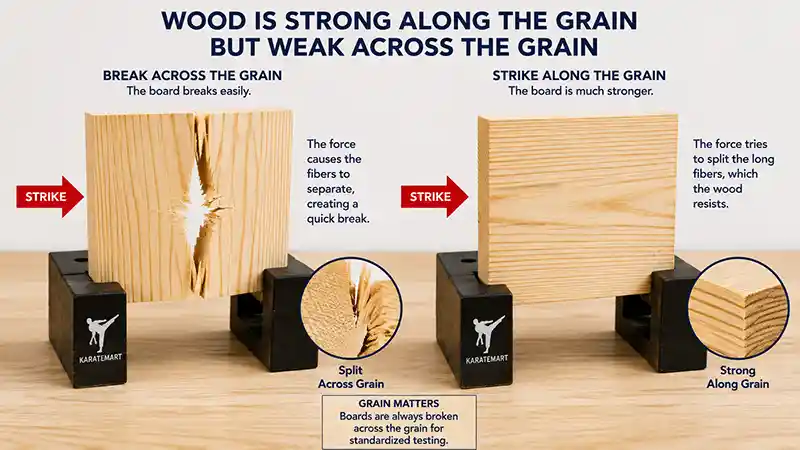
A wooden breaking board may look like a solid obstacle, but wood is not equally strong in every direction. Its internal fibers run primarily along the grain, creating a structure that can withstand much more force in some directions than others. Martial arts breaking takes advantage of this natural weakness.
When a board is positioned correctly, the strike causes it to bend across the grain. One side of the board is compressed while the opposite side is stretched. Once the stress exceeds what the wood fibers can tolerate, a crack begins and rapidly travels through the board.
Turn that same piece of wood the wrong way and the difficulty can change dramatically. Instead of forcing a fracture across relatively vulnerable grain structure, the striker may be fighting against the strength of long wood fibers running through the target. This is one reason standardized breaking matters when practitioners want meaningful comparisons.
The species of wood, thickness, width, moisture content, knots, grain pattern, and other imperfections can also affect how easily a board breaks. Two pieces of lumber with identical dimensions are not necessarily identical targets. A dry, straight-grained board may behave very differently from a dense board containing a large knot near the intended breaking point.
This is also why comparisons between rebreakable boards vs. wooden boards are more complicated than they initially appear. Wooden boards fail when their fibers fracture, while reusable boards are engineered to separate at a predetermined resistance. Both can test technique, but they are fundamentally different targets.
So when somebody breaks a board, they are not simply overpowering an arbitrary chunk of wood. They are applying force to a material with predictable structural weaknesses, and understanding those weaknesses is part of what makes breaking possible.
Speed Matters More Than Most People Realize
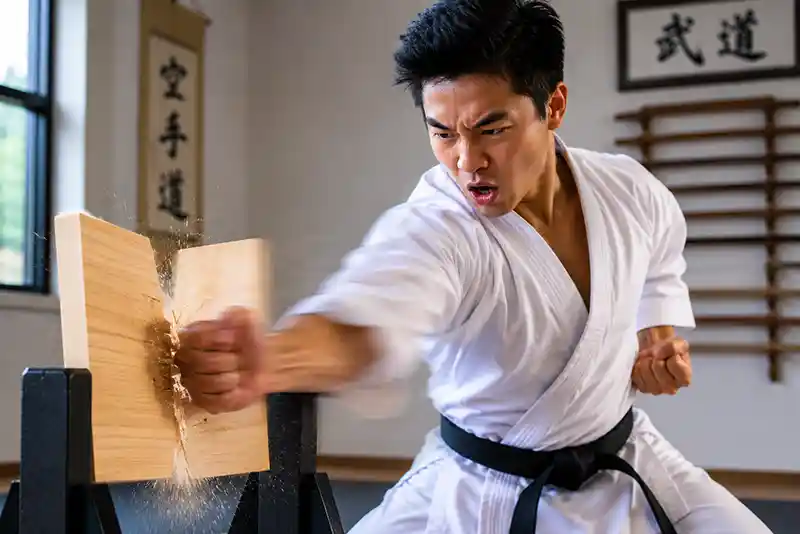
A powerful-looking physique can make a board break seem like a test of strength, but the speed of the strike plays an enormous role in what happens at impact. A relatively small person with fast, efficient technique can sometimes break a board more cleanly than a much stronger person who pushes into it slowly.
The reason comes down to how quickly momentum is transferred into the target. A fast-moving hand or foot arrives with substantial momentum, and when that motion is stopped or redirected over a very short period of time, the board experiences a sharp force. If enough stress develops before the wood can flex and absorb the impact, the fibers begin to fail.
This helps explain why trying to muscle through a board can actually produce disappointing results. A beginner may tense the entire body too early, slowing the strike before contact. An experienced practitioner can remain comparatively relaxed during acceleration and tighten the relevant muscles at the moment of impact, allowing more speed to reach the target.
Body mechanics add another layer. Rotation of the hips, movement of the torso, proper stance, and coordinated transfer of body mass can contribute to the strike. The practitioner is not merely swinging an arm or leg. When the movement is performed efficiently, different parts of the body contribute to one rapid collision with the board.
This is why good striking practice involves much more than simply becoming stronger. Proper martial arts training gear can help practitioners develop speed, accuracy, timing, and mechanics repeatedly before attempting harder breaking challenges.
Board breaking therefore does demonstrate something meaningful about power, but not necessarily the thing spectators assume. The person who breaks the board may not be the strongest person in the room. They may simply be much better at turning the strength they have into speed and delivering it efficiently at exactly the right moment.
Where You Hit the Board Can Matter as Much as How Hard You Hit It
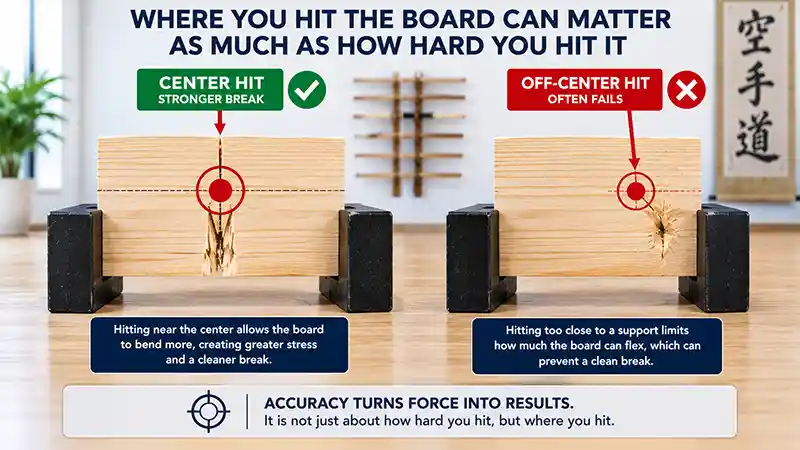
A board does not respond equally to a strike everywhere on its surface. Hit close to one of the supports and the wood has relatively little room to flex. Hit near the center, however, and the board can bend much more dramatically. That bending creates the stress that eventually causes the fibers to fracture.
This is why accuracy is such an important part of board breaking. A powerful strike that lands several inches away from the intended breaking point may fail, while a slightly less powerful strike delivered directly to the center can succeed. The difference is not necessarily that one person hits harder. One person may simply be putting the available force where it has the greatest effect.
The position of the supports matters for the same reason. When two people hold a board, or when it rests on a breaking stand, those supports determine how the wood can move when struck. Change the distance between them and you change the mechanical conditions of the break. Poorly supported boards can move backward instead of bending enough to fracture, making even a technically good strike much more difficult.
Accuracy also helps explain why breaking can have genuine training value. The practitioner is not merely trying to generate as much force as possible. They must direct that force into a relatively small target while maintaining proper alignment and committing fully to the strike. Those are skills that can be developed with other forms of martial arts conditioning as well.
So a clean break can demonstrate something that a simple strength test cannot: the ability to deliver force accurately. But once again, the broken board only tells us what happened under a very specific set of conditions. Move the target, change the supports, or miss the center, and the result can be completely different.
One Board and Five Boards Are Not Five Times as Difficult
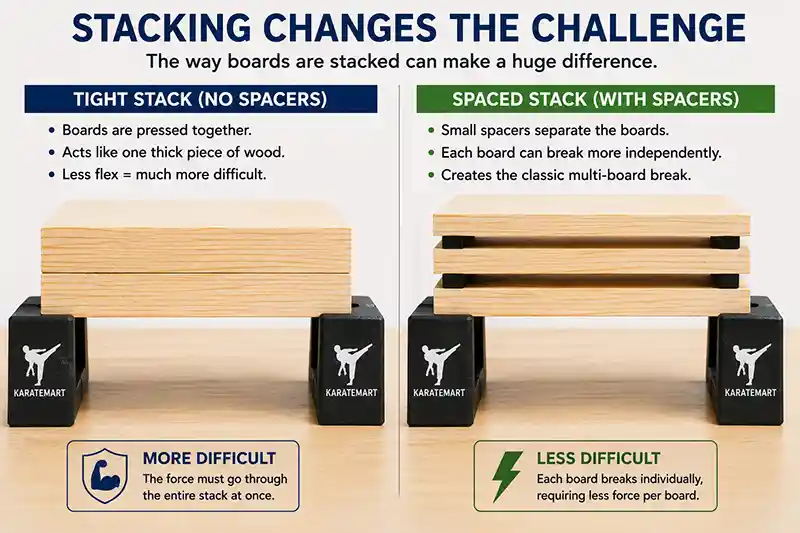
Stacking several boards together looks like a straightforward way to multiply the difficulty of a break. If one board requires a certain amount of force, it seems logical that five boards should require five times as much. In reality, the mechanics change depending on exactly how those boards are arranged.
One of the biggest variables is whether spacers are placed between them. With small gaps separating the boards, the first board can begin breaking before transferring the strike into the next. Each board behaves more like an individual target, producing the dramatic sequence of fractures commonly seen in martial arts demonstrations.
Remove those spacers and the challenge changes considerably. Several boards pressed tightly together behave more like a single thick structure. The stack has less opportunity to flex board by board, and the striker must create enough stress to drive the fracture through the entire group. That can make an unspaced stack substantially more difficult than a visually similar spaced break.
The boards themselves still matter too. Thickness, dimensions, grain, moisture, wood species, and defects can all influence the result. Ten carefully selected thin boards with spacers cannot automatically be compared with three thicker boards stacked tightly together simply by counting how many pieces of wood ended up on the floor.
This is one reason spectacular breaking demonstrations can be misleading when treated as measurements of absolute power. Breaking more boards usually represents a greater challenge when everything else is standardized, but the number alone tells us surprisingly little unless we also know exactly what was being broken and how the break was set up.
A towering stack can certainly require excellent technique and considerable commitment. It just does not give us a simple equation where twice as many boards automatically means twice as much striking power.
Rebreakable Boards Change What the Test Actually Measures
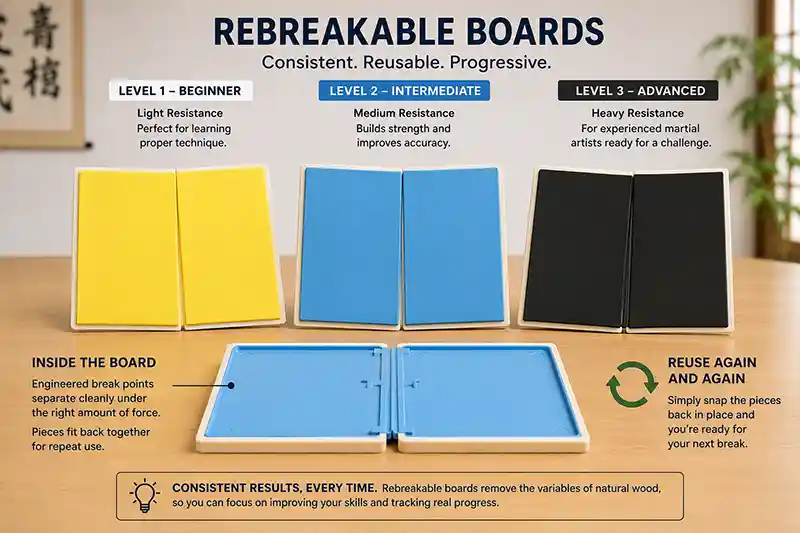
Wooden boards are naturally inconsistent. Even when two boards are cut to exactly the same dimensions, differences in grain, knots, density, moisture, and other characteristics can make one noticeably easier to break than another. Rebreakable boards were created in part to remove some of that unpredictability from training.
Instead of fracturing wood fibers, a rebreakable board is made from sections designed to separate when enough force is applied. After the break, the pieces can be fitted back together and used again. Different resistance levels can also allow students to progress from relatively easy breaks to much more challenging ones without constantly purchasing new lumber.
That consistency changes what the break tells us. If the same rebreakable board is used repeatedly under the same conditions, instructors have a more standardized target for evaluating improvements in technique. A student who initially struggles to separate a particular board but later breaks it consistently has evidence that something about the strike has improved.
But rebreakable boards are not perfect force-measuring instruments either. Their resistance depends on their construction, condition, temperature, wear, and how they are held. Different brands and resistance levels cannot automatically be compared with one another, and breaking a reusable board does not produce a precise measurement of force in pounds or newtons.
Understanding how rebreakable boards work makes their real value much clearer. They are useful because they provide a repeatable challenge, not because they function like laboratory equipment.
That distinction gets directly to the question behind this entire article. Breaking something can demonstrate that a strike crossed a particular threshold. It does not necessarily tell us exactly how powerful that strike was.
A Board Does Not Move, Flinch, or Hit Back
This is where board breaking stops being a particularly good stand-in for fighting. A breaking board is a stationary target positioned at a known distance. The practitioner can choose the stance, line up the strike, control the timing, and commit completely without worrying about what the target will do next.
A real opponent removes nearly all of those advantages. People move, change distance, protect themselves, absorb impacts differently, and rarely present a perfectly positioned target at exactly the moment you want to strike. A technically powerful punch means little if it misses, arrives from the wrong distance, or can only be delivered after several seconds of preparation.
There is another major difference: boards are brittle targets. The entire exercise is designed around creating enough stress to initiate a fracture. A human body contains skin, muscle, fat, connective tissue, flexible joints, and bones with very different mechanical properties. Breaking wood therefore cannot be translated into a simple prediction of what the same strike would do to a person.
This is where some of the biggest martial arts myths can creep in. Someone who can perform an extraordinary breaking demonstration may possess excellent speed, accuracy, body mechanics, conditioning, and commitment, but the demonstration does not automatically prove that person is an extraordinary fighter.
None of this makes board breaking fake. It simply means the test has limits. A sprinter's time does not tell you how good they are at basketball, even though sprinting ability is unquestionably athletic. In much the same way, breaking boards can reveal specific striking skills without measuring everything required to apply those skills against another person.
Conditioning Your Hands Does Not Automatically Make You Hit Harder
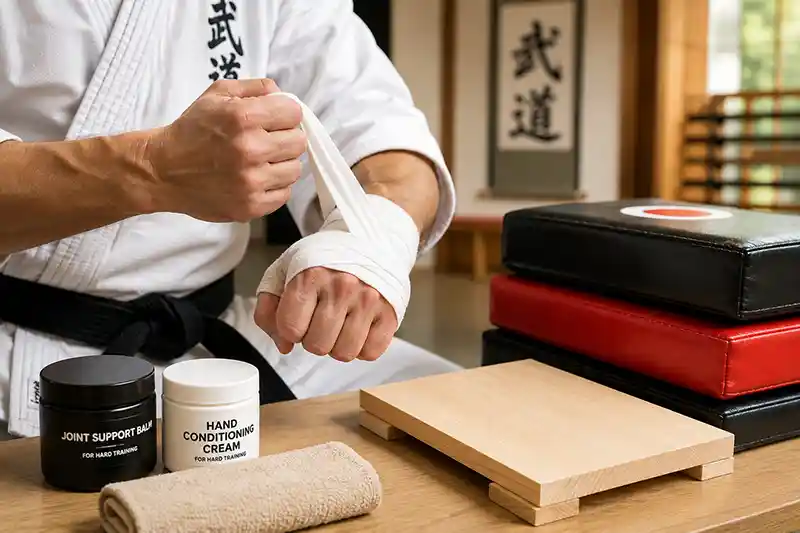
Board breaking is often associated with toughened knuckles, hardened hands, and years of striking solid objects. That connection makes sense on the surface. If someone can smash through wood without appearing bothered by the impact, their hands must have become extraordinarily powerful. But conditioning and striking power are not the same thing.
Physical conditioning can help a martial artist tolerate the stresses associated with certain training methods. Progressive practice may improve confidence in a striking surface and help practitioners maintain proper alignment when contact occurs. What it cannot do is magically create speed, timing, accuracy, or efficient body mechanics. A heavily conditioned hand attached to a poorly executed strike is still a poorly executed strike.
In fact, board breaking exposes why technique matters so much. The wrist must remain properly aligned during a punch. A palm strike needs to contact with the intended part of the hand. A knife-hand break requires accurate placement. If those structures collapse or the strike lands incorrectly, simply being accustomed to impact does not guarantee a successful break.
This is also where traditional martial arts training can drift into questionable territory. Some historical conditioning practices involved repeatedly striking extremely hard surfaces or subjecting the body to increasingly severe impacts. They may look impressive in old demonstrations, but more extreme does not automatically mean more effective. Our look at martial arts training methods that seem insane today shows just how far some conditioning traditions could go.
For board breaking, the useful lesson is simpler. Your striking surface needs to survive the collision, but making your hands progressively tougher is not a substitute for learning how to deliver force efficiently. The board ultimately breaks because of what the strike does to the wood, not because the person hitting it has the toughest knuckles in the dojo.
Confidence May Be One of the Most Important Things Board Breaking Builds
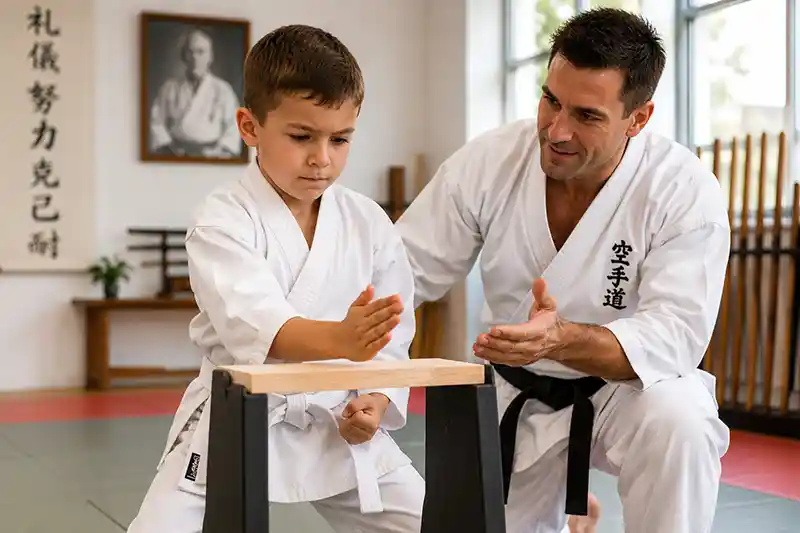
There is a psychological obstacle hidden inside every breaking board. Even when a student understands the technique, knows the board is breakable, and has successfully practiced the strike hundreds of times against pads, deliberately driving a hand or foot into a solid piece of wood can still trigger hesitation.
That hesitation matters. Pulling a strike at the last instant reduces speed and follow-through, which can turn an otherwise successful attempt into a painful failure. Ironically, being afraid that the board will hurt can cause the practitioner to strike in exactly the way most likely to make the attempt hurt.
Breaking therefore requires commitment. Once the strike begins, the student has to trust the technique and continue through the target rather than subconsciously stopping at its surface. Successfully doing that can provide immediate feedback in a way that hitting a pad cannot. The board either breaks or it does not.
This is one reason progressive breaking can be valuable even when nobody is trying to prove how hard they can hit. Students can begin with relatively manageable targets, develop consistent technique, and gradually increase the challenge. Repeated success can replace hesitation with confidence while still demanding accuracy and proper mechanics.
There is also an emotional component that helps explain why breaking remains popular in demonstrations, belt tests, and martial arts schools. The sound of the board snapping and the sight of the pieces falling away create an unmistakable moment of accomplishment. For a student who once believed they could never do it, that moment can be more memorable than any numerical measurement of striking force.
In that sense, the greatest value of board breaking may have surprisingly little to do with proving physical power. Sometimes the board is there to test whether the martial artist trusts their training enough to commit completely when the moment arrives.
Why Board Breaking Became Such a Popular Martial Arts Demonstration
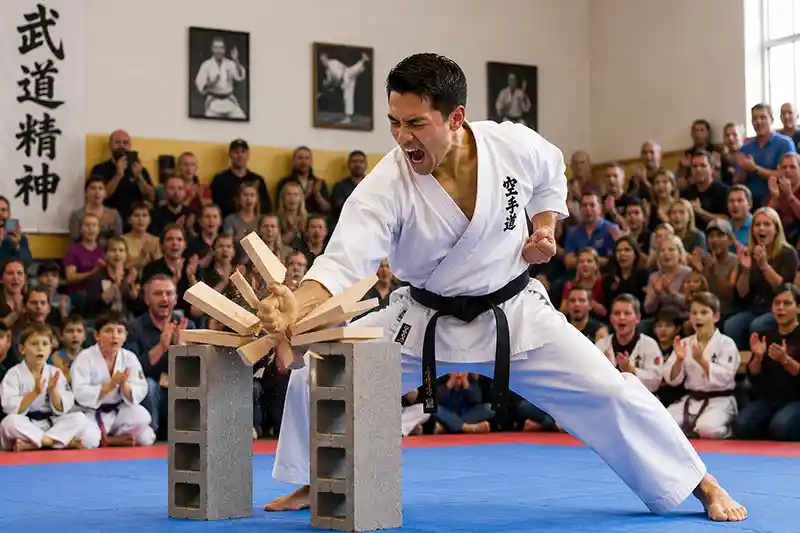
There is a reason martial arts demonstrations rarely end with someone simply throwing ten technically perfect punches into the air. To an experienced instructor, those punches might reveal excellent mechanics. To an audience, they can look almost identical to mediocre ones. Breaking a solid object gives everyone in the room an unmistakable result.
A board begins intact. The martial artist strikes it. A fraction of a second later, it is in pieces. No explanation is necessary, which makes breaking unusually effective as a public demonstration of martial arts skill.
That spectacle also magnifies the qualities breaking actually does require. Accuracy, speed, commitment, body alignment, and confidence all become visible in a single dramatic moment. Add multiple boards, difficult techniques, jumping kicks, or more challenging breaking materials and the demonstration becomes even more impressive to spectators.
The problem begins when spectacle is mistaken for measurement. Demonstrations can be arranged specifically to produce dramatic results. Board selection, grain orientation, spacers, support placement, thickness, and breaking technique can all influence how difficult a break really is. Two demonstrations that look equally impressive may represent very different challenges.
Even the famous yell accompanying many martial arts demonstrations can contribute to the spectacle, although the traditional martial arts yell has purposes beyond simply making a break look dramatic. Breathing, tension, focus, and commitment can all become part of the moment when a practitioner launches the strike.
None of this diminishes a legitimate breaking demonstration. Difficult breaks can require tremendous skill. It simply explains why board breaking became such a recognizable symbol of martial arts in the first place. It turns an invisible quality like striking technique into something an audience can see, hear, and understand instantly.
Breaking Can Reveal Bad Technique Just as Quickly as Good Technique
One of the most useful things about board breaking is that the target is brutally honest. A heavy bag can swing backward after a poorly aligned strike. Focus mitts can move with the impact. A breaking board gives much clearer feedback. Either the strike creates enough properly directed stress to fracture the target, or it does not.
A failed break can expose problems that are difficult to notice during ordinary practice. The practitioner may be slowing down before contact, striking away from the center, allowing the wrist to bend, failing to rotate the hips, or stopping the technique at the surface instead of following through. Sometimes the problem is not a lack of power at all.
That makes failure surprisingly useful. When the board remains intact, an instructor can examine what happened and make a specific correction. Move the striking point slightly. Improve the stance. Relax during acceleration. Correct the alignment. Commit farther through the target. The student can then attempt the same challenge again and immediately see whether the adjustment worked.
This feedback is especially valuable when the breaking conditions remain consistent. Using boards of similar dimensions or standardized rebreakable targets allows students to focus on changes in their technique rather than wondering whether the next piece of wood happens to be easier than the last one.
There is an important limitation, however. Repeatedly attacking a target that a student cannot break is not automatically productive training. The difficulty should match the practitioner's experience and technique. Board breaking works best as a controlled test of skills that have already been developed, not as a contest to see how much punishment someone's hand or foot can tolerate.
A board that refuses to break can therefore teach just as much as one that explodes on the first attempt. The failure does not necessarily say, "You aren't strong enough." Sometimes it says something much more useful: "Your power isn't reaching the target efficiently yet."
So Does Breaking Boards Actually Prove Striking Power?
Yes, but only within limits. If a martial artist breaks a properly supported board with a clean strike, they have demonstrated that they can generate and deliver enough force to overcome that particular target. Speed, accuracy, body mechanics, alignment, timing, and commitment all contribute to making that happen. The break is real, and so are the skills required to produce it.
What the broken board cannot tell us is exactly how powerful that person is compared with someone else. Change the thickness of the wood, grain orientation, moisture content, supports, spacers, number of boards, or breaking material and the difficulty changes. Without standardized conditions and actual measuring equipment, counting broken boards is a poor substitute for measuring force scientifically.
It tells us even less about fighting ability. A board never changes distance, blocks the strike, moves unexpectedly, or forces the martial artist to create an opening first. Someone can become exceptionally skilled at breaking while lacking other abilities necessary for sparring or competition. Likewise, an excellent fighter may have little experience breaking boards and perform surprisingly poorly the first time they try.
That does not make board breaking a gimmick. Used properly, it can test whether a practitioner is able to combine several important elements of striking into one committed technique. It can reveal flaws, build confidence, provide immediate feedback, and give students a tangible goal that becomes progressively more challenging as their skills improve.
The mistake is assuming the shattered wood proves more than it actually does. Breaking a board proves that you successfully broke a board under those particular conditions. How you accomplished it can reveal quite a bit about your striking technique, but the number of pieces on the floor will never tell the whole story.
Does Breaking Boards Actually Prove How Hard You Can Hit?
Breaking a board demonstrates that a martial artist can generate and deliver enough force to fracture that particular target, but it does not provide a precise measurement of striking power. Board thickness, wood type, grain direction, support placement, accuracy, speed, and technique all affect the difficulty of a break. A successful break can demonstrate effective striking mechanics, but it cannot tell you exactly how hard someone hits or how that power compares with another person.
Are Martial Arts Breaking Boards Weaker Than Normal Wood?
Martial arts breaking boards are real wood, but they are usually selected and prepared to provide a predictable breaking challenge. Boards are typically positioned so the strike bends them across the grain, where the wood is easier to fracture. Thickness, dimensions, wood species, moisture, knots, and grain pattern can all change the difficulty, which is why breaking a board should not be confused with smashing through an arbitrary piece of lumber.
How Hard Is It to Break a Wooden Board With Your Hand?
The difficulty depends heavily on the board and the technique being used. A relatively thin, properly supported breaking board can be surprisingly manageable for someone who has learned correct striking mechanics, while a thicker or poorly positioned board can be considerably more difficult. Speed, accuracy, alignment, follow-through, and confidence often matter more than simply having large or muscular arms.
Why Do Martial Artists Aim Through the Board Instead of at It?
Martial artists are commonly taught to visualize a target beyond the surface of the board because this encourages acceleration and follow-through. If someone subconsciously treats the board itself as the stopping point, they may begin slowing the strike before impact. Aiming through the target helps the practitioner maintain commitment as the strike reaches the board.
Does It Hurt to Break a Board With Your Hand?
A properly executed board break can still create a noticeable impact on the hand, and unsuccessful attempts can be uncomfortable. Correct striking-surface selection, alignment, appropriate board difficulty, and qualified instruction all matter. Beginners should progress gradually rather than attempting difficult breaks simply to see whether they can tolerate the impact.
Can Anyone Learn to Break a Board?
Many martial arts students can learn basic board breaking with proper instruction and an appropriately selected target. Successful breaking depends heavily on technique rather than extraordinary physical strength. Students are generally taught the strike first and then introduced to progressively more challenging targets as their mechanics, accuracy, and confidence improve.
Why Are Breaking Boards Held a Certain Way?
The way a board is supported determines how easily it can flex when struck. Supports positioned on opposite sides allow the center of the board to bend under impact, creating stress that helps initiate a fracture. If the holders move excessively or the supports are positioned poorly, some of the strike's energy can move the entire board rather than bending it enough to break.
Is It Harder to Break Boards Without Spacers?
Generally, tightly stacked boards can be considerably more challenging than boards separated by spacers. Spaced boards can begin breaking individually as the strike progresses through the stack. Boards pressed tightly together behave more like one thicker structure, changing how the stack flexes and distributes force. This is why simply counting the number of boards in a demonstration does not always reveal how difficult the break actually was.
How Many Boards Can a Martial Artist Break at Once?
There is no meaningful universal maximum because breaking difficulty depends on much more than the number of boards. Thickness, wood species, dimensions, grain, spacers, support method, striking technique, and even natural differences between individual boards can dramatically affect the challenge. A smaller tightly stacked break can sometimes be more demanding than a larger stack arranged under easier conditions.
Are Rebreakable Boards Easier to Break Than Wooden Boards?
Not necessarily. Rebreakable boards are manufactured with different resistance levels, so some are designed for beginners while others require substantially more force. Unlike wood, which fractures along its fibers, a rebreakable board separates at an engineered connection and can then be put back together. This makes reusable boards more consistent for repeated training, but difficulty varies considerably between models and resistance levels.
Can Board Breaking Injure Your Hand or Foot?
Yes. Poor alignment, inappropriate targets, excessive difficulty, or repeated unsuccessful attempts can injure the striking surface. Board breaking should be approached progressively with proper technique and suitable equipment rather than treated as a test of how much impact someone can endure. Beginners should learn under qualified instruction before attempting more difficult breaks.
Why Is Board Breaking Used in Martial Arts Belt Tests?
Some martial arts schools use board breaking because it provides immediate feedback on several striking skills at once. A successful break may require speed, accuracy, alignment, body mechanics, commitment, and confidence. It can also give students a clear challenge to work toward as they progress. However, breaking requirements vary widely between martial arts, organizations, and individual schools, and many legitimate belt tests do not include breaking at all.
You May Also Be Interested In:
Leave a Reply