




Why Did Ancient Warriors Destroy Their Own Swords?
August 13th, 2026
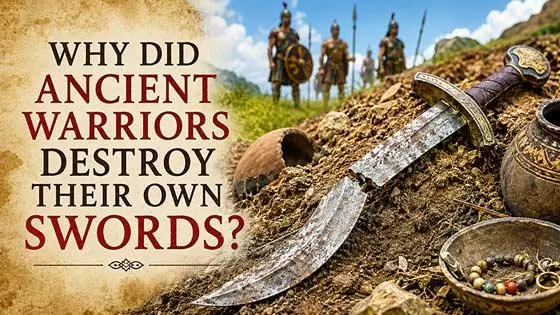
Archaeologists occasionally uncover ancient swords that look as though someone deliberately tried to ruin them. Blades have been bent into dramatic curves, folded back on themselves, snapped into pieces, or otherwise damaged before being placed in graves, rivers, bogs, and other deposits. What makes these discoveries so puzzling is that swords were often expensive possessions requiring enormous skill and resources to produce, which raises an obvious question: why would anyone intentionally destroy one? The answer may have had little to do with anger or waste. In some ancient societies, damaging a sword could have been part of a burial ritual, an offering to supernatural powers, a symbolic way of ending the weapon's life, or something archaeologists still do not completely understand. These battered blades reveal a world in which a sword could be far more than a piece of military equipment, and destroying one may sometimes have been just as meaningful as forging it.
Some Ancient Swords Were Destroyed Deliberately
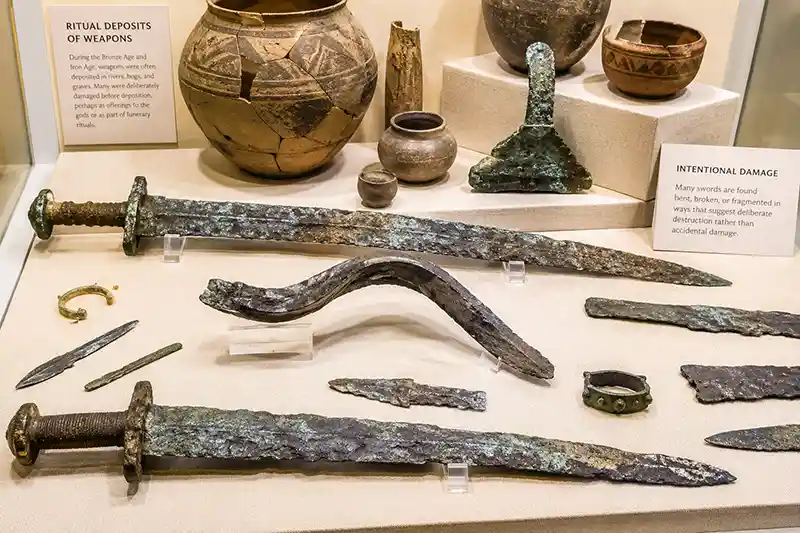
A sword pulled from the ground with a badly bent blade might initially look like the victim of battle, centuries of pressure, or an unfortunate accident. Archaeologists have discovered examples, however, where the damage is so extreme and occurs in such revealing contexts that accidental destruction becomes difficult to accept. Some blades were bent sharply, twisted, broken, or folded before they entered the archaeological record.
These discoveries become especially intriguing when damaged weapons appear in graves or deliberate deposits alongside other carefully arranged objects. A sword that had simply broken during combat could have been repaired, recycled, or discarded. Taking a valuable weapon and intentionally deforming it before placing it somewhere it was unlikely to be recovered suggests that something more complicated was happening.
The practice was not confined to one people or one century. Deliberately damaged weapons have been documented in archaeological contexts spanning parts of Bronze Age and Iron Age Europe and continuing into later periods. Swords are particularly striking examples because producing a high-quality blade could require valuable material, specialized craftsmanship, and considerable labor.
That value is what makes the destruction so important. Across history, swords could function as weapons, possessions, symbols of status, heirlooms, and objects carrying personal or cultural meaning. Deliberately ruining one was therefore potentially a significant act rather than simple disposal.
The difficult part is determining what that act meant. Archaeologists can identify evidence that a blade was intentionally damaged far more confidently than they can reconstruct the thoughts of the person who damaged it. Ritual sacrifice, funerary customs, symbolic destruction, practical concerns, and other explanations have all been proposed, and the answer was almost certainly not identical in every culture or every deposit.
Some Swords Were Bent So Badly They Could Never Be Used Again
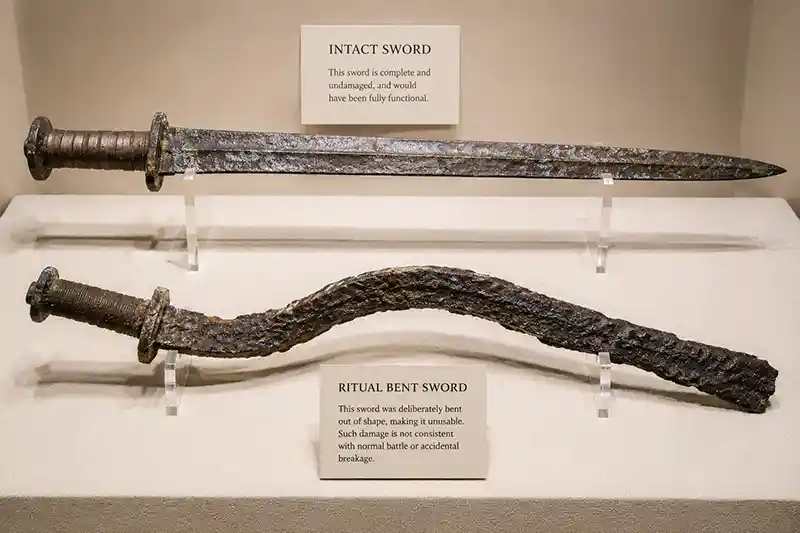
Breaking a sword is one thing. Deliberately bending one can be even more revealing. Archaeologists have recovered ancient blades curved into arcs, folded sharply, or deformed so severely that restoring them to working weapons would have been nearly impossible. In some cases, the amount of force required makes casual damage an unlikely explanation.
This matters because ancient metal was valuable. A damaged sword did not necessarily have to be abandoned. Its material could potentially be salvaged, reforged, or repurposed rather than permanently removed from circulation. When people instead placed a badly deformed blade into a grave, body of water, or deliberate deposit, they were giving up both the weapon and much of its practical value.
The bending itself may therefore have been important. One interpretation is that deforming the blade visibly demonstrated that the sword's useful life had ended. An intact sword could theoretically return to the world of the living. A sword twisted into an unmistakably unusable shape had crossed a much clearer boundary.
Archaeologists sometimes describe this broader practice as the ritual "killing" of an object. The phrase does not mean we know ancient people literally believed every sword was alive. Instead, it captures the possibility that deliberately destroying a meaningful possession could symbolically transform it before burial or deposition.
That distinction is crucial. A broken sword might simply be a broken sword. But when valuable weapons are repeatedly found deliberately deformed in carefully chosen contexts, destruction itself begins to look like part of the story.
Were Ancient Warriors Really "Killing" Their Swords?
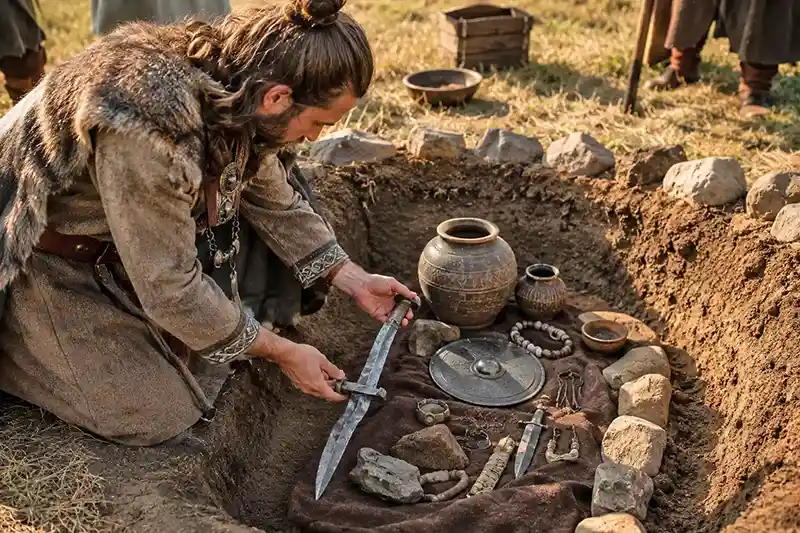
One of the most fascinating explanations for deliberately damaged weapons is that the destruction may have represented a kind of symbolic death. Archaeologists sometimes use phrases such as "killing" an object when discussing artifacts that appear to have been intentionally rendered unusable before burial or deposition. A sword might be bent, broken, burned, or otherwise transformed before being placed beyond ordinary human use.
The idea becomes especially compelling when damaged swords accompany the dead. If a warrior's weapon had been closely connected to his identity during life, destroying it during funerary rituals could have symbolically ended the sword's service at the same moment its owner left the world of the living. In that interpretation, the damaged weapon was not discarded because it had become worthless. It was altered precisely because it mattered.
There is an important caution, however. Archaeologists cannot interview the people who performed these rituals, and ancient communities rarely left explanations describing exactly what a bent sword meant. The phrase "killing the sword" is therefore a modern interpretation of archaeological evidence, not proof that every culture believed weapons possessed literal lives or spirits.
What we can see is a repeated pattern in which valuable objects were deliberately transformed before being removed from circulation. Swords are particularly striking because their cultural importance could extend far beyond their effectiveness in combat. Even when other weapons were more effective than swords in certain battlefield situations, the sword could remain an extraordinary symbol of rank, identity, wealth, and martial prestige.
Seen from that perspective, destroying a sword stops looking like senseless waste. If the destruction itself carried meaning, then bending or breaking a prized blade may have been the final chapter in the object's story.
Rivers and Bogs Became Final Resting Places for Swords

Not every deliberately deposited sword was buried with a warrior. Archaeologists have recovered weapons from rivers, lakes, wetlands, and bogs across Europe, sometimes in quantities that are difficult to explain as accidental losses. Swords were valuable possessions, and repeatedly finding them in watery places raises the possibility that at least some were intentionally surrendered.
The practice reaches deep into European prehistory. During the Bronze Age and Iron Age, weapons and other valuable objects were deposited in rivers and wetlands, occasionally alongside jewelry, tools, shields, and other prestigious possessions. Some objects were intact when deposited, while others appear to have been deliberately damaged beforehand.
Why water mattered is much harder to answer. Rivers, springs, lakes, and wetlands may have held religious or symbolic importance for certain communities, perhaps serving as boundaries, sacred places, or locations where offerings could be made. Depositing a valuable sword into deep water also created a powerful act of sacrifice because the owner was intentionally giving up something that might otherwise have remained useful for generations.
There are practical explanations to consider as well. Weapons could be lost while crossing rivers, deposited after battles, hidden for later recovery, or moved by changing waterways over centuries. Archaeologists therefore examine the surrounding context rather than assuming every sword recovered from water was a ritual offering.
Yet when valuable weapons repeatedly appear in particular watery landscapes, sometimes deliberately damaged and accompanied by other prestigious objects, coincidence becomes less satisfying as a universal explanation. Whatever these places meant to the people who left their possessions there, throwing a prized sword into the water may have been an act from which there was never supposed to be a return.
A Destroyed Sword Could Become an Offering
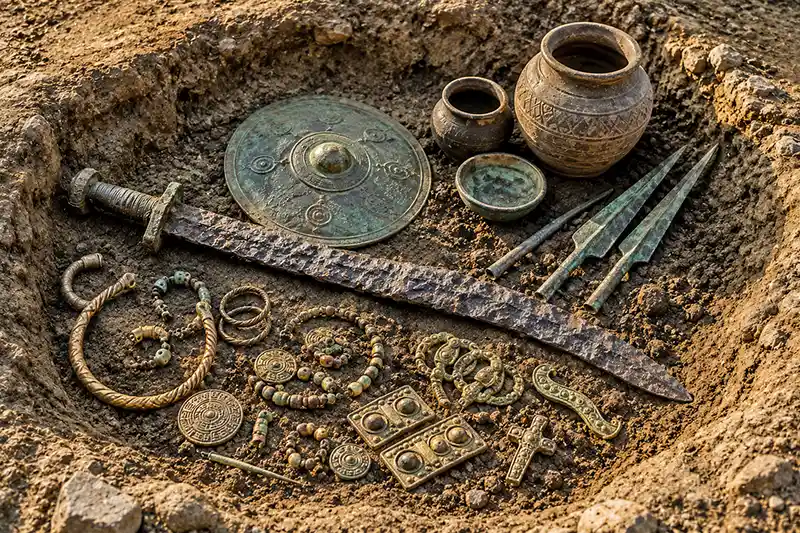
If deliberately damaging a sword ended its practical life, depositing it could begin an entirely different kind of existence. Across parts of ancient Europe, valuable weapons were placed in locations that archaeologists interpret as possible ritual deposits. Swords, spearheads, shields, jewelry, tools, and other prized objects could be surrendered rather than recovered, recycled, or passed to another owner.
The sacrifice involved may have been precisely what gave the act significance. Giving away something common required little commitment. Giving up a finely made sword represented the loss of an object containing valuable metal, skilled craftsmanship, and considerable social importance. The more valuable the object, the more meaningful its permanent removal may have been.
Some offerings may have followed victories in warfare, with captured weapons dedicated rather than distributed among the victors. Others may have been connected to funerals, religious ceremonies, important places, or events that can no longer be reconstructed. In certain archaeological deposits, weapons were damaged before being deposited, suggesting that destruction and offering could sometimes have been parts of the same ritual process.
This possibility also changes the way we think about the value of ancient swords. Modern discussions often judge a sword almost entirely by practical questions such as cutting ability, durability, reach, or whether it deserves to be called the best sword of all time. Ancient owners could value the same object for reasons that had little to do with battlefield performance.
A sword could represent wealth, victory, ancestry, authority, or a connection to the person who carried it. If an object possessed that much meaning, destroying and surrendering it may have been one of the most powerful offerings a community could make.
Destroying Captured Swords Could Turn Victory Into a Ritual
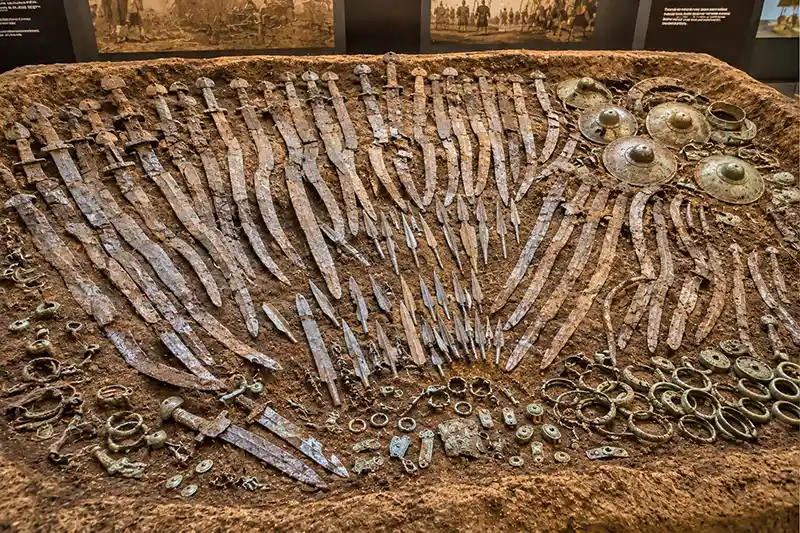
Not every deliberately destroyed sword necessarily belonged to the person who damaged it. Some ancient weapon deposits may represent equipment taken from defeated enemies, transforming the destruction of weapons into part of the celebration or commemoration of military victory.
This possibility becomes particularly compelling at sites where archaeologists have uncovered large collections of weapons rather than a single treasured blade. In parts of northern Europe, Iron Age deposits have yielded swords, spearheads, shields, and other military equipment that appear to have been deliberately damaged before being deposited in wetlands or lakes. Some swords were bent, shields dismantled, and other objects broken beyond practical use.
If these weapons were captured after battle, destroying them accomplished something very different from simply collecting valuable equipment. A captured sword could have been repaired, reused, or melted down. Deliberately ruining it and surrendering it instead converted a useful piece of military equipment into a permanent symbol of victory.
The scale of some deposits makes the idea even more striking. Rather than one warrior sacrificing one personal possession, an entire collection of captured equipment could potentially represent the defeat of an opposing force. The weapons themselves became evidence of what had happened, and their destruction may have formed part of a public ritual acknowledging the victory.
That possibility reminds us that the value of a sword did not end with its original owner. Capturing an enemy's weapon could transfer possession, but deliberately destroying it made a much stronger statement: this blade would never fight for anyone again.
Funeral Rituals Could End a Sword's Life Alongside Its Owner
A sword buried with its owner carried an obvious connection to the person who once wielded it. But when that sword was deliberately bent, broken, or burned before entering the grave, the relationship becomes even more intriguing. The weapon was not merely being stored beside the dead. Something had been done to it first.
One possibility is that the sword's destruction mirrored the death of its owner. A weapon closely associated with a warrior might have been considered inappropriate to pass immediately into someone else's hands. Damaging it ensured that the sword and its owner effectively left ordinary society together, permanently ending a relationship that may have lasted for years.
There may also have been a practical consequence. An intact sword placed in a grave remained valuable enough to tempt someone to retrieve it. A severely bent or broken blade was much less useful to a grave robber. That does not mean preventing theft explains every damaged burial weapon, but practical and symbolic motivations did not have to be mutually exclusive.
The extraordinary cultural importance attached to swords makes these burials particularly revealing. Centuries later and thousands of miles away, Japanese traditions would develop their own powerful relationships between warriors and samurai swords. The customs were very different, and they should not be treated as versions of the same ritual, but both remind us that a sword can acquire meaning far beyond its value as sharpened metal.
For archaeologists, that personal meaning is the hardest part to recover. The grave can reveal where a sword was placed and whether it was damaged before burial. It cannot tell us whether mourners believed they were honoring the dead, retiring a treasured possession, protecting the grave, performing a religious obligation, or accomplishing several of those things at once.
Not Every Broken Sword Was Part of a Ritual
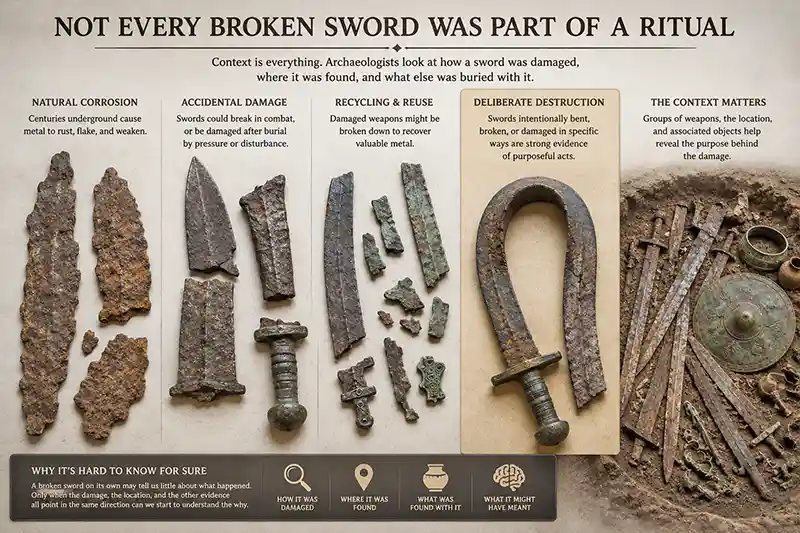
The idea of ancient warriors ceremonially "killing" their swords is fascinating, but it can also become too convenient. A damaged blade does not automatically prove that a ritual took place. Swords could break in combat, deteriorate after centuries underground, become distorted by pressure in the soil, or be damaged during later disturbances to an archaeological site.
Ancient metalworkers also had strong reasons to recycle damaged weapons. Iron and bronze were valuable resources, and a sword that could no longer function as a weapon might still provide useful material. In some circumstances, fragments could have been collected for reuse rather than treated as sacred objects. Archaeologists therefore have to distinguish intentional destruction from the ordinary life cycle of metal equipment.
Context is what makes the difference. A single broken blade discovered without reliable archaeological information may tell us very little about how it was damaged. A group of valuable weapons repeatedly bent in similar ways and carefully deposited alongside other objects presents a much stronger case that the destruction was deliberate.
Even then, deliberate does not necessarily mean religious. A sword might have been damaged to prevent an enemy from recovering it, to make captured equipment unusable, to fit inside a grave, or for another practical reason that has disappeared from the historical record. Ritual interpretation becomes strongest when patterns in the objects, location, and surrounding evidence all point in the same direction.
That uncertainty is actually part of what makes these swords so interesting. Archaeology can sometimes tell us with remarkable confidence what ancient people did to an object while leaving the question of why tantalizingly unresolved.
Sometimes a Sword Had to Be Broken Just to Fit in the Grave
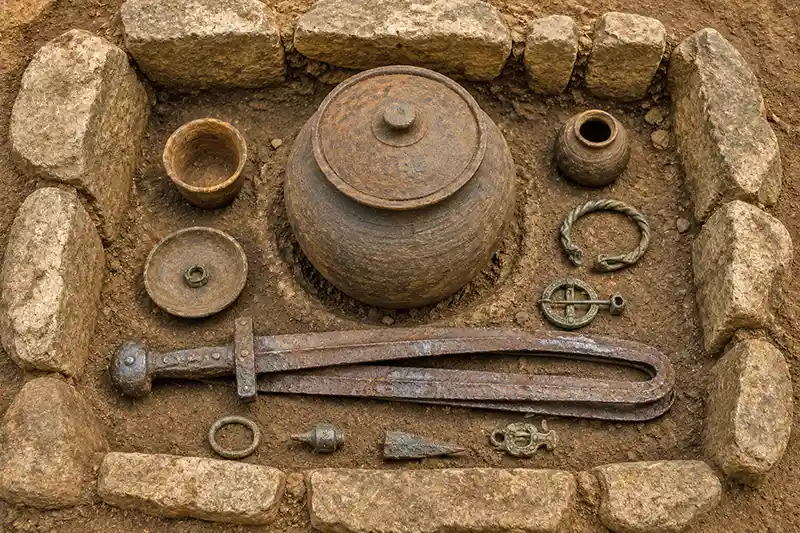
Not every deliberately damaged burial weapon needs a complicated spiritual explanation. In some graves, the dimensions of the burial itself may have created a much more practical problem: the sword was simply too long to fit comfortably into the available space.
This possibility becomes particularly interesting in cremation burials. After the body was cremated, remains and selected possessions might be placed into a relatively compact grave or container. A full-length sword could be awkward or impossible to include without first bending, folding, or breaking the blade. Deliberate deformation may therefore have allowed a large personal possession to accompany the dead in a much smaller burial space.
Of course, practicality and symbolism could overlap. If mourners needed to bend a sword to place it with cremated remains, the act of permanently destroying the weapon may also have acquired ritual significance. Ancient funerary customs rarely divide as neatly into "practical" and "religious" categories as modern explanations sometimes imply.
The idea also helps explain why archaeologists pay close attention to the exact position of damaged weapons. A sword carefully folded into a compact burial arrangement tells a different story from one violently twisted and thrown into a wetland alongside dozens of captured weapons. Both may have been deliberately destroyed, but probably not for identical reasons.
That is one of the recurring lessons of these strange archaeological finds. Ancient people may have destroyed swords for several completely different reasons, and the shape of the damaged blade is only the beginning of the investigation.
Fire Could Destroy a Sword Without Breaking It
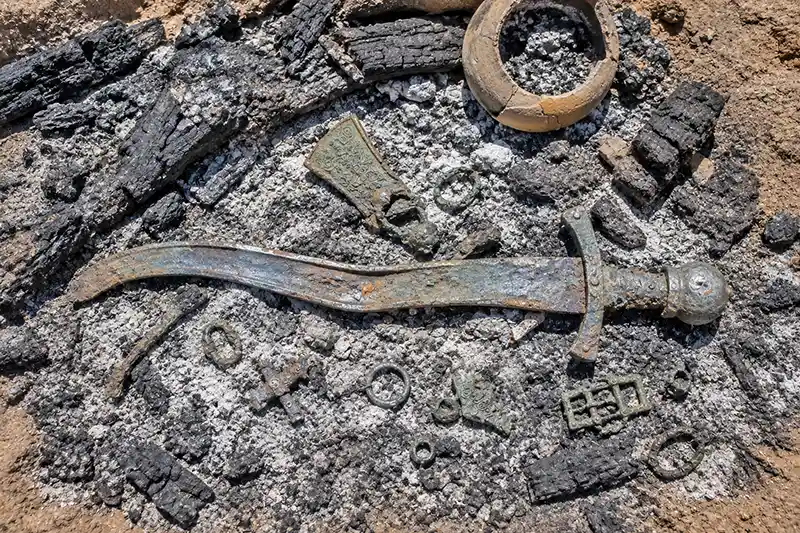
Not every intentionally altered sword was bent or snapped. In some funerary contexts, weapons were exposed to intense heat, particularly when they accompanied their owners onto a cremation pyre. A sword recovered from such a burial might survive as a recognizable object while still showing evidence that fire had permanently changed it.
High temperatures can affect metal in several ways. A blade may warp, develop heavy scaling, lose parts of its fittings, or become structurally compromised. Handles made from wood, leather, horn, or other organic materials could disappear almost completely, leaving behind only the metal components that survived the fire.
The important question is whether this damage was simply a consequence of cremation or an intentional part of the funeral. If a warrior was burned with personal possessions, placing a sword on the pyre may have been enough to transform it without anyone needing to bend the blade afterward. In other cases, weapons could undergo additional treatment before or after burning.
This makes fire-damaged swords especially difficult to interpret. Archaeologists have to separate evidence created by heat from evidence of deliberate mechanical destruction, all while considering where the surviving fragments were ultimately deposited.
Yet the symbolism is hard to ignore. A sword that accompanied its owner through the flames was undergoing the same destructive process as everything else on the pyre. Whether ancient mourners thought of that as "killing" the weapon is impossible to know, but fire offered another way for a valuable sword to be permanently transformed before entering the grave.
The Sword May Have Been Too Important to Inherit
Ancient swords were valuable enough that passing one to the next generation might seem like the obvious choice. A well-made blade represented usable metal, skilled craftsmanship, and considerable wealth. Yet some communities deliberately removed swords from circulation instead, burying, depositing, burning, or destroying objects that could otherwise have continued serving new owners.
One explanation is that certain swords may have become inseparable from the identities of the people who carried them. A weapon acquired during an important victory, received as a prestigious gift, or carried throughout a warrior's life could accumulate a personal history that made it more than transferable property. When that person died, handing the sword to someone else may not always have been considered appropriate.
This possibility is difficult to prove archaeologically because personal attachment leaves no physical trace. What survives is the decision itself. Someone took an object valuable enough to preserve, repair, or inherit and instead ensured that nobody would use it again.
The contrast with other sword traditions is fascinating. In some cultures and periods, prized blades could become treasured heirlooms precisely because of their connection to previous owners. Japanese swords, for example, could survive through generations, which is part of why questions surrounding myths about samurai swords are so interesting today. That tradition should not be projected backward onto ancient European societies, but the comparison demonstrates how differently cultures can treat the relationship between a warrior and a weapon.
For one society, preserving a famous sword might keep an ancestor's memory alive. For another, permanently destroying or surrendering it may have accomplished something equally meaningful. The archaeological record preserves both possibilities, even when the beliefs behind them have disappeared.
Destroying a Sword Was Also a Display of Wealth
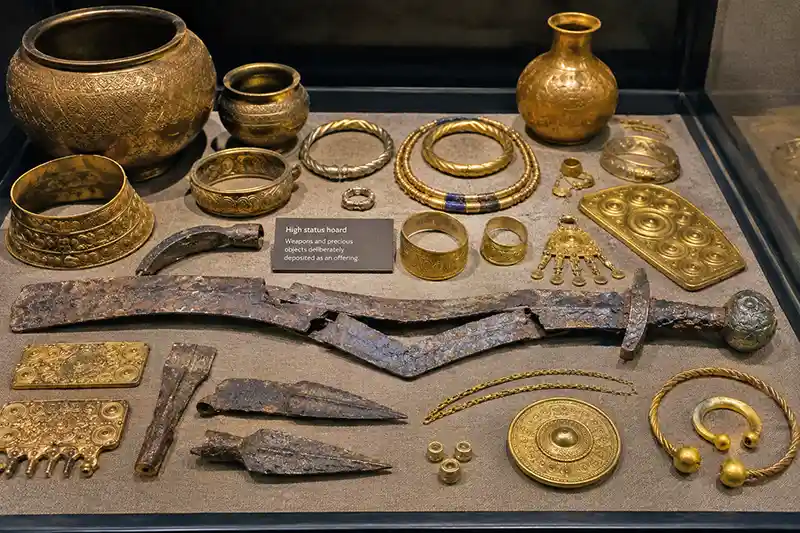
There is another possibility that can seem almost backwards from a modern perspective. Deliberately destroying something valuable could actually demonstrate just how wealthy or powerful a person or community was. If a sword represented a major investment of metal, labor, and craftsmanship, permanently giving one up was a far more impressive gesture than sacrificing something easily replaced.
This idea becomes particularly interesting when archaeologists find valuable weapons deposited alongside jewelry, decorated metalwork, tools, and other prestigious objects. Whoever assembled such a collection was not simply getting rid of unwanted possessions. In some cases, people were removing substantial amounts of usable wealth from circulation.
Anthropologists have documented societies in which status could be expressed through extravagant giving, feasting, sacrifice, or even the deliberate destruction of valuable property. We cannot automatically assume ancient weapon deposits followed exactly the same logic, but the broader principle offers an important possibility: waste can become meaningful when everyone understands how valuable the thing being surrendered actually is.
Swords were particularly well suited to such displays because they could carry both economic and symbolic value. Even centuries later, finely crafted medieval swords could represent far more than their raw materials alone. Earlier cultures likewise had reasons to treat exceptional weapons as objects of prestige rather than merely tools for fighting.
Seen this way, bending a beautiful sword and placing it somewhere nobody could retrieve it might have sent a powerful message. The destruction was costly precisely because the object was worth saving.
Ancient Smiths Could Have Recycled the Metal Instead
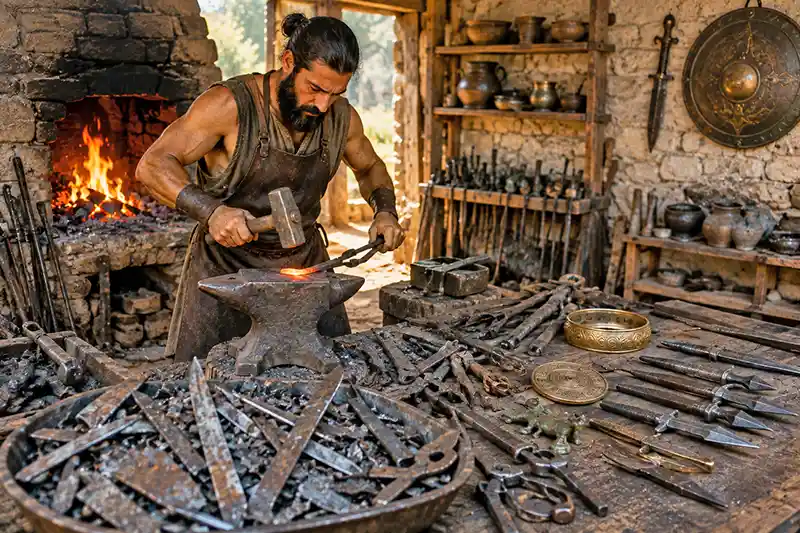
Destroying a sword becomes even stranger when we remember that the metal itself did not stop being valuable just because the weapon was damaged. Bronze could be melted and recast, while iron and steel could potentially be reforged or repurposed. A broken blade was therefore not automatically worthless scrap.
This makes deliberately deposited weapons different from ordinary discarded objects. If a sword had simply reached the end of its useful life, recovering its material could make economic sense. Metal production required raw materials, fuel, specialized knowledge, and considerable labor. Leaving large quantities of usable metal in a grave, river, bog, or ritual deposit meant surrendering resources that could have been turned into something new.
Archaeological hoards make this particularly striking. Some contain enough weapons and metal objects to represent a substantial concentration of wealth. When those objects were deliberately damaged and then placed somewhere they were unlikely to be recovered, the people responsible were effectively removing valuable material from their economy.
That does not mean every ancient sword was an extraordinary luxury object. Their value varied enormously across periods, cultures, materials, and manufacturing methods. But even a relatively plain weapon represented resources that could often have been reused. Deliberately preventing that reuse suggests that preserving the metal was sometimes less important than whatever the act of destruction and deposition accomplished.
In a world where metal could be laborious to produce, throwing away a sword was one thing. Making absolutely certain that nobody would ever turn it into another weapon was something else entirely.
Archaeologists Can Sometimes Tell When a Sword Was Bent on Purpose
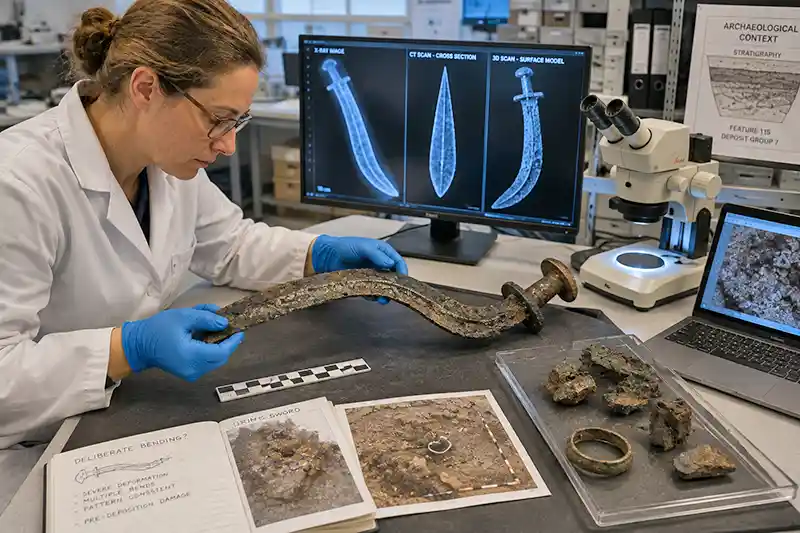
After centuries underground, almost any metal object can look badly damaged. Corrosion eats away at surfaces, soil shifts, roots grow through archaeological layers, and the weight of sediment can distort weakened artifacts. So how can archaeologists argue that a particular sword was deliberately bent thousands of years ago rather than gradually deformed after burial?
One clue is the severity and pattern of the deformation. A blade folded into a tight curve or bent repeatedly in different directions may require forces that ordinary burial conditions are unlikely to produce. When several weapons from the same archaeological context show similarly extreme treatment, accidental damage becomes even harder to explain.
Researchers can also study fractures, corrosion, metal structure, and the relationship between a damaged weapon and the objects surrounding it. If pieces of a deliberately broken sword were deposited together in an undisturbed archaeological layer, for example, that can provide evidence that the blade was already fragmented when it entered the ground.
Modern imaging and metallurgical analysis can reveal details that are invisible from the surface. X-rays, microscopy, and other techniques allow specialists to examine construction methods, hidden cracks, corrosion layers, and structural changes within ancient metal. None of these methods can reveal what someone was thinking while destroying a sword, but they can help establish whether the damage happened before, during, or long after deposition.
This is why the strangest bent swords are so compelling. Archaeologists are not simply looking at a rusty blade and inventing a ritual explanation. The strongest cases combine unusual physical damage with archaeological context, patterns among multiple artifacts, and scientific evidence that something extraordinary happened to the weapon before it disappeared into the ground.
The Mystery Is That There Was Probably Never Just One Reason
It is tempting to search for a single explanation for deliberately destroyed swords. Perhaps warriors "killed" their weapons before burial, sacrificed them to supernatural powers, or destroyed captured blades after victory. The archaeological evidence suggests something more complicated. Similar-looking acts could have meant very different things depending on where, when, and why they occurred.
A bent sword discovered beside cremated remains does not necessarily tell the same story as dozens of damaged weapons recovered from a wetland. A sword thrown intact into a river may represent something different again. Even two nearly identical bent blades could have been destroyed for entirely different reasons if they came from different societies separated by hundreds of years.
That is why archaeologists increasingly focus on context rather than treating every damaged weapon as evidence for one universal ritual. The location of the deposit, the other objects found nearby, the condition of the blade, the treatment of human remains, and patterns at surrounding archaeological sites can all change how a discovery is interpreted.
It also cautions us against assuming that every warrior culture thought about swords in the same way. Chinese, European, and Japanese sword traditions developed within very different historical environments. Even something as seemingly straightforward as comparing a samurai sword vs katana can reveal how easily modern terminology obscures complicated histories. Projecting one culture's beliefs about weapons onto another can create an appealing story that the evidence does not actually support.
Perhaps that uncertainty is the most interesting answer of all. We know ancient people sometimes went to extraordinary lengths to destroy objects that were valuable, useful, and difficult to replace. We can see what they did to their swords. In many cases, the reason they believed it was necessary disappeared with them.
A Broken Sword Can Tell Us More Than a Perfect One
An intact ancient sword can reveal extraordinary things about metallurgy, craftsmanship, warfare, and the people who carried it. But sometimes the most revealing sword is the one somebody deliberately ruined. A blade folded nearly in half, burned on a funeral pyre, shattered beside other captured weapons, or surrendered to a river preserves evidence of something an undamaged weapon cannot: a deliberate decision to stop treating the sword as an ordinary object.
Exactly what that decision meant may never be known. For one community, destroying a sword may have honored its dead owner. For another, it could have transformed captured weapons into offerings after a victory. Elsewhere, bending a blade may have allowed it to fit inside a burial, prevented its reuse, demonstrated extraordinary wealth, or fulfilled beliefs that left no written explanation behind.
That uncertainty is precisely what makes these damaged weapons so fascinating. The people who destroyed them clearly understood that swords were valuable. They knew the metal could be recycled, the weapon could be inherited, and an intact blade could continue functioning for years. Yet sometimes they chose destruction anyway.
Thousands of years later, the sword survives but the explanation does not. We are left with a twisted piece of ancient metal and evidence of a moment when someone decided that preserving a valuable weapon was less important than permanently taking it out of the world.
Why Did Ancient Warriors Bend Their Swords Before Burial?
Ancient swords may have been bent before burial for several different reasons. In some cases, deforming the blade may have symbolically ended the weapon's useful life alongside the death of its owner. In others, bending a long sword could have made it easier to place inside a compact grave or cremation burial. Archaeologists therefore avoid assuming that every deliberately bent sword represents the same ritual or belief.
Did Ancient People Really Destroy Swords on Purpose?
Yes. Archaeologists have recovered swords that appear to have been deliberately bent, broken, burned, or otherwise rendered unusable before being buried or deposited. The strongest evidence comes from archaeological contexts where multiple weapons received similar treatment or where severely damaged blades were carefully placed alongside other valuable objects. Not every broken ancient sword was intentionally destroyed, but deliberate destruction is well documented in a number of ancient and early medieval contexts.
What Does It Mean to "Kill" a Sword?
Archaeologists sometimes use the idea of "killing" a sword to describe deliberately making the weapon unusable before burial or deposition. The term reflects the possibility that destroying an important object symbolically ended its useful life, perhaps alongside the death of its owner or as part of an offering. It does not prove that ancient people literally believed swords were alive, and the meaning of deliberate destruction probably differed between cultures and periods.
Why Were Ancient Swords Thrown Into Rivers and Bogs?
Swords and other valuable objects have been recovered from rivers, lakes, bogs, and wetlands across parts of Europe. Some may have been accidentally lost, hidden, or deposited for practical reasons, but repeated concentrations of valuable objects suggest that certain watery places were also used for deliberate offerings. Exactly what rivers and wetlands represented to the communities making these deposits is often impossible to determine with certainty.
Were Swords Destroyed as Offerings to the Gods?
Possibly, although archaeologists have to be careful with this interpretation. Valuable swords and other weapons were sometimes deliberately damaged and deposited in locations that appear to have had ritual significance, making religious offerings one plausible explanation. Without written testimony explaining a particular deposit, however, it is usually difficult to identify which deity, supernatural power, or belief was involved, or even prove that religion was the primary motivation.
Did Warriors Destroy Captured Enemy Swords?
Some large ancient weapon deposits are interpreted as captured military equipment that was deliberately damaged after conflict. Archaeologists have discovered collections containing bent swords, dismantled shields, spearheads, and other weapons that may represent the equipment of defeated forces. Rather than repairing or reusing these valuable objects, the victors may have destroyed and deposited them as part of rituals commemorating a military victory.
Why Were Swords Burned During Ancient Funerals?
In societies that practiced cremation, a warrior's possessions could accompany the body onto the funeral pyre. Exposure to intense heat could warp blades, damage metal surfaces, and destroy organic handles and fittings. Whether damaging the sword was always an intentional objective is difficult to know. In some burials, the weapon may simply have undergone the same funerary process as its owner rather than being separately destroyed beforehand.
Were Broken Swords Ever Reforged or Recycled?
Metal was valuable in the ancient world, so damaged weapons could potentially be repaired, reforged, melted, or repurposed rather than discarded. This is one reason deliberately deposited swords are so intriguing. When people permanently surrendered usable bronze, iron, or steel instead of recovering the material, the decision may indicate that the symbolic, social, or ritual importance of removing the object outweighed its remaining economic value.
How Can Archaeologists Tell If a Sword Was Broken on Purpose?
Archaeologists examine the type of deformation, fracture patterns, archaeological context, surrounding artifacts, and condition of the metal. A severely folded blade or several weapons bent in similar ways within the same undisturbed deposit can provide strong evidence of intentional damage. X-rays, microscopy, metallurgical analysis, and other modern techniques can also help researchers distinguish ancient deformation from corrosion, soil pressure, excavation damage, and other changes that occurred long after burial.
Were Ancient Swords Too Valuable to Destroy?
Ancient swords could represent substantial investments in metal, fuel, craftsmanship, and labor, which is precisely what makes their deliberate destruction so significant. A damaged sword could often provide material for another object, yet some communities permanently removed valuable weapons from circulation. In certain circumstances, sacrificing something expensive may actually have increased the importance of the act because everyone involved understood what was being surrendered.
Did Vikings Deliberately Bend or Break Swords?
Deliberately damaged swords are known from Viking Age archaeological contexts, including weapons associated with burials and other deposits. Some blades were bent or broken before deposition, but there was no universal Viking custom requiring every sword to be destroyed when its owner died. Practices varied by region, period, burial tradition, and individual circumstances, so deliberately damaged Viking swords need to be interpreted within their specific archaeological contexts.
Do Archaeologists Know Why Ancient Swords Were Destroyed?
Sometimes the archaeological context provides strong clues, but there is no single explanation that applies to every destroyed sword. Proposed reasons include funerary rituals, offerings, destruction of captured weapons, preventing reuse, fitting weapons into graves, displays of wealth, and symbolic transformation of important possessions. Archaeologists can often establish that a sword was deliberately damaged more confidently than they can determine exactly what the act meant to the people who performed it.
You May Also Be Interested In:
- The Hidden History of the Bolas: The Ancient Weapon That Could Stop You in Your Tracks
- What Happened to a Warriors Weapons After He Died?
- Mastering Practical Self-Defense: Concealed Staffs for Modern Warriors
- Foam Practice Swords vs Wooden Swords: Which Is Better?
- Did Ninjas Really Use Straight Swords?
- Why Are Some Chinese Swords So Flexible?
- Five Types of Deadly Japanese Swords
- Real vs. Decorative Samurai Swords: What You Need to Know
- The Biggest Myths About Samurai Swords
- New SAP Gloves, Stun Guns & Swords!
Leave a Reply