



Why Was the Kusarigama So Difficult to Fight Against?
August 14th, 2026
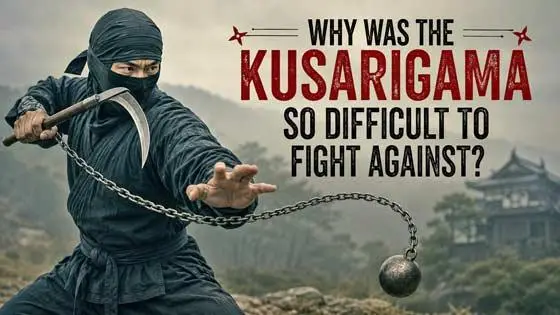
The kusarigama looked like a weapon designed to break the rules of a fight. At one end was a razor-sharp sickle meant for close combat. At the other was a weighted chain that could strike, distract, entangle, or interfere with an opponent from several feet away. A swordsman facing one could not simply watch the blade, because the real danger might already be circling through the air beside him. Yet the kusarigama was more than an intimidating combination of two weapons. In the hands of someone trained to use its radically different ranges together, it could force an opponent to defend against threats that behaved almost nothing alike. So how did such an unusual weapon develop in Japan, and what made the kusarigama so notoriously difficult to fight against?
The Kusarigama Forced a Swordsman to Fight at Two Distances
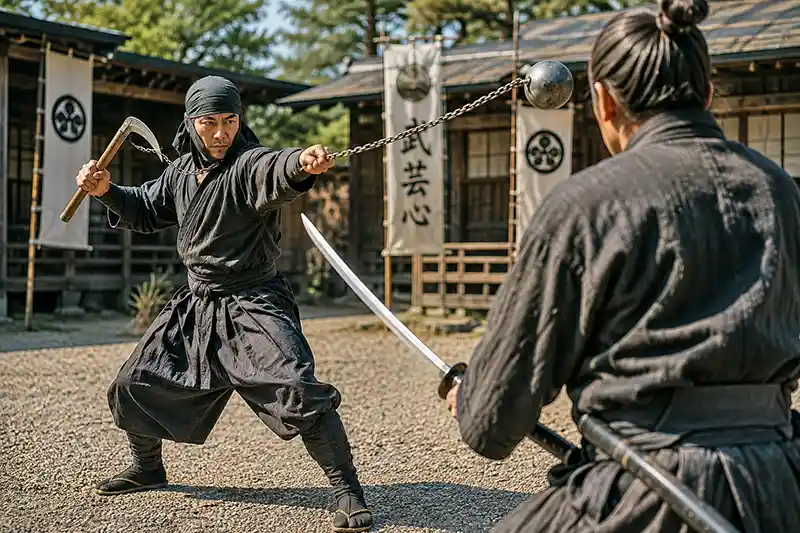
Most traditional weapons become easier to understand once an opponent recognizes their effective range. A sword is dangerous within the reach of its blade. A spear extends that danger considerably farther. The kusarigama complicated this calculation because its two primary threats occupied completely different distances. The sickle was a compact close-range weapon, while the weighted chain could threaten an opponent before the blade was anywhere near him.
That difference was more important than simply giving the kusarigama extra reach. A swordsman watching the sickle still had to account for the weight at the end of the chain, which could be directed toward his body or used to interfere with his weapon. If he concentrated too heavily on avoiding the chain, the kusarigama wielder could use that disruption to close the distance where the sickle became dangerous. The defender was effectively being asked to solve two different combat problems in rapid succession.
This is what made the kusarigama fundamentally different from simply attaching a longer handle to a blade. Its reach could change without the wielder changing weapons. At one moment, the opponent had to respect the space occupied by a moving chain and weight. At another, the fight could collapse into the much tighter range of the kama.
That did not make the kusarigama unbeatable. In fact, its complexity created serious weaknesses for its own user, especially if the chain missed or there was not enough room to manipulate it effectively. But against someone accustomed to judging distance against more conventional weapons, the constant transition between long-range disruption and close-range blade work could make the kusarigama exceptionally difficult to read.
The Chain Made the First Attack Difficult to Predict
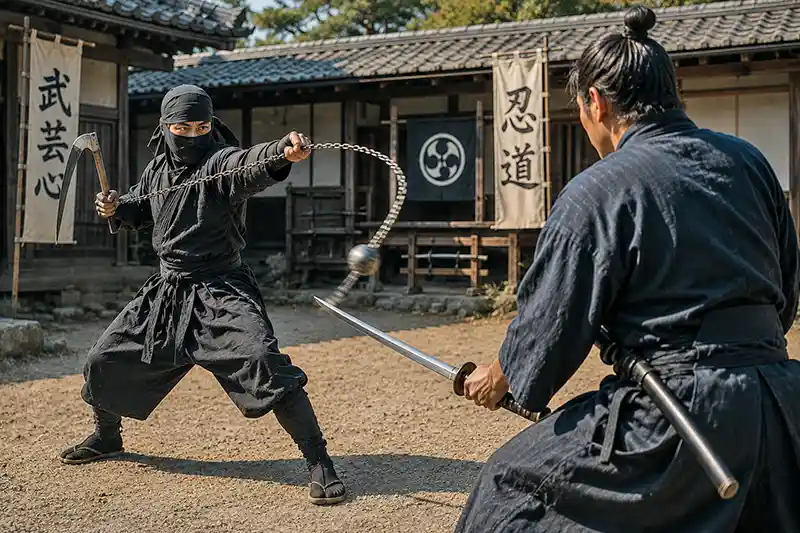
Before the sickle ever came within striking distance, the kusarigama wielder could put an opponent under pressure with the weighted end of the chain. Depending on the weapon and the school using it, the weight could be swung in broad circles or redirected toward an opponent from outside normal sword range. The threat was not simply that the weight might land a clean blow. Its movement forced the defender to continually track something that could change direction while the person controlling it remained several steps away.
That created an uncomfortable problem for a swordsman. Charging directly toward the kusarigama wielder meant entering the path of the moving weight, while hanging back allowed the chain user to continue controlling the distance. Even an attack that failed to connect could disrupt timing, force movement, or create the hesitation needed for the kusarigama wielder to reposition.
The weapon belonged to a broader family of Japanese chain weapons that exploited movement and flexible reach in ways rigid weapons could not. A sword blade followed a comparatively predictable path once a cut began. A flexible chain could behave very differently, particularly as its direction changed or the weighted end rebounded after a missed attack.
This unpredictability was also one of the kusarigama's greatest liabilities. Controlling a moving weight attached to a long chain required considerable skill, and a poorly executed attack could leave the user exposed or create danger for the wielder himself. But when handled by someone who understood its timing and momentum, the chain forced an opponent to pay attention long before the sickle became the immediate threat.
The Weight Could Turn a Sword Into a Liability
Avoiding the weighted end of the chain was only part of the problem. One of the kusarigama's most distinctive tactical possibilities was using the chain to interfere with an opponent's weapon. Rather than trying to defeat a sword blade against blade, a skilled practitioner could attempt to wrap or catch the chain around the sword, creating an entirely different kind of contest.
A sword was designed to cut and thrust with precise control, but that precision became harder to maintain once a flexible chain became involved. If the chain caught the blade or another part of the weapon, tension applied from the opposite end could disrupt the swordsman's balance, pull the weapon away from its intended line, or create an opening while the defender tried to regain control. Even the possibility of entanglement could make an opponent more cautious about committing fully to an attack.
This principle helps explain why flexible weapons in martial arts could present such an unusual defensive challenge. Their movement did not always stop at the point where a rigid weapon would have been blocked. A chain could bend around an obstruction, wrap around an object, or continue moving after part of it made contact.
Popular depictions sometimes make this look effortless, with a chain neatly wrapping around a sword on command. Reality would have been far less predictable. Deliberately entangling a moving weapon required exceptional timing, distance, and control, and a failed attempt could give the swordsman an opportunity to close in. The important advantage was not that the kusarigama could magically snatch away every sword it encountered. It was that the swordsman had to consider the possibility at all, adding yet another danger to an already complicated fight.
The Chain Could Attack From Around a Guard
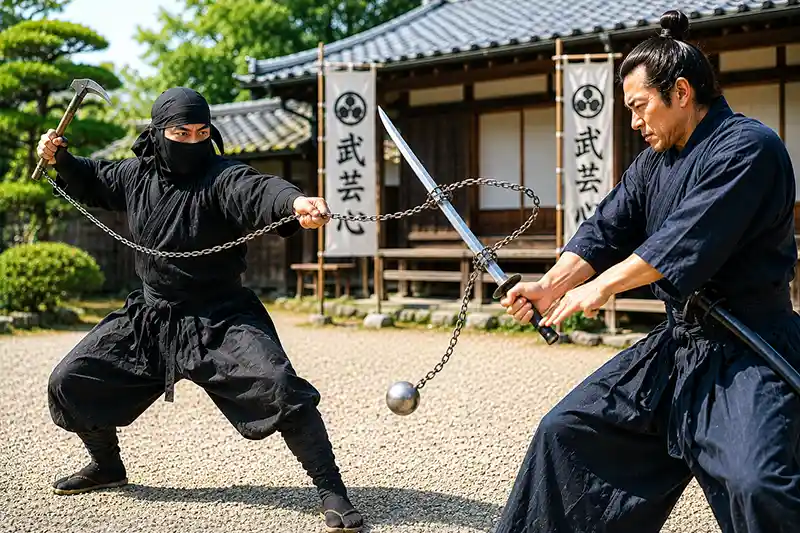
Blocking a rigid weapon usually depends on meeting its path with another solid object. A sword can intercept another sword because both blades travel along relatively predictable lines. The kusarigama's chain complicated that basic defensive idea. Because it was flexible, part of the chain could make contact with a sword or other obstruction while the weighted end continued traveling beyond it.
That meant a successful-looking block did not always end the attack. Depending on the angle and momentum involved, the chain could bend around a weapon or potentially pass beyond the defender's guard. The swordsman therefore had to think about more than the point where his blade met the incoming attack. He also had to track what the rest of the chain was doing.
This ability to threaten around conventional defenses helps explain why the kusarigama belongs among some of the most dangerous chain weapons in martial arts history. Flexible weapons introduced movement that was fundamentally different from the straight cuts, thrusts, and blocks that dominated many encounters with rigid weapons. Even experienced fighters could face an unfamiliar problem when the object they attempted to block simply changed shape around their defense.
Of course, flexibility worked both ways. Once the chain contacted something, its path became harder for the kusarigama wielder to predict as well. A rebound, snag, or poorly judged swing could ruin an attack instantly. The weapon demanded tremendous control precisely because the characteristic that made it troublesome for an opponent also made it unforgiving for the person holding it.
The Sickle Became Most Dangerous After the Chain Did Its Job
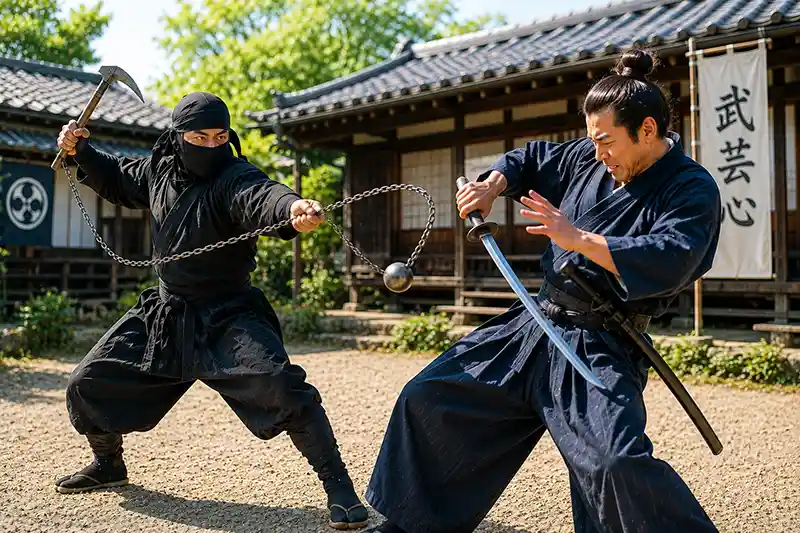
For all the attention given to the kusarigama's swinging chain, the weapon was still built around a sickle. The chain could create distance, interfere with a weapon, or force an opponent into an awkward position, but those actions could also prepare the way for the much shorter blade. This relationship between the two halves of the weapon was what made the kusarigama more sophisticated than simply fighting with a sickle attached to a chain.
Once an opponent became distracted, entangled, off balance, or committed to avoiding the weighted end, the kusarigama wielder could close the distance. At that range, the curved blade offered a completely different threat. Its shape allowed for cutting attacks while also creating opportunities for hooking and controlling movements that would have been difficult to perform with a straight blade.
The sickle itself was related to the Japanese kama, a tool with agricultural roots that also became associated with martial arts. What changed with the kusarigama was the tactical relationship between that familiar curved blade and the flexible weapon attached to it. Instead of relying entirely on the sickle's limited reach, the practitioner could use the chain to influence what happened before entering close range.
That sequence was potentially more important than either component by itself. The weight did not necessarily need to incapacitate an opponent, and the chain did not need to perfectly capture a sword. If either caused a moment of hesitation or disrupted the defender's posture, the sickle suddenly became far more difficult to avoid. The kusarigama's real danger came from making an opponent react to one threat while preparing to exploit that reaction with another.
The Kusarigama Could Punish an Opponent for Rushing In
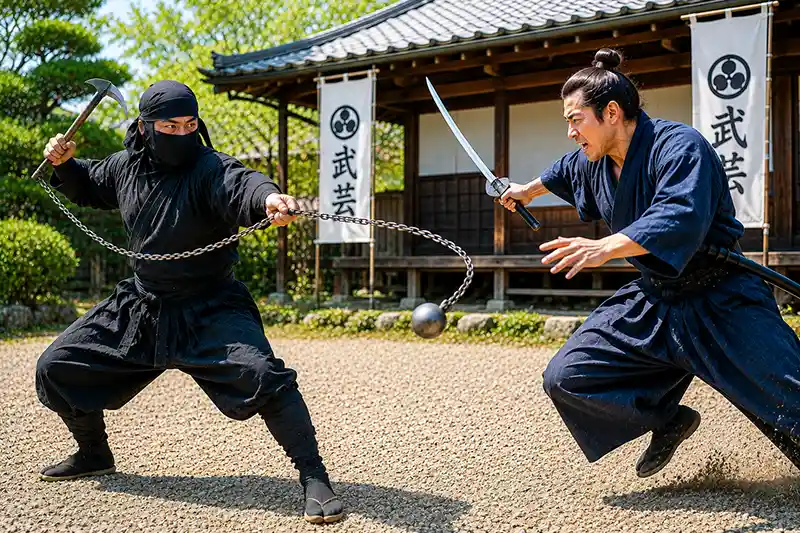
Closing the distance might seem like the obvious solution against a weapon that depended partly on a long chain. If a swordsman could get past the swinging weight quickly enough, the kusarigama wielder would lose much of the space needed to use it effectively. The problem was that rushing forward could be exactly the reaction the weapon was prepared to exploit.
A moving opponent was easier to anticipate than one who remained patient. Once a swordsman committed to advancing, the kusarigama wielder could redirect the weight toward his approach, use the chain to disrupt his path, or retreat while maintaining pressure from a distance. Even if the chain failed to stop the advance completely, forcing the attacker to dodge or alter his footing could rob the sword attack of its timing.
If the swordsman managed to push through anyway, he had not necessarily escaped the weapon's danger. He had simply entered the range where the sickle became useful. This ability to punish hesitation from afar while still presenting a threat to someone who charged forward helps explain why the kusarigama earned a place among some of history's most intimidating weapons.
The defender therefore faced a frustrating choice. Stay outside and deal with the chain, or move inside and risk the sickle. Neither option guaranteed the kusarigama wielder an advantage, and an experienced swordsman could certainly exploit mistakes. But the weapon made one of combat's most basic decisions, whether to advance or remain at distance, considerably harder to make with confidence.
Footwork Became Much Harder When the Chain Controlled the Ground
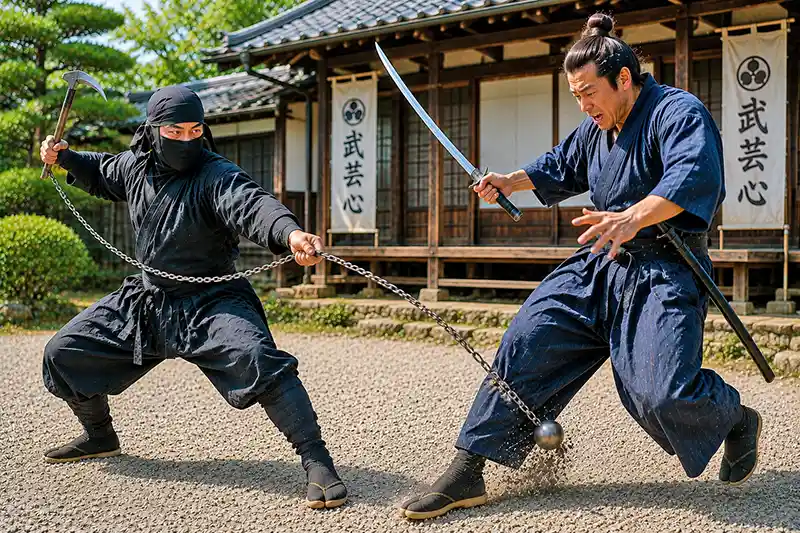
The kusarigama did not have to strike an opponent's upper body to create a serious problem. The weighted chain could also threaten the legs and lower body, forcing a swordsman to pay attention to attacks arriving far below the level where he normally expected to meet another blade. A fighter concentrating on the sickle or watching a weight circle near his head could suddenly find the same flexible weapon threatening his footing.
Low attacks were especially disruptive because balance was essential to effective swordsmanship. A swordsman needed stable footing to cut with power, change direction, retreat, or advance. A chain moving toward the ankles or legs could force him to jump, step away, shorten his stance, or abandon an attack before it was completed. The kusarigama wielder did not necessarily need to wrap the chain neatly around both legs. Simply making the defender move at the wrong moment could be enough to create an opening.
This helps separate the historical weapon from the exaggerated version often associated with ninja weapons in popular culture. The kusarigama did not need impossible tricks or spectacular acrobatics to be troublesome. Its practical advantage came from forcing an opponent to divide his attention between different heights, distances, and types of movement.
A swordsman watching the sickle could lose track of the weight. Watching the weight too closely could make him vulnerable as the wielder advanced. Looking high could leave the legs exposed, while reacting to a low swing could disrupt the stance needed to respond to whatever came next. The kusarigama made defense difficult because there was rarely just one place the opponent needed to watch.
The Kusarigama Was Hard to Read Because Its Rhythm Could Keep Changing
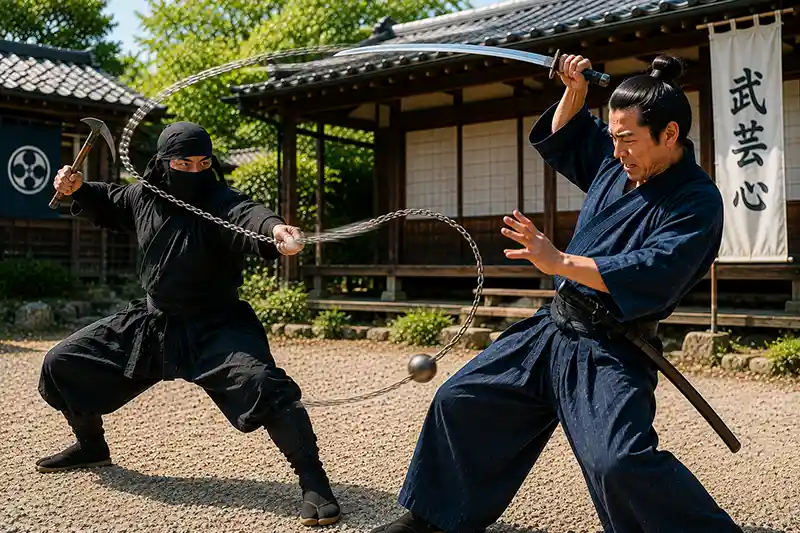
A fighter facing a conventional weapon could begin looking for patterns. Repeated cuts, thrusts, steps, and recoveries offered clues about when the next attack might arrive. The kusarigama made that process more complicated because the chain did not have to move at one consistent speed or follow the same circular path. Its wielder could accelerate the weight, slow its rotation, shorten the effective length of the chain, or change the angle from which the next movement began.
Those changes mattered because timing is often built on expectation. After watching several wide rotations, a swordsman might begin anticipating when the weight would cross the space in front of him. A sudden change in speed or a tighter movement could upset that calculation. The defender was not simply trying to avoid a moving object. He was trying to predict the behavior of a flexible weapon whose rhythm could be deliberately altered.
The kusarigama shared this deceptive quality with other unusual weapons such as the kyoketsu-shoge, which also combined a hand-held blade with a long flexible component. Weapons like these demanded an awareness of momentum and distance that differed considerably from fighting with a sword, spear, or other rigid weapon.
For the kusarigama practitioner, however, changing rhythm without losing control required extensive training. Every acceleration increased the energy that eventually had to be redirected or recovered. That is an important part of understanding why the weapon could be so difficult to fight against without turning it into a legendary superweapon. Its unpredictability was real, but only when the person holding it possessed the skill to control that unpredictability rather than becoming a victim of it himself.
The Kusarigama Could Turn a Miss Into Another Attack
Against most rigid weapons, a missed strike creates an obvious moment of vulnerability. A sword that cuts past its target has to be recovered before it can threaten effectively again. The weighted chain of the kusarigama behaved differently. Missing the opponent did not necessarily mean the movement was finished, because the momentum of the weight could be redirected into another path rather than brought to an immediate stop.
A practitioner who maintained control could allow the weight to continue through its arc, circle it back toward the opponent, or use the returning movement to transition into another attack. That made judging the end of an exchange unusually difficult. A swordsman who saw the weight fly past might instinctively interpret the miss as an opportunity to advance, only to discover that the chain was already changing direction.
This continuous movement was one of the characteristics that made the strangest martial arts weapons so different from conventional blades. Their unusual designs often created movements that opponents accustomed to swords and polearms would not encounter as frequently. With the kusarigama, the weapon's momentum could make the distinction between one attack and the next surprisingly difficult to recognize.
There were limits, of course. A wild miss could leave the weight badly positioned, tangle the chain, or give an opponent exactly the opening he needed. Redirecting momentum was a skill, not an automatic feature that made every failed attack harmless. But in capable hands, the kusarigama could make one of the most tempting moments in a fight, the instant after an opponent appeared to miss, considerably more dangerous than it looked.
The Weapon Was Probably More Dangerous in Open Space
The kusarigama's greatest strengths depended heavily on having room to move. A long chain and swinging weight needed space to accelerate, change direction, and threaten an opponent from different angles. In an open courtyard, field, or training ground, the wielder could potentially take advantage of the weapon's reach while repositioning to maintain a favorable distance.
Confined spaces changed that equation dramatically. Walls, trees, furniture, other fighters, and even low ceilings could interfere with the chain. A weapon that was difficult for an opponent to predict could become equally unpredictable for its owner once the weight began striking obstacles or the chain became snagged. In extremely tight quarters, much of the kusarigama's distinctive long-range advantage could disappear altogether.
This limitation is useful when separating historical reality from popular myths about ninja weapons. Movies and games often portray flexible weapons working perfectly in cramped hallways, forests, rooftops, and crowded rooms. Realistically, the environment would have mattered enormously. The kusarigama could not ignore the physical space around it simply because its wielder was highly trained.
That also helps explain why the kusarigama should not be thought of as universally superior to a sword. Its advantages were situational. Give a skilled practitioner enough room to manipulate the chain and control distance, and an opponent faced a remarkably complicated defensive problem. Take that space away, and many of the same characteristics that made the kusarigama dangerous could become serious disadvantages.
The Kusarigama Was Difficult to Use for the Same Reasons It Was Difficult to Fight
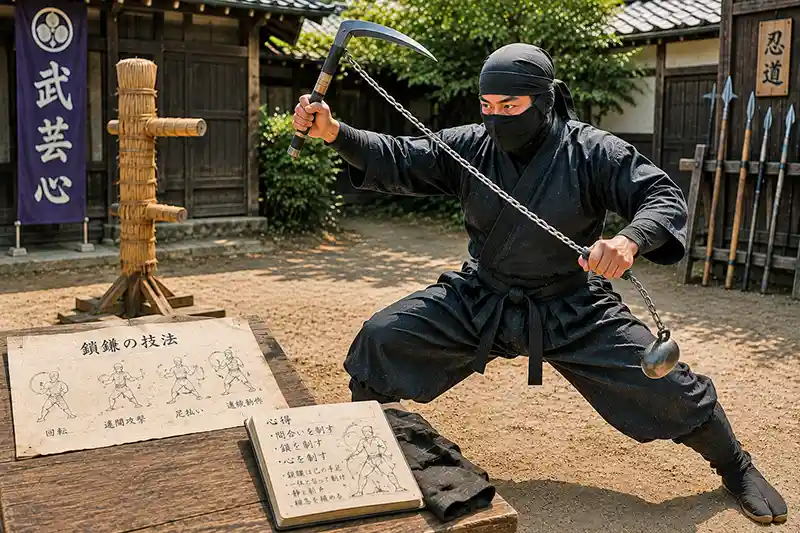
Almost every advantage the kusarigama offered came with a corresponding risk. A long flexible chain could attack from unexpected directions, but it could also strike the wielder, become tangled, or lose momentum at exactly the wrong moment. The weighted end could disrupt an opponent from a distance, but controlling it while simultaneously managing the sickle required coordination that simpler weapons did not demand.
That complexity meant the kusarigama was not something a fighter could simply pick up and expect to use effectively. Distance had to be judged constantly. The practitioner needed to understand how the weight accelerated, how much space the chain required, how to recover from missed attacks, and when to transition from long-range movements to the sickle. A mistake with any one of those elements could create an opening for an opponent armed with a much more straightforward weapon.
This is an important detail that often disappears when discussing the secrets behind kusarigama techniques. The weapon's unusual capabilities were not inherent advantages that existed regardless of who held it. They depended on training. A skilled practitioner could make the chain appear unpredictable to an opponent precisely because its movement was predictable to the person controlling it.
In that sense, the kusarigama's difficulty may have contributed to its reputation. Someone encountering a poorly trained user might see an awkward weapon with obvious vulnerabilities. Someone facing a practitioner who had spent years learning its timing, distance, and transitions could encounter something entirely different. The weapon was difficult to fight because mastering it allowed a skilled user to control movements that looked chaotic to everyone else.
The Kusarigama Was Not Simply a Ninja Weapon
Modern popular culture has tied the kusarigama so closely to the ninja that the two can seem inseparable. The combination certainly looks the part. A concealed-looking sickle, a long chain, and a flying iron weight fit perfectly with the image of an unconventional warrior using strange weapons to overcome heavily armed opponents. The historical picture, however, is considerably more complicated.
Kusarigamajutsu developed as a specialized martial discipline, and traditions involving the weapon were not limited to covert warriors. Samurai and other trained martial practitioners studied methods for using the chain and sickle against conventional weapons, particularly the sword. Surviving martial traditions demonstrate that the kusarigama belonged to organized systems of weapons training rather than existing solely as an improvised tool of espionage.
That distinction matters because the popular ninja association can obscure what actually made the weapon interesting. The kusarigama did not need secret assassins or legendary techniques to explain its effectiveness. Its design already presented an unusual tactical problem: a flexible long-range component paired with a close-range blade. Like many supposedly mysterious pieces of ninja gear, its real history is more interesting when the mythology is separated from the documented martial principles behind it.
The ninja connection is not something that needs to be erased entirely, but neither should it define the weapon. The kusarigama's reputation ultimately came from the unusual fighting system its design made possible. Whether the person holding it was imagined as a shadowy infiltrator or recognized as a trained martial practitioner, the opponent still faced the same problem: somehow getting past a moving chain without forgetting about the sickle waiting at the other end.
A Skilled Opponent Could Exploit the Kusarigama's Weaknesses
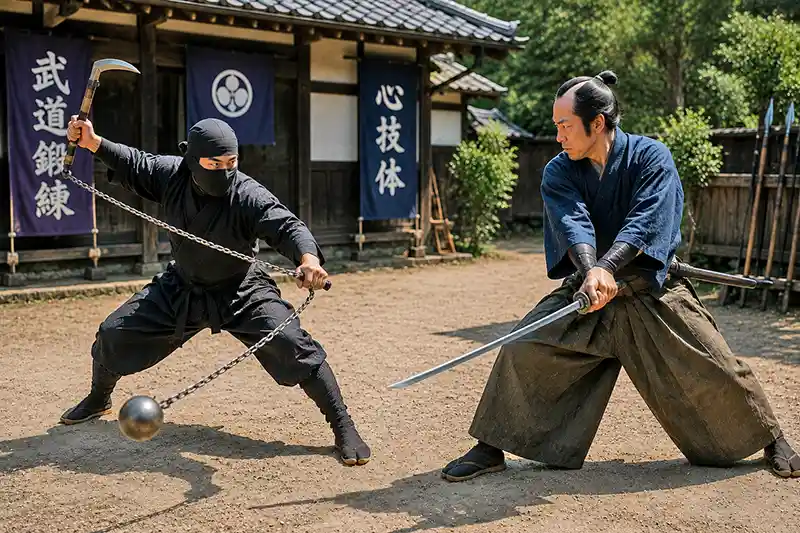
For all the problems the kusarigama could create, facing one was not hopeless. The same chain that gave the weapon its extraordinary reach also created opportunities for an opponent who understood how it worked. The weight needed time and space to develop useful momentum, and every committed swing created a brief period in which the kusarigama wielder had fewer options than the weapon's chaotic appearance might suggest.
A swordsman who correctly judged the chain's path could potentially move outside its arc, close distance during a recovery, or force the kusarigama practitioner into terrain where the chain became difficult to use. The sickle remained dangerous at close range, but once the chain was neutralized, the fight became much less complicated. Suddenly the swordsman was no longer defending against two radically different ranges at the same time.
This is why accounts of unusual combat weapons throughout history need to be treated carefully. An unconventional design could provide a genuine tactical advantage without making the weapon superior in every situation. The kusarigama was dangerous because it could force an unfamiliar problem onto an opponent, but familiarity, patience, and good timing could reduce that advantage considerably.
In fact, the greatest weakness of the kusarigama may have been the commitment required to use it well. A swordsman could concentrate almost entirely on controlling a single rigid weapon. The kusarigama practitioner had to manage a blade, a chain, a moving weight, changing distances, and the environment around him. Against an equally skilled opponent, one small mistake could transform all that versatility into an opening.
What Made the Kusarigama Truly Difficult to Fight Was Uncertainty
The kusarigama's greatest advantage was not necessarily its blade, its reach, or even the ability of its chain to interfere with another weapon. It was the number of possibilities an opponent had to consider at the same time. A swordsman could not concentrate entirely on defending against a cut because the weight might already be moving toward him. He could not focus entirely on the weight because doing so might allow the wielder to close the distance with the sickle.
Every reaction created another decision. Retreat from the weight and the kusarigama wielder could maintain control of the distance. Rush forward and the chain could disrupt the advance. Raise the sword to protect the upper body and the legs might become vulnerable. Attempt to intercept the chain and there was a possibility of becoming entangled. Wait too long for the perfect opening and the opponent could continue changing the chain's rhythm and angle.
That helps explain why the kusarigama remains one of the most fascinating examples of unconventional Japanese weapon design. Its effectiveness did not depend on possessing some secret ability that made swords useless. Instead, it forced a fighter armed with a relatively straightforward weapon to process several very different threats in rapid succession. The physical weapon was dangerous, but the uncertainty it created may have been just as important.
That distinction is also what makes the historical kusarigama more interesting than the nearly magical weapon sometimes depicted in fiction. In skilled hands, the chain, weight, and sickle formed a system in which each component could create opportunities for the others. The kusarigama was difficult to fight not because there was no answer to it, but because finding the correct answer could change from one second to the next.
Why the Kusarigama Never Replaced the Sword
If the kusarigama could create so many problems for a swordsman, it raises an obvious question: why did Japanese warriors not simply abandon their swords and adopt kusarigama instead? The answer reveals the difference between a specialized weapon and a practical general-purpose one. The kusarigama could be formidable under the right circumstances, but many of its advantages depended on conditions that could not be guaranteed in an actual fight.
A sword was comparatively straightforward to carry, draw, and use in confined spaces. It did not require a wide area to build momentum, and its effectiveness was not dramatically reduced by a nearby wall, tree, or another person. The kusarigama demanded more room, more specialized training, and constant awareness of where its chain and weight were traveling. Those disadvantages mattered enormously outside controlled practice.
The weapon also became less practical when fighting conditions grew chaotic. Multiple opponents, uneven terrain, dense vegetation, and crowded environments could turn the kusarigama's flexible chain from an advantage into a liability. A sword remained useful across a much broader range of circumstances, which helps explain why specialized weapons could earn fearsome reputations without displacing more conventional ones.
That is ultimately what makes the kusarigama so interesting. It was not a forgotten superweapon that should have made the sword obsolete. It was a highly specialized solution to a particular combat problem, capable of making distance, timing, and defense extraordinarily complicated for an opponent when used by someone who knew exactly how to exploit its unusual design.
The Kusarigama Earned Its Reputation Without Needing the Legends
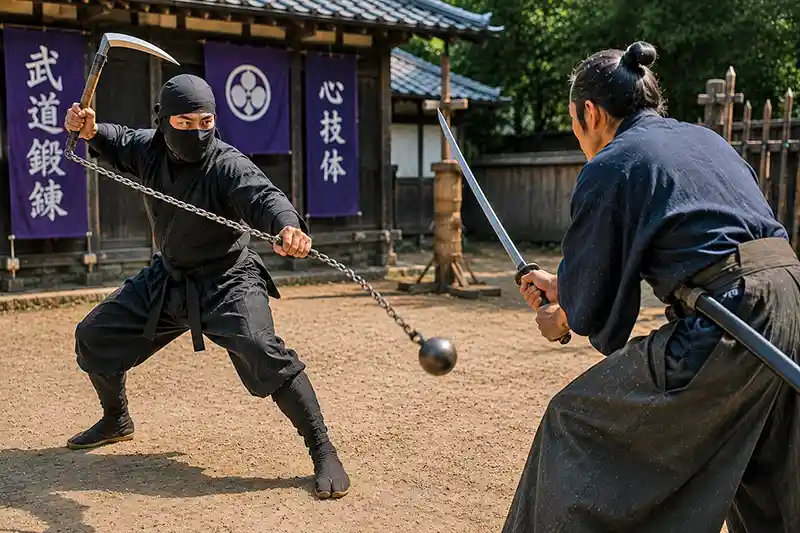
The kusarigama has accumulated the kind of reputation that follows many unusual Japanese weapons. Stories of impossible entanglements, perfectly controlled chains, and ninja effortlessly defeating groups of swordsmen have helped turn it into something larger than the historical weapon itself. Yet stripping away those exaggerations does not make the kusarigama less impressive. If anything, the mechanics behind it reveal why such stories were able to develop in the first place.
A skilled practitioner could threaten an opponent from outside sword range, alter the rhythm of the chain, attack high or low, interfere with a weapon, disrupt footwork, and then transition to the sickle when the distance collapsed. None of those capabilities required supernatural skill. What they required was extensive training with a weapon whose different components could be made to work together.
This is a recurring pattern with unusual historical weapons. The designs that seem strangest to modern eyes often existed because someone was trying to solve a very specific tactical problem. The kusarigama's solution was to make an opponent deal with distance and close combat almost simultaneously. That placed it comfortably alongside some of the most memorable combat weapons, even if it was never as widespread as the sword or spear.
The kusarigama did not need to be unbeatable to be frightening. It only needed to make a capable swordsman hesitate, misjudge the distance, watch the wrong threat, or commit to an attack at the wrong moment. Against a practitioner who truly understood the weapon, that single mistake could be all the opening the kusarigama needed.
Why the Kusarigama Survived as a Martial Art
The kusarigama never became a standard battlefield weapon on the scale of the sword, spear, or bow, yet knowledge of its use did not simply disappear. Methods of kusarigamajutsu were preserved within Japanese martial traditions, where practitioners could study the precise timing and distance that made such a complicated weapon functional. That survival gives us something more valuable than the exaggerated stories that eventually surrounded it: evidence that people actually developed systematic methods for using its unusual design.
Training could break the weapon into skills that would have been extremely difficult to learn during an actual confrontation. Practitioners could study how to control the weighted end, manage the length of the chain, recover after a swing, transition between ranges, and coordinate the chain with movements of the sickle. Repetition transformed what initially looked chaotic into a series of deliberate actions.
This is one reason the kusarigama deserves to be understood as more than another exotic weapon associated with ninja folklore. Japanese martial traditions preserved specialized weapons because they presented distinctive tactical and technical problems. Studying them could demand exceptional control of distance, timing, coordination, and awareness, even when those weapons were no longer commonly carried for practical combat.
The kusarigama's survival also helps explain why it continues to fascinate martial artists today. There is something inherently compelling about watching a weapon that appears almost uncontrollable become precise in trained hands. Its chain and weight create the spectacle, but the real achievement is the discipline required to make them behave exactly as the practitioner intends.
The Kusarigama Was a Weapon Built Around Creating Mistakes
Many weapons are designed primarily around delivering a more powerful strike, extending reach, or improving protection. The kusarigama approached combat differently. Its unusual combination of chain, weight, and sickle gave the wielder multiple ways to pressure an opponent into making a bad decision before the blade ever needed to land a decisive attack.
A swordsman who stepped backward to avoid the weight could surrender distance. One who rushed forward might expose himself during the approach. Attempting to block the chain could create the risk of entanglement, while concentrating too heavily on the sickle could allow the weighted end to attack from another angle. Even when none of these actions produced an immediate result, they could steadily narrow the defender's choices.
That principle is what separates the kusarigama from weapons that were intimidating primarily because of their size or destructive power. Its effectiveness depended heavily on manipulation. The practitioner was trying to influence where the opponent moved, what he watched, and when he committed to an attack. In that sense, the weapon could create a sequence in which the opponent's own reactions became part of the kusarigama wielder's strategy.
It is also why the kusarigama remains such a fascinating example of historical weapon design. The chain and sickle look bizarre when viewed separately from the system developed around them. Once their roles are considered together, however, the logic becomes much clearer. The kusarigama was not merely designed to attack an opponent. It was designed to give him several bad choices and punish whichever one he made.
The Kusarigama Was Most Dangerous Before the Fight Became Predictable
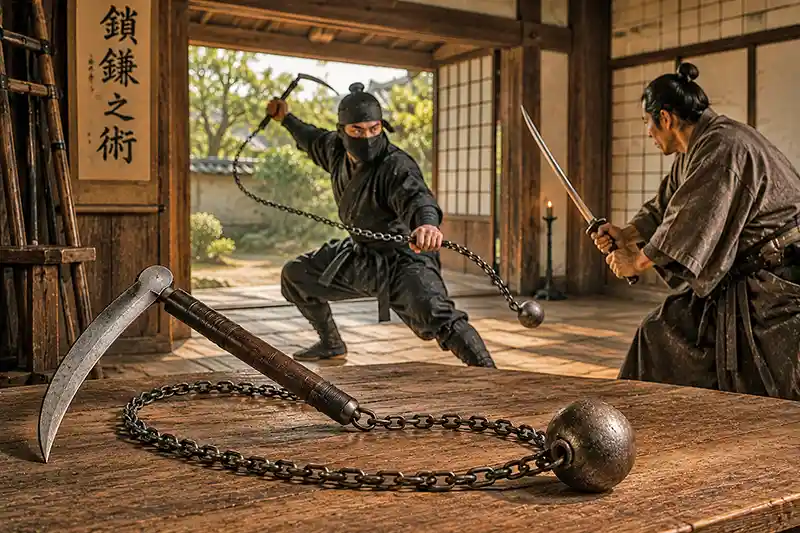
Perhaps the greatest advantage of the kusarigama appeared during the first moments of an encounter. A swordsman who had never trained against one could understand the obvious danger of the sickle, yet the behavior of the chain was much harder to judge by sight alone. How far could the weight reach? How quickly could it change direction? What happened if the sword intercepted the chain? Could the wielder attack while the weight was still moving? Every unanswered question made committing to an attack more difficult.
That uncertainty would diminish as an opponent gained experience. Someone who had trained against kusarigama techniques could learn to recognize its ranges, anticipate common movements, and identify moments when the chain was difficult to redirect. This helps explain why specialized weapons could sometimes gain an advantage from unfamiliarity without necessarily being superior to more conventional weapons.
The same principle appears throughout the history of unusual martial arts weapons. Designs that behaved differently from familiar swords, spears, and staffs could force even an experienced fighter to solve a new problem under enormous pressure. The kusarigama simply took that principle unusually far by combining a rigid blade and a flexible chain into a single fighting system.
Once its movements became familiar, some of the mystery disappeared. But that may be the clearest answer to why the kusarigama was so difficult to fight against in the first place. A swordsman did not merely have to defeat the person holding it. He first had to understand a weapon whose range, rhythm, direction, and immediate threat could change before he had fully decided how to respond.
The Real Advantage Was Making a Swordsman Think About Too Many Things at Once
By itself, almost every individual threat created by the kusarigama had an answer. A swordsman could evade a swinging weight. He could avoid becoming entangled. He could defend against a sickle at close range. He could advance when the chain was poorly positioned or retreat when the kusarigama wielder tried to close the distance. The difficulty came from having to recognize which problem mattered most at any particular moment.
That mental pressure was amplified because the threats were connected. Moving away from one could create an opportunity for another. A retreat that avoided the sickle might restore the chain's ideal range. An aggressive advance that neutralized a wide swing could bring the attacker directly toward the blade. Raising attention toward a circling weight could make it harder to notice changes in the wielder's footwork.
This is where the kusarigama becomes more interesting than its reputation as an exotic or frightening weapon. Its design encouraged the practitioner to create dilemmas rather than rely on a single devastating technique. The chain could influence movement, the weight could demand attention, and the sickle could exploit whatever opening those actions produced. Each component made the others more troublesome.
The best explanation for why the kusarigama was so difficult to fight against may therefore be surprisingly simple. It gave an opponent too many things to solve at once. A swordsman only needed to make one wrong decision, while an experienced kusarigama practitioner could keep changing the question.
The Kusarigama Was Dangerous Because Every Part Had a Different Job
The kusarigama can look almost unnecessarily complicated when viewed for the first time. A sickle was already a functional close-range weapon, while a weighted chain could have been used independently as a flexible weapon. Combining them created something more difficult to carry, harder to master, and potentially dangerous to its own user. Yet that complexity was also the entire point.
The weight could threaten from a distance and force an opponent to react. The chain could interfere with movement, weapons, and positioning. The sickle provided a compact blade for the moment the distance collapsed. Instead of three components performing the same task, each addressed a different stage of the encounter.
That division of roles is what made the weapon so tactically unusual. The kusarigama wielder did not necessarily need the weighted end to deliver a decisive blow. A near miss that forced a swordsman to step sideways could be useful. The chain did not have to perfectly bind a sword if merely interfering with it created hesitation. Each action could prepare the conditions for whatever came next.
Seen this way, the kusarigama was less a bizarre collection of weapon parts than a carefully interconnected fighting system. Its components compensated for one another's limitations, allowing a short sickle to threaten beyond its normal reach and a flexible chain to create opportunities for a blade that otherwise required close contact. That relationship between the parts, rather than any single spectacular technique, was the real genius behind the design.
What the Kusarigama Reveals About Japanese Weapon Design
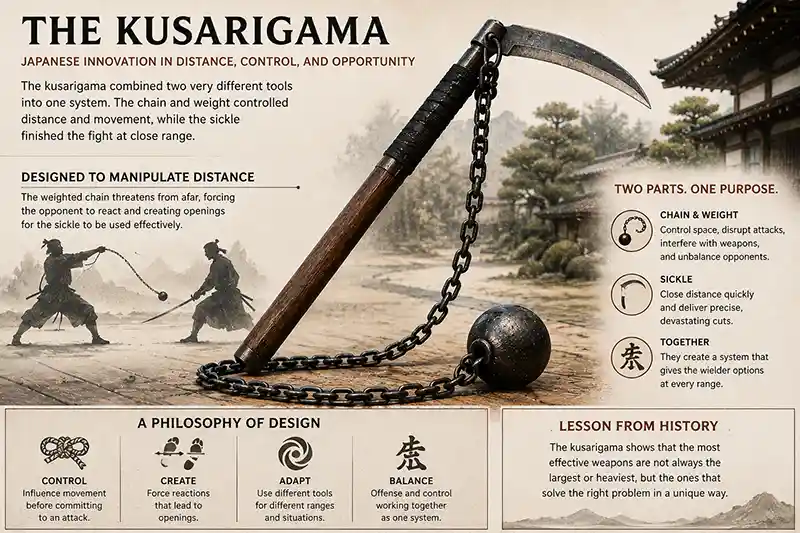
The kusarigama is easy to dismiss as one of Japan's stranger historical weapons, but its unusual appearance hides a remarkably logical idea. Rather than trying to make a sickle longer, heavier, or more powerful, its designers paired it with something that solved the sickle's greatest limitation: reach. The result was a weapon capable of influencing an opponent before the blade itself could ever touch him.
That same philosophy can be seen in other specialized Japanese weapons. Chains, cords, hooks, weights, and unconventional blades were sometimes combined to create options that a simple rigid weapon could not provide. The goal was not necessarily to overpower an opponent directly. It could be to control distance, interfere with movement, create hesitation, or force a conventional weapon into an unfamiliar type of encounter.
The kusarigama is an especially clear example because its two halves seem almost contradictory. One depends on flexible movement at a distance, while the other is a compact blade meant for close range. Yet when those capabilities are coordinated, the contradiction disappears. The chain helps create opportunities for the sickle, while the sickle gives the practitioner an answer when the opponent gets past the chain.
That is ultimately why the kusarigama deserves more than its reputation as a bizarre relic or theatrical ninja weapon. It represents a sophisticated attempt to manipulate one of the most important elements in any fight: distance. Its appearance may have been unusual, but the problem it was designed to solve was as old as combat itself.
The Weapon's Reputation Makes More Sense Once You Stop Looking at the Sickle
At first glance, the sickle seems like the part of the kusarigama an opponent should fear most. It was sharp, immediately recognizable as a weapon, and capable of delivering cuts at close range. Yet focusing on the blade alone misses what made the kusarigama such an unusual challenge. Much of the weapon's tactical value existed several feet away from the sickle.
The chain and weight could begin influencing the encounter before either fighter entered normal striking distance with a short blade. They could force movement, disrupt an advance, threaten different heights, and make an opponent reluctant to commit. By the time the sickle became relevant, the kusarigama practitioner might already have spent several moments manipulating the opponent's position and attention.
This is one reason historical weapons can be misleading when judged only by appearance. The largest blade was not necessarily the most important component, and the most spectacular attack was not necessarily the purpose of the design. With the kusarigama, the relatively simple iron weight could be the component that allowed everything else to work.
The sickle may have been what made the weapon look dangerous, but the chain was what made fighting against it complicated. Together they created something far more troublesome than either component would have been on its own, and that combination is ultimately what gave the kusarigama its enduring reputation.
Why the Kusarigama Remains One of Japan's Most Fascinating Weapons
The kusarigama was never the dominant weapon of the Japanese battlefield, and it did not make the sword obsolete. Its importance comes from something more interesting. It shows just how far martial artists were willing to experiment with distance, timing, movement, and psychology in an attempt to gain an advantage over a conventionally armed opponent.
The sickle provided the obvious danger, but the chain and weight changed the rules of the encounter. A swordsman could be threatened before reaching sword range, pressured into moving, distracted from the blade, or forced to defend against attacks that behaved nothing like a rigid weapon. The kusarigama practitioner could then exploit those reactions rather than relying entirely on strength or cutting power.
At the same time, none of those advantages came easily. The kusarigama demanded tremendous coordination and could become a liability when used poorly or in the wrong environment. That balance between extraordinary possibilities and equally serious weaknesses is part of what makes the weapon so compelling. Its effectiveness depended less on possessing an exotic weapon than on understanding exactly how to use its unusual characteristics together.
Centuries later, the kusarigama still looks strange enough to belong in a legend. But the real reason it was so difficult to fight against is far more believable. In skilled hands, it could manipulate distance, divide an opponent's attention, and turn a moment of hesitation into an opening. The mythology made the kusarigama famous, but the ingenious fighting principles behind it are what make it worth remembering.
Was the Kusarigama Actually Used by Samurai?
Yes. Although the kusarigama is commonly portrayed as a ninja weapon, its use was not limited to ninja. Kusarigamajutsu became part of established Japanese martial traditions, including schools associated with trained warriors who studied methods for confronting opponents armed with swords and other conventional weapons.
The weapon's modern association with ninja is understandable because its chain, weight, and sickle fit the popular image of unconventional ninja weaponry. Historically, however, the kusarigama is better understood as a specialized Japanese martial weapon whose use extended beyond the ninja mythology that later surrounded it.
Could a Kusarigama Really Disarm a Swordsman?
Potentially, but probably not with the effortless precision often shown in movies and games. The chain could be used to interfere with an opponent's sword, and techniques involving entanglement or controlling a weapon were part of the tactical possibilities offered by flexible weapons. Successfully doing this against a resisting swordsman, however, would require excellent timing, distance, and control.
A more realistic advantage was disruption. The chain did not necessarily have to rip a sword completely from someone's hands to be useful. Catching, pulling, redirecting, or even briefly interfering with the weapon could upset the swordsman's timing and create an opening for the sickle. The dramatic disarm gets most of the attention, but momentarily preventing an opponent from using his weapon effectively could be just as valuable.
How Long Was the Chain on a Kusarigama?
There was no single standardized chain length used on every kusarigama. The weapon existed in different forms, and its dimensions could vary according to the martial tradition, intended techniques, and construction of the individual weapon. Some examples used relatively manageable chains, while others provided considerably more reach.
Chain length also involved a tradeoff. A longer chain could allow the weighted end to threaten an opponent from farther away, but additional length made the weapon more difficult to control and required more space to use effectively. A shorter chain sacrificed some reach while potentially making transitions and recovery easier.
This variation is another reason the kusarigama should not be imagined as one universally standardized weapon. Different designs could emphasize different aspects of the same basic concept: combining the close-range cutting ability of a sickle with the distance and flexibility provided by a weighted chain.
Was the Kusarigama Better Than a Katana?
Not necessarily. The kusarigama and katana were designed around very different strengths, so declaring one universally superior misses what made each weapon effective. The kusarigama could create an unusual advantage at distance with its weighted chain, while the katana offered a comparatively straightforward and versatile cutting weapon that could be used effectively without requiring a large open area.
Much would have depended on the skill of the people involved and the circumstances of the encounter. In open space, an experienced kusarigama practitioner might use the chain to keep a swordsman at an uncomfortable distance and create an opportunity for the sickle. In confined surroundings, the chain could become much harder to manipulate, potentially giving the swordsman a significant advantage.
The kusarigama's greatest strength against a katana was therefore not that it was inherently more powerful. It could force the swordsman into an unfamiliar type of fight. Once the swordsman understood the weapon's range, timing, and weaknesses, however, much of that advantage depended on which fighter could execute his techniques more effectively.
Could the Kusarigama Be Used Without Swinging the Chain?
Yes. The dramatic image of a kusarigama practitioner constantly whirling a weighted chain overhead can give the impression that the weapon depended on continuous swinging. In practice, the sickle could still function at close range, and the chain did not always need to be moving in enormous circles to be useful.
Smaller, more controlled movements could make the weight easier to manage while still allowing the chain to threaten, interfere, or help control distance. The practitioner could also adjust how much chain was effectively in use, giving the weapon more flexibility than the spectacular spinning techniques usually emphasized in fictional portrayals.
This is another example of how the real kusarigama was more practical than its popular image suggests. Constantly making huge swings would require considerable space and could make the weapon easier to anticipate. The ability to change between controlled chain movements and close-range sickle techniques was part of what made the kusarigama so difficult for an opponent to read.
How Heavy Was the Weight on a Kusarigama?
Like the chain itself, the weight attached to a kusarigama was not universally standardized. Historical examples and martial traditions used weights of different shapes and sizes, often made from iron and designed to provide enough mass for the chain to develop useful momentum without becoming excessively difficult to control.
A heavier weight could potentially deliver a more forceful impact, but raw striking power was not its only purpose. The weight also helped keep the chain moving under tension and could be used to disrupt an opponent's timing, threaten his position, or create opportunities for the sickle. Making it excessively heavy would have reduced the speed and control that made those tactics possible.
This balance between power and control is important when understanding the kusarigama. The weighted end was not simply a miniature wrecking ball attached to a chain. It was one component of a coordinated weapon, and its usefulness depended on the practitioner being able to accelerate, redirect, and recover it without losing control of the fight.
Was the Kusarigama Ever Used on the Battlefield?
The kusarigama was a real martial weapon, but it was not a major battlefield weapon in the same sense as the yari, bow, sword, or later firearms. Large battles favored weapons that could function reliably in formations, around other soldiers, and across chaotic terrain. A long chain swinging through the air was poorly suited to those conditions.
The kusarigama made considerably more sense as a specialized weapon for individual combat and martial training. With enough open space, a practitioner could take advantage of the chain's reach and unusual movement without worrying about striking nearby allies or becoming tangled among tightly packed fighters.
This distinction helps explain how the kusarigama could develop sophisticated fighting methods without ever becoming one of Japan's dominant military weapons. Its value came from presenting an individual opponent with an unusual tactical problem, not from being the most practical weapon to equip an army with.
Did the Kusarigama Really Come From a Farming Tool?
The sickle portion of the kusarigama clearly resembles the kama, an agricultural tool traditionally used for cutting grasses and harvesting crops in Japan. This connection has encouraged the familiar story that farmers simply attached chains to their sickles and transformed ordinary tools into weapons. The real development of the kusarigama, however, is not documented neatly enough to support such a simple origin story.
What can be said with confidence is that sickle-shaped implements were familiar in Japanese agriculture and that specialized sickle weapons eventually became part of established martial traditions. Once a chain and weighted end were incorporated into the design, the result required techniques far beyond simply fighting with an improvised farm tool.
That distinction is important because the popular "farm tool turned weapon" explanation appears frequently with Japanese martial arts weapons. Agricultural origins certainly influenced some weapon forms, but later martial versions could become purpose-built implements with specialized dimensions, construction, and techniques that separated them considerably from the tools that inspired them.
The kusarigama may therefore owe part of its design ancestry to an ordinary Japanese sickle, but the weapon that emerged was anything but ordinary. Adding the chain and weight fundamentally changed how the sickle could be used, transforming a short cutting implement into one of the most technically unusual weapons found in Japanese martial traditions.
Why Does a Kusarigama Have a Weight on the End of the Chain?
The weight gave the chain momentum and made it possible to threaten an opponent at a distance. Without sufficient mass at the end, a loose chain would have been far more difficult to project, control, and redirect effectively. The weighted end transformed the chain into an active part of the weapon rather than simply a connection to the sickle.
Its purpose went beyond delivering direct impacts. A practitioner could use the moving weight to pressure an opponent, influence where he stepped, distract his attention, or create opportunities for the chain to interfere with his weapon. Even a swing that never struck the opponent could be useful if it forced a defensive reaction.
This is what made the kusarigama's design so clever. The weight created the momentum, the chain extended the weapon's influence beyond the reach of the sickle, and the sickle provided the close-range threat. None of the three components explains the weapon by itself. The kusarigama worked because all three were designed to function together.
Are Kusarigama Still Practiced Today?
Yes. Kusarigamajutsu has survived within a small number of traditional Japanese martial arts lineages, allowing aspects of the weapon's historical use to continue being studied today. It is far less common than training with weapons such as the sword, staff, or modern versions of the kama, but the kusarigama has not disappeared entirely from martial practice.
Modern training also provides an important reminder that the kusarigama was more than an exotic object. Learning to coordinate the sickle, chain, and weighted end requires careful control of distance, timing, momentum, and body movement. Those skills help explain why historical practitioners developed formal systems for a weapon that would be extremely difficult to use effectively through improvisation alone.
Of course, modern practice is generally conducted under controlled conditions and does not tell us exactly what every historical encounter involving a kusarigama looked like. What it does preserve is something arguably more useful: the technical logic behind a weapon whose unusual design can otherwise seem almost impossible to understand from museum examples and illustrations alone.
Why Is the Kusarigama So Rare Compared With Other Japanese Weapons?
The kusarigama demanded a combination of space, coordination, and specialized training that made it far less practical than simpler weapons. A sword, staff, or spear could be taught through comparatively direct movements and remained useful across a wide variety of situations. The kusarigama required its user to simultaneously control a blade, a flexible chain, and a moving weight while constantly judging the distance between himself and his opponent.
Its unusual construction also limited where it could be used effectively. Confined spaces reduced the usefulness of the chain, while crowded environments increased the risk of striking obstacles or other people. These limitations made the kusarigama better suited to specialized martial practice than widespread adoption.
That rarity may actually be part of the reason the weapon remains so fascinating today. The kusarigama represents an unusually specialized solution to combat rather than a weapon designed for everyone. It sacrificed simplicity and versatility in exchange for capabilities that few conventional weapons could reproduce.
For a skilled practitioner, that tradeoff could create a formidable weapon. For everyone else, the kusarigama's complexity may have been its greatest obstacle, which helps explain why it became famous without ever becoming common.
Could a Kusarigama Chain Cut Someone?
The chain of a typical kusarigama was not designed to cut like a blade. Its danger came primarily from the weight attached to its end, the momentum generated while swinging it, and the chain's ability to interfere with an opponent's movement or weapon. A rapidly moving metal chain could certainly cause injury, but slicing through an opponent was not its primary function.
This is sometimes exaggerated in fictional portrayals, where chains behave almost like flexible swords. Historically, the kusarigama already had a dedicated cutting component: the sickle. The chain served a different purpose by extending the weapon's reach and helping create opportunities for that blade.
How Far Could a Kusarigama Reach?
There was no universal fighting range because kusarigama varied in size and chain length. What made the weapon remarkable was that its effective threat extended far beyond the reach of its relatively short sickle. Once the weighted end was put into motion, an opponent had to respect an area several feet beyond the blade itself.
Practical reach also depended on how much of the chain the practitioner chose to use. More chain could increase distance but also required additional space and became more difficult to control. A skilled practitioner could therefore alter the weapon's effective range rather than being restricted to one fixed distance.
Could a Kusarigama Be Used Against a Spear?
It could, although a spear presented a very different problem from a sword. One of the kusarigama's advantages against a swordsman was its ability to create a threat beyond normal sword range. A long spear could eliminate or even reverse that advantage, allowing the spearman to threaten the kusarigama practitioner from considerable distance.
The flexible chain could still potentially be used to interfere with the spear shaft, disrupt its movement, or create an opportunity to move closer. However, attempting to manipulate the chain while remaining outside the spearhead's reach would have required excellent timing and distance control. As with the sword, the outcome would depend far more on the practitioners and circumstances than on one weapon automatically defeating the other.
Were There Different Types of Kusarigama?
Yes. Kusarigama were not manufactured according to one universal design. Historical examples and different martial traditions could vary in the dimensions and shape of the sickle, the length of the handle, the length of the chain, the shape and weight of the iron weight, and even where the chain was attached to the weapon.
Those differences could influence how a particular kusarigama was handled. A longer chain emphasized reach but increased the difficulty of controlling the weight, while differences in the sickle and handle could affect close-range techniques. The familiar sickle-and-chain concept therefore represents a family of related designs rather than one perfectly standardized weapon.
Could the Kusarigama Be Concealed?
Some kusarigama could be relatively compact when the chain was gathered, but describing the weapon as inherently concealed would be misleading. A metal sickle, length of chain, and iron weight still had to be carried somewhere, and many examples would have been considerably less discreet than the hidden weapons associated with ninja in popular culture.
Its agricultural-looking sickle may have appeared less immediately suspicious in certain historical settings than a conventional sword, but that does not mean every kusarigama was disguised as an innocent farming implement. The idea of the weapon as a secret assassin's tool owes a great deal to its later association with ninja mythology.
What Is the Difference Between a Kusarigama and a Kyoketsu-Shoge?
Both weapons combine a blade with a flexible component, which makes them easy to confuse, but their construction is quite different. A kusarigama uses a sickle attached to a chain ending in a weighted object. A kyoketsu-shoge traditionally uses a distinctive double-edged or hooked blade connected to a long cord or chain that terminates in a metal ring.
Those differences create different possibilities for handling and technique. The weighted end is central to the kusarigama's ability to generate momentum and threaten at range, while the ring and long flexible connection of the kyoketsu-shoge produce a different system altogether. Popular culture frequently groups both under the broad category of unusual ninja weapons, but they should not be treated as interchangeable designs.
Was the Kusarigama Used to Capture Opponents Alive?
The kusarigama's chain created possibilities for entangling, controlling, or restricting an opponent, but it would be misleading to describe the weapon primarily as a nonlethal capture device. The sickle and weighted end were capable of causing serious injury, and the martial systems surrounding the weapon included techniques intended for genuine combat.
That said, controlling an opponent did not always require immediately striking with the blade. If the chain interfered with a weapon, restricted movement, or compromised someone's balance, the practitioner could potentially gain control of the encounter without relying solely on a cutting attack. This versatility was another consequence of combining a flexible weapon with a blade.
How Dangerous Was the Kusarigama to Its Own User?
Potentially very dangerous, particularly without proper training. The practitioner was deliberately accelerating a metal weight attached to a flexible chain while simultaneously handling a sharp sickle. Losing track of the weight, misjudging a rebound, allowing the chain to become tangled, or making a mistake while recovering from a swing could put the wielder at risk.
This is why the kusarigama's spectacular appearance can be deceptive. The same unpredictability that made the weapon difficult for an opponent to understand also had to be brought under precise control by its user. Experienced practitioners trained extensively to manage momentum, distance, recovery, and transitions between the chain and sickle. Without that control, the kusarigama could become almost as troublesome for the person holding it as for the person facing it.
You May Also Be Interested In:
Leave a Reply