



We Tested the Deadliest Ninja Stars!
April 28th, 2021
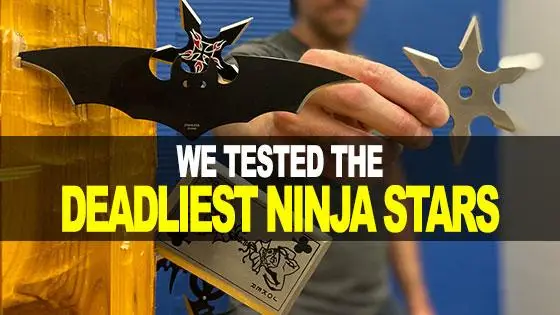
Throwing stars are available in so many different shapes and sizes that it is difficult to know which ones would actually make an effect weapon and which ones would just look better hanging on your wall.
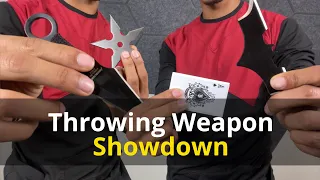
One of the questions we get most often from our customers is "Which ninja stars will actually stick into a tree?". At KarateMart.com, we carry a huge variety of throwing stars that come in different sizes, colors and even shapes like throwing cards and bats. So, it can be confusing trying to decide which stars to purchase. To make the decision easier for our customers, I decided to test out a bunch of the different shuriken in our warehouse.
Here's the Video:

Here are the ninja stars I tested out in this video:
1) 6 Point Silver Throwing Star
2) Black Throwing Star Set
3) Dark Night Bat Throwers
4) Dragon Rage Shuriken
5) Death Claw Throwing Star
6) Lethal Chrome Bat Shuriken
7) Joker Throwing Cards
Are there any other throwing stars on the website that you would like to see us test out?
At first glance, the biggest difference between throwing stars might seem to be their appearance. Some have three or four points, while others have six, eight, or even more. But when you actually start throwing them, factors such as weight, size, balance, and point design can make a noticeable difference in how a star behaves after it leaves your hand.
Balance is particularly important because a throwing star rotates rapidly as it travels toward the target. If the weight is distributed evenly around the center, the star tends to rotate more predictably. An unusually heavy point or an asymmetrical design can change that rotation, although experienced throwers can sometimes compensate for unusual shapes with practice.
Weight also affects how much momentum the star carries into the target. A heavier throwing star can hit with more authority, but additional weight does not automatically make it easier to throw. Lighter stars may feel quicker and require less effort, while heavier designs can require more deliberate technique to achieve consistent results.
Finally, there is the design of the points themselves. Long, narrow points and shorter, broader points can behave differently depending on the target material and throwing distance. This is one reason there isn't a single throwing star design that is automatically superior to every other one. The best-performing star often depends on what you're throwing at, how far away you are, and how consistently you can reproduce your throwing technique.
One of the most noticeable differences between throwing stars is the number of points they have. Traditional and modern designs can range from just a few large points to eight or more smaller ones. While adding more points increases the chances that one of them will contact the target, it does not necessarily make the star more effective.
Throwing stars with fewer points generally have more space available for each individual point. This allows manufacturers to use longer or broader points without making the overall star excessively large. Depending on the design, those larger points may penetrate certain targets more easily when they strike at a favorable angle.
Stars with more points offer a different advantage. Because the points are positioned closer together around the perimeter, there is less rotation required before another point comes into position. That can increase the likelihood that a point rather than a flat edge will contact the target, particularly when the throw is less than perfect.
There is a tradeoff, however. Packing more points around the same diameter usually means making each point smaller. This is why a six-point or eight-point throwing star is not automatically better than a four-point design. Point geometry, overall diameter, weight, balance, and throwing technique all matter alongside the number of points.
Weight can have a noticeable effect on the way a throwing star behaves, but a heavier star is not automatically more likely to stick. Additional mass gives the star more momentum at a given speed, which can produce a more forceful impact when one of the points reaches the target at the proper angle.
Heavier throwing stars can also feel more stable in the hand. Their extra weight provides clearer feedback during the throwing motion, which some people find helpful when learning to release the star consistently. The tradeoff is that heavier stars generally require more effort to accelerate and can become tiring during longer practice sessions.
Lighter throwing stars behave differently. They can be easier to throw repeatedly and may rotate quickly, but they carry less momentum into the target. They can also be more affected by inconsistencies in the release, particularly as throwing distance increases.
Ultimately, whether a throwing star sticks depends on more than weight alone. The sharpness and shape of the points, the angle at which the star arrives, the target material, throwing distance, and the quality of the release all play a role. A well-thrown lighter star can outperform a poorly thrown heavier one, which makes consistency more important than simply choosing the heaviest design available.
The overall diameter of a throwing star can influence everything from how it feels in the hand to how quickly it rotates after release. Smaller stars are generally easier to carry and require less movement to get them spinning, while larger stars can feel more substantial and may carry greater momentum toward the target.
A larger diameter also means that the points travel around a wider circle as the star rotates. This can change the timing required for a clean release and may make a larger star feel noticeably different even when it weighs about the same as a smaller design. Switching between sizes can therefore require a little adjustment before throws become consistent again.
Smaller throwing stars tend to feel quicker and more compact. Their reduced size can make them comfortable for repeated practice, but very small stars may provide less surface area to grip consistently. Depending on the design, that can make finger placement and release technique more important.
There is no ideal diameter that works for every thrower. Hand size, throwing style, weight distribution, and personal preference all affect which size feels most controllable. Trying several different sizes is often the easiest way to discover which design produces the most predictable rotation and consistent results.
It is easy to assume that buying a different throwing star will immediately produce better results, but technique usually has a much greater influence on consistency. Even a perfectly balanced star will struggle to stick if it is released awkwardly, tilted excessively, or sent toward the target without enough controlled rotation.
A consistent release is especially important. Small changes in wrist angle, grip pressure, or the point at which the star leaves the hand can alter its flight. Developing a repeatable throwing motion makes it much easier to determine whether differences in performance are actually caused by the star rather than variations from one throw to the next.
Distance matters as well. Moving closer to or farther from the target changes how many times the star rotates before impact. A throwing technique that produces reliable results at one distance may require adjustment at another, particularly when switching between stars with noticeably different diameters or weights.
This is also why testing several throwing stars using the same target and distance can be so useful. Keeping the conditions consistent makes differences in weight, size, balance, and point design easier to notice. Ultimately, the star that performs best is often the one that works most naturally with the thrower's technique rather than the one with the most aggressive appearance.
For someone learning to throw for the first time, an elaborate design is usually less important than choosing a star that feels balanced and predictable. A medium-sized throwing star with an evenly distributed shape can make it easier to develop a consistent grip, release, and throwing motion before experimenting with more unusual designs.
Beginners may also find that stars with several evenly spaced points are relatively forgiving during practice. Because another point comes into position after a relatively small amount of rotation, there may be a greater chance of achieving a clean stick even when the release timing is not perfect. That can make early practice less frustrating while technique is still developing.
Extremely small, unusually shaped, or especially heavy throwing stars can be fun to experiment with later, but each introduces characteristics that may require adjustments in technique. Starting with a relatively conventional design provides a useful baseline. Once throws become consistent, changing the size, weight, or number of points makes it easier to recognize how those characteristics affect performance.
Regardless of the design, throwing stars should only be practiced with an appropriate target in a controlled area where missed throws cannot reach people, animals, or property. Beginners should also check applicable local laws before purchasing, carrying, or practicing with throwing stars, since regulations vary considerably by location.
After comparing different throwing stars, the biggest takeaway is that there is no single design that will outperform every other star for every thrower. A star with more points may be more forgiving, a heavier design may carry more momentum, and a larger star may feel more substantial, but none of those characteristics guarantees better results on its own.
The most important factors are balance, predictable rotation, and how naturally the star works with your throwing technique. Once you can throw consistently, experimenting with different weights, sizes, and point configurations becomes much more meaningful because you can actually feel how each design changes the throw.
That is also part of what makes throwing stars so interesting to practice with. Two designs that look similar can behave surprisingly differently once they leave your hand, and sometimes the star that performs best is not the one you expected.
Here's the Video:
Here are the ninja stars I tested out in this video:
1) 6 Point Silver Throwing Star
2) Black Throwing Star Set
3) Dark Night Bat Throwers
4) Dragon Rage Shuriken
5) Death Claw Throwing Star
6) Lethal Chrome Bat Shuriken
7) Joker Throwing Cards
Are there any other throwing stars on the website that you would like to see us test out?
What Makes One Throwing Star More Effective Than Another?
At first glance, the biggest difference between throwing stars might seem to be their appearance. Some have three or four points, while others have six, eight, or even more. But when you actually start throwing them, factors such as weight, size, balance, and point design can make a noticeable difference in how a star behaves after it leaves your hand.
Balance is particularly important because a throwing star rotates rapidly as it travels toward the target. If the weight is distributed evenly around the center, the star tends to rotate more predictably. An unusually heavy point or an asymmetrical design can change that rotation, although experienced throwers can sometimes compensate for unusual shapes with practice.
Weight also affects how much momentum the star carries into the target. A heavier throwing star can hit with more authority, but additional weight does not automatically make it easier to throw. Lighter stars may feel quicker and require less effort, while heavier designs can require more deliberate technique to achieve consistent results.
Finally, there is the design of the points themselves. Long, narrow points and shorter, broader points can behave differently depending on the target material and throwing distance. This is one reason there isn't a single throwing star design that is automatically superior to every other one. The best-performing star often depends on what you're throwing at, how far away you are, and how consistently you can reproduce your throwing technique.
Does the Number of Points on a Throwing Star Matter?
One of the most noticeable differences between throwing stars is the number of points they have. Traditional and modern designs can range from just a few large points to eight or more smaller ones. While adding more points increases the chances that one of them will contact the target, it does not necessarily make the star more effective.
Throwing stars with fewer points generally have more space available for each individual point. This allows manufacturers to use longer or broader points without making the overall star excessively large. Depending on the design, those larger points may penetrate certain targets more easily when they strike at a favorable angle.
Stars with more points offer a different advantage. Because the points are positioned closer together around the perimeter, there is less rotation required before another point comes into position. That can increase the likelihood that a point rather than a flat edge will contact the target, particularly when the throw is less than perfect.
There is a tradeoff, however. Packing more points around the same diameter usually means making each point smaller. This is why a six-point or eight-point throwing star is not automatically better than a four-point design. Point geometry, overall diameter, weight, balance, and throwing technique all matter alongside the number of points.
Does a Heavier Throwing Star Stick Better?
Weight can have a noticeable effect on the way a throwing star behaves, but a heavier star is not automatically more likely to stick. Additional mass gives the star more momentum at a given speed, which can produce a more forceful impact when one of the points reaches the target at the proper angle.
Heavier throwing stars can also feel more stable in the hand. Their extra weight provides clearer feedback during the throwing motion, which some people find helpful when learning to release the star consistently. The tradeoff is that heavier stars generally require more effort to accelerate and can become tiring during longer practice sessions.
Lighter throwing stars behave differently. They can be easier to throw repeatedly and may rotate quickly, but they carry less momentum into the target. They can also be more affected by inconsistencies in the release, particularly as throwing distance increases.
Ultimately, whether a throwing star sticks depends on more than weight alone. The sharpness and shape of the points, the angle at which the star arrives, the target material, throwing distance, and the quality of the release all play a role. A well-thrown lighter star can outperform a poorly thrown heavier one, which makes consistency more important than simply choosing the heaviest design available.
How Size Changes the Way a Throwing Star Flies
The overall diameter of a throwing star can influence everything from how it feels in the hand to how quickly it rotates after release. Smaller stars are generally easier to carry and require less movement to get them spinning, while larger stars can feel more substantial and may carry greater momentum toward the target.
A larger diameter also means that the points travel around a wider circle as the star rotates. This can change the timing required for a clean release and may make a larger star feel noticeably different even when it weighs about the same as a smaller design. Switching between sizes can therefore require a little adjustment before throws become consistent again.
Smaller throwing stars tend to feel quicker and more compact. Their reduced size can make them comfortable for repeated practice, but very small stars may provide less surface area to grip consistently. Depending on the design, that can make finger placement and release technique more important.
There is no ideal diameter that works for every thrower. Hand size, throwing style, weight distribution, and personal preference all affect which size feels most controllable. Trying several different sizes is often the easiest way to discover which design produces the most predictable rotation and consistent results.
Why Throwing Technique Matters More Than the Star
It is easy to assume that buying a different throwing star will immediately produce better results, but technique usually has a much greater influence on consistency. Even a perfectly balanced star will struggle to stick if it is released awkwardly, tilted excessively, or sent toward the target without enough controlled rotation.
A consistent release is especially important. Small changes in wrist angle, grip pressure, or the point at which the star leaves the hand can alter its flight. Developing a repeatable throwing motion makes it much easier to determine whether differences in performance are actually caused by the star rather than variations from one throw to the next.
Distance matters as well. Moving closer to or farther from the target changes how many times the star rotates before impact. A throwing technique that produces reliable results at one distance may require adjustment at another, particularly when switching between stars with noticeably different diameters or weights.
This is also why testing several throwing stars using the same target and distance can be so useful. Keeping the conditions consistent makes differences in weight, size, balance, and point design easier to notice. Ultimately, the star that performs best is often the one that works most naturally with the thrower's technique rather than the one with the most aggressive appearance.
Which Type of Throwing Star Is Best for Beginners?
For someone learning to throw for the first time, an elaborate design is usually less important than choosing a star that feels balanced and predictable. A medium-sized throwing star with an evenly distributed shape can make it easier to develop a consistent grip, release, and throwing motion before experimenting with more unusual designs.
Beginners may also find that stars with several evenly spaced points are relatively forgiving during practice. Because another point comes into position after a relatively small amount of rotation, there may be a greater chance of achieving a clean stick even when the release timing is not perfect. That can make early practice less frustrating while technique is still developing.
Extremely small, unusually shaped, or especially heavy throwing stars can be fun to experiment with later, but each introduces characteristics that may require adjustments in technique. Starting with a relatively conventional design provides a useful baseline. Once throws become consistent, changing the size, weight, or number of points makes it easier to recognize how those characteristics affect performance.
Regardless of the design, throwing stars should only be practiced with an appropriate target in a controlled area where missed throws cannot reach people, animals, or property. Beginners should also check applicable local laws before purchasing, carrying, or practicing with throwing stars, since regulations vary considerably by location.
So Which Throwing Star Is Actually the Best?
After comparing different throwing stars, the biggest takeaway is that there is no single design that will outperform every other star for every thrower. A star with more points may be more forgiving, a heavier design may carry more momentum, and a larger star may feel more substantial, but none of those characteristics guarantees better results on its own.
The most important factors are balance, predictable rotation, and how naturally the star works with your throwing technique. Once you can throw consistently, experimenting with different weights, sizes, and point configurations becomes much more meaningful because you can actually feel how each design changes the throw.
That is also part of what makes throwing stars so interesting to practice with. Two designs that look similar can behave surprisingly differently once they leave your hand, and sometimes the star that performs best is not the one you expected.
You May Also Be Interested In:
- What Are the Different Types of Ninja Stars?
- Our Five Deadliest Ninja Weapons
- Deadliest Throwing Weapons for Your Ninja Arsenal
- Mall Ninja Weapons Tested!
- Do Ninja Climbing Tools Actually Work? We Tested Them Out!
- Quickly Learn How To Throw Knives, Axes, Spikes, Cards & Stars!
- Deadliest Kung Fu Weapon Challenge
- The Meteor Hammer: The Deadliest Weapon Almost Nobody Could Master
- The Most Powerful Stun Gun We've Ever Tested!
- OTF Knuckle Knife and Other New Weapons Tested!
Leave a Reply