



Why the War Hammer Was More Dangerous Than the Sword
August 6th, 2026
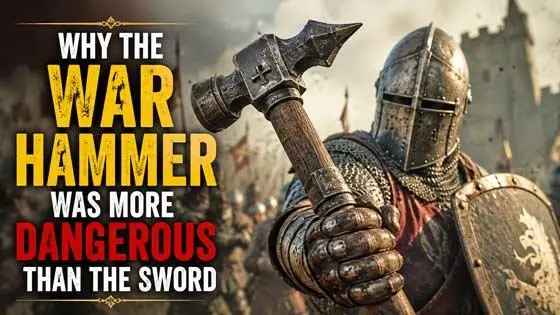
Most people picture the medieval sword as the ultimate battlefield weapon, but history tells a different story. As armor became stronger and knights covered themselves in steel from head to toe, swords began to lose much of their advantage. Warriors needed a weapon capable of crushing helmets, denting plate armor, and delivering devastating force through layers of metal. That weapon was the war hammer. Compact, brutally efficient, and specifically designed to defeat heavily armored opponents, it became one of the most feared weapons of the Middle Ages. Here's why this seemingly simple hammer often proved far more dangerous than the sword.
Armor Changed Everything
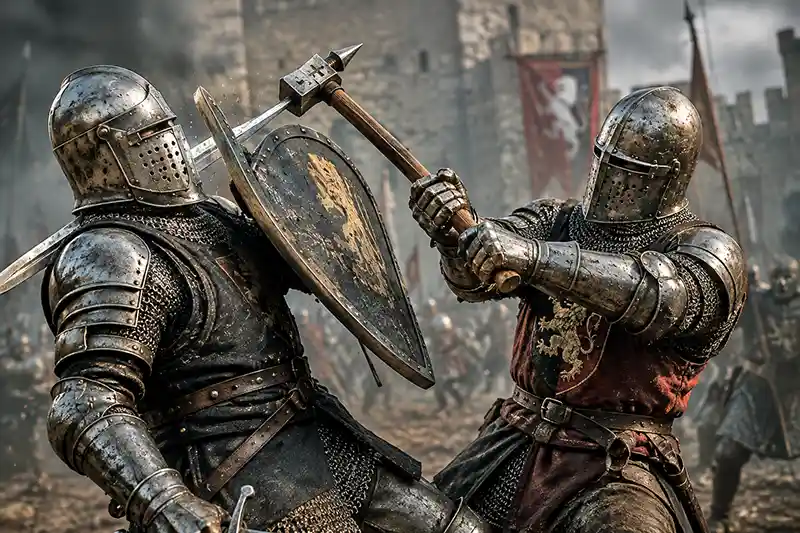
For centuries, swords earned their reputation as the king of the battlefield. They were versatile, relatively easy to carry, and deadly against lightly armored opponents. But as medieval armor evolved from chainmail into expertly crafted steel plate, even the finest blades began running into a serious problem. A sharp edge could glance harmlessly off a breastplate or fail to penetrate a reinforced helmet, leaving the swordsman vulnerable in the middle of a fight.
Weapon makers responded by designing tools that attacked armor instead of trying to slice through it. Heavy maces, axes, polearms, and eventually the war hammer became the preferred choice for fighting fully armored knights. As we explored in our article about weapons that were far more effective than swords, battlefield success often depended less on elegance and more on finding the fastest way to overcome an opponent's protection.
The war hammer excelled because it concentrated tremendous force into a very small impact point. Instead of relying on a long cutting edge, its compact steel head delivered crushing blows capable of denting helmets, damaging armor, and staggering even heavily protected warriors. Many designs also featured a hardened spike on the opposite side, giving fighters a tool that could hook shields, strike weak points, or punch into thinner sections of armor when an opening appeared.
Unlike the sword, which often required a clean cut to be effective, the war hammer remained dangerous even when it never pierced the armor at all. The sheer force of the impact could break bones, cause severe internal injuries, or leave an opponent stunned long enough to finish the fight. In an age where survival increasingly depended on steel armor, the weapon built to defeat that armor naturally became one of the battlefield's most feared tools.
Designed to Defeat Plate Armor
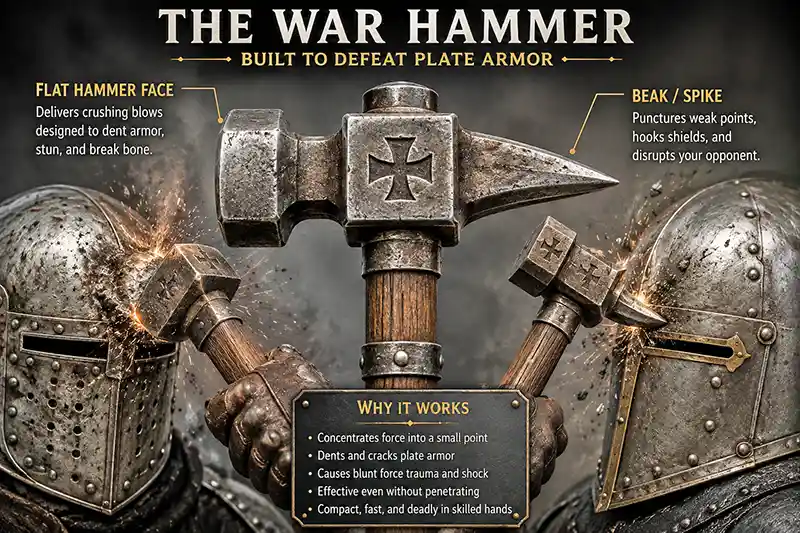
The greatest strength of the war hammer wasn't its weight. In fact, many medieval war hammers were surprisingly compact, with heads weighing only a few pounds. Their true advantage came from physics. By concentrating tremendous force into a tiny striking surface, the weapon could dent steel, crack helmets, and deliver bone-breaking blows that a sword simply couldn't match against heavily armored opponents.
Most war hammers featured two distinct striking surfaces. One side had a flat hammer face designed to deliver crushing impacts capable of stunning or disabling an enemy through their armor. The opposite side often featured a narrow beak or spike that could bite into plate armor, puncture weaker sections, or hook an opponent's shield or weapon. This combination made the war hammer one of the most versatile close-combat weapons of the late Middle Ages.
Unlike many medieval swords, which relied on long, razor-sharp edges, a war hammer required very little maintenance to remain effective. Its hardened steel head didn't need to slice through flesh to win a fight. Even a solid hit to the shoulder, arm, or helmet could leave an armored knight unable to continue fighting. On crowded battlefields where every second mattered, that efficiency made an enormous difference.
The war hammer also rewarded precision over brute strength. A skilled fighter could target vulnerable joints in plate armor, strike hands gripping weapons, or land devastating blows to helmets with remarkable speed. Against an opponent protected by the finest armor money could buy, the war hammer transformed the armor itself into part of the weapon's destructive force.
A Sword Could Cut, but a War Hammer Could Disable
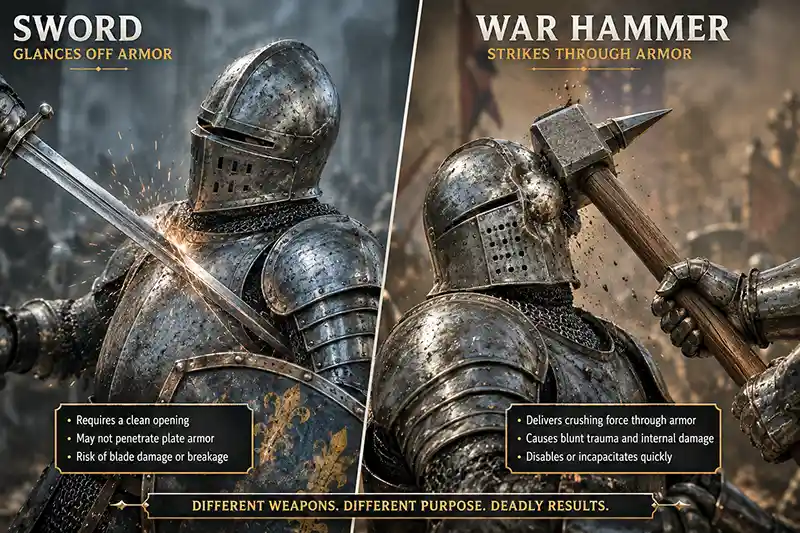
A sword was still a formidable weapon, but its effectiveness depended heavily on what it struck. Against an unarmored opponent, a sharp blade could end a fight almost instantly. Against plate armor, however, the same swing might skid across curved steel, chip the blade, or waste precious energy without causing a serious injury.
The war hammer attacked the body in a completely different way. Its purpose was not to create a long wound. It was designed to transfer concentrated force through armor and into the person wearing it. A blow to the helmet could cause a concussion even when the steel remained intact. A strike to the arm could fracture bone beneath a reinforced gauntlet. A hit to the chest could knock the wind from a knight or leave him unable to stand.
This made the hammer especially dangerous in short, chaotic encounters. A fighter didn't always need to land a perfect killing blow. Disabling an opponent's weapon arm, damaging a knee, or stunning him for only a few seconds could be enough to decide the fight. The sword often required an opening. The hammer could create one.
That difference helps explain why the sword's reputation can be misleading. The many swords carried throughout history were symbols of status, skill, and military authority, but the most prestigious weapon was not always the most practical one. When armored warriors met at close range, the blunt, concentrated violence of the war hammer could be far more decisive than the elegant sweep of a blade.
Why Knights Carried Both Weapons
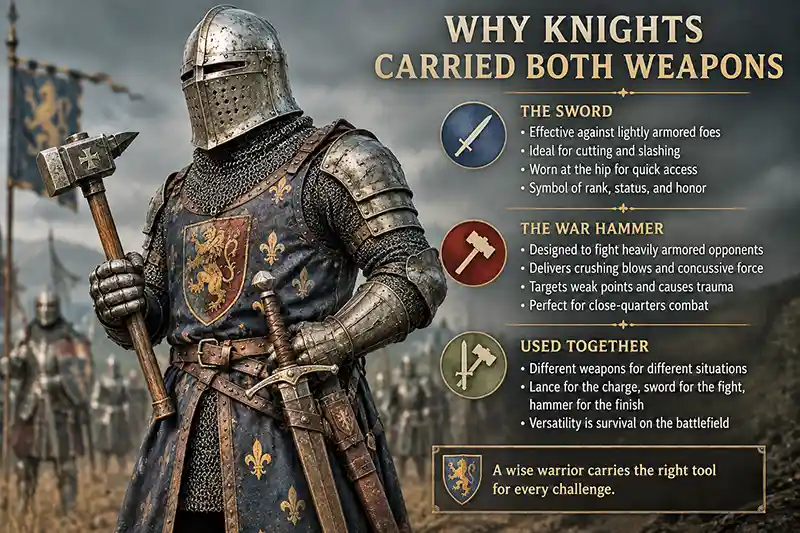
The war hammer did not completely replace the sword. Instead, the two weapons often served different purposes on the same battlefield. A sword remained useful against lightly armored troops, exposed limbs, and opponents who had already lost their protection. It was also easier to wear at the hip and could function as both a practical weapon and a visible symbol of rank.
The war hammer became the specialized answer to heavily armored enemies. A knight might begin a fight with a lance, draw a sword when the formation broke apart, and reach for a hammer once the battle turned into close combat against armored opponents. Carrying multiple weapons was not excessive. It was an acknowledgment that no single tool worked equally well in every situation.
This is one reason the war hammer became associated with experienced knights and men-at-arms. It was not merely a crude club for an unskilled fighter. Using it effectively required timing, balance, and the ability to identify weak points while moving inside an opponent's reach. Missing a powerful swing could leave the wielder exposed, while a carefully placed strike could end the fight immediately.
Its compact shape also made it easier to use in cramped spaces where a long sword could become awkward. During sieges, cavalry clashes, and dense fighting on foot, the hammer could be raised and redirected without requiring a wide arc. That combination of speed, precision, and concentrated force helped place it among the most intimidating weapons in history, even though it lacked the sword's elegance and prestige.
The Beak Was Often More Dangerous Than the Hammer
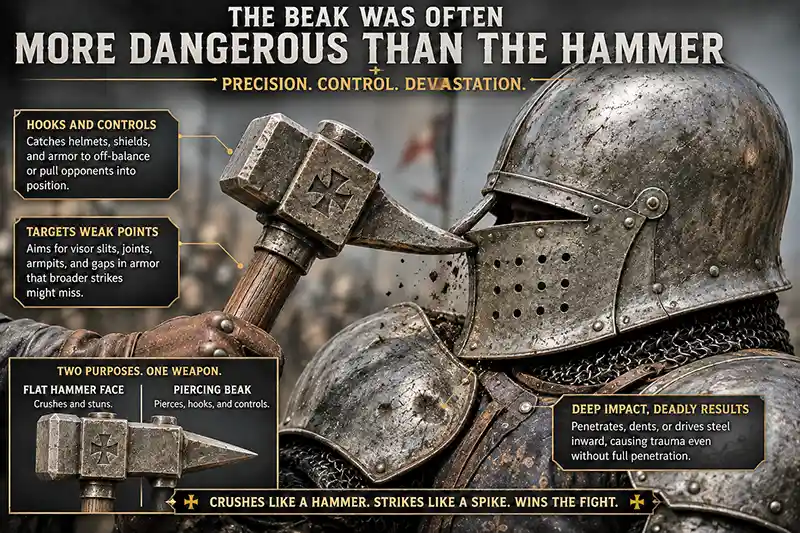
The flat face of a war hammer could crush armor, but the pointed beak on the opposite side gave the weapon an entirely different kind of threat. Narrow, rigid, and sometimes slightly curved, the beak concentrated the force of a swing into an even smaller area than the hammer face. That made it ideal for attacking the vulnerable sections of plate armor that a broad strike might only dent.
A skilled fighter could aim for visor slits, joints, shoulder plates, and the thinner steel around the arms or legs. The beak could also catch beneath the edge of a helmet, hook a shield, or pull an opponent off balance. In close combat, that hooking ability was nearly as valuable as its piercing power because it allowed the wielder to control where the enemy moved.
Not every strike had to punch completely through the armor to be effective. A sharp impact could drive steel inward, damage the padding underneath, or create a deep dent that restricted movement. Even when the point failed to penetrate, the concentrated blow could still cause serious injury beneath the plate.
This combination of crushing force and precision explains why the war hammer appears so frequently among the strangest weapons ever carried into real battles. It looked simple at first glance, but every part of its design served a specific purpose. The hammer stunned and crushed. The beak pierced, hooked, and controlled. Together, they gave one compact weapon several ways to defeat an armored opponent.
Real War Hammers Were Smaller Than Movies Suggest
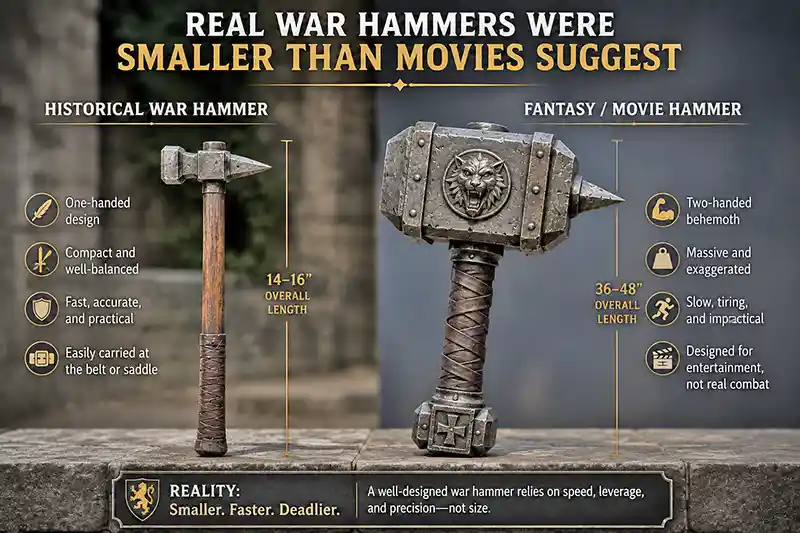
Modern movies and video games often portray war hammers as enormous blocks of iron that only the strongest warrior could lift. Historical examples were usually far more practical. Many one-handed war hammers were compact enough to carry at the belt or saddle, with relatively small steel heads mounted on wooden or reinforced shafts.
This lighter construction made the weapon faster than its brutal reputation suggests. A knight could change direction mid-swing, recover quickly after a missed strike, and deliver several precise blows without exhausting himself. The goal was not to overwhelm an opponent with the largest possible weapon. It was to concentrate speed and force into a carefully placed impact.
A massive hammer head would have created serious problems in combat. It would be slow to accelerate, difficult to stop, and easy for an opponent to avoid. Once the swing missed, the wielder's own momentum could pull him off balance. Medieval weapon makers understood that a smaller head moving quickly could deliver devastating force while remaining controllable.
Some two-handed war hammers and polearms were naturally longer and heavier, but even these were designed around balance rather than sheer bulk. Their extended shafts provided reach and leverage, while spikes, hooks, and compact striking faces gave the fighter several ways to attack armor. The real war hammer was dangerous not because it was enormous, but because nearly every ounce of its weight served a purpose.
Why the War Hammer Disappeared
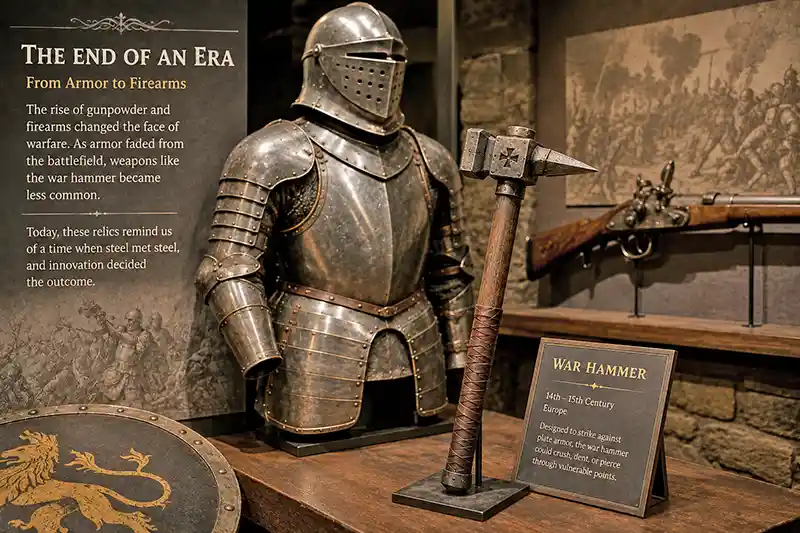
The war hammer was one of the most effective weapons of the late Middle Ages, but like many battlefield innovations, its dominance did not last forever. The arrival of increasingly powerful firearms changed warfare in ways that even the best armor could not withstand. As guns became more reliable and widespread, knights gradually abandoned the heavy plate armor that had inspired the war hammer's design in the first place.
Without armored opponents to fight, the hammer's greatest advantage disappeared. Swords remained useful as military sidearms and ceremonial weapons, while firearms became the primary tools of war. Specialized anti-armor weapons like the war hammer slowly faded from the battlefield, surviving mainly in the hands of guards, cavalry officers, and a handful of elite soldiers for a time before becoming largely obsolete.
Ironically, the war hammer did not fail because it was ineffective. It vanished because it was too closely tied to a style of warfare that no longer existed. Once steel plate armor disappeared, there was little need for a weapon built specifically to crush it. The battlefield had changed, and military technology evolved along with it.
Today, surviving examples can be found in museums and private collections around the world. Their compact size often surprises visitors, especially those expecting the oversized versions made famous by fantasy movies and video games. Yet these authentic weapons remain remarkable reminders that practical engineering often mattered far more than brute strength, and that history's most effective weapons were not always the largest or the most impressive-looking.
The War Hammer's Legacy Lives On
Although it disappeared from military service centuries ago, the war hammer remains one of history's most respected medieval weapons. Historians admire its ingenious design, collectors value surviving examples for their craftsmanship, and museums display them as symbols of a time when warfare evolved as quickly as the armor it sought to defeat. Few weapons demonstrate the relationship between offense and defense as clearly as the war hammer.
Its influence also lives on in popular culture. Movies, television series, fantasy novels, and video games frequently feature oversized war hammers wielded by legendary warriors. While these fictional versions are often exaggerated, they reflect the weapon's enduring reputation for raw power. The real historical designs may have been smaller, but they were every bit as purposeful and intimidating.
The war hammer also serves as a reminder that the most famous weapon is not always the most effective one. Just as the yari dominated Japanese battlefields despite the katana's legendary status, the war hammer earned its place by solving a specific battlefield problem better than almost any other weapon of its time. History repeatedly shows that practical innovation often matters more than romance or reputation.
Today, the sword remains the iconic symbol of medieval warfare, but those who look beyond the legends often discover that the humble war hammer was one of the true game changers of the age. Built with precision instead of excess, it proved that a compact weapon, used with skill, could overcome even the strongest armor on the battlefield.
The Best Weapon Was the One That Solved the Problem
History has a way of turning certain weapons into legends while overlooking others that were just as important. The sword became the enduring symbol of the medieval warrior because it represented honor, status, and skill. The war hammer, by contrast, was built with a far more practical purpose. It existed to solve one very specific problem: how to defeat an enemy protected by the best armor of the age.
That practical mindset is why the war hammer earned such a formidable reputation. It wasn't elegant, and it wasn't meant to be. Every part of its design, from the compact head to the armor-piercing beak, reflected centuries of battlefield experience. When plate armor reached its peak, few weapons could match the war hammer's ability to neutralize heavily armored opponents quickly and efficiently.
As military technology evolved, the need for the war hammer eventually disappeared, but its story remains an excellent reminder that history is often shaped by innovation rather than tradition. Many of the world's most successful weapons were not the most beautiful or the most famous. They were simply the tools that adapted best to the challenges of their time.
The next time you picture a medieval battlefield, it may be worth looking beyond the shining swords. Standing among the knights was a compact weapon that changed the balance of power in close combat and proved that, sometimes, the most dangerous weapon wasn't the one everyone remembered. It was the one that quietly got the job done.
What Modern Tests Reveal About War Hammers
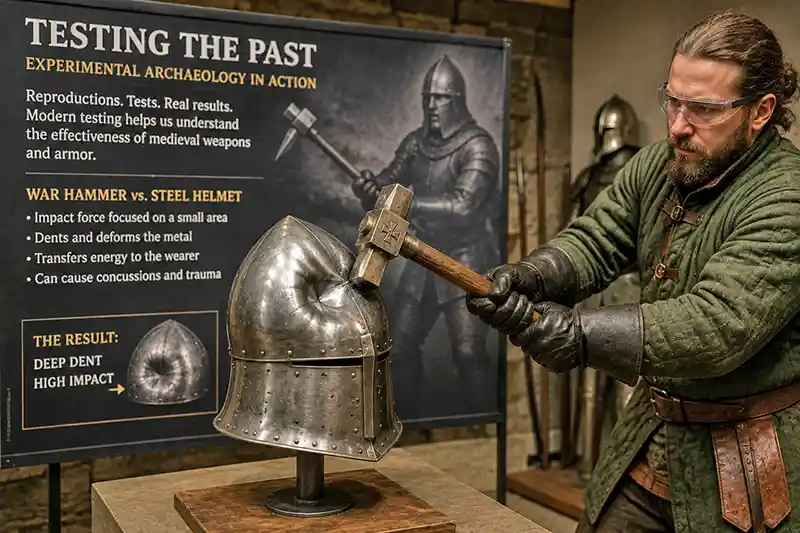
While no one can perfectly recreate the chaos of a medieval battlefield, modern historians, blacksmiths, and experimental archaeologists have learned a great deal by testing accurate reproductions of historical armor and weapons. Again and again, these demonstrations reinforce what medieval soldiers already knew: defeating plate armor was rarely about cutting through it. It was about delivering enough force to stop the person inside.
When replica war hammers strike properly made steel helmets and breastplates, they often leave deep dents without punching completely through the metal. Those dents may not look dramatic compared to a sword slicing flesh, but they represent tremendous energy transferred directly into the wearer. A helmet could remain intact while the person beneath it suffered a concussion, a broken collarbone, or other serious injuries from the impact alone.
These tests have also helped dispel the popular myth that medieval weapons were oversized and clumsy. Authentic war hammers are consistently shown to be compact, fast, and surprisingly well balanced. Their effectiveness came from intelligent design rather than brute weight, proving that medieval armorers understood physics remarkably well long before the science was formally described.
For historians, these experiments provide a fascinating glimpse into the realities of medieval combat. For everyone else, they offer a simple lesson: the war hammer earned its fearsome reputation not through legend, but because it was exceptionally good at the job it was designed to do.
The War Hammer Was Especially Deadly from Horseback
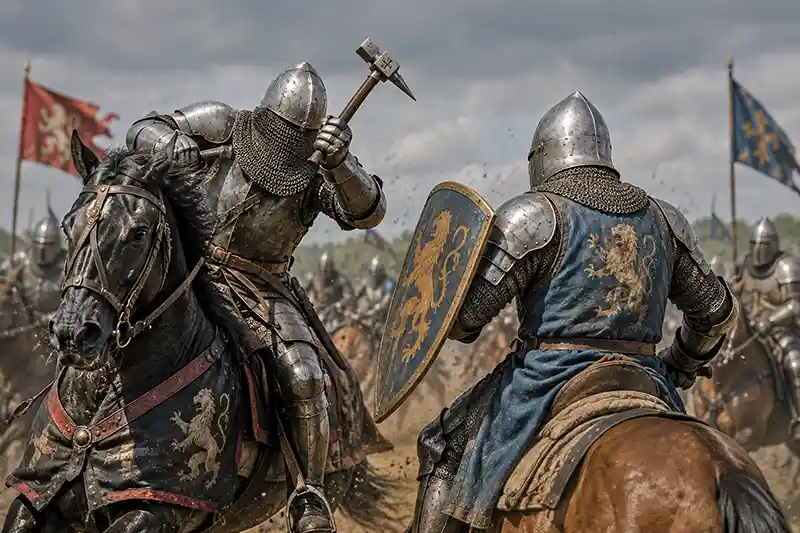
Mounted combat gave the war hammer an additional advantage that was difficult to match on foot. A knight charging on horseback could combine the speed of the horse with the compact weight of the weapon, turning a short swing into an extremely powerful impact. Against another armored rider, that extra momentum could make even a glancing blow dangerous.
The hammer's small head was well suited to cavalry because it was easier to control than a long, heavy weapon. A rider could keep the reins in one hand and strike with the other, aiming at an opponent's helmet, shoulder, or weapon arm as the two horses passed. The pointed beak could also catch armor or equipment, potentially pulling a rider off balance or out of the saddle.
This made the war hammer a natural companion to the lance. The lance dominated the initial charge, but it could break, become lodged, or prove awkward once the fighting collapsed into close quarters. At that point, a knight needed a weapon that could be drawn quickly and used effectively against opponents who were still protected by plate armor.
A compact war hammer filled that role perfectly. It delivered the concentrated force needed to damage armor without requiring the wide swings of a larger weapon. In the confusion of mounted combat, where fighters had only brief opportunities to strike, speed and precision mattered more than spectacle.
Not Every War Hammer Looked the Same
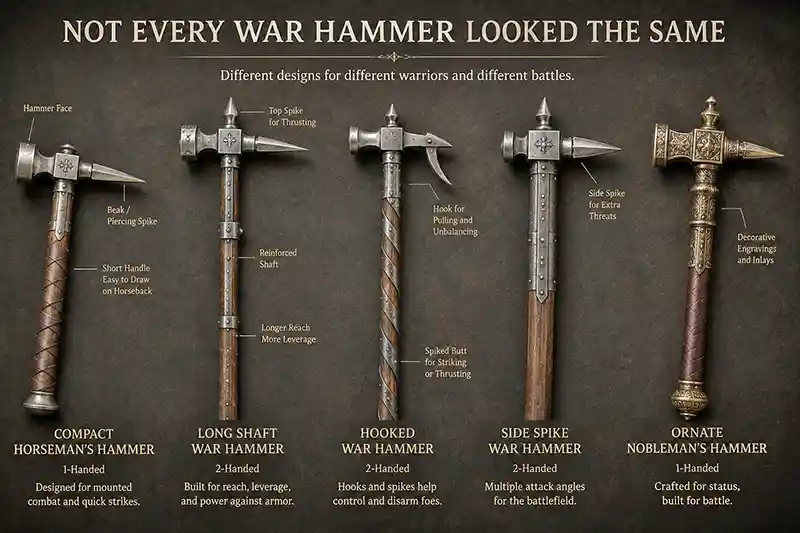
The term "war hammer" describes a family of weapons rather than one perfectly standardized design. Medieval examples varied widely depending on where they were made, how they were intended to be carried, and whether the wielder expected to fight on foot or from horseback. Some were compact sidearms with short handles, while others were mounted on long shafts and used more like polearms.
One-handed versions were especially popular among mounted warriors. These weapons typically featured a small hammer face paired with a long, pointed beak. Their compact size made them easy to draw quickly, and their narrow heads allowed riders to deliver precise blows without losing control of the weapon during a fast pass.
Longer war hammers offered greater reach and leverage. Some included side spikes, hooks, reinforced shafts, and metal strips that protected the handle from sword cuts. These designs blurred the line between hammer, spear, and polearm, giving foot soldiers several ways to strike, hook, or thrust at armored opponents.
Regional preferences also shaped their appearance. Some surviving examples are plain and brutally functional, while others feature engraved heads, decorative metalwork, and elaborate grips that suggest ownership by wealthy knights or nobles. Like many unusual weapons that actually existed, the war hammer proved that practical battlefield tools could evolve into surprisingly diverse forms.
Despite their differences, nearly all war hammers followed the same basic philosophy. They used a compact striking surface to focus force, paired that force with a spike or hook, and gave armored fighters a weapon capable of attacking both the armor and the person trapped inside it.
Armor Could Turn the Impact Against Its Wearer
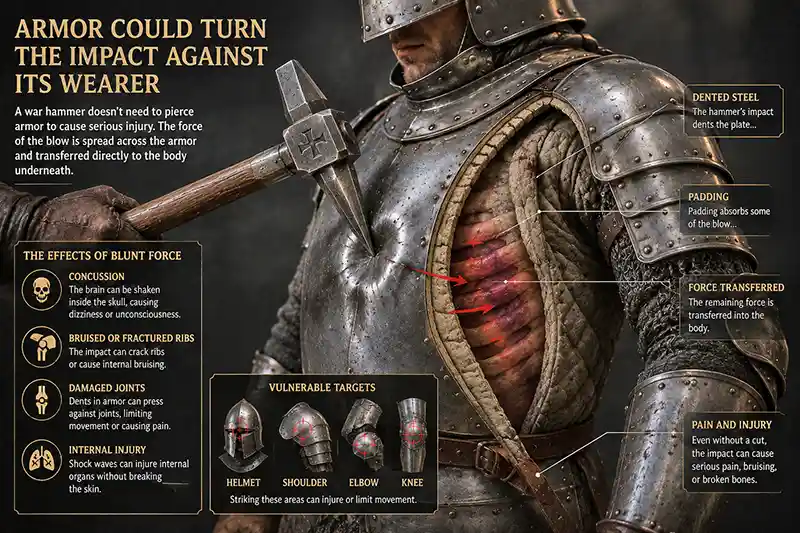
Plate armor was designed to deflect blades, arrows, and glancing blows, but a war hammer exploited one of its unavoidable weaknesses. Steel could protect the body from being cut while still transmitting the force of an impact directly into the person underneath. In some cases, the armor that saved a knight from penetration also helped spread the shock across bones, joints, and internal organs.
A deep dent could become dangerous even after the initial strike. Bent metal might press against the shoulder, restrict an elbow, or prevent a knee joint from moving freely. Damage to a helmet could narrow the wearer's vision, interfere with breathing, or make it difficult to turn the head. A knight did not need to be knocked unconscious to become vulnerable. Losing mobility for only a few seconds could be enough.
The padding worn beneath plate armor absorbed some of the impact, but it could not eliminate it. A powerful strike might leave the outer steel intact while still causing bruising, fractures, or severe disorientation. This is what made the war hammer so unsettling. It did not always need to break the armor because it attacked the body through it.
Swords were often forced to search for exposed gaps around the neck, armpits, groin, and joints. The hammer could target those openings too, but it also had the option of striking the armor directly. That gave its wielder more ways to create an advantage and made even a well-protected knight vulnerable to a carefully placed blow.
Few Medieval Weapons Inspired More Respect
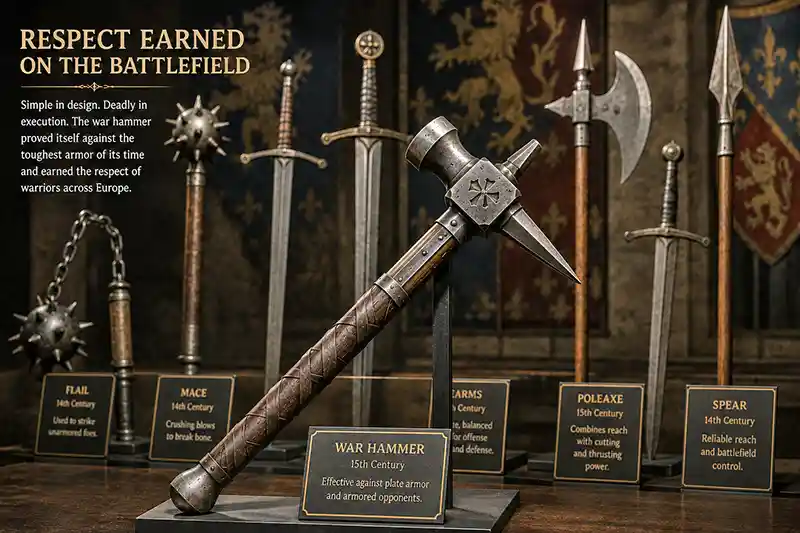
Medieval soldiers respected weapons that consistently worked, and the war hammer earned that respect through results rather than appearance. It lacked the graceful curves of a sword and the impressive reach of a polearm, yet it developed a reputation as one of the most reliable answers to heavily armored opponents. When survival depended on stopping a charging knight, effectiveness mattered far more than elegance.
Contemporary artwork, surviving examples, and historical accounts all suggest that the war hammer was far from a rare curiosity. It appeared in the hands of knights, cavalrymen, and professional soldiers across Europe, especially during the period when plate armor reached its greatest sophistication. As armor improved, so did the weapons designed to defeat it, creating a constant cycle of innovation between offense and defense.
This pattern can be found throughout military history. Different cultures developed specialized weapons to overcome the challenges they faced, whether it was the long-reaching spear, the powerful longbow, or the elegant Japanese polearms featured in our article about the history of the naginata. The war hammer was Europe's answer to an age dominated by steel armor.
Centuries later, the weapon still captures the imagination because its design is so brutally logical. It reminds us that history's greatest battlefield innovations were often remarkably simple. Instead of becoming larger or more elaborate, the war hammer became more focused, delivering concentrated power exactly where it mattered most. That practical brilliance is why it remains one of the most admired weapons of the medieval world.
War Hammers Were Not Just Weapons for Knights
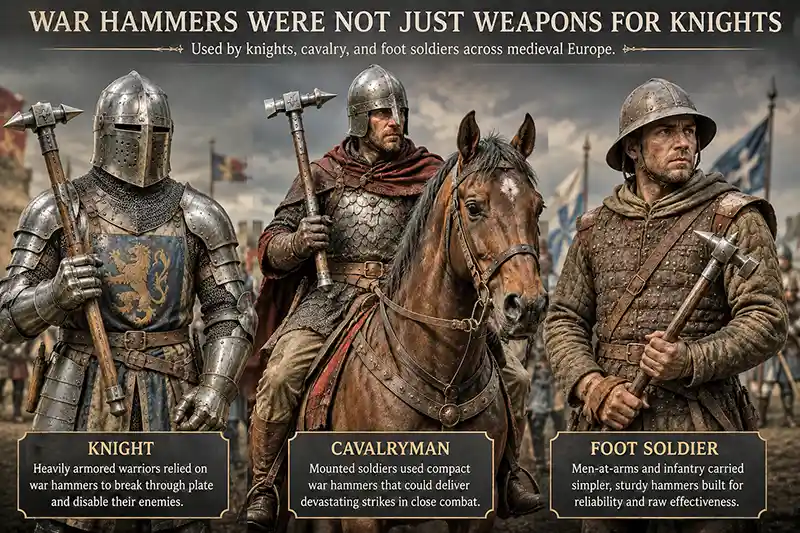
The war hammer is often associated with wealthy knights in full plate armor, but its use was not limited to the nobility. Professional soldiers, cavalrymen, guards, and men-at-arms also carried hammer-style weapons when they expected to face armored opponents. What mattered most was not social rank, but whether the weapon could solve the problems a fighter was likely to encounter.
For a trained soldier, the war hammer offered several advantages. It was compact enough to carry as a secondary weapon, sturdy enough to survive repeated impacts, and effective even when its striking edge became worn. Unlike a fine sword, it did not depend on a perfectly maintained blade. A damaged or weathered hammer could still deliver a devastating blow.
Simpler versions could also be produced without the elaborate decoration found on weapons owned by nobles. A functional iron head, a strong wooden shaft, and careful balance were enough to create a dangerous battlefield tool. More expensive examples might feature engraving, reinforced grips, and decorative metalwork, but ornamentation did not make the weapon effective. Its performance came from the shape of the head and the force behind the strike.
This helped the war hammer spread beyond ceremonial combat and elite dueling. It was a practical military weapon used by people whose survival depended on reliable equipment. The sword may have carried greater prestige, but the hammer appealed to warriors who cared less about appearances and more about stopping the armored enemy in front of them.
The War Hammer Proved Bigger Wasn't Better
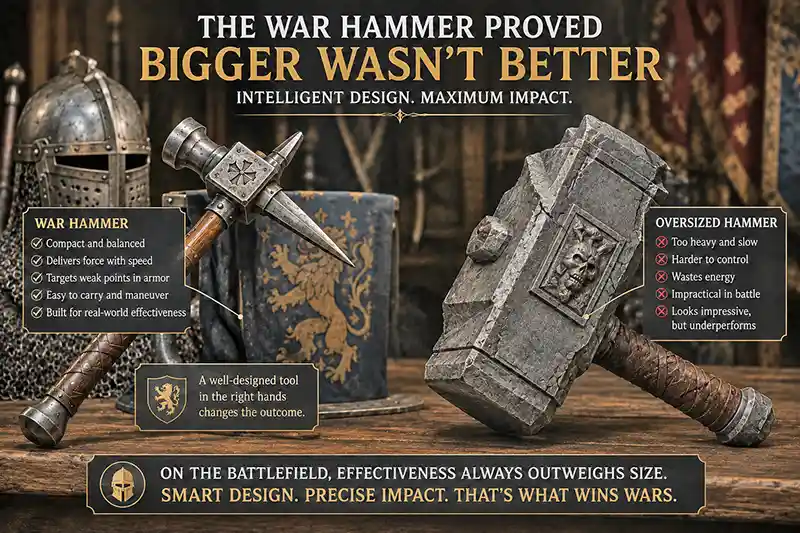
Throughout history, armies often learned the same lesson: the most effective weapon was rarely the largest one. The war hammer is one of the clearest examples. It relied on intelligent design rather than overwhelming size, using leverage, balance, and concentrated impact to accomplish what much heavier weapons often could not.
This philosophy appears again and again in military history. Spears defeated swords through reach. Longbows outperformed crossbows in the hands of trained archers. Even seemingly ordinary weapons often proved more valuable than elaborate designs because they solved real battlefield problems. As we explored in our article about why the yumi was more important than the katana, practical effectiveness frequently mattered far more than reputation.
The war hammer followed that same principle. It did not need an enormous head or an impossibly long handle to be feared. A compact, well-balanced weapon could strike faster, recover more quickly, and place tremendous force exactly where it was needed. Every feature served a purpose, eliminating unnecessary weight while maximizing performance against armored opponents.
Perhaps that is the greatest lesson the war hammer leaves behind. Success on the battlefield has never belonged to the flashiest weapon. It has belonged to the one that best adapted to the challenge at hand. For centuries, few weapons met that challenge better than the medieval war hammer.
Why Historians Still Study the War Hammer
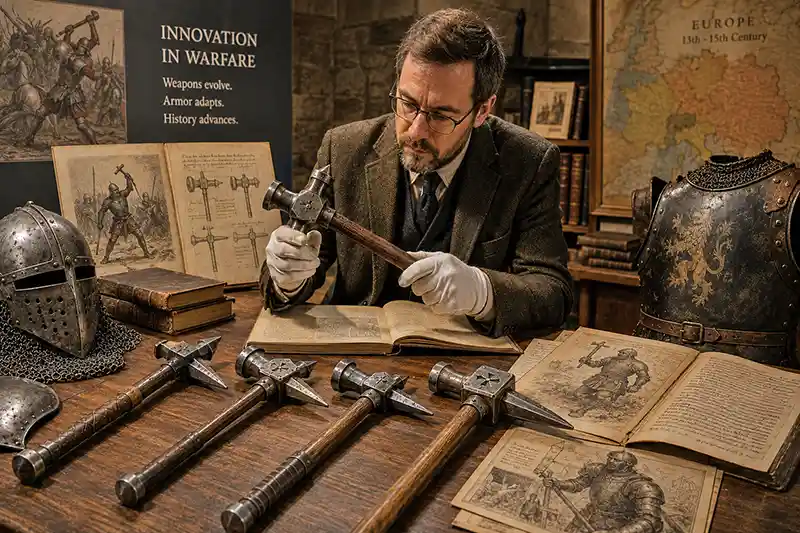
Despite its relatively short time on the battlefield, the war hammer continues to fascinate military historians because it represents one of history's clearest examples of weapons evolving to meet new defensive technology. Every detail of its design reflects a practical response to stronger armor, making it an ideal case study in how innovation shaped medieval warfare.
Archaeologists have uncovered war hammers across Europe in castles, battlefields, riverbeds, and private collections. Combined with period artwork, surviving armor, and written accounts, these discoveries allow researchers to compare different designs and better understand how they were used. Even subtle differences in the shape of a hammer's beak or striking face can reveal whether it was intended for mounted combat, fighting on foot, or ceremonial use.
The weapon also helps explain a broader truth about military history. Technologies rarely remain dominant for long. As armor improved, weapons changed to defeat it. As firearms improved, armor declined, and weapons like the war hammer gradually disappeared from military service. This constant cycle of adaptation has shaped warfare for thousands of years.
For that reason, the war hammer is remembered as far more than a medieval curiosity. It stands as a reminder that history's most influential weapons were often those that solved a specific problem better than anything that came before. Its legacy isn't measured by how long it remained in use, but by how effectively it changed the battlefield during the era when it mattered most.
The War Hammer Changed Medieval Warfare Forever
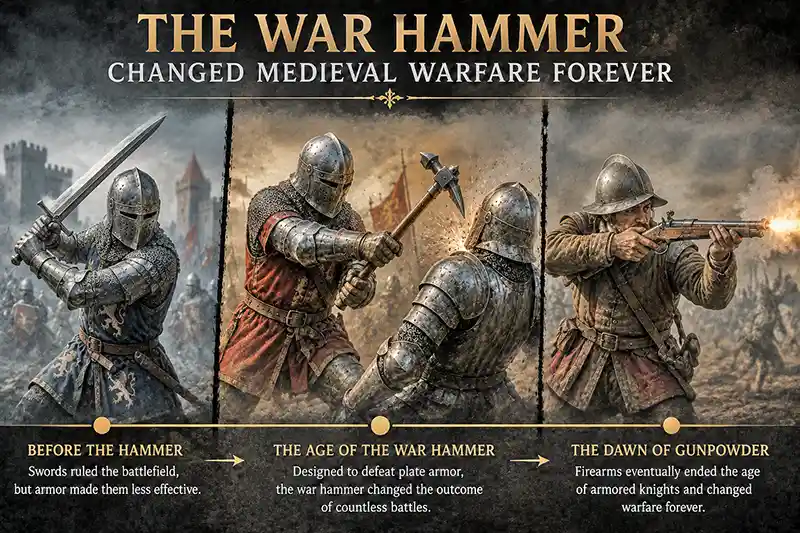
Very few weapons can be credited with changing the way wars were fought, but the war hammer deserves a place on that short list. It emerged because armor had become so effective that traditional cutting weapons were losing their advantage. Rather than trying to build a better sword, medieval weapon makers approached the problem from an entirely different direction, creating a weapon designed to defeat the armor itself instead of the man wearing it.
That shift influenced centuries of military thinking. It demonstrated that every defensive breakthrough would eventually inspire a new offensive solution. The contest between armor and weapons became an ongoing race, with each innovation forcing the other side to adapt. The war hammer was one of the clearest examples of that cycle, proving that battlefield success often belonged to those who embraced new ideas instead of relying on tradition.
Although firearms eventually ended the age of armored knights, the lessons behind the war hammer never disappeared. Military technology continues to evolve in much the same way today. New defenses lead to new weapons, and new weapons inspire even stronger defenses. The names and materials may have changed, but the underlying pattern remains remarkably familiar.
For that reason, the medieval war hammer is remembered as much more than a brutal weapon. It stands as a symbol of practical innovation, showing that history's greatest breakthroughs often come from rethinking the problem rather than simply making an existing solution bigger or stronger. That enduring lesson is one reason the war hammer continues to fascinate historians, collectors, and medieval enthusiasts around the world.
The Sword Won the Legend, but the War Hammer Won the Fight
Ask someone to picture a medieval battlefield, and they will almost always imagine flashing swords. Popular culture has turned the sword into the defining weapon of the Middle Ages, celebrating its beauty, craftsmanship, and symbolism. Yet history paints a more complicated picture. When armored knights became the dominant force on European battlefields, the weapon that often offered the greatest tactical advantage was not the sword, but the war hammer.
That does not diminish the sword's importance. Swords remained versatile, prestigious, and indispensable throughout medieval Europe. But against a heavily armored opponent, practicality often outweighed tradition. The war hammer was purpose-built for one of the hardest challenges of its era, and it met that challenge with remarkable efficiency.
Perhaps that is why the war hammer continues to capture the imagination centuries later. It reminds us that history is full of forgotten innovations that quietly changed the world while more glamorous inventions received the credit. Behind every famous weapon is another that solved a problem more effectively, even if it never became the symbol of an age.
The next time you see a knight carrying both a sword and a war hammer, remember that each weapon had its place. One represented honor and status. The other represented adaptation and survival. When steel armor ruled the battlefield, few tools were better suited to the job than the compact, devastating war hammer.
Frequently Asked Questions About War Hammers
Could a War Hammer Really Break Plate Armor?
Not usually. Contrary to popular belief, most war hammers were not designed to smash completely through high-quality plate armor. Their real strength was delivering massive blunt force that could dent steel, damage joints, and transfer enough energy to injure the person inside the armor. Even without penetrating the metal, a well-placed strike could cause broken bones, concussions, or leave a knight unable to continue fighting.
The pointed beak found on many war hammers could sometimes pierce thinner sections of armor or exploit vulnerable gaps around the visor, shoulders, or elbows. However, completely punching through a well-made breastplate was uncommon. Medieval weapon makers understood that disabling the wearer was often far easier than destroying the armor itself.
Why Didn't Everyone Simply Carry a War Hammer Instead of a Sword?
Because medieval battles required different weapons for different situations. A war hammer excelled against heavily armored opponents, but swords were more versatile. They were effective against lightly armored soldiers, easier to wear every day, and could be used for cutting, thrusting, and self-defense in a wide variety of circumstances.
Many professional warriors carried multiple weapons. A knight might begin a battle with a lance, switch to a war hammer when fighting armored enemies at close range, and rely on a sword as a dependable backup if another weapon was lost or broken. Rather than replacing the sword, the war hammer complemented it, giving medieval fighters the right tool for the right opponent.
Did War Hammers Replace Swords on the Battlefield?
No. War hammers became popular because they filled a specific role, not because they made swords obsolete. As plate armor became more common, hammers offered a more effective way to fight heavily armored opponents. Swords, however, remained valuable for their versatility, reach, and effectiveness against lightly armored enemies.
For much of the late Middle Ages, the two weapons existed side by side. A knight might carry both, choosing the one best suited to the situation. The sword remained a symbol of rank and authority, while the war hammer earned its reputation through practical battlefield performance. Each weapon had strengths that the other lacked, which is why both remained in military use for centuries.
Were War Hammers Used Outside of Europe?
Yes. While the classic medieval war hammer is most closely associated with Europe, hammer-like military weapons appeared in several cultures throughout history. Persia, India, and parts of Central Asia all developed their own versions, many featuring narrow spikes or beaks designed to fight armored opponents. Although the shapes varied, they shared the same basic idea: concentrate tremendous force into a small striking point.
These weapons evolved independently because they solved a common battlefield problem. Whenever armor became more effective, weapon makers looked for ways to overcome it. The European war hammer is simply the best-known example of a practical concept that appeared in different forms across multiple civilizations.
Did War Hammers Require Great Strength to Use?
Not as much as many people think. Historical war hammers were designed to be compact, well-balanced, and efficient rather than excessively heavy. A skilled fighter relied on timing, accuracy, and leverage to deliver powerful blows, not brute force alone. Concentrating the weapon's weight into a small striking surface made it effective without requiring an enormous swing.
In fact, an oversized hammer would have been a disadvantage in real combat. It would tire the wielder more quickly, recover slowly after a missed strike, and be easier for an opponent to avoid. The most effective war hammers were those that balanced speed, control, and impact, allowing trained warriors to strike precisely where the armor was most vulnerable.
What Was the Difference Between a War Hammer and a Mace?
Although they were both designed to fight armored opponents, they worked in slightly different ways. A mace relied on a heavy head, often fitted with flanges, to deliver crushing blows that could dent armor and injure the wearer through blunt force. A war hammer, by contrast, concentrated its impact into a much smaller striking face and usually included a pointed beak on the opposite side for attacking thinner sections of armor or hooking an opponent's equipment.
In practice, both weapons were highly effective, and many medieval soldiers chose one based on personal preference or the type of combat they expected to face. The war hammer generally offered greater precision, while the mace excelled at delivering powerful, straightforward strikes. Both earned a place among the most feared anti-armor weapons of the Middle Ages.
What Was the Most Famous War Hammer in History?
Unlike legendary swords such as Excalibur or famous Japanese katanas, individual war hammers rarely became household names. They were valued as practical military tools rather than ceremonial symbols. Even so, some historical figures were closely associated with them. One of the best-known was King Robert I of Scotland, better known as Robert the Bruce, who is said to have used a war hammer to kill the English knight Sir Henry de Bohun at the Battle of Bannockburn in 1314. That dramatic duel became one of the most famous single combats of the Middle Ages.
Although Robert the Bruce's hammer is the best-known example, countless other war hammers served anonymously on medieval battlefields. Their legacy comes not from legendary names, but from the decisive role they played during the age of plate armor.
How Heavy Was a Typical Medieval War Hammer?
Most people are surprised to learn that authentic medieval war hammers were much lighter than their fictional counterparts. A typical one-handed war hammer often weighed between 2 and 4 pounds (0.9 to 1.8 kg), making it comparable to many medieval swords. Rather than relying on sheer weight, it depended on balance, leverage, and a compact steel head to deliver devastating force exactly where it was needed.
This relatively light weight allowed a skilled warrior to strike quickly, recover after each swing, and fight for extended periods without excessive fatigue. It also made the weapon practical to carry alongside a sword, lance, or shield, which is one reason the war hammer became such a popular secondary weapon during the height of the plate armor era.
Why Did the War Hammer Have a Spike on the Back?
The spike, often called a beak or pick, made the war hammer much more versatile than a simple hammer. While the flat face delivered crushing blows capable of denting armor, the pointed end concentrated the same force into a much smaller area. This allowed it to target thinner sections of plate armor, strike vulnerable joints, or hook an opponent's shield, weapon, or limbs during close combat.
The spike wasn't intended to punch through every breastplate with a single blow, as movies often suggest. Instead, it gave the wielder another option when facing different types of armor and different combat situations. Combined with the hammer face, it transformed a compact weapon into one of the most adaptable anti-armor weapons of the medieval battlefield.
Could a War Hammer Defeat Chainmail as Well as Plate Armor?
Yes, but for a different reason. Chainmail was excellent at stopping cuts from swords, yet it offered much less protection against heavy blunt impacts. A powerful strike from a war hammer could fracture bones, damage joints, or leave an opponent incapacitated even if the mail itself remained largely intact. The padding worn beneath the armor helped absorb some of the force, but it could not eliminate it entirely.
Against plate armor, the war hammer relied on concentrated impact and precise strikes to dents and weak points. Against chainmail, its crushing force alone was often enough to make it an extremely dangerous weapon. This ability to remain effective against multiple types of armor is one of the reasons war hammers became such a respected battlefield weapon during the late Middle Ages.
Did Medieval War Hammers Have Wooden or Metal Handles?
Most medieval war hammers had sturdy wooden handles, usually made from strong hardwoods such as ash or oak. Wood kept the weapon relatively light, absorbed some of the shock from impact, and was easier to replace if damaged. Many handles were reinforced with metal strips called langets, which protected the shaft from being cut by swords during combat.
Fully metal-handled war hammers did exist, but they were less common and often heavier or more expensive to produce. For most warriors, a well-made wooden shaft with strategic metal reinforcement offered the ideal balance of durability, weight, and handling, making it the preferred choice on medieval battlefields.
Why Didn't War Hammers Stay Popular After the Middle Ages?
War hammers gradually disappeared because the battlefield changed. As firearms became more powerful and reliable during the 15th and 16th centuries, heavy plate armor became less practical. Without armored opponents to fight, there was little need for a weapon designed specifically to crush or pierce steel armor.
Some military hammers remained in use for a time, particularly among cavalry and officers, but their importance steadily declined as gunpowder weapons reshaped warfare. By the early modern period, the war hammer had become more of a historical relic than a frontline weapon, remembered as one of the most effective tools ever created for defeating armored knights.
Did War Hammers Need to Be Razor Sharp?
No. Unlike swords or axes, a war hammer did not rely on a sharpened edge to be effective. Its power came from concentrating tremendous force into a small striking surface. The flat hammer face was designed to crush, while the pointed beak focused impact into a narrow area that could dent armor, damage weak points, or hook an opponent's equipment.
Because of this design, war hammers required far less edge maintenance than bladed weapons. A warrior did not need to keep the hammer razor sharp for it to remain deadly. As long as the head stayed securely attached and the striking surfaces remained intact, the weapon could continue delivering devastating blows even after repeated use on the battlefield.
Could a War Hammer Be Used to Fight Unarmored Opponents?
Yes. Although the war hammer was designed primarily to defeat armored enemies, it was still a formidable weapon against opponents wearing little or no armor. A solid strike from the hammer face could easily break bones or incapacitate an enemy, while the pointed beak could inflict devastating wounds if it connected. Its compact size also made it quick to maneuver in close combat.
That said, many warriors preferred swords when facing lightly armored opponents because they offered greater reach, faster follow-up attacks, and the ability to cut as well as thrust. The war hammer's greatest advantage appeared when armor entered the equation. Against an unprotected enemy, it remained dangerous, but it was no longer uniquely superior in the way it was against a knight encased in steel.
Did War Hammers Have Any Advantages Over Axes?
Yes. Although both weapons were capable of delivering devastating blows, they were designed with different priorities in mind. A battle axe relied on a broad cutting edge that could chop through lightly armored opponents and wooden shields, while a war hammer concentrated its force into a much smaller impact point. That made it especially effective against plate armor, where cutting edges often struggled to do meaningful damage.
Many war hammers also featured a pointed beak opposite the hammer face, giving the wielder the ability to hook, puncture, or target weak points in an opponent's armor. Axes remained versatile battlefield weapons, but when the goal was defeating a heavily armored knight, the war hammer often offered the greater advantage.
Did Any Medieval Armors Resist the War Hammer Well?
Yes. High-quality plate armor was remarkably effective and could often withstand multiple blows from a war hammer without being pierced. Skilled armorers carefully shaped breastplates and helmets with rounded surfaces that helped deflect impacts and spread force over a larger area. Well-fitted padding beneath the armor also absorbed part of the shock, reducing the risk of injury.
Even so, no armor made its wearer invulnerable. A powerful strike could dent steel, damage joints, or transmit enough force to break bones or leave a knight dazed. This constant struggle between better armor and better weapons drove centuries of innovation, with each improvement forcing the other side to adapt in response.
What Was the Difference Between a War Hammer and a Horseman's Hammer?
A horseman's hammer was a specific type of war hammer designed for mounted combat. It typically featured a shorter handle that was easier to control with one hand while riding, allowing the other hand to manage the reins or a shield. Its compact size also made it easier to carry on the saddle and draw quickly after a lance charge.
While all horseman's hammers are war hammers, not all war hammers were made for cavalry. Many infantry versions had longer handles for greater reach and leverage on foot. Regardless of size, both types shared the same goal: delivering concentrated force capable of defeating heavily armored opponents.
Did War Hammers Ever Break During Battle?
Yes, although a well-made war hammer was built to withstand tremendous punishment. The steel head was extremely durable, but the wooden shaft could crack or break after repeated heavy impacts, especially if it was struck directly by another weapon. For this reason, many medieval war hammers were reinforced with long steel strips called langets, which helped protect the handle from sword cuts and added strength where it was needed most.
Even when damaged, a war hammer often remained usable. Unlike a sword, which could lose much of its effectiveness if the blade bent or chipped, a hammer could still deliver powerful blows as long as the head remained attached. This rugged reliability was one of the reasons it earned such a respected place on medieval battlefields.
How Long Did the War Hammer Remain in Military Use?
War hammers rose to prominence during the 14th century as plate armor became more common and remained important through much of the 15th century. They continued to see military use into the 16th century, particularly among cavalry and specialized troops, even as firearms began changing the nature of warfare. During this period, they were often carried alongside swords, lances, and other traditional weapons rather than replacing them outright.
As gunpowder weapons became more reliable and heavy armor gradually disappeared from the battlefield, the war hammer lost the role it had been designed to fill. By the late Renaissance, it had largely faded from military service, surviving mainly as a ceremonial weapon, a symbol of rank, or a prized historical artifact preserved in museums and private collections.
Were War Hammers Effective Against Shields?
Yes, although not always in the way people imagine. A war hammer was less likely than an axe to chop through a wooden shield, but it could still be extremely effective against one. Heavy blows could crack wooden boards, damage the shield's metal boss, or numb and injure the arm holding it. Many war hammers also featured a pointed beak that could hook the edge of a shield, pulling it aside to expose the defender or throw them off balance.
As plate armor became more common, large shields gradually became less important for many heavily armored knights. This shifted the war hammer's primary role toward defeating armor rather than breaking shields. Even so, its combination of crushing force and hooking capability made it a dangerous weapon against both defensive tools and the warriors carrying them.
Did Medieval Blacksmiths Specialize in Making War Hammers?
Yes. While many village blacksmiths could repair or produce simple tools and weapons, high-quality war hammers were often crafted by skilled armorers and weapon smiths who specialized in military equipment. Forging a durable hammer head that could withstand repeated impacts while maintaining the correct balance required considerable experience and precision.
In many medieval cities, swordsmiths, armorers, and weapon makers belonged to specialized guilds that focused on different aspects of military production. A well-made war hammer was not just a lump of iron attached to a stick. Its weight distribution, hardened steel head, reinforced shaft, and carefully shaped beak were all the result of skilled craftsmanship, making it a trusted weapon for professional soldiers and knights alike.
You May Also Be Interested In:
- Tactical War Hammer and Other Dangerous Weapons | Ian's Top Picks
- Modern Tactical Kopis Sword and Other Dangerous Weapons! ☠️
- Combat War Hammer and Other Lethal Weapons!
- Tactical War Hammer and Other Deadly Weapons!
- The Meteor Hammer: The Deadliest Weapon Almost Nobody Could Master
- Sword Buyers Guide: What To Look For When Buying a Sword
- $20 Sword vs $200 Sword: We Put Them to the Test!
- 5 Dangerous Weapons You Wish You Had!
- Brass Knuckles - Are They Too Dangerous To Have?!
- Deadly Throwing Axe and Other Dangerous Weapons!
Leave a Reply