




What Is Kendo? Beginner Guide to Japanese Sword Training
May 12th, 2026
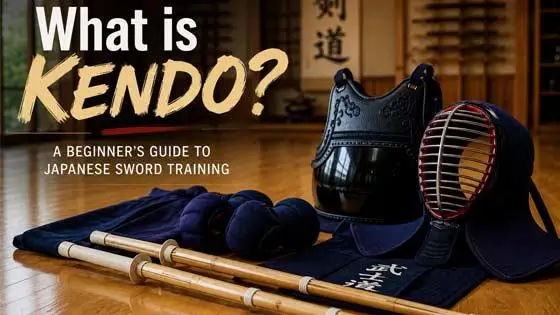
Kendo is a traditional Japanese martial art that focuses on sword-based training, discipline, timing, footwork, and controlled sparring. The name "kendo" roughly translates to "the way of the sword," and the practice evolved from older samurai swordsmanship traditions into a modern martial art centered around skill development, focus, respect, and structured training. Today, kendo is practiced around the world by students of all ages who want to study Japanese sword training in a safe and disciplined environment.
One of the most recognizable parts of kendo training is the use of protective armor and bamboo training swords called shinai. These tools allow practitioners to safely practice strikes, movement, timing, and sparring drills with realistic speed and contact while reducing the risks associated with rigid wooden or metal swords. Because of this balance between realism and safety, kendo has become one of the most respected sword-based martial arts still actively practiced today.
In this guide, we'll explain what kendo is, how it is practiced, what equipment is used during training, and why this traditional Japanese martial art continues to attract students around the world today.
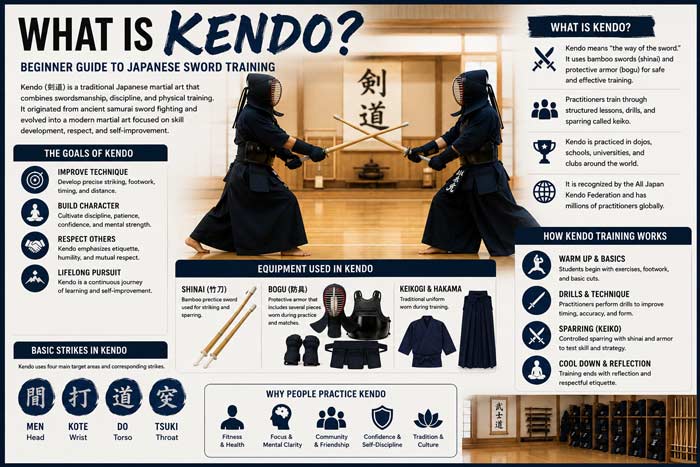
Kendo is a traditional Japanese martial art focused on sword-based training, discipline, timing, footwork, and controlled sparring. The word "kendo" translates roughly to "the way of the sword," reflecting the martial art's deep connection to traditional Japanese swordsmanship and samurai training practices. Over time, kendo evolved into a structured modern discipline that emphasizes technical skill, self-improvement, respect, and mental focus alongside physical training.
Modern kendo practitioners train using bamboo practice swords called shinai along with protective armor known as bogu. This equipment allows students to safely practice strikes, movement, timing, distancing, and controlled sparring with realistic speed and intensity. Many martial artists who study traditional bamboo sparring swords appreciate how kendo combines technical precision with fast-paced movement and disciplined training methods.
Unlike many martial arts that focus primarily on self-defense or competition, kendo places a strong emphasis on character development and personal discipline. Respect, etiquette, focus, posture, and self-control are all considered important parts of training both inside and outside the dojo. Practitioners spend years refining footwork, striking accuracy, reaction speed, and timing through repetition and structured practice.
Today, kendo is practiced all over the world in schools, martial arts academies, universities, and traditional dojos. Although its roots trace back to historical Japanese swordsmanship, modern kendo continues to attract students interested in martial arts training, physical conditioning, discipline, and Japanese martial arts culture.
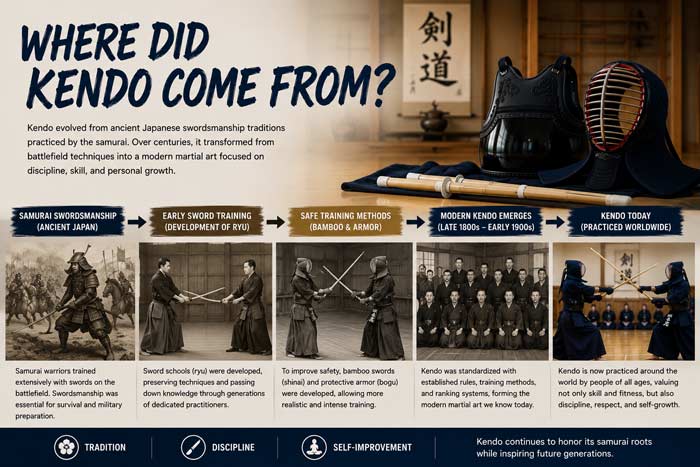
Kendo developed from older Japanese swordsmanship traditions practiced by the samurai class centuries ago. Early forms of sword training focused on combat techniques used during feudal Japan, where warriors trained extensively with swords as part of military preparation. Over time, many of these battlefield-focused systems evolved into organized martial arts that emphasized discipline, technical skill, and personal development in addition to combat effectiveness.
As sword training became more structured, practitioners began using safer training equipment to reduce injuries during partner drills and sparring exercises. This eventually led to the development of protective armor and bamboo practice swords, which allowed students to practice strikes and timing with greater realism and intensity. The use of the traditional shinai training sword became one of the defining features of modern kendo practice.
During the late 1800s and early 1900s, kendo continued evolving into the modern martial art recognized today. Training methods became more standardized, rules were established for competition and sparring, and formal ranking systems helped organize instruction. Although modern kendo still preserves many traditions connected to samurai swordsmanship, the emphasis shifted heavily toward discipline, technical refinement, respect, and personal growth.
Today, kendo is practiced internationally by students of all ages and skill levels. Many martial artists who study traditional Japanese training systems appreciate kendo because it preserves historical sword-training concepts while allowing practitioners to safely train in a modern martial arts environment.
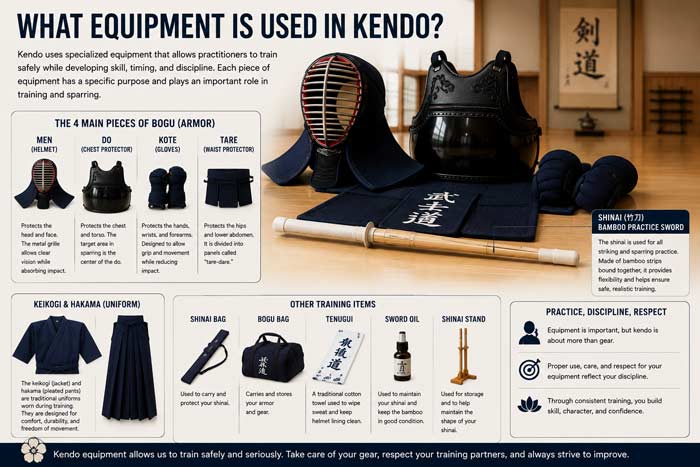
Kendo training uses several specialized pieces of equipment designed to allow practitioners to safely practice sparring, striking, footwork, and technical drills. The most recognizable piece of equipment is the shinai, a bamboo training sword used during controlled contact practice and sparring sessions. Unlike rigid wooden or metal swords, the flexible bamboo construction helps absorb impact while still allowing realistic movement and timing drills.
A standard kendo practice sword is commonly paired with protective armor called bogu. This armor typically includes a protective helmet, chest protector, gloves, and waist protection that help reduce injury during sparring exercises. The armor allows practitioners to train with speed and controlled contact while maintaining safety during partner drills and competition matches.
Kendo practitioners also wear traditional uniforms during training. These usually include a jacket and wide pleated pants designed specifically for movement, comfort, and traditional appearance. Many martial artists who study Japanese training equipment appreciate how kendo combines protective gear, structured uniforms, and technical practice into a highly organized martial arts system.
In addition to sparring equipment, students often use training tools and drills to improve footwork, timing, posture, striking accuracy, and reaction speed. Although the equipment itself is important, kendo places just as much emphasis on discipline, focus, repetition, and proper technique throughout training.
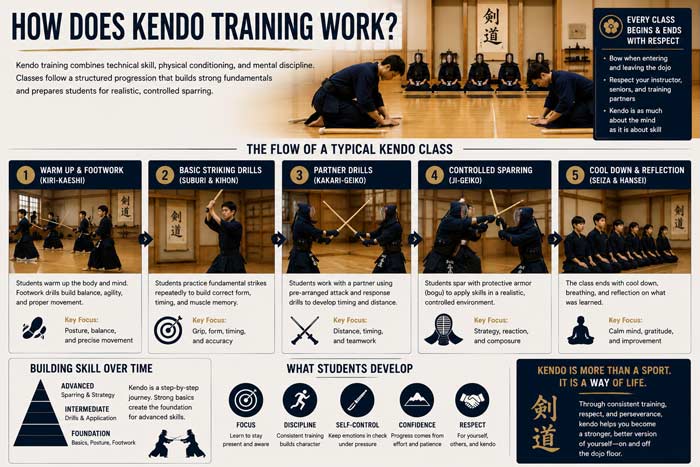
Kendo training is built around repetition, discipline, technical development, and controlled sparring practice. Students spend time learning footwork, posture, striking mechanics, timing, distancing, and movement patterns before gradually progressing into more advanced drills and live sparring exercises. Training sessions are typically structured and highly disciplined, with a strong emphasis on focus, respect, and consistent improvement.
Many classes begin with warmups, footwork drills, and striking practice using a traditional bamboo practice sword. Students repeatedly practice basic target strikes while instructors focus on correcting posture, timing, grip, movement mechanics, and accuracy. These foundational exercises help build muscle memory and prepare students for more advanced training later on.
As students improve, they begin participating in partner drills and controlled sparring exercises while wearing protective armor. Many practitioners who study Japanese martial arts training systems appreciate how kendo combines technical precision with realistic movement and fast-paced reaction training. Sparring sessions help students develop timing, distancing, strategy, reaction speed, and composure under pressure.
Kendo training also places a strong emphasis on etiquette and mental discipline. Bowing, respect for instructors and training partners, focus, self-control, and consistent effort are considered essential parts of practice. For many students, kendo becomes not only physical training, but also a long-term discipline centered around self-improvement and personal growth.
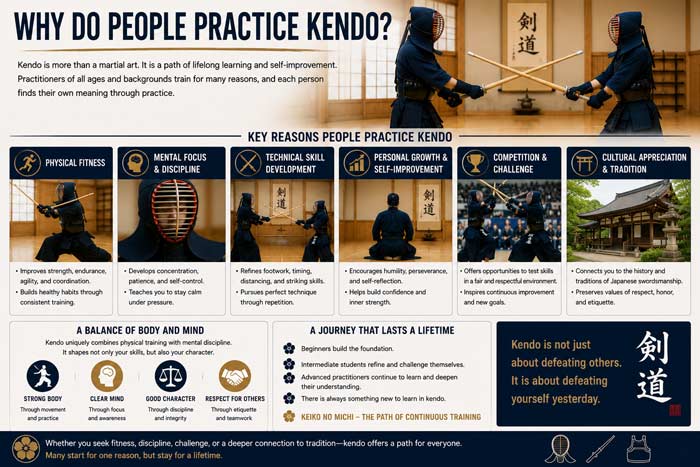
People practice kendo for many different reasons, including physical fitness, discipline, technical skill development, mental focus, competition, and cultural appreciation. Although kendo is rooted in traditional Japanese swordsmanship, modern practitioners often view it as a long-term martial art centered around personal growth, self-improvement, and structured training rather than simply learning how to fight with a sword.
One of the biggest reasons people are drawn to kendo is the balance between physical and mental training. Kendo develops footwork, timing, reaction speed, coordination, posture, endurance, and striking accuracy, while also emphasizing discipline, focus, patience, composure, and respect. Many martial artists who study traditional martial arts training systems appreciate how kendo combines technical precision with strong mental discipline.
Kendo also creates a highly structured training environment where students constantly work toward improvement through repetition and consistent practice. Practitioners spend years refining movement mechanics, distancing, timing, and technical execution while learning how to remain calm and focused under pressure. This long-term progression is one reason many students continue practicing kendo for decades.
For some people, kendo is also a way to connect with Japanese martial arts history and culture. Training traditions, etiquette, uniforms, equipment, and dojo customs all help preserve aspects of historical swordsmanship while adapting them into a modern martial arts system. Whether someone trains for competition, exercise, discipline, or cultural appreciation, kendo continues to attract practitioners around the world today.
Kendo remains one of the most respected and widely practiced Japanese martial arts in the world today. By combining sword-based training, discipline, technical precision, controlled sparring, and mental focus, kendo offers students a unique balance of physical and personal development. Although its origins trace back to historical samurai swordsmanship, modern kendo continues to evolve as a structured martial art centered around improvement, respect, and lifelong learning.
One of the reasons kendo has remained so popular is because it allows practitioners to safely practice realistic movement and controlled contact using specialized equipment like the traditional shinai training sword and protective armor. Many martial artists who study Japanese martial arts equipment appreciate how kendo develops timing, footwork, coordination, posture, focus, and technical precision through consistent practice and repetition.
Beyond the physical aspects of training, kendo also emphasizes etiquette, discipline, respect, patience, and self-control. For many practitioners, the martial art becomes a long-term path of personal growth that continues far beyond competition or technical skill development alone.
Whether someone is interested in Japanese swordsmanship, martial arts culture, physical fitness, competition, or disciplined training, kendo continues to provide a challenging and rewarding martial arts experience practiced around the world today.
In this guide, we'll explain what kendo is, how it is practiced, what equipment is used during training, and why this traditional Japanese martial art continues to attract students around the world today.
What Is Kendo?
Kendo is a traditional Japanese martial art focused on sword-based training, discipline, timing, footwork, and controlled sparring. The word "kendo" translates roughly to "the way of the sword," reflecting the martial art's deep connection to traditional Japanese swordsmanship and samurai training practices. Over time, kendo evolved into a structured modern discipline that emphasizes technical skill, self-improvement, respect, and mental focus alongside physical training.
Modern kendo practitioners train using bamboo practice swords called shinai along with protective armor known as bogu. This equipment allows students to safely practice strikes, movement, timing, distancing, and controlled sparring with realistic speed and intensity. Many martial artists who study traditional bamboo sparring swords appreciate how kendo combines technical precision with fast-paced movement and disciplined training methods.
Unlike many martial arts that focus primarily on self-defense or competition, kendo places a strong emphasis on character development and personal discipline. Respect, etiquette, focus, posture, and self-control are all considered important parts of training both inside and outside the dojo. Practitioners spend years refining footwork, striking accuracy, reaction speed, and timing through repetition and structured practice.
Today, kendo is practiced all over the world in schools, martial arts academies, universities, and traditional dojos. Although its roots trace back to historical Japanese swordsmanship, modern kendo continues to attract students interested in martial arts training, physical conditioning, discipline, and Japanese martial arts culture.
Where Did Kendo Come From?
Kendo developed from older Japanese swordsmanship traditions practiced by the samurai class centuries ago. Early forms of sword training focused on combat techniques used during feudal Japan, where warriors trained extensively with swords as part of military preparation. Over time, many of these battlefield-focused systems evolved into organized martial arts that emphasized discipline, technical skill, and personal development in addition to combat effectiveness.
As sword training became more structured, practitioners began using safer training equipment to reduce injuries during partner drills and sparring exercises. This eventually led to the development of protective armor and bamboo practice swords, which allowed students to practice strikes and timing with greater realism and intensity. The use of the traditional shinai training sword became one of the defining features of modern kendo practice.
During the late 1800s and early 1900s, kendo continued evolving into the modern martial art recognized today. Training methods became more standardized, rules were established for competition and sparring, and formal ranking systems helped organize instruction. Although modern kendo still preserves many traditions connected to samurai swordsmanship, the emphasis shifted heavily toward discipline, technical refinement, respect, and personal growth.
Today, kendo is practiced internationally by students of all ages and skill levels. Many martial artists who study traditional Japanese training systems appreciate kendo because it preserves historical sword-training concepts while allowing practitioners to safely train in a modern martial arts environment.
What Equipment Is Used in Kendo?
Kendo training uses several specialized pieces of equipment designed to allow practitioners to safely practice sparring, striking, footwork, and technical drills. The most recognizable piece of equipment is the shinai, a bamboo training sword used during controlled contact practice and sparring sessions. Unlike rigid wooden or metal swords, the flexible bamboo construction helps absorb impact while still allowing realistic movement and timing drills.
A standard kendo practice sword is commonly paired with protective armor called bogu. This armor typically includes a protective helmet, chest protector, gloves, and waist protection that help reduce injury during sparring exercises. The armor allows practitioners to train with speed and controlled contact while maintaining safety during partner drills and competition matches.
Kendo practitioners also wear traditional uniforms during training. These usually include a jacket and wide pleated pants designed specifically for movement, comfort, and traditional appearance. Many martial artists who study Japanese training equipment appreciate how kendo combines protective gear, structured uniforms, and technical practice into a highly organized martial arts system.
In addition to sparring equipment, students often use training tools and drills to improve footwork, timing, posture, striking accuracy, and reaction speed. Although the equipment itself is important, kendo places just as much emphasis on discipline, focus, repetition, and proper technique throughout training.
How Does Kendo Training Work?
Kendo training is built around repetition, discipline, technical development, and controlled sparring practice. Students spend time learning footwork, posture, striking mechanics, timing, distancing, and movement patterns before gradually progressing into more advanced drills and live sparring exercises. Training sessions are typically structured and highly disciplined, with a strong emphasis on focus, respect, and consistent improvement.
Many classes begin with warmups, footwork drills, and striking practice using a traditional bamboo practice sword. Students repeatedly practice basic target strikes while instructors focus on correcting posture, timing, grip, movement mechanics, and accuracy. These foundational exercises help build muscle memory and prepare students for more advanced training later on.
As students improve, they begin participating in partner drills and controlled sparring exercises while wearing protective armor. Many practitioners who study Japanese martial arts training systems appreciate how kendo combines technical precision with realistic movement and fast-paced reaction training. Sparring sessions help students develop timing, distancing, strategy, reaction speed, and composure under pressure.
Kendo training also places a strong emphasis on etiquette and mental discipline. Bowing, respect for instructors and training partners, focus, self-control, and consistent effort are considered essential parts of practice. For many students, kendo becomes not only physical training, but also a long-term discipline centered around self-improvement and personal growth.
Why Do People Practice Kendo?
People practice kendo for many different reasons, including physical fitness, discipline, technical skill development, mental focus, competition, and cultural appreciation. Although kendo is rooted in traditional Japanese swordsmanship, modern practitioners often view it as a long-term martial art centered around personal growth, self-improvement, and structured training rather than simply learning how to fight with a sword.
One of the biggest reasons people are drawn to kendo is the balance between physical and mental training. Kendo develops footwork, timing, reaction speed, coordination, posture, endurance, and striking accuracy, while also emphasizing discipline, focus, patience, composure, and respect. Many martial artists who study traditional martial arts training systems appreciate how kendo combines technical precision with strong mental discipline.
Kendo also creates a highly structured training environment where students constantly work toward improvement through repetition and consistent practice. Practitioners spend years refining movement mechanics, distancing, timing, and technical execution while learning how to remain calm and focused under pressure. This long-term progression is one reason many students continue practicing kendo for decades.
For some people, kendo is also a way to connect with Japanese martial arts history and culture. Training traditions, etiquette, uniforms, equipment, and dojo customs all help preserve aspects of historical swordsmanship while adapting them into a modern martial arts system. Whether someone trains for competition, exercise, discipline, or cultural appreciation, kendo continues to attract practitioners around the world today.
Final Thoughts on Kendo
Kendo remains one of the most respected and widely practiced Japanese martial arts in the world today. By combining sword-based training, discipline, technical precision, controlled sparring, and mental focus, kendo offers students a unique balance of physical and personal development. Although its origins trace back to historical samurai swordsmanship, modern kendo continues to evolve as a structured martial art centered around improvement, respect, and lifelong learning.
One of the reasons kendo has remained so popular is because it allows practitioners to safely practice realistic movement and controlled contact using specialized equipment like the traditional shinai training sword and protective armor. Many martial artists who study Japanese martial arts equipment appreciate how kendo develops timing, footwork, coordination, posture, focus, and technical precision through consistent practice and repetition.
Beyond the physical aspects of training, kendo also emphasizes etiquette, discipline, respect, patience, and self-control. For many practitioners, the martial art becomes a long-term path of personal growth that continues far beyond competition or technical skill development alone.
Whether someone is interested in Japanese swordsmanship, martial arts culture, physical fitness, competition, or disciplined training, kendo continues to provide a challenging and rewarding martial arts experience practiced around the world today.
You May Also Be Interested In:
- What Is a Shinai? Beginner Guide to Kendo Training Swords
- How to Use Focus Mitts for Training: Beginner Guide
- The History of the Kendo Uniform: From Samurai Armor to Modern Training
- What Is Iaido? The Japanese Art of Drawing the Sword
- A Visual Guide to Japanese Swords: The Blades of the Samurai Era
- What Size Bo Staff Should I Get? Beginner Guide
- What Is Sparring Gear? A Complete Beginner Guide
- What Is a Bokken? A Beginner Guide to Wooden Swords
- A Beginner's Guide to Traditional Martial Arts Weapons
- Sword Buyers Guide: What To Look For When Buying a Sword
Leave a Reply