



Bo Staff Battle: Steel vs. High Strength Aluminum
May 19th, 2016

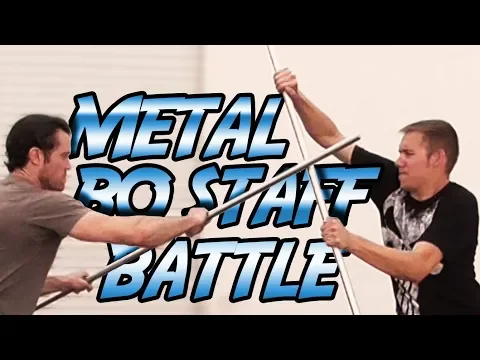
Our ninja forges have been cranking out steel and aluminum bo staffs to meet with your demand. But the burning question you all want to know is how they stack up when it comes to durability. After considerable effort, we have your answer.
The Steel Bo Staff and the High Strength Aluminum Bo Staff have a lot in common. They are solid and metallic, and are made with specialized machined grips to keep your hands from slipping. But they are different. The obvious, measurable distinction is the weight. While the aluminum staff weighs about the same as a wooden bo, the steel staff is easily twice as heavy. This denseness in the steel bo staff is great for strength and speed training, since it modifies your muscle memory to exert more power in your strikes.
The durability question, though, is one that has burned through our hearts for too long. We called up engineers, chemists, and even experienced welders. We went through the most obscure materials science journals and pored through all sorts of charts and graphs to find the answer. But in the end, the simple answer stared us right in the face: Just hit them together and see what sort of abuse they can take.
Watch the video below to find out the results of our experiment. If you like what you see, grab yourself a bo or two and begin a study of your own!
How Weight Changes the Feel of a Metal Bo Staff
The most noticeable difference between a steel and aluminum bo staff is not necessarily how either one looks. It is what happens the moment you pick one up. Steel is considerably denser than aluminum, so two staffs with similar dimensions can have dramatically different weights and handling characteristics.
A heavier steel staff requires more effort to accelerate. Spins, strikes, and rapid changes in direction demand greater control because there is more mass moving through each technique. Once the staff is in motion, that additional mass also creates more momentum, which means the practitioner has to work harder to slow it down or reverse its direction.
An aluminum staff feels much quicker by comparison. Its lower weight makes it easier to start and stop, particularly during techniques involving repeated spins or fast transitions. That can make aluminum appealing to practitioners who want the feel and appearance of a metal staff without dealing with as much weight in their hands.
The difference becomes even more noticeable during longer practice sessions. Repeatedly moving a heavy steel staff can fatigue the hands, wrists, forearms, and shoulders much faster than working with a lightweight aluminum staff. That does not necessarily make the additional weight a disadvantage, but it does change the type of training experience the staff provides.
Neither weight is automatically better. Steel provides resistance and substantial momentum, while aluminum emphasizes speed and maneuverability. Understanding that difference is more useful than simply choosing whichever metal seems stronger, because the weight of the staff affects nearly every movement you perform with it.
Steel vs. Aluminum for Strength and Conditioning
The additional weight of a steel bo staff can turn familiar staff movements into a very different physical challenge. Techniques that feel relatively effortless with a lightweight staff require more muscular effort when the same motions are performed with substantially more weight.
That resistance can place greater demands on the hands, forearms, shoulders, and core as the practitioner works to accelerate and control the staff. Even relatively simple movements can become tiring after repeated practice, especially when changing direction or bringing the staff's momentum to a controlled stop.
Aluminum provides a different training experience. Because there is less mass to move, the practitioner can generally perform techniques with less fatigue and concentrate more on speed, fluidity, and repetition. This can make an aluminum staff more practical for longer practice sessions or routines involving frequent spins and rapid transitions.
A heavier staff should not simply be swung as fast as possible in an attempt to make training more difficult. The additional momentum places greater demands on control, so movements should remain deliberate and comfortable. If technique begins to deteriorate as fatigue increases, slowing down or switching to a lighter staff makes more sense than forcing additional repetitions.
It is also important to remember that practicing with a heavy steel staff is not a replacement for learning proper technique with the type of staff you normally use. Instead, the additional resistance can provide a different form of practice. Steel emphasizes controlling weight and momentum, while aluminum allows the practitioner to place greater emphasis on speed and maneuverability.
Which Is More Durable: Steel or Aluminum?
Durability is where the difference between steel and aluminum becomes especially interesting. Both metals can produce a strong bo staff, but they do not respond to stress in exactly the same way. The properties that make aluminum so appealing for its light weight also mean it behaves differently from steel when subjected to significant impact.
Steel is generally denser and harder than aluminum, which gives a steel staff considerable resistance to dents and deformation. That additional strength is one reason steel can feel almost overbuilt when compared with a lightweight aluminum staff of similar dimensions.
Aluminum trades some of that strength for a major reduction in weight. A well-constructed aluminum bo can still withstand normal martial arts practice, but sufficiently hard impacts may leave dents, bends, or other visible damage more readily than they would on a comparable steel staff.
That does not automatically make steel the better material. Durability only matters in relation to how the staff will actually be used. If your training consists primarily of forms, spins, and controlled solo practice, the lighter weight of aluminum may provide a greater practical benefit than the additional impact resistance of steel.
It is also worth remembering that no metal bo staff should be assumed to be indestructible. Repeated hard impacts can eventually damage the staff, its finish, or other components regardless of the material. Inspecting a metal staff for bends, cracks, loose components, or other signs of damage is still important, particularly after unusually hard contact.
The original steel-versus-aluminum test in this article demonstrates the difference in a much more dramatic way than normal training ever should. For everyday use, the more useful question is not simply which metal can survive the hardest impact, but whether you would rather have the additional strength and weight of steel or the lighter, faster handling of aluminum.
Rust and Maintenance: Steel vs. Aluminum Bo Staffs
Durability is not only about how well a metal bo staff survives an impact. The environment in which you use and store it can also affect how the staff holds up over time, and this is one area where steel and aluminum behave quite differently.
Steel can rust when exposed to moisture for extended periods, particularly in humid environments. Sweat from your hands can also leave moisture and salts on the surface during training. Wiping a steel staff down after use and keeping it in a dry location can therefore help preserve its finish and prevent corrosion from developing.
Aluminum does not rust in the same way that steel does. It naturally forms a thin oxide layer on its surface that helps protect the underlying metal from further corrosion. This makes an aluminum bo relatively low-maintenance when moisture is a concern, although its surface can still become scratched, marked, or otherwise worn through regular use.
Neither material should be stored wet or neglected simply because it is metal. After training, it is a good habit to wipe down the entire staff and inspect it for damage. Pay particular attention to the grip areas, ends, and any locations where the finish has been scratched or worn away.
Storage matters as well. Keeping a metal staff somewhere dry and protected is preferable to leaving it outdoors, in a damp garage, or anywhere it will experience repeated exposure to moisture. If a steel staff begins developing light surface rust, addressing it early is much easier than allowing corrosion to become more established.
For someone who wants the lowest-maintenance option, aluminum has an advantage because rust is not the same concern. Steel requires a little more attention, but with reasonable care, its additional weight and durability may make that small amount of maintenance worthwhile for practitioners who prefer the way it handles.
Which Metal Bo Staff Should You Choose?
Choosing between a steel and aluminum bo staff ultimately comes down to what you want the staff to emphasize during training. Although the two may look similar, their differences in weight, momentum, durability, and maintenance create noticeably different experiences once you begin using them.
A steel bo staff makes the most sense for someone who specifically wants a heavier training tool. The additional mass creates more resistance during movement and requires greater control when accelerating, stopping, or changing direction. For practitioners who enjoy the substantial feel of a heavy staff, steel can provide a very different challenge from traditional wooden or lightweight metal designs.
An aluminum bo staff is better suited to someone who wants the characteristics of a metal staff without as much weight. Its lighter construction makes spins and rapid transitions easier to perform and can reduce fatigue during longer practice sessions. Aluminum also has the advantage of not developing rust in the same way as steel.
Neither material is automatically the better choice. Someone focused on strength and controlling momentum may prefer steel, while a practitioner interested in speed and maneuverability may be happier with aluminum. In some cases, owning both can even be useful because each staff emphasizes a different aspect of training.
The important thing is to choose based on how the staff will actually be used rather than assuming that heavier means better or that lighter means weaker. Steel and aluminum each have advantages, and understanding those tradeoffs makes it much easier to choose the metal bo staff that best matches your training goals.
You May Also Be Interested In:
- Metal Bo Staff: Steel vs Aluminum
- Which is Stronger? Solid Aluminum vs Steel Bo Staff - Watch the Video
- New High-Impact LED Bo Staff
- Expandable Bo Staff Review & Strength Test
- Steel Spear Staff and Other New Weapons!
- Ultimate Bo Workout with an Aluminum Staff
- Reverse Roll Tutorial with the Ultra Light Aluminum Bo Staff
- Spring-Loaded Baton Review & Strength Test
- Middle-Earth Battle Mace and Other New Weapons
- Spiked Battle Club and Other Combat Weapons!
1 Comment(s)
"Good testing of both weapons (also very entertaining). As it is known in metallurgy the stronger steel will always bend or damage the weaker steel and this is more proof regarding this. Also it is a good example to know which metal is better to make combat oriented weapons (regarding steel not wood which is also good to make weapons and some kinds of wood like rattan can take quite a punishment without bending or breaking due to its flexibility). Nice testing karate mart and good concept on the building of both bo staff's."
Written By: Shadow N
6/19/17 - 11:06am
Leave a Reply