




The Biggest Martial Arts Myths That Refuse to Die
June 5th, 2026

Some martial arts myths are so persistent that they almost feel impossible to kill. Even people who have never stepped into a dojo have probably heard at least a few of them: black belts are unbeatable, martial artists have to register their hands as weapons, ninjas dressed in all black, or certain styles simply "do not work" in real fights. The strange part is that many of these ideas have survived for decades, despite being exaggerated, misunderstood, or completely made up. Some came from movies. Others spread through pop culture, bad information, or endless internet debates. And a surprising number still shape how people think about martial arts today.
Myth #1: Black Belts Are Unbeatable Fighters
The black belt might be the most misunderstood symbol in martial arts. To the general public, it often represents mastery, toughness, and near-superhuman fighting ability. In movies, the black belt is usually the person who can defeat a room full of attackers without breaking a sweat.
In real life, a black belt usually means something more specific. It represents commitment, consistency, discipline, and a strong understanding of a particular system. That is impressive, but it does not automatically mean someone is unbeatable, dangerous, or prepared for every possible fighting situation.
Different schools also use different standards. In some traditional programs, earning a black belt can take many years of serious training. In other schools, especially weaker ones, the path may be much faster and less demanding. That is one reason the phrase "black belt" can mean very different things depending on the instructor, style, and school culture.
A black belt in karate, taekwondo, judo, Brazilian Jiu-Jitsu, or kung fu may also represent very different skill sets. One person may be excellent at forms and traditional technique. Another may be highly experienced in sparring. Another may specialize in throws, submissions, or competition strategy. The belt color alone does not tell the whole story.
The real value of a black belt is not that it makes someone invincible. It is that it marks a serious stage in a longer journey. In many schools, black belt is not the finish line at all. It is the point where deeper training really begins.
Myth #2: Martial Artists Have to Register Their Hands as Weapons
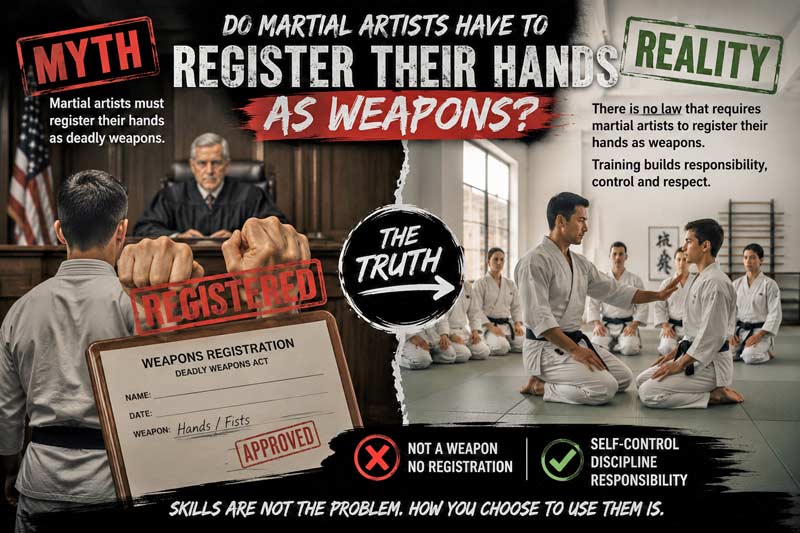
This might be the most famous martial arts myth of all time. Someone knows a guy, who knew a guy, who supposedly had to register his hands with the police because he was a black belt. It sounds dramatic, which is probably why the story has survived for so long.
But it is not true.
There is no general law in the United States requiring martial artists, boxers, black belts, or professional fighters to register their hands as deadly weapons. A trained fighter can certainly face serious legal consequences for assault, just like anyone else, but that is very different from having their hands officially listed as weapons by the government.
The myth probably survives because it plays into something people already want to believe: that martial arts training turns the human body into a kind of legal weapon. There is a tiny grain of truth in the sense that training can make someone more capable of causing harm, and courts may consider someone's training in certain legal situations. But that still does not mean their hands are "registered."
The better lesson is simple. Martial arts training comes with responsibility. A skilled martial artist should have more self-control, not less. The goal is not to become someone who is looking for excuses to fight. The goal is to build enough discipline and awareness to avoid violence whenever possible.
Myth #3: Ninjas Really Dressed in All Black
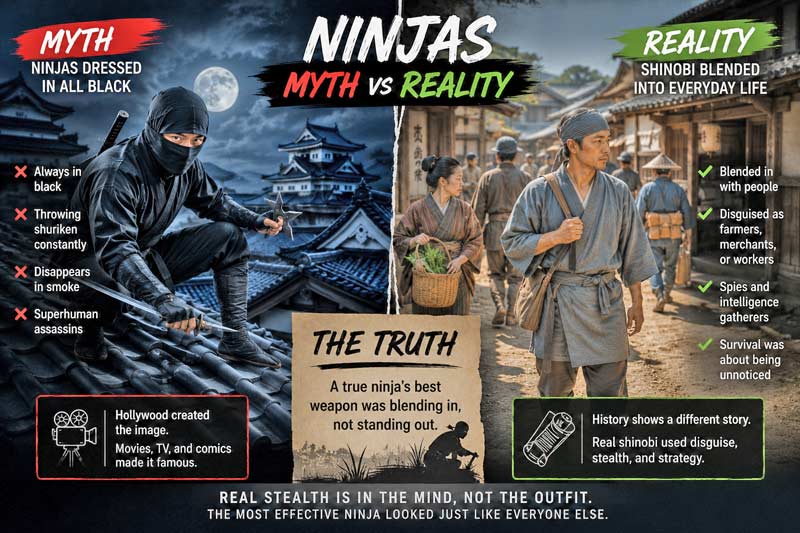
If movies taught us anything about ninjas, it is this: they always wear black, move through the shadows, and somehow disappear into smoke after throwing a handful of ninja stars.
The reality is a lot less dramatic and far more interesting.
Historically, real ninjas, often called shinobi, were spies, scouts, and intelligence gatherers in feudal Japan. Their entire job depended on blending in, not standing out. Walking around in a head-to-toe black outfit would have made someone incredibly easy to spot, especially in villages, marketplaces, or enemy territory.
In many cases, people believed to be shinobi likely dressed like ordinary farmers, merchants, laborers, or even samurai depending on the situation. Disguise was part of survival. Looking forgettable was often far more useful than looking intimidating.
So where did the all-black ninja image come from? Much of it traces back to Japanese theater. Stagehands traditionally wore black because audiences were trained to ignore them, treating them almost like invisible helpers. Over time, theatrical productions began using black-clad figures to represent stealthy assassins and spies. Movies, comic books, and television eventually turned that image into the ninja stereotype most people recognize today.
That does not mean traditional ninja weapons and training are entirely fictional. Historical martial arts included tools like staffs, chain weapons, blades, and concealment tactics, although Hollywood tends to exaggerate how they were used. Modern martial arts enthusiasts still practice with traditional training weapons like bo staffs, nunchaku, and sai, though not usually while sneaking across rooftops at midnight.
The funny part is that ninjas became more visually recognizable than they ever would have wanted to be in real life. A truly effective ninja probably would have looked completely ordinary.
Myth #4: Breaking Boards Proves Someone Can Fight
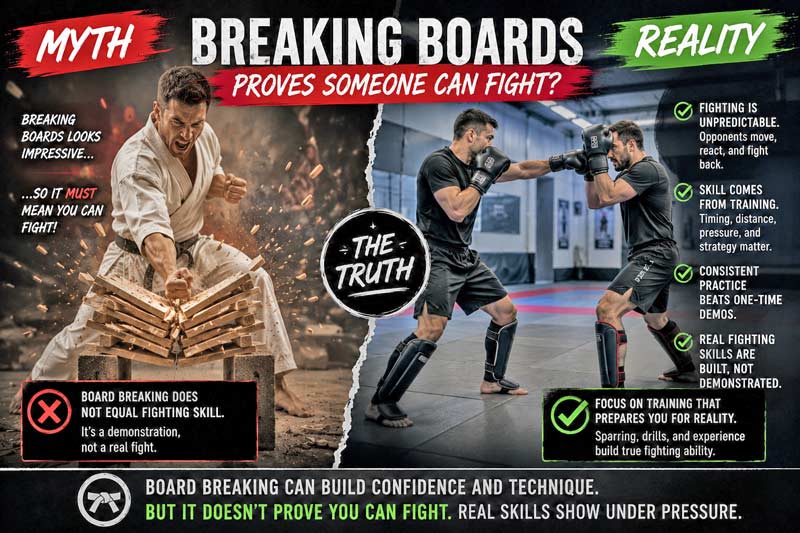
Few martial arts demonstrations look more impressive than someone smashing through a stack of boards with a punch, kick, elbow, or palm strike. To people outside the martial arts world, board breaking can seem like proof that someone is a dangerous fighter with incredible power.
The truth is more complicated.
Board breaking, often called breaking or "tameshiwari" in some styles, is real training in the sense that it can help build focus, precision, confidence, commitment, and technique. Successfully breaking something requires proper timing, body mechanics, accuracy, and follow-through. It is not completely fake, and anyone who has failed a board break can tell you it definitely still hurts.
What board breaking does not prove is whether someone can actually fight. Fighting involves timing, distance management, reactions, stress, unpredictability, and dealing with a resisting opponent who is trying very hard not to cooperate. Someone might be excellent at demonstrations but struggle under pressure. Meanwhile, another person with little interest in flashy techniques may perform extremely well in sparring or competition.
Hollywood probably deserves part of the blame for the confusion. Movies spent decades using dramatic breaking scenes as shortcuts for toughness. If someone could punch through wood or smash bricks, audiences instantly understood:
This person is dangerous.
In reality, most experienced instructors see board breaking more as a teaching tool than a fighting measurement. It can build confidence and showcase technique, but it is only one small piece of a much bigger skill set.
Ironically, many skilled martial artists care far less about breaking boards than they do about consistency in training, sparring, and developing solid fundamentals over time.
Myth #5: Martial Arts Do Not Work in Real Fights
This myth usually shows up after someone watches a bad demonstration online or sees a viral clip of unrealistic techniques.
A person throws five slow punches into the air, someone dramatically flips through a table, and the internet immediately decides:
"See? Martial arts do not work."
The truth is far more nuanced.
Martial arts absolutely can work in real fights, but not all training is created equal. Effectiveness often depends on the style, the school, the instructor, and most importantly, how someone trains. A person who regularly spars, pressure tests techniques, and practices against resisting opponents is usually developing a very different skill set than someone who only memorizes choreographed movements.
That does not mean traditional martial arts are useless either, despite what online arguments sometimes suggest. Karate, judo, wrestling, Muay Thai, boxing, Brazilian Jiu-Jitsu, taekwondo, and many other systems have all produced effective fighters. The difference often comes down to realism in training rather than the name of the style on the front door.
In fact, many of today's strongest martial artists cross-train. A student might practice striking from karate or kickboxing while learning grappling through jiu-jitsu or wrestling. That hybrid approach became far more common after MMA exposed both the strengths and limitations of individual systems.
There is also an uncomfortable truth people sometimes ignore: real fights are messy, unpredictable, and dangerous. No martial art turns someone into an action movie hero. Training improves confidence, reactions, awareness, and physical ability, but avoiding violence is still usually the smartest outcome.
Perhaps the better question is not whether martial arts "work," but what someone expects them to do. Build confidence? Improve fitness? Help with self-defense? Teach discipline? For millions of people, martial arts have already proven their value in all of those areas.
Myth #6: You Are Too Old to Start Martial Arts

A surprising number of adults believe they missed their chance to start martial arts somewhere around age twelve.
Maybe they picture elite athletes flipping through the air, lifelong black belts sparring at full speed, or twenty-year-olds training six days a week. Compared to that image, starting at 35, 45, or even 60 can feel intimidating.
But this myth falls apart the moment you walk into most martial arts schools.
Many programs today are filled with beginners who started as adults. Some show up for fitness. Others want confidence, stress relief, self-defense, or simply something more interesting than another treadmill workout. Plenty of parents even start training after bringing their kids to class and realizing they want to try it themselves.
The key is finding the right environment. Not every school focuses on hard competition or intense sparring. Some programs prioritize traditional discipline and steady progress. Others emphasize fitness, flexibility, or beginner-friendly self-defense. A good instructor knows how to adapt training for different ages, goals, and physical abilities.
In fact, many adults have advantages younger students do not. Patience. Consistency. Discipline. A clearer understanding of why they are training. Someone who trains two or three times a week consistently for years often progresses much farther than the person chasing quick results for a few months.
There is also a misconception that martial arts only matter if someone becomes an expert fighter. In reality, many students never compete and still get tremendous value from training. Better fitness. Improved confidence. Stress relief. Flexibility. Focus. Community. Those benefits do not suddenly disappear because someone started later in life.
The truth is simple: the best age to start martial arts was probably years ago. The second-best time is today.
Myth #7: MMA Proved Traditional Martial Arts Are Fake
This argument shows up constantly online.
Someone watches a UFC fight, sees a wrestler or Brazilian Jiu-Jitsu practitioner dominate, and immediately declares:
"Traditional martial arts do not work."
Like most sweeping internet opinions, the truth is much more complicated.
What MMA really exposed was not that traditional martial arts were fake. It revealed that training methods matter. A school focused entirely on choreographed movements with no sparring or resistance training may struggle to prepare someone for a chaotic fight. But a traditional school that includes realistic sparring, timing, pressure testing, and practical application can produce highly capable martial artists.
There is also an important detail people often overlook: MMA itself is built on traditional martial arts. Boxing, wrestling, judo, Muay Thai, karate, Brazilian Jiu-Jitsu, and taekwondo have all influenced modern mixed martial arts in different ways. Fighters did not invent techniques out of thin air. They borrowed, adapted, and combined systems that already existed.
In fact, many successful MMA fighters have traditional martial arts backgrounds. Fighters like Lyoto Machida famously used karate-based movement and timing. Others brought taekwondo kicks, judo throws, or traditional striking principles into competition. What changed was not necessarily the techniques. It was how they were tested and combined.
The stronger takeaway is this: martial arts are tools. Some tools work better in certain situations than others. A hammer is useful, but not for every job. The same goes for fighting systems. No single style solves every problem, which is one reason so many serious practitioners eventually cross-train.
MMA did not prove traditional martial arts were fake. If anything, it proved that training realistically matters more than arguing about style names.
Myth #8: More Belts Always Mean More Skill
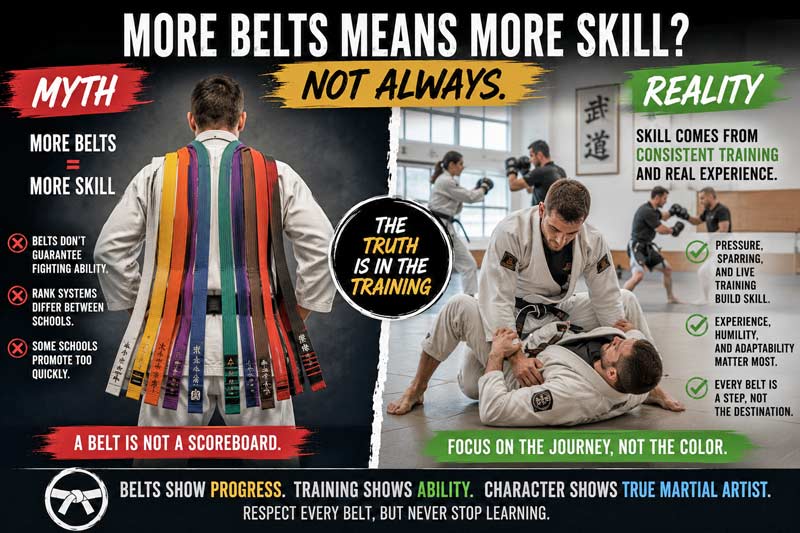
For many people outside martial arts, belts seem like a simple scoreboard.
Higher belt equals better fighter.
More stripes equals more skill.
Easy, right?
Not exactly.
Belts can absolutely represent experience, consistency, and achievement. In many schools, earning rank requires years of practice, technical growth, discipline, and testing. Progression systems exist for a reason. They help students stay motivated and provide visible milestones along the way.
The problem is that not every school measures progress the same way. A black belt earned through years of hard sparring, competition, and demanding testing may represent something very different than one earned through minimal resistance training or unusually fast promotions. That is part of why experienced martial artists often say:
"The school matters as much as the belt."
There is also another misconception hiding underneath this myth. Rank and fighting ability are not always the same thing. A person might be highly technical, disciplined, and deeply knowledgeable about forms or traditional training but have little interest in competitive sparring. Meanwhile, a lower-ranked student who trains aggressively under pressure might perform better in certain fighting situations.
That does not mean belts are meaningless. Far from it. For many students, they represent hard work, perseverance, and long-term commitment. Learning how to tie a belt for the first time often marks the beginning of a journey that lasts years. Over time, those colors become reminders of progress, setbacks, and persistence, not just status. For beginners, even understanding how to tie a karate belt becomes part of stepping into martial arts culture.
In the best schools, belts are not treated like trophies. They are treated like milestones. Important milestones, but still just part of a much longer journey.
Myth #9: You Need to Be Naturally Tough or Athletic to Succeed in Martial Arts
Watch enough action movies and it starts to seem like every successful martial artist was born with perfect balance, incredible speed, and movie-star confidence.
Reality tends to look very different.
Most people who stick with martial arts start out awkward.
The first punches feel unnatural. Kicks feel clumsy. Footwork feels confusing. Sparring feels intimidating. Even basic things, like learning stance, timing, or coordination, can take far longer than beginners expect.
That is completely normal.
In fact, many experienced instructors will tell you that natural athletic ability matters far less than consistency. The student who trains twice a week for several years almost always outperforms the person relying only on talent. Martial arts reward repetition, patience, and persistence more than raw physical gifts.
Some of the best students are not naturally aggressive at all. They are people who slowly build confidence over time. Someone may start class feeling nervous, shy, or completely out of shape and gradually develop coordination, discipline, and self-belief through regular practice.
There is also a misconception that martial arts are only for highly competitive personalities. Plenty of students train simply because they enjoy learning, want stress relief, or like having a structured way to improve themselves. Success does not always mean winning tournaments or becoming the toughest person in the room.
The funny thing about martial arts is that the people who seem naturally talented are often just the ones who quietly kept showing up for years while everyone else assumed they were gifted from the start.
Myth #10: Martial Arts Are Mostly About Fighting
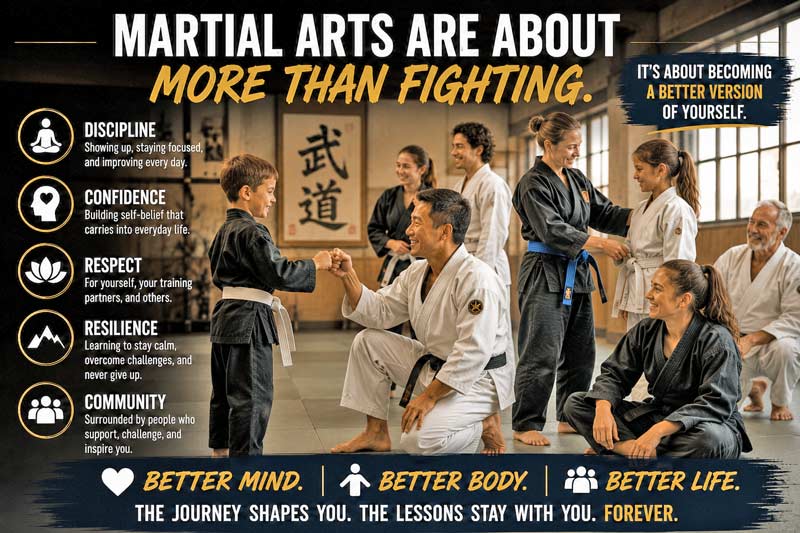
Ask someone who has never trained what martial arts are about and you will usually hear the same answer:
"Learning how to fight."
That is understandable. Movies, UFC highlights, self-defense videos, and tournament clips all tend to focus on combat. Fighting is the part people notice most.
But for many long-term students, fighting ends up becoming only a small piece of the experience.
Walk into enough martial arts schools and you start hearing very different reasons people train. One person wants confidence after a difficult period in life. Another is trying to manage stress. Some parents enroll their children to improve focus or discipline. Others simply want a healthier routine that feels more engaging than a traditional gym membership.
Even schools known for sparring and competition often emphasize things outsiders rarely think about: consistency, humility, emotional control, patience, and respect. Students learn how to stay calm under pressure, work through frustration, and improve slowly over time. Ironically, people who train for years often become less interested in proving toughness and more interested in personal growth.
That does not mean fighting skills are irrelevant. Martial arts can absolutely improve self-defense, timing, awareness, and confidence in difficult situations. But reducing martial arts to fighting alone misses a huge part of why millions of people keep training long after the novelty wears off.
For many students, the real transformation happens outside the dojo. Better discipline. More confidence. Less stress. Improved health. Strong friendships. A greater sense of progress. Those benefits tend to stick around far longer than any sparring session.
The biggest surprise for many beginners is this: martial arts may start as something physical, but for a lot of people, they eventually become something much bigger.
Why These Martial Arts Myths Refuse to Die
By this point, you may have noticed a pattern.
Most martial arts myths survive because they contain a tiny piece of truth wrapped inside a much bigger exaggeration.
Yes, martial arts can make someone more dangerous, but nobody registers their hands as weapons. Yes, board breaking takes skill, but it does not automatically prove fighting ability. Yes, black belts matter, but they do not guarantee someone is unbeatable. Most myths survive because they sound believable enough to repeat without questioning.
Hollywood deserves some of the blame too. Movies gave us silent ninjas dressed head-to-toe in black, masters who become unstoppable after earning a black belt, and heroes who defeat impossible odds after one training montage. Those stories are entertaining, but they shaped how millions of people think martial arts actually work.
The internet only accelerated things. Today, one unrealistic demonstration can go viral and suddenly become "proof" that all martial arts are fake. Meanwhile, a single UFC knockout becomes evidence that one style somehow invalidates every other system. Nuance rarely spreads as quickly as dramatic opinions.
Ironically, people who actually train tend to become less extreme in their views over time. Experienced martial artists often recognize that nearly every system has strengths, weaknesses, and contexts where it works best. They stop arguing so much about style names and start paying closer attention to training quality, instructors, and consistency.
Maybe that is the biggest myth of all: the idea that martial arts can be reduced to simple answers. In reality, they are messy, complicated, personal, and constantly evolving, which is probably why people are still debating them decades later.
The Truth About Martial Arts Is More Interesting Than the Myths
Martial arts myths probably are not disappearing anytime soon.
People will still talk about registered hands, unstoppable black belts, invincible ninjas, and magical fighting techniques that somehow work against anyone. Those stories are fun, dramatic, and easy to repeat, which is exactly why they have survived for so long.
But the reality of martial arts tends to be far more interesting than the myths.
Real martial arts are not about shortcuts or movie moments. They are about repetition. Patience. Failure. Progress. Learning how to stay calm under pressure. Building confidence one uncomfortable class at a time. Improving slowly enough that most people barely notice until they suddenly realize they have changed.
That change looks different for everyone. Some people train for self-defense. Others want fitness, confidence, discipline, stress relief, competition, or simply a community they enjoy being part of. The longer many students train, the more they realize martial arts are rarely about becoming unbeatable. They are about becoming better than they were yesterday.
And maybe that is why these myths keep surviving. Martial arts have always carried a little mystery around them. For outsiders, the stories are entertaining. For people who actually train, the truth ends up being more rewarding anyway.
If there is one takeaway worth remembering, it is this: you do not have to believe the myths to appreciate martial arts. You just have to step onto the mat and experience them for yourself.
For beginners curious about getting started, learning about the best martial arts gear for beginners can make that first step feel a whole lot easier.
Frequently Asked Questions
Is There Really a "Best" Martial Art?
Probably not, although people love arguing about it.
The idea of a single "best" martial art sounds appealing, but it usually ignores an important reality: different systems are designed for different goals. A style that works well for competition may not be ideal for someone focused on fitness or confidence. A martial art built around self-defense may feel very different than one centered on tradition, sport, or personal discipline.
For example, Brazilian Jiu-Jitsu is often praised for grappling and ground control. Boxing and Muay Thai are known for striking. Wrestling develops balance, pressure, and control. Karate and taekwondo often emphasize discipline, structure, and striking fundamentals, though schools vary widely in training style.
The quality of the instructor and school usually matters more than the style itself. A great coach teaching a style you enjoy will almost always outperform chasing the "perfect" martial art you never stick with.
In reality, the best martial art is often the one that matches your goals and keeps you training consistently. The person who trains for years in a solid school generally develops far more skill than the person endlessly debating styles online without ever stepping onto the mat.
Do Martial Arts Actually Help in Self-Defense?
Yes, but probably not in the way movies make people imagine.
Martial arts can absolutely improve self-defense by building awareness, confidence, timing, reactions, and the ability to stay calmer under pressure. Many styles also teach practical techniques for striking, grappling, escaping holds, or creating distance during dangerous situations.
That said, not all martial arts schools train for self-defense in the same way. Some focus heavily on competition. Others prioritize forms, tradition, fitness, or personal growth. Schools that regularly include realistic sparring, pressure testing, and scenario-based training often provide a very different experience than programs built entirely around choreographed movements.
There is also an important misconception worth clearing up: self-defense is not just about fighting ability. Many experienced instructors will tell you that awareness, confidence, and avoiding dangerous situations are often more valuable than throwing the perfect punch. De-escalation, good judgment, and staying calm matter just as much as physical techniques.
No martial art turns someone into an unstoppable fighter, and real confrontations are always unpredictable. But for many people, martial arts can absolutely improve confidence and preparedness while teaching skills that may help if a situation ever becomes unavoidable.
Why Do Martial Arts Schools Have So Many Belts?
For beginners, martial arts belts can feel a little confusing.
Why are there so many colors?
Why do some schools have stripes while others do not?
And why does one black belt sometimes seem completely different from another?
The answer is that belt systems were designed to track progress, motivate students, and create clear milestones along the training journey. Instead of feeling like one endless road to mastery, students can see visible improvement over time through rank advancement.
Different martial arts handle this differently. Karate, taekwondo, judo, Brazilian Jiu-Jitsu, and other systems often have their own belt structures, testing standards, and expectations. Even within the same martial art, schools may organize rank progression differently depending on the instructor or organization.
Belts are also more modern than many people realize. Contrary to popular belief, ancient martial artists were not walking around with rainbow-colored belt systems. The structured ranking approach became much more common through martial arts like judo and later spread into karate, taekwondo, and other styles as training expanded around the world.
At their best, belts give students motivation and structure. They provide goals, celebrate progress, and reward consistency. Learning simple traditions, even something like how to tie a karate belt, becomes part of feeling connected to the culture and discipline of martial arts.
The healthiest schools tend to treat belts as milestones rather than trophies. Helpful, meaningful milestones, but still only one part of a much longer journey.
Is It Too Late to Start Martial Arts as an Adult?
Not even close.
One of the biggest misconceptions about martial arts is that everyone starts as a kid and spends decades training before becoming good. In reality, many schools are filled with adults who started in their 30s, 40s, 50s, or even later.
People begin training for all kinds of reasons. Some want better fitness. Others are looking for confidence, stress relief, self-defense, discipline, or simply a hobby that feels more rewarding than a standard gym routine. Plenty of parents even start classes after watching their kids train and deciding to give it a try themselves.
The biggest factor is finding the right school for your goals. Not every program is built around intense sparring or competition. Some focus heavily on beginner-friendly instruction, traditional training, flexibility, fitness, or practical self-defense. A good instructor will know how to scale training to different ages, abilities, and experience levels.
Adults often bring strengths younger students do not have. Patience. Consistency. Better focus. A clearer reason for training. Many long-term students succeed not because they were naturally gifted, but because they simply kept showing up.
The hardest part for most adults is not training itself. It is walking through the door for the first time. Once that happens, many people quickly realize they were worried far more than necessary.
The truth is simple: if you are healthy enough to move and willing to learn, it is almost never too late to start martial arts.
You May Also Be Interested In:
- The Biggest Myths About Samurai Swords
- The Truth About Ninja Weapons: 7 Myths Debunked
- 10 Reasons Why You Should Try Martial Arts
- What is the Best Bo Staff for Martial Arts?
- Whatever Happened to These Martial Arts?
- LED Weapons for Cosplay and Martial Arts
- What Martial Arts Style Should I Choose?
- Top 5 Least Practical Martial Arts Weapons You Know You Want
- How to Tell if a Martial Arts School Is Actually Good
- What Gear Do I Need For My First Martial Arts Class?
Leave a Reply