



The Most Famous Asian Weapons and How They Are Actually Used
May 27th, 2026
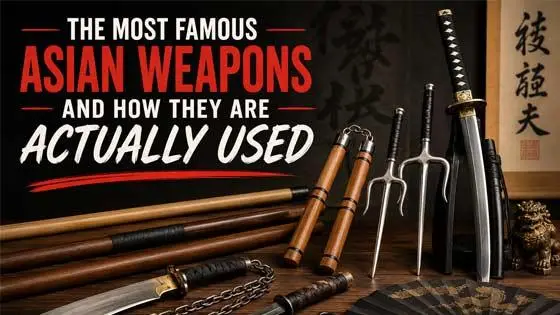
Asian weapons have fascinated people for centuries, and not just because they look impressive in movies. From the spinning speed of nunchucks to the precision of a samurai sword, many of these weapons were developed for real combat, self-defense, military use, or specialized martial arts training. Today, they continue to be practiced around the world by martial artists, collectors, and people who simply appreciate the history and craftsmanship behind traditional weapons. But despite how recognizable many of them are, there are still plenty of misconceptions about where these weapons came from and how they were actually used.
In this guide, we'll look at some of the most famous Asian weapons, where they originated, how martial artists trained with them, and why many are still popular today.
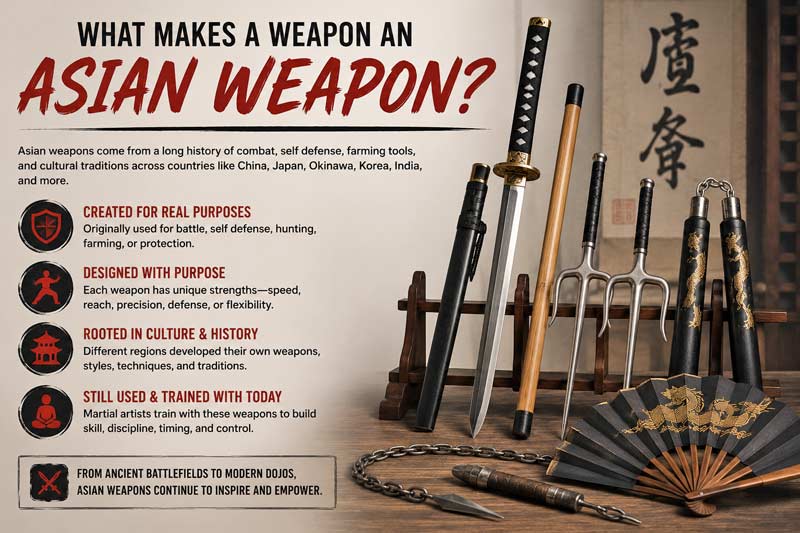
When people talk about Asian weapons, they are usually referring to traditional weapons that originated in countries like China, Japan, Okinawa, Korea, India, and other parts of Asia. Many of these weapons were originally created for military combat, self defense, farming adaptation, hunting, or personal protection long before modern firearms existed. Over time, many became deeply connected to martial arts systems and cultural traditions.
What makes Asian weapons especially interesting is how different they are from one another. Some focus on speed and flexibility, like nunchucks or rope darts. Others emphasize reach and control, such as the bo staff or spear. Then there are weapons built around precision and defense, including the sai or certain styles of short swords. Even weapons that look simple often require years of training to use properly.
Many people first discover these weapons through movies, television, anime, or video games, but the real history behind them is often much more interesting. For example, some martial arts weapons evolved from everyday tools, while others were designed specifically for battlefield combat or law enforcement purposes. Different regions developed their own styles, techniques, and philosophies around how weapons were used in combat and training.
Today, many martial artists still practice with traditional weapons to improve coordination, balance, timing, discipline, and body control. Some train with realistic versions, while others use safer training equipment like wooden practice swords or padded gear before progressing to more advanced weapons.
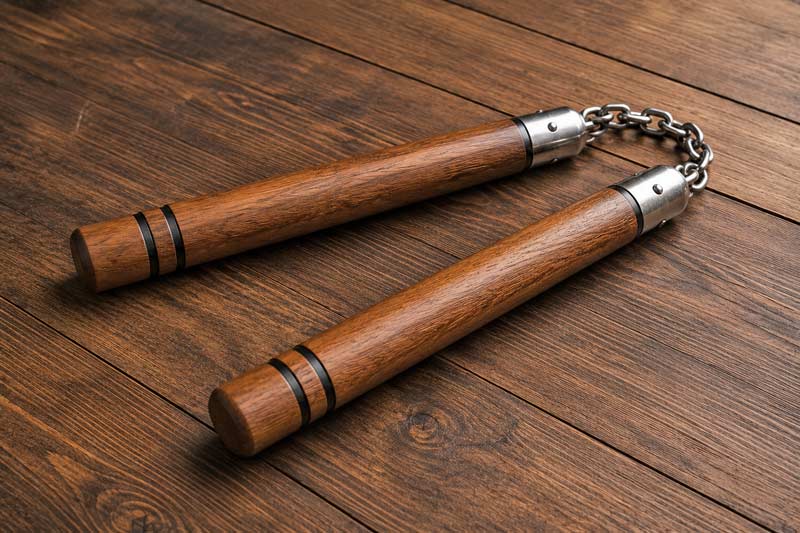
Few Asian weapons are more recognizable than nunchaku. Also called nunchucks, this weapon usually consists of two short sticks connected by a chain or cord. Although many people associate nunchaku with flashy demonstrations and movie scenes, they were originally developed as practical weapons that rewarded speed, timing, and coordination. Over time, they became one of the most recognizable training weapons in martial arts.
Nunchaku are most commonly associated with Okinawan martial arts and later became wildly popular thanks to martial arts films in the 1970s. Their fast movement makes them excellent for practicing hand speed, rhythm, coordination, and control. At the same time, they can be surprisingly difficult for beginners because improper technique often leads to accidental bumps and bruises during practice.
Many martial artists start learning with foam or padded training versions before moving to wood or metal models. If you are interested in learning with this traditional weapon, it helps to start with beginner-friendly nunchaku designed specifically for practice and skill development.
Today, nunchaku are used for martial arts training, demonstrations, competition forms, and collection purposes. While movies often portray them as unstoppable weapons, real training focuses much more on control, precision, and safe handling than flashy spinning tricks.
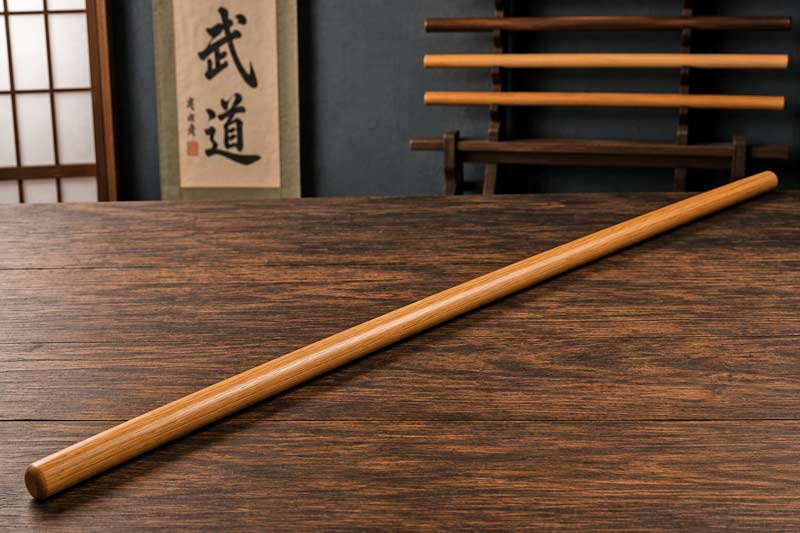
The bo staff is one of the oldest and most widely practiced Asian weapons still used in martial arts today. Usually measuring around six feet long, the bo staff may look simple at first glance, but experienced martial artists know it can be incredibly versatile. A skilled practitioner can use it for striking, blocking, sweeping, controlling distance, and defending against multiple angles of attack.
Many historians believe the bo staff evolved from common farming tools or carrying poles, especially in Okinawa, where restrictions on traditional weapons led people to adapt everyday objects into practical self defense tools. Over time, these techniques became formalized and turned into some of the weapon systems still practiced in martial arts schools today.
One reason the bo staff remains so popular is because it teaches fundamentals that carry over into many other weapons and empty-hand techniques. Training with a staff helps develop balance, timing, coordination, body movement, hand positioning, and distance control. Even beginners can start learning basic movements fairly quickly compared to some more complicated weapons.
Today, many martial artists train with traditional hardwood staffs, while others prefer tapered or lightweight versions depending on their style and experience level. If you want to explore different options, there are many types of bo staffs designed for beginner practice, demonstrations, martial arts forms, and advanced training.
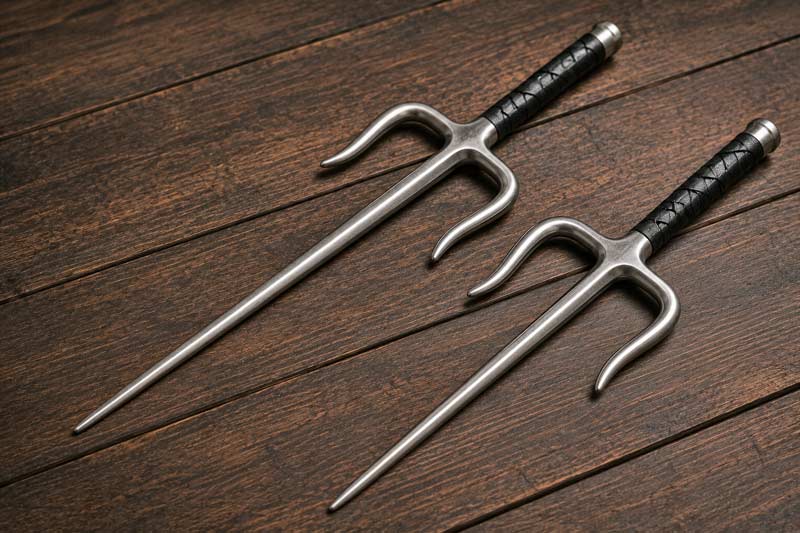
The sai is one of the most recognizable traditional Asian weapons, thanks in part to movies, martial arts demonstrations, and even pop culture. Many people first discovered the weapon through Raphael from Teenage Mutant Ninja Turtles, but the real history of the sai goes back much further. Traditionally associated with Okinawan martial arts, the sai was designed more for defense and control than slashing or cutting.
Unlike swords or knives, a sai typically has no sharpened edge. Instead, its unique shape allows practitioners to block strikes, trap weapons, redirect attacks, and strike with speed and precision. The long center prong is paired with two curved side guards that help protect the hand and create opportunities to control an opponent's weapon during training or self defense situations.
Sai training requires coordination, timing, and strong wrist control. Martial artists often practice spins, blocking drills, striking combinations, and forms to improve precision and dexterity. Although they may look intimidating at first, many practitioners appreciate sai because they reward technical skill and control rather than brute strength.
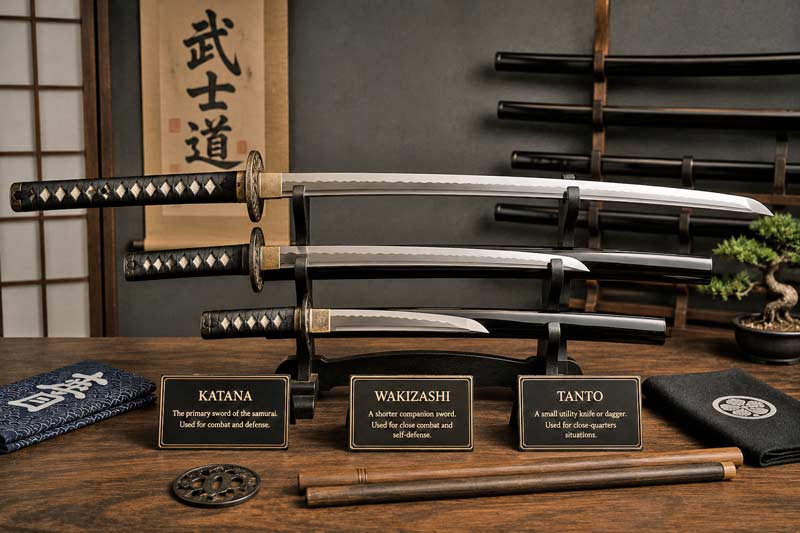
When most people think of Asian weapons, the samurai sword is usually one of the first that comes to mind. Often referred to as a katana, these curved swords are strongly associated with Japan's samurai warriors and have become symbols of discipline, craftsmanship, and martial skill. But despite how often the word "katana" gets used, there are actually several different types of traditional Japanese swords, each designed for different purposes.
The katana is known for its slightly curved blade, long grip, and ability to be wielded with one or two hands. Samurai used these swords for close combat, precision cutting, and quick defensive movements. Other swords, such as the wakizashi and tanto, served different roles and were often carried alongside a katana as part of a larger weapon system.
Today, samurai swords remain incredibly popular for martial arts practice, collecting, historical appreciation, and display. Some practitioners train with real steel blades, while many beginners start with safer options such as bokken or other wooden practice swords before advancing. For collectors and enthusiasts, there are also many styles of samurai swords inspired by traditional Japanese craftsmanship.
Although movies often focus on dramatic sword fights, traditional sword training places heavy emphasis on control, discipline, posture, and technique. In many martial arts schools, students spend years mastering basic movements before ever attempting advanced cutting techniques.
Today, sai remain popular for martial arts demonstrations, traditional kata, collecting, and training. If you want to explore different styles and materials, there are many types of sai available, including lightweight practice models and traditional metal versions.
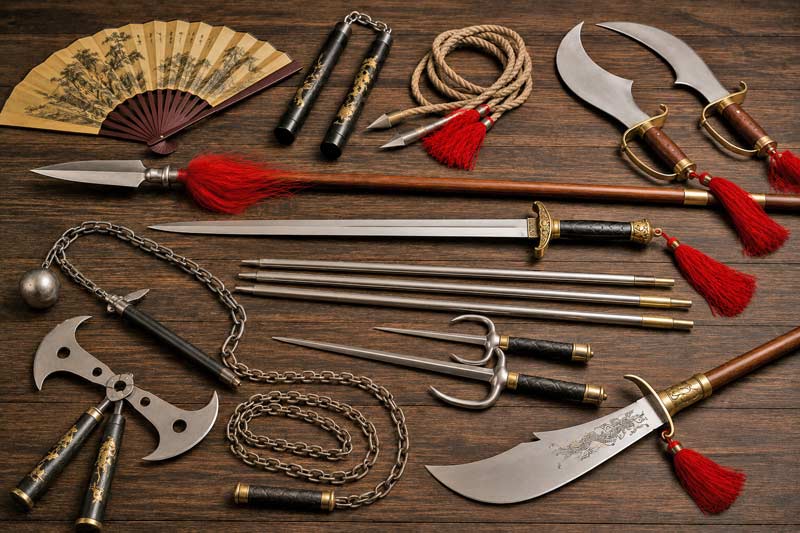
While Japanese and Okinawan weapons tend to get most of the attention, Chinese martial arts introduced some of the most unusual and visually impressive weapons ever created. Often grouped under the term kung fu weapons, these tools were designed for speed, flexibility, reach, deception, and adaptability. Many required incredible coordination and years of practice to master effectively.
Some kung fu weapons are fairly straightforward, such as straight swords, spears, and staffs. Others are far more unusual and specialized. Flexible weapons like rope darts, chain whips, and three section staffs are known for their flowing movements and unpredictable attack angles. Weapons such as butterfly swords, hook swords, and fighting fans were developed for more specialized techniques and close-range combat.
Because many kung fu weapons rely heavily on timing and body control, they remain popular for demonstrations, forms training, and martial arts performance. At the same time, practitioners also value them for improving agility, coordination, precision, and overall weapon handling skills. Even experienced martial artists often find flexible weapons challenging due to their complexity.
If you want to explore a wide variety of traditional Chinese martial arts weapons, there are many styles of kung fu weapons available, ranging from beginner-friendly training tools to more advanced options inspired by traditional designs.
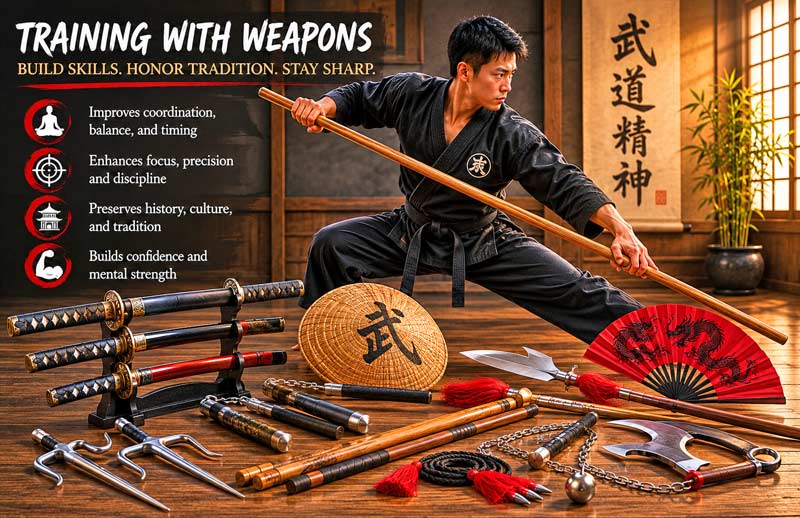
Even though most traditional Asian weapons are no longer used for real combat, martial artists around the world still train with them for a variety of practical reasons. Weapons training helps build coordination, timing, focus, balance, precision, and body control in ways that empty-hand training alone often cannot. Many students also find that practicing weapons improves their overall martial arts technique by teaching better distance management and movement.
For some martial artists, traditional weapons training is also about preserving history and culture. Many martial arts systems include weapons forms, drills, and techniques that have been passed down for generations. Learning how these tools were used gives students a better understanding of where their martial art came from and how different fighting systems evolved over time.
Others simply enjoy the challenge. Weapons like nunchaku, rope darts, chain whips, and sai require patience, coordination, and repetition to learn properly. Even experienced martial artists often discover that weapon training introduces entirely new skills and movements that feel completely different from empty-hand practice.
Whether someone is interested in history, demonstrations, martial arts forms, collecting, or traditional training, Asian weapons continue to attract attention because they combine skill, craftsmanship, and cultural significance in a way few other training tools can. From beginner-friendly practice equipment to more traditional designs, there is a huge variety of martial arts weapons available for people interested in learning more.
Asian weapons continue to capture attention because they combine history, craftsmanship, martial skill, and cultural tradition in a way few other training tools can. Whether someone is drawn to the speed of nunchaku, the reach of a bo staff, the precision of sai, or the elegance of a samurai sword, each weapon has its own story and training philosophy behind it. Many of these tools were originally created for practical use, but today they also serve as a way to preserve martial arts traditions and develop new skills.
For martial artists, weapons training often becomes about much more than learning techniques. It teaches discipline, patience, timing, coordination, and body control while helping students better understand the roots of their martial art. Even people who are not actively training often enjoy collecting or learning about traditional weapons because of the craftsmanship and history involved.
If you are interested in exploring traditional martial arts weapons for training, demonstrations, collecting, or historical appreciation, there is a wide selection of Asian-inspired gear available today. From beginner-friendly Chinese martial arts weapons to practice nunchucks for training, traditional martial arts staffs, and authentic-style Japanese swords, there are plenty of ways to continue learning about the tools that helped shape martial arts history.
What Makes a Weapon an "Asian Weapon"?
When people talk about Asian weapons, they are usually referring to traditional weapons that originated in countries like China, Japan, Okinawa, Korea, India, and other parts of Asia. Many of these weapons were originally created for military combat, self defense, farming adaptation, hunting, or personal protection long before modern firearms existed. Over time, many became deeply connected to martial arts systems and cultural traditions.
What makes Asian weapons especially interesting is how different they are from one another. Some focus on speed and flexibility, like nunchucks or rope darts. Others emphasize reach and control, such as the bo staff or spear. Then there are weapons built around precision and defense, including the sai or certain styles of short swords. Even weapons that look simple often require years of training to use properly.
Many people first discover these weapons through movies, television, anime, or video games, but the real history behind them is often much more interesting. For example, some martial arts weapons evolved from everyday tools, while others were designed specifically for battlefield combat or law enforcement purposes. Different regions developed their own styles, techniques, and philosophies around how weapons were used in combat and training.
Today, many martial artists still practice with traditional weapons to improve coordination, balance, timing, discipline, and body control. Some train with realistic versions, while others use safer training equipment like wooden practice swords or padded gear before progressing to more advanced weapons.
Nunchaku: The Fast-Spinning Weapon Made Famous by Bruce Lee
Few Asian weapons are more recognizable than nunchaku. Also called nunchucks, this weapon usually consists of two short sticks connected by a chain or cord. Although many people associate nunchaku with flashy demonstrations and movie scenes, they were originally developed as practical weapons that rewarded speed, timing, and coordination. Over time, they became one of the most recognizable training weapons in martial arts.
Nunchaku are most commonly associated with Okinawan martial arts and later became wildly popular thanks to martial arts films in the 1970s. Their fast movement makes them excellent for practicing hand speed, rhythm, coordination, and control. At the same time, they can be surprisingly difficult for beginners because improper technique often leads to accidental bumps and bruises during practice.
Many martial artists start learning with foam or padded training versions before moving to wood or metal models. If you are interested in learning with this traditional weapon, it helps to start with beginner-friendly nunchaku designed specifically for practice and skill development.
Today, nunchaku are used for martial arts training, demonstrations, competition forms, and collection purposes. While movies often portray them as unstoppable weapons, real training focuses much more on control, precision, and safe handling than flashy spinning tricks.
Bo Staff: One of the Most Practical Martial Arts Weapons
The bo staff is one of the oldest and most widely practiced Asian weapons still used in martial arts today. Usually measuring around six feet long, the bo staff may look simple at first glance, but experienced martial artists know it can be incredibly versatile. A skilled practitioner can use it for striking, blocking, sweeping, controlling distance, and defending against multiple angles of attack.
Many historians believe the bo staff evolved from common farming tools or carrying poles, especially in Okinawa, where restrictions on traditional weapons led people to adapt everyday objects into practical self defense tools. Over time, these techniques became formalized and turned into some of the weapon systems still practiced in martial arts schools today.
One reason the bo staff remains so popular is because it teaches fundamentals that carry over into many other weapons and empty-hand techniques. Training with a staff helps develop balance, timing, coordination, body movement, hand positioning, and distance control. Even beginners can start learning basic movements fairly quickly compared to some more complicated weapons.
Today, many martial artists train with traditional hardwood staffs, while others prefer tapered or lightweight versions depending on their style and experience level. If you want to explore different options, there are many types of bo staffs designed for beginner practice, demonstrations, martial arts forms, and advanced training.
Sai: The Defensive Weapon Popularized by Raphael from TMNT
The sai is one of the most recognizable traditional Asian weapons, thanks in part to movies, martial arts demonstrations, and even pop culture. Many people first discovered the weapon through Raphael from Teenage Mutant Ninja Turtles, but the real history of the sai goes back much further. Traditionally associated with Okinawan martial arts, the sai was designed more for defense and control than slashing or cutting.
Unlike swords or knives, a sai typically has no sharpened edge. Instead, its unique shape allows practitioners to block strikes, trap weapons, redirect attacks, and strike with speed and precision. The long center prong is paired with two curved side guards that help protect the hand and create opportunities to control an opponent's weapon during training or self defense situations.
Sai training requires coordination, timing, and strong wrist control. Martial artists often practice spins, blocking drills, striking combinations, and forms to improve precision and dexterity. Although they may look intimidating at first, many practitioners appreciate sai because they reward technical skill and control rather than brute strength.
Samurai Swords: More Than Just a Katana
When most people think of Asian weapons, the samurai sword is usually one of the first that comes to mind. Often referred to as a katana, these curved swords are strongly associated with Japan's samurai warriors and have become symbols of discipline, craftsmanship, and martial skill. But despite how often the word "katana" gets used, there are actually several different types of traditional Japanese swords, each designed for different purposes.
The katana is known for its slightly curved blade, long grip, and ability to be wielded with one or two hands. Samurai used these swords for close combat, precision cutting, and quick defensive movements. Other swords, such as the wakizashi and tanto, served different roles and were often carried alongside a katana as part of a larger weapon system.
Today, samurai swords remain incredibly popular for martial arts practice, collecting, historical appreciation, and display. Some practitioners train with real steel blades, while many beginners start with safer options such as bokken or other wooden practice swords before advancing. For collectors and enthusiasts, there are also many styles of samurai swords inspired by traditional Japanese craftsmanship.
Although movies often focus on dramatic sword fights, traditional sword training places heavy emphasis on control, discipline, posture, and technique. In many martial arts schools, students spend years mastering basic movements before ever attempting advanced cutting techniques.
Today, sai remain popular for martial arts demonstrations, traditional kata, collecting, and training. If you want to explore different styles and materials, there are many types of sai available, including lightweight practice models and traditional metal versions.
Kung Fu Weapons: Flexible and Unpredictable Fighting Tools
While Japanese and Okinawan weapons tend to get most of the attention, Chinese martial arts introduced some of the most unusual and visually impressive weapons ever created. Often grouped under the term kung fu weapons, these tools were designed for speed, flexibility, reach, deception, and adaptability. Many required incredible coordination and years of practice to master effectively.
Some kung fu weapons are fairly straightforward, such as straight swords, spears, and staffs. Others are far more unusual and specialized. Flexible weapons like rope darts, chain whips, and three section staffs are known for their flowing movements and unpredictable attack angles. Weapons such as butterfly swords, hook swords, and fighting fans were developed for more specialized techniques and close-range combat.
Because many kung fu weapons rely heavily on timing and body control, they remain popular for demonstrations, forms training, and martial arts performance. At the same time, practitioners also value them for improving agility, coordination, precision, and overall weapon handling skills. Even experienced martial artists often find flexible weapons challenging due to their complexity.
If you want to explore a wide variety of traditional Chinese martial arts weapons, there are many styles of kung fu weapons available, ranging from beginner-friendly training tools to more advanced options inspired by traditional designs.
Why Martial Artists Still Train With Traditional Weapons Today
Even though most traditional Asian weapons are no longer used for real combat, martial artists around the world still train with them for a variety of practical reasons. Weapons training helps build coordination, timing, focus, balance, precision, and body control in ways that empty-hand training alone often cannot. Many students also find that practicing weapons improves their overall martial arts technique by teaching better distance management and movement.
For some martial artists, traditional weapons training is also about preserving history and culture. Many martial arts systems include weapons forms, drills, and techniques that have been passed down for generations. Learning how these tools were used gives students a better understanding of where their martial art came from and how different fighting systems evolved over time.
Others simply enjoy the challenge. Weapons like nunchaku, rope darts, chain whips, and sai require patience, coordination, and repetition to learn properly. Even experienced martial artists often discover that weapon training introduces entirely new skills and movements that feel completely different from empty-hand practice.
Whether someone is interested in history, demonstrations, martial arts forms, collecting, or traditional training, Asian weapons continue to attract attention because they combine skill, craftsmanship, and cultural significance in a way few other training tools can. From beginner-friendly practice equipment to more traditional designs, there is a huge variety of martial arts weapons available for people interested in learning more.
Why Asian Weapons Still Fascinate People Today
Asian weapons continue to capture attention because they combine history, craftsmanship, martial skill, and cultural tradition in a way few other training tools can. Whether someone is drawn to the speed of nunchaku, the reach of a bo staff, the precision of sai, or the elegance of a samurai sword, each weapon has its own story and training philosophy behind it. Many of these tools were originally created for practical use, but today they also serve as a way to preserve martial arts traditions and develop new skills.
For martial artists, weapons training often becomes about much more than learning techniques. It teaches discipline, patience, timing, coordination, and body control while helping students better understand the roots of their martial art. Even people who are not actively training often enjoy collecting or learning about traditional weapons because of the craftsmanship and history involved.
If you are interested in exploring traditional martial arts weapons for training, demonstrations, collecting, or historical appreciation, there is a wide selection of Asian-inspired gear available today. From beginner-friendly Chinese martial arts weapons to practice nunchucks for training, traditional martial arts staffs, and authentic-style Japanese swords, there are plenty of ways to continue learning about the tools that helped shape martial arts history.
You May Also Be Interested In:
- The Most Famous Combat Weapons and How They Were Used
- Why the Ka-Bar Became America's Most Famous Military Knife
- Unusual Weapons Made for a Superhero! Slashing, Piercing and Bludgeoning Weapons!
- 5 Popular Weapons You Need To See!
- The Most Unusual Weapons You've Ever Seen!
- 5 Deadly Weapons You Wish You Had!
- 5 Unusual Weapons You've Never Seen Before
- 5 Unusual Weapons You Wish You Had!
- The Best Hidden Weapons
- 5 Modern Weapons You Wish You Had!
Leave a Reply