



The Most Intimidating Weapons in History (And Whether They Deserved Their Reputation)
June 18th, 2026
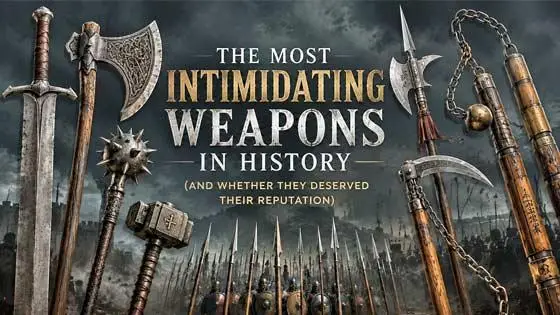
Some weapons were designed to kill. Others seemed designed to terrify. Long before the first strike was thrown, certain weapons could change the way people thought, moved, and fought simply because of how frightening they looked. A wall of spear points, a massive two-handed sword, a spiked war hammer, or a chain weapon spinning through the air could create fear long before any actual damage was done.
That fear was not always irrational. Throughout history, armies, warriors, and even entire civilizations developed weapons that earned fearsome reputations for very good reasons. Some were brutally effective in combat. Others became legendary because of myths, stories, or the psychological impact they had on opponents. In some cases, the reputation grew larger than the weapon itself.
What makes this topic especially interesting is that intimidation and effectiveness are not always the same thing. Some terrifying-looking weapons were surprisingly practical and deadly. Others looked like something from a nightmare but were less useful than their reputation suggests. The weapons people feared most were not always the weapons that actually dominated battlefields.
In this guide, we are looking at some of the most intimidating weapons ever created, what made them so frightening, and whether they truly deserved the fear they inspired.
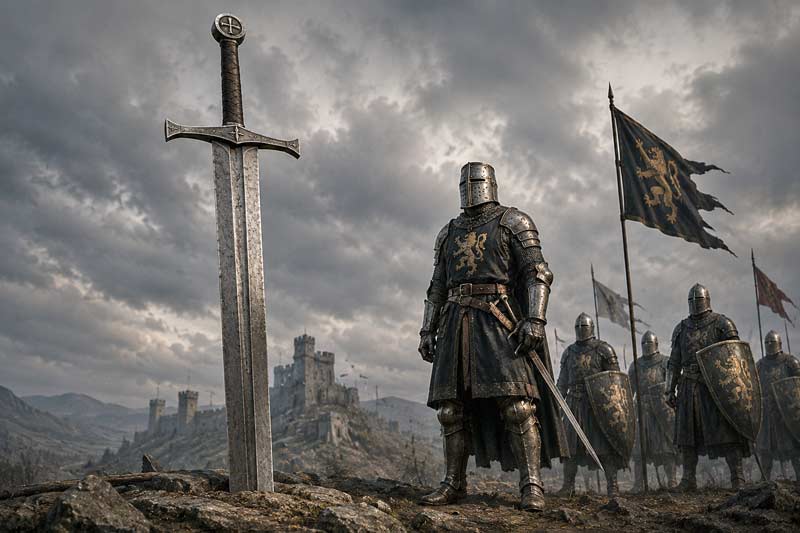
Few weapons in history created the same immediate reaction as the greatsword. Standing far taller than a typical sword and often requiring two hands to wield effectively, these massive blades looked less like weapons and more like something pulled from a legend. Even today, people who see a true greatsword for the first time are often surprised by its size.
Part of the weapon's reputation came from pure visual impact. On a battlefield filled with spears, shields, and ordinary swords, a warrior carrying an enormous blade naturally attracted attention. The weapon projected confidence, strength, and aggression before a fight even started. In many ways, the greatsword was one of history's most effective psychological weapons.
Unlike many exaggerated movie portrayals, however, real greatswords were not simply oversized swords designed to look impressive. Skilled users trained extensively to handle them, using leverage, momentum, and reach to create openings against multiple opponents. Some historical accounts suggest they were particularly useful for disrupting formations, defending narrow positions, or creating space in crowded battles.
That said, the greatsword's reputation sometimes exceeds its practical battlefield role. It was intimidating, but it was never the dominant weapon of warfare. Armies still relied far more heavily on spears, polearms, and other weapons that could be produced and deployed on a larger scale. As we explored in our article on weapons that often outperformed swords throughout history, battlefield effectiveness and battlefield fame are not always the same thing.
Even so, few weapons have ever matched the greatsword's ability to command attention. Whether carried by elite soldiers, bodyguards, or warriors seeking to make an impression, the weapon succeeded in one area almost better than anything else on this list: making opponents think twice before getting closer.
For modern enthusiasts, collections of traditional medieval swords and historically inspired sword designs offer a glimpse into why large blades continue to capture people's imagination centuries after their battlefield peak.
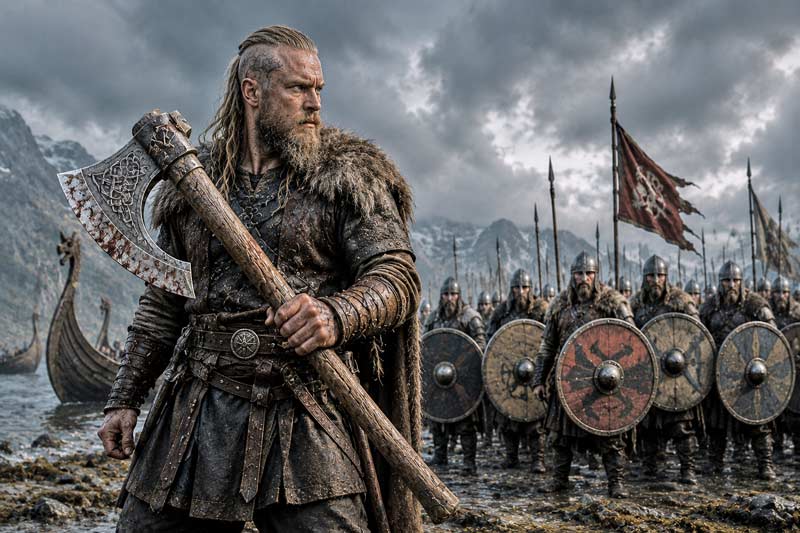
If the greatsword intimidated people through sheer size, the Viking axe did it through raw aggression. Few weapons in history project the same sense of violence at first glance. A broad cutting edge mounted on a long wooden handle sends a very clear message, and that message has remained powerful enough to survive a thousand years of storytelling.
Unlike some weapons whose fearsome reputations grew larger than reality, the Viking axe largely earned its place on this list. Well-made axes could deliver devastating cutting power, and their design allowed warriors to generate tremendous force without carrying the weight of a massive sword. They were effective, relatively affordable, and practical enough to be used by warriors across different social classes.
The psychological impact was significant. Facing an opponent armed with a weapon capable of delivering crushing chops to shields, armor, and limbs was unnerving enough. Watching an entire line of warriors carrying them was something else entirely. Even today, the silhouette of a Viking axe remains one of the most recognizable and intimidating weapon designs ever created.
Another reason axes inspired fear was unpredictability. A sword generally attacks with the blade. An axe can hook, pull, chop, and strike with different parts of the head. Larger two-handed axes extended that threat even further, creating reach and power that could overwhelm opponents who underestimated them.
Of course, popular culture sometimes exaggerates the image. Not every Viking charged into battle swinging a giant axe overhead. Many warriors carried spears more often than axes, and battlefield success still depended on training, tactics, and discipline. But when it comes to weapons that genuinely looked terrifying and remained highly effective, the axe is one of the strongest candidates on this entire list.
Modern collections of throwing hatchets and axes help explain why the design has remained popular for centuries. There is something timeless about a weapon built around simple, devastating efficiency.
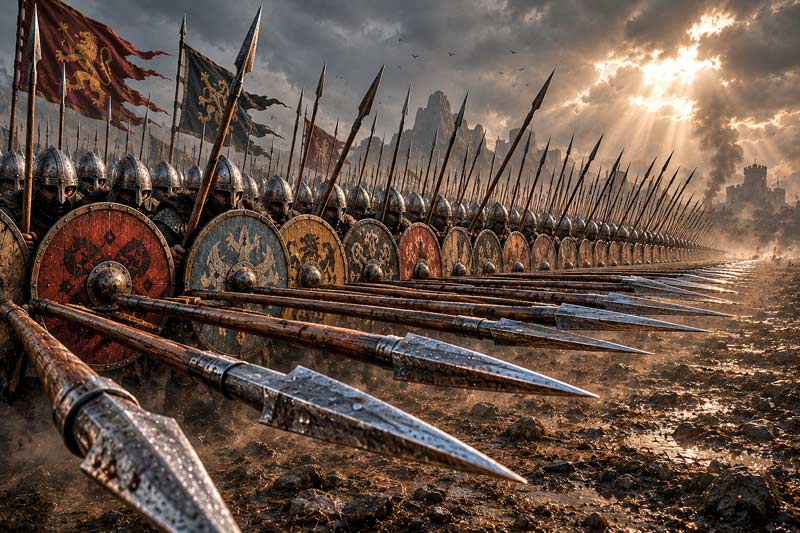
Some weapons intimidated people because of their size. Others did it through brutal design. The spear wall was terrifying for a different reason: it transformed dozens or even hundreds of ordinary soldiers into a single deadly obstacle.
Imagine advancing toward a line of warriors and seeing not one weapon pointed at you, but an entire forest of spear tips. Every step forward meant entering a zone where multiple opponents could strike before you ever reached them. Unlike a duel against a single fighter, there was no obvious opening and no easy way to isolate one target. The formation itself became the weapon.
History repeatedly shows how effective this approach was. Greek phalanxes, Viking shield walls, medieval infantry formations, and countless other armies relied on long weapons working together rather than individual heroics. The psychological impact was enormous. Many battles were influenced as much by discipline and cohesion as by actual casualties.
What made spear walls especially frightening was their ability to stop things people assumed were unstoppable. Charging cavalry, elite warriors, and heavily armored opponents often found themselves facing a problem that courage alone could not solve. Reaching the enemy meant surviving a gauntlet of spear points first.
The irony is that spears rarely receive the same attention as swords in popular culture. Yet for much of military history, they were among the most important weapons ever created. We explored this idea in our article on why certain weapons often outperformed swords on the battlefield, where reach and formation fighting repeatedly proved decisive.
Even today, the image of a spear wall remains intimidating because it represents something larger than a weapon. It represents coordination, discipline, and the realization that one person is no longer fighting another person. They are fighting an entire formation.
For a broader look at how weapons evolved across different cultures, our guide to history's most famous combat weapons highlights just how often long-reach weapons shaped the outcome of battles.
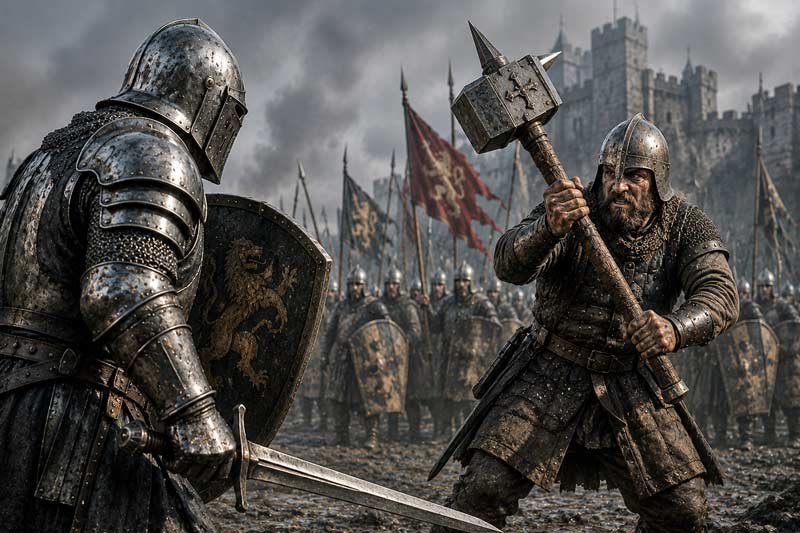
Few weapons looked more intimidating than the war hammer, and unlike some weapons on this list, its terrifying appearance was not just for show. The war hammer existed for one reason: to deal with opponents who had become too well protected for conventional weapons to handle efficiently.
As armor improved throughout the medieval period, swords faced a growing problem. A sharp blade is incredibly effective against unarmored targets, but heavy armor can dramatically reduce the effectiveness of cutting attacks. The war hammer approached the problem differently. Instead of trying to slice through armor, it focused on delivering concentrated force to crush, dent, fracture, or exploit weak points.
The result was a weapon that inspired genuine fear among armored warriors. A knight facing a sword might trust his armor to absorb or deflect the blow. Facing a war hammer was another matter entirely. Even if the armor prevented penetration, the force of the impact could still cause serious injury. In some cases, simply surviving the strike did not mean escaping unharmed.
The hammer's appearance contributed to its reputation as well. Many featured heavy striking heads, spikes, or beaks designed to focus tremendous energy into a small area. Unlike elegant swords, war hammers looked brutally practical. They seemed purpose-built for destruction, and in many ways, they were.
What makes the weapon especially interesting is that it represents a recurring pattern throughout military history: whenever defenses improve, weapons evolve to overcome them. The war hammer was not designed to look impressive. It was designed to solve a problem. That practical focus made it one of the most intimidating weapons ever carried onto a battlefield.
Ironically, the weapon's fearsome reputation is probably one of the rare cases where reality and appearance matched remarkably well. If an armored knight had the choice between facing a sword or a skilled opponent carrying a war hammer, many would have preferred the sword.
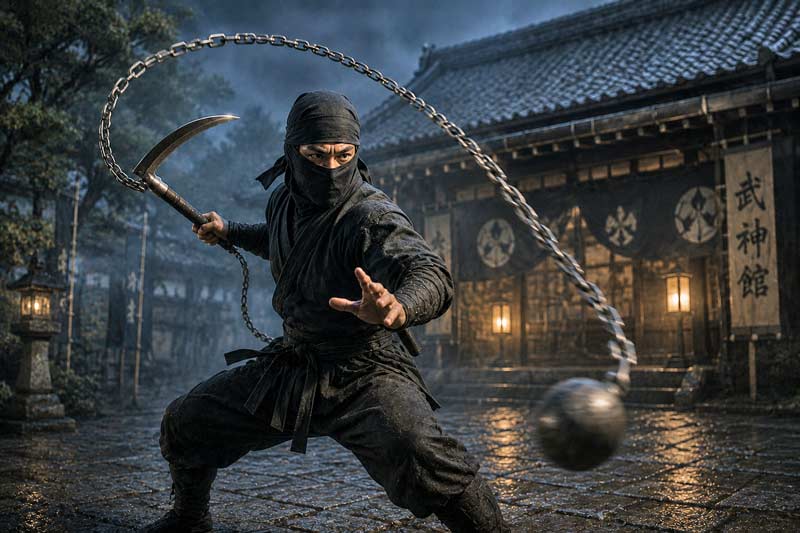
Few weapons on this list create the same immediate reaction as the kusarigama. Even people with little knowledge of martial arts tend to look at it and think the same thing: "How would anyone fight against that?" Combining a sickle with a weighted chain, the weapon looks less like a practical combat tool and more like something designed to appear in a nightmare.
Part of what made the kusarigama so intimidating was unpredictability. Most weapons attack from fairly obvious directions. A sword swings along a blade path. A spear thrusts forward. The kusarigama could strike from multiple distances and angles, forcing opponents to track both the blade and the spinning weight at the same time.
The chain was often the real source of fear. A skilled user could swing the weighted end to distract, entangle, or disrupt an opponent before closing in with the sickle. Even if the weapon never made contact, the constant movement created uncertainty. And uncertainty has always been one of the most powerful psychological weapons in combat.
That said, the kusarigama's reputation sometimes grows larger than reality. It required significant training to use effectively and could be difficult to manage in crowded battlefields. Like many highly specialized weapons, it was not necessarily the most practical option in every situation. But intimidation was never its problem.
Weapons like this help explain why so many people remain fascinated by unusual martial arts designs. Looking at a traditional kusarigama and chain weapon, it is easy to understand why opponents might hesitate before engaging someone carrying one.
The weapon also fits perfectly into a larger pattern we explored in our breakdown of ninja weapon myths and realities. Some weapons became legendary because of how effective they were. Others became legendary because they seemed to break the normal rules of combat. The kusarigama managed to do both.
If intimidation were based on appearance alone, Chinese hook swords might rank near the top of this entire list. Almost every part of the weapon seems designed to make people uncomfortable. The blades curve into hooks, the handguards form additional crescent-shaped blades, and even the pommels can be used as striking surfaces. At first glance, they look less like weapons and more like a collection of sharp edges somehow fused into a single design.
That unusual appearance is exactly why hook swords have fascinated martial artists for generations. Unlike conventional swords, they were capable of trapping, hooking, redirecting, and controlling an opponent's weapon in ways that seem almost impossible until you see them demonstrated. Skilled practitioners could even connect two hook swords together to extend their reach, creating attack angles most opponents would never expect.
The intimidation factor came from uncertainty. Most people understand what a sword does. The purpose of a spear is obvious. Hook swords create questions. Which edge is the main blade? What happens if the hooks catch a weapon? Why are there blades protecting the hands? Opponents facing unfamiliar weapons often become hesitant, and hesitation can be a serious disadvantage.
Of course, their fearsome appearance sometimes leads people to overestimate their battlefield importance. Hook swords were highly specialized weapons that required significant training to master. They were never as common as spears, polearms, or standard swords. But rarity does not diminish their ability to command attention.
Today, they remain some of the most visually striking examples of traditional Chinese weapon design. Looking at a pair of Chinese hook swords, it is easy to understand why they continue to appear in martial arts demonstrations, movies, and weapon collections around the world.
Many of the most intimidating weapons in history shared a common trait: they looked completely different from anything an opponent expected. Hook swords fit that description perfectly. They may not have dominated battlefields, but they certainly dominated first impressions.
For those interested in other unusual designs, collections of traditional Kung Fu weapons showcase just how creative weapon development became throughout Chinese martial arts history.
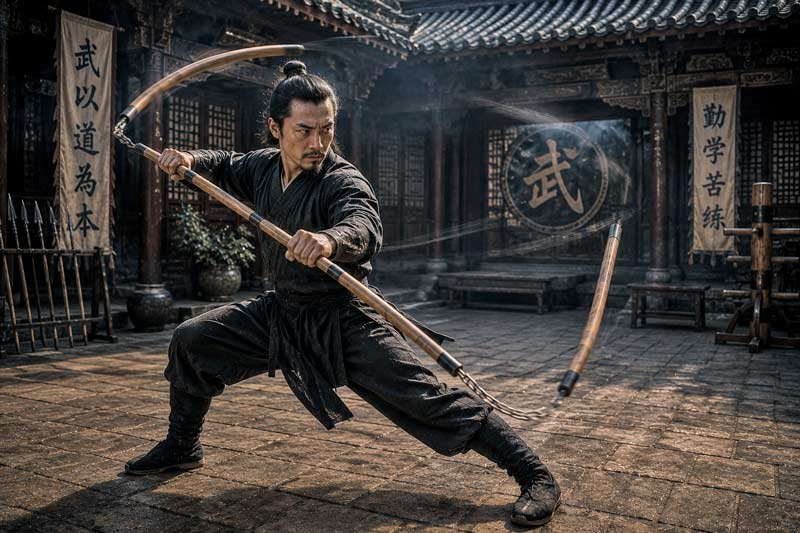
Some intimidating weapons inspire fear because they are large. Others do it because they look brutal. The three-section staff earned its reputation for a different reason entirely: nobody was quite sure where the next strike was coming from.
At first glance, the weapon appears confusing. Consisting of three wooden staffs connected by chains or ropes, it can function like a long staff one moment and a flexible weapon the next. To an opponent unfamiliar with its mechanics, that unpredictability can be deeply unsettling. A weapon that behaves differently from what you expect forces you to hesitate, and hesitation is often dangerous.
The intimidation factor becomes even clearer when the weapon is in motion. Sections can swing, wrap, redirect, and accelerate from unexpected angles. Unlike a sword or spear, which generally attack along obvious lines, the three-section staff can create attacks that seem to appear from nowhere. Even experienced martial artists often develop a healthy respect for the weapon after seeing it used properly.
Of course, there is a reason it never became a common battlefield weapon. Mastering a three-section staff requires enormous amounts of training. Beginners quickly discover that the weapon can be just as dangerous to its user as to an opponent. The complexity that makes it intimidating is the same complexity that makes it difficult to control.
Yet that difficulty is part of the weapon's mystique. Watching a skilled practitioner use one effectively feels almost unreal. The weapon appears to bend the normal rules that govern staffs, spears, and swords, creating a style that seems chaotic while remaining highly controlled.
For anyone interested in exploring one of martial arts history's most unusual designs, the three-section staff remains one of the most visually impressive weapons ever developed. It also helps explain why flexible weapons have fascinated practitioners for centuries.
We took a deeper look at the mechanics behind the weapon in our article explaining how the three-section staff actually works. Once you understand what it is capable of, its intimidating reputation makes perfect sense.
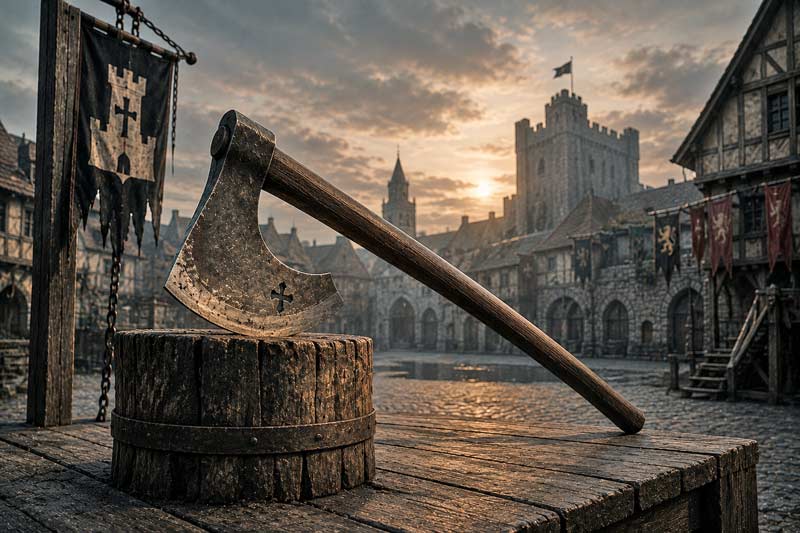
Most weapons on this list earned their intimidating reputations through combat. The executioner's axe was different. Its purpose was psychological from the very beginning. It was not primarily a battlefield weapon. It was a symbol of authority, punishment, and consequences.
Throughout history, public executions served as both legal proceedings and public spectacles. Crowds gathered to witness them, and the executioner's axe became one of the most recognizable symbols of state power. Unlike weapons carried into battle, its reputation was built on certainty. Everyone knew exactly what it was for.
That certainty created a unique kind of fear. A spear might miss. A sword fight might be survived. The executioner's axe represented a predetermined outcome. Once it appeared, the story was usually already over. That psychological weight helped elevate the weapon far beyond its practical design.
Visually, the weapon contributed to its own legend. Large axe heads, broad cutting edges, and imposing proportions made it immediately recognizable. Artists, writers, and storytellers reinforced that image for centuries, turning the executioner's axe into one of history's most enduring symbols of fear and judgment.
Ironically, despite its fearsome reputation, the executioner's axe was often a specialized tool rather than a combat weapon. Many battlefield axes were more versatile and arguably more dangerous in actual fighting. Yet few weapons have ever achieved the same cultural impact.
The weapon's legacy also explains why axes remain among the most intimidating designs ever created. Whether used in battle or ceremony, the silhouette alone tends to trigger a strong emotional reaction. Modern collections of axes and hatchets still capture some of that timeless appeal, even when used for sport, training, or collection purposes.
In terms of raw combat effectiveness, many weapons on this list were more dangerous. In terms of psychological impact, however, the executioner's axe belongs near the very top. Fear was not simply a side effect of the weapon. Fear was the entire point.
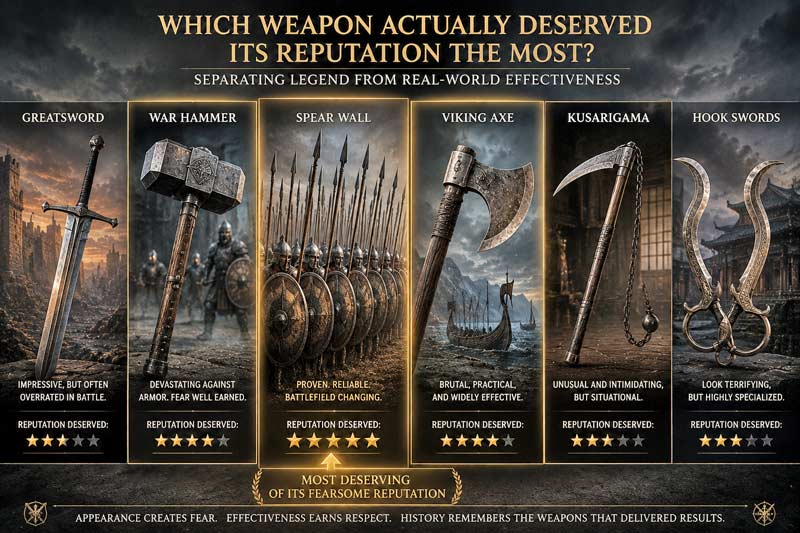
By this point, it is clear that many intimidating weapons earned at least part of their reputation through appearance alone. A giant sword, a bizarre chain weapon, or a blade covered in hooks naturally captures attention. But if we strip away the legends and focus purely on whether the fear was justified, a few weapons begin to separate themselves from the rest.
The greatsword was impressive, but its fame often exceeded its battlefield importance. Hook swords looked terrifying, yet they remained highly specialized weapons. The executioner's axe inspired enormous fear, though much of that fear came from symbolism rather than combat performance. Even the kusarigama's reputation is amplified by its unusual appearance and association with martial arts folklore.
The strongest candidates are arguably the weapons that combined intimidation with proven battlefield effectiveness. The war hammer genuinely threatened heavily armored opponents. The Viking axe delivered devastating power while remaining practical and widely used. Most of all, the spear wall repeatedly changed the outcome of battles across centuries of military history. Unlike some legendary weapons, these did not merely look frightening. They consistently produced results.
There is a reason so many armies trusted long weapons and disciplined formations. Fear is useful, but effectiveness is what keeps a weapon in service generation after generation. Throughout history, the most successful weapons were usually the ones that solved real problems rather than simply creating dramatic stories.
That conclusion may sound less exciting than crowning the strangest or most intimidating design. But history rarely rewards appearances alone. Again and again, the weapons that truly deserved their reputations were the ones warriors relied upon when their lives depended on the outcome.
Looking across many of history's most famous Asian weapons and other legendary designs, the same pattern appears repeatedly: the weapons people remembered were not always the weapons they feared most, and the weapons they feared most were not always the ones that won the most battles.
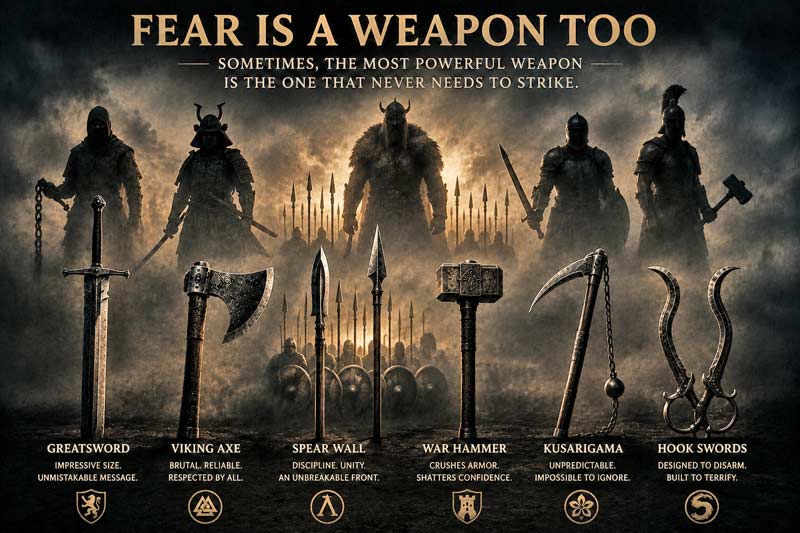
One of the most interesting lessons from history is that weapons do not need to be used to be effective. Sometimes, simply seeing a weapon was enough to influence decisions, lower morale, or convince an opponent to think twice about fighting in the first place.
Military leaders have understood this for thousands of years. A towering warrior carrying a greatsword, a line of soldiers standing behind a spear wall, or a fighter spinning a chain weapon all create uncertainty. And uncertainty is dangerous. People perform differently when they are afraid, especially when facing something they do not fully understand.
This is one reason intimidating weapons appear throughout so many cultures. The goal was not always to create the most efficient killing tool possible. Sometimes the goal was to project strength, confidence, and authority. A weapon that made enemies hesitate could create advantages before the first blow was ever thrown.
That psychological effect still exists today. Many of history's most intimidating weapons remain popular not because people expect to use them in battle, but because they symbolize power, skill, and martial tradition. Their reputations survived because they left lasting impressions on the people who saw them.
In fact, some of the most memorable weapons ever created became famous largely because of the stories surrounding them. Looking back at history's most famous Asian weapons, it becomes clear that reputation often spreads far beyond the battlefield itself.
Whether a weapon truly deserved its fearsome reputation or not, the impact was often real. Fear influences judgment. Fear changes behavior. And throughout history, some weapons became legendary because they were capable of weaponizing fear itself.
Ask most people to name a terrifying historical weapon and they will usually mention something dramatic: a giant sword, a Viking axe, or perhaps a weapon from a movie. But if you could travel back in time and ask actual soldiers what they feared most, the answers might be very different.
Many warriors feared formations more than individual weapons. A disciplined spear wall, a cavalry charge timed perfectly, or a rain of arrows from a distant hill could be far more dangerous than a duel against a famous weapon. The things that inspired the most fear were often the things that removed control from the situation.
This helps explain why some of history's most influential weapons are not always the most famous. The weapons that shaped battlefields were frequently practical, efficient, and designed to work as part of a larger system. Individual heroics made for great stories, but organized tactics won wars.
That does not mean the legendary weapons on this list were overrated. Most earned their reputations for a reason. The greatsword projected power. The war hammer threatened armored opponents. The kusarigama created uncertainty. The three-section staff seemed almost impossible to predict. Each weapon carried a psychological impact that extended beyond its physical capabilities.
Yet the deeper lesson is that fear itself has always been a battlefield resource. The most successful commanders understood that intimidating an opponent could be almost as valuable as defeating them. Weapons, formations, and tactics all contributed to that goal in different ways.
When you examine many of history's most famous combat weapons, a pattern emerges. The weapons that survive in popular memory are often the ones that combined effectiveness, symbolism, and fear into a single unforgettable package.
Some deserved every bit of their reputation. Others became legends because people believed they deserved it. Either way, centuries later, we are still talking about them.
Looking back at history's most intimidating weapons, one thing becomes clear: fear and effectiveness are related, but they are not the same thing. Some weapons earned terrifying reputations because they repeatedly proved themselves in battle. Others became legendary because they looked frightening, appeared unusual, or captured people's imagination long after their practical use had faded.
The weapons that truly stood out were the ones that combined both qualities. A Viking axe was intimidating because it looked dangerous and was dangerous. A war hammer earned fear through its ability to threaten heavily armored opponents. A spear wall terrified enemies because it transformed individual soldiers into a nearly impenetrable obstacle. In each case, the reputation was backed by real-world results.
At the same time, history reminds us that appearances can be deceiving. Some of the most famous weapons ever created were not necessarily the most effective, while some of the most effective weapons were never celebrated in stories, movies, or legends. Fear often follows perception rather than reality.
That is part of what makes martial arts and weapons history so fascinating. Every culture developed tools that reflected its unique challenges, tactics, and beliefs. Some became symbols of power. Some became symbols of fear. A select few managed to become both.
Whether it was a giant sword, a spinning chain weapon, a wall of spear points, or a simple axe, the most intimidating weapons in history all shared one important trait: they made people think differently before the fight even began.
And in many cases, that was exactly the point.
There is no universally accepted answer, but a strong case can be made for the spear wall rather than any individual weapon. Throughout history, countless soldiers faced swords, axes, and hammers. Far fewer willingly charged into a disciplined formation of hundreds of spear points.
What made the spear wall so frightening was not just the weapon itself. It was the realization that you were facing an organized system rather than a single opponent. Even elite warriors often struggled against formations that maintained discipline and reach.
If we are judging purely by appearance, however, weapons like the greatsword, war hammer, and hook swords are usually among the most intimidating designs ever created. They project danger in a way that few weapons can match.
Rarely. Fear by itself almost never wins a battle. However, fear can absolutely influence the outcome of one. Throughout history, armies have routed, surrendered, broken formation, or retreated because they believed they were facing an overwhelming threat.
That is why intimidating weapons mattered. A giant greatsword, a charging line of axe-wielding warriors, or an unfamiliar weapon like a kusarigama could create hesitation and uncertainty. If that hesitation spread through a formation, it could become a serious tactical problem.
Military leaders have long understood that perception matters. The goal is not necessarily to make enemies run away at the sight of a weapon. The goal is to make them slower, less confident, and more likely to make mistakes.
The most successful weapons combined psychological impact with genuine effectiveness. Fear worked best when opponents knew there was a very good reason to be afraid.
That depends on the situation, but many historians and martial artists would argue that long-reach weapons deserve serious consideration. A spear, polearm, or staff allows an opponent to attack while staying farther away, which creates immediate problems for anyone carrying a shorter weapon.
From a purely psychological perspective, however, unusual weapons often generate the strongest reactions. Weapons like the kusarigama, three-section staff, or hook swords can be intimidating because most people have little idea how they work. Unfamiliarity creates uncertainty, and uncertainty tends to amplify fear.
Interestingly, some of the weapons that look the most terrifying are not necessarily the ones experienced fighters fear most. Many seasoned warriors throughout history worried more about practical weapons with proven battlefield records than exotic weapons that simply looked dangerous.
In other words, the scariest weapon to face is often not the one that looks the deadliest. It is the one that gives you the fewest good options for defending yourself.
What makes this topic especially interesting is that intimidation and effectiveness are not always the same thing. Some terrifying-looking weapons were surprisingly practical and deadly. Others looked like something from a nightmare but were less useful than their reputation suggests. The weapons people feared most were not always the weapons that actually dominated battlefields.
In this guide, we are looking at some of the most intimidating weapons ever created, what made them so frightening, and whether they truly deserved the fear they inspired.
The Greatsword: Intimidating Beyond Reason
Few weapons in history created the same immediate reaction as the greatsword. Standing far taller than a typical sword and often requiring two hands to wield effectively, these massive blades looked less like weapons and more like something pulled from a legend. Even today, people who see a true greatsword for the first time are often surprised by its size.
Part of the weapon's reputation came from pure visual impact. On a battlefield filled with spears, shields, and ordinary swords, a warrior carrying an enormous blade naturally attracted attention. The weapon projected confidence, strength, and aggression before a fight even started. In many ways, the greatsword was one of history's most effective psychological weapons.
Unlike many exaggerated movie portrayals, however, real greatswords were not simply oversized swords designed to look impressive. Skilled users trained extensively to handle them, using leverage, momentum, and reach to create openings against multiple opponents. Some historical accounts suggest they were particularly useful for disrupting formations, defending narrow positions, or creating space in crowded battles.
That said, the greatsword's reputation sometimes exceeds its practical battlefield role. It was intimidating, but it was never the dominant weapon of warfare. Armies still relied far more heavily on spears, polearms, and other weapons that could be produced and deployed on a larger scale. As we explored in our article on weapons that often outperformed swords throughout history, battlefield effectiveness and battlefield fame are not always the same thing.
Even so, few weapons have ever matched the greatsword's ability to command attention. Whether carried by elite soldiers, bodyguards, or warriors seeking to make an impression, the weapon succeeded in one area almost better than anything else on this list: making opponents think twice before getting closer.
For modern enthusiasts, collections of traditional medieval swords and historically inspired sword designs offer a glimpse into why large blades continue to capture people's imagination centuries after their battlefield peak.
The Viking Axe: A Weapon That Looked as Brutal as It Was
If the greatsword intimidated people through sheer size, the Viking axe did it through raw aggression. Few weapons in history project the same sense of violence at first glance. A broad cutting edge mounted on a long wooden handle sends a very clear message, and that message has remained powerful enough to survive a thousand years of storytelling.
Unlike some weapons whose fearsome reputations grew larger than reality, the Viking axe largely earned its place on this list. Well-made axes could deliver devastating cutting power, and their design allowed warriors to generate tremendous force without carrying the weight of a massive sword. They were effective, relatively affordable, and practical enough to be used by warriors across different social classes.
The psychological impact was significant. Facing an opponent armed with a weapon capable of delivering crushing chops to shields, armor, and limbs was unnerving enough. Watching an entire line of warriors carrying them was something else entirely. Even today, the silhouette of a Viking axe remains one of the most recognizable and intimidating weapon designs ever created.
Another reason axes inspired fear was unpredictability. A sword generally attacks with the blade. An axe can hook, pull, chop, and strike with different parts of the head. Larger two-handed axes extended that threat even further, creating reach and power that could overwhelm opponents who underestimated them.
Of course, popular culture sometimes exaggerates the image. Not every Viking charged into battle swinging a giant axe overhead. Many warriors carried spears more often than axes, and battlefield success still depended on training, tactics, and discipline. But when it comes to weapons that genuinely looked terrifying and remained highly effective, the axe is one of the strongest candidates on this entire list.
Modern collections of throwing hatchets and axes help explain why the design has remained popular for centuries. There is something timeless about a weapon built around simple, devastating efficiency.
The Spear Wall: The Weapon That Turned Fear Into a Formation
Some weapons intimidated people because of their size. Others did it through brutal design. The spear wall was terrifying for a different reason: it transformed dozens or even hundreds of ordinary soldiers into a single deadly obstacle.
Imagine advancing toward a line of warriors and seeing not one weapon pointed at you, but an entire forest of spear tips. Every step forward meant entering a zone where multiple opponents could strike before you ever reached them. Unlike a duel against a single fighter, there was no obvious opening and no easy way to isolate one target. The formation itself became the weapon.
History repeatedly shows how effective this approach was. Greek phalanxes, Viking shield walls, medieval infantry formations, and countless other armies relied on long weapons working together rather than individual heroics. The psychological impact was enormous. Many battles were influenced as much by discipline and cohesion as by actual casualties.
What made spear walls especially frightening was their ability to stop things people assumed were unstoppable. Charging cavalry, elite warriors, and heavily armored opponents often found themselves facing a problem that courage alone could not solve. Reaching the enemy meant surviving a gauntlet of spear points first.
The irony is that spears rarely receive the same attention as swords in popular culture. Yet for much of military history, they were among the most important weapons ever created. We explored this idea in our article on why certain weapons often outperformed swords on the battlefield, where reach and formation fighting repeatedly proved decisive.
Even today, the image of a spear wall remains intimidating because it represents something larger than a weapon. It represents coordination, discipline, and the realization that one person is no longer fighting another person. They are fighting an entire formation.
For a broader look at how weapons evolved across different cultures, our guide to history's most famous combat weapons highlights just how often long-reach weapons shaped the outcome of battles.
The War Hammer: The Weapon Built to Ruin a Knight's Day
Few weapons looked more intimidating than the war hammer, and unlike some weapons on this list, its terrifying appearance was not just for show. The war hammer existed for one reason: to deal with opponents who had become too well protected for conventional weapons to handle efficiently.
As armor improved throughout the medieval period, swords faced a growing problem. A sharp blade is incredibly effective against unarmored targets, but heavy armor can dramatically reduce the effectiveness of cutting attacks. The war hammer approached the problem differently. Instead of trying to slice through armor, it focused on delivering concentrated force to crush, dent, fracture, or exploit weak points.
The result was a weapon that inspired genuine fear among armored warriors. A knight facing a sword might trust his armor to absorb or deflect the blow. Facing a war hammer was another matter entirely. Even if the armor prevented penetration, the force of the impact could still cause serious injury. In some cases, simply surviving the strike did not mean escaping unharmed.
The hammer's appearance contributed to its reputation as well. Many featured heavy striking heads, spikes, or beaks designed to focus tremendous energy into a small area. Unlike elegant swords, war hammers looked brutally practical. They seemed purpose-built for destruction, and in many ways, they were.
What makes the weapon especially interesting is that it represents a recurring pattern throughout military history: whenever defenses improve, weapons evolve to overcome them. The war hammer was not designed to look impressive. It was designed to solve a problem. That practical focus made it one of the most intimidating weapons ever carried onto a battlefield.
Ironically, the weapon's fearsome reputation is probably one of the rare cases where reality and appearance matched remarkably well. If an armored knight had the choice between facing a sword or a skilled opponent carrying a war hammer, many would have preferred the sword.
The Kusarigama: The Weapon That Looked Impossible to Defend Against
Few weapons on this list create the same immediate reaction as the kusarigama. Even people with little knowledge of martial arts tend to look at it and think the same thing: "How would anyone fight against that?" Combining a sickle with a weighted chain, the weapon looks less like a practical combat tool and more like something designed to appear in a nightmare.
Part of what made the kusarigama so intimidating was unpredictability. Most weapons attack from fairly obvious directions. A sword swings along a blade path. A spear thrusts forward. The kusarigama could strike from multiple distances and angles, forcing opponents to track both the blade and the spinning weight at the same time.
The chain was often the real source of fear. A skilled user could swing the weighted end to distract, entangle, or disrupt an opponent before closing in with the sickle. Even if the weapon never made contact, the constant movement created uncertainty. And uncertainty has always been one of the most powerful psychological weapons in combat.
That said, the kusarigama's reputation sometimes grows larger than reality. It required significant training to use effectively and could be difficult to manage in crowded battlefields. Like many highly specialized weapons, it was not necessarily the most practical option in every situation. But intimidation was never its problem.
Weapons like this help explain why so many people remain fascinated by unusual martial arts designs. Looking at a traditional kusarigama and chain weapon, it is easy to understand why opponents might hesitate before engaging someone carrying one.
The weapon also fits perfectly into a larger pattern we explored in our breakdown of ninja weapon myths and realities. Some weapons became legendary because of how effective they were. Others became legendary because they seemed to break the normal rules of combat. The kusarigama managed to do both.
Hook Swords: The Weapon That Looked Like It Was Designed by a Villain
If intimidation were based on appearance alone, Chinese hook swords might rank near the top of this entire list. Almost every part of the weapon seems designed to make people uncomfortable. The blades curve into hooks, the handguards form additional crescent-shaped blades, and even the pommels can be used as striking surfaces. At first glance, they look less like weapons and more like a collection of sharp edges somehow fused into a single design.
That unusual appearance is exactly why hook swords have fascinated martial artists for generations. Unlike conventional swords, they were capable of trapping, hooking, redirecting, and controlling an opponent's weapon in ways that seem almost impossible until you see them demonstrated. Skilled practitioners could even connect two hook swords together to extend their reach, creating attack angles most opponents would never expect.
The intimidation factor came from uncertainty. Most people understand what a sword does. The purpose of a spear is obvious. Hook swords create questions. Which edge is the main blade? What happens if the hooks catch a weapon? Why are there blades protecting the hands? Opponents facing unfamiliar weapons often become hesitant, and hesitation can be a serious disadvantage.
Of course, their fearsome appearance sometimes leads people to overestimate their battlefield importance. Hook swords were highly specialized weapons that required significant training to master. They were never as common as spears, polearms, or standard swords. But rarity does not diminish their ability to command attention.
Today, they remain some of the most visually striking examples of traditional Chinese weapon design. Looking at a pair of Chinese hook swords, it is easy to understand why they continue to appear in martial arts demonstrations, movies, and weapon collections around the world.
Many of the most intimidating weapons in history shared a common trait: they looked completely different from anything an opponent expected. Hook swords fit that description perfectly. They may not have dominated battlefields, but they certainly dominated first impressions.
For those interested in other unusual designs, collections of traditional Kung Fu weapons showcase just how creative weapon development became throughout Chinese martial arts history.
The Three-Section Staff: Chaos You Could Not Predict
Some intimidating weapons inspire fear because they are large. Others do it because they look brutal. The three-section staff earned its reputation for a different reason entirely: nobody was quite sure where the next strike was coming from.
At first glance, the weapon appears confusing. Consisting of three wooden staffs connected by chains or ropes, it can function like a long staff one moment and a flexible weapon the next. To an opponent unfamiliar with its mechanics, that unpredictability can be deeply unsettling. A weapon that behaves differently from what you expect forces you to hesitate, and hesitation is often dangerous.
The intimidation factor becomes even clearer when the weapon is in motion. Sections can swing, wrap, redirect, and accelerate from unexpected angles. Unlike a sword or spear, which generally attack along obvious lines, the three-section staff can create attacks that seem to appear from nowhere. Even experienced martial artists often develop a healthy respect for the weapon after seeing it used properly.
Of course, there is a reason it never became a common battlefield weapon. Mastering a three-section staff requires enormous amounts of training. Beginners quickly discover that the weapon can be just as dangerous to its user as to an opponent. The complexity that makes it intimidating is the same complexity that makes it difficult to control.
Yet that difficulty is part of the weapon's mystique. Watching a skilled practitioner use one effectively feels almost unreal. The weapon appears to bend the normal rules that govern staffs, spears, and swords, creating a style that seems chaotic while remaining highly controlled.
For anyone interested in exploring one of martial arts history's most unusual designs, the three-section staff remains one of the most visually impressive weapons ever developed. It also helps explain why flexible weapons have fascinated practitioners for centuries.
We took a deeper look at the mechanics behind the weapon in our article explaining how the three-section staff actually works. Once you understand what it is capable of, its intimidating reputation makes perfect sense.
The Executioner's Axe: A Weapon Designed to Inspire Fear
Most weapons on this list earned their intimidating reputations through combat. The executioner's axe was different. Its purpose was psychological from the very beginning. It was not primarily a battlefield weapon. It was a symbol of authority, punishment, and consequences.
Throughout history, public executions served as both legal proceedings and public spectacles. Crowds gathered to witness them, and the executioner's axe became one of the most recognizable symbols of state power. Unlike weapons carried into battle, its reputation was built on certainty. Everyone knew exactly what it was for.
That certainty created a unique kind of fear. A spear might miss. A sword fight might be survived. The executioner's axe represented a predetermined outcome. Once it appeared, the story was usually already over. That psychological weight helped elevate the weapon far beyond its practical design.
Visually, the weapon contributed to its own legend. Large axe heads, broad cutting edges, and imposing proportions made it immediately recognizable. Artists, writers, and storytellers reinforced that image for centuries, turning the executioner's axe into one of history's most enduring symbols of fear and judgment.
Ironically, despite its fearsome reputation, the executioner's axe was often a specialized tool rather than a combat weapon. Many battlefield axes were more versatile and arguably more dangerous in actual fighting. Yet few weapons have ever achieved the same cultural impact.
The weapon's legacy also explains why axes remain among the most intimidating designs ever created. Whether used in battle or ceremony, the silhouette alone tends to trigger a strong emotional reaction. Modern collections of axes and hatchets still capture some of that timeless appeal, even when used for sport, training, or collection purposes.
In terms of raw combat effectiveness, many weapons on this list were more dangerous. In terms of psychological impact, however, the executioner's axe belongs near the very top. Fear was not simply a side effect of the weapon. Fear was the entire point.
Which Weapon Actually Deserved Its Reputation the Most?
By this point, it is clear that many intimidating weapons earned at least part of their reputation through appearance alone. A giant sword, a bizarre chain weapon, or a blade covered in hooks naturally captures attention. But if we strip away the legends and focus purely on whether the fear was justified, a few weapons begin to separate themselves from the rest.
The greatsword was impressive, but its fame often exceeded its battlefield importance. Hook swords looked terrifying, yet they remained highly specialized weapons. The executioner's axe inspired enormous fear, though much of that fear came from symbolism rather than combat performance. Even the kusarigama's reputation is amplified by its unusual appearance and association with martial arts folklore.
The strongest candidates are arguably the weapons that combined intimidation with proven battlefield effectiveness. The war hammer genuinely threatened heavily armored opponents. The Viking axe delivered devastating power while remaining practical and widely used. Most of all, the spear wall repeatedly changed the outcome of battles across centuries of military history. Unlike some legendary weapons, these did not merely look frightening. They consistently produced results.
There is a reason so many armies trusted long weapons and disciplined formations. Fear is useful, but effectiveness is what keeps a weapon in service generation after generation. Throughout history, the most successful weapons were usually the ones that solved real problems rather than simply creating dramatic stories.
That conclusion may sound less exciting than crowning the strangest or most intimidating design. But history rarely rewards appearances alone. Again and again, the weapons that truly deserved their reputations were the ones warriors relied upon when their lives depended on the outcome.
Looking across many of history's most famous Asian weapons and other legendary designs, the same pattern appears repeatedly: the weapons people remembered were not always the weapons they feared most, and the weapons they feared most were not always the ones that won the most battles.
Fear Is a Weapon Too
One of the most interesting lessons from history is that weapons do not need to be used to be effective. Sometimes, simply seeing a weapon was enough to influence decisions, lower morale, or convince an opponent to think twice about fighting in the first place.
Military leaders have understood this for thousands of years. A towering warrior carrying a greatsword, a line of soldiers standing behind a spear wall, or a fighter spinning a chain weapon all create uncertainty. And uncertainty is dangerous. People perform differently when they are afraid, especially when facing something they do not fully understand.
This is one reason intimidating weapons appear throughout so many cultures. The goal was not always to create the most efficient killing tool possible. Sometimes the goal was to project strength, confidence, and authority. A weapon that made enemies hesitate could create advantages before the first blow was ever thrown.
That psychological effect still exists today. Many of history's most intimidating weapons remain popular not because people expect to use them in battle, but because they symbolize power, skill, and martial tradition. Their reputations survived because they left lasting impressions on the people who saw them.
In fact, some of the most memorable weapons ever created became famous largely because of the stories surrounding them. Looking back at history's most famous Asian weapons, it becomes clear that reputation often spreads far beyond the battlefield itself.
Whether a weapon truly deserved its fearsome reputation or not, the impact was often real. Fear influences judgment. Fear changes behavior. And throughout history, some weapons became legendary because they were capable of weaponizing fear itself.
The Weapons Soldiers Feared Most Were Not Always the Ones We Remember
Ask most people to name a terrifying historical weapon and they will usually mention something dramatic: a giant sword, a Viking axe, or perhaps a weapon from a movie. But if you could travel back in time and ask actual soldiers what they feared most, the answers might be very different.
Many warriors feared formations more than individual weapons. A disciplined spear wall, a cavalry charge timed perfectly, or a rain of arrows from a distant hill could be far more dangerous than a duel against a famous weapon. The things that inspired the most fear were often the things that removed control from the situation.
This helps explain why some of history's most influential weapons are not always the most famous. The weapons that shaped battlefields were frequently practical, efficient, and designed to work as part of a larger system. Individual heroics made for great stories, but organized tactics won wars.
That does not mean the legendary weapons on this list were overrated. Most earned their reputations for a reason. The greatsword projected power. The war hammer threatened armored opponents. The kusarigama created uncertainty. The three-section staff seemed almost impossible to predict. Each weapon carried a psychological impact that extended beyond its physical capabilities.
Yet the deeper lesson is that fear itself has always been a battlefield resource. The most successful commanders understood that intimidating an opponent could be almost as valuable as defeating them. Weapons, formations, and tactics all contributed to that goal in different ways.
When you examine many of history's most famous combat weapons, a pattern emerges. The weapons that survive in popular memory are often the ones that combined effectiveness, symbolism, and fear into a single unforgettable package.
Some deserved every bit of their reputation. Others became legends because people believed they deserved it. Either way, centuries later, we are still talking about them.
Intimidation Only Matters If It Changes Behavior
Looking back at history's most intimidating weapons, one thing becomes clear: fear and effectiveness are related, but they are not the same thing. Some weapons earned terrifying reputations because they repeatedly proved themselves in battle. Others became legendary because they looked frightening, appeared unusual, or captured people's imagination long after their practical use had faded.
The weapons that truly stood out were the ones that combined both qualities. A Viking axe was intimidating because it looked dangerous and was dangerous. A war hammer earned fear through its ability to threaten heavily armored opponents. A spear wall terrified enemies because it transformed individual soldiers into a nearly impenetrable obstacle. In each case, the reputation was backed by real-world results.
At the same time, history reminds us that appearances can be deceiving. Some of the most famous weapons ever created were not necessarily the most effective, while some of the most effective weapons were never celebrated in stories, movies, or legends. Fear often follows perception rather than reality.
That is part of what makes martial arts and weapons history so fascinating. Every culture developed tools that reflected its unique challenges, tactics, and beliefs. Some became symbols of power. Some became symbols of fear. A select few managed to become both.
Whether it was a giant sword, a spinning chain weapon, a wall of spear points, or a simple axe, the most intimidating weapons in history all shared one important trait: they made people think differently before the fight even began.
And in many cases, that was exactly the point.
What Is the Most Intimidating Weapon Ever Invented?
There is no universally accepted answer, but a strong case can be made for the spear wall rather than any individual weapon. Throughout history, countless soldiers faced swords, axes, and hammers. Far fewer willingly charged into a disciplined formation of hundreds of spear points.
What made the spear wall so frightening was not just the weapon itself. It was the realization that you were facing an organized system rather than a single opponent. Even elite warriors often struggled against formations that maintained discipline and reach.
If we are judging purely by appearance, however, weapons like the greatsword, war hammer, and hook swords are usually among the most intimidating designs ever created. They project danger in a way that few weapons can match.
Did Any Weapons Win Battles Through Fear Alone?
Rarely. Fear by itself almost never wins a battle. However, fear can absolutely influence the outcome of one. Throughout history, armies have routed, surrendered, broken formation, or retreated because they believed they were facing an overwhelming threat.
That is why intimidating weapons mattered. A giant greatsword, a charging line of axe-wielding warriors, or an unfamiliar weapon like a kusarigama could create hesitation and uncertainty. If that hesitation spread through a formation, it could become a serious tactical problem.
Military leaders have long understood that perception matters. The goal is not necessarily to make enemies run away at the sight of a weapon. The goal is to make them slower, less confident, and more likely to make mistakes.
The most successful weapons combined psychological impact with genuine effectiveness. Fear worked best when opponents knew there was a very good reason to be afraid.
What Weapon Would Be the Scariest to Face One-on-One?
That depends on the situation, but many historians and martial artists would argue that long-reach weapons deserve serious consideration. A spear, polearm, or staff allows an opponent to attack while staying farther away, which creates immediate problems for anyone carrying a shorter weapon.
From a purely psychological perspective, however, unusual weapons often generate the strongest reactions. Weapons like the kusarigama, three-section staff, or hook swords can be intimidating because most people have little idea how they work. Unfamiliarity creates uncertainty, and uncertainty tends to amplify fear.
Interestingly, some of the weapons that look the most terrifying are not necessarily the ones experienced fighters fear most. Many seasoned warriors throughout history worried more about practical weapons with proven battlefield records than exotic weapons that simply looked dangerous.
In other words, the scariest weapon to face is often not the one that looks the deadliest. It is the one that gives you the fewest good options for defending yourself.
You May Also Be Interested In:
- The Weapons That Were Far More Effective Than Swords (And Why History Forgot)
- The Most Dangerous Chain Weapons in Martial Arts History
- The History of the Halberd
- A Brief History of Judo
- A Brief History of Kung Fu
- The Strange History of the Blowgun
- What Is a Kusarigama? History, Uses, and Training Basics
- What Is a Three Section Staff? History, Uses & How It Works
- The History of the Medieval Flail Weapon
- The Different Types of Spears Used in History (And What Made Each One Deadly)
Leave a Reply