



Why the Ka-Bar Became America's Most Famous Military Knife
June 30th, 2026
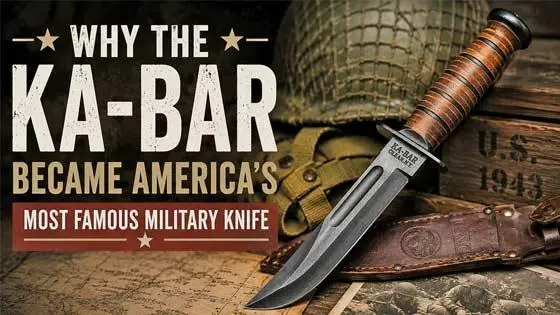
Few military knives have achieved the legendary status of the KA-BAR. More than just a piece of equipment, it became a symbol of toughness, ingenuity, and the resilience of the American servicemen who carried it through some of the most challenging battles of World War II. Decades after its introduction, the unmistakable clip-point blade is still recognized by soldiers, collectors, outdoorsmen, and history enthusiasts around the world. Yet its rise to fame wasn't the result of clever marketing or Hollywood. It was earned through battlefield performance, practical design, and countless stories passed down by the people who trusted it when everything else failed.
In this article, we'll explore how the KA-BAR earned its legendary reputation, uncover the surprising story behind its unusual name, and discover why this iconic knife continues to influence military and survival blades nearly a century after it first appeared.
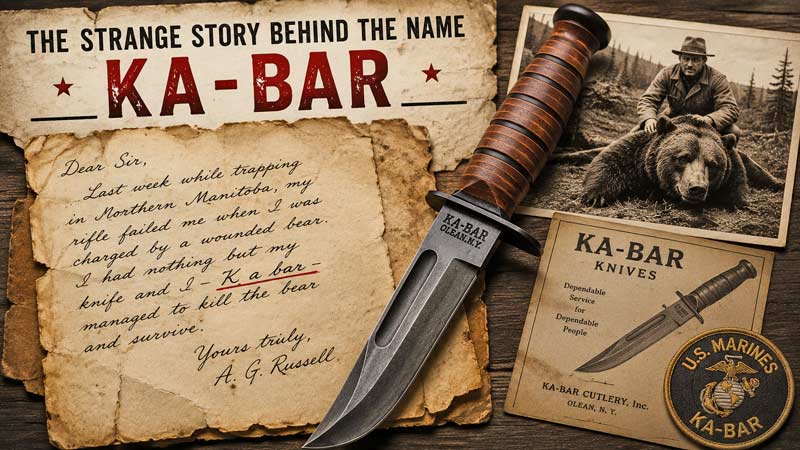
One of the most recognizable names in knife history almost never existed. Unlike many military products that received simple model numbers or official designations, the KA-BAR earned a name with a story behind it. According to company history, a trapper once wrote a letter explaining how he had survived an attack by a wounded bear after his rifle malfunctioned. The handwritten letter was badly damaged, but one phrase could still be made out: "K a bar," believed to be part of the words "kill a bear." The unusual phrase stuck, and the company eventually adopted KA-BAR as its brand name.
Whether every detail of the story is perfectly accurate has been debated for years, but there's no question that the name helped set the knife apart. It sounded rugged, memorable, and distinctly American. By the time World War II began, KA-BAR had become closely associated with dependable working knives, making it a natural choice when the U.S. military sought a stronger replacement for the aging Mark I trench knife.
The timing couldn't have been better. Thousands of Marines quickly came to rely on the knife for everything from cutting rope and opening ammunition crates to preparing meals and building shelters. Its reputation grew not because of advertising, but because soldiers repeatedly proved its value under the harshest possible conditions.
Today, the name KA-BAR is almost synonymous with military knives, yet few people realize it originated from a partially legible letter and a story that has become part of American knife folklore. Like many legendary weapons, its greatest strength wasn't just the steel itself, but the stories that followed it from one generation to the next.
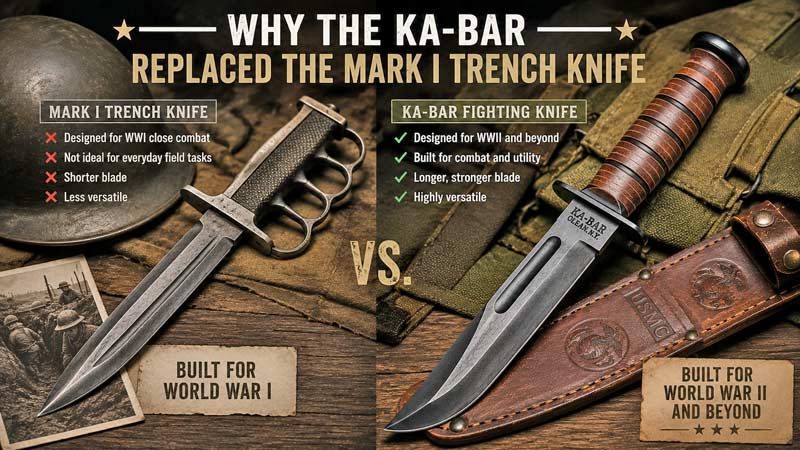
When the United States entered World War II, the military quickly discovered that many of its existing combat knives were no longer suited to the realities of modern warfare. The Mark I trench knife, while effective in close combat, had been designed with World War I in mind. It excelled as a fighting weapon but wasn't particularly useful for the countless everyday tasks soldiers faced in the field. Troops needed something far more versatile.
The answer was a stronger, more practical fixed-blade knife that could handle almost anything. In 1942, the U.S. Marine Corps adopted what would become known as the KA-BAR fighting knife. Its seven-inch clip-point blade was long enough for combat but equally capable of cutting rope, opening supply crates, preparing food, clearing brush, and building shelters. Instead of carrying separate tools, Marines suddenly had one dependable knife that could do nearly everything.
Much of the KA-BAR's success came from its balanced design. Drawing inspiration from classic frontier blades, particularly the iconic Bowie knife, it combined a strong clip-point blade, stacked leather handle, and sturdy crossguard into a package that felt equally at home on the battlefield or around camp. It wasn't simply replacing an older military knife. It was redefining what a military knife could be.
That shift had a lasting impact on knife design. Many of today's fixed blade knives still follow the same philosophy established by the KA-BAR: build one rugged tool that performs reliably in almost any situation. More than eighty years later, that approach remains just as practical as it was when Marines first carried the knife into battle.
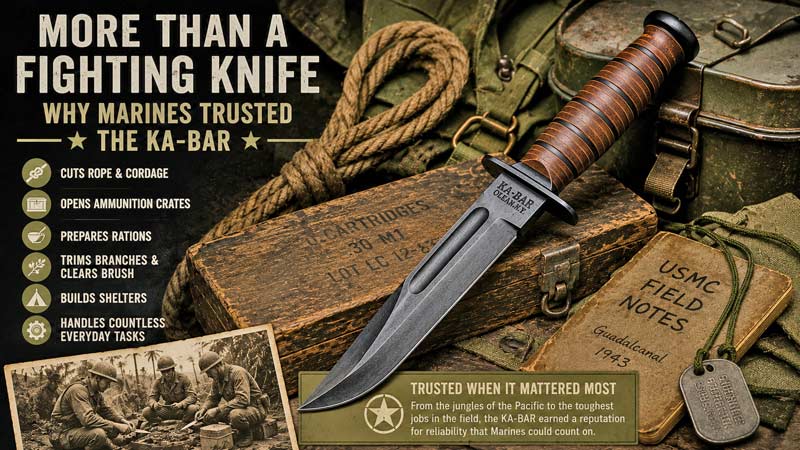
Although the KA-BAR earned its reputation as a combat knife, most Marines relied on it for far more than fighting. In the Pacific Theater, where dense jungles, tropical weather, and long supply lines created constant challenges, the knife became an indispensable all-purpose tool. It cut rope, opened ammunition crates, prepared rations, trimmed branches, built shelters, and handled countless daily jobs that never appeared in official battle reports.
That versatility helped separate the KA-BAR from many earlier military knives. Instead of carrying a blade designed for a single purpose, Marines had one dependable tool that could adapt to almost any situation. The knife was strong enough for demanding field work while remaining well-balanced and easy to control, making it valuable whether a soldier was clearing a campsite or facing an emergency.
Stories from World War II veterans repeatedly highlight this practical reliability. While rifles and other equipment occasionally failed under harsh conditions, the KA-BAR developed a reputation for simply getting the job done. It became one of those rare pieces of military gear that soldiers genuinely wanted to keep long after their service ended, a testament to the confidence it inspired in the field.
That lasting reputation explains why the KA-BAR remains one of the most recognizable military knives ever produced. Even many modern military survival knives still follow the same philosophy: create one rugged blade that excels as both a field tool and a dependable combat knife. The technology has evolved, but the idea behind the KA-BAR continues to influence military blade design more than eighty years later.
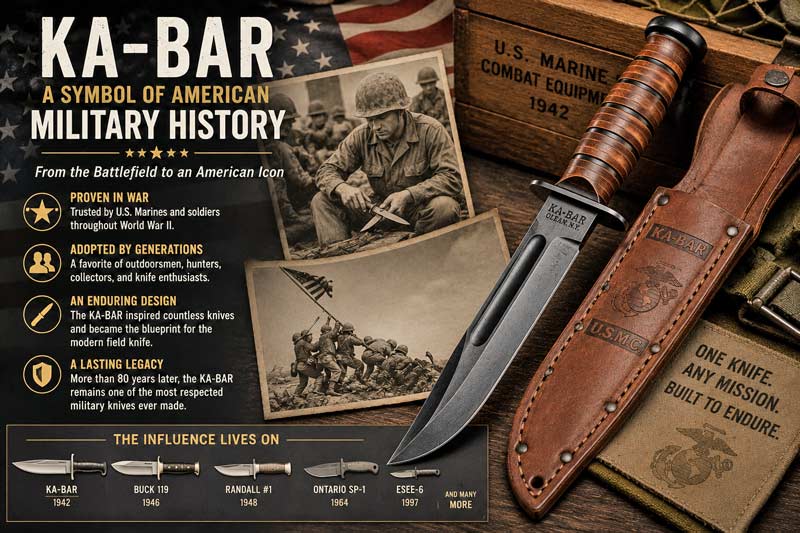
By the end of World War II, the KA-BAR had become much more than standard military equipment. It represented the resourcefulness and determination of the Marines and soldiers who carried it across the Pacific and into some of the war's most demanding campaigns. Long after the fighting ended, veterans continued to tell stories about the knife's reliability, helping transform it from a battlefield tool into an American icon.
Unlike many pieces of military equipment that disappeared once newer technology arrived, the KA-BAR never truly went out of style. Hunters, campers, outdoorsmen, collectors, and knife enthusiasts all embraced the design, appreciating the same balance of strength and versatility that made it successful during the war. Even people who know very little about military history can often recognize the distinctive stacked leather handle and clip-point blade at a glance.
Its influence extends far beyond a single manufacturer. Countless companies have produced knives inspired by the original design, borrowing its proportions, blade profile, and rugged simplicity. In many ways, the KA-BAR became the blueprint for the modern field knife, much like the Bowie knife shaped an earlier generation of American blades. If you're interested in other historic military designs that helped pave the way for today's combat knives, our article on forgotten combat knives that shaped modern warfare explores several fascinating examples that deserve far more recognition.
More than eighty years after its adoption, the KA-BAR continues to symbolize a timeless principle of good design: build one dependable tool, build it well, and let its performance speak for itself. That's why the knife remains one of the most respected military blades ever created, and why its story continues to be told generation after generation.
Military equipment is constantly evolving. New materials replace old ones, manufacturing techniques improve, and battlefield requirements change with every generation. Yet despite decades of innovation, the KA-BAR has remained remarkably relevant. That kind of longevity is rare, especially for a tool originally designed during World War II.
The reason is surprisingly simple: the KA-BAR was never built to excel at just one job. It was designed to solve real problems faced by soldiers in the field. A blade that could cut, chop, pry, dig, prepare food, and still serve as a dependable last line of defense proved far more valuable than a knife optimized for a single purpose. That philosophy continues to shape many of today's military and outdoor blades.
Its enduring popularity also reflects something deeper than good engineering. The KA-BAR represents an era when equipment earned its reputation through performance rather than advertising. Veterans trusted it because it consistently delivered under difficult conditions, and that reputation has been passed from one generation to the next. Few military tools have become symbols of both American history and practical design in quite the same way.
Whether you're interested in military history, knife design, or the stories behind iconic equipment, the KA-BAR remains one of the best examples of how a well-built tool can outlive the conflict it was created for. More than eight decades after it first entered service, it still stands as the benchmark against which countless military knives are measured.
The clip-point blade became popular because it offers an excellent balance of strength, control, and versatility. Its distinctive curved tip creates a finer point than a standard straight-back blade, making it easier to perform precise cutting tasks while still maintaining enough durability for demanding field use. That combination proved especially valuable for soldiers who needed one knife capable of handling a wide variety of jobs.
The KA-BAR helped cement the clip-point design as a military standard, but the concept dates back even further to the famous Bowie knife. Today, countless military, survival, and outdoor knives still use some variation of the clip-point because it remains one of the most practical blade shapes ever developed. More than a century after it first gained widespread recognition, its effectiveness has stood the test of time.
No. While the KA-BAR became the standard fighting and utility knife for the U.S. Marine Corps during World War II and was widely used by other branches of the military, it never replaced every knife in military service. Specialized units often carried mission-specific blades, and different countries continued developing their own combat knives to meet unique operational needs.
Even today, there is no single "official" military knife used by every soldier. Modern armed forces issue a variety of blades depending on the mission, environment, and branch of service. What makes the KA-BAR remarkable isn't that it replaced every military knife, but that its rugged, multi-purpose design became the benchmark that countless later combat and survival knives would follow.
Yes, although its role has evolved over the years. The original World War II-era KA-BAR is no longer issued universally across every branch of the U.S. military, but modern versions continue to be used by certain service members, and the knife remains closely associated with the U.S. Marine Corps. Many military personnel also choose to carry commercially purchased KA-BAR knives because of their proven durability and long-standing reputation.
Perhaps more importantly, the KA-BAR's legacy lives on in the countless military and survival knives it inspired. Its emphasis on strength, versatility, and reliability established a design philosophy that continues to influence modern combat blades. More than eighty years after it first entered service, the KA-BAR remains one of the most recognizable and respected military knives ever made.
The Strange Story Behind the Name "KA-BAR"
One of the most recognizable names in knife history almost never existed. Unlike many military products that received simple model numbers or official designations, the KA-BAR earned a name with a story behind it. According to company history, a trapper once wrote a letter explaining how he had survived an attack by a wounded bear after his rifle malfunctioned. The handwritten letter was badly damaged, but one phrase could still be made out: "K a bar," believed to be part of the words "kill a bear." The unusual phrase stuck, and the company eventually adopted KA-BAR as its brand name.
Whether every detail of the story is perfectly accurate has been debated for years, but there's no question that the name helped set the knife apart. It sounded rugged, memorable, and distinctly American. By the time World War II began, KA-BAR had become closely associated with dependable working knives, making it a natural choice when the U.S. military sought a stronger replacement for the aging Mark I trench knife.
The timing couldn't have been better. Thousands of Marines quickly came to rely on the knife for everything from cutting rope and opening ammunition crates to preparing meals and building shelters. Its reputation grew not because of advertising, but because soldiers repeatedly proved its value under the harshest possible conditions.
Today, the name KA-BAR is almost synonymous with military knives, yet few people realize it originated from a partially legible letter and a story that has become part of American knife folklore. Like many legendary weapons, its greatest strength wasn't just the steel itself, but the stories that followed it from one generation to the next.
Why the KA-BAR Replaced the Mark I Trench Knife
When the United States entered World War II, the military quickly discovered that many of its existing combat knives were no longer suited to the realities of modern warfare. The Mark I trench knife, while effective in close combat, had been designed with World War I in mind. It excelled as a fighting weapon but wasn't particularly useful for the countless everyday tasks soldiers faced in the field. Troops needed something far more versatile.
The answer was a stronger, more practical fixed-blade knife that could handle almost anything. In 1942, the U.S. Marine Corps adopted what would become known as the KA-BAR fighting knife. Its seven-inch clip-point blade was long enough for combat but equally capable of cutting rope, opening supply crates, preparing food, clearing brush, and building shelters. Instead of carrying separate tools, Marines suddenly had one dependable knife that could do nearly everything.
Much of the KA-BAR's success came from its balanced design. Drawing inspiration from classic frontier blades, particularly the iconic Bowie knife, it combined a strong clip-point blade, stacked leather handle, and sturdy crossguard into a package that felt equally at home on the battlefield or around camp. It wasn't simply replacing an older military knife. It was redefining what a military knife could be.
That shift had a lasting impact on knife design. Many of today's fixed blade knives still follow the same philosophy established by the KA-BAR: build one rugged tool that performs reliably in almost any situation. More than eighty years later, that approach remains just as practical as it was when Marines first carried the knife into battle.
More Than a Fighting Knife: Why Marines Trusted the KA-BAR
Although the KA-BAR earned its reputation as a combat knife, most Marines relied on it for far more than fighting. In the Pacific Theater, where dense jungles, tropical weather, and long supply lines created constant challenges, the knife became an indispensable all-purpose tool. It cut rope, opened ammunition crates, prepared rations, trimmed branches, built shelters, and handled countless daily jobs that never appeared in official battle reports.
That versatility helped separate the KA-BAR from many earlier military knives. Instead of carrying a blade designed for a single purpose, Marines had one dependable tool that could adapt to almost any situation. The knife was strong enough for demanding field work while remaining well-balanced and easy to control, making it valuable whether a soldier was clearing a campsite or facing an emergency.
Stories from World War II veterans repeatedly highlight this practical reliability. While rifles and other equipment occasionally failed under harsh conditions, the KA-BAR developed a reputation for simply getting the job done. It became one of those rare pieces of military gear that soldiers genuinely wanted to keep long after their service ended, a testament to the confidence it inspired in the field.
That lasting reputation explains why the KA-BAR remains one of the most recognizable military knives ever produced. Even many modern military survival knives still follow the same philosophy: create one rugged blade that excels as both a field tool and a dependable combat knife. The technology has evolved, but the idea behind the KA-BAR continues to influence military blade design more than eighty years later.
How the KA-BAR Became a Symbol of American Military History
By the end of World War II, the KA-BAR had become much more than standard military equipment. It represented the resourcefulness and determination of the Marines and soldiers who carried it across the Pacific and into some of the war's most demanding campaigns. Long after the fighting ended, veterans continued to tell stories about the knife's reliability, helping transform it from a battlefield tool into an American icon.
Unlike many pieces of military equipment that disappeared once newer technology arrived, the KA-BAR never truly went out of style. Hunters, campers, outdoorsmen, collectors, and knife enthusiasts all embraced the design, appreciating the same balance of strength and versatility that made it successful during the war. Even people who know very little about military history can often recognize the distinctive stacked leather handle and clip-point blade at a glance.
Its influence extends far beyond a single manufacturer. Countless companies have produced knives inspired by the original design, borrowing its proportions, blade profile, and rugged simplicity. In many ways, the KA-BAR became the blueprint for the modern field knife, much like the Bowie knife shaped an earlier generation of American blades. If you're interested in other historic military designs that helped pave the way for today's combat knives, our article on forgotten combat knives that shaped modern warfare explores several fascinating examples that deserve far more recognition.
More than eighty years after its adoption, the KA-BAR continues to symbolize a timeless principle of good design: build one dependable tool, build it well, and let its performance speak for itself. That's why the knife remains one of the most respected military blades ever created, and why its story continues to be told generation after generation.
Why the KA-BAR Still Matters More Than 80 Years Later
Military equipment is constantly evolving. New materials replace old ones, manufacturing techniques improve, and battlefield requirements change with every generation. Yet despite decades of innovation, the KA-BAR has remained remarkably relevant. That kind of longevity is rare, especially for a tool originally designed during World War II.
The reason is surprisingly simple: the KA-BAR was never built to excel at just one job. It was designed to solve real problems faced by soldiers in the field. A blade that could cut, chop, pry, dig, prepare food, and still serve as a dependable last line of defense proved far more valuable than a knife optimized for a single purpose. That philosophy continues to shape many of today's military and outdoor blades.
Its enduring popularity also reflects something deeper than good engineering. The KA-BAR represents an era when equipment earned its reputation through performance rather than advertising. Veterans trusted it because it consistently delivered under difficult conditions, and that reputation has been passed from one generation to the next. Few military tools have become symbols of both American history and practical design in quite the same way.
Whether you're interested in military history, knife design, or the stories behind iconic equipment, the KA-BAR remains one of the best examples of how a well-built tool can outlive the conflict it was created for. More than eight decades after it first entered service, it still stands as the benchmark against which countless military knives are measured.
Why Do So Many Military Knives Have a Clip-Point Blade?
The clip-point blade became popular because it offers an excellent balance of strength, control, and versatility. Its distinctive curved tip creates a finer point than a standard straight-back blade, making it easier to perform precise cutting tasks while still maintaining enough durability for demanding field use. That combination proved especially valuable for soldiers who needed one knife capable of handling a wide variety of jobs.
The KA-BAR helped cement the clip-point design as a military standard, but the concept dates back even further to the famous Bowie knife. Today, countless military, survival, and outdoor knives still use some variation of the clip-point because it remains one of the most practical blade shapes ever developed. More than a century after it first gained widespread recognition, its effectiveness has stood the test of time.
Did the KA-BAR Replace Every Military Knife?
No. While the KA-BAR became the standard fighting and utility knife for the U.S. Marine Corps during World War II and was widely used by other branches of the military, it never replaced every knife in military service. Specialized units often carried mission-specific blades, and different countries continued developing their own combat knives to meet unique operational needs.
Even today, there is no single "official" military knife used by every soldier. Modern armed forces issue a variety of blades depending on the mission, environment, and branch of service. What makes the KA-BAR remarkable isn't that it replaced every military knife, but that its rugged, multi-purpose design became the benchmark that countless later combat and survival knives would follow.
Is the KA-BAR Still Used by the U.S. Military Today?
Yes, although its role has evolved over the years. The original World War II-era KA-BAR is no longer issued universally across every branch of the U.S. military, but modern versions continue to be used by certain service members, and the knife remains closely associated with the U.S. Marine Corps. Many military personnel also choose to carry commercially purchased KA-BAR knives because of their proven durability and long-standing reputation.
Perhaps more importantly, the KA-BAR's legacy lives on in the countless military and survival knives it inspired. Its emphasis on strength, versatility, and reliability established a design philosophy that continues to influence modern combat blades. More than eighty years after it first entered service, the KA-BAR remains one of the most recognizable and respected military knives ever made.
You May Also Be Interested In:
- The Rise and Fall of Martial Arts in America
- The Most Famous Asian Weapons and How They Are Actually Used
- The Most Famous Combat Weapons and How They Were Used
- Military Trench Club and Other Combat Weapons!
- Military Trench Cleaver and Other Brutal Weapons!
- Military Survival Knives: Features That Could Save Your Life
- Knife Giveaway Contest
- Which Knife Would You Choose To Survive In The Wild?
- Ninja Combat Knife and Other New Weapons!
- OTF Knuckle Knife and Other New Weapons Tested!
Leave a Reply