



What Is a Three Section Staff? History, Uses & How It Works
May 18th, 2026
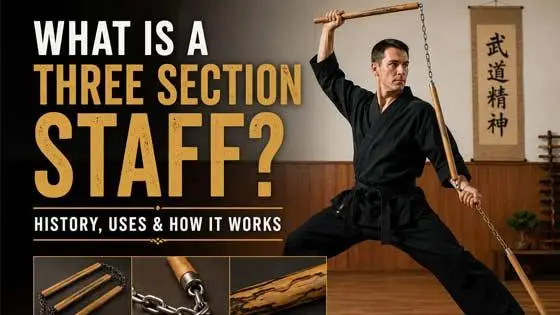
At first glance, a three section staff can look confusing, intimidating, or even impossible to control. Unlike a traditional bo staff made from a single solid piece of wood, a three section staff consists of three shorter staffs connected by chains or rope, allowing it to bend, wrap, and move in ways that most martial arts weapons cannot. That unique design makes it one of the most visually impressive and challenging traditional weapons to learn.
Over the years, the three section staff has appeared in martial arts demonstrations, kung fu training, movies, and even video games, helping build a reputation as one of the most difficult weapons to master. But where did it come from, how does it actually work, and why would someone choose it over a traditional staff? In this guide, we will break down what a three section staff is, how it is used, and why martial artists continue to find it so fascinating today.
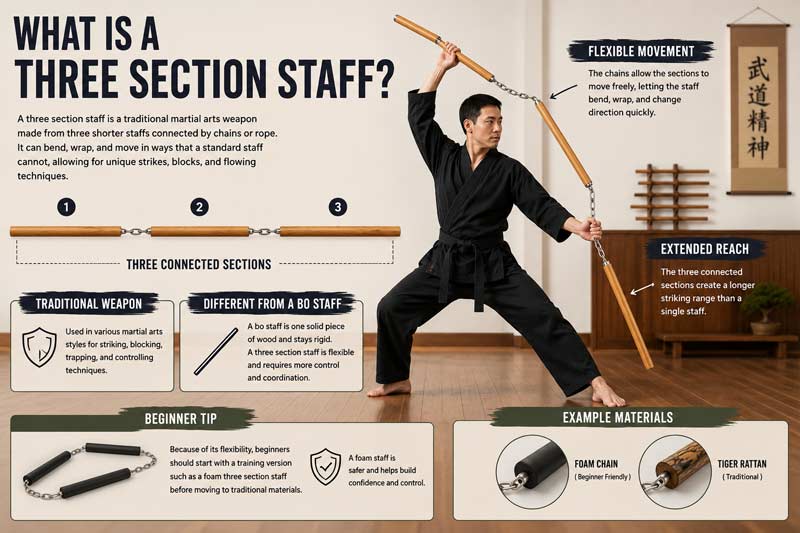
A three section staff is a traditional martial arts weapon made from three shorter staffs connected together by chains or rope. Unlike a standard bo staff, which stays rigid from end to end, the three section staff can bend, wrap, swing, and strike from multiple angles. That unique flexibility gives it a very different feel and makes it one of the more visually impressive and challenging weapons in martial arts training.
At first glance, the weapon may look complicated, but its design serves a purpose. The connected sections allow the weapon to extend reach, change direction quickly, wrap around objects, and create fast, flowing movements that are difficult to predict. Skilled practitioners can transition between striking, trapping, blocking, and spinning techniques in ways that are difficult to do with a traditional staff.
Because of its flexibility, the three section staff usually takes more coordination and patience to learn than a regular bo staff. Beginners often find it more difficult to control at first because improper handling can cause the staff to rebound unexpectedly. For that reason, many martial artists start with safer training versions like a foam chain three section staff before moving into traditional materials.
If you want to explore different styles and training options, browsing our selection of three section staffs can help you compare beginner-friendly and traditional versions of this unique weapon.
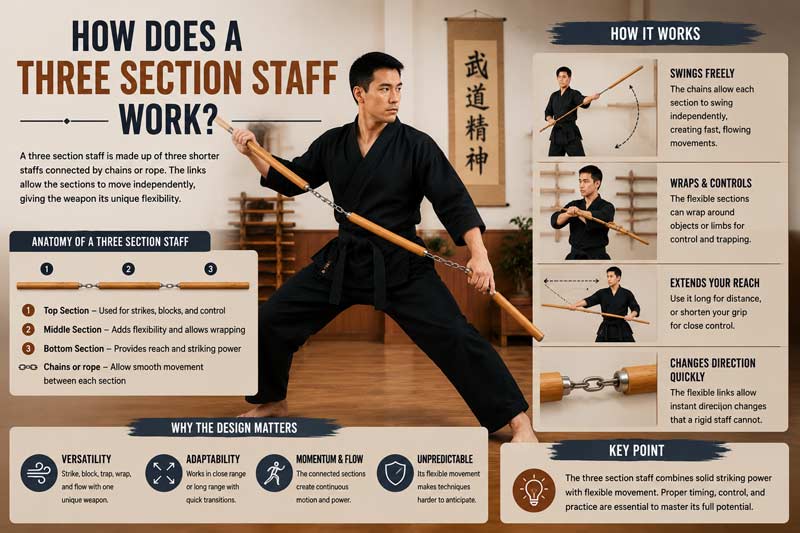
Unlike a traditional bo staff that stays rigid from end to end, a three section staff works by combining solid striking sections with flexible movement between the connected links. The chains or rope between each section allow the weapon to swing, fold, wrap, and change direction quickly, giving skilled users access to techniques that are difficult to perform with a standard staff.
One of the biggest advantages of the design is versatility. A practitioner can hold the weapon like a shorter staff for close control, extend it for longer reach, or use the flexible sections to create flowing movements and momentum-based strikes. The connected design also allows the staff to wrap around objects or redirect movement in ways a rigid staff cannot.
That flexibility comes with a learning curve. Because the sections move independently, timing and coordination become extremely important. Beginners often discover quickly that poor technique can cause the weapon to swing unpredictably or rebound if not controlled properly. This is one reason many martial artists recommend starting with a softer training option before moving into traditional materials like rattan.
If you enjoy traditional staff weapons but prefer something more straightforward to learn, browsing our selection of martial arts staffs can help you compare more rigid training weapons like bo staffs alongside flexible options like the three section staff.
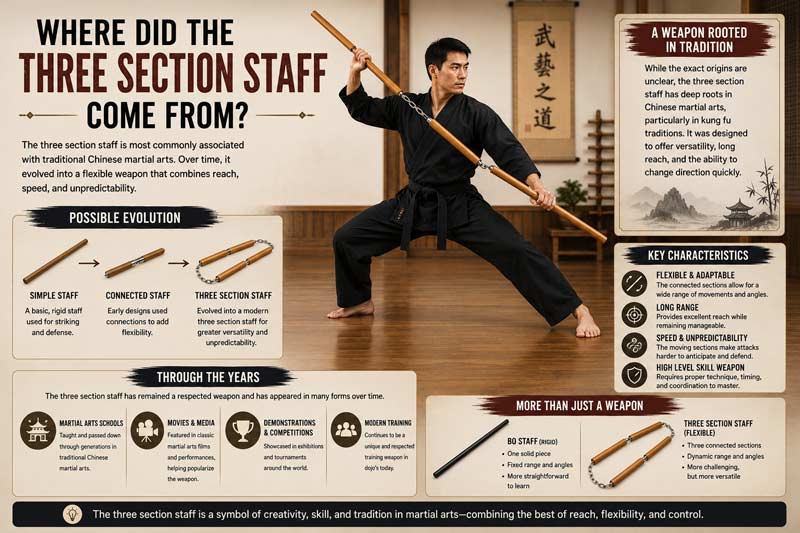
The exact origins of the three section staff are difficult to pinpoint, but the weapon is most commonly associated with traditional Chinese martial arts. Often linked to kung fu systems, the three section staff developed as a flexible weapon designed to combine the reach of a long staff with the versatility of a shorter, more adaptable weapon. Over time, it became known for its speed, unpredictability, and high level of difficulty.
Some historians believe the weapon may have evolved from simpler staff designs, allowing practitioners to carry something more compact while still maintaining long-range striking ability. Because the sections fold and move independently, the weapon offered martial artists unique advantages that rigid staffs could not, especially when transitioning between different ranges or changing attack angles quickly.
Like many traditional martial arts weapons, the three section staff eventually gained attention outside of formal training. It appeared in martial arts demonstrations, movies, competitions, and pop culture, helping introduce it to audiences who may never have encountered it in a traditional school. Despite its dramatic appearance, the weapon remains deeply tied to martial arts history and disciplined practice.
If you enjoy learning about unusual martial arts staffs, exploring our selection of traditional staff weapons can help you compare flexible weapons like the three section staff with more rigid training tools such as bo staffs and jo staffs.
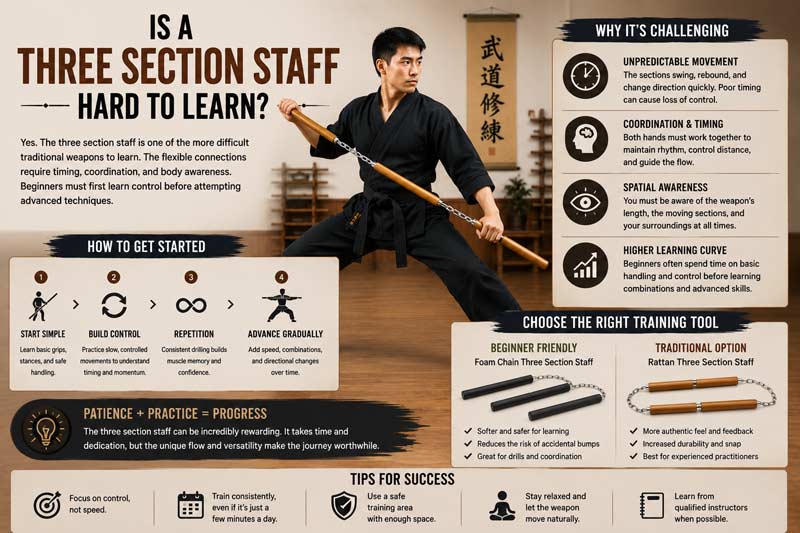
Yes, most martial artists would consider the three section staff one of the more difficult traditional weapons to learn. Unlike a rigid bo staff that moves in predictable ways, a three section staff has flexible connections that require much more timing, coordination, and body awareness. The moving sections can swing, rebound, or change direction quickly, which means beginners often spend time simply learning control before attempting advanced techniques.
That does not mean it is impossible to learn. Like any martial arts weapon, progress comes from patience and repetition. Many practitioners begin with simple handling drills to understand spacing, momentum, and grip transitions before attempting spins or combinations. Starting slowly is usually much more effective than trying flashy movements right away.
For beginners, training with a safer option can make the learning process much less intimidating. A softer training tool like this foam chain three section staff can help reduce accidental bumps while learning control and coordination. More experienced martial artists sometimes transition into traditional options such as a rattan three section staff once they feel comfortable with the basics.
If you enjoy challenging martial arts weapons, the three section staff can be incredibly rewarding to learn. It takes time, patience, and practice, but many practitioners enjoy the unique flow, creativity, and skill that come with mastering a weapon that moves so differently from a traditional staff.
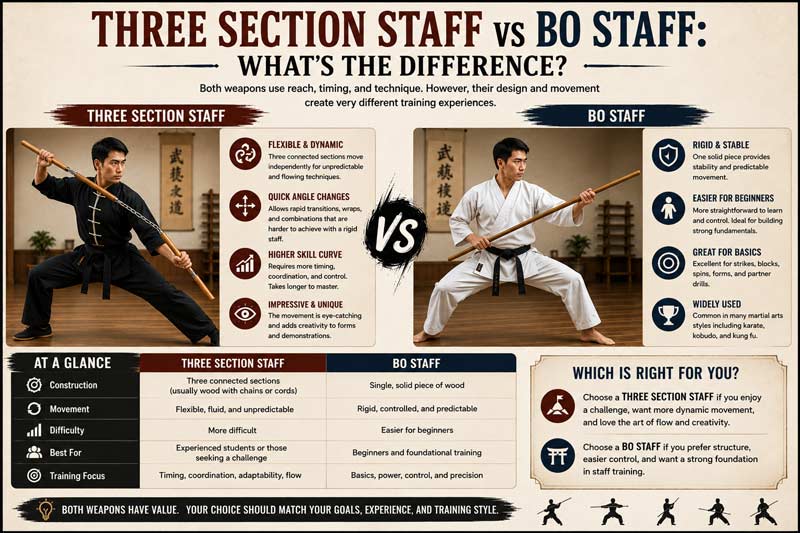
At first glance, a three section staff and a bo staff may seem similar since both are long martial arts weapons built around reach and striking. However, they feel completely different once you start training with them. A traditional bo staff is a single rigid piece of wood, while a three section staff uses multiple connected sections that move independently, creating a much more flexible and unpredictable training experience.
A bo staff is generally easier for beginners to learn because its movements are more controlled and predictable. It is commonly used for forms, strikes, blocks, spins, and coordination drills in karate, kobudo, and other martial arts systems. Many students begin with a standard bo staff to build fundamentals before moving into more advanced weapons. If you are new to staff training, our guide on beginner bo staff techniques covers simple movements that help build coordination and confidence.
A three section staff, on the other hand, rewards timing, flow, and adaptability. Because the sections move freely, practitioners can change angles quickly, wrap movements around objects, and create combinations that are difficult to mimic with a rigid staff. That flexibility makes it visually impressive, but it also creates a steeper learning curve and usually requires more patience to master.
Neither weapon is necessarily "better." The right choice usually depends on your goals, training style, and experience level. If you prefer traditional structure and easier control, a bo staff may feel more natural. If you enjoy a challenge and want something more dynamic, browsing our selection of three section staffs may help you decide whether this unique weapon fits your training style.
Even after centuries of martial arts history, the three section staff still captures attention in a way few traditional weapons can. Part of the fascination comes from how unusual it looks. The connected sections move differently than a rigid staff, creating fast, flowing movements that stand out in demonstrations, forms, and martial arts performances. For many people, it is one of the first weapons that sparks curiosity simply because it looks so different from the norm.
Martial artists also respect the challenge that comes with learning it. The weapon rewards patience, coordination, timing, and body control, which means progress often feels earned. While many beginners start with more traditional weapons, practitioners who enjoy difficult or highly technical training often appreciate the unique experience that a three section staff provides.
Modern training has also made the weapon more approachable than ever. Safer training versions, flexible materials, and online instruction have made it easier for curious martial artists to experiment with the weapon without immediately jumping into advanced traditional models. For many practitioners, simply learning the basics becomes a rewarding challenge on its own.
If the three section staff has sparked your curiosity, exploring our full range of flexible martial arts staffs can help you compare beginner-friendly foam trainers and more traditional options designed for experienced practitioners interested in this unique weapon.
What Is a Three Section Staff?
A three section staff is a traditional martial arts weapon made from three shorter staffs connected together by chains or rope. Unlike a standard bo staff, which stays rigid from end to end, the three section staff can bend, wrap, swing, and strike from multiple angles. That unique flexibility gives it a very different feel and makes it one of the more visually impressive and challenging weapons in martial arts training.
At first glance, the weapon may look complicated, but its design serves a purpose. The connected sections allow the weapon to extend reach, change direction quickly, wrap around objects, and create fast, flowing movements that are difficult to predict. Skilled practitioners can transition between striking, trapping, blocking, and spinning techniques in ways that are difficult to do with a traditional staff.
Because of its flexibility, the three section staff usually takes more coordination and patience to learn than a regular bo staff. Beginners often find it more difficult to control at first because improper handling can cause the staff to rebound unexpectedly. For that reason, many martial artists start with safer training versions like a foam chain three section staff before moving into traditional materials.
If you want to explore different styles and training options, browsing our selection of three section staffs can help you compare beginner-friendly and traditional versions of this unique weapon.
How Does a Three Section Staff Work?
Unlike a traditional bo staff that stays rigid from end to end, a three section staff works by combining solid striking sections with flexible movement between the connected links. The chains or rope between each section allow the weapon to swing, fold, wrap, and change direction quickly, giving skilled users access to techniques that are difficult to perform with a standard staff.
One of the biggest advantages of the design is versatility. A practitioner can hold the weapon like a shorter staff for close control, extend it for longer reach, or use the flexible sections to create flowing movements and momentum-based strikes. The connected design also allows the staff to wrap around objects or redirect movement in ways a rigid staff cannot.
That flexibility comes with a learning curve. Because the sections move independently, timing and coordination become extremely important. Beginners often discover quickly that poor technique can cause the weapon to swing unpredictably or rebound if not controlled properly. This is one reason many martial artists recommend starting with a softer training option before moving into traditional materials like rattan.
If you enjoy traditional staff weapons but prefer something more straightforward to learn, browsing our selection of martial arts staffs can help you compare more rigid training weapons like bo staffs alongside flexible options like the three section staff.
Where Did the Three Section Staff Come From?
The exact origins of the three section staff are difficult to pinpoint, but the weapon is most commonly associated with traditional Chinese martial arts. Often linked to kung fu systems, the three section staff developed as a flexible weapon designed to combine the reach of a long staff with the versatility of a shorter, more adaptable weapon. Over time, it became known for its speed, unpredictability, and high level of difficulty.
Some historians believe the weapon may have evolved from simpler staff designs, allowing practitioners to carry something more compact while still maintaining long-range striking ability. Because the sections fold and move independently, the weapon offered martial artists unique advantages that rigid staffs could not, especially when transitioning between different ranges or changing attack angles quickly.
Like many traditional martial arts weapons, the three section staff eventually gained attention outside of formal training. It appeared in martial arts demonstrations, movies, competitions, and pop culture, helping introduce it to audiences who may never have encountered it in a traditional school. Despite its dramatic appearance, the weapon remains deeply tied to martial arts history and disciplined practice.
If you enjoy learning about unusual martial arts staffs, exploring our selection of traditional staff weapons can help you compare flexible weapons like the three section staff with more rigid training tools such as bo staffs and jo staffs.
Is a Three Section Staff Hard to Learn?
Yes, most martial artists would consider the three section staff one of the more difficult traditional weapons to learn. Unlike a rigid bo staff that moves in predictable ways, a three section staff has flexible connections that require much more timing, coordination, and body awareness. The moving sections can swing, rebound, or change direction quickly, which means beginners often spend time simply learning control before attempting advanced techniques.
That does not mean it is impossible to learn. Like any martial arts weapon, progress comes from patience and repetition. Many practitioners begin with simple handling drills to understand spacing, momentum, and grip transitions before attempting spins or combinations. Starting slowly is usually much more effective than trying flashy movements right away.
For beginners, training with a safer option can make the learning process much less intimidating. A softer training tool like this foam chain three section staff can help reduce accidental bumps while learning control and coordination. More experienced martial artists sometimes transition into traditional options such as a rattan three section staff once they feel comfortable with the basics.
If you enjoy challenging martial arts weapons, the three section staff can be incredibly rewarding to learn. It takes time, patience, and practice, but many practitioners enjoy the unique flow, creativity, and skill that come with mastering a weapon that moves so differently from a traditional staff.
Three Section Staff vs Bo Staff: What's the Difference?
At first glance, a three section staff and a bo staff may seem similar since both are long martial arts weapons built around reach and striking. However, they feel completely different once you start training with them. A traditional bo staff is a single rigid piece of wood, while a three section staff uses multiple connected sections that move independently, creating a much more flexible and unpredictable training experience.
A bo staff is generally easier for beginners to learn because its movements are more controlled and predictable. It is commonly used for forms, strikes, blocks, spins, and coordination drills in karate, kobudo, and other martial arts systems. Many students begin with a standard bo staff to build fundamentals before moving into more advanced weapons. If you are new to staff training, our guide on beginner bo staff techniques covers simple movements that help build coordination and confidence.
A three section staff, on the other hand, rewards timing, flow, and adaptability. Because the sections move freely, practitioners can change angles quickly, wrap movements around objects, and create combinations that are difficult to mimic with a rigid staff. That flexibility makes it visually impressive, but it also creates a steeper learning curve and usually requires more patience to master.
Neither weapon is necessarily "better." The right choice usually depends on your goals, training style, and experience level. If you prefer traditional structure and easier control, a bo staff may feel more natural. If you enjoy a challenge and want something more dynamic, browsing our selection of three section staffs may help you decide whether this unique weapon fits your training style.
Why the Three Section Staff Still Fascinates Martial Artists
Even after centuries of martial arts history, the three section staff still captures attention in a way few traditional weapons can. Part of the fascination comes from how unusual it looks. The connected sections move differently than a rigid staff, creating fast, flowing movements that stand out in demonstrations, forms, and martial arts performances. For many people, it is one of the first weapons that sparks curiosity simply because it looks so different from the norm.
Martial artists also respect the challenge that comes with learning it. The weapon rewards patience, coordination, timing, and body control, which means progress often feels earned. While many beginners start with more traditional weapons, practitioners who enjoy difficult or highly technical training often appreciate the unique experience that a three section staff provides.
Modern training has also made the weapon more approachable than ever. Safer training versions, flexible materials, and online instruction have made it easier for curious martial artists to experiment with the weapon without immediately jumping into advanced traditional models. For many practitioners, simply learning the basics becomes a rewarding challenge on its own.
If the three section staff has sparked your curiosity, exploring our full range of flexible martial arts staffs can help you compare beginner-friendly foam trainers and more traditional options designed for experienced practitioners interested in this unique weapon.
You May Also Be Interested In:
- Metal Bo Staff 2.0 - The Next Stage of Staff Evolution
- Collapsible Bo Staff 2.0: The Next Generation of Staff
- Bo Staff vs Jo Staff: What's the Difference?
- What's the Right Wooden Bo Staff for You?
- What is the Best Bo Staff for Martial Arts?
- How to Make a Metal Bo Staff
- New High-Impact LED Bo Staff
- New 2-Piece Collapsible Bo Staff
- Transforming Bo Staff Just Like in the Movies!
- Steel Spear Staff and Other New Weapons!
Leave a Reply