



What Is a Tanto Knife? The Samurai's Short Blade Explained
May 18th, 2026
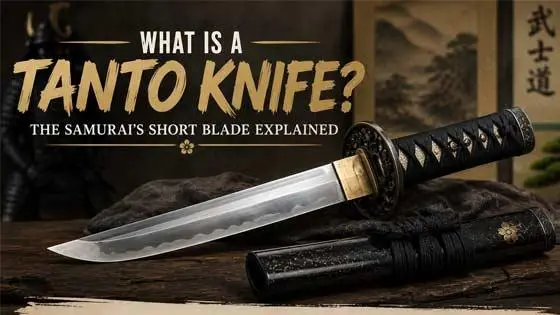
When most people think about samurai weapons, they picture a long curved katana or perhaps a shorter wakizashi carried at the waist. But another important blade in Japanese history is the tanto, a compact weapon that was often carried for utility, close-range defense, and everyday practicality. Although smaller than a katana or wakizashi, the tanto played an important role in samurai culture and was designed for situations where a longer blade was not always practical.
Because of its size, the tanto is sometimes mistaken for a knife or dagger, but its history and purpose go much deeper than that. Over the centuries, tanto blades evolved into many styles and served different roles depending on the time period and owner. In this guide, we will break down what a tanto is, how samurai used it, and how it compares to larger Japanese swords like the wakizashi and katana.
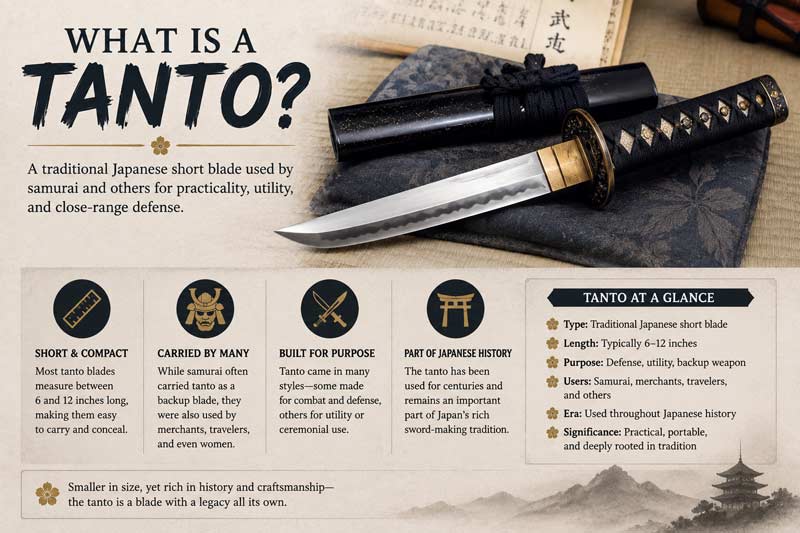
A tanto is a traditional Japanese short blade that was carried by samurai and other members of society for both practical and defensive purposes. Smaller than a wakizashi or katana, the tanto is often described as a dagger or knife, though many historical examples were crafted with the same level of detail and skill as larger samurai swords. Most tanto blades measured somewhere between 6 and 12 inches long, making them compact enough for everyday carry while still being effective in close-range situations.
Although the tanto is smaller than most people imagine when thinking of samurai weapons, it played an important role in Japanese history. Samurai often carried one as a backup blade, but tantos were also used by merchants, travelers, and even women in certain historical periods for self-defense. Depending on the era and intended purpose, tanto blades came in several shapes and styles, some designed more for utility while others were highly decorative or ceremonial.
One thing that makes the tanto especially interesting is how closely it connects to larger Japanese blades. While a katana was built for battlefield combat and a wakizashi served as a companion sword, the tanto filled a different role by offering portability and practicality. Even though it was smaller, it still reflected the same craftsmanship and attention to detail found in larger traditional samurai swords.
Today, many people appreciate the tanto for its historical significance, compact size, and elegant design. Whether viewed as a practical tool, collector's piece, or part of samurai history, it remains one of the most recognizable short blades to come from Japan.
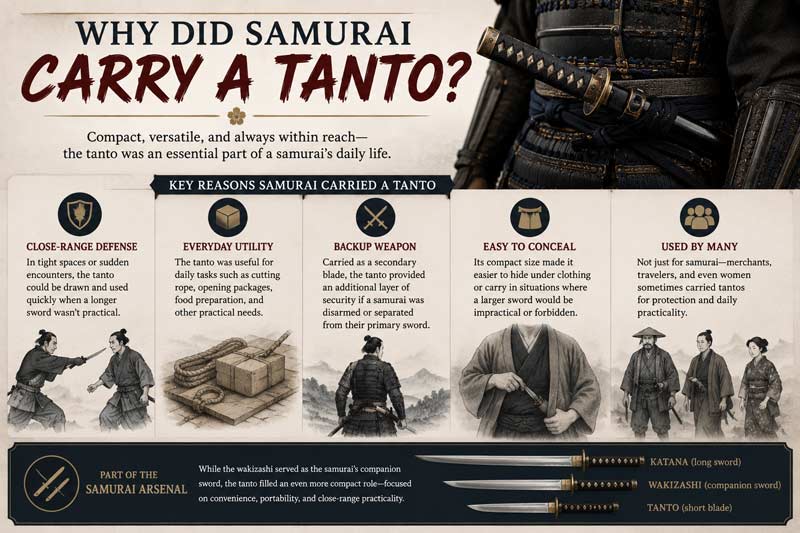
Although samurai are most closely associated with larger swords like the katana and wakizashi, many also carried a tanto for practical reasons. Its compact size made it useful in situations where a longer blade would be inconvenient, difficult to draw, or unnecessary. Rather than replacing a katana, the tanto served a different purpose by offering a smaller, more portable option for close-range defense and everyday utility.
One reason the tanto was valuable was its versatility. Samurai could carry it discreetly, use it as a backup weapon, or rely on it for tasks that would not make sense with a full-size sword. Because it was compact and easy to access, the tanto often remained close at hand when larger weapons were unavailable or impractical.
Tanto blades were not only carried by samurai. Throughout Japanese history, merchants, travelers, and even women sometimes carried smaller blades for protection or utility depending on the period and region. This wider use helped make the tanto one of the most practical and recognizable short blades in Japanese culture.
While the wakizashi often served as the samurai's companion sword, the tanto filled an even more compact role focused on convenience and portability. Together, these blades highlight how Japanese weapons were designed for different situations rather than a one-size-fits-all approach.
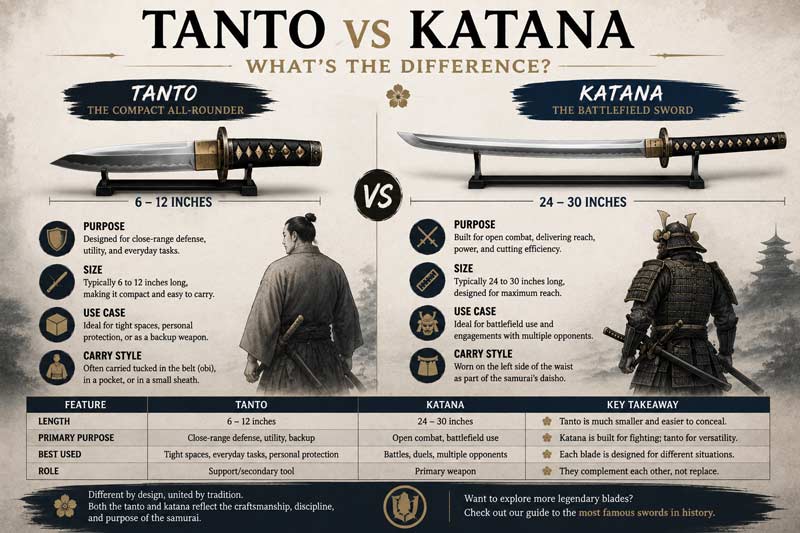
At first glance, a tanto and katana may seem closely related because both are traditional Japanese blades associated with samurai culture. However, they were designed for very different purposes. The biggest difference comes down to size and intended use. A katana is a long sword built for open combat and battlefield use, while a tanto is much smaller and designed for close-range practicality, utility, and personal defense.
Most katana blades typically measure somewhere around 24 to 30 inches long, while tanto blades usually fall between 6 and 12 inches. That difference in size gave each weapon distinct advantages. The katana offered reach, cutting power, and effectiveness in open fighting situations, while the tanto was easier to carry discreetly and more practical in confined spaces or everyday situations.
Another key difference is how they were carried and used. Samurai often wore a katana as a primary weapon and might pair it with a wakizashi companion sword as part of the daisho. The tanto, on the other hand, served more as a compact utility blade or backup weapon that could remain close at hand when larger swords were impractical.
If you want a broader look at how different Japanese blades compare, our article on legendary swords throughout history explores how weapons like the katana earned their reputation while also showing how smaller blades filled different roles.
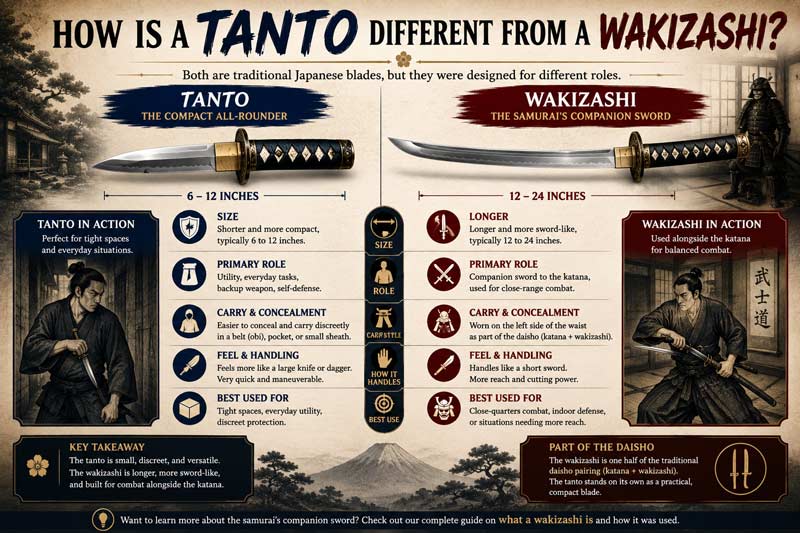
Because both blades are smaller than a katana, people often confuse the tanto and wakizashi. However, the biggest difference comes down to size and intended role. A wakizashi is longer and more sword-like, usually measuring between 12 and 24 inches, while a tanto is shorter and more compact, typically falling between 6 and 12 inches in blade length. Although both could serve defensive purposes, they were designed for different situations.
The wakizashi was commonly carried alongside a katana as part of the traditional daisho pairing and often served as a companion sword for close-range combat or indoor use. The tanto, on the other hand, was more compact and focused on portability, convenience, and everyday practicality. Depending on the period and owner, a tanto might be carried as a utility blade, backup weapon, or discreet self-defense tool.
Another difference is how the blades feel and handle. A wakizashi behaves much more like a short sword, while a tanto is closer to a knife or dagger in both size and maneuverability. That smaller size made the tanto easier to conceal and quicker to access in situations where carrying a larger blade might be inconvenient.
If you want a deeper look at the samurai's companion sword, our guide on what a wakizashi is and how samurai used it breaks down its role, history, and how it compares to other Japanese blades.
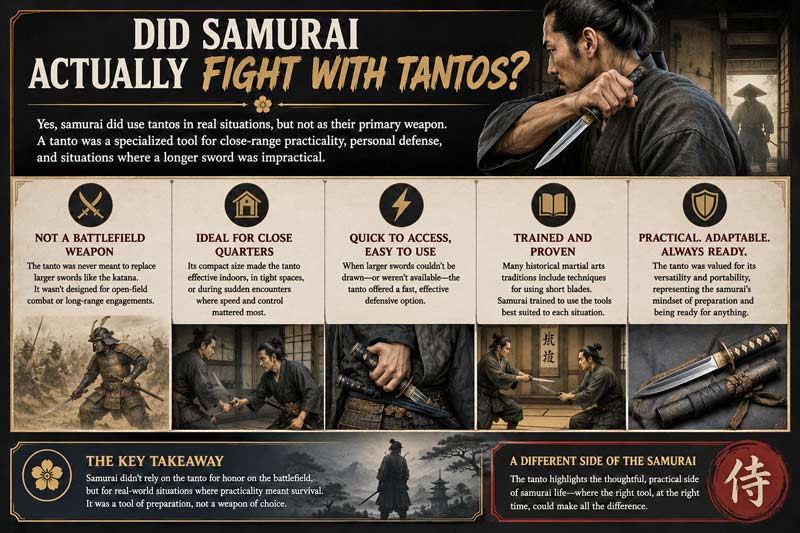
Yes, samurai did use tantos in real situations, although not in the same way they used larger swords like katanas. A tanto was never intended to replace a battlefield weapon. Instead, it filled a more specialized role focused on close-range practicality, personal defense, and situations where carrying or drawing a longer blade would be difficult or impossible.
Because of its compact size, the tanto could be useful indoors, in tight spaces, or during sudden encounters where speed mattered more than reach. Samurai sometimes relied on shorter blades when maneuverability was limited or when larger swords had been left behind. In those situations, a tanto could provide an effective defensive option while remaining quick to access.
Some historical martial arts traditions also included techniques for using short blades in close-range combat. While the katana often gets most of the attention in movies and popular culture, the reality is that samurai used many different tools depending on the environment and situation. The tanto was valued not because it was large or intimidating, but because it was practical and adaptable.
Today, the tanto still fascinates martial artists and collectors because it represents a different side of samurai life. Rather than focusing on battlefield combat alone, it highlights the importance of preparation, portability, and having the right tool available when needed.
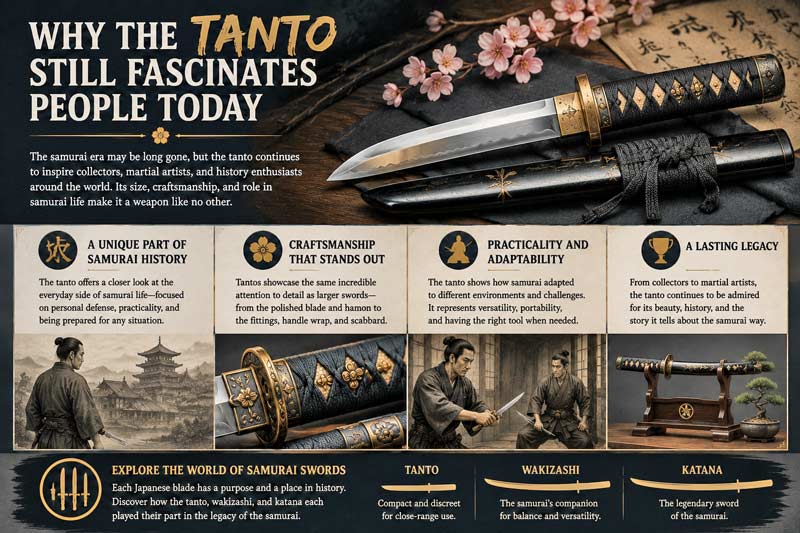
Even though the samurai era ended centuries ago, the tanto continues to capture people's attention for many of the same reasons as larger Japanese blades. Its compact size, elegant craftsmanship, and practical role in samurai history make it feel unique compared to more famous weapons like the katana. For many people, the tanto offers a closer look at the everyday side of samurai life rather than only battlefield combat.
Collectors are often drawn to tantos because they feature the same level of detail found in larger Japanese swords while being easier to display and appreciate up close. Traditional tantos often include carefully crafted fittings, wrapped handles, polished blades, and decorative scabbards that reflect centuries of Japanese craftsmanship.
Martial artists and history enthusiasts also appreciate the tanto because it highlights how samurai adapted to different situations. While larger swords like the katana and wakizashi served important combat roles, the tanto represented practicality, portability, and preparation. Learning about these differences gives deeper insight into why Japanese weapons evolved the way they did.
If exploring traditional Japanese blades sparked your interest, browsing different samurai sword styles can help you better understand how weapons like the tanto, wakizashi, and katana each played unique roles in Japanese history.
What Is a Tanto?
A tanto is a traditional Japanese short blade that was carried by samurai and other members of society for both practical and defensive purposes. Smaller than a wakizashi or katana, the tanto is often described as a dagger or knife, though many historical examples were crafted with the same level of detail and skill as larger samurai swords. Most tanto blades measured somewhere between 6 and 12 inches long, making them compact enough for everyday carry while still being effective in close-range situations.
Although the tanto is smaller than most people imagine when thinking of samurai weapons, it played an important role in Japanese history. Samurai often carried one as a backup blade, but tantos were also used by merchants, travelers, and even women in certain historical periods for self-defense. Depending on the era and intended purpose, tanto blades came in several shapes and styles, some designed more for utility while others were highly decorative or ceremonial.
One thing that makes the tanto especially interesting is how closely it connects to larger Japanese blades. While a katana was built for battlefield combat and a wakizashi served as a companion sword, the tanto filled a different role by offering portability and practicality. Even though it was smaller, it still reflected the same craftsmanship and attention to detail found in larger traditional samurai swords.
Today, many people appreciate the tanto for its historical significance, compact size, and elegant design. Whether viewed as a practical tool, collector's piece, or part of samurai history, it remains one of the most recognizable short blades to come from Japan.
Why Did Samurai Carry a Tanto?
Although samurai are most closely associated with larger swords like the katana and wakizashi, many also carried a tanto for practical reasons. Its compact size made it useful in situations where a longer blade would be inconvenient, difficult to draw, or unnecessary. Rather than replacing a katana, the tanto served a different purpose by offering a smaller, more portable option for close-range defense and everyday utility.
One reason the tanto was valuable was its versatility. Samurai could carry it discreetly, use it as a backup weapon, or rely on it for tasks that would not make sense with a full-size sword. Because it was compact and easy to access, the tanto often remained close at hand when larger weapons were unavailable or impractical.
Tanto blades were not only carried by samurai. Throughout Japanese history, merchants, travelers, and even women sometimes carried smaller blades for protection or utility depending on the period and region. This wider use helped make the tanto one of the most practical and recognizable short blades in Japanese culture.
While the wakizashi often served as the samurai's companion sword, the tanto filled an even more compact role focused on convenience and portability. Together, these blades highlight how Japanese weapons were designed for different situations rather than a one-size-fits-all approach.
Tanto vs Katana: What's the Difference?
At first glance, a tanto and katana may seem closely related because both are traditional Japanese blades associated with samurai culture. However, they were designed for very different purposes. The biggest difference comes down to size and intended use. A katana is a long sword built for open combat and battlefield use, while a tanto is much smaller and designed for close-range practicality, utility, and personal defense.
Most katana blades typically measure somewhere around 24 to 30 inches long, while tanto blades usually fall between 6 and 12 inches. That difference in size gave each weapon distinct advantages. The katana offered reach, cutting power, and effectiveness in open fighting situations, while the tanto was easier to carry discreetly and more practical in confined spaces or everyday situations.
Another key difference is how they were carried and used. Samurai often wore a katana as a primary weapon and might pair it with a wakizashi companion sword as part of the daisho. The tanto, on the other hand, served more as a compact utility blade or backup weapon that could remain close at hand when larger swords were impractical.
If you want a broader look at how different Japanese blades compare, our article on legendary swords throughout history explores how weapons like the katana earned their reputation while also showing how smaller blades filled different roles.
How Is a Tanto Different From a Wakizashi?
Because both blades are smaller than a katana, people often confuse the tanto and wakizashi. However, the biggest difference comes down to size and intended role. A wakizashi is longer and more sword-like, usually measuring between 12 and 24 inches, while a tanto is shorter and more compact, typically falling between 6 and 12 inches in blade length. Although both could serve defensive purposes, they were designed for different situations.
The wakizashi was commonly carried alongside a katana as part of the traditional daisho pairing and often served as a companion sword for close-range combat or indoor use. The tanto, on the other hand, was more compact and focused on portability, convenience, and everyday practicality. Depending on the period and owner, a tanto might be carried as a utility blade, backup weapon, or discreet self-defense tool.
Another difference is how the blades feel and handle. A wakizashi behaves much more like a short sword, while a tanto is closer to a knife or dagger in both size and maneuverability. That smaller size made the tanto easier to conceal and quicker to access in situations where carrying a larger blade might be inconvenient.
If you want a deeper look at the samurai's companion sword, our guide on what a wakizashi is and how samurai used it breaks down its role, history, and how it compares to other Japanese blades.
Did Samurai Actually Fight With Tantos?
Yes, samurai did use tantos in real situations, although not in the same way they used larger swords like katanas. A tanto was never intended to replace a battlefield weapon. Instead, it filled a more specialized role focused on close-range practicality, personal defense, and situations where carrying or drawing a longer blade would be difficult or impossible.
Because of its compact size, the tanto could be useful indoors, in tight spaces, or during sudden encounters where speed mattered more than reach. Samurai sometimes relied on shorter blades when maneuverability was limited or when larger swords had been left behind. In those situations, a tanto could provide an effective defensive option while remaining quick to access.
Some historical martial arts traditions also included techniques for using short blades in close-range combat. While the katana often gets most of the attention in movies and popular culture, the reality is that samurai used many different tools depending on the environment and situation. The tanto was valued not because it was large or intimidating, but because it was practical and adaptable.
Today, the tanto still fascinates martial artists and collectors because it represents a different side of samurai life. Rather than focusing on battlefield combat alone, it highlights the importance of preparation, portability, and having the right tool available when needed.
Why the Tanto Still Fascinates People Today
Even though the samurai era ended centuries ago, the tanto continues to capture people's attention for many of the same reasons as larger Japanese blades. Its compact size, elegant craftsmanship, and practical role in samurai history make it feel unique compared to more famous weapons like the katana. For many people, the tanto offers a closer look at the everyday side of samurai life rather than only battlefield combat.
Collectors are often drawn to tantos because they feature the same level of detail found in larger Japanese swords while being easier to display and appreciate up close. Traditional tantos often include carefully crafted fittings, wrapped handles, polished blades, and decorative scabbards that reflect centuries of Japanese craftsmanship.
Martial artists and history enthusiasts also appreciate the tanto because it highlights how samurai adapted to different situations. While larger swords like the katana and wakizashi served important combat roles, the tanto represented practicality, portability, and preparation. Learning about these differences gives deeper insight into why Japanese weapons evolved the way they did.
If exploring traditional Japanese blades sparked your interest, browsing different samurai sword styles can help you better understand how weapons like the tanto, wakizashi, and katana each played unique roles in Japanese history.
You May Also Be Interested In:
- What Is an Odachi? The Giant Samurai Sword Explained
- What Is Kenjutsu? Traditional Japanese Swordsmanship Explained
- Why Are Karate Uniforms White? The Real Meaning Explained
- Why Is the Karambit Blade Curved?
- Brass Knuckles Explained: History, Design, and Modern Laws
- Steampunk Gun Blade and Other Unusual Weapons
- Hidden Blade Knuckles and Other Dangerous Weapons!
- Bushcraft vs Survival Knives: Which Blade Would You Trust in the Wild?
- Hidden Blade Walking Stick and Other Dangerous Weapons
- EDC Knives for Beginners: How to Choose Your First Everyday Carry Blade
Leave a Reply