



Bo Staff vs Jo Staff: What's the Difference?
May 7th, 2026
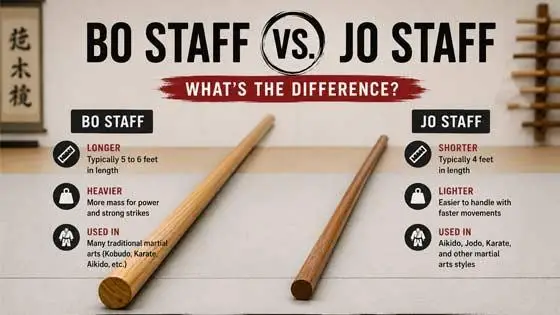
Bo staffs and jo staffs are two of the most well-known traditional martial arts weapons, but many beginners are not entirely sure what separates them. At first glance, both weapons look very similar because they are essentially long wooden staffs used for striking, blocking, spinning, and traditional martial arts training. The biggest differences usually come down to length, handling speed, training style, and the martial arts systems they are commonly associated with.
A traditional bo staff is normally longer and heavier than a jo staff, which allows it to generate more reach and striking power during training. A jo staff is shorter, slightly easier to maneuver in tight spaces, and often faster during quick defensive movements and counterattacks. Both weapons are widely used in martial arts training, demonstrations, forms competitions, and weapons practice, but they each offer a very different training experience depending on the student's goals and skill level.
In this guide, we'll compare bo staffs and jo staffs side by side, including their size differences, training styles, handling characteristics, beginner friendliness, and the different types of martial arts that use them today.
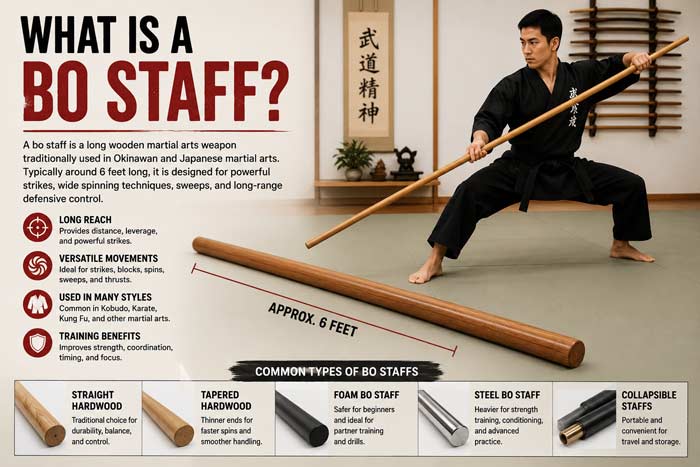
A bo staff is a long wooden martial arts staff traditionally used in Okinawan and Japanese martial arts. Most bo staffs are approximately six feet long, although the exact length can vary depending on the martial art style, the student's height, and the intended type of training. Because of its longer reach and larger size, the bo staff is often associated with powerful strikes, wide spinning techniques, sweeping movements, and long-range defensive control.
Bo staffs are commonly used in martial arts systems like kobudo, karate weapons training, and some styles of kung fu and traditional Japanese martial arts. Students use them for forms practice, spinning drills, striking combinations, blocking exercises, and partner training. The longer length of the weapon allows practitioners to generate significant leverage and momentum during movements, which is one reason the bo staff remains one of the most recognizable traditional martial arts weapons in the world.
Most traditional bo staffs are made from hardwoods like oak, rattan, or other dense materials designed to withstand repeated training. Some martial artists prefer straight hardwood staffs for traditional forms and technique practice, while others use tapered staffs that shift more weight toward the center for faster spinning and improved handling. Traditional hardwood bo staffs are still widely used because they provide realistic balance, durability, and control during martial arts training.
Modern training staffs now come in several different materials depending on the type of practice being performed. Some students use padded or foam bo staffs for beginner drills and safer partner training, while others prefer heavier options like steel staffs for conditioning and strength-focused practice. There are also portable collapsible staffs designed for demonstrations, storage convenience, and compact transport.
Because of its reach, versatility, and dramatic spinning techniques, the bo staff continues to be one of the most popular traditional weapons used in martial arts schools, tournaments, demonstrations, and weapons competitions today.
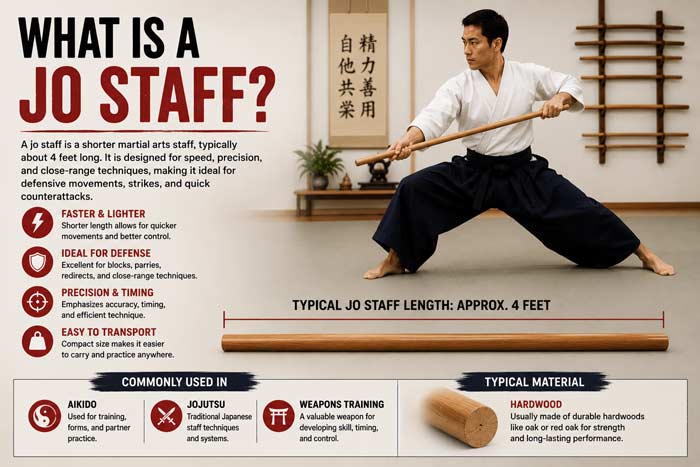
A jo staff is a shorter traditional martial arts staff that is commonly used in Japanese martial arts training. While a bo staff is usually around six feet long, a jo staff is typically about four feet in length. That shorter size makes the jo staff faster to maneuver, easier to control in tight spaces, and well suited for quick defensive movements, thrusts, strikes, and counterattacks.
The jo staff is widely associated with martial arts styles like aikido, jojutsu, and some traditional Japanese weapons systems. Because the weapon is shorter and lighter than a bo staff, practitioners often rely more heavily on speed, timing, redirection, and precision rather than long-range power techniques. Many jo staff drills emphasize fluid movement and close-range control instead of the larger sweeping motions commonly seen with longer staffs.
One advantage of the jo staff is that it can transition quickly between offensive and defensive techniques. Its smaller size allows practitioners to change grips rapidly, perform fast strikes from multiple angles, and maneuver more comfortably during partner drills. Many martial artists also find jo staffs easier to carry and practice with because they require less open space than longer weapons.
Traditional jo staffs are commonly made from hardwood materials similar to bo staffs, although they are usually thinner and lighter overall. Some martial artists who train with both weapons prefer practicing with longer martial arts staffs for power development while using jo staffs to improve speed, coordination, and precision handling.
Although the jo staff is smaller than a bo staff, it remains one of the most respected traditional weapons in martial arts training because of its versatility, speed, and emphasis on technical control. Many practitioners consider it an excellent weapon for developing timing, movement, and overall weapon-handling skills.
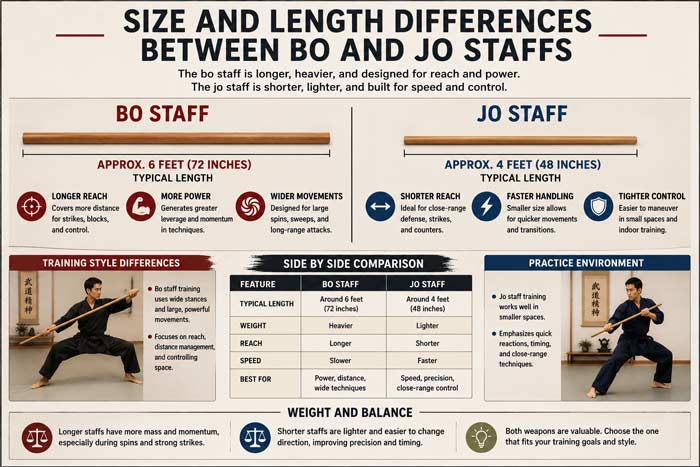
The biggest difference between a bo staff and a jo staff is their overall length. A traditional bo staff is usually around six feet long, while a jo staff is typically closer to four feet in length. That extra size gives the bo staff more reach, leverage, and striking power, while the shorter jo staff allows for faster handling, tighter movements, and quicker directional changes during training.
Because the bo staff is longer, practitioners often use wider stances and larger spinning techniques to generate momentum and maintain distance from an opponent. The weapon can cover more range during strikes and defensive movements, which makes it especially effective for long-range control and sweeping attacks. Many traditional wooden staffs used in martial arts training are designed specifically to maximize reach and leverage during forms and weapons drills.
A jo staff, on the other hand, is more compact and maneuverable. The shorter size allows practitioners to react quickly at close range and transition smoothly between strikes, thrusts, blocks, and defensive counters. Because the jo staff requires less open space to handle effectively, many students find it easier to practice with indoors or in smaller training environments.
Weight distribution also changes the way these weapons feel during training. Longer staffs naturally generate more momentum, especially during spinning movements and powerful strikes. Shorter staffs generally feel lighter and faster, which can help improve precision, timing, and close-range control. Some martial artists prefer lightweight tapered staffs like the tapered hardwood bo because they spin faster and feel more balanced during advanced weapon forms.
Neither weapon is automatically better because they are designed for different training styles and movement patterns. Some martial artists prefer the reach and power of a full-length bo staff, while others enjoy the speed and maneuverability that come with training using a jo staff.
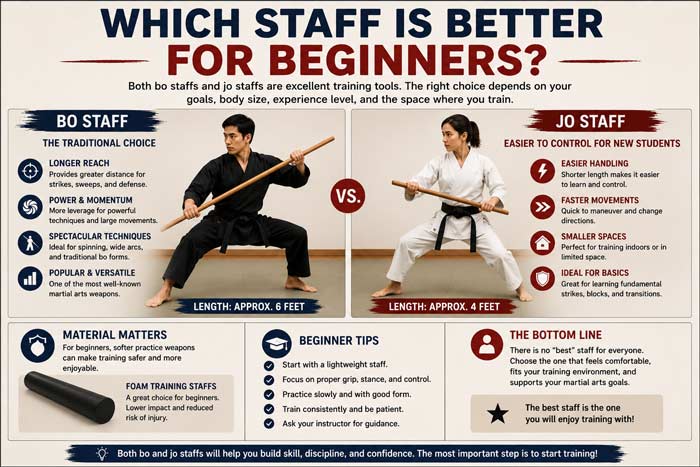
Both bo staffs and jo staffs can be good beginner weapons, but the best option usually depends on the student's age, training goals, available practice space, and overall comfort level. Some beginners prefer the reach and traditional feel of a full-length bo staff, while others find the shorter jo staff easier to control during early training sessions.
A jo staff is often considered slightly easier for beginners because the shorter length makes it more manageable during spins, strikes, blocks, and transitions. New students usually have an easier time controlling a shorter weapon, especially when learning basic hand positioning, timing, and coordination. Jo staffs also work well in smaller practice areas where a six-foot staff might feel difficult to maneuver safely.
Bo staffs, however, are often more popular among beginners simply because they are one of the most recognizable martial arts weapons in the world. Many students are drawn to the larger spinning techniques, long-range strikes, and traditional forms associated with bo staff training. Although a longer staff can feel more challenging at first, many martial artists quickly adapt with regular practice.
Material choice can also make a big difference for beginners. Softer practice weapons are often easier and safer to learn with during partner drills or spinning practice. Some instructors recommend padded or foam training staffs for beginners because they reduce the risk of injury while students develop coordination and control.
For students interested in traditional martial arts weapons training, many instructors recommend starting with lightweight hardwood practice staffs that provide realistic balance without being overly heavy. The most important factor is choosing a staff that feels comfortable to handle and matches the type of training the student plans to focus on long term.
Both bo staffs and jo staffs are highly respected traditional martial arts weapons that offer valuable training benefits for students of all skill levels. While they may look similar at first glance, the differences in length, handling speed, reach, and training style create two very different experiences during practice. Choosing between them usually comes down to personal preference, training goals, and the type of martial arts system being studied.
Bo staffs are often favored for their longer reach, powerful spinning techniques, and dramatic traditional forms. Many martial artists enjoy the challenge of controlling a full-length staff while developing strength, coordination, balance, and long-range weapon control. Jo staffs, on the other hand, are typically appreciated for their faster handling, close-range versatility, and precise technical movement.
Some students eventually train with both weapons because each one helps develop different skills and movement patterns. Longer staffs can improve leverage, momentum, and large-scale movement control, while shorter staffs often help refine timing, speed, and precision. Many martial artists also experiment with different materials and designs depending on their experience level and training preferences.
For beginners, lightweight hardwood or padded martial arts staff weapons are often the best starting point because they provide realistic handling without feeling overly difficult to control. More advanced practitioners sometimes transition into heavier hardwood, steel, or specialty staffs as their skills continue to improve over time.
No matter which weapon someone chooses, both bo staffs and jo staffs remain excellent tools for building discipline, coordination, focus, and traditional martial arts technique. Their continued popularity in martial arts schools around the world shows just how timeless and versatile these classic training weapons truly are.
In this guide, we'll compare bo staffs and jo staffs side by side, including their size differences, training styles, handling characteristics, beginner friendliness, and the different types of martial arts that use them today.
What Is a Bo Staff?
A bo staff is a long wooden martial arts staff traditionally used in Okinawan and Japanese martial arts. Most bo staffs are approximately six feet long, although the exact length can vary depending on the martial art style, the student's height, and the intended type of training. Because of its longer reach and larger size, the bo staff is often associated with powerful strikes, wide spinning techniques, sweeping movements, and long-range defensive control.
Bo staffs are commonly used in martial arts systems like kobudo, karate weapons training, and some styles of kung fu and traditional Japanese martial arts. Students use them for forms practice, spinning drills, striking combinations, blocking exercises, and partner training. The longer length of the weapon allows practitioners to generate significant leverage and momentum during movements, which is one reason the bo staff remains one of the most recognizable traditional martial arts weapons in the world.
Most traditional bo staffs are made from hardwoods like oak, rattan, or other dense materials designed to withstand repeated training. Some martial artists prefer straight hardwood staffs for traditional forms and technique practice, while others use tapered staffs that shift more weight toward the center for faster spinning and improved handling. Traditional hardwood bo staffs are still widely used because they provide realistic balance, durability, and control during martial arts training.
Modern training staffs now come in several different materials depending on the type of practice being performed. Some students use padded or foam bo staffs for beginner drills and safer partner training, while others prefer heavier options like steel staffs for conditioning and strength-focused practice. There are also portable collapsible staffs designed for demonstrations, storage convenience, and compact transport.
Because of its reach, versatility, and dramatic spinning techniques, the bo staff continues to be one of the most popular traditional weapons used in martial arts schools, tournaments, demonstrations, and weapons competitions today.
What Is a Jo Staff?
A jo staff is a shorter traditional martial arts staff that is commonly used in Japanese martial arts training. While a bo staff is usually around six feet long, a jo staff is typically about four feet in length. That shorter size makes the jo staff faster to maneuver, easier to control in tight spaces, and well suited for quick defensive movements, thrusts, strikes, and counterattacks.
The jo staff is widely associated with martial arts styles like aikido, jojutsu, and some traditional Japanese weapons systems. Because the weapon is shorter and lighter than a bo staff, practitioners often rely more heavily on speed, timing, redirection, and precision rather than long-range power techniques. Many jo staff drills emphasize fluid movement and close-range control instead of the larger sweeping motions commonly seen with longer staffs.
One advantage of the jo staff is that it can transition quickly between offensive and defensive techniques. Its smaller size allows practitioners to change grips rapidly, perform fast strikes from multiple angles, and maneuver more comfortably during partner drills. Many martial artists also find jo staffs easier to carry and practice with because they require less open space than longer weapons.
Traditional jo staffs are commonly made from hardwood materials similar to bo staffs, although they are usually thinner and lighter overall. Some martial artists who train with both weapons prefer practicing with longer martial arts staffs for power development while using jo staffs to improve speed, coordination, and precision handling.
Although the jo staff is smaller than a bo staff, it remains one of the most respected traditional weapons in martial arts training because of its versatility, speed, and emphasis on technical control. Many practitioners consider it an excellent weapon for developing timing, movement, and overall weapon-handling skills.
Size and Length Differences Between Bo and Jo Staffs
The biggest difference between a bo staff and a jo staff is their overall length. A traditional bo staff is usually around six feet long, while a jo staff is typically closer to four feet in length. That extra size gives the bo staff more reach, leverage, and striking power, while the shorter jo staff allows for faster handling, tighter movements, and quicker directional changes during training.
Because the bo staff is longer, practitioners often use wider stances and larger spinning techniques to generate momentum and maintain distance from an opponent. The weapon can cover more range during strikes and defensive movements, which makes it especially effective for long-range control and sweeping attacks. Many traditional wooden staffs used in martial arts training are designed specifically to maximize reach and leverage during forms and weapons drills.
A jo staff, on the other hand, is more compact and maneuverable. The shorter size allows practitioners to react quickly at close range and transition smoothly between strikes, thrusts, blocks, and defensive counters. Because the jo staff requires less open space to handle effectively, many students find it easier to practice with indoors or in smaller training environments.
Weight distribution also changes the way these weapons feel during training. Longer staffs naturally generate more momentum, especially during spinning movements and powerful strikes. Shorter staffs generally feel lighter and faster, which can help improve precision, timing, and close-range control. Some martial artists prefer lightweight tapered staffs like the tapered hardwood bo because they spin faster and feel more balanced during advanced weapon forms.
Neither weapon is automatically better because they are designed for different training styles and movement patterns. Some martial artists prefer the reach and power of a full-length bo staff, while others enjoy the speed and maneuverability that come with training using a jo staff.
Which Staff Is Better for Beginners?
Both bo staffs and jo staffs can be good beginner weapons, but the best option usually depends on the student's age, training goals, available practice space, and overall comfort level. Some beginners prefer the reach and traditional feel of a full-length bo staff, while others find the shorter jo staff easier to control during early training sessions.
A jo staff is often considered slightly easier for beginners because the shorter length makes it more manageable during spins, strikes, blocks, and transitions. New students usually have an easier time controlling a shorter weapon, especially when learning basic hand positioning, timing, and coordination. Jo staffs also work well in smaller practice areas where a six-foot staff might feel difficult to maneuver safely.
Bo staffs, however, are often more popular among beginners simply because they are one of the most recognizable martial arts weapons in the world. Many students are drawn to the larger spinning techniques, long-range strikes, and traditional forms associated with bo staff training. Although a longer staff can feel more challenging at first, many martial artists quickly adapt with regular practice.
Material choice can also make a big difference for beginners. Softer practice weapons are often easier and safer to learn with during partner drills or spinning practice. Some instructors recommend padded or foam training staffs for beginners because they reduce the risk of injury while students develop coordination and control.
For students interested in traditional martial arts weapons training, many instructors recommend starting with lightweight hardwood practice staffs that provide realistic balance without being overly heavy. The most important factor is choosing a staff that feels comfortable to handle and matches the type of training the student plans to focus on long term.
Final Thoughts on Bo Staffs vs Jo Staffs
Both bo staffs and jo staffs are highly respected traditional martial arts weapons that offer valuable training benefits for students of all skill levels. While they may look similar at first glance, the differences in length, handling speed, reach, and training style create two very different experiences during practice. Choosing between them usually comes down to personal preference, training goals, and the type of martial arts system being studied.
Bo staffs are often favored for their longer reach, powerful spinning techniques, and dramatic traditional forms. Many martial artists enjoy the challenge of controlling a full-length staff while developing strength, coordination, balance, and long-range weapon control. Jo staffs, on the other hand, are typically appreciated for their faster handling, close-range versatility, and precise technical movement.
Some students eventually train with both weapons because each one helps develop different skills and movement patterns. Longer staffs can improve leverage, momentum, and large-scale movement control, while shorter staffs often help refine timing, speed, and precision. Many martial artists also experiment with different materials and designs depending on their experience level and training preferences.
For beginners, lightweight hardwood or padded martial arts staff weapons are often the best starting point because they provide realistic handling without feeling overly difficult to control. More advanced practitioners sometimes transition into heavier hardwood, steel, or specialty staffs as their skills continue to improve over time.
No matter which weapon someone chooses, both bo staffs and jo staffs remain excellent tools for building discipline, coordination, focus, and traditional martial arts technique. Their continued popularity in martial arts schools around the world shows just how timeless and versatile these classic training weapons truly are.
You May Also Be Interested In:
- Metal Bo Staff 2.0 - The Next Stage of Staff Evolution
- Collapsible Bo Staff 2.0: The Next Generation of Staff
- What's the Right Wooden Bo Staff for You?
- New High-Impact LED Bo Staff
- How to Make a Metal Bo Staff
- New 2-Piece Collapsible Bo Staff
- Transforming Bo Staff Just Like in the Movies!
- What is the Best Bo Staff for Martial Arts?
- What Size Bo Staff Should I Get? Beginner Guide
- Metal Bo Staff: Steel vs Aluminum
Leave a Reply