




Could Ninjas Really Walk on Water? The Truth About Ninja Water Shoes
September 4th, 2026

Of all the strange abilities attributed to ninjas, walking across water sounds like one of the easiest to dismiss as pure fantasy. Yet museums, historical illustrations, and books about ninjutsu have long featured an unusual device known as the mizugumo, or "water spider," that supposedly allowed a shinobi to cross ponds, rivers, or even the defensive moat surrounding a castle. Reconstructions often resemble bizarre wooden flotation shoes strapped to the feet, creating an irresistible image of a ninja quietly stepping across the surface while everyone else would have to swim. There is just one problem: actually trying to make such a device support a human raises some serious questions. Were ninja water shoes an ingenious piece of covert equipment, a misunderstood historical tool, or one of those legends that became much more impressive with every retelling?
The Legend Begins With a Device Called the Mizugumo
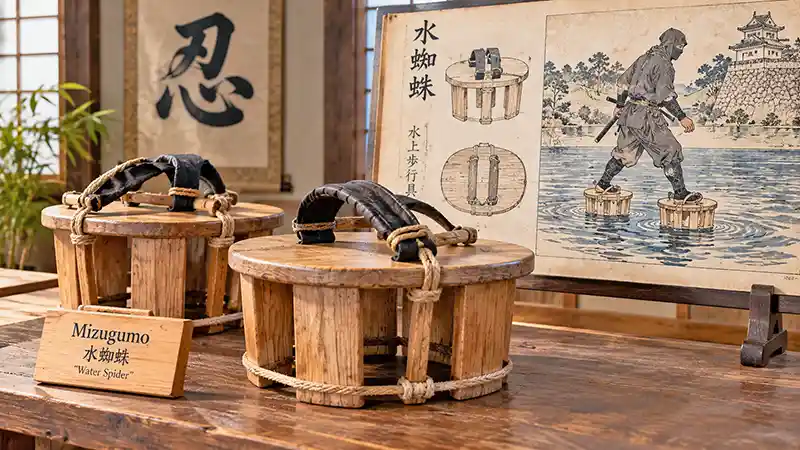
The strange object at the center of the ninja water-walking story is usually called the mizugumo, a name commonly translated as "water spider." Reconstructions vary, but one of the most familiar versions consists of a broad wooden or buoyant frame associated with the feet. Strap something like that beneath a shinobi, the story suggests, and the increased surface area would allow him to cross water without sinking like an ordinary person.
It is easy to understand why the idea became famous. Moats, rivers, marshes, and flooded ground could present serious obstacles to anyone attempting infiltration or escape. If a piece of specialized ninja equipment really allowed a shinobi to cross those obstacles while remaining above the surface, it would have been an extraordinary advantage. The device also fits perfectly with the later image of ninjas carrying ingenious tools for overcoming seemingly impossible barriers.
Historical illustrations associated with ninjutsu have helped keep the idea alive, because they appear to show unusual equipment intended for movement around water. The difficult part is determining exactly how those objects were supposed to be used. A drawing can preserve the shape of a device without preserving every detail of its operation, and later interpreters can easily turn an unfamiliar tool into something much more spectacular. Before accepting the image of a ninja calmly walking across a castle moat, there is one unavoidable question: would the physics actually allow it?
The Physics Creates a Pretty Serious Problem
The easiest way to test the traditional water-walking interpretation is to forget about ninjas for a moment and think about buoyancy. A person standing on water needs to displace enough water to support the weight of both the person and whatever equipment they are wearing. That requires considerably more volume than a pair of relatively small wooden platforms can provide.
Imagine a shinobi weighing roughly 150 pounds. Even before adding clothing and equipment, his flotation devices would need to displace roughly the same weight in water to keep him at the surface. Two compact platforms strapped beneath his feet simply do not contain enough buoyant volume to accomplish that. Instead of standing neatly on top of the moat, the wearer would sink until enough of his body and equipment entered the water to provide the necessary displacement.
Balance would make the situation even worse. A person's center of gravity is high above the tiny floating platforms beneath their feet, turning each step into a fight against tipping sideways. Anyone who has tried standing on a small floating object knows how quickly it rolls or slides away beneath them. Trying to quietly cross a castle moat this way while carrying ninja gear would be less like supernatural stealth and more like an extremely complicated way to fall into the water.
That does not necessarily mean the mizugumo was useless. It suggests something more interesting: perhaps generations of people have been asking the wrong question about what the device was actually designed to do.
The Mizugumo May Never Have Been Water Shoes at All

This is where the story becomes much stranger. The familiar interpretation assumes that the mizugumo was worn as a pair, with one flotation device strapped beneath each foot. But that assumption may be the very thing that turned an unusual historical tool into a seemingly impossible ninja invention. Some researchers and modern reconstructions have proposed that devices associated with the mizugumo could have been used very differently, including as a larger flotation aid rather than as two magical shoes.
That interpretation immediately makes more practical sense. Instead of attempting to stand upright on tiny floating platforms, a shinobi could use buoyant equipment to help support the body while moving through water. The result would not look anything like walking across the surface. The person would still get wet and would probably have to paddle, kick, or otherwise propel themselves forward, but even modest additional flotation could make crossing a moat or river easier while carrying equipment.
There is also a broader lesson here about supposedly bizarre ninja weapons and tools. Historical drawings can show us that an object existed within a tradition without giving modern viewers a perfect instruction manual for how it was used. Once an unfamiliar device receives an exciting explanation, that explanation can be repeated in books, demonstrations, museums, and popular culture until it begins to feel like established history.
The difference is enormous. A ninja walking upright across water would require equipment capable of overcoming a serious physical problem. A ninja using specialized equipment to help cross difficult water is entirely believable. Somewhere between those two ideas, the legend of the ninja who could walk on water may have been born.
Another Theory Puts the Mizugumo in the Mud

Water is not the only difficult terrain a shinobi might have needed to cross. Japan's rice paddies, wetlands, muddy riverbanks, and marshy ground could become deep enough for an ordinary foot to sink with every step. That has led to another intriguing interpretation of the mizugumo: perhaps at least some devices described as water-crossing equipment were intended to help a person move over soft mud rather than float on open water.
In that role, a broad platform beneath the foot suddenly becomes much easier to explain. Spreading a person's weight across a larger surface area reduces the pressure placed on the ground, much like a snowshoe helps keep someone from sinking deeply into snow. A wooden frame would not need enough buoyancy to support an entire human body. It would simply need to distribute weight well enough to make swampy or muddy terrain easier to cross.
That could have been genuinely useful for covert movement. Mud can slow a traveler, pull footwear loose, leave obvious footprints, and turn an otherwise simple escape route into an exhausting obstacle. Specialized equipment that made difficult terrain more manageable would fit comfortably alongside the climbing aids, ropes, and other practical tools traditionally associated with shinobi. It is the same reason unusual devices deserve to be examined as functional equipment before assuming their most spectacular explanation is correct.
The irony is that this version of the story is far less exciting than walking across a moat, but considerably easier to reconcile with physics. A device remembered as a pair of miraculous "water shoes" may instead have been useful precisely because it solved a much more ordinary problem.
Real Ninjas Still Had Good Reasons to Cross Water
Even if the famous water-walking shoes were misunderstood, the problem they supposedly solved was very real. Rivers, canals, marshes, and castle moats were part of the landscape a shinobi might encounter while scouting, infiltrating, carrying messages, or escaping. Knowing how to deal with water would therefore have been far more useful than possessing a single miraculous gadget.
Historical ninjutsu traditions describe a much broader approach to difficult terrain. Swimming, judging water conditions, improvising flotation, protecting equipment from moisture, and choosing an unexpected crossing point could all be more valuable than attempting to stroll across the surface. A moat that looked like an obstacle to everyone else might actually provide concealment if a skilled infiltrator was willing to enter the water rather than approach the guarded bridge or gate.
This practical mindset also helps explain why so much unusual ninja climbing equipment became surrounded by extraordinary stories. Shinobi needed ways to negotiate walls, rough terrain, buildings, waterways, and other obstacles without attracting attention. The real ingenuity was not necessarily inventing devices that seemed to defy physics. It was finding unconventional ways around problems that other people assumed could not be crossed.
A shinobi who quietly swam a moat using a simple flotation aid is less spectacular than one walking across it, but from the perspective of the guards on the opposite bank, the result could have been exactly the same: someone had reached a place they were not supposed to be.
Ninja Footwear Has Attracted Strange Claims Before
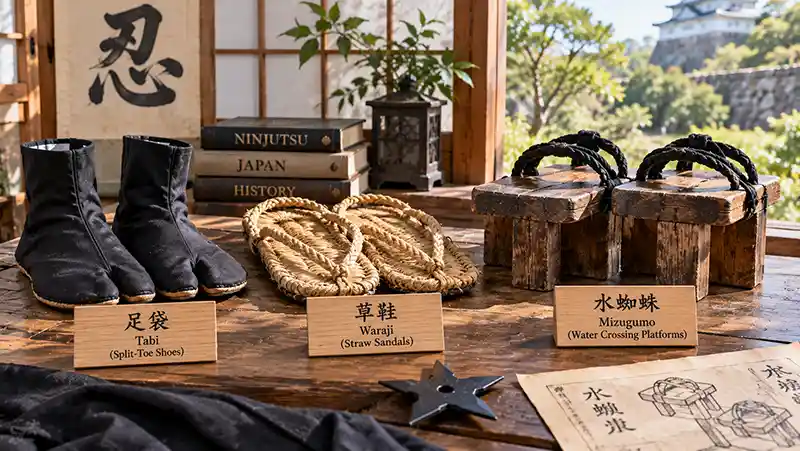
The mizugumo is not the only piece of ninja footwear that has acquired abilities far beyond what a pair of shoes could realistically provide. Even the split-toe footwear commonly associated with ninjas has been credited with improving balance, making climbing easier, increasing agility, and allowing a shinobi to move almost silently. Some of those claims contain a grain of practical logic, but they can quickly become exaggerated when ordinary equipment is viewed through the larger ninja legend.
Traditional Japanese tabi were not invented specifically for ninjas, and split-toe footwear existed within Japanese society far beyond the world of espionage. The separation between the big toe and the others had practical connections to the sandals and footwear people already wore. Later popular culture helped transform that familiar design into something that looked uniquely engineered for stealth.
The same pattern may help explain the water shoes. Once ninjas became famous for possessing specialized equipment, almost any unusual object associated with them could acquire an extraordinary purpose. Footwear for difficult terrain becomes footwear that prevents sinking. Equipment used around water becomes equipment that floats. Eventually, a practical device becomes a pair of shoes that supposedly allows someone to walk across a moat.
That is why the history behind why ninjas wore split-toe shoes is such a useful comparison. The real story of ninja footwear is usually more complicated than the superhuman explanation, and often more interesting once the legend is stripped away.
Modern Reconstructions Can Accidentally Make the Legend Look More Certain
One reason the water-walking story remains so convincing is that people can now see physical mizugumo reconstructions in museums, demonstrations, books, and online photographs. Once an object is sitting behind glass with a label explaining what it is, it is natural to assume that historians know exactly how the original device worked. But a reconstruction is still an interpretation of historical evidence, not necessarily an untouched artifact accompanied by complete instructions from the person who used it.
That distinction matters enormously with unusual equipment. A historical illustration may reveal the general shape of an object while leaving its materials, dimensions, assembly, or intended method of use uncertain. A modern craftsperson then has to fill in those missing details. If the reconstruction begins with the assumption that the object was a water-walking shoe, the finished version will naturally look like a water-walking shoe. Later photographs of that reconstruction can then be presented as evidence that ninjas possessed water-walking shoes in the first place.
This is one of the traps that makes the history of ninja weapons and their famous myths so fascinating. Physical replicas make legendary objects feel tangible, but tangibility is not the same thing as certainty. Sometimes the most recognizable version of a historical tool tells us as much about modern interpretation as it does about the people who supposedly carried it centuries ago.
The mizugumo therefore presents two separate questions that are easy to confuse. Did historical ninja traditions contain unusual equipment associated with crossing difficult terrain and water? There is good reason to take that idea seriously. Did shinobi routinely strap small platforms beneath their feet and walk upright across castle moats? That much more spectacular claim deserves considerably more skepticism.
Walking Across a Castle Moat Would Have Been a Terrible Way to Stay Hidden
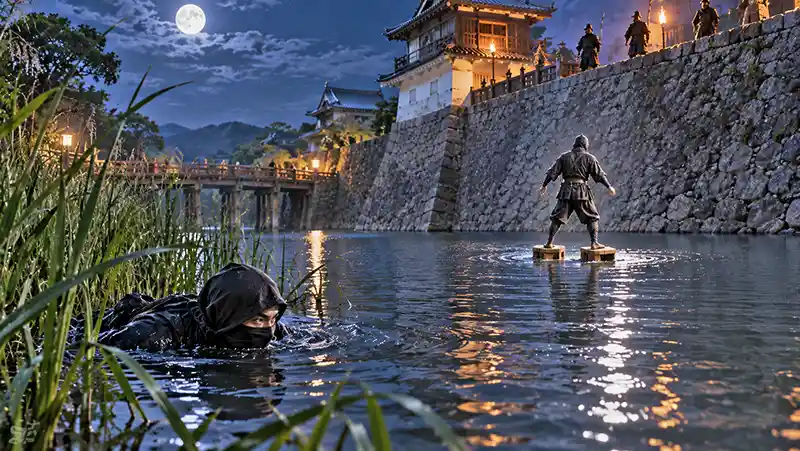
There is another problem with the classic story that has nothing to do with buoyancy. Even if a pair of miraculous shoes could support a person on water, walking upright across the middle of a castle moat would make a shinobi remarkably easy to see. The entire body would be exposed above the surface, and every awkward step could create ripples and movement visible from the walls.
Swimming presents almost the opposite profile. A person moving quietly through dark water could keep most of the body submerged, especially if the goal was simply to reach another bank rather than move quickly. Reeds, shadows, bridge supports, embankments, and other features could provide additional concealment. Crossing at night or during poor weather could make the approach even harder to notice.
That difference reveals something important about the popular image of ninjas. Many legendary techniques are impressive precisely because an audience can see them. Real infiltration works best when there is no audience at all. A shinobi attempting to enter a guarded location would have little reason to choose the most visually astonishing method if a quieter and less conspicuous alternative existed.
In other words, walking on water would have been an incredible trick, but swimming through it may have been much better ninjutsu.
The Water-Walking Legend Was Almost Too Good Not to Survive
Once ninjas entered popular storytelling, the mizugumo had everything necessary to become legendary. It was strange-looking, associated with secretive warriors, and could be explained with a single irresistible sentence: ninjas had special shoes that let them walk on water. That version is far easier to remember than a complicated discussion about flotation aids, marsh crossings, historical illustrations, and uncertain interpretations.
It also fit the increasingly superhuman image of the ninja. Stories already credited shinobi with extraordinary climbing abilities, near-silent movement, ingenious hidden weapons, disappearing tricks, and escapes that seemed impossible. Walking across water did not feel out of place beside those abilities. Instead, it reinforced the idea that ninjas possessed secret knowledge unavailable to ordinary warriors.
Over time, repetition can make a claim feel like evidence. Illustrations inspire reconstructions, reconstructions appear in books and displays, and those displays inspire new illustrations. Eventually the familiar image becomes so deeply associated with ninjas that questioning it feels almost like questioning whether the device existed at all. But those are two different questions.
The more interesting possibility is that the legend preserved the memory of something real while completely transforming what made it useful. Shinobi may indeed have employed specialized methods for crossing difficult terrain and water. The part that probably grew in the telling was the idea that they could simply strap something to their feet and stroll across a moat as if it were solid ground.
The Real Skill Was Probably Choosing the Right Way Across
The obsession with water shoes can distract from a more believable form of expertise. A shinobi did not need to defeat water itself. He needed to understand the terrain well enough to cross it without being caught. That could mean finding a shallow section, approaching through reeds, swimming beneath a bridge, using a simple flotation aid, waiting for darkness, or avoiding the water entirely.
Reconnaissance would have mattered just as much as specialized equipment. Knowing where guards were positioned, how deep a moat was, whether the banks were steep, where vegetation provided cover, and which areas could be approached without creating noise could turn an intimidating obstacle into a manageable one. The cleverest solution might have involved no unusual device whatsoever.
That practical flexibility is easy to lose when historical shinobi are reduced to collections of exotic gadgets. The tools associated with them are fascinating, but tools only make sense in relation to the problem being solved. A rope is useful when there is something to climb. A flotation device is useful when there is water to cross. Neither needs supernatural properties to become valuable in the hands of someone who knows when and where to use it.
In that sense, the truth behind ninja water shoes fits the broader history of ninjutsu remarkably well. The legendary version focuses on an impossible feat. The more believable version focuses on preparation, improvisation, and finding a route that an opponent did not expect anyone to use.
So Could Ninjas Really Walk on Water?
Probably not in the way the legend suggests. There is no convincing reason to believe that historical shinobi could strap small wooden platforms beneath their feet and casually walk upright across deep water. The basic requirements of buoyancy and balance make the familiar version extremely difficult to reconcile with physics, and from a stealth perspective, standing fully exposed in the middle of a moat would have offered few advantages anyway.
That does not mean the entire mizugumo story should simply be dismissed as fiction. Historical ninja traditions contain references to specialized tools and techniques for overcoming difficult terrain, and devices later interpreted as water-crossing equipment may have served practical purposes. They could have assisted with flotation, helped negotiate marshy ground, or been used in ways that modern reconstructions do not perfectly preserve.
What almost certainly changed was the story surrounding the equipment. A device that helped someone cross difficult terrain is useful. A secret ninja invention that allows someone to walk across water is unforgettable. Once that interpretation became attached to the mysterious world of the shinobi, it had everything necessary to survive for generations.
So the ninja who calmly walks across a castle moat probably belongs to legend. The historical shinobi who studied the terrain, entered the water where nobody was watching, and used whatever equipment made the crossing easier is far more believable, and arguably far more impressive.
The Truth Is Better Than Walking on Water
The image of a ninja stepping effortlessly across a moonlit moat is exactly the kind of legend that has kept shinobi fascinating for centuries. It transforms a difficult obstacle into another demonstration of mysterious ninja technology, and the strange appearance of the mizugumo makes the story just believable enough to survive.
But stripping away the supernatural part does not make the history less interesting. Real shinobi had practical reasons to understand waterways, marshes, castle defenses, and difficult terrain. Specialized equipment could help them overcome those obstacles, even if it could not magically support a person standing on the surface of deep water. The ingenuity was in solving the problem, not violating the laws of physics.
That may be the most revealing thing about ninja legends in general. The historical shinobi was already interesting enough: an infiltrator willing to study an obstacle, improvise with unusual equipment, and approach from a direction nobody expected. Centuries of storytelling simply took that ingenuity and pushed it one step further. A tool that might help a ninja cross water eventually became a tool that let him walk on it.
Frequently Asked Questions
What Were Ninja Water Shoes Called?
The unusual devices commonly described as ninja water shoes are usually called mizugumo, a Japanese term often translated as "water spider." They have become closely associated with stories of shinobi using specialized equipment to cross rivers, ponds, marshes, and castle moats.
The name does not necessarily prove that the devices functioned like shoes that allowed someone to walk on top of deep water. Exactly how equipment identified as mizugumo was intended to be used remains much more complicated than the popular legend suggests.
Did Ninjas Really Have Shoes That Let Them Walk on Water?
There is little reason to believe ninjas could strap small wooden devices beneath their feet and walk upright across deep water as they are sometimes depicted doing. Supporting a human body requires enough buoyancy to displace a substantial amount of water, and relatively small platforms would not provide enough flotation.
The legend may instead preserve a distorted memory of equipment intended to assist with crossing water, mud, marshes, or other difficult terrain.
How Did Mizugumo Work?
That is one of the biggest unanswered questions surrounding the mizugumo. Popular reconstructions often show broad wooden devices attached to the feet, supposedly allowing the wearer to move across water. The physics of that arrangement make the traditional water-walking interpretation questionable.
Alternative explanations suggest that related equipment could have functioned as flotation aids or helped distribute a person's weight across muddy ground. Historical illustrations can preserve the appearance of unusual equipment without necessarily telling modern viewers exactly how it was operated.
Would Ninja Water Shoes Actually Float?
Wooden components can certainly float, but that does not mean a small wooden platform can keep a person standing above the surface. A flotation device must displace enough water to support the combined weight placed upon it.
A pair of compact wooden platforms might provide some buoyancy, but keeping an adult upright and stable on deep water would require considerably more displacement and stability than the familiar water-shoe design appears to offer.
Were Mizugumo Used for Walking Through Mud?
One theory is that devices interpreted as water shoes may have been useful on mud, marshy ground, or similarly soft terrain. A broad platform spreads a person's weight over a larger area, reducing the pressure exerted on the ground and potentially limiting how deeply the foot sinks.
This would make the basic concept somewhat similar to a snowshoe. It is a much less spectacular explanation than walking across a moat, but it requires no extraordinary buoyancy and would have had practical value in certain environments.
How Did Ninjas Cross Castle Moats?
There was unlikely to be one universal ninja technique for crossing a moat. Depending on the location, a shinobi could potentially swim, use flotation equipment, cross at a shallow or concealed location, move beneath or around structures, or simply choose an entirely different approach.
Reconnaissance would have been crucial. Knowing the depth of the water, location of guards, available cover, condition of the banks, and surrounding terrain could be more valuable than possessing a specialized gadget.
Did Ninjas Know How to Swim?
Swimming and water-crossing skills are traditionally associated with ninjutsu, which makes practical sense for people expected to travel, scout, infiltrate, and escape across varied terrain. Rivers, wetlands, canals, and defensive moats could all create situations in which being comfortable around water was valuable.
For a covert infiltrator, swimming could also be more useful than walking upright across water. Keeping most of the body submerged offered a much lower profile than standing exposed above the surface.
Did Ninjas Use Special Equipment for Crossing Water?
Historical ninja traditions include specialized tools associated with overcoming obstacles and difficult terrain, including equipment connected with water travel. The difficult question is determining exactly how individual devices were used and whether later interpretations accurately preserve their original purpose.
The existence of unusual water-crossing equipment is therefore much more plausible than the specific claim that ninjas possessed shoes capable of letting them stroll across deep water.
Are Museum Mizugumo Historically Accurate?
Museum displays and modern replicas can be valuable for understanding historical equipment, but reconstructions should not automatically be treated as proof of exactly how an object was used. When the surviving evidence is incomplete, reconstructing an unusual device requires modern craftspeople and researchers to make interpretive decisions.
This is especially important with the mizugumo. A reconstruction based on the assumption that it was a water-walking shoe can make that interpretation appear more certain than the historical evidence actually allows.
Why Did People Believe Ninjas Could Walk on Water?
The idea fits perfectly with the larger legend of the ninja as someone capable of seemingly impossible feats. Once unusual water-crossing equipment became associated with shinobi, transforming a practical tool into secret footwear that allowed ninjas to walk on water was an easy leap for storytellers and popular culture.
It also makes for a much better story. A ninja carefully swimming across a moat with flotation equipment is plausible. A ninja silently walking across its surface appears almost supernatural, which is exactly why that version became so memorable.
You May Also Be Interested In:
- Why Ninjas Wore Split-Toe Shoes (And Whether They Actually Helped)
- The Truth About Ninja Weapons: 7 Myths Debunked
- Did Ninjas Really Use Poisoned Weapons?
- Did Ninjas Really Use Straight Swords?
- Did Ninjas Actually Throw Smoke Bombs to Disappear?
- The Untold History of Female Ninjas: Secrets of the Kunoichi
- Ninja Science
- Four Ninja Costumes We Guarantee You've Never Seen Before!
- 2018: The Year of the Ninja
- What's Your Favorite Ninja Star?
Leave a Reply