



Did Ninjas Really Use Straight Swords?
August 12th, 2026
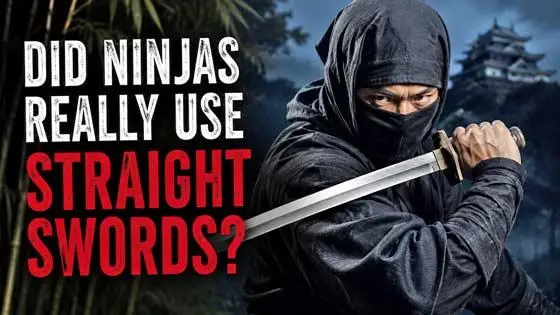
Few weapons are more instantly associated with the ninja than the straight-bladed ninjato. Movies, video games, martial arts catalogs, and modern demonstrations have made its square guard and short, straight blade almost as recognizable as the curved katana of the samurai. There is just one problem: historians have remarkably little evidence that the iconic "ninja sword" existed in this standardized form during the period when historical shinobi were actually active. That does not mean ninja never carried swords, nor does it mean every story about their weapons is fiction. The real mystery is more interesting. If historical ninja used swords, what did those weapons actually look like, and where did the straight-bladed ninjato we recognize today come from?
The Famous Ninjato Has a Surprisingly Modern Problem
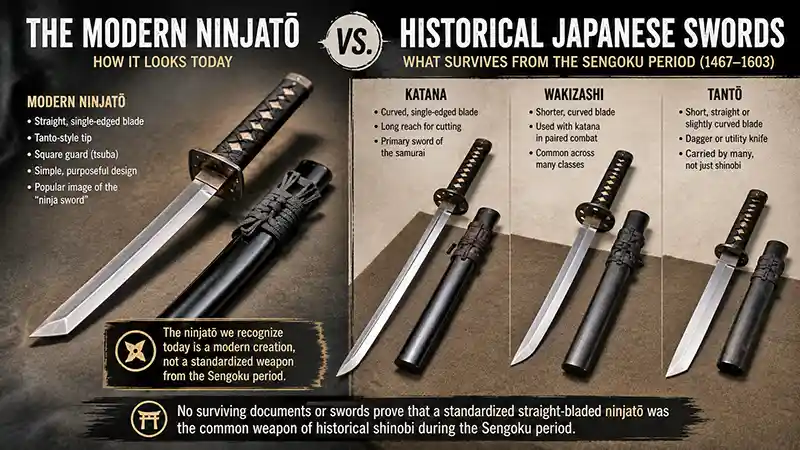
The sword most people picture as a "ninja sword" has a remarkably consistent appearance: a relatively short straight blade, a large square guard, and a dark scabbard designed to look simple and utilitarian. Modern ninja swords still commonly follow this pattern. The difficulty begins when we try to trace that exact design backward through Japanese history.
There are no securely documented surviving swords from Japan's Sengoku period that historians can confidently identify as standardized ninjato made specifically for shinobi. Period texts associated with ninjutsu discuss swords and methods for carrying or using equipment, but they do not provide clear evidence for a separate class of straight-bladed ninja sword matching the familiar modern version.
That absence matters because Japan preserved an enormous number of swords, sword fittings, illustrations, inventories, and written traditions. If large numbers of professional shinobi had routinely carried a distinctive straight sword unlike those used by other people around them, we might reasonably expect stronger physical or documentary evidence to have survived.
None of this proves that a historical ninja never possessed a straight sword. Individual weapons varied, older blades could be reused, and covert operatives had little reason to follow a standardized equipment catalog. What the evidence challenges is the much bigger claim that the straight-bladed ninjato was the universal or defining sword of the historical ninja.
Historical Ninja Probably Used the Swords Everyone Else Used
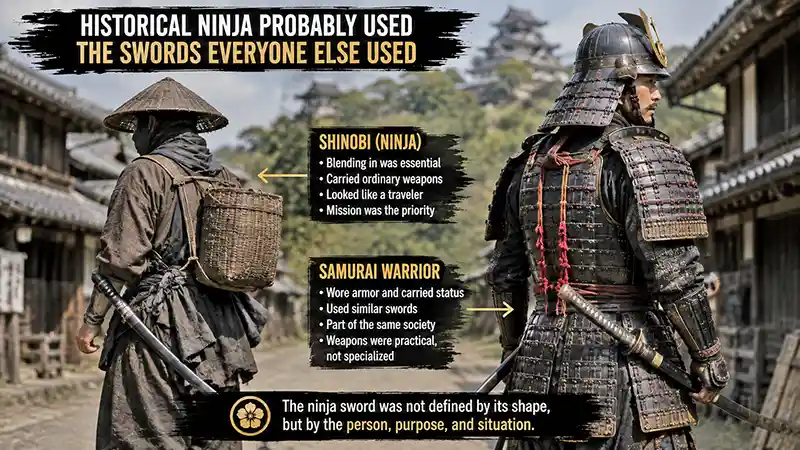
The popular image of the ninja as a completely separate warrior class with its own uniform, weapons, and equipment can be misleading. Historical shinobi were scouts, infiltrators, messengers, intelligence gatherers, and sometimes fighters operating within the same society as samurai and other warriors. Many were themselves members of the samurai class or served powerful military families. There was little reason for them to carry a conspicuously unique sword that immediately announced what they were.
A more practical choice would have been whatever sword was available, appropriate, and ordinary enough not to attract attention. During the periods most strongly associated with historical shinobi, that could include curved Japanese blades similar to the samurai swords carried by other warriors. Shorter blades and daggers could also make sense depending on the mission and circumstances.
This fits the basic purpose of covert activity far better than the modern stereotype. Someone attempting to enter enemy territory, gather information, or move unnoticed would gain little from carrying a weapon that effectively said "ninja" the moment anyone saw it. Blending in could be more valuable than possessing specialized equipment.
The irony is that the historically plausible ninja sword may have looked disappointingly ordinary. Instead of a secret weapon forged exclusively for shadow warriors, it was probably often just a sword. What made it a ninja weapon was the person carrying it and the way it was used.
But Straight Japanese Swords Really Did Exist
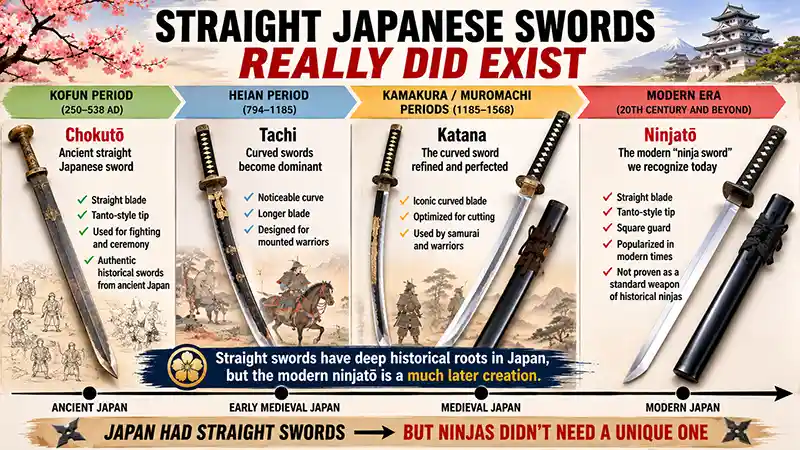
The lack of evidence for a standardized straight ninja sword does not mean straight swords were unknown in Japan. Centuries before the age most closely associated with shinobi, Japanese swordmakers produced straight or nearly straight blades commonly grouped under the term chokuto. Examples survive from Japan's ancient Kofun and Nara periods, long before the familiar curved form of the later Japanese sword became dominant.
That timeline is crucial. Chokuto demonstrate that a straight Japanese sword is historically authentic, but they do not prove that ninja hundreds of years later carried them as specialized weapons. By the medieval and Sengoku periods, curved swords had long since become firmly established in Japanese warfare. Connecting an ancient straight sword directly to the much later ninjat?? simply because both have straight blades skips centuries of sword development.
There were also variations in curvature among later Japanese blades. Not every sword had the dramatic arc people associate with a katana, and some could appear comparatively straight. Blades were remounted, shortened, inherited, repaired, and reused over generations, creating far more variety than modern categories sometimes suggest.
This is where the ninja sword debate becomes particularly easy to muddle. The statement "Japan had straight swords" is absolutely true. The statement "therefore historical ninja carried the modern straight-bladed ninjato" does not automatically follow. Those are two very different historical claims.
The Straight Blade May Have Survived Because It Made a Better Story
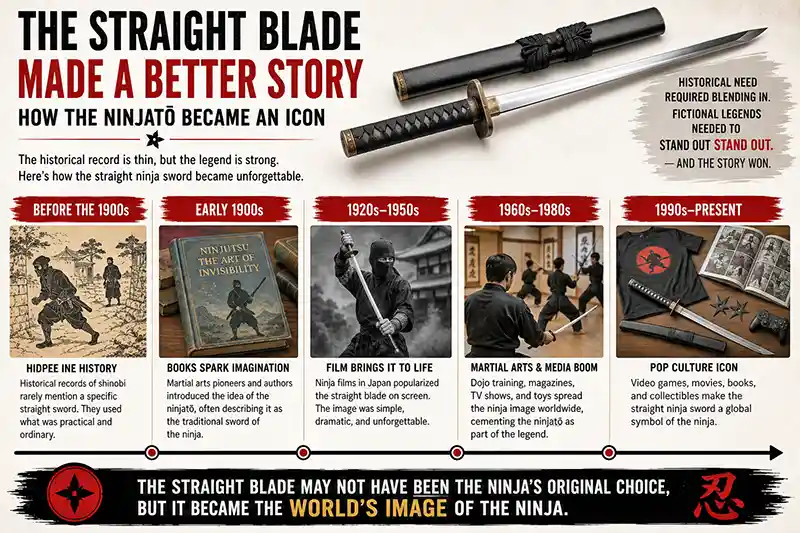
If the historical evidence for a standardized ninjato is so thin, why has the straight sword become inseparable from the ninja? One likely answer is visual storytelling. A curved katana immediately evokes the samurai. Giving the ninja a short, straight blade created an equally recognizable silhouette and made it easy for audiences to tell the two warriors apart at a glance.
That distinction became especially powerful as ninjas exploded into international popular culture during the 20th century. Martial arts demonstrations, books, films, television, toys, and eventually video games helped establish a visual vocabulary for the ninja: black clothing, throwing stars, specialized climbing equipment, and the straight sword with its characteristic square guard. Repetition gradually made the design feel ancient, even when the historical trail behind it was surprisingly difficult to find.
The process is similar to what happened with many supposed ninja weapons. Some have genuine historical connections to Japanese warfare or everyday tools, while others acquired a specifically "ninja" identity much later. Once an object becomes strongly associated with shinobi in popular culture, separating documented history from modern tradition can become surprisingly difficult.
Ironically, the straight blade may have succeeded precisely because it looks different from a samurai sword. Historical shinobi had reasons to blend in. Fictional ninjas needed exactly the opposite: a weapon audiences could recognize instantly.
The Square Guard Is Just as Mysterious as the Straight Blade
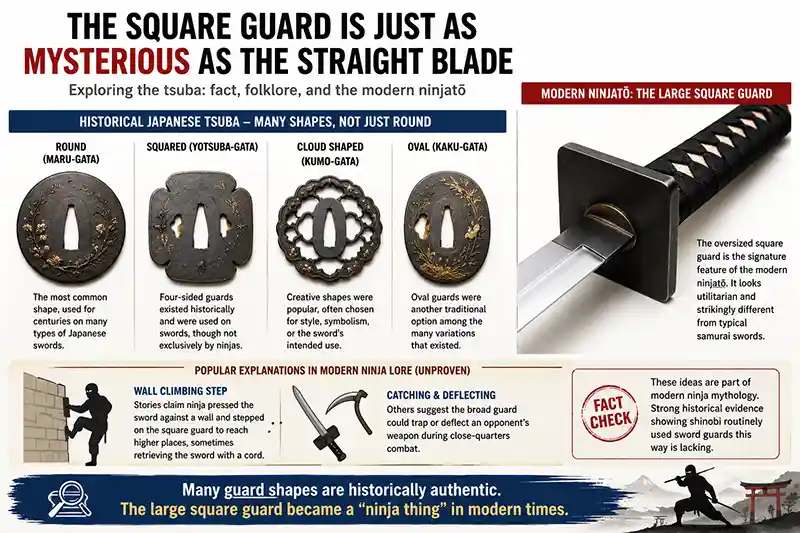
The blade is not the only feature that makes the modern ninjato instantly recognizable. Most versions also have a large square or rectangular tsuba, the hand guard positioned between the blade and handle. It creates a stark, utilitarian appearance that looks completely different from the rounded and intricately decorated guards commonly associated with Japanese swords.
Popular explanations often give the square guard a secret secondary purpose. One story claims ninja could press the sword against a wall and step on the oversized guard to gain extra height while climbing, sometimes retrieving the weapon afterward with a cord attached to the scabbard. Another suggests the broad guard was useful for catching weapons or performing specialized techniques. These ideas appear frequently in modern ninja lore, but strong period evidence showing historical shinobi routinely using sword guards this way is difficult to find.
Square Japanese sword guards themselves were certainly not impossible or unknown. Historical tsuba survive in many shapes, including four-sided designs. The questionable part is treating a large square guard as a standardized feature created specifically for ninja. Much like the straight blade, an authentic element of Japanese weapon design appears to have become much more narrowly associated with shinobi in modern culture.
That pattern is important because ninja mythology often works by combining things that genuinely existed into a package that may never have existed in quite that form. Swords were real. Square guards were real. Shinobi were real. The familiar black, straight-bladed, square-guarded ninjato is where the historical certainty begins to disappear.
Historical Ninjutsu Texts Make the Story More Complicated
If the ninjato had been a defining weapon of the historical ninja, surviving ninjutsu manuals would seem like an obvious place to find it. Important texts such as the 17th-century Bansenshukai preserve information about infiltration, disguises, tools, explosives, climbing equipment, intelligence gathering, and other techniques associated with shinobi. Yet they do not clearly establish the familiar straight-bladed, square-guarded ninjato as a standard ninja sword.
This is particularly interesting because historical ninjutsu writings were not shy about discussing specialized equipment. They describe ingenious tools for entering buildings, crossing obstacles, creating distractions, carrying fire, and operating after dark. In other words, these sources contain exactly the sort of material where a purpose-built secret sword might be expected to appear if it were truly central to shinobi equipment.
Swords do appear in ninja traditions, but that is very different from evidence for a unique sword design. Later accounts and martial traditions sometimes describe unconventional ways of carrying a sword, using the scabbard, manipulating the sageo cord, or adapting an ordinary weapon to unusual circumstances. The specialization may therefore have been found more in technique than in the blade itself.
This is one of the recurring problems examined in the truth about historical ninja weapons. Shinobi really did use specialized equipment, but centuries of storytelling have made it surprisingly difficult to determine which objects belonged to historical espionage and which became "ninja weapons" much later.
The Ninja Was Not a Separate Type of Warrior
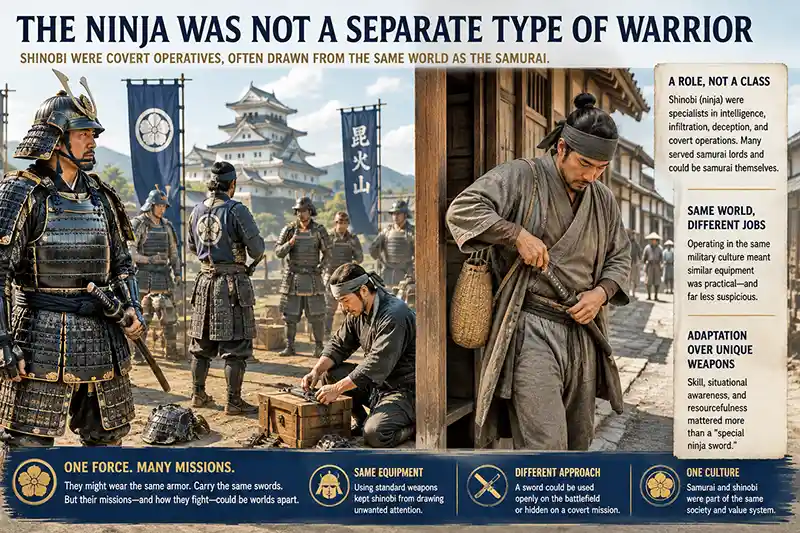
One reason the ninjato myth is so persistent is that modern popular culture tends to divide samurai and ninja into opposing categories. Samurai are portrayed as honorable armored warriors carrying curved swords, while ninja become secretive outsiders equipped with an entirely different arsenal. Historical Japan was considerably messier than that distinction suggests.
Shinobi was primarily a role or function involving activities such as reconnaissance, infiltration, intelligence gathering, deception, and covert operations. Men performing those tasks could serve samurai lords and could themselves come from the warrior class. A person did not necessarily stop being a samurai because he was assigned to gather intelligence or infiltrate enemy territory.
This changes the sword question considerably. If shinobi were operating within the same military culture as other Japanese warriors, there is no reason to assume they required an entirely separate family of swords. A conventional weapon could be acquired, repaired, carried openly when appropriate, and most importantly, would not immediately identify its owner as someone involved in covert activity.
The familiar image of a samurai facing a black-clad ninja with two completely different swords makes excellent entertainment. Historically, the more intriguing possibility is that the two men might have belonged to the same army, carried similar weapons, and simply been given very different jobs.
A Shorter Sword Would Make Sense, Even Without a Special Ninja Design
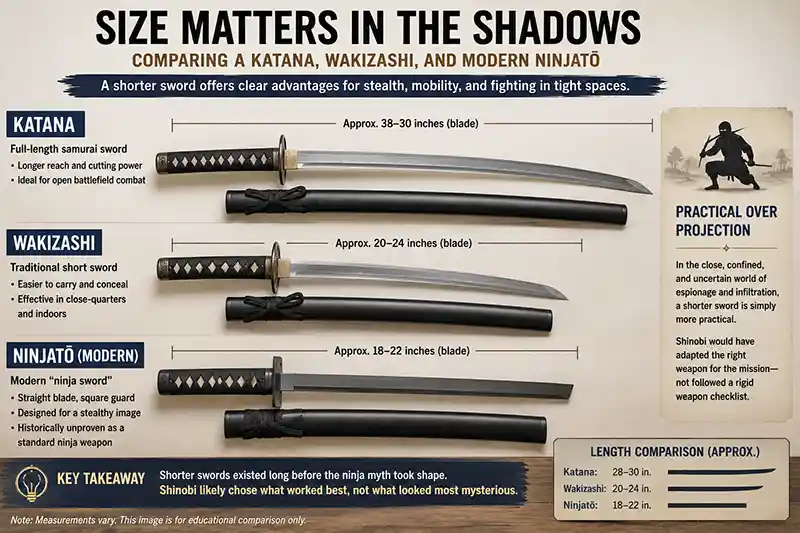
One feature of the modern ninjato may have a practical logic behind it: many examples are shorter than a typical katana. A compact sword would be easier to carry through buildings, forests, narrow passages, and other confined environments where a long blade could become cumbersome. For someone concerned with mobility rather than formal battlefield combat, that could be genuinely useful.
Japan already had shorter swords, however, so shinobi did not need a unique weapon to gain that advantage. Wakizashi and other compact blades existed within ordinary Japanese sword culture. A shorter blade could also be mounted in different fittings or carried according to the needs and social circumstances of its owner.
This creates another place where a plausible idea can quietly become a historical "fact." A shinobi certainly could have preferred a shorter sword for a particular mission. That does not prove that sword was straight, equipped with an oversized square guard, or manufactured as a dedicated ninja weapon. Practical choices made by individuals are not the same thing as a standardized weapon type.
If anything, variety would have suited covert work better. The ideal weapon for a traveler entering a town might be different from the one chosen by someone scouting a battlefield or moving through a fortified residence. The historical ninja's greatest advantage was adaptability, not conformity to the equipment checklist that later popular culture created for him.
The Scabbard May Have Been More Useful Than the Sword
Some of the most interesting traditions surrounding ninja swords have little to do with the blade. The scabbard, or saya, could potentially be treated as another piece of equipment rather than simply a protective sheath. Historical ninjutsu traditions emphasize improvisation, and later accounts describe sword scabbards being adapted for purposes far removed from ordinary swordsmanship.
One recurring idea is that an unusually long scabbard could conceal a shorter blade while leaving empty space near the tip. In theory, that space could hold small objects or supplies. Other stories describe removing the sword and using the hollow scabbard as a breathing tube while hiding in water. The latter has become one of the classic ninja legends, but it should be treated cautiously. Breathing through a long narrow tube while submerged presents obvious practical difficulties, and popular depictions often make the technique look far easier than it would actually be.
More plausible is the broader principle behind these stories. Someone engaged in reconnaissance or infiltration benefited from equipment that could perform more than one job. A cord attached to the scabbard could have practical uses, and an ordinary object adapted to an unexpected purpose fit the resourcefulness emphasized in historical accounts of shinobi far better than carrying an arsenal of conspicuously specialized gadgets.
This is also why the history of ninja gear becomes so difficult to separate from folklore. Some ingenious tools are documented, others are plausible reconstructions, and still others became attached to the ninja centuries later. The scabbard stories occupy that fascinating territory where practical improvisation and legend have become intertwined.
Why Would a Ninja Want a Sword That Looked Ordinary?
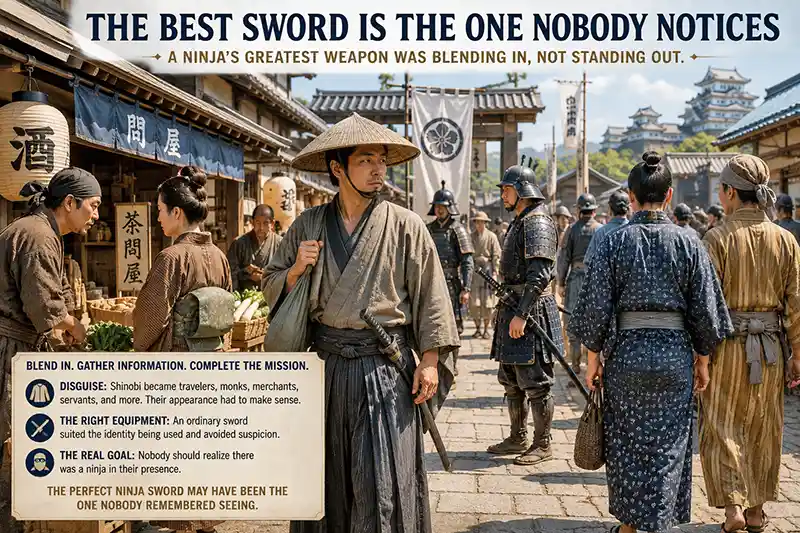
The strongest argument against a standardized, instantly recognizable ninja sword may be the simplest one: covert operatives generally benefit from not looking like covert operatives. A distinctive straight blade with an oversized square guard might look perfect on a modern ninja, but in historical Japan an unusual weapon could attract exactly the kind of attention a shinobi was trying to avoid.
Historical accounts of ninjutsu place considerable importance on disguise and deception. Shinobi might present themselves as travelers, religious figures, merchants, servants, or other people who had legitimate reasons to be where they were. Clothing, behavior, local knowledge, and believable equipment could all contribute to maintaining that disguise. Carrying a weapon appropriate to the identity being assumed would make far more sense than carrying one that marked its owner as a specialist in infiltration.
This helps explain why the search for a single definitive ninja sword may be misguided. Different missions could require different appearances. A warrior traveling openly might carry a conventional sword, while someone adopting a less conspicuous identity might choose a smaller weapon or avoid an obvious sword entirely. The goal was not to look like a ninja. The goal was to make sure nobody realized there was a ninja present.
That idea also turns one of the most famous images in martial arts history upside down. The perfect historical ninja sword may not have been the strange weapon that immediately caught everyone's eye. It may have been the completely ordinary one that nobody remembered seeing.
So When Did the Modern Ninjato Actually Appear?
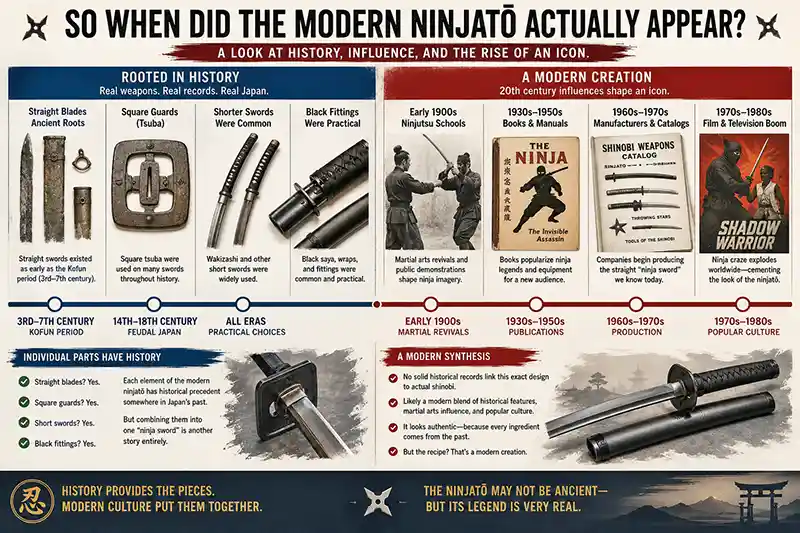
This is where the mystery becomes especially revealing. While historical Japanese swords can often be traced through surviving blades, dated fittings, artwork, inventories, and written records, the familiar straight-bladed ninjato becomes much easier to find in the modern era than in the age of the shinobi themselves. Its recognizable combination of a straight blade, angular tip, square guard, and black utilitarian fittings appears to have been standardized comparatively recently.
Pinning down a single inventor is difficult. Modern martial arts traditions helped popularize particular ideas about ninja equipment during the 20th century, while books, demonstrations, manufacturers, films, and television reinforced the same visual design. By the time the international ninja craze accelerated in the 1970s and 1980s, the straight ninja sword was perfectly suited to become part of the character's instantly recognizable silhouette.
That does not necessarily mean somebody simply invented the entire weapon from nothing. The modern design combines features that have historical precedents in Japanese weaponry: straight blades existed, square guards existed, shorter swords existed, and black sword fittings certainly existed. What remains elusive is convincing evidence that these features were combined into one standardized sword specifically associated with historical shinobi.
In that sense, the ninjato may be less a surviving medieval artifact than a modern synthesis of older Japanese weapon features. It looks historically plausible because almost every individual ingredient has roots in the past. It is the complete recipe, and its supposed exclusive connection to ninja, that becomes difficult to document.
Did Ninja Ever Use Straight Swords at All?
This is where the answer needs some nuance. Saying there is little evidence for the standardized ninjato is not the same as saying no historical shinobi ever carried a straight blade. Japan had an enormous variety of swords and knives, weapons were repaired and remounted, and individuals used whatever equipment circumstances made available. It would be far too strong to claim that every sword ever carried by a shinobi must have been curved.
What historians lack is convincing evidence for the much more specific claim: that ninja as a group routinely carried a purpose-built straight sword resembling the modern ninjato. No known collection of surviving blades establishes such a tradition, and period sources have not produced the clear description we would expect if this were one of the defining pieces of shinobi equipment.
This distinction matters because historical myths often grow from turning "possible" into "standard." A shinobi carrying an unusual sword at some point in Japanese history is entirely plausible. Thousands of people operated across centuries of warfare, and their equipment was not identical. But possibility alone cannot establish an entire weapon category.
So did a real ninja ever draw a straight sword? Quite possibly. Did historical ninja universally carry the black, straight-bladed, square-guarded sword now sold and depicted as the ninjato? The surviving evidence gives us no good reason to believe they did.
The Real Ninja Sword May Have Been Hiding in Plain Sight
The straight-bladed ninjato is so deeply embedded in modern culture that questioning its history can feel like questioning the existence of the ninja itself. Yet the two stories are very different. Shinobi unquestionably existed, swords unquestionably formed part of the world in which they operated, and straight Japanese blades unquestionably existed at various points in history. What remains elusive is evidence that these facts came together in the standardized weapon we now recognize as the ninja sword.
The historical explanation is less tidy, but far more interesting. Shinobi were not characters wearing uniforms and selecting equipment from a fixed arsenal. They were people performing specialized tasks in a complicated military society. Depending on the mission, an ordinary curved sword, a shorter blade, or something else entirely might have been the sensible choice. Looking unremarkable could itself be an advantage.
The modern ninjato still has a legitimate place in martial arts and popular culture. Its straight blade, angular tip, square guard, and dark fittings have become an extraordinarily successful visual symbol. But appreciating that design does not require pretending its history is better documented than it really is.
Perhaps that leaves us with a wonderfully appropriate conclusion. For centuries, the ninja has been associated with concealment, uncertainty, and things that are difficult to prove. His most famous sword has somehow ended up with exactly the same reputation.
Is the Ninjato a Real Historical Sword?
The ninjato is real as a modern sword design, but its status as a weapon carried by historical ninja is uncertain. No strong body of surviving swords, period illustrations, or contemporary documents demonstrates that shinobi routinely used the familiar straight-bladed sword with a large square guard. Individual ninja could certainly have carried unusual or relatively straight blades, but that is different from proving the standardized ninjato existed as a distinct historical weapon.
Why Is a Ninja Sword Straight Instead of Curved?
The straight blade is one of the defining features of the modern ninjato, but there is little historical evidence showing that ninja deliberately chose straight swords for a specific tactical advantage. Claims that the shape made the sword faster to draw, easier to manufacture, or better for confined spaces are plausible-sounding explanations rather than firmly documented reasons. The straight blade appears to have become especially important in modern depictions because it visually separated the ninja sword from the curved katana associated with samurai.
What Is the Difference Between a Ninjato and a Katana?
The modern ninjato is typically shorter, straighter, and fitted with a large square guard, while the katana traditionally has a curved blade and appears in numerous historically documented forms and mounting styles. The biggest difference, however, is historical evidence. Katana survive in enormous numbers and are extensively documented in Japanese history, while the standardized ninjato familiar today cannot be confidently traced to the period when historical shinobi were active.
Did Ninja Use Katana?
Historical shinobi could carry the same types of swords used by other Japanese warriors, including curved blades that would broadly resemble what people today recognize as katana. Since shinobi was a role rather than a completely separate warrior class, there was no requirement for them to carry a unique sword. For covert assignments, using an ordinary weapon appropriate to the person's disguise or social position may actually have been more useful than carrying something immediately identifiable as specialized ninja equipment.
Why Does a Ninjato Have a Square Guard?
The large square guard is one of the most recognizable features of the modern ninjato, but there is little evidence that historical shinobi universally used this design. Square and rectangular tsuba did exist on Japanese swords, so the shape itself is historically plausible. Stories that ninja specifically used oversized square guards for climbing walls, trapping weapons, or other specialized techniques are much harder to document and appear prominently in later ninja traditions and popular culture.
What Does Ninjato Mean?
Ninjato is commonly translated as "ninja sword," with to referring to a sword or blade. The term is now strongly associated with the short, straight-bladed sword seen in modern ninjutsu and popular culture. The name itself should not be taken as proof that this standardized weapon was historically carried by shinobi, however. Its widespread use is considerably more modern than the period in which Japan's historical ninja operated.
Did Ninja Make Their Own Swords?
There is no strong evidence that historical shinobi routinely forged a special class of swords for themselves. Swordmaking in Japan was a highly skilled profession, and a shinobi could obtain, inherit, purchase, or be issued weapons produced by established craftsmen just like other warriors. Stories sometimes portray ninja as making crude straight swords because they lacked access to professional swordsmiths, but this explanation is largely speculative and should not be treated as established history.
Did Ninja Carry Their Swords on Their Backs?
The image of a ninja wearing a sword diagonally across the back is another familiar feature of modern depictions, but evidence that historical shinobi routinely carried swords this way is limited. Japanese swords were normally worn at the waist, where they could be accessed more conveniently. A shinobi might conceivably carry equipment differently when circumstances required it, but the back-mounted ninjato should not be treated as a standard historical practice simply because it has become iconic in movies, martial arts demonstrations, and popular culture.
Were Ninja Swords Shorter Than Samurai Swords?
Modern ninjato are often made shorter than typical katana, but there is no strong evidence that historical shinobi followed a standardized shorter sword design. A compact blade could certainly have been useful in confined spaces or when mobility mattered, but Japan already had shorter weapons such as the wakizashi and tanto. A shinobi could therefore choose a smaller conventional weapon when circumstances called for one without needing a special type of ninja sword.
Did Ninja Use Chokuto Swords?
Chokuto were genuine straight-bladed Japanese swords, but most surviving examples come from centuries before the period most strongly associated with historical shinobi. Their existence proves that straight swords were part of Japanese weapon history, but it does not establish a direct connection to ninja. Claims that the modern ninjato descended from the ancient chokuto therefore go beyond what the surviving evidence can confidently demonstrate.
When Did the Modern Ninjato Become Popular?
The familiar straight-bladed ninjato appears to have become widely established during the 20th century rather than Japan's feudal era. Martial arts publications, demonstrations, commercial sword makers, and entertainment helped standardize its recognizable appearance, with the international ninja boom of the 1970s and 1980s spreading the design even further. Identifying one person who invented the modern ninjato is difficult, but its rise in recent martial arts and popular culture is much easier to document than its supposed use by historical shinobi.
Are Modern Ninjato Swords Historically Accurate?
Modern ninjato often combine features that individually have historical precedents, including straight blades, square guards, shorter proportions, and simple dark fittings. What is difficult to support historically is the complete package being a standardized sword specifically carried by ninja. A modern ninjato can therefore be inspired by genuine Japanese weapon features without being an accurate reproduction of a documented Sengoku-period ninja sword.
What Sword Did Historical Ninja Actually Use?
There probably was no single sword used by every historical shinobi. Depending on the person's status, disguise, assignment, and circumstances, a ninja could carry conventional Japanese swords and shorter blades already available within the wider warrior culture. Curved swords, wakizashi, tanto, and other ordinary weapons were far less conspicuous than a specialized sword that identified its owner as a covert operative. The most historically plausible "ninja sword" may simply have been whichever weapon best suited the mission.
Why Do Ninja Swords Have Tanto-Style Tips?
Many modern ninjato are made with an angular, tanto-style point that reinforces their distinctive straight-edged appearance. Japanese swordmaking does include historical point geometries with angular profiles, but there is little evidence that shinobi specifically adopted this tip as a defining feature of their swords. Like the straight blade and oversized square guard, the tanto-style point became part of the recognizable modern ninjato design without providing proof that the same combination was standard equipment among historical ninja.
You May Also Be Interested In:
- Foam Practice Swords vs Wooden Swords: Which Is Better?
- Did Ninjas Really Use Poisoned Weapons?
- Did Ninjas Actually Throw Smoke Bombs to Disappear?
- Why Ninjas Wore Split-Toe Shoes (And Whether They Actually Helped)
- The Untold History of Female Ninjas: Secrets of the Kunoichi
- Could Ninjas Really Walk on Water? The Truth About Ninja Water Shoes
- Why Are Some Chinese Swords So Flexible?
- New SAP Gloves, Stun Guns & Swords!
- Are these Swords Junk? You'll be Shocked by the Results!
- Did Samurai Really Test Their Swords On People?
Leave a Reply