




Did Ninjas Actually Throw Smoke Bombs to Disappear?
September 4th, 2026
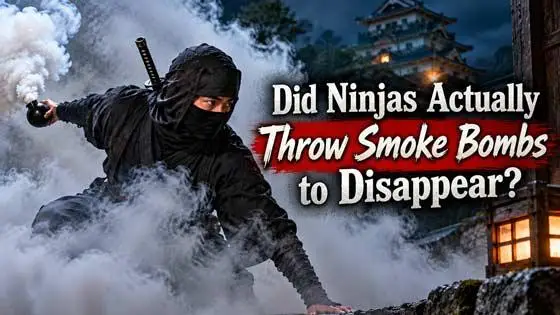
Few images are more closely associated with ninjas than a black-clad figure throwing a small bomb at the ground, vanishing inside a sudden cloud of smoke, and somehow being gone by the time the haze clears. It is such a familiar trick that it hardly seems worth questioning. But real shinobi lived in an era when gunpowder, incendiary weapons, signaling devices, and surprisingly sophisticated fire-making techniques already existed in Japan. That raises a much more interesting possibility: perhaps the famous ninja smoke bomb was not invented by movies and cartoons after all. The real question is whether historical ninjas actually carried devices that could produce enough smoke to conceal an escape, or whether centuries of storytelling transformed something far less spectacular into one of the most famous disappearing acts in history.
The Smoke Bomb Isnt Entirely a Hollywood Invention
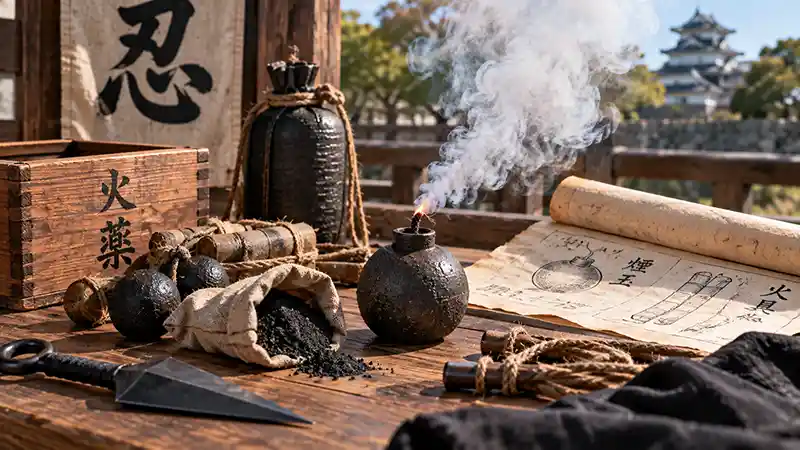
The most surprising part of the ninja smoke bomb story is that we do not have to invent gunpowder technology to make it plausible. By the time the people we now call ninja were active during Japan's turbulent medieval and early modern periods, gunpowder was already known in Japan. Firearms, incendiary devices, explosives, signaling methods, and other forms of pyrotechnics became part of Japanese warfare. A shinobi producing smoke or fire to create confusion therefore would not have required some mysterious technology unavailable to everyone else.
Historical ninjutsu traditions also contain references to fire and pyrotechnic tools. These were not necessarily the convenient little black spheres familiar from modern entertainment, and their purposes could extend far beyond disappearing dramatically. Fire could create a diversion, illuminate or signal, frighten people, damage structures, interfere with pursuit, or contribute to the confusion surrounding an infiltration or escape. In that sense, devices involving smoke belonged to a much larger collection of specialized ninja weapons and tools associated with accomplishing a mission rather than simply defeating an opponent in a fight.
That gives the famous smoke-bomb image a genuine historical foundation, but only a foundation. Evidence that shinobi understood and used pyrotechnics does not automatically prove that they routinely threw compact bombs at their feet and vanished behind an instant wall of smoke. To find out how much of that image is real, we have to separate historical fire-and-smoke techniques from the incredibly convenient disappearing device that later popular culture gave the ninja.
Historical Ninjas Really Did Study Fire and Explosives
One reason the smoke-bomb legend is so believable is that historical ninjutsu texts devote surprising attention to fire. The Bansenshukai, a seventeenth-century collection of shinobi knowledge, includes material concerning fire, incendiary devices, signaling, and methods for creating confusion. Other traditions associated with ninjutsu also preserved knowledge involving gunpowder and specialized fire tools. The historical shinobi was not simply imagined as a swordsman sneaking through the darkness. Firecraft could be another tool for solving a problem.
That distinction matters because the purpose of shinobi activity was often intelligence gathering, infiltration, deception, sabotage, or escape rather than winning a dramatic face-to-face duel. A loud noise, sudden flame, unexpected cloud of smoke, or fire started somewhere else could force guards to look in the wrong direction. For someone trying to enter or leave a guarded location, a few moments of confusion might be far more valuable than carrying another conventional weapon.
This helps explain why the historical world of shinobi included such an unusual mixture of weapons, climbing devices, concealment tools, fire-making equipment, and other specialized ninja equipment. Modern entertainment tends to separate these objects into flashy gadgets, but their real value was often much simpler. A useful tool was anything that made it easier to complete the mission without being caught.
But the Famous Throw It Down and Vanish Trick Is Another Story
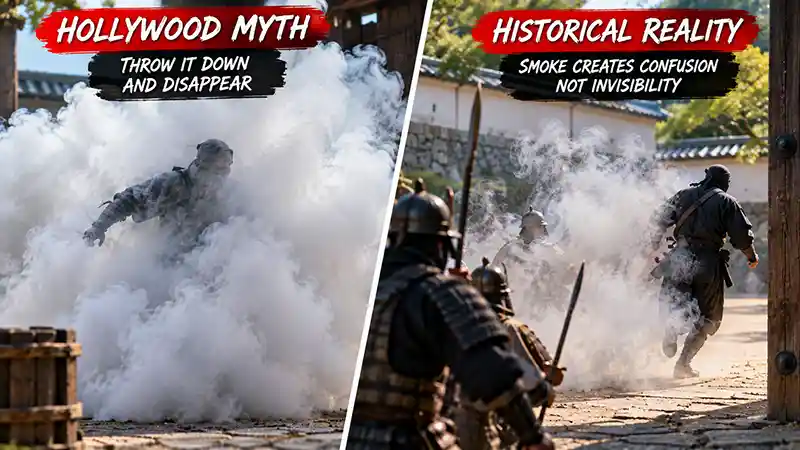
This is where history begins to separate from the ninja we recognize today. Finding evidence that shinobi knew how to use smoke and fire is very different from proving that they carried palm-sized smoke bombs specifically designed to be thrown at their feet during an escape. The familiar sequence is almost too perfect: the ninja is surrounded, a small object hits the ground, an enormous cloud instantly appears, and seconds later there is nobody there.
Real smoke is considerably less cooperative. It takes time to develop, moves with the surrounding air, and does not automatically form an opaque wall exactly where someone needs it. Outdoors, even a moderate breeze can begin pulling a cloud apart almost immediately. Indoors, smoke may accumulate more effectively, but it can also obscure the escape route of the person who created it. A useful historical smoke device therefore did not need to make its user magically disappear. It only needed to make seeing, communicating, or pursuing someone more difficult for a few critical moments.
That difference is important because many supposed facts about ninjas begin with something historically plausible and become more spectacular each time the story is retold. The completely black uniform, specialized straight sword, endless supply of exotic gadgets, and instantaneous smoke-cloud escape have all become pieces of the modern ninja image. As with many of the claims examined in myths about ninja weapons, the most interesting answer is often not that the story was invented from nothing, but that a much less theatrical reality gradually became a legend.
Smoke Didnt Need to Hide a Ninja for Very Long
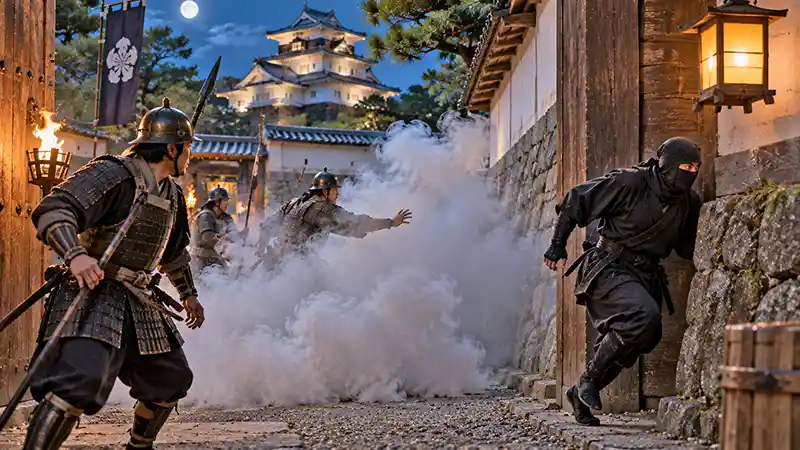
The modern version of the trick makes us judge a smoke device by an unrealistic standard. We imagine a ninja standing in plain sight, producing an enormous cloud, and somehow traveling a considerable distance before anyone can see him again. A historical shinobi would not necessarily have needed anything close to that level of concealment. In the right surroundings, disrupting someone's vision for only a few seconds could have been enough.
Consider the environments in which an escape might take place. Castle compounds contained walls, gates, buildings, corridors, stairways, courtyards, vegetation, and countless changes in elevation and sightlines. Towns offered narrow streets, alleys, fences, doorways, crowds, and buildings. At night, visibility became worse still. Someone who reached a corner, doorway, wall, roofline, or patch of darkness no longer needed the smoke to conceal him. The smoke merely had to prevent a pursuer from seeing exactly where he went.
This fits the broader logic behind much of the unusual ninja gear associated with infiltration and escape. The goal was not to grant the user a supernatural ability. A tool only needed to create a small advantage at precisely the right moment. A cloud that blocked a guard's view for three seconds sounds unimpressive compared with disappearing in a movie, but for someone already running toward the nearest wall or dark passage, those three seconds could be the entire point.
Not Every Ninja Smoke Device Would Have Looked Like a Bomb
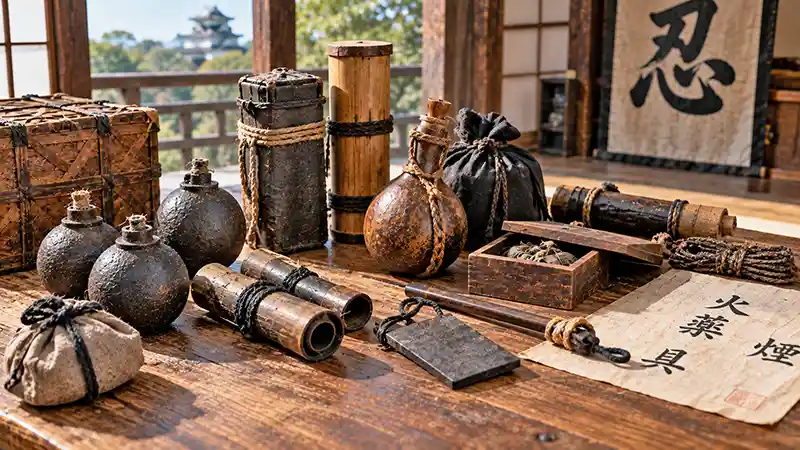
The word "smoke bomb" creates another problem because it encourages us to imagine a very specific object. Modern depictions usually show a ninja carrying a pouch filled with identical black spheres, each ready to explode into smoke the instant it hits the ground. Historical methods of producing smoke or fire could take far less convenient forms. A device might be placed rather than thrown, ignited before it was needed, or incorporated into a larger plan involving fire, noise, or distraction.
That makes the distinction between a weapon and a tool especially blurry. Shinobi equipment could be valuable precisely because an ordinary-looking object had a specialized purpose. Containers, cords, fire-making materials, climbing equipment, concealed implements, and other ninja accessories could support infiltration or escape without ever being used to strike an opponent. A smoke-producing object belongs naturally in that same philosophy.
It also means we should be cautious whenever a modern reconstruction is presented as exactly what historical ninjas carried. Surviving descriptions and illustrations can tell us that certain concepts existed, but recreating a centuries-old device requires interpretation. The standardized, pocket-sized ninja smoke bomb familiar today is best understood as a convenient modern symbol for a much broader historical knowledge of smoke, fire, distraction, and concealment.
Fire May Have Been More Important Than Smoke
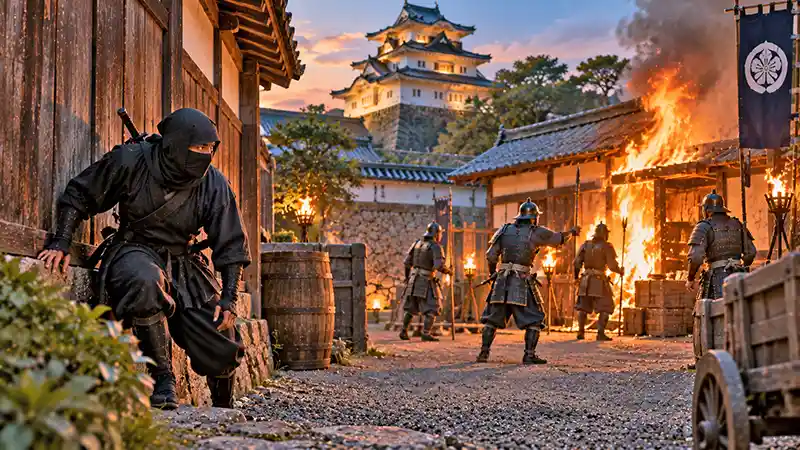
The modern obsession with smoke can actually distract from a much larger part of the historical picture. For a shinobi operating around wooden buildings, storehouses, gates, camps, and fortifications, fire could create a distraction on a completely different scale. A suspicious noise might attract one guard. A fire could pull the attention of nearly everyone in the area.
That did not necessarily mean burning an entire castle to the ground. The strategic value was disruption. Guards investigating flames or reacting to the possibility of a spreading fire were no longer concentrating exclusively on entrances, walls, prisoners, or the person attempting to escape. Fire also created its own smoke, light, noise, and confusion, meaning several useful effects could occur at once. In that context, smoke was not always the main event. Sometimes it was simply one consequence of a much larger diversion.
This is one reason historical ninja practices can seem both less magical and more interesting than their fictional counterparts. Popular culture often turns every unusual object into a specialized weapon, while actual infiltration rewarded adaptability. What mattered most was not how dramatic a tool looked, but whether it could create an opportunity that had not existed a moment earlier.
The Ninja Probably Wasnt Standing There Waiting for the Smoke
Another problem with the familiar disappearing act is the way it begins. In movies, the ninja usually waits until several enemies have completely surrounded him before finally reaching for a smoke bomb. It creates a dramatic scene, but it would be an unnecessarily dangerous way to use concealment. Someone whose survival depended on avoiding capture would have far more reason to create confusion before pursuers closed the distance.
A smoke-producing distraction would make more sense near an escape route, doorway, intersection, gate, or other location where temporarily obscuring someone's view could create uncertainty about which direction the fleeing person had taken. The shinobi might already be moving when the distraction took effect. By the time a pursuer reached the smoke, the person being chased could be somewhere else entirely.
That difference reveals something important about the gap between historical shinobi and their fictional descendants. Entertainment turns concealment into a spectacle because audiences need to see the trick happen. Real concealment works best when the other person never understands exactly what happened in the first place. The most successful disappearing act may not have involved a ninja dramatically vanishing in front of ten astonished guards. It may simply have ended with the guards reaching a smoky corner and realizing they had no idea which way he went.
The Black-Clad Ninja Made the Smoke Bomb Even More Famous
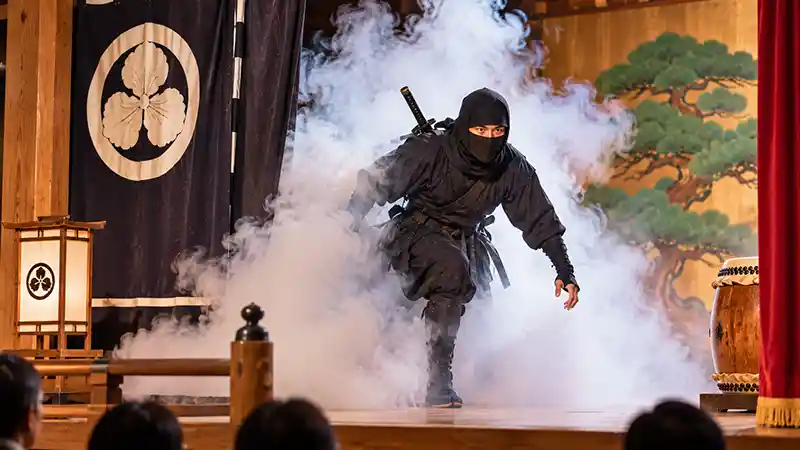
The smoke bomb did not become iconic by itself. It became part of a complete visual language for the ninja: black clothing, a covered face, a mysterious sword, throwing stars, sudden flashes, and clouds of smoke. Put those elements together and an audience can recognize a ninja almost instantly. The problem is that this standardized appearance owes a great deal to later storytelling rather than being a reliable portrait of how historical shinobi always dressed and operated.
Concealment depended on blending into the environment, which could make ordinary clothing far more useful than an unmistakable black costume. A person gathering information or moving through a populated area would hardly benefit from advertising that he was engaged in covert activity. The familiar head-to-toe ninja outfit became useful for a completely different reason: it gave theater, illustration, film, television, and other forms of entertainment an instantly recognizable character.
Once that visual identity became established, the smoke cloud fit it perfectly. A mysterious figure dressed entirely in black should not simply run through a doorway like everyone else. He should vanish. Smoke gave storytellers a visually exciting way to make that happen, helping turn a plausible method of distraction into something that looked almost supernatural. It is another example of how the popular ninja was assembled from fragments of real history, practical ideas, theatrical conventions, and centuries of exaggeration, a pattern that appears throughout many martial arts myths that refuse to die.
So Where Did the Instant Disappearing Act Come From?
There probably was no single moment when someone invented the ninja smoke-bomb escape. The trick appears to have emerged gradually as the historical shinobi became a legendary character. Stories about infiltration, unusual weapons, firecraft, deception, and remarkable escapes provided plenty of raw material. Theater and popular fiction could then exaggerate those abilities until a skilled covert operative began to resemble someone with almost supernatural powers.
Smoke was perfect for that transformation because it solved a storytelling problem. A character who simply runs away does not seem mysterious. A character who disappears behind a cloud does. On a stage, smoke can conceal movement, entrances, exits, and substitutions from an audience. In illustrated stories and later film, the same visual shorthand becomes even easier: show the cloud, remove the ninja, and the viewer understands instantly that he has escaped.
Over generations, the distinction between a historical distraction and a theatrical disappearance became increasingly difficult to see. Modern ninja fiction inherited both and fused them together. That is why the smoke bomb feels strangely authentic even when its most famous use is exaggerated. Unlike a completely invented superpower, it is built around things that really belonged to the shinobi world: concealment, misdirection, firecraft, specialized equipment, and the need to escape without allowing an enemy to follow.
Smoke Was Only One Way to Make Someone Look the Wrong Way
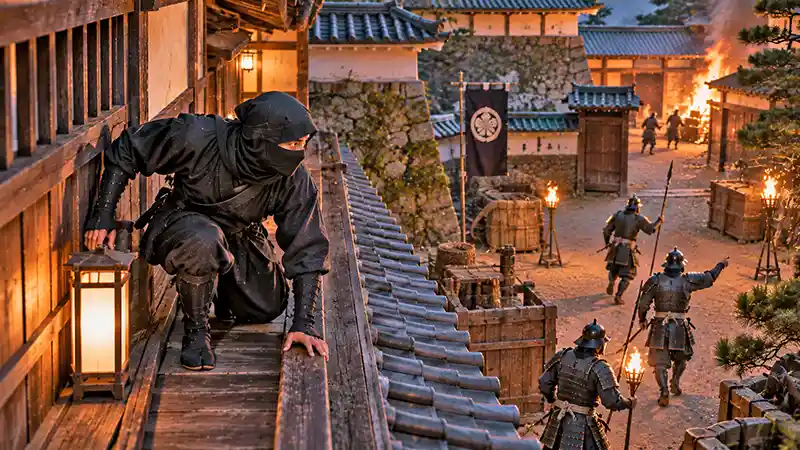
Focusing too heavily on smoke also misses the larger principle behind shinobi deception. If the objective was to slip through a guarded area or escape pursuit, the important question was not "How do I disappear?" It was "How do I make everyone pay attention to something else?" Smoke was simply one possible answer.
Noise, fire, darkness, misleading tracks, disguises, unexpected movement, and exploiting the layout of a building could all serve the same basic purpose. Even an ordinary object could become valuable if it caused a guard to hesitate or investigate the wrong location. This helps explain why the historical image of the shinobi becomes more fascinating when we stop expecting every piece of equipment to function like a conventional weapon. Deception itself was part of the toolkit.
It also explains why so many famous ninja objects have acquired exaggerated stories of their own. Once an operative known for secrecy and misdirection becomes a legendary warrior, every unusual tool starts to look like evidence of some hidden fighting technique. The same process helped turn climbing equipment into mysterious weapons and ordinary blades into supposedly ninja-specific designs. The question of whether ninjas really used straight swords, for example, reveals a similar gap between the standardized equipment we associate with ninjas today and the much messier historical reality.
Would a Real Ninja Smoke Bomb Actually Work?
If by "work" we mean instantly surrounding someone with an impenetrable cloud and allowing him to vanish without a trace, probably not. But that is the wrong test. A useful smoke device only had to interfere with visibility long enough to create hesitation, confusion, or uncertainty. Under favorable conditions, particularly around walls, gates, buildings, or other obstacles, even imperfect concealment could provide an advantage.
The surroundings would matter enormously. Wind could scatter smoke outdoors, while an enclosed area might hold it more effectively. Darkness could make a relatively modest obstruction much more useful, especially if pursuers were already struggling to determine where someone was going. Smoke combined with movement and a carefully chosen escape route would therefore be far more believable than smoke acting as a magical curtain all by itself.
That is what makes the historical possibility so interesting. The real technique does not need to match the legend to explain where the legend came from. Give a skilled infiltrator a way to suddenly obscure a doorway or passage, add generations of stories about mysterious shinobi escaping capture, and it is not difficult to imagine how temporary concealment eventually became instantaneous disappearance.
So Did Ninjas Actually Throw Smoke Bombs to Disappear?
The best answer is sort of, but probably not in the way we imagine it today. Historical shinobi had genuine knowledge of fire, smoke, pyrotechnics, concealment, and distraction. Those ideas are documented well enough that the ninja smoke bomb cannot simply be dismissed as a completely modern invention. Creating smoke to confuse observers or make an escape more difficult to follow fits remarkably well with the practical goals of infiltration and evasion.
What becomes much harder to support is the iconic version of the trick. There is little reason to picture every ninja carrying a supply of standardized black spheres that exploded into enormous clouds the instant they struck the ground. Nor would smoke have made anyone literally disappear. Realistically, it could obscure vision, redirect attention, conceal movement, and buy a few valuable seconds. Architecture, darkness, preparation, and the shinobi's own movement would have done the rest.
That makes the truth more interesting than simply declaring the smoke bomb real or fake. Like so many objects associated with ninjas, it appears to sit somewhere between historical practice and later mythology. The ninja did not need to vanish inside a magical cloud. He only needed his pursuers to lose sight of him long enough for there to be nobody there when the smoke finally cleared.
The Legend Hid a Cleverer Reality
The ninja disappearing in a puff of smoke is almost certainly more spectacular than anything a historical shinobi could have accomplished. But the image survived for a reason. Beneath the theatrical version is a very practical idea: when escape matters more than fighting, making an enemy unable to see what you are doing can be extraordinarily valuable.
That idea fits the historical shinobi far better than the supernatural figure created by later popular culture. Smoke did not need to teleport anyone, and a fire device did not need to resemble a modern grenade. A distraction only had to interrupt attention at exactly the right moment. Combined with darkness, preparation, knowledge of the surroundings, and an escape route, a few seconds of uncertainty could accomplish what centuries of storytelling eventually transformed into magic.
So the next time a fictional ninja throws something at the ground and disappears inside an enormous cloud, the scene should not be viewed as pure fantasy. The instantaneous vanishing act may belong to legend, but the principle behind it is surprisingly real. Historical shinobi understood something storytellers would later exaggerate beautifully: sometimes the easiest way to disappear is simply to make sure nobody is looking in the right place.
Frequently Asked Questions
Did Ninjas Really Use Smoke Bombs?
Historical shinobi did have knowledge of smoke, fire, gunpowder, incendiary devices, and other forms of pyrotechnics, so the basic idea behind the ninja smoke bomb has a genuine historical foundation. Smoke could potentially be used to obscure vision, create confusion, signal, or contribute to a larger distraction.
What is less certain is whether ninjas routinely carried the small, standardized smoke bombs seen in modern movies and games. Historical devices and techniques could have looked and functioned quite differently from the familiar black sphere that instantly produces an enormous cloud when thrown at the ground.
So ninja smoke bombs are best described as an exaggeration of something real rather than a complete invention. Shinobi could use smoke and fire as practical tools, but the famous instant disappearing act developed largely through later legend and entertainment.
What Were Ninja Smoke Bombs Made Of?
There was probably no single standardized recipe or design that could accurately be called the historical ninja smoke bomb. Surviving traditions describe various fire, smoke, and pyrotechnic devices, and their construction could differ depending on the intended purpose.
That is one reason modern recreations should not automatically be treated as exact replicas of something every shinobi carried. The familiar compact smoke bomb is a convenient modern image applied to a much broader historical tradition of using fire and smoke for distraction, signaling, concealment, and other purposes.
What Were Ninja Smoke Bombs Called?
The Japanese term most commonly associated today with ninja smoke bombs is kemuridama, essentially referring to a smoke ball or smoke-producing device. However, applying one modern term to every historical smoke technique can make the subject seem more standardized than it really was.
Historical ninjutsu included a wider range of fire and smoke methods rather than one universally carried gadget. Different devices could serve different purposes, which is another reason the single black smoke bomb of popular culture should not be treated as the definitive historical version.
Did Ninjas Use Gunpowder?
Yes. Gunpowder technology was known in Japan during the period associated with historical shinobi, and ninjutsu traditions include knowledge involving fire, explosives, incendiary devices, and pyrotechnics. Ninjas therefore did not need mysterious or anachronistic technology to create fire, noise, or smoke.
This is one of the strongest pieces of historical context behind the smoke-bomb legend. What remains uncertain is exactly how often particular devices were used in real missions and how closely they resembled the compact gadgets depicted today.
Could a Ninja Really Disappear in a Cloud of Smoke?
Not literally. Smoke does not make a person invisible, and outdoors it can quickly drift or disperse depending on wind and other conditions. The enormous instantaneous cloud commonly shown in entertainment is an exaggeration.
A more realistic use would be temporarily blocking someone's view while already moving toward an escape route. Around walls, buildings, gates, vegetation, or dark passages, even a brief interruption in visibility might allow someone to turn a corner or change direction without a pursuer seeing where they went.
From the pursuer's perspective, that could still feel remarkably similar to disappearing. By the time visibility returned, the shinobi might simply be gone.
Did Ninjas Use Firecrackers or Explosives?
Historical shinobi traditions included knowledge of pyrotechnics, incendiary techniques, and explosive or noise-producing devices. Such tools could have purposes beyond directly injuring an enemy. Sudden noise, flame, or smoke could attract attention, frighten people, signal allies, or create confusion.
That fits the broader role of shinobi particularly well. Someone attempting infiltration or escape could benefit more from sending guards toward the wrong location than from confronting those guards directly.
Did Ninjas Really Use Fire to Create Distractions?
Fire was potentially a powerful tool for distraction and disruption. In an environment filled with wooden structures, a fire or even the apparent threat of one could demand immediate attention from guards and occupants.
The important point was not necessarily destruction. Drawing attention toward one location could create an opportunity somewhere else. Fire also naturally produced smoke, light, noise, and confusion, making it capable of accomplishing several things simultaneously.
Are Ninja Smoke Bombs Historically Accurate?
The concept is historically plausible, while the familiar depiction is heavily exaggerated. Historical shinobi had access to the knowledge necessary to produce smoke and understood the value of fire, concealment, distraction, and misdirection.
What should be treated cautiously is the idea of a universally carried, perfectly reliable smoke bomb that instantly created an enormous opaque cloud. That version owes much more to the development of the ninja in theater, fiction, movies, television, and other popular entertainment.
Why Are Smoke Bombs So Closely Associated With Ninjas?
Smoke perfectly matches the mysterious identity later storytellers created for the ninja. It hides movement, makes entrances and exits dramatic, and allows a character to seemingly disappear without requiring the audience to watch an ordinary escape.
The idea was especially convincing because it was not created entirely from fantasy. Historical associations between shinobi, firecraft, concealment, unusual equipment, and deception gave later storytellers a believable foundation to exaggerate.
The result was one of the most enduring images in ninja mythology: a flash, a cloud of smoke, and an empty space where a ninja had been standing only moments earlier.
You May Also Be Interested In:
- How to Throw an Epic Ninja Party
- Want To Throw A Better Punch? Train Your Brain First!
- Quickly Learn How To Throw Knives, Axes, Spikes, Cards & Stars!
- Did Ninjas Really Use Poisoned Weapons?
- Did Ninjas Really Use Straight Swords?
- Why Ninjas Wore Split-Toe Shoes (And Whether They Actually Helped)
- The Untold History of Female Ninjas: Secrets of the Kunoichi
- Could Ninjas Really Walk on Water? The Truth About Ninja Water Shoes
Leave a Reply