



Why Are Some Chinese Swords So Flexible?
August 19th, 2026
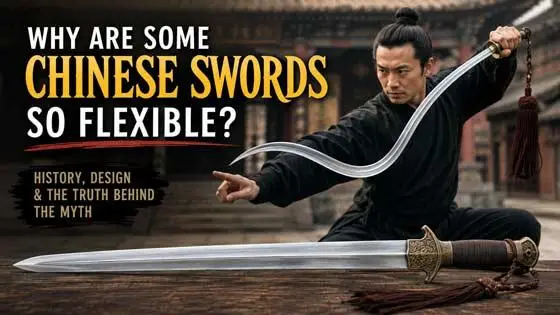
Watch a modern Chinese martial arts demonstration and you may see a sword blade bend so dramatically that it seems almost impossible for it to be made of steel. Some blades ripple during fast movements, flex deeply with surprisingly little pressure, and spring back into shape as though they were designed more like giant metal ribbons than weapons. That spectacle has helped create the impression that extreme flexibility is a traditional feature of Chinese swords, but the historical reality is considerably more complicated. The jian and dao carried into actual combat needed enough resilience to survive violent impacts, yet they also needed the stiffness required to cut, thrust, parry, and remain controllable in the hand. To understand why some Chinese swords flex so dramatically today, we have to separate the properties of historical fighting blades from the very different demands of modern martial arts performance.
The Sword Most People Are Thinking of Is a Modern Wushu Sword
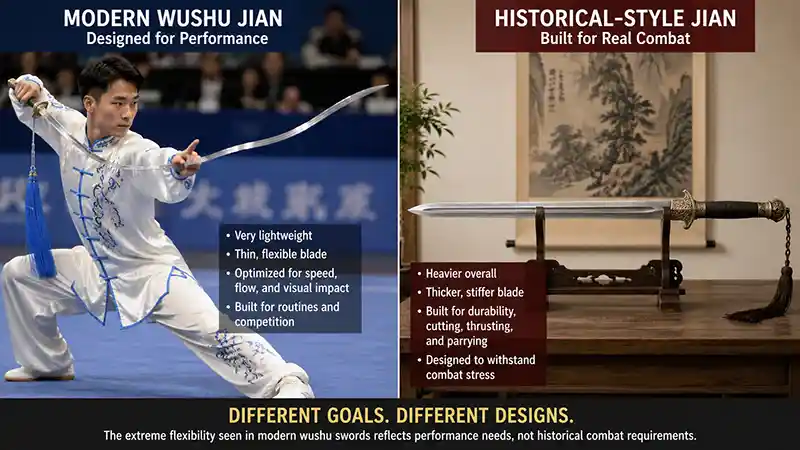
When people picture an extremely flexible Chinese sword, they are usually not picturing a typical historical battlefield blade. They are thinking of the lightweight swords commonly seen in modern wushu demonstrations and competitions. During fast routines, these blades can visibly ripple, bend during abrupt changes of direction, and sometimes flex dramatically with surprisingly little force. That movement has become so closely associated with Chinese martial arts that it is easy to assume Chinese swords were always made this way.
Modern performance changes what makes a sword desirable. A competitive wushu practitioner benefits from a weapon that is light enough for rapid movements, spins, jumps, and complex sequences. Thin blades reduce weight and can exaggerate the visual impression of speed. The movement of the blade can even make a routine appear faster and more dynamic to spectators. Those are useful qualities in a performance weapon, but they are very different from the demands placed on a sword expected to withstand combat.
That distinction becomes particularly important when looking at traditional Chinese sword families. Historical Chinese swords included both straight double-edged jian and various forms of single-edged dao, with enormous variation across different periods. Treating all of them as highly flexible weapons ignores centuries of changing metallurgy, military requirements, blade geometry, and fighting traditions.
A real fighting sword could certainly possess some elasticity. In fact, a blade that can flex slightly under stress and return to its original shape can be preferable to one so brittle that it fractures. But there is an enormous difference between useful resilience and a blade that visibly flutters whenever the sword changes direction. The dramatic flexibility familiar from modern demonstrations tells us far more about the requirements of contemporary wushu than it does about how Chinese soldiers wanted their swords to behave on a battlefield.
Flexibility and Flimsiness Are Not the Same Thing
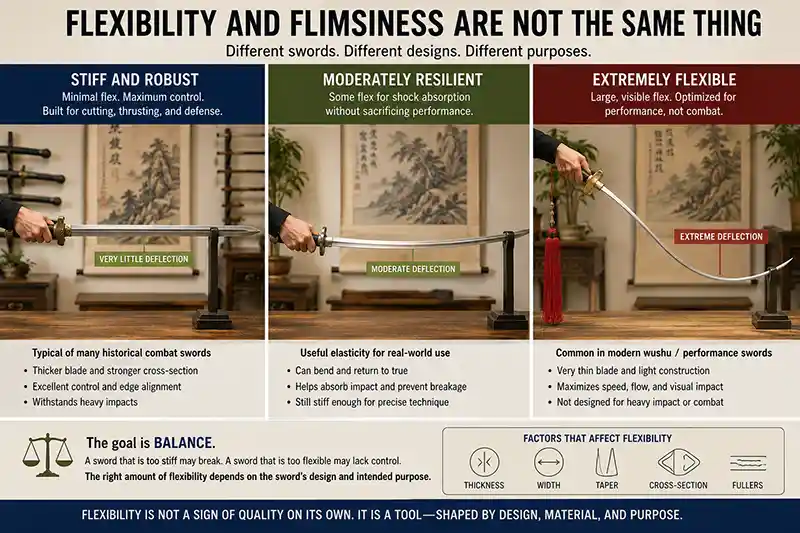
A good sword blade does not necessarily need to be completely rigid. Steel can flex under stress and return to its original shape, and that ability can help a blade survive forces that might damage a more brittle material. Historical swordsmiths therefore faced a balancing act. A blade needed enough toughness and resilience to withstand use, but it also needed enough stiffness to remain controllable when cutting, thrusting, and defending.
The crucial distinction is between elasticity and extreme flexibility. A properly made sword can bend to some degree without taking a permanent set, yet still feel remarkably stiff during ordinary handling. That is very different from the thin modern performance blades that visibly wobble after a sudden stop. Both are technically flexible, but they occupy very different points on the spectrum.
Blade geometry plays an enormous role. A small reduction in blade thickness can produce a dramatic increase in how easily the blade bends. This means two swords made from similar types of steel can behave completely differently simply because one has a substantially thinner cross-section. Width, taper, fullers, distal taper, and the shape of the blade's cross-section can further change its stiffness without requiring an entirely different material.
This is one reason the broader world of swords contains such enormous variation in blade behavior. Flexibility by itself is neither proof of superior craftsmanship nor evidence that a sword is weak. The important question is how much flexibility the blade has, where it flexes, and whether that behavior suits what the sword was actually designed to do.
Thin Blades Bend Much More Easily Than Thick Ones
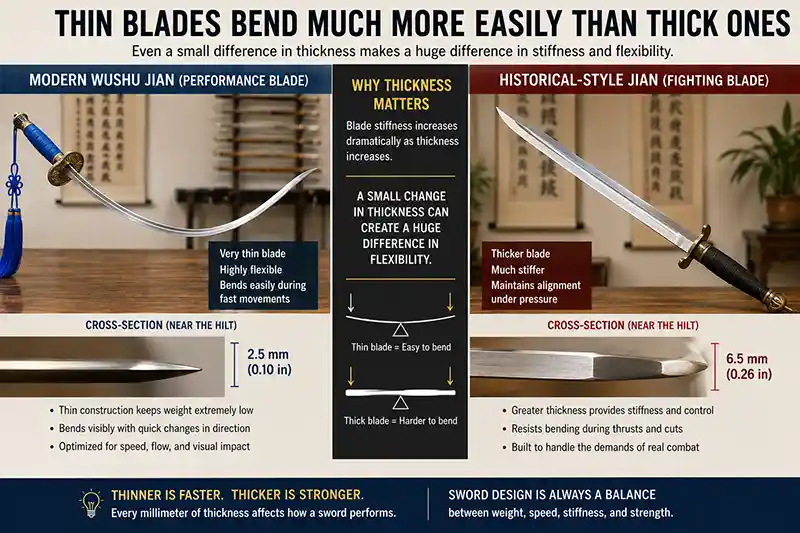
The dramatic flexibility of a modern wushu sword is not created by some mysterious type of Chinese steel. Much of it comes from something far simpler: the blade is extremely thin. Even a relatively small change in thickness can have a major effect on how resistant a blade is to bending, which is why a thin sheet of steel can flex easily while a thicker piece made from similar material feels remarkably rigid.
This relationship is especially important with swords because designers cannot change thickness without changing other characteristics at the same time. Making a blade thinner reduces its mass and can make the sword feel faster in the hand, but it also reduces stiffness. Take that process far enough and the blade begins to flex visibly during rapid acceleration, sudden stops, and changes in direction. That is exactly the behavior seen in many modern performance swords.
Historical fighting blades faced a different requirement. A jian used for thrusting needed enough stiffness that the point could be directed accurately without the blade buckling excessively under pressure. A sword used for cutting also benefited from maintaining its alignment as force traveled through the blade. If the blade flexed dramatically every time resistance was encountered, some of the control that makes a sword effective would be lost.
This does not mean historical Chinese swordsmiths simply made every blade thick and rigid. They could manipulate thickness along the length of the blade, alter its cross-section, change its width, and remove material strategically. The result could be a blade that was relatively light and resilient without behaving like the highly flexible steel seen in a modern wushu demonstration. The remarkable bend of today's performance swords is therefore less a secret of ancient metallurgy than a consequence of pushing blade geometry toward an entirely different goal.
A Jian Needed Stiffness for the Point to Matter
The jian is often called a Chinese straight sword, but that simple description leaves out one of its most important characteristics: it is a double-edged weapon with a prominent point. That point was not merely decorative. Across the long history of the jian, thrusting formed an important part of what the weapon could do, and effective thrusting places very different demands on a blade than a modern performance routine.
Imagine pushing forward with the point of an extremely thin wushu blade. If the blade bends too readily, pressure at the tip can cause it to bow rather than efficiently transmit force along the length of the sword. A stiffer blade gives the wielder greater control over where the point goes and helps maintain alignment as resistance is encountered. This does not require absolute rigidity, but it does place a practical limit on how much flexibility is useful.
The same principle affects defensive actions and cutting. When a sword changes direction or meets resistance, excessive flex can make the blade less predictable. A historical jian therefore had to balance several competing qualities at once: enough stiffness for point control, suitable geometry for cutting, enough toughness to survive stress, and a manageable weight that allowed the weapon to remain responsive.
This is where the image of the endlessly bending "Chinese sword" becomes particularly misleading. A blade that can whip dramatically from side to side may look spectacular during a fast routine, but the qualities that exaggerate that movement are not necessarily the qualities a historical swordsman would have wanted when directing the point toward a resisting target. The jian did not need to behave like a rigid steel bar, but neither was it intended to behave like a ribbon.
The Dao Had Different Demands, but It Still Was Not a Metal Ribbon
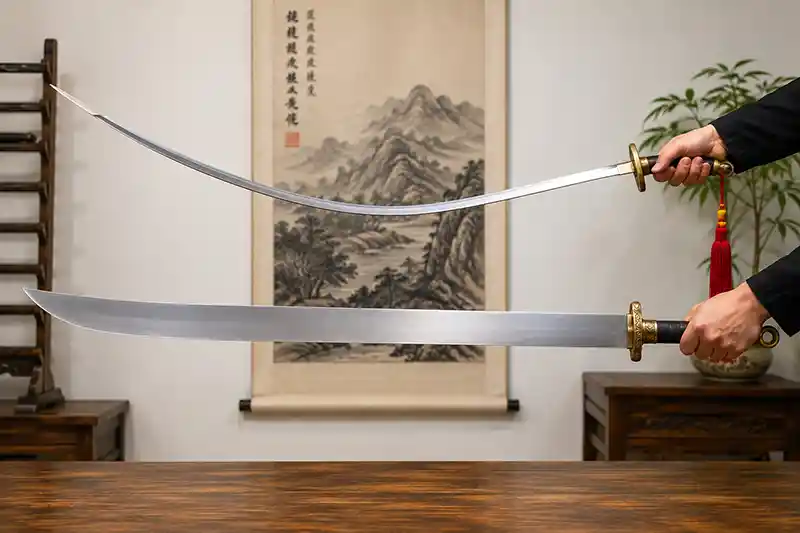
The jian is only half of the story. Chinese martial history also includes an enormous variety of dao, the broad family of single-edged swords that eventually included everything from relatively compact military sidearms to large battlefield weapons. Their shapes changed dramatically across centuries, but historical dao generally shared the same basic problem as the jian: a blade intended for actual use needed enough structural stiffness to remain controllable.
Because many dao emphasized cutting, their geometry could differ substantially from that of a straight double-edged jian. Curvature, blade width, thickness, taper, and the distribution of mass could all be adjusted to influence how the sword handled and cut. Some blades could possess noticeable resilience without being remotely as flexible as the thin dao commonly seen in modern wushu routines.
Modern performance dao make the contrast especially visible. Their thin blades can flutter and produce the characteristic metallic sound associated with fast contemporary routines. That movement provides immediate visual and audible feedback, making rapid technique appear even more dramatic. In that context, flexibility becomes part of the performance rather than merely a mechanical property of the steel.
A historical military dao had no reason to exaggerate that effect. Its blade needed to remain sufficiently stable through a cut, tolerate the stresses of use, and give the wielder predictable control over the edge. Like the jian, it could benefit from resilience, but useful resilience is very different from the spectacular bending that has become one of the most recognizable features of modern Chinese performance swords.
The Wobble Can Actually Be Useful in Modern Wushu
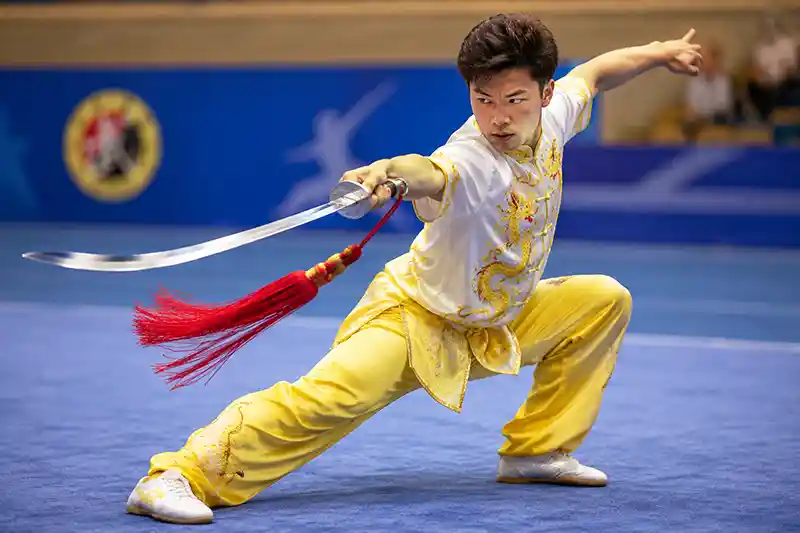
To someone judging a sword purely as a weapon, a blade that visibly shakes after every sudden movement can look like a flaw. In modern wushu, however, that movement can serve a very different purpose. The flex of a lightweight blade makes acceleration, abrupt stops, and changes of direction much easier to see, effectively turning the sword itself into a visual extension of the performer's movements.
This becomes especially noticeable during fast routines. When the practitioner snaps the sword into position, the blade may oscillate briefly before settling. During sweeping movements it can bend into a visible arc, emphasizing speed in a way that a heavier, stiffer sword would not. The effect is dramatic from a distance, which matters in demonstrations and judged competition where movements need to read clearly to spectators.
Some flexible performance swords also produce distinctive sounds as the thin blade moves rapidly through the air or vibrates during technique. Along with tassels and rapid directional changes, that sound contributes to the sensory impact of the routine. None of this requires the blade to imitate the handling characteristics of a historical fighting sword because that is not the problem the modern performance weapon is trying to solve.
Seen from that perspective, extreme flexibility stops looking like an inexplicable feature. The blade is light, fast, visually expressive, and responsive to small movements. Those characteristics make considerable sense for modern performance even though they would involve serious compromises in a sword intended for historical combat. What looks like a strangely flexible sword is really a highly specialized piece of sporting equipment.
Performance Swords Became Specialized Sporting Equipment
Once modern wushu developed into a standardized competitive sport, the sword no longer had to satisfy the same requirements as a historical weapon. Competition routines rewarded speed, precision, athleticism, difficult movements, and visual presentation. Sword makers could therefore remove weight and alter blade geometry in ways that would have made little sense for a weapon expected to endure the stresses of combat.
This specialization did not happen because Chinese sword makers suddenly discovered that flexible blades were superior. It happened because the definition of "superior" had changed. A sword intended for warfare might be judged by its durability, handling, cutting ability, point control, and resistance to damage. A modern performance sword can instead be judged by how comfortably it moves through a demanding routine and how well it complements the athlete performing with it.
The difference is similar to what happens in many sports. Equipment evolves around the rules and demands of the activity. Once nobody expects a competition jian or dao to strike armor, parry another sharpened weapon, or withstand battlefield abuse, there is little reason to carry extra steel simply to preserve those capabilities. Reducing blade thickness and overall mass can instead make rapid transitions and elaborate movements easier to perform.
This is also why judging historical Chinese swords by watching modern wushu competitions can produce such a distorted picture. The weapons may share traditional names and recognizable silhouettes, but their construction reflects very different worlds. One evolved around the demands of armed combat. The other has been refined around the demands of athletic performance.
Historical Chinese Swords Could Flex Without Looking Flexible
The contrast between a modern wushu sword and a historical fighting sword can create another misconception: that older Chinese swords must have been completely rigid. They were not. Steel is an elastic material, and a well-made blade can deflect under sufficient force and return toward its original shape without displaying the dramatic wobble associated with modern performance weapons.
That resilience could be extremely valuable. A sword used in combat might experience sudden lateral stresses, imperfect impacts, or forces that did not travel neatly along the blade. A blade with suitable toughness could absorb some of that stress rather than immediately cracking or taking permanent damage. The goal was not maximum flexibility, but a useful combination of stiffness, toughness, and elasticity.
The difference becomes most obvious during ordinary movement. A historical-style jian might appear perfectly straight and rigid as it is accelerated through a technique, even though the steel is capable of flexing when enough force is applied. A very thin wushu blade can reveal its flexibility constantly, bending and oscillating simply because the practitioner changes direction quickly.
So asking whether historical Chinese swords were flexible produces an unsatisfying answer: yes, but not necessarily in the way most people mean. A fighting blade could possess enough elasticity to survive stress while remaining sufficiently stiff to control its edge and point. The spectacular flexibility seen in modern Chinese martial arts is an extreme version of a property that steel swords have always needed in much more carefully controlled amounts.
Spring Steel Does Not Mean a Sword Should Bend Like a Whip
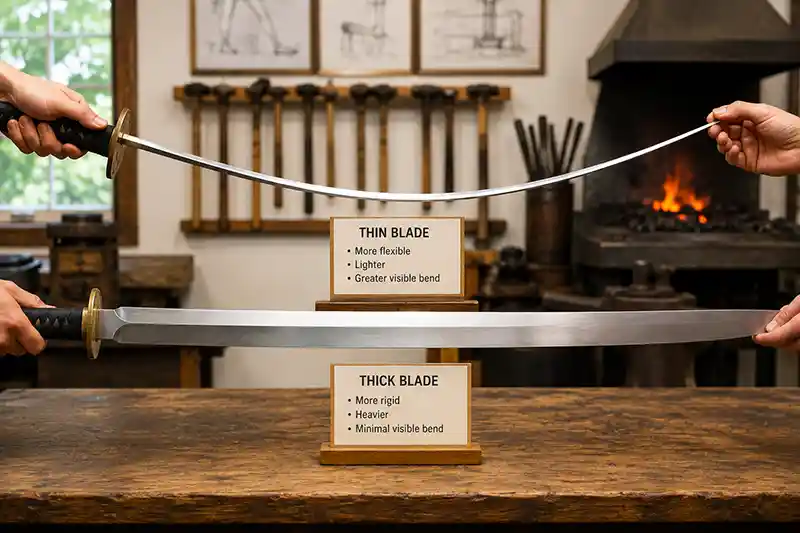
The term "spring steel" can make extreme flexibility sound like a property of some special metal, but the name is easy to misunderstand. Spring steels are formulated and heat-treated so they can deform elastically under stress and return toward their original shape. That makes them useful for many applications where toughness and resilience matter, including certain modern sword blades.
But the type of steel does not determine flexibility by itself. Take the same general material and make one blade substantially thicker than another, and the two can behave very differently. The thicker blade may feel quite stiff even though its steel is capable of considerable elastic deformation under enough force. A very thin blade made from spring steel can display the dramatic bending and oscillation associated with performance swords.
Heat treatment matters just as much. Steel that is too hard can become more vulnerable to fracture, while inadequate hardness can leave a blade prone to permanent deformation and poor edge retention. Sword makers have historically used different approaches to balance hardness and toughness, and Chinese blades were no exception. The desired result depended on the blade being produced, its geometry, and the role it was expected to perform.
So when a modern Chinese sword bends deeply and snaps back straight, it is tempting to credit "spring steel" for everything we are seeing. The steel and its heat treatment certainly matter, but much of the visible flexibility comes from the sword's physical dimensions. Material, heat treatment, and geometry work together. None of them tells the whole story by itself.
Chinese Swordsmiths Were Balancing Hardness Against Toughness
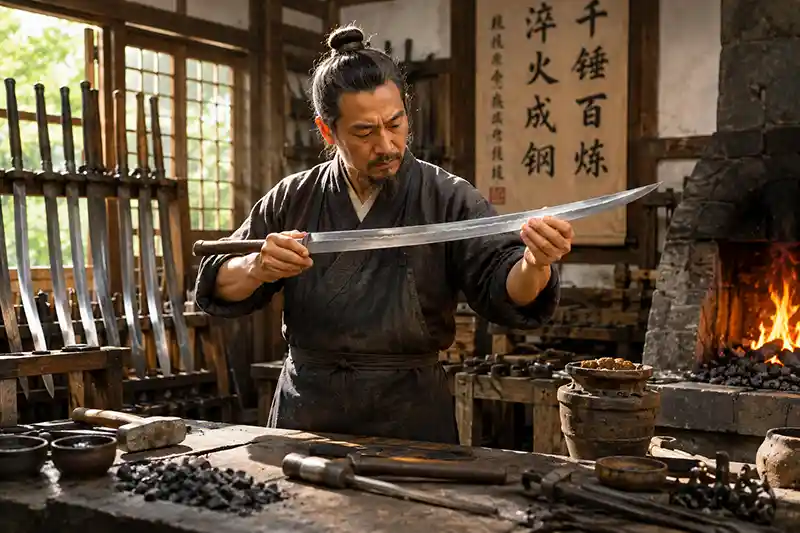
Flexibility was only one part of a much larger metallurgical problem. A sword edge benefits from hardness because harder steel can resist deformation and retain a sharp edge. Push hardness too far, however, and the blade can become more vulnerable to chipping or fracture. Make the blade too soft and it may survive impacts without breaking, but it can bend permanently or lose its edge more easily.
Chinese sword makers developed different methods of dealing with these competing demands over the centuries. Some historical blades used composite construction that placed steels with different properties in different parts of the sword. Others relied on carefully controlled heat treatment to achieve a useful compromise between edge hardness and overall toughness. There was no single construction method shared by every Chinese sword across every dynasty.
This matters because a sword that springs back after bending has not necessarily demonstrated that it is a better sword. Returning to shape tells us something about the blade's elasticity and heat treatment, but it tells us much less about edge retention, stiffness, mass distribution, durability, or how well the sword performs its intended function. A spectacular bend test can therefore exaggerate one property while hiding nearly everything else that matters about the blade.
Historical swordsmiths were not trying to maximize one characteristic. They were trying to balance several characteristics that naturally compete with one another. The ideal blade needed enough hardness where hardness mattered, enough toughness to survive stress, and enough stiffness to remain controllable. Extreme flexibility was never the only measure of sophisticated sword making, and in many fighting swords it would have been a disadvantage.
A Sword Can Be Too Flexible to Perform Well
Extreme flexibility comes with a price. When a blade bends easily, it becomes harder to keep the edge and point precisely aligned as forces travel through the sword. That may matter very little during a choreographed performance, but it becomes far more important when the blade is expected to cut, thrust, or interact with another object under resistance.
Cutting provides a good example. An effective cut depends partly on keeping the edge traveling cleanly through the target. If the blade flexes excessively during contact, some of the sword's movement can be diverted into bending rather than maintaining the intended path. A stiffer blade gives the wielder a more stable structure through which to control the edge.
Thrusting creates a similar problem. The point may begin perfectly aligned, but once it encounters resistance, a very flexible blade can bow sideways. Historical sword makers therefore had little incentive to pursue maximum flexibility simply because their metallurgy allowed it. Past a certain point, additional flexibility could undermine the very qualities that made the sword useful.
This is why asking which design makes the best sword has no simple answer. A sword optimized for cutting, thrusting, battlefield durability, training, or modern performance can require very different characteristics. Flexibility is valuable when it contributes to the intended purpose of the blade. Once it begins interfering with that purpose, more is no longer better.
Why Training Swords Solve a Completely Different Problem
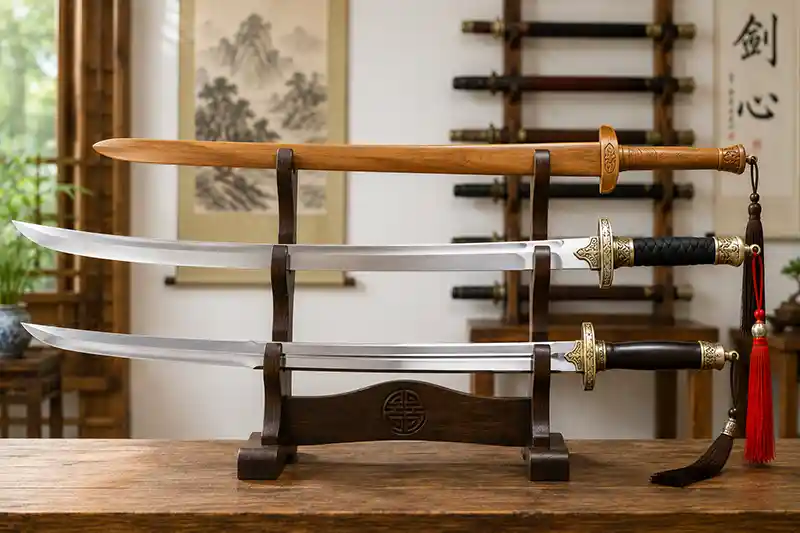
Not every Chinese sword used in martial arts practice is trying to reproduce the physical behavior of a sharpened steel weapon. Training introduces its own priorities, including durability, manageable weight, repeated practice, and reducing some of the hazards associated with working with a live blade. That is why Chinese martial arts have made use of practice swords constructed from materials very different from steel.
A wooden Tai Chi sword, for example, approaches training from almost the opposite direction of an extremely flexible wushu blade. Wood does not reproduce the springy movement of a thin performance sword, nor does it perfectly duplicate the handling of a historical steel jian. Instead, it allows practitioners to work with the recognizable shape and basic dimensions of the weapon without requiring a sharpened steel blade.
This highlights something important about modern Chinese sword practice. A sword-shaped training tool can be designed around one specific part of the experience rather than attempting to reproduce everything about an original weapon. Wooden swords, rigid practice swords, flexible competition blades, and historically inspired steel swords can therefore behave very differently even when they share the familiar silhouette of a jian.
The mistake is assuming that whichever version appears most frequently in a modern training hall must reveal how the historical weapon behaved. Training equipment evolves around the needs of training, just as competition equipment evolves around the needs of competition. To understand an actual historical sword, we have to look past its modern descendants and ask what the original blade was expected to accomplish.
Why Did Flexible Chinese Swords Become So Common in Movies and Demonstrations?
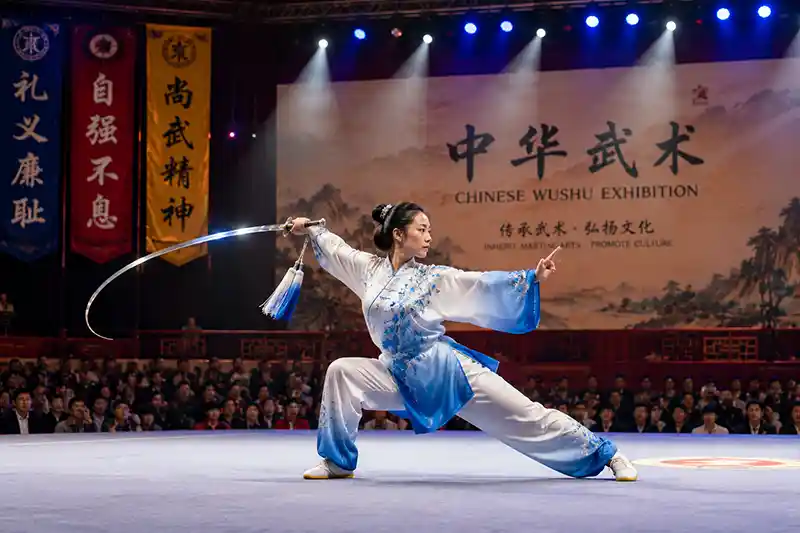
Even people who have never watched a wushu competition may recognize the sight of a Chinese sword bending dramatically during a fast movement. Martial arts demonstrations, stage performances, exhibitions, and action entertainment helped spread that image far beyond competitive wushu. A flexible blade simply produces more visible movement than a stiff one, especially when viewed from a distance or through a camera.
That visual effect is particularly striking during rapid changes of direction. The performer's hand may stop, but the thin blade continues moving for a fraction of a second, creating a ripple that exaggerates the apparent speed of the technique. Add a brightly colored tassel and flowing clothing, and the sword becomes part of a much larger visual performance. A historically stiffer blade performing exactly the same motion would often look far less dramatic.
Over time, repeated exposure can quietly change what audiences expect a Chinese sword to look like. If flexible jian and dao dominate demonstrations and entertainment, their behavior begins to seem traditional simply because it is familiar. The historical fighting sword then becomes the surprising one. A relatively stiff antique-style jian can look "wrong" to someone whose reference point is a modern performance blade.
This is a recurring problem when studying historical weapons. The versions that survive most visibly in modern culture are not always the versions that best represent their original use. In the case of Chinese swords, the spectacular bend that made them so memorable also helped blur the distinction between a modern performance tradition and centuries of actual sword design.
The Tassel Has Nothing to Do With Making the Blade Flexible
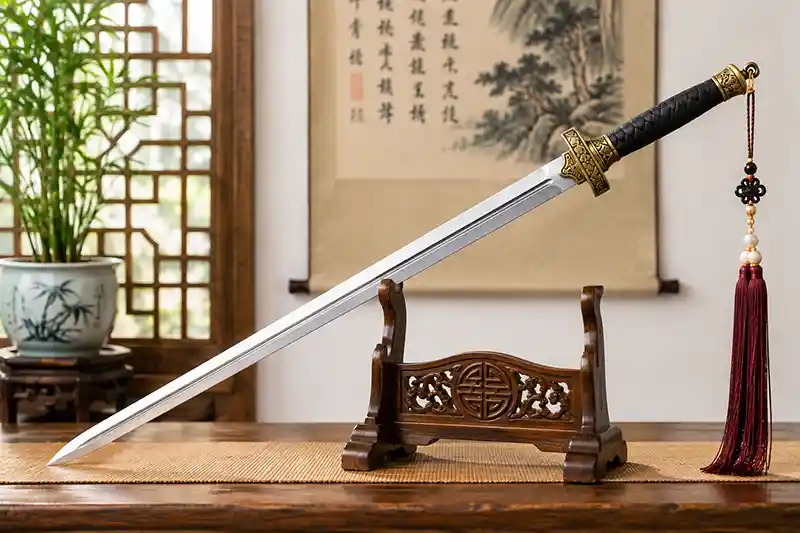
The tassel attached to many Chinese swords adds another layer to the misconception. Because tassels are so often seen moving alongside thin, flexible blades in modern demonstrations, it can seem as though the two features developed together. In reality, the tassel and the flexibility of the blade are separate characteristics with very different histories and purposes.
Tassels have long been associated with Chinese swords, particularly the jian, although their size, construction, and function have varied. Depending on the context, a tassel could be decorative, indicate status or affiliation, or become incorporated into particular martial traditions. What it did not do was somehow require the sword itself to have an unusually thin or flexible blade.
Modern performance brings the two features together beautifully. A lightweight blade responds dramatically to rapid acceleration while the tassel traces the movement of the hilt through the air. The blade bends in one direction, the tassel flows in another, and the combination makes even a brief technique visually complex. It is easy to see why this image has become so strongly associated with Chinese swordsmanship.
But remove the modern performance context and there is no reason a tasselled jian must behave that way. A substantially stiffer sword can carry a tassel just as easily. The flowing tassel may be traditional, while the extreme blade flexibility beside it can be a much more modern adaptation. Seeing both on the same sword does not mean they originated for the same reason.
Not Every Flexible Chinese Sword Is a Wushu Competition Sword
Modern wushu is the biggest reason extremely flexible Chinese swords are familiar today, but it would be a mistake to put every flexible jian or dao into the same category. Contemporary Chinese martial arts include traditional forms practice, demonstrations, competition, theatrical performance, and recreational training, and swords made for those activities can occupy many different points between rigid and extremely flexible.
Some practice swords are deliberately made lighter than historically inspired weapons without being exceptionally floppy. Others use thin blades that flex noticeably but remain more substantial than the dramatic competition weapons seen in high-level wushu. Manufacturers can change thickness, taper, blade length, steel, and overall weight to produce very different handling characteristics while preserving essentially the same recognizable sword shape.
This creates a spectrum rather than two neat categories. At one end might be a historically inspired steel sword designed to approximate the handling and construction of a functional weapon. Move along the spectrum and you encounter lighter practice swords, increasingly flexible demonstration blades, and finally extremely thin competition swords optimized around speed and presentation. There is no single point where a "real Chinese sword" suddenly becomes a "wushu sword."
That distinction is useful whenever you see a Chinese sword bending in a photograph or video. Flexibility can offer clues about what the sword was designed to do, but it cannot identify the weapon's purpose by itself. The better questions are how thin the blade is, how much it flexes during ordinary movement, how the sword is balanced, and what kind of practice or performance it was actually built for.
Flexibility Changes How a Sword Feels in the Hand
The difference between a stiff sword and a highly flexible one is not limited to what spectators can see. The person holding the sword can feel it as well. When a thin blade accelerates, stops, or changes direction, the blade continues flexing after the hilt has already moved. That creates a noticeably different sensation from handling a stiffer sword whose blade responds more immediately to movements of the hand.
This difference becomes especially important during precise techniques. With a stiffer blade, changes at the hilt translate more directly into changes at the point and edge. A highly flexible blade introduces additional movement because the steel itself can bend and oscillate. Experienced practitioners can become accustomed to either behavior, but the two swords do not provide identical feedback simply because their overall shapes look similar.
Weight distribution complicates the comparison further. Modern performance swords are often extremely light, so reducing blade thickness changes both flexibility and the way mass is distributed along the weapon. A historical-style sword with more steel in the blade can have greater presence during movement, while a lightweight performance sword may feel exceptionally quick and responsive at the hilt even as its blade continues to flex.
This is another reason photographs can be misleading. Two jian displayed side by side may have nearly identical lengths, guards, grips, and silhouettes, yet behave like remarkably different pieces of equipment once someone picks them up. The most important differences may be hidden in millimeters of blade thickness, subtle changes in taper, and the amount of steel distributed along the blade.
Modern Flexibility Can Make Historical Replicas Look Surprisingly Stiff
Once someone becomes accustomed to modern wushu swords, picking up a historically inspired Chinese sword can be surprising. The familiar outline may still be there, but the blade often feels substantially more solid. Rapid movements do not produce the same dramatic rippling, and when the sword stops, the point may settle almost immediately instead of continuing to oscillate.
That stiffness can initially make the historical-style sword seem crude or unnecessarily heavy. In reality, the opposite may be true. Greater stiffness can be an intentional consequence of designing a blade around edge alignment, point control, structural strength, and the ability to withstand resistance. The sword is behaving differently because it was built around different expectations.
This is also why modern replicas need to be interpreted carefully. Some are designed primarily for display. Others are intended for forms practice, while still others attempt to reproduce the dimensions and handling characteristics of surviving historical examples. Two swords both advertised as a "Chinese jian" can therefore differ dramatically in weight, thickness, balance, flexibility, and construction.
The silhouette alone tells us surprisingly little. If we want to understand how an original Chinese sword might have behaved, surviving antiques, historical measurements, construction methods, and period context are much more informative than simply comparing it with whichever modern version happens to look the most similar.
The Most Flexible Sword Is Not the Most Historically Accurate Sword
Flexibility is easy to demonstrate, which may be one reason it receives so much attention. A seller or performer can bend a blade dramatically and immediately show that it springs back toward its original shape. Historical accuracy is harder to communicate. It depends on less spectacular details such as blade thickness, taper, cross-section, weight distribution, construction, and how those characteristics compare with surviving weapons.
This creates an odd situation in which an extremely flexible sword can sometimes appear more impressive than a stiffer historical reproduction. The flexible blade performs an obvious trick. The historically inspired blade may simply remain straight, which does not look nearly as remarkable even though that stiffness may be closer to what the original weapon required.
There is also no single measurement of flexibility that could represent centuries of Chinese sword making. Jian and dao changed across dynasties, regions, military contexts, and individual makers. Some surviving blades are relatively slender, others more substantial, and their construction can vary considerably. Historical accuracy therefore means reproducing the characteristics of a particular type, period, or surviving example rather than deciding that all authentic Chinese swords should have one universal amount of flex.
That may be the simplest way to resolve the mystery. Some Chinese swords are extraordinarily flexible because modern martial arts created good reasons for them to be. Historical Chinese swordsmiths were solving a different problem. Their blades could be resilient and elastic, but they also needed the stiffness required for the sword to function as a sword. The spectacular bend is real. It just belongs much more strongly to the modern history of Chinese martial arts than to the ancient history of Chinese warfare.
What the Bend in the Blade Really Tells Us
The extraordinary flexibility of some Chinese swords is real, but it is not an ancient secret that made Chinese blades fundamentally different from every other sword. Much of the dramatic bending seen today comes from modern weapons built for wushu, demonstrations, and other forms of martial arts performance. Thin blades, low weight, suitable steels, and appropriate heat treatment allow these swords to move in ways that make fast routines more expressive and visually impressive.
Historical Chinese swords had another set of priorities. Jian and dao intended for serious use could benefit from toughness and elasticity, but they also needed stiffness. The point had to remain controllable, the edge had to stay aligned during a cut, and the blade needed to tolerate resistance without behaving like a strip of sheet metal. Chinese swordsmiths were not trying to eliminate flexibility. They were trying to control it.
That distinction explains why two swords with nearly identical silhouettes can behave so differently. A competition jian, wooden practice sword, modern training blade, historical reproduction, and surviving antique may all represent the same broad weapon tradition while being optimized for completely different purposes. The shape tells only part of the story.
So the next time a Chinese sword bends into a spectacular arc during a martial arts demonstration, the most interesting question is not how ancient warriors fought with such a flexible blade. It is how a centuries-old weapon evolved into a modern piece of sporting equipment whose movement has become so visually distinctive that it changed what much of the world thinks a Chinese sword is supposed to look like.
Were historical Chinese swords flexible?
Yes, historical Chinese sword blades could possess some flexibility and elasticity, but that does not mean they behaved like the extremely thin blades seen in modern wushu. A fighting sword benefited from being able to withstand stress without breaking or remaining permanently bent, while still retaining enough stiffness for controlled cutting and thrusting.
The amount of flexibility varied according to blade geometry, construction, steel, heat treatment, and the particular type of sword. It is therefore misleading to describe historical Chinese swords as either completely rigid or extremely flexible. Their makers were generally seeking a practical balance between stiffness, toughness, and resilience rather than maximum bend.
Why do wushu swords wobble so much?
Wushu swords wobble because their blades are typically made extremely thin and light. When the practitioner accelerates the sword, stops suddenly, or changes direction, the thin steel flexes and continues oscillating briefly even after the movement of the hilt has changed.
This behavior can be useful in modern performance because it makes fast movements more visually apparent and allows the sword to remain exceptionally lightweight. The wobble is therefore not evidence that all traditional Chinese swords were designed to behave this way. It is largely a consequence of blade geometry optimized for the speed and presentation of modern wushu.
Are flexible Chinese swords made from spring steel?
Many modern flexible Chinese swords are made from steels capable of returning to their original shape after substantial elastic bending, and spring steels are commonly associated with this type of blade. However, simply describing a sword as "spring steel" does not explain why it flexes so dramatically.
Blade thickness and geometry are just as important. A relatively thick blade made from spring steel can feel quite stiff, while an extremely thin blade made from suitable steel can bend considerably with little force. Heat treatment also affects how well the blade tolerates bending and whether it returns to shape rather than taking a permanent set. The spectacular flexibility of a wushu sword is therefore the result of material, heat treatment, and especially its thin construction working together.
Are flexible wushu swords sharp?
Many highly flexible wushu swords are made for forms practice, competition, and demonstration rather than cutting, so they are commonly sold with unsharpened edges. Their extremely thin, lightweight blades are designed around speed and performance rather than the edge geometry expected from a functional cutting sword.
That does not mean every flexible Chinese sword is necessarily blunt. Construction varies between manufacturers and sword types, so flexibility alone cannot tell you whether a particular blade has been sharpened. Historically functional jian and dao could also possess some elasticity while carrying sharpened edges, but they generally combined that resilience with considerably greater stiffness than an extremely flexible modern performance blade.
What is the difference between a wushu sword and a traditional jian?
A modern wushu jian is typically designed for forms, competition, and performance, so it often uses a very thin, lightweight blade that can flex visibly during rapid movements. A historically functional jian was designed around the demands of an actual sword, including cutting, thrusting, point control, structural strength, and durability.
The two can look remarkably similar from a distance because both retain the familiar straight, double-edged profile of the jian. Their handling characteristics can be dramatically different, however. A traditional-style functional blade is generally substantially stiffer and more substantial, while a competition wushu blade sacrifices some of that stiffness in exchange for low weight, speed, and expressive movement.
Does a more flexible sword mean it is better quality?
No. A sword's ability to bend dramatically and return to shape demonstrates certain properties of its steel, heat treatment, and blade geometry, but it does not prove that the sword is better made. An extremely flexible blade may be excellent for wushu performance while being poorly suited to the cutting, thrusting, and structural demands expected from a functional sword.
Sword quality has to be judged according to intended purpose. A historical-style fighting sword may deliberately be much stiffer while still possessing enough elasticity to survive stress without permanent deformation. Edge geometry, toughness, heat treatment, balance, construction, and overall handling can all matter more than how far the blade can bend. Maximum flexibility is a specialization, not a universal measure of quality.
Can a flexible Chinese sword be used for cutting?
Flexibility alone does not determine whether a Chinese sword can cut effectively. Historically functional jian and dao could possess some elasticity while remaining stiff enough to maintain edge alignment during a cut. Blade geometry, sharpness, construction, weight distribution, and stiffness all contribute to cutting performance.
Extremely flexible wushu blades are a different matter. They are generally optimized for forms and performance rather than cutting, and their thin construction can flex substantially when resistance is encountered. A sword can therefore be both flexible and capable of cutting, but the dramatic flexibility associated with modern performance swords should not be confused with the more controlled resilience found in functional blades.
Why are Tai Chi swords so flexible?
Many swords sold today for Tai Chi practice are lightweight training or performance weapons rather than replicas of historical fighting jian. Thin steel blades reduce overall weight and can make flowing forms easier to perform, while some versions are deliberately flexible enough to produce the distinctive movement associated with modern Chinese martial arts demonstrations.
Tai Chi practice swords vary considerably, however. Wooden swords, relatively rigid steel trainers, lightweight flexible jian, and more historically inspired swords can all be used in different forms of practice. The extreme flexibility seen in some modern Tai Chi swords should therefore not be treated as evidence that historical jian were designed to bend the same way.
Were ancient Chinese jian stiffer than modern jian?
Compared with the extremely flexible jian used in modern wushu competition, historically functional Chinese jian were generally much stiffer. They needed enough structural rigidity to control the point during thrusting, maintain edge alignment during cutting, and remain predictable when encountering resistance.
That does not mean historical jian were completely rigid. Steel blades can possess useful elasticity and resilience without visibly wobbling during ordinary movement. There was also considerable variation among Chinese swords across different periods, so there is no single stiffness that represents every historical jian.
Why do flexible Chinese swords make a rattling or fluttering sound?
The sound associated with some modern Chinese performance swords is largely a consequence of their thin blades vibrating and flexing during rapid movement. Sudden acceleration, stopping, and changes of direction can cause the blade to oscillate, producing the metallic flutter frequently heard during wushu routines.
That sound can enhance a performance because it provides audible feedback that emphasizes speed and sharp changes in movement. It should not be interpreted as a characteristic that historical Chinese swordsmiths necessarily tried to reproduce in fighting weapons.
Can a Chinese sword bend without being damaged?
Yes. A properly made steel blade can flex within its elastic range and return toward its original shape without being permanently damaged. How far it can safely bend depends on its steel, heat treatment, thickness, geometry, construction, and other factors.
Flexing and permanently bending are not the same thing. If the stresses exceed what the blade can tolerate, it may take a permanent set or suffer other damage rather than springing back straight. The fact that some modern performance swords can bend dramatically does not mean every Chinese sword is designed to tolerate the same degree of deformation.
Are Chinese dao as flexible as Chinese jian?
There is no universal flexibility for either type. Jian are broadly characterized as straight, double-edged swords, while dao encompass a large and diverse family of primarily single-edged Chinese blades. Historical examples of both could possess resilience while remaining substantially stiffer than many modern performance weapons.
Modern wushu versions of both jian and dao can be extremely thin and flexible because they are optimized for lightweight handling and visual performance. As a result, seeing a flexible dao or jian today tells us more about that particular sword's construction and intended use than it does about the historical weapon family as a whole.
You May Also Be Interested In:
- Chinese Hook Swords and Other Deadly Weapons!
- What Are Flexible Weapons in Martial Arts?
- Foam Practice Swords vs Wooden Swords: Which Is Better?
- Did Ninjas Really Use Straight Swords?
- New SAP Gloves, Stun Guns & Swords!
- Are these Swords Junk? You'll be Shocked by the Results!
- Did Samurai Really Test Their Swords On People?
- Five Types of Deadly Japanese Swords
- The Biggest Myths About Samurai Swords
- Why Did Ancient Warriors Destroy Their Own Swords?
Leave a Reply