


The Biggest Myths About Samurai Swords
June 1st, 2026
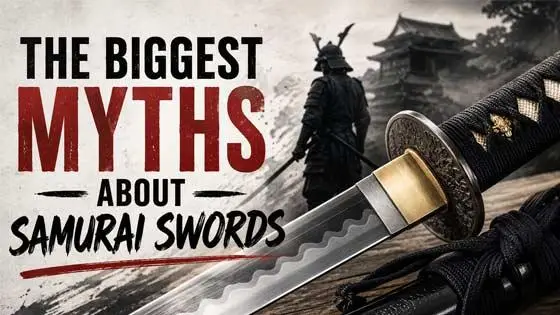
Samurai swords have been surrounded by myths for centuries. Depending on who you ask, a katana can slice through steel, cut a person clean in half with almost no effort, or outperform every other sword ever made. Movies, anime, video games, and even martial arts folklore have helped turn the samurai sword into something almost legendary. But how much of what people believe is actually true?
The reality is that samurai swords are fascinating enough without the exaggeration. While katanas were beautifully crafted weapons with a rich history, many of the stories people repeat today are either oversimplified, misunderstood, or completely made up. From the myth of "folded a thousand times" steel to the idea that every samurai carried the same sword, there is a lot of misinformation floating around.
In this guide, we are breaking down some of the biggest myths about samurai swords, where they came from, and what history actually tells us about these iconic weapons.
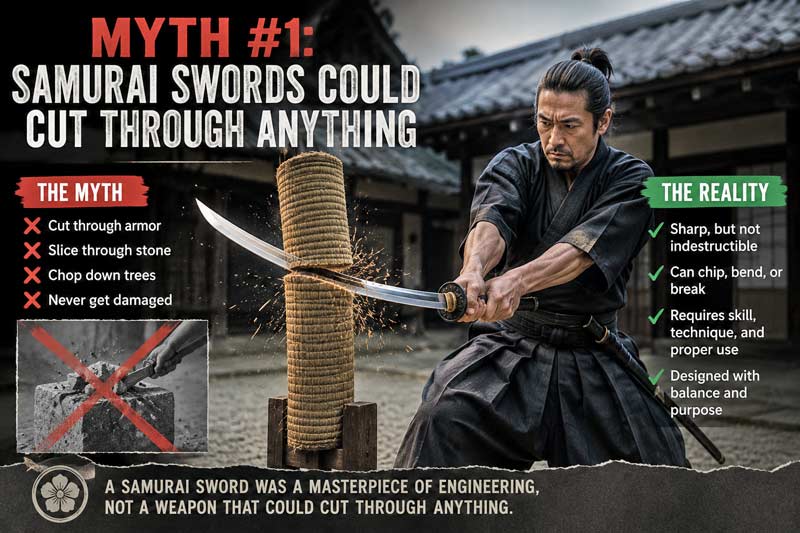
One of the most common samurai sword myths is the idea that a katana could slice through almost anything without damage. In movies and video games, samurai swords are often shown cutting through armor, other weapons, trees, stone, and sometimes objects that would destroy a real blade almost instantly. It makes for a dramatic scene, but it is not how swords actually work.
A well-made katana was definitely sharp, and in the hands of a skilled swordsman, it could be an extremely effective weapon. But it was still made of steel, not magic. Like any sword, it had limits. Hard targets could chip, bend, or crack the blade if the cut was poorly aimed or if the sword struck something it was never meant to cut. Even highly respected Japanese swordsmiths had to balance sharpness, flexibility, hardness, and durability.
That balance is part of what made samurai swords so interesting. A blade that is too hard may hold a sharp edge, but it can also become brittle. A blade that is too soft may be less likely to break, but it will not hold the same cutting edge. The katana became famous because it found a practical balance between these traits, not because it could cut through every object in its path.
This is also why technique mattered so much. A clean cut required proper edge alignment, body movement, timing, and control. The sword was only one part of the equation. The person using it mattered just as much, if not more. That is one of the reasons the debate over the samurai sword vs katana can get confusing. People often use the terms interchangeably, but the history and design details are more specific than most movie scenes suggest.
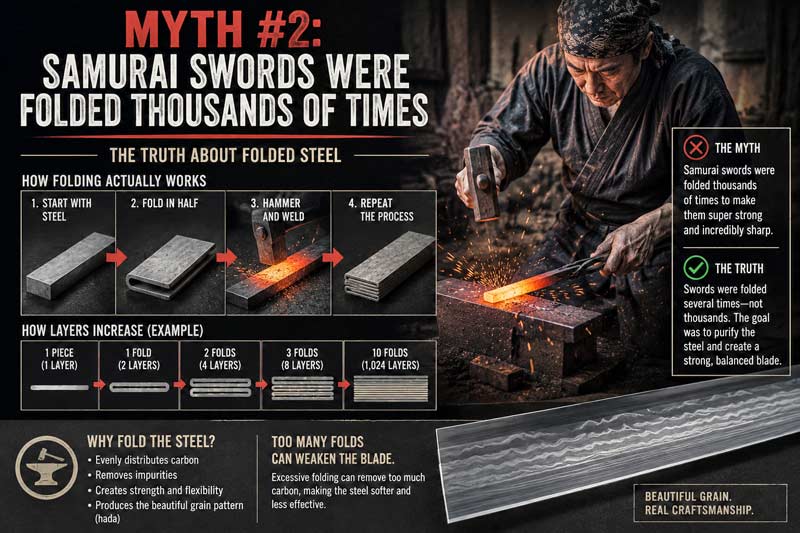
Another popular myth is that samurai swords were folded thousands of times during the forging process. This sounds impressive, but it is not accurate. Traditional Japanese swordsmiths did fold the steel, but not anywhere near that many times. In most cases, the folding process was repeated several times, not thousands.
The purpose of folding the steel was not to make the sword magically sharp or indestructible. It was mainly done to help improve the quality of the metal. Early Japanese swordsmiths often worked with tamahagane, a traditional steel made from iron sand. This material could contain uneven carbon levels and impurities, so folding and hammering helped spread the carbon more evenly and remove unwanted material from the blade.
The confusion usually comes from the way folding multiplies layers. If a piece of steel is folded once, it creates two layers. Fold it again, and it creates four. After several folds, the number of layers can become very high, even though the sword was not literally folded hundreds or thousands of separate times. That is where the myth gets exaggerated.
In reality, folding a sword too many times can actually weaken the blade. Each fold can remove carbon from the steel, and too much carbon loss can make the sword less effective. A skilled swordsmith had to know when the steel had been refined enough and when to stop. That judgment was part of the craft.
So yes, folded steel was real. The beautiful grain pattern seen on many traditional Japanese blades is part of what makes them so visually striking. But the idea that samurai swords were folded thousands of times is more legend than fact. Like many katana myths, the truth is still impressive, just not as exaggerated as the version people often repeat online.
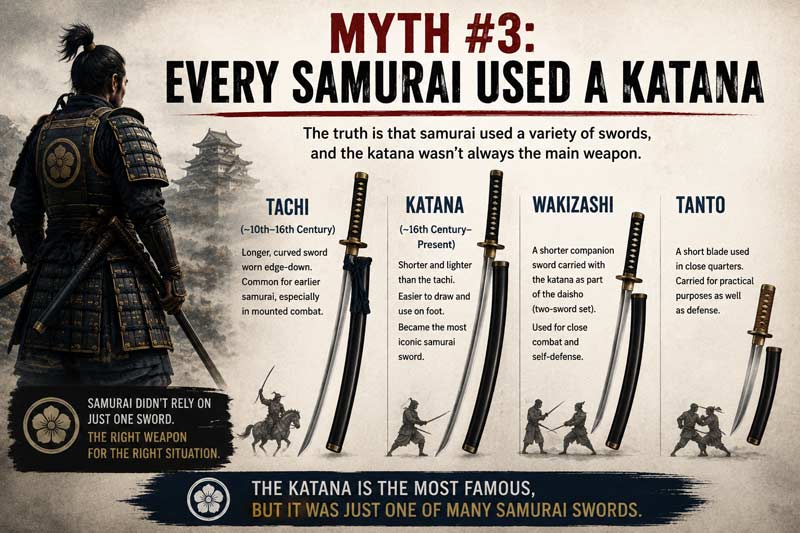
When most people picture a samurai sword, they picture a katana. That makes sense, because the katana is easily the most famous Japanese sword today. It is the weapon most often shown in movies, anime, video games, and modern martial arts displays. Because of that, it is easy to assume that every samurai carried the same curved sword into battle.
The truth is more complicated. Samurai used different swords during different time periods, and the katana was not always the main weapon associated with them. Earlier warriors often used longer curved swords called tachi, which were typically worn edge-down and were better suited for mounted combat. As fighting styles changed, the katana became more common because it was easier to draw and use on foot.
Samurai also carried shorter blades, including the wakizashi and tanto. The wakizashi was often paired with the katana as part of the daisho, the two-sword combination strongly associated with samurai status. The tanto was a shorter blade used in close quarters and carried for practical purposes. These weapons all had different roles, and they show that samurai sword history is much broader than one blade style.
That is why it is more accurate to think of the katana as the most iconic samurai sword, not the only one. If you look at different types of samurai swords, you will see that Japanese sword design included a wide range of lengths, shapes, and purposes. The katana earned its legendary reputation, but it was part of a much larger sword tradition.
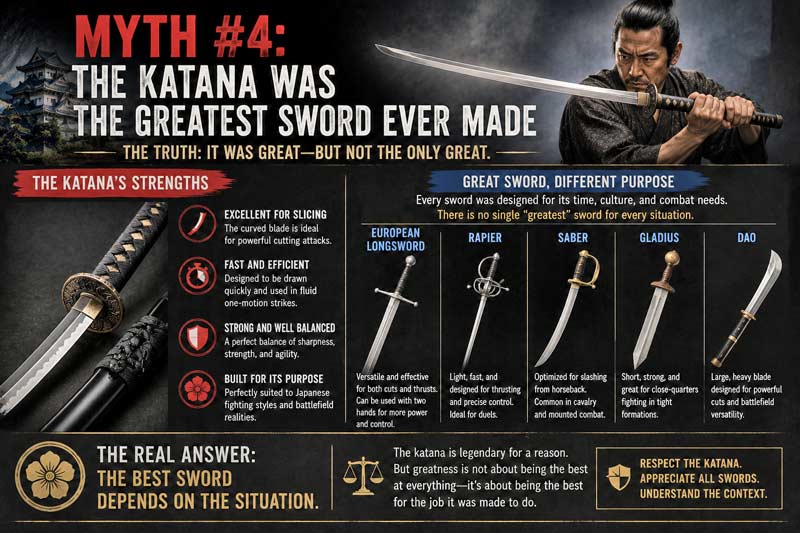
This might be the most debated samurai sword myth of all. The katana is often described as the greatest sword ever made, and depending on the source, it is sometimes treated like it was superior to every other blade in history. That makes for a fun argument, but it is not really how weapons work.
The katana was an excellent sword for its time, place, and purpose. It was fast, sharp, elegant, and well suited for the fighting styles associated with Japanese warriors. Its curved blade made it especially effective for slicing cuts, and its design allowed it to be drawn and used quickly. There is a reason it became one of the most recognizable swords in the world.
But calling it the greatest sword ever made ignores context. A sword that works well in one setting may not be ideal in another. A European longsword, for example, had different strengths. It could be used with two hands, delivered powerful cuts and thrusts, and was often designed with armor in mind. A rapier, saber, gladius, claymore, or dao all served different purposes too. Comparing all of them as if there is one universal winner oversimplifies the entire subject.
The better question is not whether the katana was the best sword of all time, but what it was best at. If you are interested in that broader debate, we covered it in more detail in our article about the best sword of all time. The short answer is that the katana deserves its legendary reputation, but no sword is automatically better than every other sword in every situation.
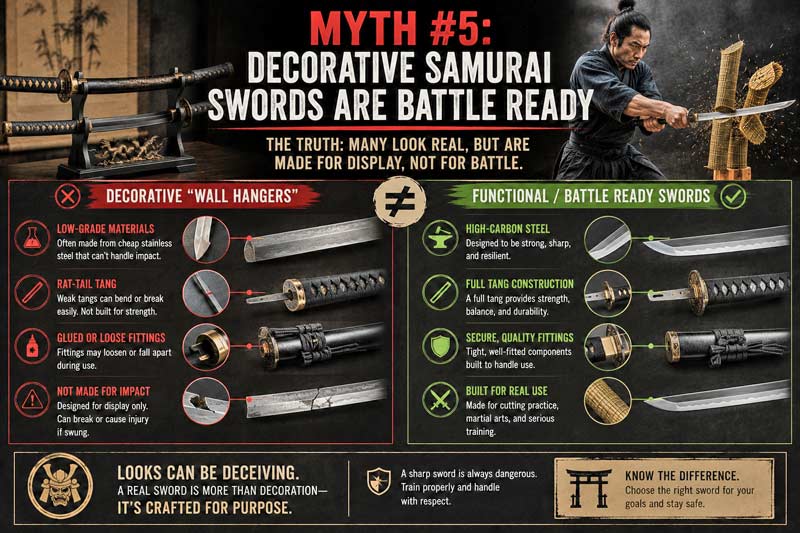
A lot of people assume that if a samurai sword looks real, it must function like a real weapon. After all, many decorative katanas have metal blades, detailed handles, and realistic scabbards. From a distance, they can look nearly identical to a functional sword. But appearance can be misleading.
The truth is that many decorative samurai swords, often called wall hangers, are designed for display only. They may use lower-grade stainless steel, rat-tail tangs, glued fittings, or lightweight construction methods that are not intended to handle impact or cutting practice. Trying to swing or cut with a decorative sword can be dangerous because parts may loosen, bend, or even break unexpectedly.
Functional samurai swords are built differently. A battle-ready or cutting sword is usually made from high-carbon steel and designed with durability in mind. Features like a full tang construction, secure fittings, proper balance, and quality craftsmanship all matter. Even then, proper training and safe handling are important, because a sharp sword is still a serious weapon.
This confusion happens a lot because movies and online videos rarely explain the difference. A sword hanging on a wall may look impressive, but that does not mean it was designed for cutting practice or martial arts training. If you want a deeper breakdown of what separates a display sword from a functional blade, check out our guide to real vs decorative samurai swords.
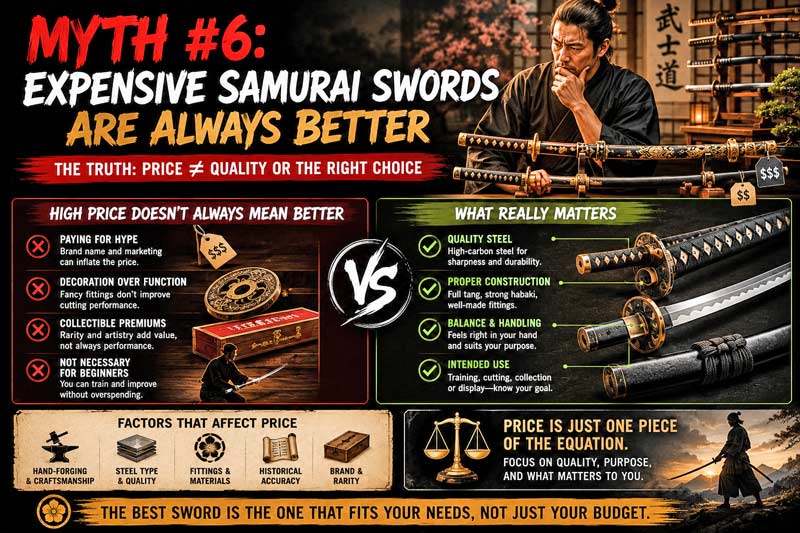
It is easy to assume that a more expensive samurai sword is automatically a better sword. After all, price often signals quality in many products. But when it comes to katanas and other samurai swords, the truth is a little more complicated. A higher price does not always mean the sword is better for your needs.
Several things can affect the price of a samurai sword. Materials matter, of course. High-carbon steel blades, hand-forged construction, premium fittings, folded steel patterns, and detailed craftsmanship can all increase cost. Limited editions, handmade features, and decorative details can also drive prices much higher. In some cases, you may be paying for artistry or collectability just as much as performance.
At the same time, an expensive sword is not necessarily the right choice for everyone. Someone interested in martial arts training or backyard cutting practice may need something very different from a collector looking for a display piece. Beginners sometimes spend far more than they need because they assume the most expensive option must be the best option.
The smarter approach is to think about how the sword will actually be used. Are you looking for something decorative, functional, beginner-friendly, or historically inspired? Understanding the basics of steel type, construction, balance, and intended use can make a much bigger difference than price alone. If you are shopping for a katana and want to know what features actually matter, our katana buying guide breaks down what to look for before making a decision.
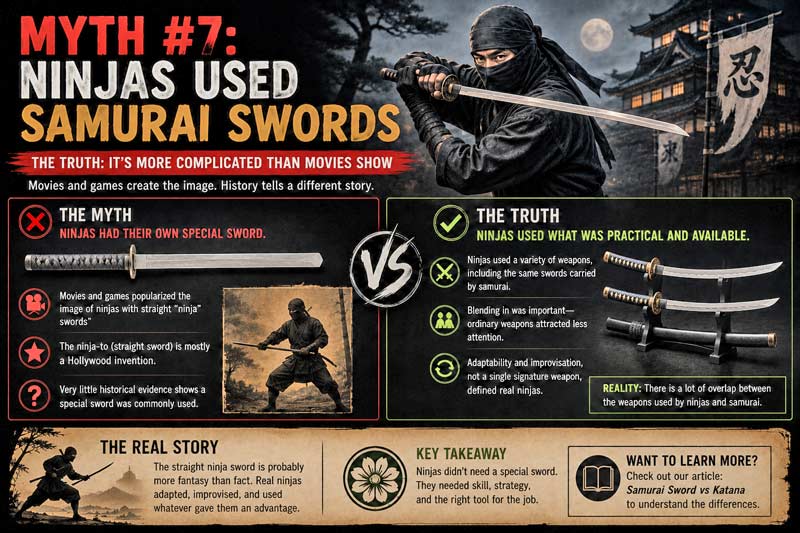
Thanks to movies and video games, many people picture ninjas carrying a perfectly straight "ninja sword" strapped across their back. It has become such a common image that a lot of people assume ninjas used a completely different sword from samurai. The reality is much less dramatic and far more debated by historians.
There is very little historical evidence that a special straight-bladed "ninja-to" was commonly used by real ninjas. In fact, many historians believe the famous ninja sword is largely a Hollywood invention. Pop culture helped popularize the image, especially in martial arts films from the 1970s and 1980s, but historical records are surprisingly limited.
That does not mean ninjas never used swords. They absolutely did. But they likely used whatever weapons were practical and available, which often included ordinary Japanese blades that looked very similar to what samurai carried. Since many ninjas operated covertly and blended into society, carrying unusual weapons may have attracted unwanted attention.
This is one reason the line between ninja and samurai weapons gets blurry. Many people assume every curved Japanese sword is either a "samurai sword" or a "ninja sword," when in reality there was a lot more overlap than movies suggest. If you are curious about how samurai blades compare to the iconic katana most people picture, our article on samurai sword vs katana explains some of those differences in more detail.
The truth is that the classic straight ninja sword is probably more fantasy than historical fact. Real ninjas were known for adapting, improvising, and using whatever tools gave them an advantage, not for carrying one perfectly standardized weapon.
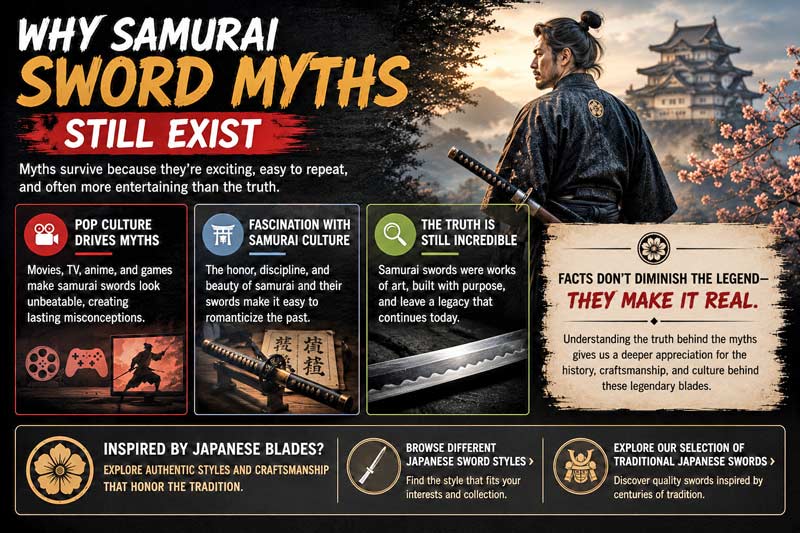
So why do so many samurai sword myths continue to stick around? A big reason is simple: the truth is not always as exciting as the legend. Movies, television shows, anime, video games, and internet discussions have all helped turn the katana into something almost mythical. It is often portrayed as an unstoppable weapon capable of impossible feats, which makes for great entertainment, even if it is not historically accurate.
There is also something fascinating about samurai culture itself. The craftsmanship behind Japanese blades, the discipline associated with samurai warriors, and the visual appeal of swords like the katana make them easy to romanticize. Over time, facts and fiction tend to blend together, especially when stories get repeated often enough online.
The reality is that samurai swords do not need exaggeration to be interesting. They were beautifully designed weapons with a long history, impressive craftsmanship, and a major cultural impact that still influences movies, martial arts, and collectors today. Understanding the facts behind the myths makes their history even more interesting, not less.
If this article sparked your interest in Japanese blades, you can browse different sword styles or explore our selection of traditional Japanese swords to see some of the designs inspired by these legendary weapons for yourself.
No, that is one of the biggest myths about samurai swords. Traditional Japanese swordsmiths did fold the steel during the forging process, but not thousands of times. In most cases, the steel was folded several times to help remove impurities and distribute carbon more evenly throughout the blade. The confusion comes from the number of layers multiplying with each fold, which can make it sound like the sword was folded far more times than it actually was.
In fact, folding steel too many times could weaken the blade by reducing carbon content. Skilled swordsmiths had to know the right balance between refining the steel and preserving its strength. The real process is still impressive, just not quite as exaggerated as the myths often suggest.
Not in the way movies often show. A katana was a highly effective weapon, but it was not designed to slice clean through heavy metal armor like butter. Samurai swords worked best against lightly armored or unarmored targets, where their sharp edges and curved blades made slicing cuts very effective.
Against armor, samurai often relied on precision strikes aimed at weak points, exposed areas, or gaps in protection rather than trying to cut straight through metal plates. Like any sword, a katana could also chip, bend, or become damaged if used improperly against very hard materials. The idea that samurai swords could effortlessly cut through anything is one of the most exaggerated myths surrounding Japanese blades.
A katana is a type of samurai sword, but not all samurai swords are katanas. The term "samurai sword" is a broader category that can include several different Japanese blade styles used throughout history, including the katana, tachi, wakizashi, and tanto. Each had different purposes depending on the time period, fighting style, and situation.
The katana is simply the most famous and recognizable samurai sword today. It is known for its curved blade, long grip, and quick-draw design. Because movies and pop culture focus so heavily on the katana, many people use the words interchangeably, even though samurai historically carried a variety of weapons depending on their role and era.
Probably not, at least not in the way movies often portray them. The famous straight-bladed "ninja sword" has become a huge part of pop culture, but historians have found very little evidence that real ninjas commonly carried a unique, standardized sword that looked different from what samurai used.
In reality, ninjas likely used whatever weapons were practical and available, including many of the same Japanese blades used by samurai. Since ninjas often relied on stealth and blending in, carrying an unusual or highly recognizable weapon may have worked against them. The image of the perfectly straight ninja sword strapped across the back is largely believed to have been popularized by movies and television rather than historical records.
Some are, but many are not designed for actual use. Decorative samurai swords, often called wall hangers, are usually made for display rather than cutting practice or martial arts training. Even if the blade looks realistic or has a sharpened edge, that does not automatically mean it is safe or durable enough for use.
Functional samurai swords are typically built with stronger materials, secure fittings, and construction methods intended to handle movement and impact. Decorative swords may use lower-grade materials or weaker tangs that are not designed for stress. If you are considering a sword for anything beyond display, it is important to understand the difference between decorative and functional blades before making a purchase.
Several factors can affect the value of a samurai sword, and price is not just about appearance. Materials, craftsmanship, steel type, construction quality, age, historical significance, and decorative details can all influence value. Handmade or traditionally forged swords often cost more because of the time and skill involved in creating them.
At the same time, the most expensive sword is not always the best choice for everyone. A collector looking for authenticity may value different features than someone shopping for a display piece or training sword. Understanding how the sword will be used is often more important than focusing only on price, especially for beginners who are still learning what features matter most.
In many places, yes, real samurai swords are legal to own, but the laws can vary depending on where you live. In the United States, owning a katana or other samurai sword is generally legal in most states, especially if it is kept at home for collecting, display, or martial arts practice. However, there may be restrictions on carrying swords in public or transporting them in certain situations.
Laws can also differ internationally, and some locations have stricter rules regarding blade length, concealed weapons, or public possession. If you are thinking about buying a real samurai sword, it is always a good idea to check your local laws first. Responsible storage and safe handling are important too, especially if children are present in the home.
Samurai swords are curved mainly because the shape makes them more effective for slicing cuts. The curve helps the blade move smoothly through a target during a strike, which can make cutting more efficient compared to a completely straight blade. It also helped samurai draw the sword quickly from its scabbard, an advantage in fast-moving combat situations.
The curved design evolved over time as Japanese warfare changed. Earlier swords, such as the tachi, often had a more noticeable curve and were commonly used by mounted warriors. Later designs like the katana refined that shape for fighting on foot. While the curve became one of the katana's most recognizable features, it was not just for appearance. It served a practical purpose based on how the sword was actually used.
Yes, many samurai were known for carrying two swords, a combination called the daisho, which means "big and small." This typically included a katana paired with a shorter sword called a wakizashi. The katana was usually the primary weapon, while the wakizashi served as a backup weapon and was useful in close quarters or indoor settings where a longer blade was harder to use.
Carrying two swords also became a symbol of samurai status during certain periods of Japanese history. However, not every samurai in every era carried the exact same combination, and weapon choices often changed depending on the time period, battlefield conditions, and personal preference. Like many aspects of samurai history, movies tend to simplify something that was actually more complex.
Not usually, despite what movies often show. Samurai swords were incredibly well made, but they were not designed to slice clean through other steel weapons. In reality, striking another blade with enough force to cut through it would be extremely difficult and could damage both swords. Hard impacts against metal could chip, crack, or bend even a high-quality katana.
Sword fights in real life were more about timing, positioning, and targeting openings than dramatic blade destruction. Samurai swords were designed to cut effectively against intended targets, not smash through armor or chop other weapons in half. While there are stories and demonstrations involving damaged blades, the idea of effortlessly cutting through another sword is mostly Hollywood fiction.
A well-made samurai sword can last for generations if it is properly cared for. In fact, many authentic Japanese swords have survived for hundreds of years and are still displayed in museums, private collections, or passed down through families. The lifespan of a sword depends heavily on the quality of the materials, how it is used, and how well it is maintained.
Regular cleaning, proper storage, and protection from moisture are important because steel can rust over time if neglected. Functional swords used for cutting practice may also require occasional maintenance to keep the blade in good condition. Decorative swords generally experience less wear, but they can still deteriorate if exposed to humidity or poor storage conditions. With proper care, a quality samurai sword can remain in excellent shape for a very long time.
Traditional samurai swords were commonly made from a type of steel called tamahagane, which was produced using iron sand and a traditional smelting process in a clay furnace called a tatara. This steel often contained uneven carbon levels and impurities, which is one reason Japanese swordsmiths developed the folding process to refine and strengthen the material.
Modern samurai swords can be made from many different types of steel, including high-carbon steel, spring steel, and stainless steel depending on whether the sword is intended for display, collecting, or functional use. The materials and construction method can make a big difference in durability, sharpness, and overall performance. That is why understanding how a sword is made is often more important than focusing only on price or appearance.
Yes, samurai swords required regular maintenance to stay in good condition. Traditional Japanese blades were made from high-carbon steel, which could rust if exposed to moisture, fingerprints, or poor storage conditions. Samurai often cleaned and cared for their swords carefully because a damaged or neglected blade could lose both effectiveness and value.
Proper maintenance usually involved cleaning the blade, lightly oiling it to protect against rust, and storing it in a dry place inside its scabbard. Even today, collectors and martial artists who own functional katanas often follow similar care routines. A well-maintained sword can last for generations, while poor care can cause corrosion or permanent damage much faster than many people realize.
One reason samurai often wore the katana edge-up was speed. Carrying the sword this way made it easier to draw and strike in one smooth motion, a technique that became especially important as combat styles evolved. Unlike earlier swords such as the tachi, which were commonly worn edge-down by mounted warriors, the katana was designed for quicker access during foot combat.
Wearing the blade edge-up also helped protect the cutting edge inside the scabbard and made certain drawing techniques more practical. This style became closely associated with the katana and helped shape many of the martial arts techniques still practiced today. Like many parts of samurai history, the design was based on function as much as tradition.
Yes, samurai swords were absolutely used in battle, but perhaps not in the way many people imagine. While the katana became the most iconic samurai weapon, earlier samurai often relied more heavily on bows, spears, and polearms during large-scale battles. Swords were important, but they were not always the primary battlefield weapon.
Over time, especially as combat styles changed and warfare became less focused on mounted fighting, the katana grew in importance as both a weapon and a symbol of samurai identity. It was valued for close combat, personal defense, and status. In peaceful periods of Japanese history, the sword became even more closely associated with the samurai class, helping build the legendary reputation it still has today.
Samurai swords earned a reputation for being sharp because of the way they were designed and crafted. Traditional Japanese swordsmiths carefully balanced hardness and flexibility during the forging process. Many katanas featured a hard cutting edge for sharpness and a softer spine to help absorb impact and reduce the risk of breaking. This combination made the sword both effective and durable for its intended purpose.
The curved blade design also played a role. Katanas were especially effective at slicing motions, which can feel sharper and more efficient during a cut compared to a straight chopping motion. That said, the idea that samurai swords were impossibly sharp or could cut through anything is often exaggerated. Like any blade, performance depended on craftsmanship, maintenance, and the skill of the person using it.
Sometimes, yes. Certain samurai swords, especially famous or historically significant blades, were given names and treated with great respect. In some cases, swords earned names because of their craftsmanship, battlefield history, unique characteristics, or legendary stories connected to them. Named swords were often passed down through generations and could become symbols of family heritage or status.
That said, not every samurai walked around with a personally named sword like in movies or anime. Many swords were simply practical weapons used for combat and everyday carry. The idea of every blade having a dramatic name or mystical reputation is mostly a modern exaggeration, although some famous Japanese swords did gain legendary status over time.
In this guide, we are breaking down some of the biggest myths about samurai swords, where they came from, and what history actually tells us about these iconic weapons.
Myth #1: Samurai Swords Could Cut Through Anything
One of the most common samurai sword myths is the idea that a katana could slice through almost anything without damage. In movies and video games, samurai swords are often shown cutting through armor, other weapons, trees, stone, and sometimes objects that would destroy a real blade almost instantly. It makes for a dramatic scene, but it is not how swords actually work.
A well-made katana was definitely sharp, and in the hands of a skilled swordsman, it could be an extremely effective weapon. But it was still made of steel, not magic. Like any sword, it had limits. Hard targets could chip, bend, or crack the blade if the cut was poorly aimed or if the sword struck something it was never meant to cut. Even highly respected Japanese swordsmiths had to balance sharpness, flexibility, hardness, and durability.
That balance is part of what made samurai swords so interesting. A blade that is too hard may hold a sharp edge, but it can also become brittle. A blade that is too soft may be less likely to break, but it will not hold the same cutting edge. The katana became famous because it found a practical balance between these traits, not because it could cut through every object in its path.
This is also why technique mattered so much. A clean cut required proper edge alignment, body movement, timing, and control. The sword was only one part of the equation. The person using it mattered just as much, if not more. That is one of the reasons the debate over the samurai sword vs katana can get confusing. People often use the terms interchangeably, but the history and design details are more specific than most movie scenes suggest.
Myth #2: Samurai Swords Were Folded Thousands Of Times
Another popular myth is that samurai swords were folded thousands of times during the forging process. This sounds impressive, but it is not accurate. Traditional Japanese swordsmiths did fold the steel, but not anywhere near that many times. In most cases, the folding process was repeated several times, not thousands.
The purpose of folding the steel was not to make the sword magically sharp or indestructible. It was mainly done to help improve the quality of the metal. Early Japanese swordsmiths often worked with tamahagane, a traditional steel made from iron sand. This material could contain uneven carbon levels and impurities, so folding and hammering helped spread the carbon more evenly and remove unwanted material from the blade.
The confusion usually comes from the way folding multiplies layers. If a piece of steel is folded once, it creates two layers. Fold it again, and it creates four. After several folds, the number of layers can become very high, even though the sword was not literally folded hundreds or thousands of separate times. That is where the myth gets exaggerated.
In reality, folding a sword too many times can actually weaken the blade. Each fold can remove carbon from the steel, and too much carbon loss can make the sword less effective. A skilled swordsmith had to know when the steel had been refined enough and when to stop. That judgment was part of the craft.
So yes, folded steel was real. The beautiful grain pattern seen on many traditional Japanese blades is part of what makes them so visually striking. But the idea that samurai swords were folded thousands of times is more legend than fact. Like many katana myths, the truth is still impressive, just not as exaggerated as the version people often repeat online.
Myth #3: Every Samurai Used A Katana
When most people picture a samurai sword, they picture a katana. That makes sense, because the katana is easily the most famous Japanese sword today. It is the weapon most often shown in movies, anime, video games, and modern martial arts displays. Because of that, it is easy to assume that every samurai carried the same curved sword into battle.
The truth is more complicated. Samurai used different swords during different time periods, and the katana was not always the main weapon associated with them. Earlier warriors often used longer curved swords called tachi, which were typically worn edge-down and were better suited for mounted combat. As fighting styles changed, the katana became more common because it was easier to draw and use on foot.
Samurai also carried shorter blades, including the wakizashi and tanto. The wakizashi was often paired with the katana as part of the daisho, the two-sword combination strongly associated with samurai status. The tanto was a shorter blade used in close quarters and carried for practical purposes. These weapons all had different roles, and they show that samurai sword history is much broader than one blade style.
That is why it is more accurate to think of the katana as the most iconic samurai sword, not the only one. If you look at different types of samurai swords, you will see that Japanese sword design included a wide range of lengths, shapes, and purposes. The katana earned its legendary reputation, but it was part of a much larger sword tradition.
Myth #4: The Katana Was The Greatest Sword Ever Made
This might be the most debated samurai sword myth of all. The katana is often described as the greatest sword ever made, and depending on the source, it is sometimes treated like it was superior to every other blade in history. That makes for a fun argument, but it is not really how weapons work.
The katana was an excellent sword for its time, place, and purpose. It was fast, sharp, elegant, and well suited for the fighting styles associated with Japanese warriors. Its curved blade made it especially effective for slicing cuts, and its design allowed it to be drawn and used quickly. There is a reason it became one of the most recognizable swords in the world.
But calling it the greatest sword ever made ignores context. A sword that works well in one setting may not be ideal in another. A European longsword, for example, had different strengths. It could be used with two hands, delivered powerful cuts and thrusts, and was often designed with armor in mind. A rapier, saber, gladius, claymore, or dao all served different purposes too. Comparing all of them as if there is one universal winner oversimplifies the entire subject.
The better question is not whether the katana was the best sword of all time, but what it was best at. If you are interested in that broader debate, we covered it in more detail in our article about the best sword of all time. The short answer is that the katana deserves its legendary reputation, but no sword is automatically better than every other sword in every situation.
Myth #5: Decorative Samurai Swords Are Battle Ready
A lot of people assume that if a samurai sword looks real, it must function like a real weapon. After all, many decorative katanas have metal blades, detailed handles, and realistic scabbards. From a distance, they can look nearly identical to a functional sword. But appearance can be misleading.
The truth is that many decorative samurai swords, often called wall hangers, are designed for display only. They may use lower-grade stainless steel, rat-tail tangs, glued fittings, or lightweight construction methods that are not intended to handle impact or cutting practice. Trying to swing or cut with a decorative sword can be dangerous because parts may loosen, bend, or even break unexpectedly.
Functional samurai swords are built differently. A battle-ready or cutting sword is usually made from high-carbon steel and designed with durability in mind. Features like a full tang construction, secure fittings, proper balance, and quality craftsmanship all matter. Even then, proper training and safe handling are important, because a sharp sword is still a serious weapon.
This confusion happens a lot because movies and online videos rarely explain the difference. A sword hanging on a wall may look impressive, but that does not mean it was designed for cutting practice or martial arts training. If you want a deeper breakdown of what separates a display sword from a functional blade, check out our guide to real vs decorative samurai swords.
Myth #6: Expensive Samurai Swords Are Always Better
It is easy to assume that a more expensive samurai sword is automatically a better sword. After all, price often signals quality in many products. But when it comes to katanas and other samurai swords, the truth is a little more complicated. A higher price does not always mean the sword is better for your needs.
Several things can affect the price of a samurai sword. Materials matter, of course. High-carbon steel blades, hand-forged construction, premium fittings, folded steel patterns, and detailed craftsmanship can all increase cost. Limited editions, handmade features, and decorative details can also drive prices much higher. In some cases, you may be paying for artistry or collectability just as much as performance.
At the same time, an expensive sword is not necessarily the right choice for everyone. Someone interested in martial arts training or backyard cutting practice may need something very different from a collector looking for a display piece. Beginners sometimes spend far more than they need because they assume the most expensive option must be the best option.
The smarter approach is to think about how the sword will actually be used. Are you looking for something decorative, functional, beginner-friendly, or historically inspired? Understanding the basics of steel type, construction, balance, and intended use can make a much bigger difference than price alone. If you are shopping for a katana and want to know what features actually matter, our katana buying guide breaks down what to look for before making a decision.
Myth #7: Ninjas Used Samurai Swords
Thanks to movies and video games, many people picture ninjas carrying a perfectly straight "ninja sword" strapped across their back. It has become such a common image that a lot of people assume ninjas used a completely different sword from samurai. The reality is much less dramatic and far more debated by historians.
There is very little historical evidence that a special straight-bladed "ninja-to" was commonly used by real ninjas. In fact, many historians believe the famous ninja sword is largely a Hollywood invention. Pop culture helped popularize the image, especially in martial arts films from the 1970s and 1980s, but historical records are surprisingly limited.
That does not mean ninjas never used swords. They absolutely did. But they likely used whatever weapons were practical and available, which often included ordinary Japanese blades that looked very similar to what samurai carried. Since many ninjas operated covertly and blended into society, carrying unusual weapons may have attracted unwanted attention.
This is one reason the line between ninja and samurai weapons gets blurry. Many people assume every curved Japanese sword is either a "samurai sword" or a "ninja sword," when in reality there was a lot more overlap than movies suggest. If you are curious about how samurai blades compare to the iconic katana most people picture, our article on samurai sword vs katana explains some of those differences in more detail.
The truth is that the classic straight ninja sword is probably more fantasy than historical fact. Real ninjas were known for adapting, improvising, and using whatever tools gave them an advantage, not for carrying one perfectly standardized weapon.
Why Samurai Sword Myths Still Exist
So why do so many samurai sword myths continue to stick around? A big reason is simple: the truth is not always as exciting as the legend. Movies, television shows, anime, video games, and internet discussions have all helped turn the katana into something almost mythical. It is often portrayed as an unstoppable weapon capable of impossible feats, which makes for great entertainment, even if it is not historically accurate.
There is also something fascinating about samurai culture itself. The craftsmanship behind Japanese blades, the discipline associated with samurai warriors, and the visual appeal of swords like the katana make them easy to romanticize. Over time, facts and fiction tend to blend together, especially when stories get repeated often enough online.
The reality is that samurai swords do not need exaggeration to be interesting. They were beautifully designed weapons with a long history, impressive craftsmanship, and a major cultural impact that still influences movies, martial arts, and collectors today. Understanding the facts behind the myths makes their history even more interesting, not less.
If this article sparked your interest in Japanese blades, you can browse different sword styles or explore our selection of traditional Japanese swords to see some of the designs inspired by these legendary weapons for yourself.
Are Samurai Swords Really Folded Thousands Of Times?
No, that is one of the biggest myths about samurai swords. Traditional Japanese swordsmiths did fold the steel during the forging process, but not thousands of times. In most cases, the steel was folded several times to help remove impurities and distribute carbon more evenly throughout the blade. The confusion comes from the number of layers multiplying with each fold, which can make it sound like the sword was folded far more times than it actually was.
In fact, folding steel too many times could weaken the blade by reducing carbon content. Skilled swordsmiths had to know the right balance between refining the steel and preserving its strength. The real process is still impressive, just not quite as exaggerated as the myths often suggest.
Could A Katana Cut Through Armor?
Not in the way movies often show. A katana was a highly effective weapon, but it was not designed to slice clean through heavy metal armor like butter. Samurai swords worked best against lightly armored or unarmored targets, where their sharp edges and curved blades made slicing cuts very effective.
Against armor, samurai often relied on precision strikes aimed at weak points, exposed areas, or gaps in protection rather than trying to cut straight through metal plates. Like any sword, a katana could also chip, bend, or become damaged if used improperly against very hard materials. The idea that samurai swords could effortlessly cut through anything is one of the most exaggerated myths surrounding Japanese blades.
What Is The Difference Between A Katana And A Samurai Sword?
A katana is a type of samurai sword, but not all samurai swords are katanas. The term "samurai sword" is a broader category that can include several different Japanese blade styles used throughout history, including the katana, tachi, wakizashi, and tanto. Each had different purposes depending on the time period, fighting style, and situation.
The katana is simply the most famous and recognizable samurai sword today. It is known for its curved blade, long grip, and quick-draw design. Because movies and pop culture focus so heavily on the katana, many people use the words interchangeably, even though samurai historically carried a variety of weapons depending on their role and era.
Did Ninjas Actually Use Straight Swords?
Probably not, at least not in the way movies often portray them. The famous straight-bladed "ninja sword" has become a huge part of pop culture, but historians have found very little evidence that real ninjas commonly carried a unique, standardized sword that looked different from what samurai used.
In reality, ninjas likely used whatever weapons were practical and available, including many of the same Japanese blades used by samurai. Since ninjas often relied on stealth and blending in, carrying an unusual or highly recognizable weapon may have worked against them. The image of the perfectly straight ninja sword strapped across the back is largely believed to have been popularized by movies and television rather than historical records.
Are Decorative Samurai Swords Sharp?
Some are, but many are not designed for actual use. Decorative samurai swords, often called wall hangers, are usually made for display rather than cutting practice or martial arts training. Even if the blade looks realistic or has a sharpened edge, that does not automatically mean it is safe or durable enough for use.
Functional samurai swords are typically built with stronger materials, secure fittings, and construction methods intended to handle movement and impact. Decorative swords may use lower-grade materials or weaker tangs that are not designed for stress. If you are considering a sword for anything beyond display, it is important to understand the difference between decorative and functional blades before making a purchase.
What Makes A Samurai Sword Valuable?
Several factors can affect the value of a samurai sword, and price is not just about appearance. Materials, craftsmanship, steel type, construction quality, age, historical significance, and decorative details can all influence value. Handmade or traditionally forged swords often cost more because of the time and skill involved in creating them.
At the same time, the most expensive sword is not always the best choice for everyone. A collector looking for authenticity may value different features than someone shopping for a display piece or training sword. Understanding how the sword will be used is often more important than focusing only on price, especially for beginners who are still learning what features matter most.
Are Real Samurai Swords Legal To Own?
In many places, yes, real samurai swords are legal to own, but the laws can vary depending on where you live. In the United States, owning a katana or other samurai sword is generally legal in most states, especially if it is kept at home for collecting, display, or martial arts practice. However, there may be restrictions on carrying swords in public or transporting them in certain situations.
Laws can also differ internationally, and some locations have stricter rules regarding blade length, concealed weapons, or public possession. If you are thinking about buying a real samurai sword, it is always a good idea to check your local laws first. Responsible storage and safe handling are important too, especially if children are present in the home.
Why Are Samurai Swords Curved?
Samurai swords are curved mainly because the shape makes them more effective for slicing cuts. The curve helps the blade move smoothly through a target during a strike, which can make cutting more efficient compared to a completely straight blade. It also helped samurai draw the sword quickly from its scabbard, an advantage in fast-moving combat situations.
The curved design evolved over time as Japanese warfare changed. Earlier swords, such as the tachi, often had a more noticeable curve and were commonly used by mounted warriors. Later designs like the katana refined that shape for fighting on foot. While the curve became one of the katana's most recognizable features, it was not just for appearance. It served a practical purpose based on how the sword was actually used.
Did Samurai Really Carry Two Swords?
Yes, many samurai were known for carrying two swords, a combination called the daisho, which means "big and small." This typically included a katana paired with a shorter sword called a wakizashi. The katana was usually the primary weapon, while the wakizashi served as a backup weapon and was useful in close quarters or indoor settings where a longer blade was harder to use.
Carrying two swords also became a symbol of samurai status during certain periods of Japanese history. However, not every samurai in every era carried the exact same combination, and weapon choices often changed depending on the time period, battlefield conditions, and personal preference. Like many aspects of samurai history, movies tend to simplify something that was actually more complex.
Can A Samurai Sword Cut Through Another Sword?
Not usually, despite what movies often show. Samurai swords were incredibly well made, but they were not designed to slice clean through other steel weapons. In reality, striking another blade with enough force to cut through it would be extremely difficult and could damage both swords. Hard impacts against metal could chip, crack, or bend even a high-quality katana.
Sword fights in real life were more about timing, positioning, and targeting openings than dramatic blade destruction. Samurai swords were designed to cut effectively against intended targets, not smash through armor or chop other weapons in half. While there are stories and demonstrations involving damaged blades, the idea of effortlessly cutting through another sword is mostly Hollywood fiction.
How Long Does A Samurai Sword Last?
A well-made samurai sword can last for generations if it is properly cared for. In fact, many authentic Japanese swords have survived for hundreds of years and are still displayed in museums, private collections, or passed down through families. The lifespan of a sword depends heavily on the quality of the materials, how it is used, and how well it is maintained.
Regular cleaning, proper storage, and protection from moisture are important because steel can rust over time if neglected. Functional swords used for cutting practice may also require occasional maintenance to keep the blade in good condition. Decorative swords generally experience less wear, but they can still deteriorate if exposed to humidity or poor storage conditions. With proper care, a quality samurai sword can remain in excellent shape for a very long time.
What Was A Samurai Sword Made From?
Traditional samurai swords were commonly made from a type of steel called tamahagane, which was produced using iron sand and a traditional smelting process in a clay furnace called a tatara. This steel often contained uneven carbon levels and impurities, which is one reason Japanese swordsmiths developed the folding process to refine and strengthen the material.
Modern samurai swords can be made from many different types of steel, including high-carbon steel, spring steel, and stainless steel depending on whether the sword is intended for display, collecting, or functional use. The materials and construction method can make a big difference in durability, sharpness, and overall performance. That is why understanding how a sword is made is often more important than focusing only on price or appearance.
Did Samurai Swords Need A Lot Of Maintenance?
Yes, samurai swords required regular maintenance to stay in good condition. Traditional Japanese blades were made from high-carbon steel, which could rust if exposed to moisture, fingerprints, or poor storage conditions. Samurai often cleaned and cared for their swords carefully because a damaged or neglected blade could lose both effectiveness and value.
Proper maintenance usually involved cleaning the blade, lightly oiling it to protect against rust, and storing it in a dry place inside its scabbard. Even today, collectors and martial artists who own functional katanas often follow similar care routines. A well-maintained sword can last for generations, while poor care can cause corrosion or permanent damage much faster than many people realize.
Why Did Samurai Carry Swords Edge-Up?
One reason samurai often wore the katana edge-up was speed. Carrying the sword this way made it easier to draw and strike in one smooth motion, a technique that became especially important as combat styles evolved. Unlike earlier swords such as the tachi, which were commonly worn edge-down by mounted warriors, the katana was designed for quicker access during foot combat.
Wearing the blade edge-up also helped protect the cutting edge inside the scabbard and made certain drawing techniques more practical. This style became closely associated with the katana and helped shape many of the martial arts techniques still practiced today. Like many parts of samurai history, the design was based on function as much as tradition.
Were Samurai Swords Really Used In Battle?
Yes, samurai swords were absolutely used in battle, but perhaps not in the way many people imagine. While the katana became the most iconic samurai weapon, earlier samurai often relied more heavily on bows, spears, and polearms during large-scale battles. Swords were important, but they were not always the primary battlefield weapon.
Over time, especially as combat styles changed and warfare became less focused on mounted fighting, the katana grew in importance as both a weapon and a symbol of samurai identity. It was valued for close combat, personal defense, and status. In peaceful periods of Japanese history, the sword became even more closely associated with the samurai class, helping build the legendary reputation it still has today.
Why Were Samurai Swords So Sharp?
Samurai swords earned a reputation for being sharp because of the way they were designed and crafted. Traditional Japanese swordsmiths carefully balanced hardness and flexibility during the forging process. Many katanas featured a hard cutting edge for sharpness and a softer spine to help absorb impact and reduce the risk of breaking. This combination made the sword both effective and durable for its intended purpose.
The curved blade design also played a role. Katanas were especially effective at slicing motions, which can feel sharper and more efficient during a cut compared to a straight chopping motion. That said, the idea that samurai swords were impossibly sharp or could cut through anything is often exaggerated. Like any blade, performance depended on craftsmanship, maintenance, and the skill of the person using it.
Did Samurai Name Their Swords?
Sometimes, yes. Certain samurai swords, especially famous or historically significant blades, were given names and treated with great respect. In some cases, swords earned names because of their craftsmanship, battlefield history, unique characteristics, or legendary stories connected to them. Named swords were often passed down through generations and could become symbols of family heritage or status.
That said, not every samurai walked around with a personally named sword like in movies or anime. Many swords were simply practical weapons used for combat and everyday carry. The idea of every blade having a dramatic name or mystical reputation is mostly a modern exaggeration, although some famous Japanese swords did gain legendary status over time.
You May Also Be Interested In:
- The Biggest Martial Arts Myths That Refuse to Die
- Did Samurai Really Test Their Swords On People?
- Real vs. Decorative Samurai Swords: What You Need to Know
- A Visual Guide to Japanese Swords: The Blades of the Samurai Era
- The Truth About Ninja Weapons: 7 Myths Debunked
- Foam Practice Swords vs Wooden Swords: Which Is Better?
- What Is a Wakizashi? The Samurai's Companion Sword
- Samurai Sword vs Katana: What's the Difference?
- Samurai Sword Buying Guide: Which Katana is Best?
- The Real History of the Jutte (And Why Samurai Carried It)
Leave a Reply