



Whatever Happened to These Martial Arts?
June 5th, 2026
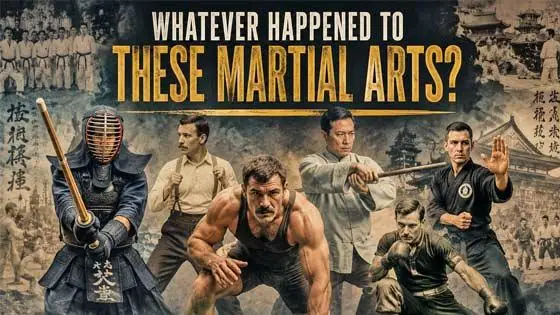
Karate. Taekwondo. Brazilian Jiu-Jitsu. Ask most Americans to name a martial art and the answers usually come pretty quickly. But martial arts history is filled with styles that once had serious momentum, passionate students, and loyal followings before quietly fading from the mainstream. Some were overshadowed by changing trends. Others struggled to adapt as MMA, modern fitness culture, and shifting attention spans reshaped what people wanted from training. And a few simply never got the recognition they probably deserved in the first place. So, whatever happened to these martial arts?
Whatever Happened to Kendo?
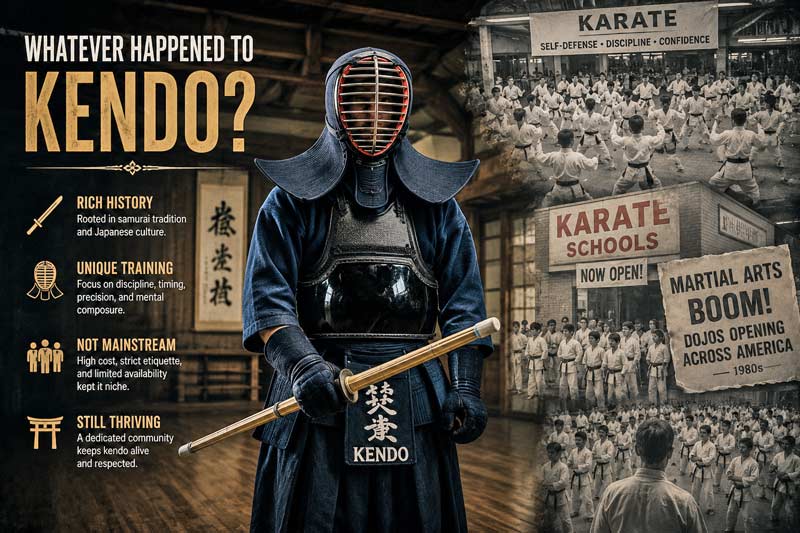
For a while, kendo looked like it might become far more popular in America than it is today.
With its armored uniforms, bamboo swords, and unmistakable intensity, kendo has always been one of the most visually recognizable Japanese martial arts. It feels traditional, disciplined, and dramatic all at once, almost like stepping into a living piece of samurai history. Yet despite its strong cultural identity, kendo never quite broke into the American mainstream the way karate, taekwondo, or Brazilian Jiu-Jitsu eventually did.
Part of the challenge may have been accessibility. Compared to many martial arts, kendo can feel intimidating for beginners. The equipment is specialized, training often emphasizes strict etiquette and repetition, and finding a school is not always easy depending on where someone lives. While karate schools exploded into suburbs during the 1980s, kendo generally remained more niche and community-based.
There is also the reality that kendo appeals to a very specific kind of student. Unlike martial arts built heavily around self-defense or MMA-style realism, kendo focuses on timing, discipline, precision, mental composure, and highly structured sparring. For the right person, that is incredibly rewarding. For someone expecting movie-style sword fighting, it can be a surprise.
Ironically, some of the things that kept kendo from becoming mainstream are exactly what helped preserve it. The art never watered itself down to chase trends. It remained deeply connected to Japanese tradition, etiquette, and ritual in a way many martial arts slowly moved away from over time.
Today, kendo still has a loyal following in the United States, even if it quietly exists outside the spotlight. In many ways, it feels less like a forgotten martial art and more like a hidden one. If you are curious about its history, training, and culture, this guide on what kendo is offers a deeper look.
Whatever Happened to Hapkido?
For a while, hapkido looked like it had all the ingredients to become huge in America.
It had flashy joint locks, powerful kicks, throws, self-defense techniques, and an unmistakable connection to Korean martial arts during the same period taekwondo was exploding in popularity. In theory, it seemed like the perfect complement to America's growing martial arts obsession in the 1980s and 1990s.
But while taekwondo became a household name, hapkido quietly stayed in the shadows.
Part of the reason may have been timing. Taekwondo had strong Olympic momentum, family-friendly schools, and clear sports appeal. Hapkido, by contrast, leaned harder into practical self-defense, joint manipulation, and close-range control. That made it fascinating to dedicated practitioners, but harder to package for mainstream audiences looking for tournaments, kids' programs, and recognizable competition formats.
Another challenge was branding. To the average American beginner, hapkido often looked similar to taekwondo at first glance, despite being very different in philosophy and training. Without a massive competitive spotlight or pop culture push, many people simply never learned what made it unique.
Ironically, some martial artists argue that hapkido was ahead of its time. Long before cross-training became common, it blended striking, grappling, throws, and self-defense concepts into one system. In today's MMA-influenced world, that versatility feels far more familiar than it did decades ago.
Hapkido never completely disappeared, of course. Schools still exist across the country, and many practitioners remain deeply loyal to the art. But compared to the explosive popularity of karate or taekwondo, hapkido feels like one of those martial arts that somehow almost became mainstream, then quietly drifted off most people's radar.
Whatever Happened to Kung Fu?
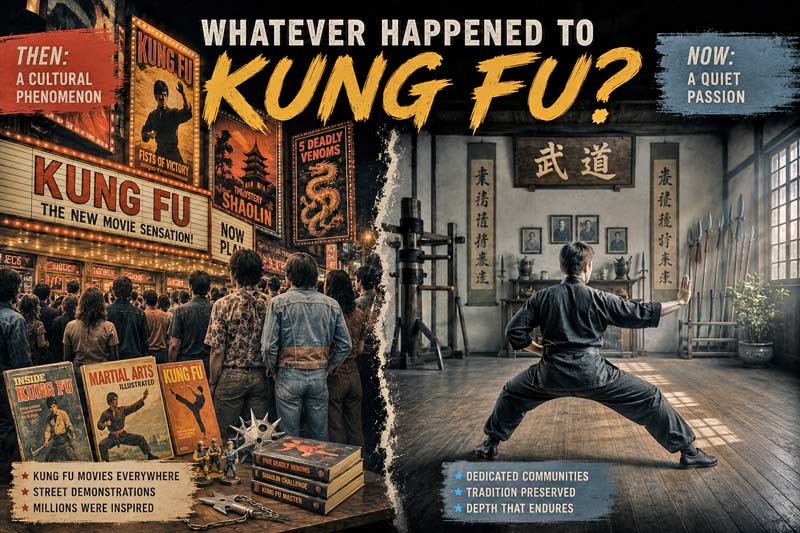
There was a time when kung fu felt impossible to escape in America.
Bruce Lee films helped ignite the fascination in the 1970s. Then came Jackie Chan, Jet Li, kung fu movies on late-night television, and entire generations growing up convinced they might secretly become martial arts masters after enough training montages. For years, Chinese martial arts carried an almost mythical reputation.
So why does kung fu feel so much less visible today?
One reason is that "kung fu" was never really one thing. Unlike karate or taekwondo, kung fu includes hundreds of systems, styles, philosophies, and training approaches. Wing Chun, Hung Gar, Northern Shaolin, Southern Praying Mantis, Tai Chi, Choy Li Fut, and countless others all fall under the kung fu umbrella. That diversity gave kung fu tremendous depth, but it also made it harder to unify into a mainstream identity Americans could easily understand.
The rise of MMA also changed public perception. As combat sports grew more mainstream, many people shifted toward martial arts that emphasized regular sparring and direct competition. Fair or not, some kung fu schools developed reputations for forms-heavy training that felt disconnected from modern fighting expectations. At the same time, viral internet videos sometimes unfairly painted all traditional Chinese martial arts with the same brush.
Yet kung fu never truly disappeared. It simply became more niche. Schools still exist across the country, dedicated communities continue preserving traditional systems, and Chinese martial arts still influence everything from choreography to movement training. Even many traditional training tools and weapons remain popular among enthusiasts exploring deeper martial arts history. For people curious about traditional Chinese equipment, collections of kung fu weapons still reflect just how broad and fascinating those systems can be.
In some ways, kung fu may have suffered from its own mystique. It became so tied to movie expectations and larger-than-life legends that real training could feel very different than what newcomers imagined. But for practitioners who stuck with it, that depth and tradition are exactly what kept it meaningful.
Interestingly, many of the misconceptions surrounding traditional kung fu overlap with broader martial arts misunderstandings. As we covered in the biggest martial arts myths that refuse to die, internet debates rarely tell the full story.
Whatever Happened to Savate?
At one point, savate looked like it had a chance to become one of the more unique striking arts in America.
Often called "French kickboxing," savate blends punches and kicks into a highly technical striking system that developed in France during the 1800s. Unlike many martial arts, practitioners traditionally wear shoes during training and competition, giving savate a very different look and feel than barefoot systems like karate or taekwondo.
And honestly, it is kind of surprising more people do not know about it.
Savate has speed, precision, practical striking, real competition, and a long history. On paper, it checks many of the same boxes that helped arts like kickboxing and Muay Thai grow in popularity. Yet somehow, savate never quite broke into the American mainstream in a meaningful way.
Part of the issue may have been visibility. Savate lacked the pop culture momentum that helped karate explode in the 1980s or the UFC spotlight that boosted Brazilian Jiu-Jitsu and MMA. It also competed for attention in an increasingly crowded striking world filled with boxing, kickboxing, Muay Thai, taekwondo, and karate schools.
Another challenge is that savate can feel difficult to categorize for beginners. Is it kickboxing? A traditional martial art? A sport? Self-defense? The answer is a little bit of all of those, which may have unintentionally made it harder to market to mainstream audiences looking for something simple to understand.
Still, savate quietly survives through dedicated schools and practitioners who appreciate its technical style and unusual history. In a different timeline, it feels like the kind of martial art that easily could have become far more popular than it ever did in America.
Whatever Happened to Catch Wrestling?
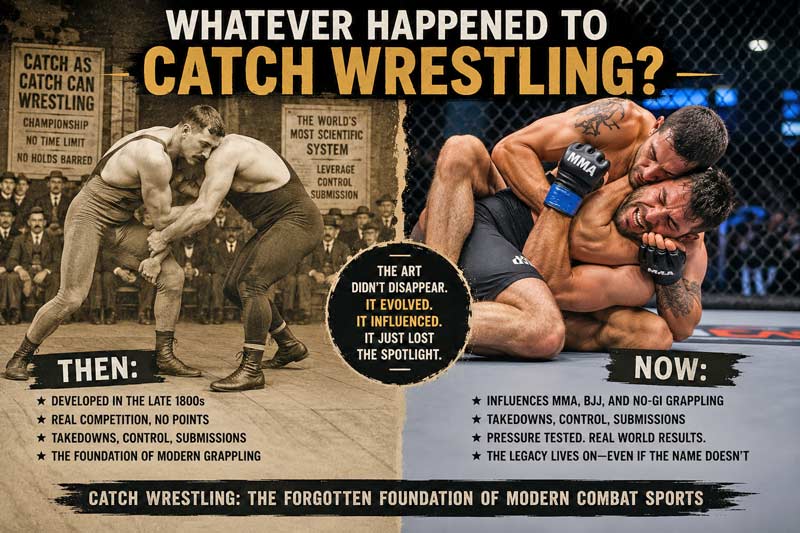
Long before MMA made grappling mainstream, catch wrestling was already doing many of the same things people now associate with modern combat sports.
In fact, for a while, catch wrestling was everywhere.
Developed from a blend of wrestling styles in the late 1800s, catch-as-catch-can wrestling emphasized takedowns, control, submissions, and rough, highly competitive matches. Unlike some traditional systems built around forms or structured techniques, catch wrestling developed through pressure, resistance, and real competition. The goal was simple: control your opponent and force a finish.
So why does it feel like hardly anyone talks about it today?
Part of the answer is fragmentation. As amateur wrestling, collegiate wrestling, Olympic freestyle, professional wrestling entertainment, and Brazilian Jiu-Jitsu all grew in different directions, catch wrestling slowly lost its mainstream identity. Some of its techniques survived and evolved, but the art itself stopped being the thing people recognized.
Ironically, many martial artists today train techniques influenced by catch wrestling without even realizing it. Submission grappling, MMA, no-gi grappling, and even some professional fighters still borrow heavily from concepts that catch wrestlers were using generations ago.
There is also a branding problem. "Catch wrestling" sounds old-fashioned to modern audiences, especially compared to polished terms like MMA or Brazilian Jiu-Jitsu. Without strong marketing, celebrity champions, or massive school networks, the style quietly drifted into niche territory despite its influence remaining everywhere.
In some ways, catch wrestling may be one of the strangest examples on this list. It did not completely disappear. It just quietly became part of other martial arts while losing its own spotlight.
Whatever Happened to Bartitsu?
If the name "bartitsu" sounds vaguely familiar, there is a strange reason for that.
You may have heard of it without realizing it.
Bartitsu is often connected to Sherlock Holmes because Arthur Conan Doyle referenced "baritsu" in one of the detective stories, famously helping explain how Holmes survived what looked like certain death at Reichenbach Falls. The funny part is that the real martial art was actually called bartitsu, and for a brief moment, it looked surprisingly ahead of its time.
Developed in England around the late 1800s, bartitsu blended techniques from multiple fighting systems into one practical self-defense method. It combined boxing, wrestling, cane fighting, jujutsu, and striking into something that almost resembles a Victorian version of mixed martial arts.
In some ways, it feels shockingly modern.
Long before cross-training became common, bartitsu instructors recognized something many martial artists now take for granted: no single fighting system had every answer. Instead of forcing students into one style, they pulled useful techniques from different disciplines and adapted them for real-world self-defense situations.
So why did it disappear?
Timing may have played a big role. Bartitsu struggled to survive after its founder's London academy closed, and without major organizations, tournaments, or widespread schools, the system slowly faded into obscurity. By the time martial arts booms arrived decades later, karate, judo, taekwondo, and kung fu had captured public attention instead.
Ironically, bartitsu may have simply arrived too early. Today's MMA culture, self-defense training, and hybrid martial arts philosophy feel surprisingly close to ideas it was already exploring more than a century ago.
And while bartitsu never became mainstream, its fascination with practical tools still feels strangely relevant. Traditional self-defense systems often included walking sticks, canes, and improvised weapons, a reminder that martial arts history has always been broader than empty-hand fighting alone. Even modern collections of exotic martial arts weapons hint at just how varied those traditions became across different cultures.
Whatever Happened to Shuai Jiao?
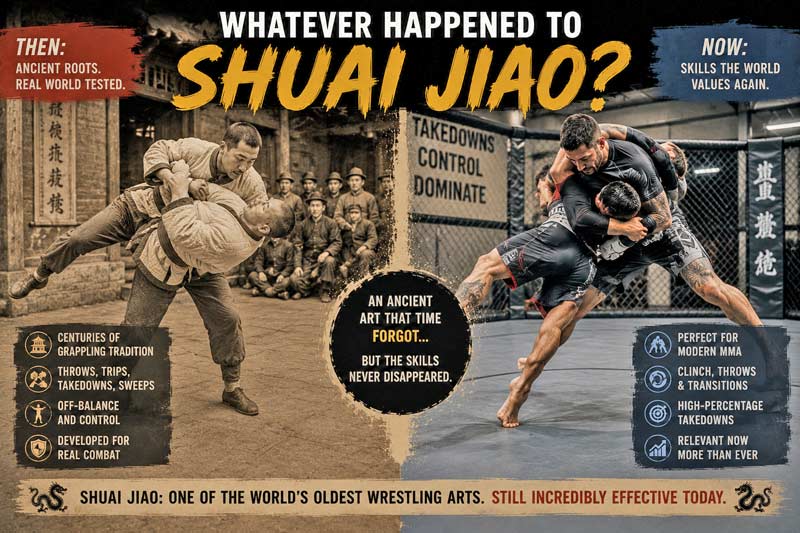
If you have never heard of shuai jiao, you are definitely not alone.
That is surprising, because this Chinese grappling art has been around for centuries and arguably should be much more well known than it is.
Often described as one of the oldest forms of wrestling in the world, shuai jiao focuses on throws, balance disruption, trips, takedowns, and fast stand-up grappling. In some ways, it feels like a fascinating middle ground between judo, wrestling, and traditional Chinese martial arts.
And honestly, in today's MMA era, it seems like the kind of martial art Americans would love.
So why did it never really take off?
Part of the answer may be visibility. Unlike karate, taekwondo, or kung fu, shuai jiao never had a major movie boom, Olympic spotlight, or nationwide school expansion in America. Even many martial arts enthusiasts have never encountered a dedicated shuai jiao school in person.
Another issue is branding. Chinese martial arts in America often became grouped together under the broad label of "kung fu," even when systems were dramatically different. As a result, grappling-focused styles like shuai jiao sometimes got overshadowed by the more visually recognizable striking styles people associated with kung fu films and demonstrations.
Ironically, shuai jiao may have become more relevant at the exact moment people stopped hearing about it. As MMA made takedowns, clinch work, and grappling more respected, many of the skills shuai jiao emphasized suddenly looked very modern. It just happened without the art itself getting much credit.
For martial arts fans who enjoy exploring overlooked training systems, shuai jiao feels like one of those rare examples where people's first reaction is usually:
"Wait... how have I never heard of this before?"
Whatever Happened to Kyudo?
Most Americans recognize archery immediately.
Kyudo feels completely different.
Often called "the way of the bow," kyudo is a traditional Japanese martial art centered around archery, but reducing it to simply shooting arrows misses the point entirely. In kyudo, posture, breathing, focus, ritual, and mental discipline matter just as much as accuracy. In some schools, how the shot is performed is considered every bit as important as whether the target is hit.
And honestly, that may be part of why kyudo never really became mainstream in America.
Compared to martial arts built around sparring, competition, self-defense, or physical intensity, kyudo can feel quiet and highly meditative. Training emphasizes patience, repetition, and precision over adrenaline. For students looking for action-packed combat or fast progression, it may not immediately grab attention the same way karate, kickboxing, or Brazilian Jiu-Jitsu often does.
Accessibility likely played a role too. Specialized equipment, fewer schools, and the need for proper space made kyudo harder to spread than martial arts that could easily open inside suburban strip malls. During America's martial arts boom, flashy kicks and sparring simply attracted bigger audiences.
Yet for practitioners who stayed with it, that calm, ritualistic structure is exactly the appeal. Kyudo feels less like learning to fight and more like learning to master yourself. The goal is often described not as defeating an opponent, but refining focus, discipline, and intention through years of practice.
In a strange way, kyudo may have been too patient for modern culture. While faster, louder martial arts grabbed attention, kyudo quietly remained what it always was: deeply traditional, highly disciplined, and intentionally slow-moving.
Whatever Happened to American Kenpo?
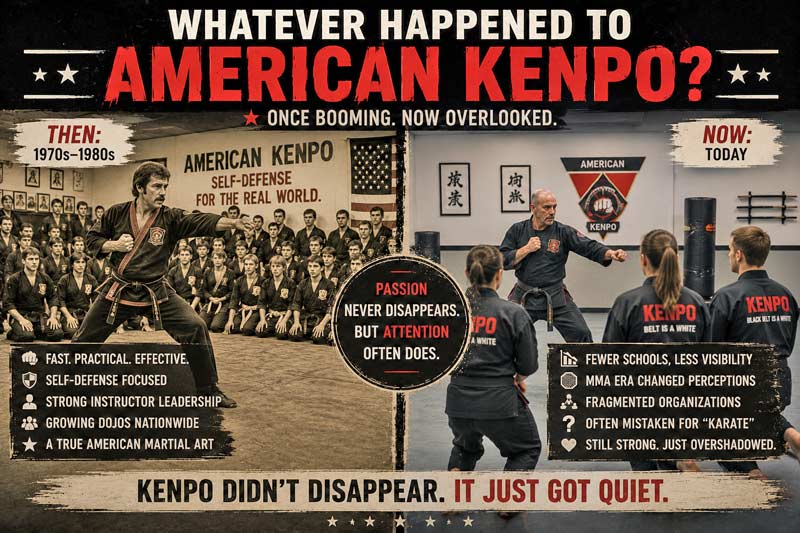
For a while, American Kenpo looked like it might become one of the biggest martial arts in the country.
Fast hand combinations. Practical self-defense. Strong personality-driven instruction. A uniquely American identity. During the martial arts boom of the 1970s and 1980s, American Kenpo developed a loyal following and earned a reputation for blending traditional martial arts with street-oriented self-defense concepts.
And yet, compared to karate, taekwondo, or Brazilian Jiu-Jitsu, it feels far less visible today.
Part of the reason may be that American Kenpo became heavily tied to specific instructors and organizations. Unlike arts with massive Olympic exposure or standardized global systems, Kenpo schools often developed around individual teaching lineages. That created passionate communities, but it also made nationwide growth more fragmented.
The rise of MMA likely played a role too. As combat sports shifted attention toward sparring-heavy systems, some traditional self-defense arts struggled with perception problems online. Fair or not, many people began judging every martial art through an MMA lens, even systems designed around broader self-defense situations rather than sport competition.
There is also a branding challenge. To outsiders, American Kenpo sometimes gets lumped into the general "karate" category, despite having its own philosophy, striking combinations, and self-defense emphasis. That confusion may have made it harder to stand apart in an already crowded martial arts landscape.
Still, American Kenpo never disappeared. Dedicated schools continue teaching it across the country, and many practitioners remain fiercely loyal to the art. In some ways, Kenpo feels less forgotten than quietly overshadowed, especially as newer martial arts trends pulled attention elsewhere.
Interestingly, American Kenpo's rise and decline mirrors broader shifts in martial arts popularity throughout the country. As we explored in the rise and fall of martial arts in America, many once-dominant systems experienced similar changes as trends evolved.
Whatever Happened to Sambo?
For a martial art that produces incredibly tough fighters, sambo remains surprisingly unknown in America.
That is especially strange when you consider how effective it looks on paper.
Developed in the Soviet Union during the early 1900s, sambo blended wrestling, judo, grappling, throws, and practical combat training into one system designed to create highly capable fighters. Depending on the style, sambo can focus on sport grappling, self-defense, or combat applications that include striking and takedowns.
And yet, despite producing world-class athletes and influencing modern MMA, most Americans could probably walk past a sambo school without recognizing what it is.
Part of the issue may be timing and geography. During America's major martial arts booms, karate, taekwondo, kung fu, and later Brazilian Jiu-Jitsu dominated public attention. Sambo arrived without the same Hollywood exposure, Olympic familiarity, or cultural momentum that helped other arts grow.
There is also a visibility problem. Sambo tends to live in the shadow of wrestling, judo, and MMA. To casual observers, it can look like some combination of all three. Without instantly recognizable uniforms or mainstream media attention, it often struggles to stand out despite being highly respected among serious grapplers and fighters.
Ironically, many martial artists who love practical fighting systems would probably enjoy sambo if they ever tried it. It emphasizes takedowns, balance, aggression, submissions, and adaptability, many of the same qualities people now admire in MMA fighters.
In some ways, sambo feels like one of martial arts' best-kept secrets. It never completely disappeared. Most people just never realized it was there in the first place.
Traditional grappling arts like sambo also remind us how broad martial arts training really is. Long before modern gyms standardized equipment, practitioners often relied on specialized drills, partner work, and simple tools to build skill, something still reflected in modern martial arts training gear and practice methods today.
Whatever Happened to Aikijujutsu?
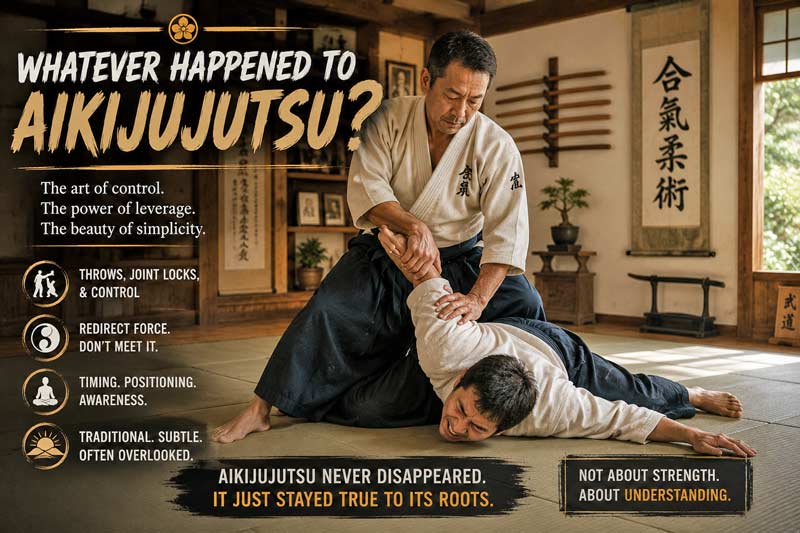
If aikijujutsu sounds familiar, there is a good chance you are thinking of aikido.
That makes sense, because aikijujutsu is often considered one of the older systems that heavily influenced what eventually became aikido. But unlike its more widely recognized descendant, aikijujutsu never came close to mainstream popularity in America.
And honestly, it feels like one of the easiest martial arts to overlook.
Traditional aikijujutsu focuses heavily on joint locks, throws, balance disruption, leverage, and controlling an opponent with timing and positioning rather than brute force. The philosophy often emphasizes redirecting force instead of meeting it head-on, which makes it feel very different from striking-heavy systems like karate or kickboxing.
So why did it stay so niche?
One reason may be complexity. Aikijujutsu can feel subtle, technical, and difficult for beginners to understand quickly. Unlike flashy kicks or obvious sparring exchanges, many of its movements look small or even unimpressive to outsiders, especially in an era shaped by highlight reels and knockout clips.
There is also the reality that aikido largely absorbed much of the public attention. As aikido schools spread internationally and became associated with philosophy, discipline, and non-aggressive training, aikijujutsu remained more fragmented and less visible to mainstream audiences.
Critics online sometimes dismiss arts built around leverage and control because they do not always look dramatic in demonstrations. But supporters argue that much of the value lies in body mechanics, timing, and learning how to control difficult situations without relying entirely on size or strength.
In some ways, aikijujutsu feels like a martial art that became overshadowed by its own family tree. It never disappeared entirely. It just quietly remained in the background while more recognizable systems took center stage.
Whatever Happened to Kuk Sool Won?
For a while, Kuk Sool Won looked like it had a real shot at becoming one of America's major martial arts systems.
It had something a lot of other schools struggled to offer: variety.
Kicks. Joint locks. forms. Weapons. Throws. Self-defense. Traditional Korean culture. Kuk Sool Won positioned itself as a comprehensive martial art that blended many aspects of Korean fighting traditions into one structured system. For students who wanted a little bit of everything, it could feel incredibly appealing.
So why does it feel far less visible today than taekwondo?
Part of the answer may simply be competition. Kuk Sool Won grew during the same decades that taekwondo was exploding across America. But taekwondo had a huge advantage: Olympic recognition, widespread school expansion, easy-to-understand branding, and strong family appeal. To many parents, taekwondo became the obvious Korean martial art choice before they even knew alternatives existed.
Kuk Sool Won also remained more centralized and structured than many martial arts organizations. That consistency helped preserve standards and identity, but it may have limited how quickly the art spread compared to looser systems that multiplied rapidly through independent schools and affiliations.
Ironically, Kuk Sool Won checks many of the boxes modern martial artists now appreciate. Cross-training? It already blended different skill sets. Weapons? Built in. Self-defense? A major focus. Traditional structure? Absolutely. In some ways, it feels like a martial art that quietly anticipated trends before they became mainstream.
And for students drawn to traditional training tools, Kuk Sool Won's emphasis on weapons and structured practice still stands out. Systems like it helped preserve interest in historical training methods that continue today through modern martial arts training weapons and traditional practice equipment.
Kuk Sool Won never completely disappeared. It simply remained in the shadow of a much bigger martial arts giant while quietly keeping its own loyal following.
Why Some Martial Arts Survived While Others Quietly Faded
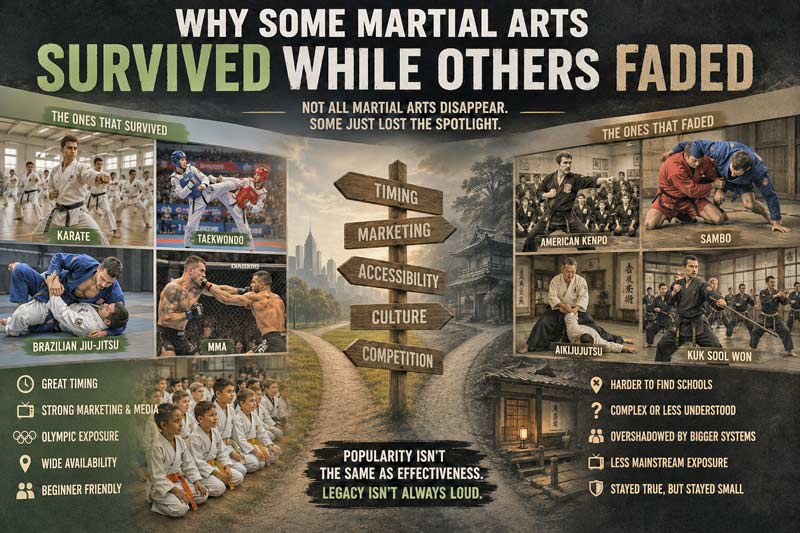
By now, a pattern is probably starting to emerge.
Most martial arts did not disappear because they suddenly stopped working.
They disappeared, or at least faded from mainstream attention, because culture changed.
Timing mattered. Marketing mattered. Movies mattered. Competition mattered. Olympic recognition mattered. Sometimes, a martial art simply arrived at the wrong moment or got overshadowed by something easier for the public to understand.
Karate exploded because it arrived during the perfect cultural moment. Taekwondo benefited from Olympic visibility and family-friendly schools. Brazilian Jiu-Jitsu gained momentum through the UFC. MMA reshaped how many people thought about fighting entirely. Other systems, even effective or deeply respected ones, quietly slipped into smaller communities simply because they lacked that same spotlight.
Accessibility played a role too. Martial arts with widespread schools, simple branding, and beginner-friendly programs naturally spread faster. Compare that to systems requiring specialized equipment, hard-to-find instructors, or highly traditional training environments, and it becomes easier to understand why some remained niche.
There is also an uncomfortable truth martial arts enthusiasts sometimes forget: most beginners are not choosing styles based on historical accuracy or technical nuance. They are choosing based on convenience, reputation, confidence, fitness goals, movie influence, or what school happens to be five minutes from home.
That does not mean forgotten martial arts failed.
In many cases, they simply stayed smaller, more specialized, or more traditional while bigger systems adapted to mainstream culture. Some quietly preserved their identity rather than watering themselves down for mass appeal. Others evolved into pieces of modern martial arts without keeping the spotlight for themselves.
Interestingly, many of the misunderstandings surrounding these lesser-known systems mirror broader misconceptions about martial arts in general. As we covered in the biggest martial arts myths that refuse to die, popularity and effectiveness are rarely the same thing.
Forgotten Does Not Mean Useless
If this list proves anything, it is that martial arts popularity has never been entirely about effectiveness.
Some systems exploded because they arrived at exactly the right moment. Others benefited from movies, Olympic exposure, strong marketing, or massive school networks. A few simply became easier for the public to understand.
Meanwhile, many deeply respected martial arts quietly drifted into smaller communities, not because they stopped working, but because culture moved in a different direction.
That is what makes forgotten martial arts so interesting.
Many of them still exist. Schools are still teaching them. Dedicated students are still training. In some cases, these arts quietly influenced modern martial arts without getting much recognition for it. Catch wrestling shaped grappling. Shuai jiao emphasized takedowns long before MMA made them mainstream. Systems like bartitsu explored cross-training decades before mixed martial arts even existed.
And sometimes, smaller can be a good thing.
Martial arts that stayed niche often preserved traditions, discipline, and training methods that bigger systems slowly adapted or simplified for mass audiences. That does not make one approach better than the other. It simply makes martial arts history much more complicated, and much more interesting, than most people realize.
The funny thing is that many of these forgotten systems are only one curious search away from finding new students again. The next great martial arts trend may already exist. Most people just have not discovered it yet.
If nothing else, hopefully this list leaves you with one thought:
How many fascinating martial arts are still out there that most of us have never even heard of?
You May Also Be Interested In:
- What Happened to a Warriors Weapons After He Died?
- 10 Reasons Why You Should Try Martial Arts
- What is the Best Bo Staff for Martial Arts?
- Best Martial Arts Gear for Beginners: What You Actually Need
- What Gear Do I Need For My First Martial Arts Class?
- 5 Good Martial Arts Styles You Might Not Know About
- Which Uniform Should I Buy for My First Martial Arts Class?
- What Are Flexible Weapons in Martial Arts?
- How to Tell if a Martial Arts School Is Actually Good
- Should I Enroll my Child in the Martial Arts?
Leave a Reply