




The Rise and Fall of Martial Arts in America
June 5th, 2026
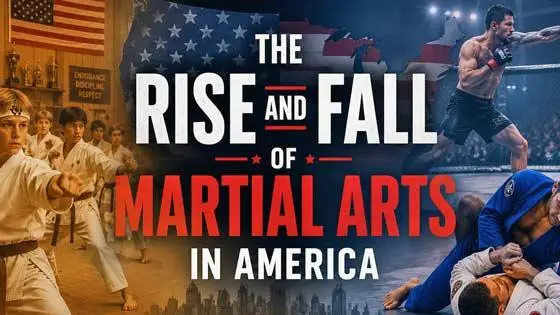
There was a time when martial arts felt almost impossible to avoid in America. In the 1980s and early 1990s, karate schools seemed to appear in every shopping center, kids practiced spinning kicks in backyard uniforms, and movies turned martial artists into larger-than-life heroes. Then something changed. Some styles exploded in popularity, others quietly faded into the background, and entirely new combat systems reshaped what Americans expected from self-defense and competition. Today, the martial arts landscape looks dramatically different than it did forty years ago, and the story of how we got here is more surprising than most people realize.
The 1980s Karate Boom
In the 1980s, karate was not just another martial art in America. For a lot of families, it was the martial art. Strip malls filled with karate schools, kids begged their parents for lessons, and the black belt became one of the clearest symbols of discipline, toughness, and personal achievement.
A big part of that boom came from pop culture. Martial arts movies had been gaining attention for years, but the 1980s turned karate into something more familiar and family-friendly. It was no longer just mysterious fighting from faraway places. It became after-school activity, self-defense training, character development, and childhood fantasy all wrapped into one.
That is what made the karate boom so powerful. Parents saw structure. Kids saw confidence. School owners saw demand. A good dojo could promise focus, respect, fitness, and self-defense without feeling too aggressive or too intimidating. Karate fit perfectly into suburban America because it looked disciplined, exciting, and safe enough for children.
But the same thing that helped karate explode also made it vulnerable. As more schools opened, the quality started to vary. Some dojos preserved serious training. Others leaned harder into trophies, belt promotions, birthday parties, and kid-friendly programs. By the end of the boom, karate was everywhere, but it no longer meant exactly the same thing everywhere.
The Taekwondo Explosion of the 1990s
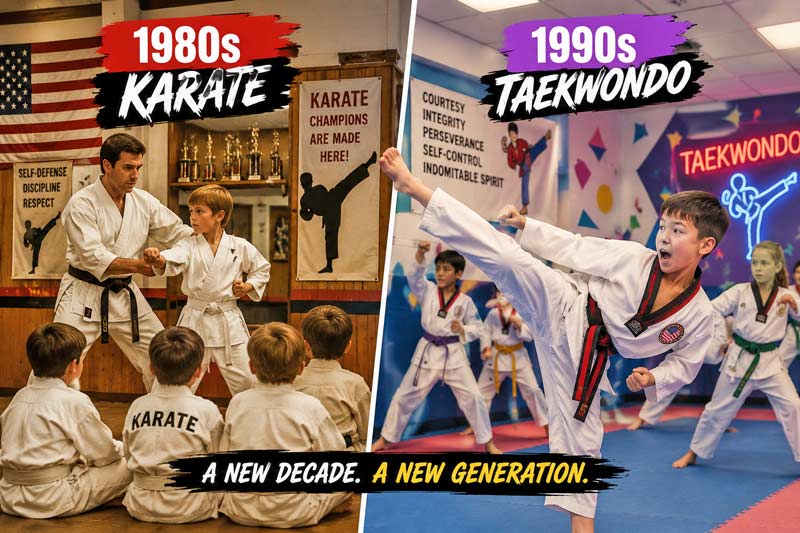
As karate settled into American suburbia, another martial art quietly began taking over. By the 1990s, taekwondo schools were opening at an incredible pace, especially for children. In many cities, families suddenly had options. The karate dojo down the street was now competing with brightly lit taekwondo academies promising discipline, confidence, and exciting high-flying kicks.
Part of taekwondo's rise came down to timing. The sport gained enormous visibility after becoming an official Olympic event in 2000, but even before that, its momentum had been building throughout the 1990s. Schools embraced structured curriculums, clear belt progression, and highly organized youth programs. For parents, it often felt approachable and family-friendly. For kids, spinning kicks and fast-paced drills looked exciting in a way traditional training sometimes did not.
Taekwondo also benefited from something many people overlook today: accessibility. In the 80s, martial arts still carried a bit of mystery. By the 90s, parents were actively searching for activities that built confidence and discipline without requiring kids to play traditional team sports. Martial arts schools stepped into that space, and taekwondo, in particular, became one of the biggest beneficiaries.
At the same time, kung fu remained popular thanks to movies and television, but it often struggled to scale in the same way. Many schools leaned more heavily into traditional instruction, which appealed deeply to dedicated students but sometimes felt less structured for casual families looking for after-school activities.
By the end of the decade, the martial arts landscape in America looked very different than it had just ten years earlier. Karate was still everywhere, but taekwondo had firmly established itself as one of the country's dominant styles, especially among younger students.
When the UFC Changed Everything
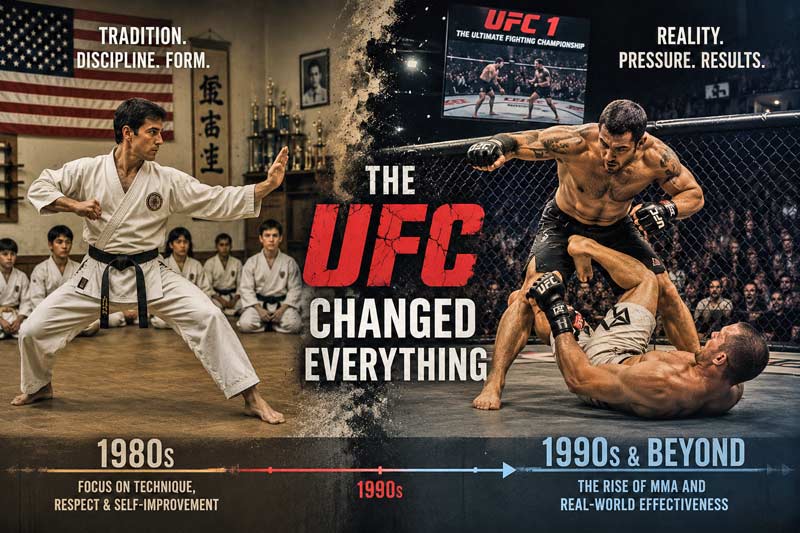
For decades, most Americans experienced martial arts in carefully structured environments. Classes focused on forms, discipline, point sparring, and controlled techniques. Then, in the 1990s, something arrived that completely changed the conversation: mixed martial arts.
When the UFC first appeared in 1993, it looked chaotic, controversial, and unlike anything mainstream audiences had seen before. Early events asked a question people had quietly argued about for years:
Which martial art actually works in a real fight?
Suddenly, styles were not being judged by movie scenes, trophies, or dojo reputation. They were being tested against resisting opponents in front of millions of viewers. Some martial arts looked incredibly effective. Others struggled badly under pressure.
Perhaps the biggest surprise for casual fans was the rise of Brazilian Jiu-Jitsu. At a time when many Americans associated fighting with punching and kicking, Royce Gracie stepped into the cage and consistently defeated much larger opponents using leverage, submissions, and ground control. For many people, it felt like watching the rules of fighting get rewritten in real time.
That moment changed martial arts culture permanently. Schools across America started adapting. Traditional striking arts remained popular, but students increasingly wanted practical sparring, grappling, and realistic self-defense training. Even karate and taekwondo schools began evolving, adding kickboxing drills, grappling exposure, or more modern approaches to sparring.
The UFC did not kill traditional martial arts the way some people claim. But it absolutely changed expectations. Americans became more interested in what worked under pressure, and that shift reshaped martial arts training for the next three decades.
The BJJ Revolution and the Rise of MMA Gyms
If the UFC planted the seed of change, Brazilian Jiu-Jitsu helped it spread across America. By the early 2000s, a growing number of students were walking into martial arts schools asking a very different question than they had twenty years earlier.
Not:
"How fast can I get my black belt?"
But:
"Will this actually work?"
That shift changed everything.
For decades, many traditional martial arts schools emphasized forms, repetition, discipline, and point-based sparring. Those things still mattered to plenty of students, but the success of grapplers in early MMA events created enormous curiosity around practical fighting systems. Brazilian Jiu-Jitsu, in particular, gained a reputation for helping smaller people control larger opponents through leverage, positioning, and submissions rather than brute strength.
Suddenly, a new kind of gym began appearing across America. Instead of mirrors, trophies, and rows of students practicing synchronized techniques, many MMA academies focused heavily on live sparring, pad work, conditioning, and pressure testing. Boxing, wrestling, Muay Thai, and jiu-jitsu were no longer separate worlds. They were being blended together under one roof.
This also changed the gear people trained with. Students who once focused mostly on uniforms and belts were now buying shin guards, MMA gloves, and protective equipment designed for more contact-heavy training. Even many traditional schools adapted, incorporating realistic drills and better protective equipment into classes. For beginners trying to understand modern equipment, choosing the right sparring gear became part of the learning process, especially as contact training became more common.
That does not mean traditional schools disappeared. Far from it. Karate, taekwondo, kung fu, and other arts still attracted millions of students. But MMA changed the definition of what many Americans expected from training. Discipline and tradition still mattered, yet practical application suddenly mattered a whole lot more.
Why Some Traditional Martial Arts Struggled to Keep Up
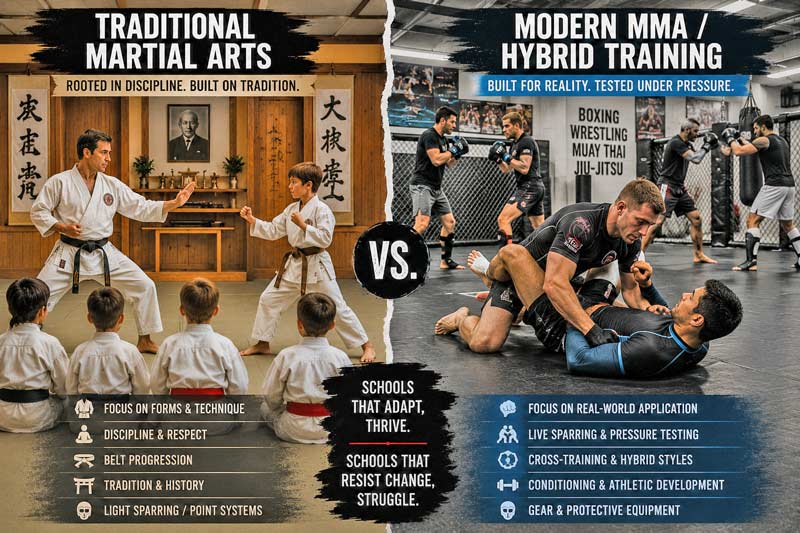
Not every martial art adapted to America's changing tastes at the same speed. As MMA grew and practical self-defense became a bigger priority, some traditional schools found themselves facing uncomfortable questions from new students.
Parents still wanted discipline and confidence-building for their children, but older teens and adults increasingly wanted realism. They wanted to spar harder, pressure test techniques, and understand how a martial art might actually work against resistance. For schools built around forms, light-contact tournaments, or highly traditional teaching methods, that cultural shift created real challenges.
Kung fu schools were hit especially hard in some areas. For years, kung fu had benefited from movie culture and the mystique surrounding traditional Chinese martial arts. But as audiences became more focused on practicality, some students viewed flashy techniques or highly choreographed demonstrations differently than previous generations had. That did not make these arts ineffective or unimportant, but public perception was changing.
Karate also faced a strange identity problem. In some cities, schools doubled down on traditional training and maintained loyal student bases. In others, "McDojo" criticism started to grow, especially online. Fast promotions, expensive testing fees, and watered-down instruction became common complaints, fair or not. At the same time, many excellent schools quietly continued producing disciplined, skilled students while adapting their training to modern expectations.
Interestingly, the schools that often thrived were the ones willing to evolve without abandoning their identity. Some karate schools introduced more realistic sparring. Others modernized training while preserving traditional values like discipline, etiquette, and structured progression. For students exploring different styles, even something as simple as understanding the difference between a taekwondo uniform and a karate gi became part of navigating America's increasingly crowded martial arts landscape. If you have ever wondered about those differences, this guide on TKD uniforms vs. karate gis breaks it down well.
In hindsight, martial arts in America did not really split into "old" versus "new." They split into schools that adapted and schools that resisted change. And that distinction still matters today.
The Cobra Kai Effect and the Return of Traditional Martial Arts
Just when it seemed like traditional martial arts might slowly fade into the background, something unexpected happened.
Nostalgia stepped into the ring.
When Cobra Kai debuted in 2018, it did more than revive an old movie franchise. It reintroduced karate to an entirely new generation while reigniting interest among adults who had trained decades earlier. Suddenly, people who had not tied a belt since childhood found themselves thinking about classes again. Parents who grew up watching martial arts movies started enrolling their own kids in local dojos.
This was not the first time pop culture shaped martial arts in America, but it might have been one of the clearest examples. In the 1980s, movies helped fuel karate's original explosion. Four decades later, streaming television gave it another unexpected boost.
Many schools reported renewed curiosity around traditional training, especially among beginners looking for structure, discipline, and confidence rather than full-contact fighting. For families, martial arts still offered something valuable that many sports struggled to match: individual growth, respect, goal setting, and visible progress through rank systems. Even simple milestones like learning how to tie a belt properly became part of the experience, especially for younger students earning promotions for the first time. For new students, guides like how to tie a karate belt suddenly became surprisingly relevant again.
At the same time, modern students entered martial arts with different expectations than previous generations. Some wanted traditional values. Others wanted practical self-defense. Many wanted both. That balance helped create a new kind of martial arts culture where old-school discipline and modern training methods increasingly existed side by side.
Karate did not fully return to its 1980s dominance, but it also never disappeared the way some people predicted. Instead, it adapted, evolving into something that still felt traditional while making room for a new generation of students.
What Martial Arts Look Like in America Today
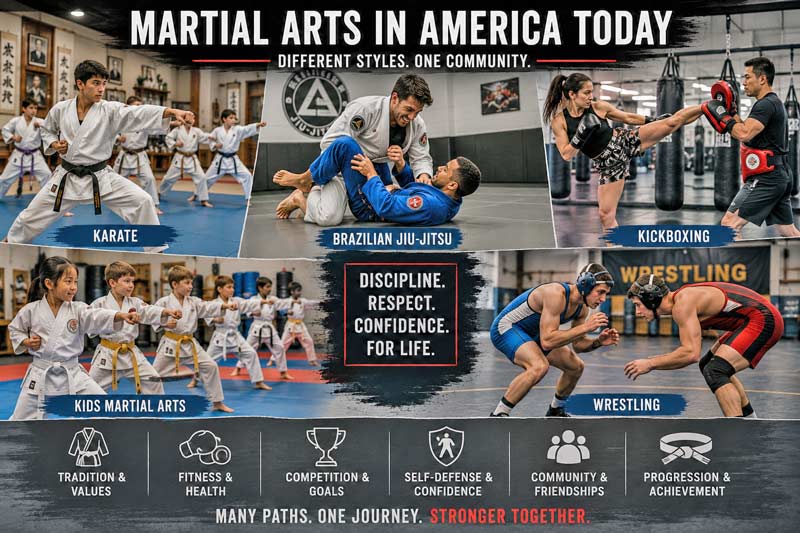
Walk into a martial arts school in America today and you will probably notice something very different than what existed forty years ago. The lines between styles have blurred. A student might train karate twice a week, attend jiu-jitsu classes on weekends, and still hit kickboxing pads for conditioning. What once felt divided into separate worlds has become far more interconnected.
For beginners, this is arguably the best time in history to start training. There are more styles, more teaching philosophies, and more specialized schools than ever before. Some people want traditional discipline and structured progression. Others care mostly about self-defense, competition, or fitness. Increasingly, students are choosing schools based less on the style itself and more on the quality of instruction and overall culture.
There has also been a noticeable shift in why people train. In the 1980s, martial arts often centered around self-defense and achievement. Today, people show up for all kinds of reasons: confidence, stress relief, weight loss, discipline, competition, anti-bullying programs for kids, or simply wanting a healthier hobby that feels more engaging than a traditional gym.
The equipment students use has evolved too. Modern schools often combine traditional uniforms with practical training gear depending on the style and level of contact. Someone beginning karate may still start with a classic gi, while kickboxing or MMA-style classes often introduce protective equipment much earlier. Beginners trying to figure out what they actually need often benefit from guides like best martial arts gear for beginners or learning more about what sparring gear is before stepping onto the mat.
Perhaps the biggest surprise is that America never really chose one "winning" martial art. Karate survived. Taekwondo remained massive. Brazilian Jiu-Jitsu exploded. MMA reshaped expectations. Wrestling gained respect. Traditional weapons training still exists in many schools through disciplines that use bo staffs, nunchaku, and sai as part of their curriculum.
In some ways, martial arts in America did not rise and fall at all. They evolved. Some styles surged. Others adapted. But the deeper idea behind martial arts, learning discipline, confidence, and control through training, managed to stick around through every generation.
What the Future of Martial Arts in America Might Look Like
If the last forty years taught us anything, it is that martial arts in America rarely stay still for very long. Trends shift. Pop culture changes. New fighting systems emerge. Yet somehow, martial arts continue finding ways to reinvent themselves for each new generation.
One of the biggest shifts already happening is flexibility. Many schools no longer define themselves by a single style alone. It is becoming increasingly common to see karate schools offering kickboxing classes, jiu-jitsu academies adding wrestling instruction, or traditional dojos blending modern self-defense concepts into long-established curriculums.
Technology is changing things too. Students today can watch breakdowns from world champions on YouTube, study techniques online, or compare training philosophies before ever stepping into a school. That kind of access simply did not exist during the karate boom of the 1980s. In some ways, martial arts education has become far more open and interconnected.
At the same time, the fundamentals people want from training have stayed surprisingly consistent. Parents still want confidence and discipline for their kids. Adults still want fitness, self-defense, stress relief, and a sense of progress. The details may evolve, but the core reasons people train have remained remarkably stable across generations.
There is also a good chance traditional martial arts continue benefiting from something many people underestimated for years: authenticity. In a world dominated by screens and short attention spans, structured training, real-world mentorship, and visible progress can feel refreshing. Earning a belt still means something to a lot of people, especially when the journey requires patience and consistency.
The next chapter of martial arts in America probably will not belong to one single style. More likely, it will belong to schools that can balance tradition with practicality, discipline with fun, and history with modern expectations. That may be the biggest lesson from the rise and fall of martial arts in America: the styles that survive are usually the ones willing to evolve.
Martial Arts Never Really Disappeared
Looking back, the story of martial arts in America is not really about one style winning and another losing. It is about adaptation.
Karate exploded in the 1980s. Taekwondo surged through the 1990s. The UFC changed how people thought about fighting. Brazilian Jiu-Jitsu reshaped expectations. MMA gyms introduced a new training philosophy. Then, unexpectedly, traditional martial arts found new life again through nostalgia, family programs, and renewed appreciation for discipline and structure.
What changed most was not necessarily the martial arts themselves. It was what Americans wanted from them. One generation chased trophies and black belts. Another wanted realism and pressure testing. Today, many students want a combination of both, practical skills alongside confidence, discipline, fitness, and personal growth.
That is probably why martial arts have endured for so long. They continue evolving without losing what made them meaningful in the first place. Whether someone walks into a traditional karate dojo, a taekwondo academy, a jiu-jitsu gym, or a modern MMA facility, the deeper appeal often stays the same: self-improvement through consistent effort.
For someone thinking about starting martial arts today, there has arguably never been a better time. There are more styles, more specialized schools, and more training approaches than ever before. If you are not sure where to begin, resources like this guide to the best martial arts gear for beginners can help make those first steps a little less intimidating.
The rise and fall of martial arts in America may sound dramatic, but maybe "evolution" is the better word. Some styles faded. Others exploded. Most adapted. And the story is still unfolding.
Frequently Asked Questions
Why Did Karate Become So Popular in America in the 1980s?
Karate exploded in popularity during the 1980s because several trends collided at exactly the right time. Martial arts movies had already introduced audiences to fighting styles from around the world, but films like The Karate Kid helped make karate feel approachable for everyday families. Suddenly, martial arts were not just about action heroes. They became associated with discipline, confidence, respect, and personal growth.
At the same time, suburban America was expanding, and martial arts schools began opening in shopping centers across the country. Parents liked the structure and goal setting that came with belt systems, while kids loved the excitement of uniforms, sparring, and earning ranks. For many families, karate became an alternative to traditional youth sports, offering something that felt both practical and character-building.
That momentum created the dojo boom many people still remember today. In some communities, karate schools seemed to appear almost overnight, helping shape an entire generation's perception of martial arts.
Did the UFC Really Hurt Traditional Martial Arts?
The short answer is yes and no.
When the UFC first exploded in popularity during the 1990s, it definitely changed how many Americans viewed martial arts. For years, styles had often been judged by demonstrations, tournaments, or movie influence. Suddenly, audiences were watching fighters from different backgrounds test their skills against fully resisting opponents in real competition. That shift led many people to question whether certain traditional training methods were practical in real-world situations.
Some schools struggled during this period, especially those unwilling to evolve. Critics began using terms like "McDojo" to describe programs that emphasized quick belt promotions or avoided realistic sparring altogether. As interest in MMA and Brazilian Jiu-Jitsu grew, some traditional schools saw enrollment drop, particularly among adults looking for practical self-defense training.
But saying the UFC "hurt" traditional martial arts only tells part of the story. In many ways, it pushed schools to improve. Karate, taekwondo, and kung fu schools across America began modernizing training, introducing better sparring methods, more realistic drills, and updated protective equipment. Many traditional schools that adapted continued thriving while still preserving the discipline, etiquette, and structure that made them valuable in the first place.
Ironically, the UFC may have helped traditional martial arts survive by forcing them to evolve. Today, it is common to see schools blending old-school values with modern training expectations rather than treating them like opposing ideas.
Why Did Brazilian Jiu-Jitsu Become So Popular So Quickly?
Brazilian Jiu-Jitsu exploded in popularity because it solved a problem many people suddenly cared about:
What actually works in a real fight?
When the UFC debuted in the 1990s, casual fans were shocked to see smaller fighters defeat much larger opponents using grappling, positioning, and submissions instead of punches or flashy kicks. Royce Gracie's early dominance introduced millions of Americans to the idea that technique and leverage could sometimes overcome size and strength.
That message spread fast. People who had never considered grappling suddenly became curious about ground fighting, self-defense, and practical combat training. Brazilian Jiu-Jitsu schools began opening across the country, especially as MMA grew more mainstream throughout the 2000s.
Another reason for BJJ's growth was how training felt different from many traditional arts. Most schools emphasized live sparring, often called "rolling," where students regularly tested techniques against resisting opponents. For many people, that hands-on, practical approach felt more realistic and measurable than purely choreographed drills.
At the same time, Brazilian Jiu-Jitsu benefited from something many martial arts struggled with: adaptability. Kids trained it. Adults trained it. Law enforcement embraced it. MMA fighters relied on it. Even people with no interest in competition often joined simply for fitness, confidence, or self-defense.
Today, Brazilian Jiu-Jitsu has become one of the fastest-growing martial arts in America, and its influence can be seen almost everywhere, including in schools that do not technically teach BJJ at all.
Is Taekwondo Still Popular in America?
Yes, although it looks a little different than it did during its biggest boom years.
Taekwondo became one of America's fastest-growing martial arts during the 1990s and early 2000s, especially among children and families. Its structured curriculum, clear belt system, and emphasis on discipline made it especially appealing to parents looking for activities that built confidence and focus. The sport also gained additional credibility after becoming an official Olympic event, helping push it even further into the mainstream.
Today, taekwondo remains one of the most widely practiced martial arts in the United States, particularly for younger students. Many schools continue thriving by focusing on youth development, fitness, goal setting, and structured progression through ranks. For beginners, part of the appeal is that training feels approachable while still teaching real athletic skills like balance, flexibility, timing, and coordination.
That said, taekwondo has evolved alongside the broader martial arts world. Some schools lean heavily into Olympic-style sport sparring, while others place more emphasis on practical self-defense or traditional training. In many communities, students now cross-train in multiple styles, meaning someone might practice taekwondo while also exploring kickboxing, jiu-jitsu, or karate.
Even visually, the differences between styles can sometimes surprise beginners. While they may look similar at first glance, there are meaningful differences between uniforms, training methods, and overall culture. If you are curious, this comparison of taekwondo uniforms vs. karate gis explains some of those distinctions.
Taekwondo may not dominate pop culture the way it once did, but calling it "declining" would miss the bigger picture. In many parts of America, it remains one of the most accessible and popular ways for kids and beginners to get started in martial arts.
Are Traditional Martial Arts Making a Comeback?
In some ways, yes.
For years, many people assumed traditional martial arts like karate and taekwondo would slowly fade as MMA and Brazilian Jiu-Jitsu became more popular. But that prediction never fully came true. Instead, traditional styles adapted, and in some cases, found entirely new audiences.
One major reason has been nostalgia. Shows like Cobra Kai introduced karate to younger viewers while reconnecting adults with the martial arts experiences they remembered from childhood. Parents who grew up watching martial arts movies or training in local dojos often started enrolling their own kids, creating a surprising second wave of interest in traditional training.
At the same time, many students today are looking for something different than full-contact fighting. Not everyone wants to compete in MMA or spend every class grappling. Traditional martial arts still offer structure, discipline, confidence-building, etiquette, and clear progression through belt systems, all things that continue to appeal to families and beginners.
Another factor is evolution. The schools thriving today are often the ones blending tradition with practicality. Some karate schools include more realistic sparring. Some taekwondo programs place greater emphasis on self-defense alongside sport training. Others focus heavily on personal growth and youth development. Rather than disappearing, many traditional arts have simply adjusted to modern expectations.
Traditional martial arts may never fully recreate the massive boom of the 1980s and 1990s, but they also never vanished. If anything, they seem to be settling into a new role, one where discipline, confidence, and personal growth matter just as much as fighting ability.
What Is the Most Popular Martial Art in America Today?
That depends on how you define "popular."
If we are talking about total participation, styles like karate and taekwondo still have enormous reach, especially among children and families. Thousands of schools across the country continue teaching traditional striking arts, and many parents still see martial arts as a way to build confidence, discipline, and focus outside of team sports.
But when it comes to growth and adult interest, Brazilian Jiu-Jitsu and MMA-inspired training have seen some of the biggest momentum over the last two decades. Many adults are drawn to practical self-defense, fitness, and live sparring, while younger athletes increasingly cross-train across multiple styles instead of committing to just one system.
Wrestling and kickboxing have also gained more respect within the broader martial arts conversation, largely because of their effectiveness in mixed martial arts competition. Meanwhile, traditional arts continue evolving by blending older training methods with more modern approaches to sparring and conditioning.
In truth, America never really settled on a single "best" or "most popular" martial art. Different styles thrive for different reasons. Karate and taekwondo remain incredibly accessible for beginners and kids. Brazilian Jiu-Jitsu attracts students interested in practical grappling. MMA gyms appeal to people who want a mix of striking and ground training. And traditional schools continue drawing students who value discipline, structure, and personal development.
The biggest trend today may actually be variety. More Americans than ever are mixing styles, exploring different training philosophies, and choosing schools based on culture and instruction rather than loyalty to one specific martial art.
Why Do Some Martial Arts Schools Succeed While Others Close?
Martial arts schools close for a lot of reasons, but one of the biggest is failing to adapt to what students actually want.
In the 1980s and 1990s, many schools could thrive simply because demand for martial arts was booming. Families were eager to sign kids up, pop culture helped fuel interest, and competition between schools was often limited. Today, students have far more options and much higher expectations.
Successful schools tend to understand their audience. Some focus heavily on traditional values like discipline and structured progression. Others lean into self-defense, competition, or fitness. Many of the strongest programs find ways to balance multiple goals, helping students feel challenged while still creating a welcoming environment for beginners.
Instructor quality matters too. Students often stay because of strong teaching, positive culture, and consistent progress, not necessarily because of the specific martial art being taught. In many cases, people choose the school more than the style itself.
The schools that struggle are often the ones that resist change entirely or lose sight of what students value. Martial arts in America have constantly evolved, and the schools that survive tend to evolve with them.
You May Also Be Interested In:
- Why the Ka-Bar Became America's Most Famous Military Knife
- Secrets of the Kusarigama: The Rise of Japan's Legendary Chain Weapon
- What is the Best Bo Staff for Martial Arts?
- Whatever Happened to These Martial Arts?
- 10 Reasons Why You Should Try Martial Arts
- What Martial Arts Style Should I Choose?
- Top 5 Least Practical Martial Arts Weapons You Know You Want
- Best Martial Arts Gear for Beginners: What You Actually Need
- What Gear Do I Need For My First Martial Arts Class?
- 5 Good Martial Arts Styles You Might Not Know About
Leave a Reply