


A Visual Guide to Martial Arts Weapons Around the World
August 28th, 2026
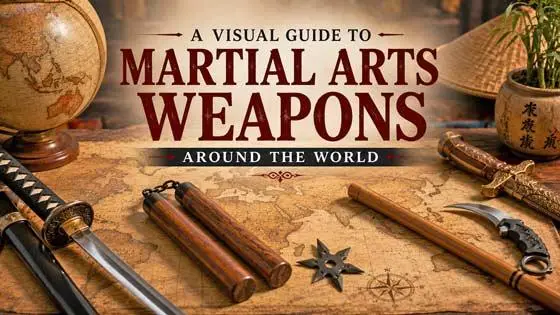
Martial arts weapons tell a story that stretches across continents, cultures, and thousands of years of human history. From the swords and polearms of Japan to the flexible weapons of China, the fighting sticks of the Philippines, and distinctive blades developed throughout Southeast Asia, each weapon reflects the environment, technology, traditions, and challenges of the people who created it. Some were carried onto battlefields, others became closely associated with systems of personal defense, and many eventually found a place in formal martial arts training. This visual guide travels around the world to examine these weapons region by region, exploring where they came from, what made them distinctive, and how they became part of the martial traditions we recognize today.
Japan: Where the Sword Was Only the Beginning
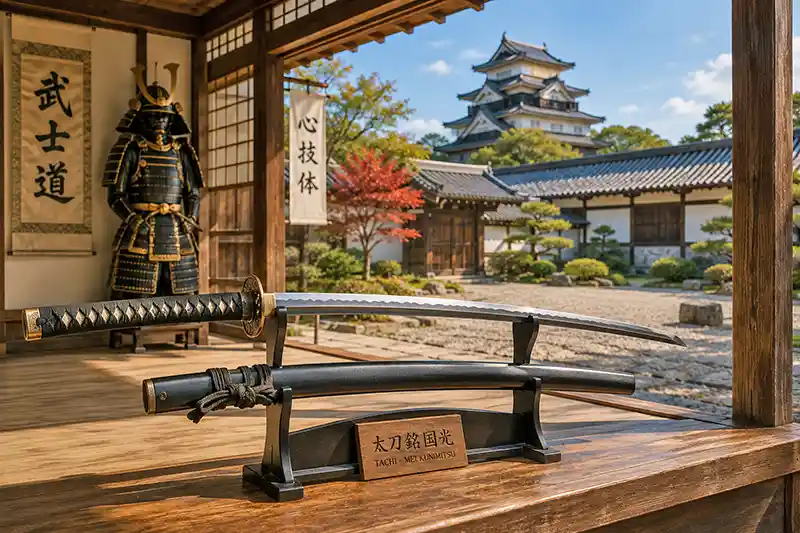
Few countries are as closely associated with martial arts weapons as Japan, yet the famous samurai sword represents only one branch of a remarkably diverse weapons tradition. Centuries of warfare produced specialized spears, polearms, short blades, bows, staffs, chains, and other weapons designed for very different circumstances. The katana eventually became the most recognizable Japanese weapon around the world, but on historical battlefields, longer-reaching weapons often played a much larger role than popular culture suggests.
The yari, for example, developed into one of Japan's most important battlefield weapons. Its relatively straightforward spear design could be adapted to different lengths and formations, making it useful to both individual warriors and organized groups of foot soldiers. The naginata took a different approach, mounting a curved blade on a long shaft to combine cutting ability with the reach and leverage of a polearm. Although both weapons are sometimes overshadowed by the sword today, they reveal just how important distance and battlefield control were in Japanese warfare.
Japanese weapon traditions also extended far beyond conventional battlefield arms. The kusarigama combined a sickle with a weighted chain, creating a weapon whose two components behaved in radically different ways. Shorter blades such as the tanto and wakizashi provided more compact alternatives to full-length swords, while weapons including the jutte developed for specialized roles. The result was not one unified collection of "samurai weapons," but a changing arsenal shaped by different historical periods, fighting environments, social classes, martial schools, and practical needs.
Notable Japanese Martial Arts Weapons: Katana, wakizashi, tanto, tachi, odachi, yari, naginata, kusarigama, jutte, kama, yumi, and jo.
Okinawa: Everyday Objects and the Weapons of Kobudo
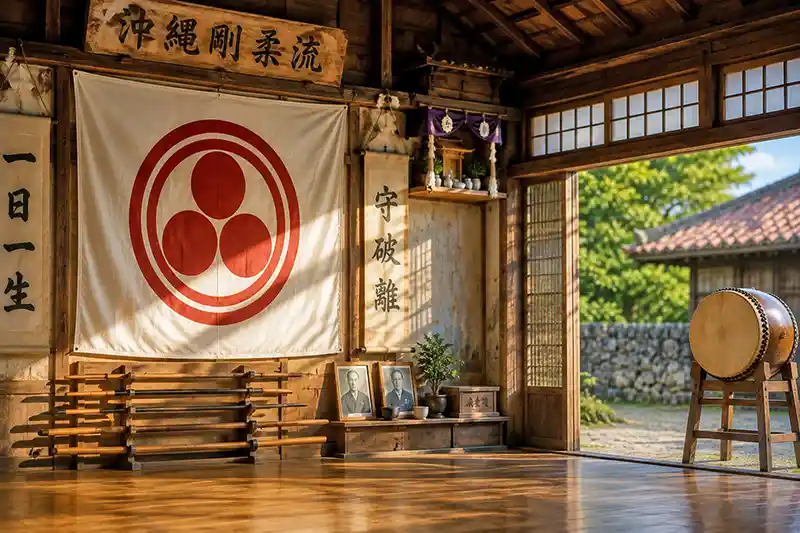
Okinawa developed one of the world's most recognizable collections of traditional martial arts weapons, but their histories are often more complicated than the familiar story that farmers simply turned ordinary tools into weapons after authorities confiscated their swords. Restrictions on weapons did exist at different points in Ryukyuan history, yet modern historians have questioned the idea of a single sweeping weapons ban that directly created the entire Okinawan arsenal. What is clear is that the Ryukyu Kingdom developed its own martial traditions through centuries of cultural exchange with Japan, China, and Southeast Asia.
Among the best-known Okinawan weapons is the nunchaku, consisting of two short sections connected by cord or chain. Its precise historical development remains uncertain despite the many origin stories surrounding it. The bo staff, by comparison, represents one of the simplest weapon forms imaginable: a long wooden staff whose effectiveness comes from reach, leverage, and the ability to strike from either end. Shorter staffs such as the jo developed their own techniques and traditions as well.
Other Okinawan kobudo weapons demonstrate just how varied the tradition became. The tonfa uses a side handle attached to a shaft, allowing it to rotate around the hand and forearm, while the kama resembles the sickles historically used for agricultural work. The sai is a metal truncheon distinguished by two projecting side prongs near the handle. Each requires a very different method of handling, which helps explain why Okinawan kobudo became known not for one signature weapon, but for training across an unusually diverse arsenal.
Notable Okinawan Martial Arts Weapons: Bo, jo, nunchaku, sai, tonfa, kama, eku, tekko, tinbe and rochin, and surujin.
China: An Extraordinary Variety of Martial Arts Weapons
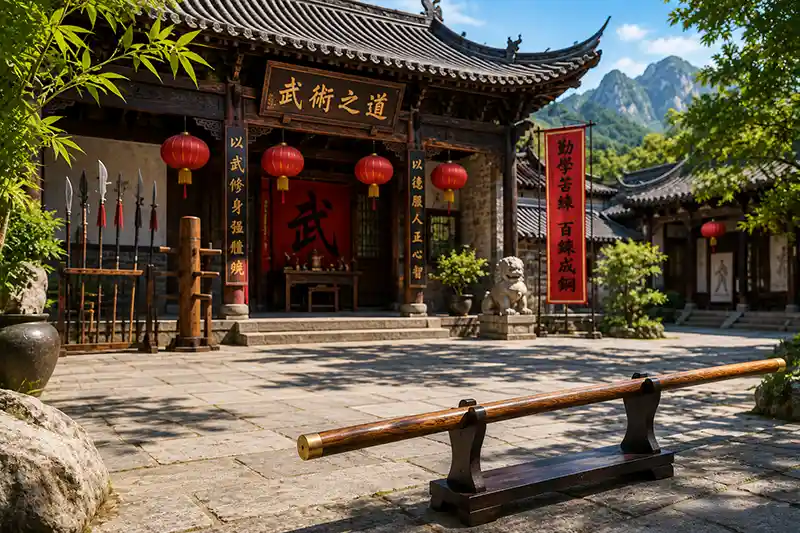
China's martial traditions developed across an enormous geographic area and thousands of years of changing warfare, producing a weapon culture far too diverse to be represented by any single sword or fighting style. Some weapons originated as military arms, others became associated with civilian martial arts, and still others evolved into specialized training weapons whose unusual movements made them instantly recognizable. This long history helps explain why Chinese martial arts weapons include everything from straightforward swords and staffs to flexible weapons made from chains, ropes, and multiple connected sections.
Two of China's most important sword families are the jian and dao. The jian is a straight, double-edged sword with a history stretching back more than two thousand years, while the dao is generally a single-edged weapon and appeared in numerous military forms over the centuries. Their differences eventually became reflected in Chinese martial arts as well, with each encouraging its own approaches to cutting, thrusting, footwork, and weapon control. Today, both remain among the most recognizable Chinese swords practiced in traditional martial arts.
Long weapons were equally important. Spears appeared in Chinese warfare for centuries, while staffs became foundational weapons in numerous martial traditions. Polearms such as the guandao combined a long shaft with a heavy blade and became strongly associated with the legendary general Guan Yu, although surviving evidence suggests that weapons resembling the familiar modern guandao appeared considerably later than his lifetime. As with many famous martial arts weapons, legend and documented history do not always tell exactly the same story.
Perhaps the most visually distinctive side of Chinese weapon culture is its collection of flexible and articulated weapons. The chain whip uses multiple metal sections joined together into a flexible length, while the rope dart places a weighted metal dart at the end of a long rope. The three-section staff applies a similar concept to rigid wooden sections connected by short flexible joints. These weapons demand precise control of momentum and distance, making them dramatically different from conventional blades and staffs.
Notable Chinese Martial Arts Weapons: Jian, dao, spear, staff, guandao, butterfly swords, hook swords, chain whip, rope dart, three-section staff, meteor hammer, and pudao.
The Philippines: Blades, Sticks, and the Fighting Arts of Arnis
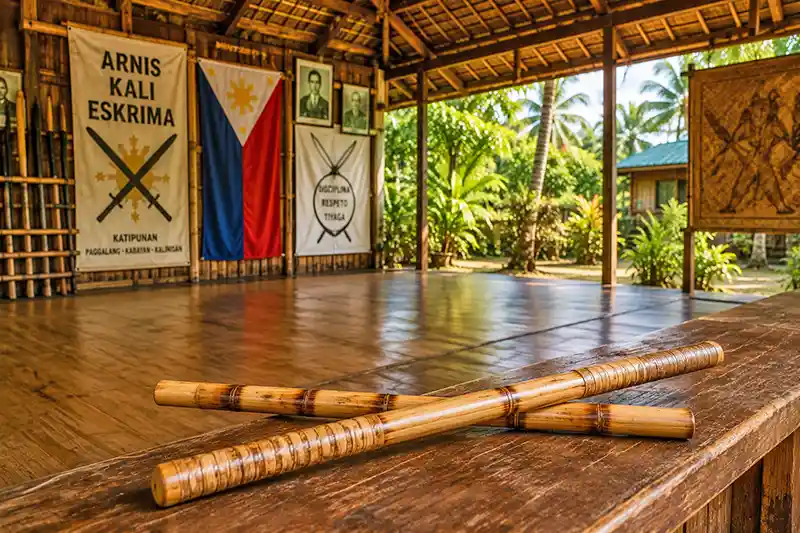
The martial traditions of the Philippines developed across thousands of islands with their own languages, cultures, and histories, so there was never a single universal Filipino weapons system. Bladed weapons were deeply embedded in everyday life and warfare long before Spanish colonization, while centuries of conflict and cultural exchange continued to shape the fighting traditions that eventually became known by names such as Arnis, Eskrima, and Kali. Today, these arts are particularly famous for their sophisticated approach to weapon training and their ability to transfer similar movements between sticks, blades, and empty-hand techniques.
Perhaps the most recognizable training weapon is the escrima stick, commonly made from rattan. Unlike dense hardwood, rattan is relatively light, resilient, and more likely to fray than break into sharp splinters after repeated impacts, characteristics that have made it particularly useful for partner drills and weapon training. Although stick fighting has become internationally synonymous with Filipino martial arts, the stick should not be mistaken for the entirety of the tradition. Many systems preserve techniques influenced by the handling of swords, machete-like blades, knives, and other edged weapons.
The Philippines also developed an extraordinary variety of regional blades. The bolo is a broad category encompassing numerous working blades and fighting weapons, while the barong is distinguished by its broad, leaf-shaped blade and strong association with the southern Philippines. The kampilan is a considerably longer sword historically associated with communities in Mindanao and surrounding areas. Kris blades, recognizable for straight or sometimes wavy profiles, are likewise found in the southern Philippines as part of a much wider Southeast Asian weapon tradition.
Rather than separating weapon practice completely from unarmed combat, many Filipino martial arts systems use weapons to teach concepts of angle, distance, timing, movement, and interception that can carry over into other forms of fighting. That emphasis has helped Arnis and related traditions become some of the most internationally influential weapon-based martial arts practiced today. In 2009, the Philippines formally designated Arnis as the country's national martial art and sport, giving official recognition to traditions whose roots reach much further into Filipino history.
Notable Filipino Martial Arts Weapons: Rattan sticks, bolo, barong, kampilan, kris, ginunting, pinuti, panabas, and various knives and regional blades.
Southeast Asia: Curved Blades and Distinctive Fighting Traditions
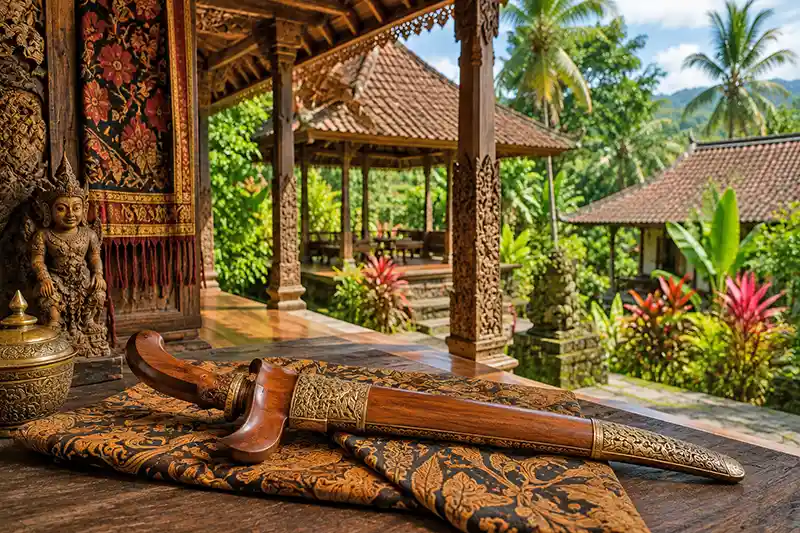
Across Indonesia, Malaysia, Thailand, Myanmar, Vietnam, and the surrounding regions, martial weapons developed within cultures connected by centuries of trade, migration, warfare, and shared technologies. There is no single "Southeast Asian" weapons tradition. Instead, the region produced an enormous assortment of blades, staffs, spears, and agricultural implements that became associated with local fighting systems. Some of these weapons remained largely regional, while others eventually became recognizable around the world.
One of the most famous is the karambit, a compact curved blade strongly associated with Indonesia and the wider Malay world. Its claw-like profile and finger ring make it immediately recognizable among traditional knives. The weapon is particularly associated today with pencak silat, although separating the karambit's documented history from the many modern stories told about its origins requires caution. Its unusual shape nevertheless demonstrates how dramatically regional blade designs could differ from the straight knives familiar elsewhere.
Another iconic weapon is the kris, or keris, found particularly in Indonesia, Malaysia, Brunei, and parts of the southern Philippines. Kris blades may be straight or feature the famous undulating profile that has made the weapon visually distinctive. More than simply a fighting blade, the kris acquired enormous cultural and ceremonial significance, with elaborate hilts, scabbards, and blades reflecting regional craftsmanship and identity. UNESCO has recognized the Indonesian kris as part of the Intangible Cultural Heritage of Humanity, illustrating how deeply a weapon can become intertwined with cultural heritage rather than existing solely as an instrument of combat.
Other regional weapons include the golok and parang, broad cutting tools that could serve practical as well as martial purposes, along with numerous spears and locally distinctive swords. Thailand developed weapons traditions associated with krabi-krabong, in which swords, staffs, clubs, and other arms are practiced, while Myanmar preserves its own weapon traditions within systems such as banshay. Taken together, these traditions reveal a recurring theme in martial history: the boundary between tool, status symbol, ceremonial object, and weapon was often far less rigid than modern categories suggest.
Notable Southeast Asian Martial Arts Weapons: Karambit, kris or keris, golok, parang, pedang, klewang, Thai daab, krabi, staff, and spear.
India and South Asia: Ancient Weapons and Unmistakable Designs
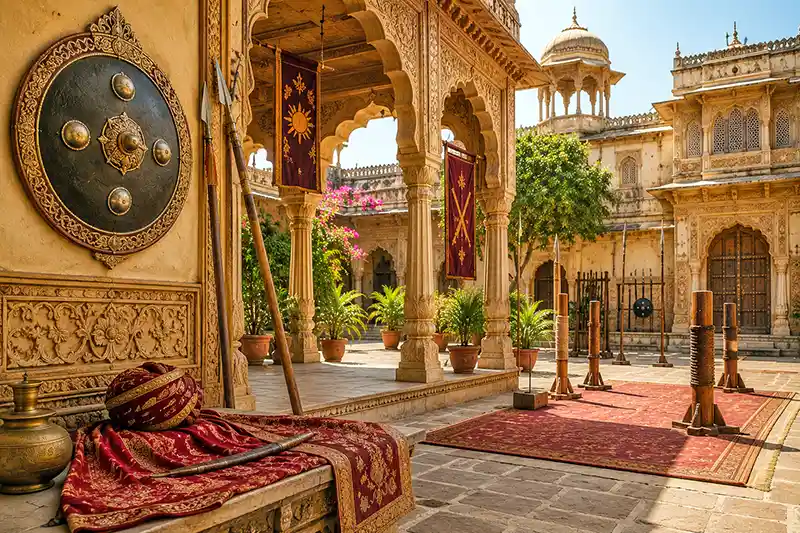
The Indian subcontinent has one of the world's longest continuous histories of armed combat, with weapon traditions shaped by ancient kingdoms, regional warrior cultures, changing empires, and centuries of contact with Central Asia, Persia, and other neighboring regions. Swords, spears, bows, clubs, and shields appeared in countless variations, but South Asia also produced several weapons whose designs are so distinctive that they are difficult to confuse with anything developed elsewhere.
One of the most recognizable is the katar, often described as an Indian push dagger. Instead of placing the blade in line with a conventional knife handle, the katar uses parallel bars and a transverse grip that positions the blade in front of the fist. Examples ranged from relatively simple fighting weapons to elaborately decorated prestige pieces produced for wealthy warriors and members of royal courts. Its unusual construction eventually influenced later push-dagger designs far beyond India.
The talwar became another iconic weapon of the subcontinent. This curved sword is particularly recognizable by its distinctive hilt, commonly incorporating a disc-shaped pommel, and variations were carried across large parts of South Asia. Other regional swords took dramatically different forms. The khanda generally featured a broad, straight, double-edged blade, while the pata extended the concept of the gauntlet sword by integrating the wielder's hand and forearm into a protective metal structure attached to the blade.
South Asian martial traditions also produced weapons that challenge the conventional idea of what a sword should look like. The urumi, associated especially with southern India and the martial art of Kalaripayattu, uses an extremely flexible blade rather than the rigid construction of an ordinary sword. Meanwhile, weapons such as the chakram took an entirely different form: a sharpened metal ring strongly associated with Sikh martial history. These unusual designs demonstrate the extraordinary variety that existed alongside more familiar swords, spears, bows, maces, and shields throughout the region.
Notable Indian and South Asian Martial Arts Weapons: Katar, talwar, khanda, pata, urumi, chakram, kukri, bichuwa, gada, spear, bow, and dhal shield.
Europe: Swords, Polearms, and the Martial Arts of the Battlefield
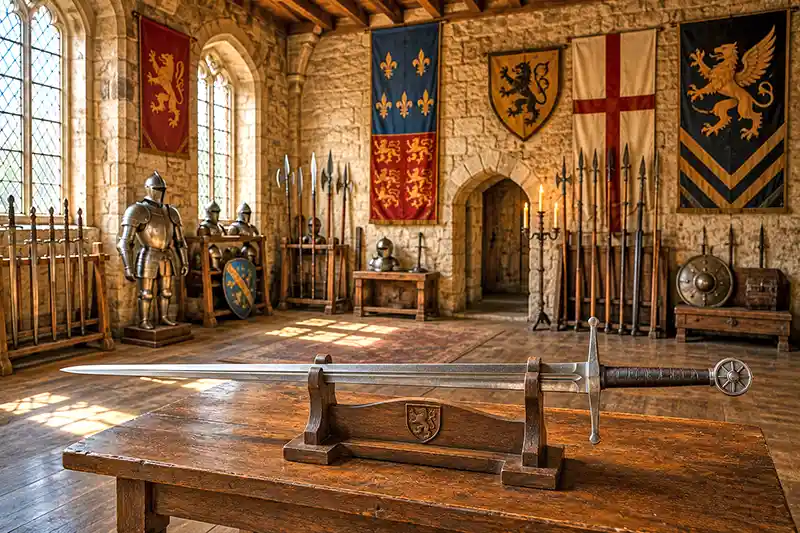
European martial arts are sometimes discussed separately from Asian martial traditions, but Europe developed sophisticated systems of armed combat of its own. Surviving medieval and Renaissance fighting manuals document techniques for swords, daggers, spears, polearms, wrestling, and armored combat in remarkable detail. These traditions are studied today through Historical European Martial Arts, commonly known as HEMA, giving modern practitioners an opportunity to reconstruct fighting systems that were recorded centuries ago.
The sword naturally occupies a prominent place in European martial history, but even the word "sword" encompasses an enormous variety of weapons. The medieval arming sword was generally designed for one-handed use, while the longsword provided a longer grip that allowed it to be controlled with both hands. Later European swords included weapons such as the rapier, sidesword, and saber, each reflecting different periods and approaches to combat. Even the famous two-handed swords of the late medieval and Renaissance eras were specialized weapons rather than simply oversized versions of ordinary swords.
Just as in Japan, however, swords were only part of the story. Spears remained among Europe's most enduring weapons, while increasingly specialized polearms combined reach with powerful striking surfaces. The halberd brought together an axe blade, thrusting point, and additional hooks or projections, while weapons such as the poleaxe were particularly well suited to fighting heavily armored opponents. The bec de corbin and similar pole weapons demonstrate how European arms evolved in response to improvements in armor and changing battlefield conditions.
European fighting manuals also reveal techniques that challenge the popular image of medieval swordsmanship as little more than two combatants hacking at one another. Longswords could be used for thrusting, grappling, and specialized armored techniques, while daggers became important at extremely close range. Fighting systems recorded by masters such as Johannes Liechtenauer and Fiore dei Liberi treated armed combat as a sophisticated martial discipline built around timing, distance, leverage, positioning, and control.
Notable European Martial Arts Weapons: Arming sword, longsword, greatsword, rapier, saber, dagger, spear, halberd, poleaxe, bec de corbin, war hammer, mace, and quarterstaff.
Africa: Regional Weapons Shaped by Kingdoms, Cultures, and Landscapes
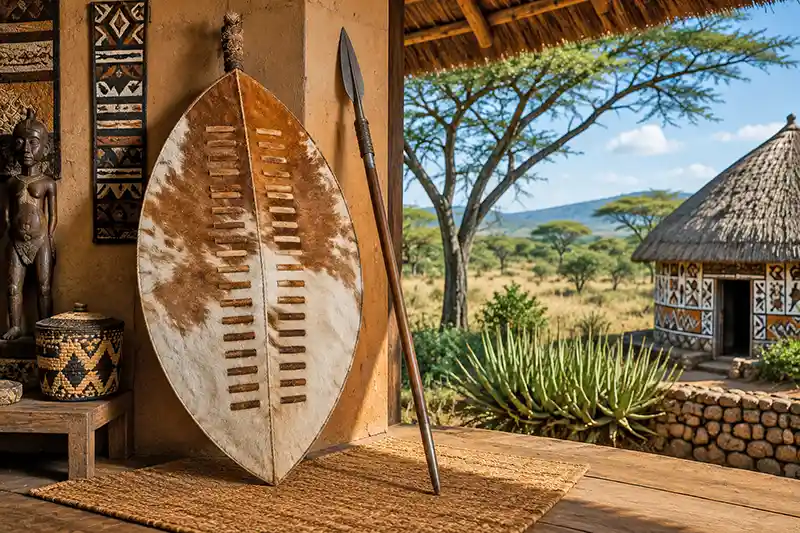
Africa's enormous size and cultural diversity produced countless weapon traditions, making any attempt to describe "African weapons" as a single category inherently misleading. Across different periods and regions, warriors carried spears, swords, throwing weapons, bows, clubs, knives, and shields whose designs reflected local materials, fighting methods, environments, and traditions. Powerful states and societies from North Africa to the southern end of the continent developed distinctive approaches to armed combat, many of which changed considerably as trade and new technologies connected different parts of Africa with the wider world.
Among the most widespread weapon forms was the spear. Different African societies developed spears for hunting, throwing, and close combat, with variations in shaft length, blade shape, and intended use. In southern Africa, the shorter stabbing spear commonly associated with the Zulu became particularly famous during the nineteenth century. Often called an iklwa in popular accounts, it was used alongside large hide shields in close-order fighting. Although Shaka is frequently credited with inventing the weapon, the history is more complicated than the familiar story of a single ruler suddenly creating an entirely new type of spear.
Northern and northeastern Africa developed very different weapon traditions. The shotel of Ethiopia is immediately recognizable for its dramatically curved blade, while the kaskara became associated with regions including Sudan and neighboring areas. In the Sahara and Sahel, the takouba was carried among Tuareg and other communities. These swords illustrate how African weapon history was connected not only to local martial cultures but also to centuries of movement, commerce, warfare, and technological exchange across the Mediterranean, Red Sea, Sahara, and Indian Ocean worlds.
Central Africa produced some of the continent's most visually unusual weapons, including elaborately shaped throwing knives that are now represented in museum collections around the world. These weapons varied significantly between cultures and were not necessarily used in identical ways despite their superficial similarities. Elsewhere, bows, clubs, axes, knives, and shields took numerous regional forms. Rather than revealing a single African fighting system, this diversity demonstrates how independently martial technologies could develop across one vast continent.
Notable African Martial and Historical Weapons: Spears, throwing spears, shotel, kaskara, takouba, knobkerrie, bows, axes, throwing knives, clubs, and hide shields.
The Middle East and Persia: Swords, Bows, and Centuries of Martial Exchange
The Middle East sat at the crossroads of some of history's most important trade routes, migrations, and empires, allowing weapon technologies to move between Europe, North Africa, Central Asia, and the Indian subcontinent. Persian, Arab, Turkish, and other martial traditions were never identical, but they continually influenced one another through warfare and cultural exchange. The result was a diverse arsenal that included swords, spears, bows, daggers, maces, axes, and eventually firearms, many of which developed distinctive regional forms.
Curved swords are among the weapons most strongly associated with the region today, although the familiar image of a universal Middle Eastern "scimitar" oversimplifies a much more complicated history. Scimitar is a broad European term that has been applied to several different curved swords rather than the historical name of one specific weapon. The Persian shamshir, Ottoman kilij, and other regional sabers differed in blade curvature, construction, and use, reflecting separate martial traditions rather than a single standardized design.
The bow was equally important and, for many centuries, arguably more significant on the battlefield than the sword. Composite bows constructed from combinations of materials could deliver considerable power from a relatively compact weapon, making them particularly valuable to mounted warriors. Horse archery became central to warfare across large parts of Western and Central Asia, where mobility and ranged attacks could determine a battle long before opponents came within sword range.
Daggers and shorter blades also became culturally distinctive. The curved jambiya is particularly associated with Yemen and other parts of the Arabian Peninsula, while Persian arms included forms such as the kard and pesh-kabz. As elsewhere in the world, some weapons served purposes extending beyond combat. Elaborately decorated swords and daggers could communicate wealth, rank, regional identity, or social status, turning the weapon itself into an object of craftsmanship and cultural expression.
Notable Middle Eastern and Persian Martial Weapons: Shamshir, kilij, composite bow, spear, jambiya, kard, pesh-kabz, mace, tabar, and various regional sabers and daggers.
The Americas: Weapons Built From Stone, Wood, Bone, and Obsidian
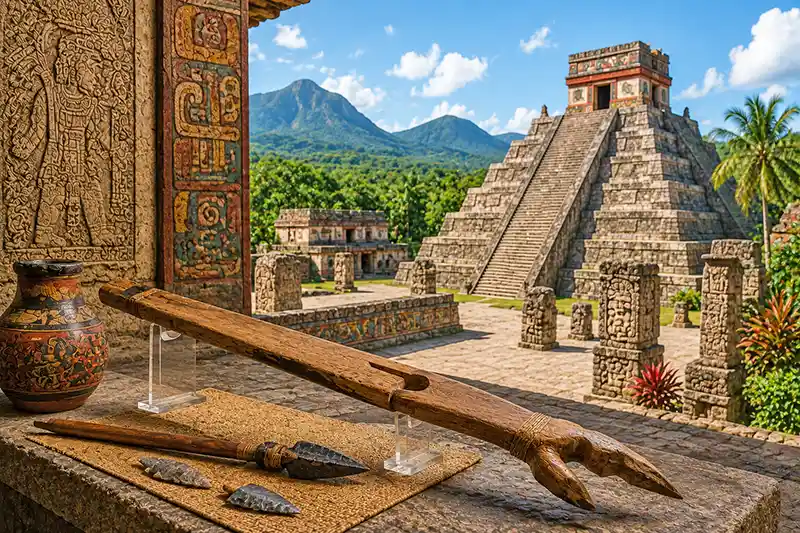
Long before European swords and firearms arrived in large numbers, the peoples of North, Central, and South America had developed their own sophisticated weapons suited to dramatically different environments and forms of warfare. Bows, spears, clubs, slings, axes, and throwing weapons appeared across the continents, while regional materials encouraged designs unlike those found elsewhere in the world. In places where iron and steel weapons were not part of the local technological tradition, craftspeople instead exploited stone, hardwood, bone, and especially volcanic glass with remarkable ingenuity.
Perhaps the most famous example is the Aztec macuahuitl, a wooden weapon fitted with extremely sharp pieces of obsidian along its edges. Often casually described as an "obsidian sword," it did not function exactly like a European metal sword and belonged to a very different technological tradition. Spanish accounts described the effectiveness of obsidian-edged weapons during the conquest of Mexico, although some of the more sensational claims repeated about the macuahuitl today should be treated cautiously. What is beyond dispute is that carefully fractured obsidian can form exceptionally sharp edges.
Projectile weapons were equally important. The atlatl, or spear-thrower, uses leverage to propel a dart or spear with greater velocity than the unaided arm can easily produce. Variations of this technology appeared in different parts of the world, but it has an especially long archaeological history in the Americas. Bows and arrows later became enormously important across many Indigenous societies, while slings were formidable weapons in the Andes. Inca armies and other Andean peoples used slings capable of launching stones over considerable distances.
Close-range weapons varied just as dramatically. Indigenous societies used numerous forms of wooden clubs, stone-headed weapons, axes, and spears, while some cultures developed highly distinctive regional designs. These weapons are an important reminder that sophisticated martial technology does not require steel. Weapon design is ultimately an exercise in making effective use of the materials, knowledge, and manufacturing techniques available within a particular culture.
Notable Indigenous Weapons of the Americas: Macuahuitl, atlatl and darts, bow and arrow, sling, spear, war club, stone-headed club, tomahawk and other regional axes, and various wooden and stone weapons.
Korea: Archery, Swords, and the Weapons Behind Korean Martial Traditions
Korea's location between powerful neighboring states placed it at the center of centuries of warfare, diplomacy, and cultural exchange, but Korean weapon traditions developed characteristics of their own. Armies of different Korean kingdoms relied on bows, spears, swords, polearms, and other weapons, while later martial manuals preserved detailed information about military training. One of the most important surviving sources is the Muyedobotongji, an illustrated martial arts manual compiled in 1790 during the Joseon dynasty that documented a wide range of armed and unarmed fighting methods.
Archery occupies an especially important place in Korean martial history. The traditional Korean composite bow, commonly called a gakgung, is relatively compact yet capable of impressive range. Mounted and foot archery played significant roles in Korean warfare, and archery eventually developed cultural importance extending far beyond the battlefield. Traditional Korean archery remains practiced today, preserving one of the clearest living connections between the country's historical weapons and its modern martial culture.
Swords also appeared in numerous forms throughout Korean history. The term geom broadly refers to a sword, while do generally refers to a single-edged blade, although terminology and classification can vary according to period and context. The Muyedobotongji recorded multiple sword methods alongside techniques involving spears, staffs, and polearms, demonstrating that historical Korean martial training was considerably broader than the empty-hand systems most internationally associated with Korea today.
One particularly distinctive weapon documented in Korean martial history is the woldo, a long polearm fitted with a large curved blade. Its appearance reflects broader East Asian traditions of bladed polearms, yet it developed its own place within Korean military training. Weapons such as the spear, staff, flail, and various polearms further illustrate a recurring theme throughout this guide: famous swords may dominate modern imagery, but historical martial systems frequently depended on a much wider arsenal.
Notable Korean Martial Arts Weapons: Gakgung, geom, do, spear, staff, woldo, flail, polearms, and various military swords and bows.
Central Asia and the Eurasian Steppe: Weapons Made for Warriors on Horseback
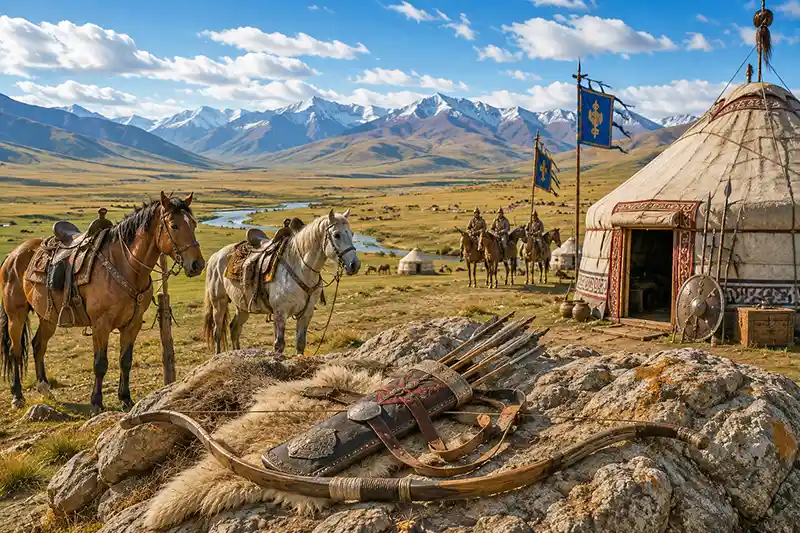
Across the enormous grasslands stretching through Central Asia and the Eurasian steppe, warfare developed around something that transformed the way weapons could be used: the horse. Scythians, Huns, Turks, Mongols, and many other peoples built martial traditions around mobility, allowing warriors to travel enormous distances and attack from directions that slower armies struggled to counter. Their weapons therefore had to work not only in a fighter's hands, but from the saddle at speed.
The composite bow became one of the defining weapons of steppe warfare. Built from multiple materials rather than a single piece of wood, these bows could combine substantial power with the compact dimensions useful to a mounted archer. Skilled horse archers could approach an enemy, release arrows, change direction, and withdraw while remaining difficult to engage. Under the Mongol Empire, combinations of mobility, archery, organization, intelligence, and disciplined tactics helped armies campaign across extraordinary distances during the thirteenth century.
Swords and sabers provided mounted warriors with close-range options once distance collapsed. Curved single-edged blades became particularly well suited to cutting from horseback and appeared in numerous forms across Central Asia over time. Spears and lances were also widely used, giving mounted fighters considerable reach during charges and close combat. Rather than relying on one celebrated weapon, successful steppe warfare combined ranged weapons, close-combat arms, horsemanship, and tactical mobility into a larger fighting system.
The influence of these traditions extended far beyond the steppe itself. Weapon designs and mounted warfare techniques traveled through conquest, migration, trade, and military exchange, influencing neighboring societies from China and Korea to Persia, the Middle East, and Eastern Europe. Central Asia therefore acted not merely as a geographic space between major civilizations, but as one of the great corridors through which martial technologies moved across the Old World.
Notable Central Asian and Steppe Weapons: Composite bow, saber, lance, spear, dagger, mace, and various forms of mounted archery equipment.
How Martial Arts Weapons Changed From Region to Region
Looking across these traditions reveals something more interesting than a simple catalog of unusual weapons. Similar problems repeatedly produced similar solutions, even among cultures separated by enormous distances. Spears appeared almost everywhere because placing a point on a long shaft provided reach without requiring complicated technology. Bows independently became essential wherever fighters needed to attack from a distance, while staffs, clubs, knives, and axes could emerge from materials and tools already familiar in everyday life.
The greatest differences often appeared in how cultures adapted these basic ideas. Japan developed highly specialized polearms alongside its famous swords. China produced an exceptional variety of flexible and articulated weapons. Filipino martial traditions became renowned for systems that move fluidly between sticks and blades. Central Asian societies refined weapons around mounted warfare, while Mesoamerican cultures achieved formidable cutting edges with obsidian rather than steel. The materials available to a society mattered, but so did terrain, armor, military organization, trade, and the opponents its warriors expected to face.
It is also important to remember that the modern categories used to describe these objects can be misleading. A weapon might simultaneously serve as a battlefield arm, hunting implement, agricultural tool, ceremonial object, symbol of status, or martial arts training device depending on the place and period. Some weapons associated strongly with martial arts today were once primarily military, while others survived long after their practical battlefield role disappeared because martial traditions preserved their techniques.
That is why the weapons in this guide are best understood not as isolated inventions, but as pieces of a much larger story. Across the world, people repeatedly experimented with reach, leverage, momentum, cutting edges, impact, flexibility, and projectile force. The resulting weapons may look dramatically different, but many were attempts to solve surprisingly similar problems.
Martial Arts Weapons Around the World: Quick Reference Guide
The chart below brings together many of the weapons featured throughout this guide. Dates and historical periods are approximate because many traditional weapons developed gradually, and the earliest surviving evidence does not necessarily represent the moment a weapon was first created. Regional labels likewise identify the places most strongly associated with each weapon rather than suggesting that every weapon existed exclusively within modern national borders.
| Weapon | Region / Origin | Weapon Type | Approximate Historical Period | Associated Martial Tradition |
|---|---|---|---|---|
| Katana | Japan | Curved sword | Medieval to early modern Japan | Kenjutsu, Iaijutsu, Iaido |
| Wakizashi | Japan | Short sword | Medieval to early modern Japan | Japanese sword traditions |
| Tanto | Japan | Dagger / short blade | Medieval Japan | Japanese martial traditions |
| Yari | Japan | Spear | Ancient origins; widespread in medieval Japan | Sojutsu |
| Naginata | Japan | Bladed polearm | Medieval Japan | Naginatajutsu |
| Kusarigama | Japan | Sickle and chain weapon | Medieval to early modern Japan | Kusarigamajutsu |
| Bo | Okinawa / Japan | Staff | Traditional origins | Okinawan Kobudo, Bojutsu |
| Nunchaku | Okinawa | Flexible striking weapon | Historical origin uncertain | Okinawan Kobudo |
| Sai | Okinawa / East and Southeast Asian influences | Metal truncheon | Historical development uncertain | Okinawan Kobudo |
| Tonfa | Okinawa | Side-handled baton | Traditional origins | Okinawan Kobudo |
| Kama | Okinawa / Japan | Sickle | Traditional agricultural origins | Okinawan Kobudo |
| Jian | China | Straight double-edged sword | Ancient China | Chinese martial arts |
| Dao | China | Single-edged sword / saber | Ancient China onward | Chinese martial arts |
| Chinese Spear | China | Spear | Ancient China onward | Chinese martial arts |
| Guandao | China | Bladed polearm | Later imperial China | Chinese martial arts |
| Chain Whip | China | Flexible segmented weapon | Historical dating uncertain | Chinese martial arts |
| Rope Dart | China | Flexible projectile weapon | Historical dating uncertain | Chinese martial arts |
| Three-Section Staff | China | Articulated staff | Historical dating uncertain | Chinese martial arts |
| Escrima Stick | Philippines | Training / impact weapon | Traditional origins | Arnis, Eskrima, Kali |
| Bolo | Philippines | Cutting blade | Pre-modern origins | Filipino martial traditions |
| Barong | Southern Philippines | Leaf-shaped blade | Pre-modern origins | Filipino martial traditions |
| Kampilan | Southern Philippines | Long sword | Pre-colonial / early historic period | Filipino martial traditions |
| Karambit | Indonesia / Malay world | Curved knife | Historical origin uncertain | Pencak Silat |
| Kris / Keris | Indonesia / Malay world | Dagger / sword | At least several centuries old | Pencak Silat and regional traditions |
| Golok | Indonesia / Malay world | Heavy cutting blade | Traditional origins | Pencak Silat and regional traditions |
| Thai Daab | Thailand | Single-edged sword | Pre-modern origins | Krabi-Krabong |
| Katar | Indian subcontinent | Push dagger | Medieval to early modern period | South Asian martial traditions |
| Talwar | Indian subcontinent | Curved sword | Medieval to early modern period | South Asian martial traditions |
| Khanda | Indian subcontinent | Straight double-edged sword | Medieval period and later | South Asian martial traditions |
| Urumi | Southern India | Flexible sword | Historical dating uncertain | Kalaripayattu |
| Chakram | Indian subcontinent | Throwing ring | Pre-modern origins | Sikh martial traditions |
| Kukri | Nepal / Himalayan region | Forward-curving knife | Historical origins predate modern era | Nepalese martial tradition |
| Longsword | Europe | Two-handed sword | Late medieval / Renaissance period | Historical European Martial Arts |
| Rapier | Europe | Thrust-oriented sword | 16th-17th centuries | European fencing traditions |
| Halberd | Europe | Polearm | Late medieval / Renaissance period | European military traditions |
| Poleaxe | Europe | Polearm | Late medieval period | Armored combat / HEMA |
| Quarterstaff | Europe | Staff | Medieval and early modern traditions | European martial traditions |
| Shotel | Ethiopia | Curved sword | Pre-modern origins | Ethiopian martial tradition |
| Takouba | Sahara / Sahel | Sword | Pre-modern origins | Tuareg and regional martial traditions |
| Stabbing Spear | Southern Africa | Short spear | Pre-modern; prominent in 19th century warfare | Southern African martial traditions |
| Shamshir | Persia | Curved saber | Medieval to early modern period | Persian martial traditions |
| Kilij | Ottoman world | Curved saber | Medieval to early modern period | Ottoman martial traditions |
| Composite Bow | Middle East / Central Asia | Projectile weapon | Ancient origins | Mounted and foot archery traditions |
| Macuahuitl | Mesoamerica | Obsidian-edged wooden weapon | Pre-Columbian period | Aztec / Mexica warfare |
| Atlatl | Americas and other world regions | Spear-thrower | Prehistoric origins | Indigenous hunting and warfare traditions |
| Sling | Andean South America | Projectile weapon | Ancient origins | Andean / Inca warfare |
| Gakgung | Korea | Composite bow | Traditional Korean origins | Korean archery |
| Woldo | Korea | Bladed polearm | Documented in Joseon-era martial traditions | Traditional Korean martial arts |
| Steppe Composite Bow | Central Asia / Eurasian Steppe | Composite bow | Ancient origins | Mounted archery |
| Steppe Saber | Central Asia / Eurasian Steppe | Curved sword | Early medieval period onward | Mounted combat traditions |
What Are the Main Types of Martial Arts Weapons?
Despite the enormous variety of weapons developed around the world, most martial arts weapons can be grouped into a handful of broad families. The boundaries are not always perfect because some weapons combine characteristics from multiple categories, but these groups provide a useful way to understand how dramatically different cultures approached many of the same fundamental problems.
Swords and Long Blades
Swords place a cutting or thrusting blade at the end of a relatively short grip, but that simple description encompasses everything from the Japanese katana and Chinese jian to the European longsword, Indian talwar, Persian shamshir, and Filipino kampilan. Blade length, curvature, number of cutting edges, point geometry, hand protection, and intended method of use can vary enormously.
Knives and Daggers
Shorter blades sacrifice some reach for portability and control at close distance. Tanto, karambits, katar, jambiya, kris, and countless regional knives demonstrate how many different solutions cultures developed within this basic category. Some were primarily fighting weapons, while others also functioned as tools, ceremonial objects, or symbols of status.
Staffs
The staff may be one of humanity's simplest weapons, yet staff fighting traditions appeared across numerous cultures. The Okinawan bo, Japanese jo, Chinese staff, and European quarterstaff all exploit reach and leverage without requiring a cutting edge. Their apparent simplicity also makes staffs useful for demonstrating an important principle of martial weaponry: sophisticated technique does not require a mechanically complicated weapon.
Spears and Polearms
Attaching a point, blade, hammer, or other striking surface to a long shaft dramatically increases reach. Spears appeared in cultures around the world, while more specialized polearms included the Japanese naginata, Chinese guandao, Korean woldo, and European halberd and poleaxe. On historical battlefields, weapons from this family were often more important than the swords that receive greater attention today.
Flexible and Articulated Weapons
Flexible weapons replace some or all of a rigid shaft with rope, chain, or connected sections. Nunchaku, chain whips, rope darts, meteor hammers, kusarigama, and three-section staffs can redirect momentum in ways rigid weapons cannot. That flexibility also makes controlling them considerably different from handling a conventional sword or staff.
Impact Weapons
Clubs, batons, maces, war hammers, and other impact weapons rely primarily on concentrated force rather than a cutting edge. Some are little more than shaped pieces of hardwood, while others use metal heads, flanges, spikes, or specialized geometry to concentrate impact. Variations of the club are among the most geographically widespread weapon concepts in human history.
Projectile and Throwing Weapons
Bows, slings, atlatls, throwing spears, throwing knives, and other projectile weapons allow force to be delivered beyond immediate striking distance. The technologies involved range from the mechanical energy stored in a composite bow to the simple leverage provided by an atlatl. Entire military traditions, particularly those of the Eurasian steppe, were transformed by the ability to combine projectile weapons with mobility.
Hybrid and Unusual Weapons
Some weapons resist easy classification. The kusarigama combines a rigid sickle with a flexible weighted chain, the macuahuitl uses pieces of obsidian mounted along a wooden body, and the Indian pata integrates a sword blade with a protective gauntlet. These hybrids are particularly useful reminders that historical weapon makers were not designing objects to fit modern categories. They were solving practical problems with the materials and ideas available to them.
Martial Arts Weapon Types Compared
Different weapon families tend to emphasize different combinations of reach, movement, and force. The comparisons below describe general characteristics rather than strict rules, since individual weapons within the same family can differ substantially in size and use.
| Weapon Family | Typical Range | Primary Action | Representative Examples | Examples Found In |
|---|---|---|---|---|
| Swords and Long Blades | Short to medium | Cutting and/or thrusting | Katana, jian, longsword, talwar, shamshir | Japan, China, Europe, South Asia, Middle East |
| Knives and Daggers | Close | Cutting and/or thrusting | Tanto, karambit, katar, jambiya, kris | Japan, Southeast Asia, South Asia, Middle East |
| Staffs | Medium to long | Striking, thrusting, controlling | Bo, jo, Chinese staff, quarterstaff | Okinawa, Japan, China, Europe |
| Spears | Long | Primarily thrusting; some forms also cut | Yari, Chinese spear, African spears, steppe lance | Nearly worldwide |
| Bladed Polearms | Long | Cutting, thrusting, hooking, or impact | Naginata, guandao, woldo, halberd, poleaxe | Japan, China, Korea, Europe |
| Flexible Weapons | Variable | Swinging, striking, entangling, or projecting | Nunchaku, chain whip, rope dart, kusarigama | East Asia and other regional traditions |
| Impact Weapons | Close to medium | Blunt-force striking | Club, mace, war hammer, baton, knobkerrie | Nearly worldwide |
| Bows | Long | Projectile | Gakgung, steppe composite bow, yumi | Korea, Central Asia, Japan, Middle East and beyond |
| Thrown and Launched Weapons | Medium to long | Projectile | Atlatl dart, sling, throwing spear, throwing knife | Americas, Europe, Africa, Asia and beyond |
| Hybrid Weapons | Variable | Multiple functions | Kusarigama, macuahuitl, pata | Japan, Mesoamerica, South Asia |
One of the clearest patterns is the near-universal value of reach. Cultures separated by thousands of miles repeatedly developed spears, staffs, bows, and other weapons that allowed a fighter to affect an opponent from farther away. The details changed dramatically, but the underlying advantage did not.
Weapons Rarely Stayed in One Place
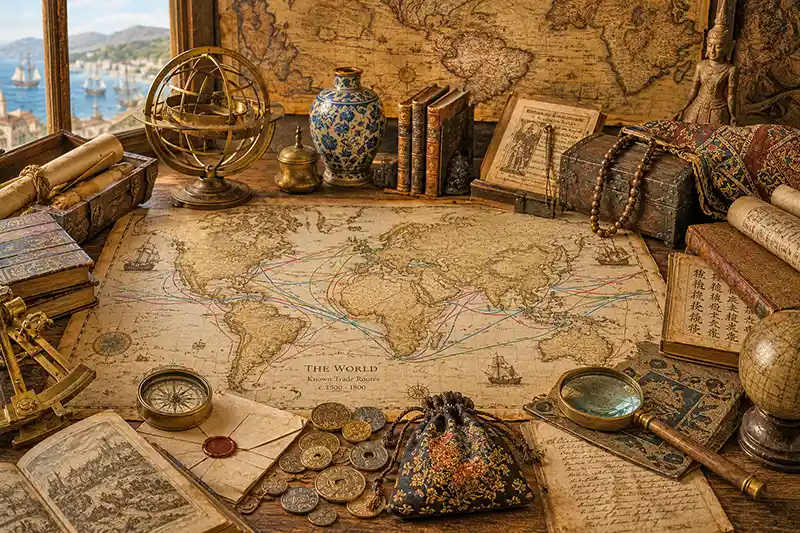
It is tempting to look at a weapon, attach it to a country, and imagine that its history begins and ends there. The reality is far more interesting. Weapons traveled with merchants, soldiers, migrants, invading armies, diplomats, and craftspeople. Ideas crossed borders even when the physical weapons themselves did not, and neighboring cultures frequently borrowed useful features while adapting them to their own materials and fighting traditions.
The sword provides countless examples. Curved single-edged blades appeared across a vast stretch of Eurasia, but they did not all develop independently or remain unchanged within modern national boundaries. Steppe warfare, Persian and Turkic traditions, expanding empires, and centuries of trade helped weapon designs and manufacturing ideas move between regions. The result was not one universal curved sword, but families of weapons that sometimes shared characteristics while remaining culturally and mechanically distinct.
The same process can be seen throughout Asia. China exerted enormous cultural and technological influence on neighboring regions, yet Japan, Korea, Okinawa, and Southeast Asian societies did not simply copy Chinese weapons. Imported ideas could be modified, specialized, combined with local traditions, or eventually transformed into weapons with identities of their own. Okinawa is an especially useful example because the Ryukyu Kingdom maintained extensive connections with both China and Japan while developing a martial culture that cannot accurately be reduced to either one.
Colonialism and global trade accelerated this exchange even further. European blades entered Asian, African, and American markets, while Europeans encountered weapons and fighting traditions they had never seen before. Local craftspeople sometimes incorporated foreign blade styles, guards, materials, or manufacturing techniques into existing designs. Military technology could therefore move in both directions, producing weapons that reflected layers of influence rather than a single moment of invention.
Even after many traditional weapons disappeared from battlefields, martial arts helped preserve and transform them. A weapon once intended for warfare might survive as a training implement, ceremonial object, competitive discipline, cultural symbol, or historical practice. In some cases, the modern martial arts version of a weapon differs considerably from examples carried centuries ago. Understanding that evolution is essential because the weapon displayed in a dojo today may represent only the latest chapter of a much longer story.
Perhaps that is the most important lesson of a worldwide view of martial arts weapons. These objects can tell us where people fought and what materials they possessed, but they can also reveal whom they traded with, whom they fought against, which technologies they adopted, and which traditions they chose to preserve. A weapon's shape may belong to one place and period, but the ideas behind it are often part of a much larger human exchange.
A World of Weapons, and the Stories Behind Them
From a simple wooden staff to an intricately forged sword, every martial arts weapon is ultimately a product of the people and circumstances that created it. Geography determined which materials were available. Warfare encouraged new ideas about reach, protection, mobility, and force. Trade carried designs across borders, while generations of martial artists preserved techniques long after many of the weapons themselves disappeared from everyday life.
That is also why no list can ever capture every martial arts weapon in existence. Regional variations, forgotten weapons, changing terminology, and centuries of cultural exchange make the subject far larger than any single guide. The weapons featured here instead provide a window into that larger history, showing how societies around the world developed remarkably different solutions to many of the same challenges.
Today, these weapons survive for reasons their original makers could never have anticipated. Some remain part of living martial arts traditions. Others are reconstructed from historical manuals, preserved in museums, practiced in competition, collected as examples of craftsmanship, or studied simply because they reveal something fascinating about the cultures that produced them. Their practical roles may have changed, but their ability to connect us with the history of martial arts has not.
And perhaps that is what makes exploring martial arts weapons from around the world so compelling. Behind every unusual blade, staff, bow, or polearm is more than a method of fighting. There is a story about technology, geography, culture, and the people who found a way to turn the materials around them into something uniquely their own.
What Is the Oldest Martial Arts Weapon?
There is no single weapon that can definitively be called the world's oldest martial arts weapon, especially because organized martial arts developed much later than weapons themselves. Simple clubs, wooden spears, and stone-tipped projectile weapons date back deep into prehistory, long before written records existed. Archaeological evidence suggests that early humans and their ancestors were using wooden spears hundreds of thousands of years ago.
If the question is limited to weapons that later became part of formal martial traditions, the staff, spear, bow, sword, and various forms of club all have extremely ancient histories. The spear is particularly notable because versions of it appeared independently across cultures throughout the world and remained militarily important for thousands of years.
What Is the Most Common Martial Arts Weapon in the World?
The staff is one of the strongest candidates for the most widespread martial arts weapon in the world. Variations of staff fighting developed across numerous cultures because the basic weapon requires little more than a suitable length of sturdy wood. Examples include the bo in Okinawan and Japanese martial arts, staffs used throughout Chinese martial traditions, and the quarterstaff found in European fighting systems.
The spear may have an even stronger claim if historical battlefield weapons are included. Spears appeared across Africa, Asia, Europe, the Americas, and the Middle East because they offered a major advantage in reach while remaining relatively straightforward to manufacture. Although individual designs varied enormously, the basic idea of attaching a point to a long shaft became one of the most successful weapon concepts in human history.
Which Martial Arts Use Weapons?
Many martial arts include weapon training, either as a central part of the system or as a specialized area of study. Okinawan Kobudo is particularly well known for weapons such as the bo, nunchaku, sai, tonfa, and kama, while Japanese arts include traditions devoted to the sword, spear, staff, and naginata. Chinese martial arts encompass an enormous assortment of weapons, including staffs, spears, swords, and flexible weapons.
Filipino martial arts such as Arnis, Eskrima, and Kali are especially associated with sticks, knives, and other weapons, while Kalaripayattu in India includes training with several traditional arms. Historical European Martial Arts reconstructs sword, dagger, polearm, and other fighting systems from surviving historical sources. Weapon practice can also appear within Korean martial traditions and many other fighting systems around the world.
Why Do So Many Martial Arts Use Traditional Weapons?
Many martial arts preserve traditional weapons because their techniques developed during periods when armed combat was an important part of military training, personal defense, or everyday life. As warfare changed and older weapons became obsolete, martial traditions sometimes preserved the movements, training methods, and cultural practices associated with them.
Traditional weapon training can also teach concepts such as distance, timing, coordination, leverage, footwork, and control in ways that differ from empty-hand practice. Today, people may study these weapons for martial training, competition, historical research, cultural preservation, or simply an appreciation of the traditions and craftsmanship surrounding them.
What Is the Difference Between a Martial Arts Weapon and a Battlefield Weapon?
There is no clear historical dividing line between a martial arts weapon and a battlefield weapon. Many weapons practiced in martial arts today, including swords, spears, bows, and polearms, originally had practical military applications. As warfare changed and these weapons became obsolete on the battlefield, some of their techniques survived through martial schools, cultural traditions, historical manuals, and later sporting practices.
Other weapons had more complicated backgrounds and could serve civilian, ceremonial, agricultural, or personal-defense purposes in addition to martial ones. Calling something a "martial arts weapon" therefore usually describes the context in which it is practiced today rather than proving that the weapon was originally invented specifically for martial arts.
Why Do Martial Arts Weapons Look So Different Around the World?
Weapon designs were influenced by the materials, technology, environments, opponents, and fighting methods available within different societies. A culture with sophisticated metalworking could produce weapons very different from one relying primarily on wood, stone, bone, or obsidian. Armor also mattered because a weapon designed to confront heavily armored opponents might emphasize different characteristics from one intended for combat where little armor was worn.
Geography and lifestyle could be equally important. Mounted warriors benefited from weapons suited to horseback, while naval, urban, forest, and open-battlefield environments created different practical challenges. Trade and warfare then allowed successful ideas to travel between cultures, which is why weapons from distant regions can sometimes share surprising characteristics.
Were Farming Tools Really Turned Into Martial Arts Weapons?
Some traditional weapons clearly resemble agricultural or everyday tools, but the popular story that farmers simply converted their tools into weapons is often much more certain than the historical evidence allows. This is particularly relevant to Okinawan weapons such as the kama, nunchaku, and tonfa, which are frequently explained through stories about farmers secretly arming themselves after weapons were prohibited.
The kama has an obvious relationship to agricultural sickles, but the histories of weapons such as the nunchaku and tonfa are less straightforward. Restrictions on weapons did occur during Ryukyuan history, yet the familiar narrative of a defenseless farming population inventing an entire arsenal from farm implements is generally considered an oversimplification. Trade, cultural exchange, existing weapon traditions, and later martial development all contributed to the weapons associated with Okinawan Kobudo today.
What Is the Most Unusual Martial Arts Weapon?
There is no objective answer, but several traditional weapons stand out because they operate very differently from an ordinary sword, staff, or spear. Japan's kusarigama combines a sickle with a weighted chain, while China's rope dart places a metal projectile at the end of a long flexible rope. The three-section staff replaces a conventional rigid staff with three connected sections, creating movements that would be impossible with a single piece of wood.
India's urumi is another remarkable example because its long blade is flexible rather than rigid. The Mesoamerican macuahuitl approached cutting from an entirely different technological direction by mounting pieces of sharp obsidian along a wooden body. What makes these weapons especially interesting is that each represents a very different solution to the same basic challenge of controlling distance, momentum, and force.
Are Martial Arts Weapons Still Practiced Today?
Yes. Traditional weapon training survives in martial arts around the world. Okinawan Kobudo preserves practice with weapons such as the bo, sai, nunchaku, tonfa, and kama, while Japanese martial traditions continue to study swords, staffs, bows, and naginata. Chinese martial arts preserve numerous traditional weapons, and Filipino systems such as Arnis and Eskrima remain strongly associated with weapon training.
Historical European Martial Arts practitioners reconstruct techniques from surviving fighting manuals, while traditional archery, Kalaripayattu, Korean martial traditions, and other systems continue to preserve historical weapons in different forms. Modern practice may emphasize cultural preservation, competition, physical training, historical reconstruction, or technical study rather than the original battlefield purposes of these weapons.
What Is the Hardest Martial Arts Weapon to Learn?
There is no universally hardest martial arts weapon because difficulty depends on the practitioner, training system, and level of proficiency being considered. However, flexible and articulated weapons can introduce challenges that are largely absent from rigid weapons. Rope darts, chain whips, nunchaku, three-section staffs, and similar weapons require the practitioner to manage momentum while controlling an object that does not remain rigidly aligned with the hand.
That does not necessarily make a flexible weapon more sophisticated than a sword, spear, or staff. Achieving a high level of skill with even an apparently simple weapon can require years of practice. The difference is that flexible weapons can make basic control particularly unforgiving, while mastering a conventional weapon often involves increasingly subtle challenges involving timing, distance, precision, movement, and technique.
You May Also Be Interested In:
- A Visual Guide to Japanese Swords: The Blades of the Samurai Era
- A Beginner's Guide to Traditional Martial Arts Weapons
- Best Martial Arts Pants: Karate and Taekwondo Training Guide
- The Complete Parents Guide to Buying a Martial Arts Uniform
- Top 5 Least Practical Martial Arts Weapons You Know You Want
- LED Weapons for Cosplay and Martial Arts
- What Are Flexible Weapons in Martial Arts?
- 10 Weird Martial Arts Weapons That Actually Existed
- The Most Dangerous Chain Weapons in Martial Arts History
- Popular Martial Arts Weapons that Started as Farm Tools
Leave a Reply