



Why the Naginata Became Japan's Most Elegant Battlefield Weapon
July 31st, 2026
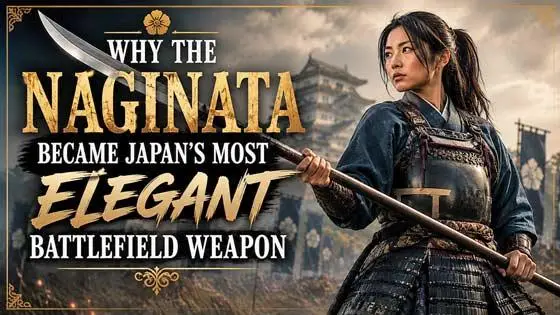
The katana has become the symbol of the samurai, but for centuries, another weapon quietly shaped the battlefields of Japan. With its long wooden shaft and gracefully curved blade, the naginata gave its wielder the reach to strike first, the leverage to control space, and the versatility to face enemies on foot or horseback. It wasn't simply another polearm. In the hands of a skilled warrior, it was one of the most effective battlefield weapons ever created.
Today, the naginata is often remembered for its elegance, yet that beauty grew out of ruthless practicality. It was carried by samurai, feared by opposing armies, mastered by warrior monks, and later became closely associated with some of Japan's most formidable female warriors. Its influence can still be seen in modern martial arts, proving that this remarkable weapon's legacy extends far beyond the age of feudal Japan.
In this article, we'll explore how the naginata earned its legendary reputation, why it dominated battlefields for centuries, and how one of Japan's most graceful weapons became one of its most respected.
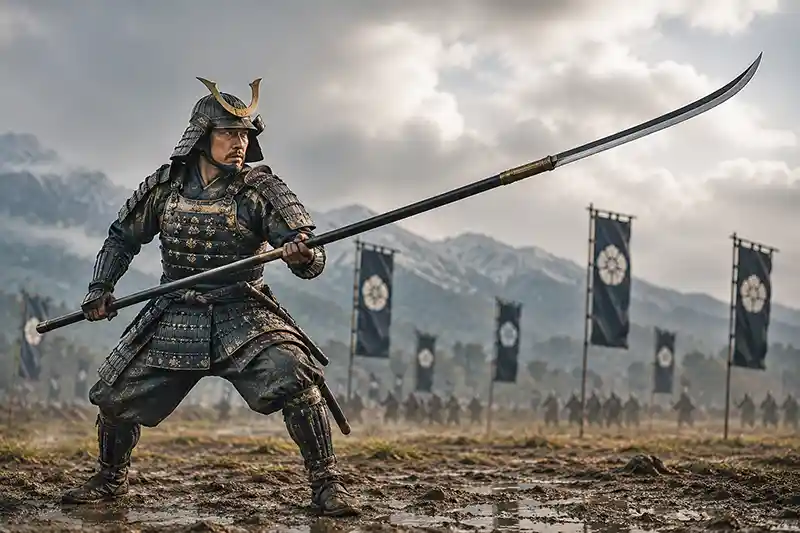
At first glance, the naginata looks like a sword attached to the end of a long pole. While that description isn't entirely wrong, it doesn't come close to explaining why the weapon became one of the most feared sights on medieval Japanese battlefields. By combining the cutting power of a curved blade with the reach of a spear, the naginata offered advantages that few other weapons could match.
Its long shaft allowed warriors to keep opponents at a safe distance while delivering wide, sweeping cuts capable of striking multiple attackers or unseating mounted cavalry. Unlike a spear, which primarily relied on thrusting attacks, the naginata could slash, hook, and redirect with remarkable fluidity. That versatility made it effective against both lightly armored soldiers and heavily equipped samurai.
Another advantage was its ability to control space. A skilled naginata user could force enemies to stay beyond sword range while constantly threatening them with long-reaching attacks. This made advancing against a trained wielder extremely dangerous. In many situations, an opponent carrying a samurai sword had to survive the naginata's reach before getting close enough to strike.
Although many people think of the katana as the defining weapon of the samurai, the naginata filled an entirely different role. It excelled in open combat where mobility, distance, and battlefield awareness mattered just as much as individual swordsmanship. That unique combination of elegance and effectiveness is why historians continue to rank it among Japan's most influential weapons.
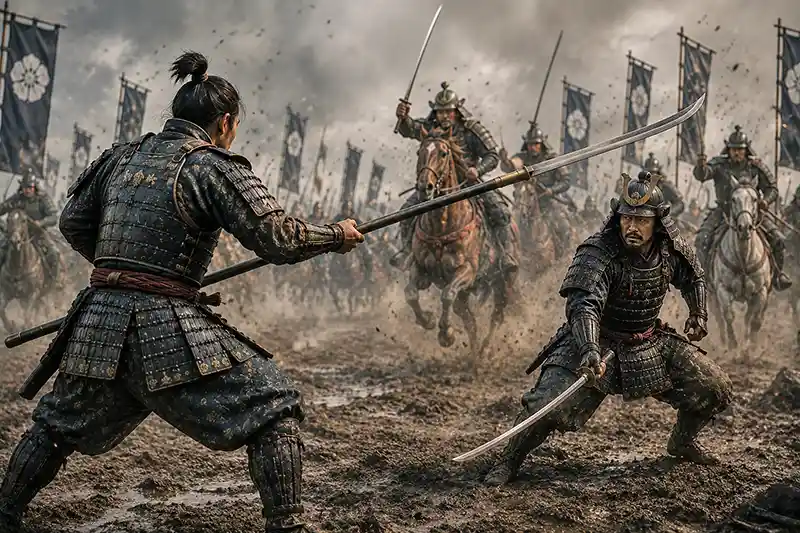
On an open battlefield, the first warrior to land a clean strike often had the advantage. That made reach incredibly valuable, and the naginata gave its user far more distance than a sword ever could. Before a swordsman could close the gap, the naginata wielder could slash at the legs, target the arms, or force the opponent to retreat.
That extra reach also made the naginata effective against cavalry. A mounted warrior had speed, height, and momentum, but the long blade gave infantry a chance to attack the horse, hook at the rider, or disrupt the charge before it reached them. In the hands of a disciplined fighter, the naginata could turn a mounted advantage into a dangerous vulnerability.
The weapon's sweeping attacks were especially useful when formations broke apart and fighting became chaotic. A katana worked best at close range, where the swordsman could control the angle and timing of each cut. The naginata controlled a much larger area. Its wielder could threaten several directions at once, making it difficult for enemies to rush in without exposing themselves.
This did not make the sword useless. Once an opponent got past the blade and moved inside the naginata's ideal range, the longer weapon became harder to maneuver. Skilled warriors trained to adjust their grip, shorten their movements, and use the shaft defensively, but distance remained the weapon's greatest advantage. Lose that distance, and the balance of the fight could change quickly.
That is why battlefield weapons should not be judged by fame alone. The katana became the enduring symbol of the samurai, but weapons like the naginata often offered more practical advantages in large-scale combat. Its ability to strike first, control space, and challenge mounted enemies made it one of Japan's most effective answers to the realities of war.
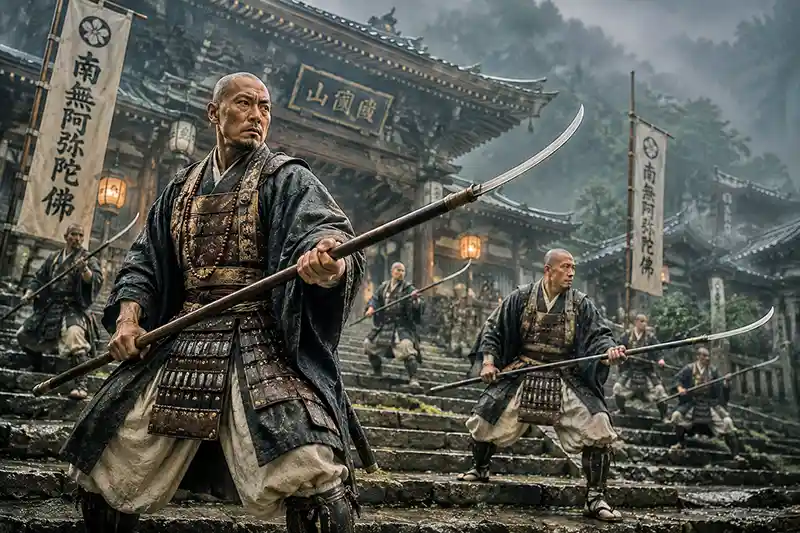
Long before the naginata became closely associated with female warriors, it had already earned a fearsome reputation in the hands of Japan's warrior monks. Known as s??hei, these armed religious fighters protected powerful temples, defended land, and took part in political conflicts that could erupt into open warfare. Their appearance on the battlefield was often enough to signal that a dispute had moved far beyond peaceful negotiation.
The naginata suited them exceptionally well. Many warrior monks fought on foot, where the weapon's reach allowed them to challenge mounted samurai and keep swordsmen outside striking distance. Its curved blade could slash through exposed limbs, hook around defenses, and deliver sweeping attacks that were difficult to avoid in crowded combat.
Temple forces were not made up entirely of ordained monks, and later stories sometimes exaggerated how uniformly they fought. Even so, the connection between warrior monks and the naginata became deeply rooted in Japanese history and legend. Famous figures such as Benkei are often depicted carrying one, reinforcing the image of the towering monk armed with a formidable pole weapon.
What made the naginata especially valuable was that it rewarded disciplined movement. A fighter had to manage the long shaft, maintain proper distance, and recover quickly after every swing. Poor technique could leave the weapon exposed or allow an enemy to rush inside its reach. In trained hands, however, the same length that made it difficult to master became its greatest advantage.
The warrior monks helped establish the naginata as more than an unusual variation of the spear. Their battlefield reputation showed that its graceful curves concealed a weapon capable of controlling space, disrupting cavalry, and punishing anyone who tried to approach carelessly. That reputation would survive long after the great temple armies themselves had faded from power.
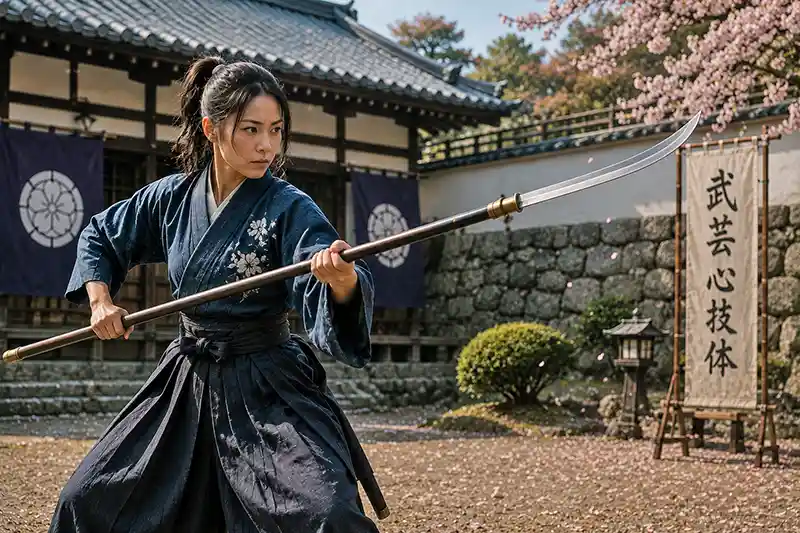
One of the most fascinating chapters in the naginata's history is its strong association with women of Japan's warrior class. This connection did not begin because the weapon was considered delicate or ceremonial. It developed because the naginata offered a practical advantage to anyone defending a home, estate, or castle against a stronger attacker.
Its long reach allowed a trained woman to keep an opponent beyond grappling or sword range. The sweeping blade could threaten the legs, arms, and body while the shaft provided leverage for blocks and counters. In a confined entrance or narrow passageway, one skilled defender could make it extremely dangerous for several attackers to advance at once.
Women from samurai families were sometimes expected to protect their households when male relatives were away at war. Training with the naginata gave them a weapon suited to that responsibility. Historical figures such as Tomoe Gozen later became symbols of female martial courage, although the details of their lives are often difficult to separate from legend.
During the peaceful Edo period, the naginata gradually became an important part of martial education for women in the warrior class. It could represent discipline, readiness, and family honor, and some were included among a bride's possessions when she married. This later cultural role strengthened the idea that the naginata was primarily a women's weapon, even though men had carried it in warfare for centuries.
That distinction matters. The naginata was not made for women, nor was it pushed aside because men considered it less effective. Its long battlefield history came first. Women became closely associated with it because they recognized the same qualities that had made it valuable to samurai and warrior monks: reach, control, versatility, and the ability to stop an enemy before he came close enough to strike.
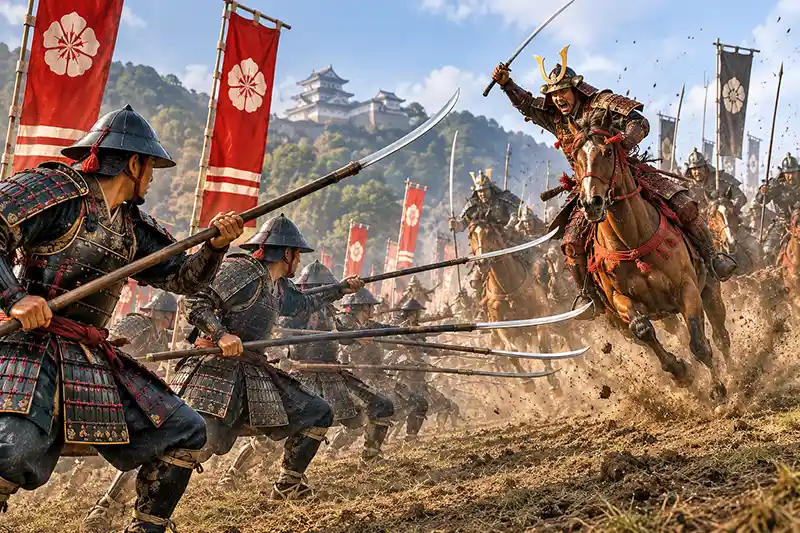
The naginata was most valuable during periods when battles were fought across open ground and cavalry still played a major role. Its long reach allowed infantry to threaten mounted warriors before they came within sword range, while the curved blade could slash at horses, riders, and exposed limbs. For armies facing fast-moving cavalry, that ability made the naginata far more than a ceremonial weapon.
Its design also encouraged warriors to think in terms of space rather than single strikes. A swordsman controlled the area immediately around his body. A naginata wielder could dominate a much wider circle, forcing opponents to hesitate before advancing. When several trained fighters stood together, their overlapping reach could create a dangerous barrier that was difficult to penetrate.
The weapon was not perfect for every battlefield. Dense formations, narrow passages, and close fighting could limit its sweeping movements. As military organization changed, straight spears became increasingly important because they were easier to use in large formations and could be produced more efficiently. Firearms eventually changed warfare even further, reducing the importance of many traditional close-combat weapons.
Still, the naginata never disappeared completely. Its influence survived because it had already proven how effective a long cutting weapon could be against swordsmen and cavalry. Other oversized Japanese weapons, including the odachi, also tried to combine reach with devastating cutting power, but few matched the naginata's balance of distance, control, and maneuverability.
The naginata helped define an era when the battlefield belonged to more than swords alone. Its success reminds us that Japanese warfare was shaped by practical decisions about range, formation, terrain, and mobility. The most famous weapon was not always the one that gave a warrior the greatest chance of surviving.
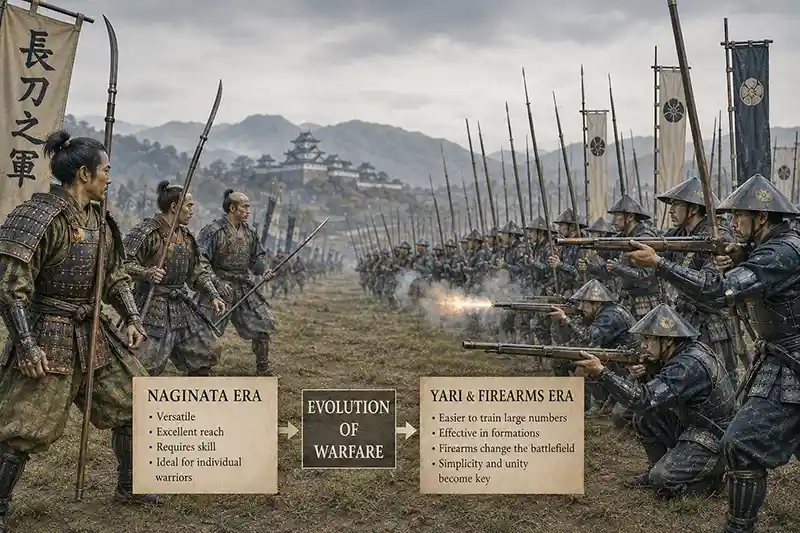
If the naginata was so effective, why did it gradually disappear from the battlefield? The answer wasn't because it failed in combat. Warfare itself changed. As armies became larger and more organized during the late medieval period, commanders increasingly favored weapons that were easier to mass-produce, easier to train with, and better suited to fighting in tight formations.
Long spears, particularly the yari, began replacing the naginata in many military units. While the naginata excelled in the hands of an experienced warrior, the yari allowed large groups of soldiers to present a unified wall of spear points that could stop cavalry and enemy infantry with remarkable efficiency. As tactics evolved, simplicity often proved more valuable than versatility.
At the same time, firearms introduced another dramatic shift. Once arquebuses appeared on Japanese battlefields, many traditional polearms lost some of the advantages they had enjoyed for centuries. Battles increasingly depended on disciplined formations, coordinated volleys, and logistics rather than individual weapon mastery alone.
Ironically, the katana became more famous during the long peace that followed Japan's great civil wars. With fewer battlefield campaigns, the sword evolved into the everyday weapon of the samurai and eventually became the defining symbol of the warrior class. That transformation has led many people to assume it was always the samurai's primary battlefield weapon, but history tells a far more complicated story. If you've ever wondered how the katana compares to the broader category of samurai blades, our guide to the samurai sword vs. katana explains the differences.
The naginata never truly vanished. Instead, it transitioned from a battlefield weapon to one preserved through martial arts, tradition, and history. While the sword captured the world's imagination, the naginata quietly remained one of the weapons that helped shape Japan's military past.
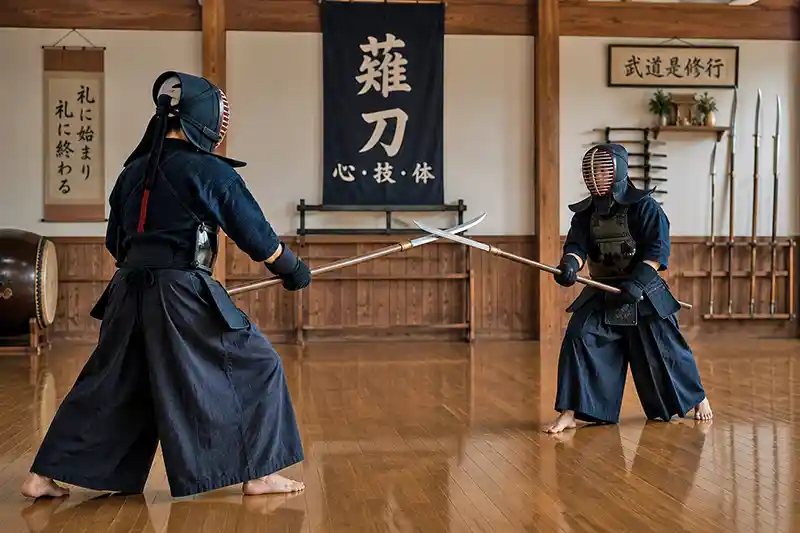
The naginata might have faded from the battlefield, but it never disappeared from Japanese culture. Instead, it evolved into a disciplined martial art that preserved the weapon's techniques while adapting them for structured practice. Modern naginata training focuses less on warfare and more on timing, distance, posture, and control.
In contemporary practice, students use safer training weapons and protective equipment while learning how to strike, defend, advance, and retreat with precision. The long shaft still demands careful movement. A small mistake in grip or footwork can throw off the entire technique, which makes naginata training especially effective for developing balance and coordination.
The art also preserves one of the weapon's greatest historical strengths: control of distance. Practitioners learn how to maintain the ideal range, threaten an opponent without overcommitting, and recognize the moment when a long weapon becomes vulnerable at close quarters. Those lessons connect modern training directly to the realities that once made the naginata so effective in battle.
Although traditional forms remain central, the naginata has also inspired modern interpretations. Contemporary designs such as the Modern Combat Naginata show how the weapon's distinctive silhouette and long-reaching concept continue to influence martial arts equipment today. The appearance may change, but the appeal of combining reach with a curved blade remains remarkably strong.
For beginners, padded equipment can provide a safer introduction to distance and weapon handling before moving into more advanced practice. Training tools such as foam practice swords can also help students explore basic movement and partner drills with less risk while they develop control and confidence.
The naginata survives because it offers more than historical curiosity. It challenges the body and mind at the same time, rewarding discipline over aggression and precision over force. That makes it just as meaningful in a modern dojo as it once was on the battlefield.
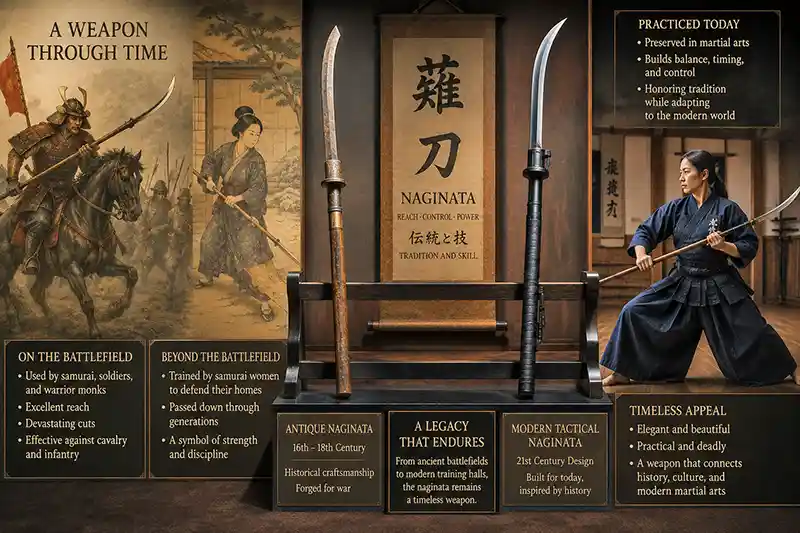
Few weapons balance beauty and battlefield purpose as naturally as the naginata. Its long shaft creates clean, sweeping lines, while the curved blade gives it the unmistakable profile of a Japanese sword. Even people who know little about its history can immediately sense that it was designed for controlled movement rather than clumsy force.
That elegance was never merely decorative. Every part of the weapon served a practical purpose. Its length kept enemies at a distance, its blade delivered powerful cuts, and its shaft could block, redirect, or strike when an opponent moved too close. The same qualities that make the naginata visually impressive also explain why it earned a place among history's most famous combat weapons.
Collectors are also drawn to the naginata because it represents several different chapters of Japanese history at once. It recalls the mounted warriors of early battlefields, the feared armies of warrior monks, the women of samurai households who trained to defend their homes, and the modern practitioners who continue preserving its techniques today.
Contemporary versions have carried that appeal into entirely new designs. A weapon such as the Dark Tactical Naginata replaces traditional fittings with a more modern appearance, yet the defining idea remains unchanged: a curved blade mounted on a long handle to combine reach, control, and cutting power.
The katana may remain Japan's most recognizable weapon, but the naginata tells a broader story. It was carried by monks, samurai, soldiers, and women defending their families. It rose and declined as warfare changed, then survived through martial arts rather than disappearing into museums. That remarkable journey is why the naginata is remembered not only as one of Japan's most effective battlefield weapons, but also as one of its most elegant.
No. The naginata had already been used by samurai, infantry, and warrior monks for centuries before it became strongly associated with women of the warrior class. Its long reach and powerful cutting ability made it a serious battlefield weapon, especially against mounted opponents and swordsmen.
During the Edo period, women from samurai families increasingly trained with the naginata for household defense, discipline, and martial education. That later tradition became so prominent that many people now think of it primarily as a women's weapon. Historically, however, the naginata belonged to a much broader range of Japanese warriors.
Not immediately. The naginata and the katana served different purposes, so one did not simply replace the other overnight. The naginata remained valuable on battlefields where its reach gave warriors an advantage against cavalry and infantry, while the katana excelled in close combat and became the everyday sidearm of the samurai.
As Japan entered a long period of peace during the Edo period, battlefield weapons became less important, and the katana gradually emerged as the defining symbol of the samurai class. Even then, the naginata continued to be practiced in martial traditions and remained an important weapon for training, ceremony, and household defense rather than disappearing entirely.
The naginata was considered one of Japan's more demanding weapons because it required much more than strength. A skilled user had to maintain the correct distance, control the long shaft with precision, and transition smoothly between sweeping cuts, thrusts, and defensive movements. A single mistake in timing or footwork could leave the wielder vulnerable to an opponent who managed to close the gap.
That challenge was also one of the weapon's greatest strengths. In the hands of a well-trained warrior, the naginata could keep enemies at a distance, counter cavalry, and control large areas of the battlefield with remarkable efficiency. Its combination of reach, versatility, and technical skill is one reason it continues to be practiced in martial arts today.
Not directly. The naginata did not evolve into a modern military weapon the way the sword eventually gave way to firearms and bayonets. Instead, it survived through traditional martial arts, where its techniques and philosophy have been carefully preserved for generations.
Its influence can still be seen in the way modern martial artists think about distance, timing, and leverage. The basic principles that made the naginata effective on medieval battlefields remain valuable in training today. While modern versions often feature updated materials or tactical styling, the classic combination of a long shaft and curved blade continues to make the naginata one of Japan's most recognizable and enduring historical weapons.
There wasn't a single "best" weapon in feudal Japan because every weapon was designed for a different purpose. On an open battlefield, the naginata often had the advantage thanks to its superior reach and ability to keep swordsmen at a distance. Against cavalry or multiple opponents, it could be far more effective than a sword in the hands of a skilled warrior.
Once the fight moved into tight spaces or an opponent managed to get inside the naginata's reach, however, the balance shifted. The katana was quicker to maneuver at close range and better suited to confined environments. Rather than competing with one another, the naginata and sword complemented each other, with each excelling in the situations it was designed to handle.
Not as much as many people think. While the naginata is a long weapon, effective use depends far more on technique than raw strength. Skilled practitioners generate power through body movement, leverage, and proper footwork rather than relying solely on their arms. The weapon's length actually helps create momentum, allowing controlled, powerful cuts without excessive effort.
This is one reason the naginata proved effective for such a wide range of warriors throughout Japanese history. Samurai, warrior monks, and women of the warrior class all trained with it because success came from timing, balance, and precision. A well-trained fighter with good technique could often outperform someone who relied on strength alone.
Not exclusively, but it excelled against mounted warriors. Its long reach allowed a foot soldier to strike at a horse's legs, threaten the rider before the horse closed the distance, or force cavalry to change direction. Even when it wasn't used to injure a horse directly, the naginata could disrupt a charge and rob mounted samurai of one of their greatest advantages.
The curved blade made the naginata far better at slicing through a target during a sweeping motion. Unlike a straight spear, which focuses on thrusting, the naginata could deliver powerful cuts while still maintaining the reach of a pole weapon. That combination of slashing ability and distance is one reason it remained effective on Japanese battlefields for centuries.
Yes. While later battlefield tactics favored the yari and firearms, the naginata demonstrated the effectiveness of combining reach with a cutting blade. Its influence can be seen in later polearms and in the martial arts that continued to preserve its techniques. Even today, it remains one of the most recognizable examples of Japanese weapon design.
Not easily. Samurai armor was designed to resist cuts from bladed weapons, including the naginata. Instead of slicing through armor, skilled warriors targeted exposed areas such as the arms, legs, neck, or joints. The weapon's long reach also allowed users to control distance and create openings that were often more important than trying to cut through armor itself.
In this article, we'll explore how the naginata earned its legendary reputation, why it dominated battlefields for centuries, and how one of Japan's most graceful weapons became one of its most respected.
Why the Naginata Was Unlike Any Other Samurai Weapon
At first glance, the naginata looks like a sword attached to the end of a long pole. While that description isn't entirely wrong, it doesn't come close to explaining why the weapon became one of the most feared sights on medieval Japanese battlefields. By combining the cutting power of a curved blade with the reach of a spear, the naginata offered advantages that few other weapons could match.
Its long shaft allowed warriors to keep opponents at a safe distance while delivering wide, sweeping cuts capable of striking multiple attackers or unseating mounted cavalry. Unlike a spear, which primarily relied on thrusting attacks, the naginata could slash, hook, and redirect with remarkable fluidity. That versatility made it effective against both lightly armored soldiers and heavily equipped samurai.
Another advantage was its ability to control space. A skilled naginata user could force enemies to stay beyond sword range while constantly threatening them with long-reaching attacks. This made advancing against a trained wielder extremely dangerous. In many situations, an opponent carrying a samurai sword had to survive the naginata's reach before getting close enough to strike.
Although many people think of the katana as the defining weapon of the samurai, the naginata filled an entirely different role. It excelled in open combat where mobility, distance, and battlefield awareness mattered just as much as individual swordsmanship. That unique combination of elegance and effectiveness is why historians continue to rank it among Japan's most influential weapons.
Why Reach Beat the Sword on the Battlefield
On an open battlefield, the first warrior to land a clean strike often had the advantage. That made reach incredibly valuable, and the naginata gave its user far more distance than a sword ever could. Before a swordsman could close the gap, the naginata wielder could slash at the legs, target the arms, or force the opponent to retreat.
That extra reach also made the naginata effective against cavalry. A mounted warrior had speed, height, and momentum, but the long blade gave infantry a chance to attack the horse, hook at the rider, or disrupt the charge before it reached them. In the hands of a disciplined fighter, the naginata could turn a mounted advantage into a dangerous vulnerability.
The weapon's sweeping attacks were especially useful when formations broke apart and fighting became chaotic. A katana worked best at close range, where the swordsman could control the angle and timing of each cut. The naginata controlled a much larger area. Its wielder could threaten several directions at once, making it difficult for enemies to rush in without exposing themselves.
This did not make the sword useless. Once an opponent got past the blade and moved inside the naginata's ideal range, the longer weapon became harder to maneuver. Skilled warriors trained to adjust their grip, shorten their movements, and use the shaft defensively, but distance remained the weapon's greatest advantage. Lose that distance, and the balance of the fight could change quickly.
That is why battlefield weapons should not be judged by fame alone. The katana became the enduring symbol of the samurai, but weapons like the naginata often offered more practical advantages in large-scale combat. Its ability to strike first, control space, and challenge mounted enemies made it one of Japan's most effective answers to the realities of war.
The Warrior Monks Who Perfected the Naginata
Long before the naginata became closely associated with female warriors, it had already earned a fearsome reputation in the hands of Japan's warrior monks. Known as s??hei, these armed religious fighters protected powerful temples, defended land, and took part in political conflicts that could erupt into open warfare. Their appearance on the battlefield was often enough to signal that a dispute had moved far beyond peaceful negotiation.
The naginata suited them exceptionally well. Many warrior monks fought on foot, where the weapon's reach allowed them to challenge mounted samurai and keep swordsmen outside striking distance. Its curved blade could slash through exposed limbs, hook around defenses, and deliver sweeping attacks that were difficult to avoid in crowded combat.
Temple forces were not made up entirely of ordained monks, and later stories sometimes exaggerated how uniformly they fought. Even so, the connection between warrior monks and the naginata became deeply rooted in Japanese history and legend. Famous figures such as Benkei are often depicted carrying one, reinforcing the image of the towering monk armed with a formidable pole weapon.
What made the naginata especially valuable was that it rewarded disciplined movement. A fighter had to manage the long shaft, maintain proper distance, and recover quickly after every swing. Poor technique could leave the weapon exposed or allow an enemy to rush inside its reach. In trained hands, however, the same length that made it difficult to master became its greatest advantage.
The warrior monks helped establish the naginata as more than an unusual variation of the spear. Their battlefield reputation showed that its graceful curves concealed a weapon capable of controlling space, disrupting cavalry, and punishing anyone who tried to approach carelessly. That reputation would survive long after the great temple armies themselves had faded from power.
Why Women Became Masters of the Naginata
One of the most fascinating chapters in the naginata's history is its strong association with women of Japan's warrior class. This connection did not begin because the weapon was considered delicate or ceremonial. It developed because the naginata offered a practical advantage to anyone defending a home, estate, or castle against a stronger attacker.
Its long reach allowed a trained woman to keep an opponent beyond grappling or sword range. The sweeping blade could threaten the legs, arms, and body while the shaft provided leverage for blocks and counters. In a confined entrance or narrow passageway, one skilled defender could make it extremely dangerous for several attackers to advance at once.
Women from samurai families were sometimes expected to protect their households when male relatives were away at war. Training with the naginata gave them a weapon suited to that responsibility. Historical figures such as Tomoe Gozen later became symbols of female martial courage, although the details of their lives are often difficult to separate from legend.
During the peaceful Edo period, the naginata gradually became an important part of martial education for women in the warrior class. It could represent discipline, readiness, and family honor, and some were included among a bride's possessions when she married. This later cultural role strengthened the idea that the naginata was primarily a women's weapon, even though men had carried it in warfare for centuries.
That distinction matters. The naginata was not made for women, nor was it pushed aside because men considered it less effective. Its long battlefield history came first. Women became closely associated with it because they recognized the same qualities that had made it valuable to samurai and warrior monks: reach, control, versatility, and the ability to stop an enemy before he came close enough to strike.
How the Naginata Shaped Japanese Warfare
The naginata was most valuable during periods when battles were fought across open ground and cavalry still played a major role. Its long reach allowed infantry to threaten mounted warriors before they came within sword range, while the curved blade could slash at horses, riders, and exposed limbs. For armies facing fast-moving cavalry, that ability made the naginata far more than a ceremonial weapon.
Its design also encouraged warriors to think in terms of space rather than single strikes. A swordsman controlled the area immediately around his body. A naginata wielder could dominate a much wider circle, forcing opponents to hesitate before advancing. When several trained fighters stood together, their overlapping reach could create a dangerous barrier that was difficult to penetrate.
The weapon was not perfect for every battlefield. Dense formations, narrow passages, and close fighting could limit its sweeping movements. As military organization changed, straight spears became increasingly important because they were easier to use in large formations and could be produced more efficiently. Firearms eventually changed warfare even further, reducing the importance of many traditional close-combat weapons.
Still, the naginata never disappeared completely. Its influence survived because it had already proven how effective a long cutting weapon could be against swordsmen and cavalry. Other oversized Japanese weapons, including the odachi, also tried to combine reach with devastating cutting power, but few matched the naginata's balance of distance, control, and maneuverability.
The naginata helped define an era when the battlefield belonged to more than swords alone. Its success reminds us that Japanese warfare was shaped by practical decisions about range, formation, terrain, and mobility. The most famous weapon was not always the one that gave a warrior the greatest chance of surviving.
Why the Sword Eventually Took Center Stage
If the naginata was so effective, why did it gradually disappear from the battlefield? The answer wasn't because it failed in combat. Warfare itself changed. As armies became larger and more organized during the late medieval period, commanders increasingly favored weapons that were easier to mass-produce, easier to train with, and better suited to fighting in tight formations.
Long spears, particularly the yari, began replacing the naginata in many military units. While the naginata excelled in the hands of an experienced warrior, the yari allowed large groups of soldiers to present a unified wall of spear points that could stop cavalry and enemy infantry with remarkable efficiency. As tactics evolved, simplicity often proved more valuable than versatility.
At the same time, firearms introduced another dramatic shift. Once arquebuses appeared on Japanese battlefields, many traditional polearms lost some of the advantages they had enjoyed for centuries. Battles increasingly depended on disciplined formations, coordinated volleys, and logistics rather than individual weapon mastery alone.
Ironically, the katana became more famous during the long peace that followed Japan's great civil wars. With fewer battlefield campaigns, the sword evolved into the everyday weapon of the samurai and eventually became the defining symbol of the warrior class. That transformation has led many people to assume it was always the samurai's primary battlefield weapon, but history tells a far more complicated story. If you've ever wondered how the katana compares to the broader category of samurai blades, our guide to the samurai sword vs. katana explains the differences.
The naginata never truly vanished. Instead, it transitioned from a battlefield weapon to one preserved through martial arts, tradition, and history. While the sword captured the world's imagination, the naginata quietly remained one of the weapons that helped shape Japan's military past.
The Naginata's Survival in Modern Martial Arts
The naginata might have faded from the battlefield, but it never disappeared from Japanese culture. Instead, it evolved into a disciplined martial art that preserved the weapon's techniques while adapting them for structured practice. Modern naginata training focuses less on warfare and more on timing, distance, posture, and control.
In contemporary practice, students use safer training weapons and protective equipment while learning how to strike, defend, advance, and retreat with precision. The long shaft still demands careful movement. A small mistake in grip or footwork can throw off the entire technique, which makes naginata training especially effective for developing balance and coordination.
The art also preserves one of the weapon's greatest historical strengths: control of distance. Practitioners learn how to maintain the ideal range, threaten an opponent without overcommitting, and recognize the moment when a long weapon becomes vulnerable at close quarters. Those lessons connect modern training directly to the realities that once made the naginata so effective in battle.
Although traditional forms remain central, the naginata has also inspired modern interpretations. Contemporary designs such as the Modern Combat Naginata show how the weapon's distinctive silhouette and long-reaching concept continue to influence martial arts equipment today. The appearance may change, but the appeal of combining reach with a curved blade remains remarkably strong.
For beginners, padded equipment can provide a safer introduction to distance and weapon handling before moving into more advanced practice. Training tools such as foam practice swords can also help students explore basic movement and partner drills with less risk while they develop control and confidence.
The naginata survives because it offers more than historical curiosity. It challenges the body and mind at the same time, rewarding discipline over aggression and precision over force. That makes it just as meaningful in a modern dojo as it once was on the battlefield.
Why the Naginata Is Still Admired Around the World
Few weapons balance beauty and battlefield purpose as naturally as the naginata. Its long shaft creates clean, sweeping lines, while the curved blade gives it the unmistakable profile of a Japanese sword. Even people who know little about its history can immediately sense that it was designed for controlled movement rather than clumsy force.
That elegance was never merely decorative. Every part of the weapon served a practical purpose. Its length kept enemies at a distance, its blade delivered powerful cuts, and its shaft could block, redirect, or strike when an opponent moved too close. The same qualities that make the naginata visually impressive also explain why it earned a place among history's most famous combat weapons.
Collectors are also drawn to the naginata because it represents several different chapters of Japanese history at once. It recalls the mounted warriors of early battlefields, the feared armies of warrior monks, the women of samurai households who trained to defend their homes, and the modern practitioners who continue preserving its techniques today.
Contemporary versions have carried that appeal into entirely new designs. A weapon such as the Dark Tactical Naginata replaces traditional fittings with a more modern appearance, yet the defining idea remains unchanged: a curved blade mounted on a long handle to combine reach, control, and cutting power.
The katana may remain Japan's most recognizable weapon, but the naginata tells a broader story. It was carried by monks, samurai, soldiers, and women defending their families. It rose and declined as warfare changed, then survived through martial arts rather than disappearing into museums. That remarkable journey is why the naginata is remembered not only as one of Japan's most effective battlefield weapons, but also as one of its most elegant.
Was the naginata only used by women?
No. The naginata had already been used by samurai, infantry, and warrior monks for centuries before it became strongly associated with women of the warrior class. Its long reach and powerful cutting ability made it a serious battlefield weapon, especially against mounted opponents and swordsmen.
During the Edo period, women from samurai families increasingly trained with the naginata for household defense, discipline, and martial education. That later tradition became so prominent that many people now think of it primarily as a women's weapon. Historically, however, the naginata belonged to a much broader range of Japanese warriors.
Did samurai stop using the naginata after the katana became popular?
Not immediately. The naginata and the katana served different purposes, so one did not simply replace the other overnight. The naginata remained valuable on battlefields where its reach gave warriors an advantage against cavalry and infantry, while the katana excelled in close combat and became the everyday sidearm of the samurai.
As Japan entered a long period of peace during the Edo period, battlefield weapons became less important, and the katana gradually emerged as the defining symbol of the samurai class. Even then, the naginata continued to be practiced in martial traditions and remained an important weapon for training, ceremony, and household defense rather than disappearing entirely.
How difficult was the naginata to master?
The naginata was considered one of Japan's more demanding weapons because it required much more than strength. A skilled user had to maintain the correct distance, control the long shaft with precision, and transition smoothly between sweeping cuts, thrusts, and defensive movements. A single mistake in timing or footwork could leave the wielder vulnerable to an opponent who managed to close the gap.
That challenge was also one of the weapon's greatest strengths. In the hands of a well-trained warrior, the naginata could keep enemies at a distance, counter cavalry, and control large areas of the battlefield with remarkable efficiency. Its combination of reach, versatility, and technical skill is one reason it continues to be practiced in martial arts today.
Did the naginata evolve into any modern weapons?
Not directly. The naginata did not evolve into a modern military weapon the way the sword eventually gave way to firearms and bayonets. Instead, it survived through traditional martial arts, where its techniques and philosophy have been carefully preserved for generations.
Its influence can still be seen in the way modern martial artists think about distance, timing, and leverage. The basic principles that made the naginata effective on medieval battlefields remain valuable in training today. While modern versions often feature updated materials or tactical styling, the classic combination of a long shaft and curved blade continues to make the naginata one of Japan's most recognizable and enduring historical weapons.
Was the naginata better than a sword?
There wasn't a single "best" weapon in feudal Japan because every weapon was designed for a different purpose. On an open battlefield, the naginata often had the advantage thanks to its superior reach and ability to keep swordsmen at a distance. Against cavalry or multiple opponents, it could be far more effective than a sword in the hands of a skilled warrior.
Once the fight moved into tight spaces or an opponent managed to get inside the naginata's reach, however, the balance shifted. The katana was quicker to maneuver at close range and better suited to confined environments. Rather than competing with one another, the naginata and sword complemented each other, with each excelling in the situations it was designed to handle.
Did the naginata require exceptional physical strength to use?
Not as much as many people think. While the naginata is a long weapon, effective use depends far more on technique than raw strength. Skilled practitioners generate power through body movement, leverage, and proper footwork rather than relying solely on their arms. The weapon's length actually helps create momentum, allowing controlled, powerful cuts without excessive effort.
This is one reason the naginata proved effective for such a wide range of warriors throughout Japanese history. Samurai, warrior monks, and women of the warrior class all trained with it because success came from timing, balance, and precision. A well-trained fighter with good technique could often outperform someone who relied on strength alone.
Was the naginata really designed to fight horses?
Not exclusively, but it excelled against mounted warriors. Its long reach allowed a foot soldier to strike at a horse's legs, threaten the rider before the horse closed the distance, or force cavalry to change direction. Even when it wasn't used to injure a horse directly, the naginata could disrupt a charge and rob mounted samurai of one of their greatest advantages.
Why does the naginata have a curved blade instead of a straight one?
The curved blade made the naginata far better at slicing through a target during a sweeping motion. Unlike a straight spear, which focuses on thrusting, the naginata could deliver powerful cuts while still maintaining the reach of a pole weapon. That combination of slashing ability and distance is one reason it remained effective on Japanese battlefields for centuries.
Did the naginata influence other Japanese weapons?
Yes. While later battlefield tactics favored the yari and firearms, the naginata demonstrated the effectiveness of combining reach with a cutting blade. Its influence can be seen in later polearms and in the martial arts that continued to preserve its techniques. Even today, it remains one of the most recognizable examples of Japanese weapon design.
Could a naginata cut through samurai armor?
Not easily. Samurai armor was designed to resist cuts from bladed weapons, including the naginata. Instead of slicing through armor, skilled warriors targeted exposed areas such as the arms, legs, neck, or joints. The weapon's long reach also allowed users to control distance and create openings that were often more important than trying to cut through armor itself.
You May Also Be Interested In:
- Why the Yari Was the Weapon That Won Japan's Greatest Battles
- Secrets of the Kusarigama: The Rise of Japan's Legendary Chain Weapon
- Dark Tactical Naginata and Other Brutal Weapons!
- Ultimate Throwing Weapon Showdown! Which Weapon Is The BEST?
- 5 Deadly Sai Weapon Types
- Was the Seax Really a Viking Weapon?
- Which Weapon Would You Choose To Defend Yourself?
- Which Throwing Weapon Would You Choose?
- Which Weapon Would You Choose To Survive The Upside Down?
- Practical Self-Defense Weapon: Kubotan
Leave a Reply