


A Visual Guide to Japanese Swords: The Blades of the Samurai Era
September 1st, 2026
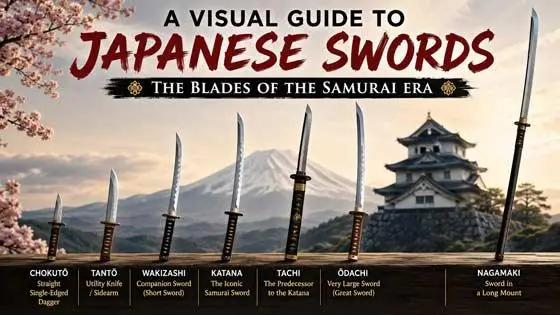
Japan's sword-making tradition produced far more than the katana most people recognize today. Across centuries of warfare and changing samurai culture, Japanese blades appeared in dramatically different lengths, proportions, mounting styles, and roles, from the compact tanto and companion-sized wakizashi to the sweeping tachi and enormous odachi. Some emerged centuries apart, some existed alongside one another, and several names that seem straightforward today become surprisingly complicated when examined historically. In this visual guide, we'll compare the major types of Japanese swords, look at when and why they appeared, and explore the details that made each blade distinct.
Before the Katana: How Japanese Swords Began
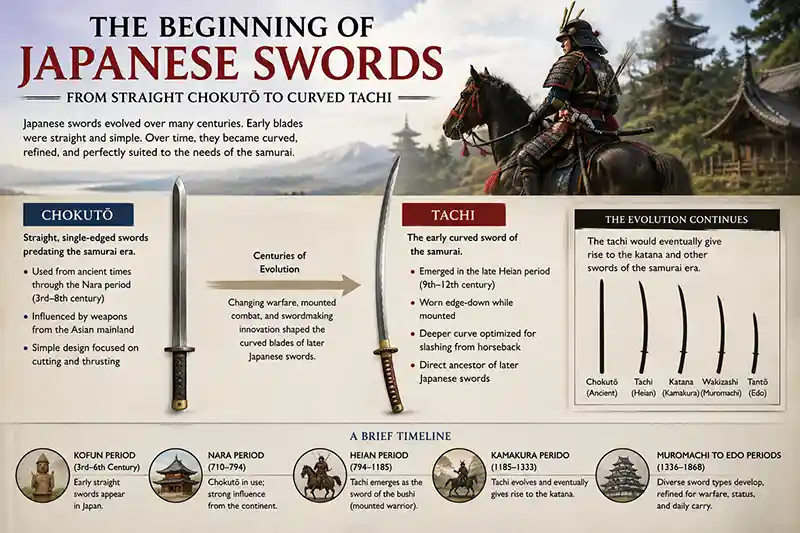
The story of the Japanese sword begins centuries before the curved katana became inseparable from the image of the samurai. Some of Japan's earliest surviving swords were straight, single-edged blades commonly grouped under the term chokuto. Produced during Japan's ancient Kofun and Nara periods, these weapons belonged to a very different world from the later samurai swords most people recognize today.
Early Japanese swordmaking did not develop in isolation. Sword designs and metalworking techniques reached Japan through centuries of interaction with the Asian mainland, particularly the Korean Peninsula and China. Many early blades therefore shared characteristics with continental weapons, including relatively straight profiles that look strikingly different from the deeply curved swords that would eventually define Japanese swordmaking.
The chokuto is especially important because it helps correct a common misconception about Japanese swords: they were not always curved. Straight Japanese blades existed long before the historical periods most closely associated with the samurai. This is also why ancient chokuto should not be confused with the familiar straight-bladed ninjato. As we discussed in our article about whether ninja really used straight swords, the existence of ancient straight Japanese swords does not prove that the standardized modern ninjato was carried by shinobi many centuries later.
Over time, Japanese sword design began changing. Curvature gradually became a defining feature of important sword traditions, particularly as mounted warriors became increasingly significant in warfare. By the late Heian period, the elegant curved tachi had emerged as a weapon closely associated with Japan's developing warrior class. Rather than appearing suddenly, the famous silhouette of the samurai sword was the result of centuries of experimentation, adaptation, and changing battlefield demands.
That transition from straight chokuto to curved tachi marks one of the most important turning points in the history of Japanese swords. The katana was still far in the future. Before it could become Japan's most famous blade, another sword would dominate the age of the mounted samurai and establish many of the characteristics we now associate with the Japanese sword.
The Tachi: The Sword of the Mounted Samurai
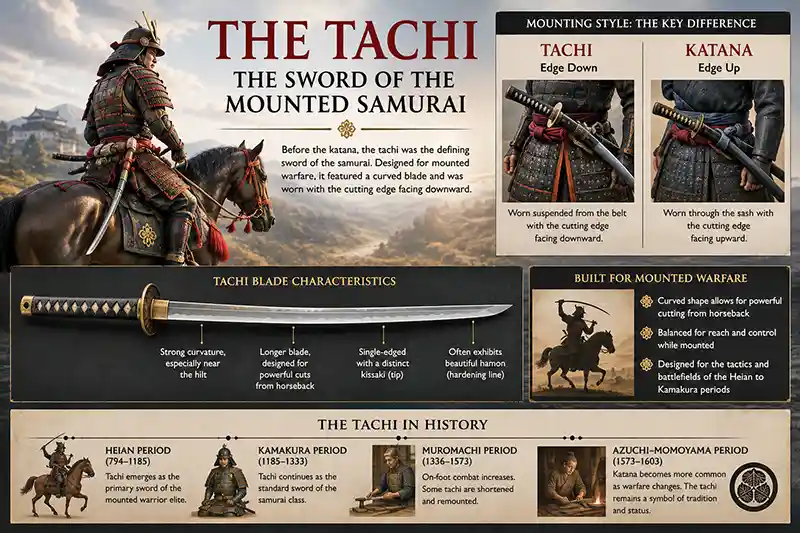
Long before the katana became the sword most closely associated with the samurai, the tachi occupied that position. Emerging as an important sword form during the late Heian period, the tachi was closely connected with Japan's mounted warrior elite and the style of warfare that developed around them. Its curved blade helped establish the unmistakable profile that would influence Japanese sword design for centuries.
One of the easiest ways to distinguish a traditionally mounted tachi from a katana is not necessarily the blade itself, but the way the sword was worn. The tachi was typically suspended from the warrior's belt with its cutting edge facing downward. Later katana mountings generally placed the sword through the sash with the cutting edge facing upward. This distinction became so important that similar blades could sometimes be classified according to how they were mounted rather than by blade shape alone.
Tachi blades also tended to exhibit characteristics associated with mounted use, including pronounced curvature in many surviving examples. That curvature was often strongest closer to the hilt, although Japanese swords varied enormously across different periods, schools, and individual smiths. There was never one universal tachi profile that every sword followed.
The relationship between the tachi and katana is consequently more complicated than simply describing them as two completely separate sword designs. As warfare changed and fighting on foot became increasingly important, preferences in sword construction and mounting changed as well. Some older tachi blades were even shortened and remounted in later styles. Our deeper look at what a tachi sword is explores the history and characteristics of this earlier samurai blade in greater detail.
For centuries, however, the tachi was among the defining swords of Japan's warrior class. If the straight chokuto represents an early chapter in Japanese sword development, the tachi represents the point at which the curved sword silhouette we now associate with the samurai unmistakably enters the story.
The Katana: How Japans Most Famous Sword Took Over
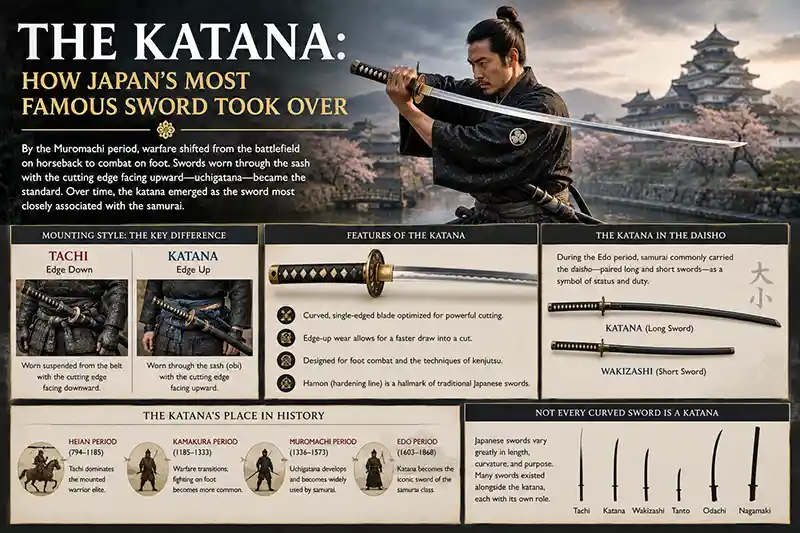
No Japanese sword is more recognizable today than the katana, but its dominance came relatively late in the history of the samurai. By the Muromachi period, changes in warfare had placed greater emphasis on fighting on foot, and swords worn thrust through the sash with the cutting edge facing upward became increasingly common. This style of sword was known as the uchigatana, and over time the katana emerged from this broader tradition as the sword now most strongly associated with the samurai.
At first glance, a katana can look remarkably similar to a tachi. Both are curved, single-edged Japanese swords, and surviving blades do not always fit neatly into modern attempts to separate the two by length or curvature alone. One of the clearest historical distinctions was how they were mounted and worn. While the tachi traditionally hung suspended with its edge downward, the katana was normally worn through the obi with its edge facing upward.
That change was more significant than it might seem. Wearing the sword edge-up made it practical to draw the blade and transition immediately into a cut, an approach that became closely associated with later Japanese swordsmanship. It also reflected a world in which the samurai increasingly fought and moved on foot rather than functioning primarily as mounted warriors.
The katana eventually became part of the daisho, the paired long and short swords associated with the samurai class during the Edo period. The longer sword was commonly paired with a wakizashi, creating one of the most recognizable symbols of samurai status. Yet the katana was never the only sword carried by Japanese warriors, nor was every curved Japanese sword automatically a katana. Our comparison of the samurai sword and katana looks more closely at why those terms should not always be treated as interchangeable.
Its worldwide fame can make the katana seem like the beginning of Japanese sword history, when it was actually the product of a much longer evolution. Straight swords had come before it. The tachi had already served generations of warriors. Other blades would continue alongside it. The katana became the icon, but it was only one branch of a much larger Japanese sword tradition.
The Wakizashi: The Katana's Shorter Companion
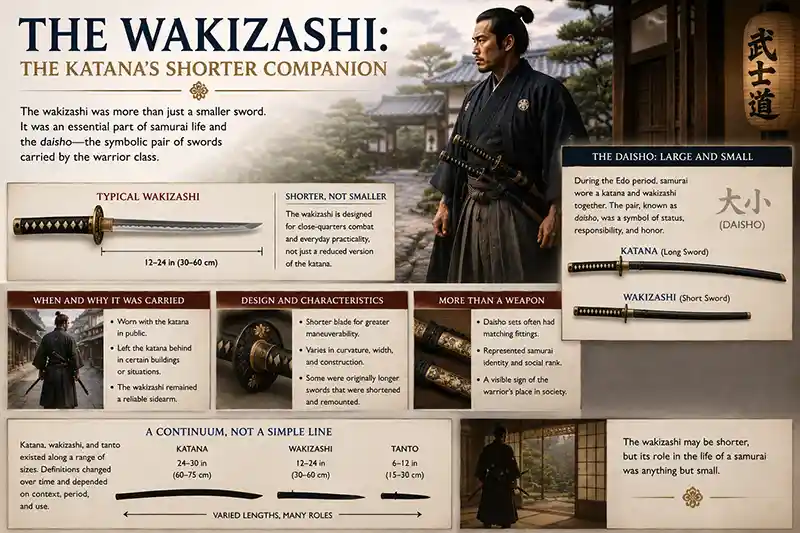
The wakizashi is often described simply as a shorter katana, but its place in samurai culture was much more significant than its size suggests. With a blade generally shorter than the long sword carried beside it, the wakizashi developed into an important weapon in its own right and eventually became the second half of the famous daisho, the paired swords that came to symbolize the samurai class.
During the Edo period, a samurai commonly wore a katana together with a wakizashi when appearing in public. The longer katana served as the primary sword, while the shorter wakizashi remained available in situations where carrying or drawing a full-length sword would have been inconvenient. When entering certain residences or buildings, a samurai might be expected to leave the katana behind while retaining the shorter sword.
Although wakizashi blades often resemble scaled-down katana, the category was not defined by one perfectly standardized design. Surviving examples vary in curvature, proportions, mounting, and construction, and some older blades were shortened and remounted during their working lives. What most clearly separated the wakizashi from the katana was its shorter blade length and the role that size allowed it to occupy alongside the longer sword.
The pairing of the two became so culturally important that the term daisho literally reflects the relationship: "large-small." A matched set could share coordinated fittings and visual details, turning the pair into more than two practical weapons. Together they became a visible expression of samurai identity and social position. Our deeper guide to what a wakizashi is examines the history and characteristics of the shorter sword in greater detail.
The wakizashi also helps reveal why dividing Japanese swords into simple categories can be misleading. Katana, wakizashi, and tanto existed along a continuum of blade lengths, and historical terminology could depend on dimensions, period, mounting, and context. The differences were real, but Japanese swordmaking was never governed by the perfectly tidy classifications that a modern comparison chart might suggest.
The Tanto: The Smallest Blade in the Samurai Arsenal
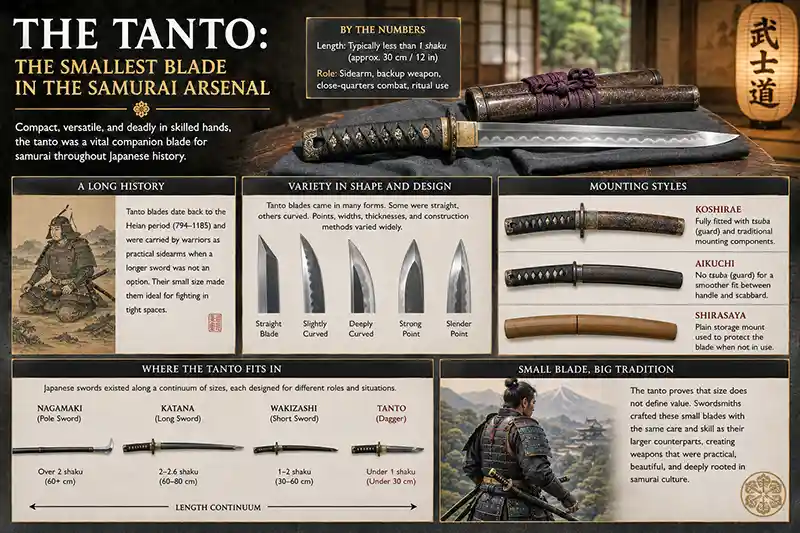
At the shorter end of the Japanese sword spectrum was the tanto, a compact blade that often resembled a large knife but belonged firmly within the tradition of Japanese swordmaking. Tanto blades were generally less than one shaku, roughly 30 centimeters or 12 inches, in length, although historical examples varied considerably. Their small size made them fundamentally different from the long swords we have examined so far, but they were no less carefully constructed.
The tanto appeared centuries before the katana became dominant, with important examples dating to the Heian and Kamakura periods. Early tanto were carried by members of the warrior class and could serve as practical sidearms when a longer sword was unavailable or unsuitable. Their compact dimensions also made them far easier to use in confined spaces than weapons such as the tachi.
Unlike the familiar curved profile of many Japanese swords, tanto blades could take an extraordinary variety of forms. Some were nearly straight, while others displayed noticeable curvature. Blade cross-sections, point geometry, width, thickness, and construction also varied. Certain examples were built with especially robust points, while others were considerably more refined and slender. The word tanto therefore describes a broad class of short Japanese blades rather than one standardized shape.
Tanto were also produced in different mounting styles. A fully fitted koshirae could include a guard and the familiar components associated with Japanese sword mountings, while the understated aikuchi style omitted a prominent guard and created a smoother transition between handle and scabbard. Some surviving tanto are now preserved in plain shirasaya storage mountings designed primarily to protect the blade rather than serve as combat fittings.
The tanto is particularly useful for understanding just how diverse Japanese swordmaking became. Shrinking the blade did not simply produce a miniature katana. Swordsmiths adapted proportions, points, curvature, construction, and mountings to create short blades with identities of their own. From enormous battlefield swords to blades barely a foot long, the Japanese sword tradition covered a far wider range than its most famous weapon suggests.
The Odachi: The Giant Sword of Medieval Japan
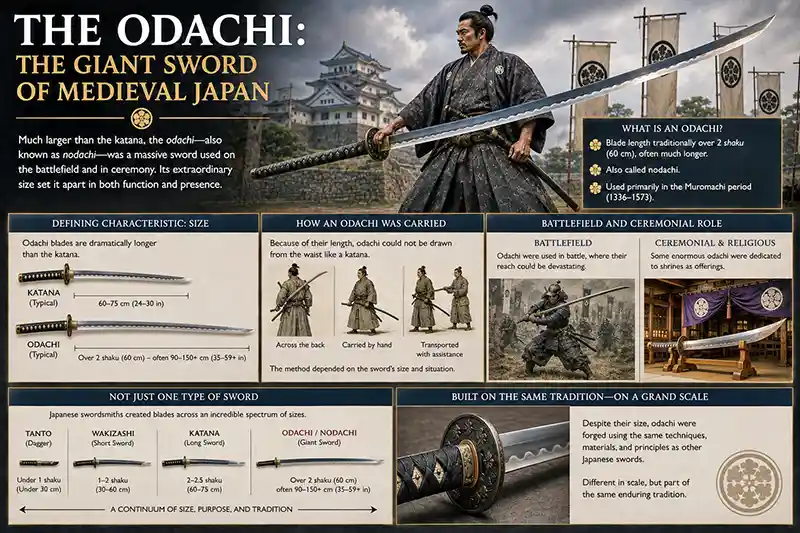
If the tanto represents one extreme of Japanese sword design, the odachi sits near the opposite end. Also commonly called nodachi, the odachi was an exceptionally large Japanese sword whose blade could extend far beyond the dimensions of an ordinary katana. Historical terminology was not always perfectly consistent, but these names are generally associated with oversized swords that immediately stood apart from the more familiar weapons carried at a samurai's waist.
Size was the defining characteristic. An odachi traditionally had a blade longer than two shaku, roughly 60 centimeters, although many examples greatly exceeded that threshold. Some surviving swords are enormous even by two-handed sword standards, demonstrating just how far Japanese swordsmiths were willing to push the proportions of a conventional curved blade.
Those dimensions created obvious practical problems. An especially long odachi could not be drawn from the waist in the same manner as a katana. Historical accounts and artwork suggest that large swords could be carried in different ways depending on their dimensions and circumstances, including across the back, carried by hand, or transported with assistance. Exactly how any particular odachi was used therefore depended heavily on its actual size rather than simply the name applied to it.
Odachi are generally associated with battlefield use, particularly during Japan's medieval period, but their enormous dimensions could also give them ceremonial and religious significance. Some exceptionally large examples were dedicated to shrines as offerings rather than created as practical battlefield weapons. This makes surviving odachi especially interesting because sheer size alone does not tell us why an individual sword was made.
The weapon also demonstrates why the popular image of every samurai carrying essentially the same sword is so misleading. Japanese swordsmiths produced blades ranging from compact tanto to extraordinary oversized swords. Our deeper article on what an odachi is explores these enormous blades and their history in greater detail.
Placed beside a katana, the odachi can look almost exaggerated. Yet it belongs to the same broad swordmaking tradition, using familiar Japanese construction principles on a dramatically different scale. Few weapons make the diversity of Japanese swords more immediately obvious.
The Nagamaki: When the Sword Handle Became Almost as Long as the Blade
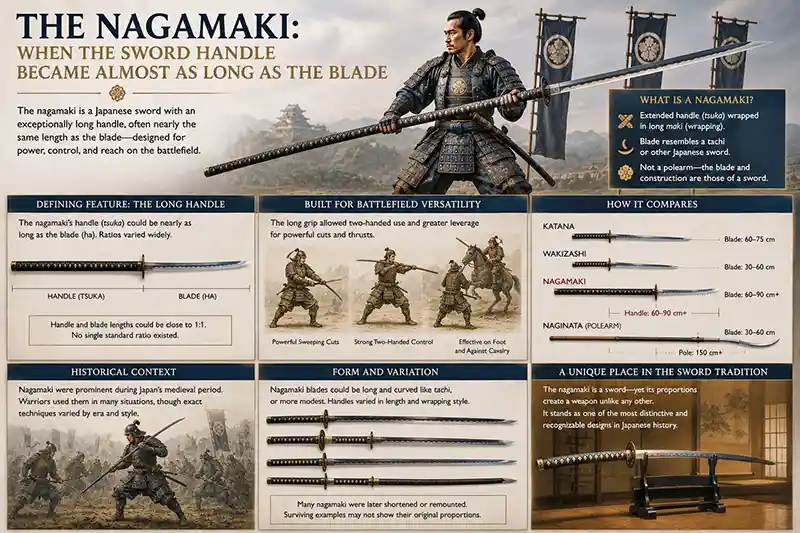
The nagamaki is one of the most visually unusual Japanese swords because its proportions seem to blur the boundary between a conventional sword and a pole-mounted weapon. Its defining feature was an exceptionally long handle, often approaching the length of the blade itself. The name reflects this construction, referring to the long wrapping traditionally applied around the extended grip.
Unlike a naginata, which places a blade at the end of a long pole, the nagamaki retained the basic construction and appearance of a sword. Its blade could resemble an enlarged tachi or other curved Japanese sword, while the dramatically extended handle gave the wielder considerably more space for two-handed control. There was substantial variation among surviving examples, so there was never one universal ratio between blade and handle length.
Nagamaki became particularly associated with Japan's medieval battlefield traditions. The long grip could provide leverage and control over a substantial blade, creating a weapon capable of powerful sweeping cuts. Historical references also connect nagamaki with warriors fighting both mounted and on foot, although reconstructing exactly how these weapons were handled in every period is difficult because surviving descriptions, artwork, and physical examples do not provide a single standardized fighting system.
The nagamaki also demonstrates how easily modern categories can become misleading when applied to historical Japanese weapons. Its proportions invite comparisons with polearms, yet it was constructed and classified within the broader tradition of Japanese swords. Some nagamaki blades were even shortened or remounted in later centuries, meaning a surviving blade may no longer retain the unusually long handle that originally defined the weapon.
Placed beside a katana, wakizashi, or tanto, the nagamaki looks almost like someone stretched the proportions of the sword in both directions. Yet its unusual design was not simply about making a larger weapon. By changing the relationship between blade and handle, Japanese swordmakers created a distinctly different approach to controlling a long cutting blade, and one of the most unmistakable silhouettes in the entire Japanese sword tradition.
The Nodachi: Is It Really Different From an Odachi?
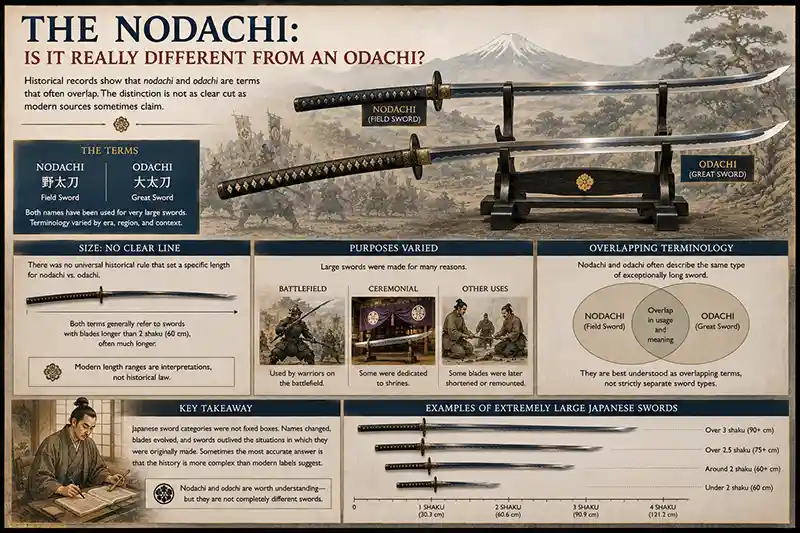
Few Japanese sword terms create as much confusion as nodachi and odachi. Modern books, websites, games, and sword sellers often present them as two distinct weapons, sometimes assigning each a different size or battlefield role. Historically, the distinction is much less clear. In many contexts, both terms have been used for exceptionally large Japanese swords, and attempting to draw a rigid line between them can create more certainty than the historical evidence supports.
The word odachi essentially means "great sword" or "large sword," while nodachi is commonly interpreted as "field sword." That difference in wording has encouraged the idea that nodachi must refer specifically to a battlefield version while odachi describes some other category. In practice, however, historical terminology varied by period and context, and the terms can overlap considerably.
This is why dimensions alone cannot reliably separate the two. You may encounter modern explanations claiming that a nodachi falls within one particular length range while an odachi begins at another, but there was no universal historical classification system using those precise modern boundaries. Both names can describe long Japanese swords whose blades extended beyond the dimensions normally associated with katana and other standard long swords.
There were certainly enormous swords made for different purposes. Some were practical battlefield weapons, while exceptionally large examples could be ceremonial objects or offerings dedicated to shrines. Individual blades also varied dramatically in length, curvature, mounting, and intended use. Those differences are more meaningful than assuming the words nodachi and odachi always represented two neatly separated sword designs.
For a visual guide like this, the most historically responsible approach is therefore to treat nodachi and odachi as closely overlapping terminology rather than pretending they represent completely separate branches of Japanese sword development. The names are worth understanding, but adding a second sword to our comparison chart as though a nodachi had one standardized shape and an odachi another would make the history look much tidier than it really was.
This ambiguity reveals something important about Japanese swords as a whole. The categories we use today are helpful for understanding them, but historical weapons were not created to fit twenty-first-century comparison charts. Names changed, blades were shortened and remounted, terminology overlapped, and swords could outlive the circumstances in which they were originally made. Sometimes understanding a sword means accepting that the most accurate answer is not a perfectly clean one.
The Uchigatana: The Sword That Bridged the Tachi and Katana
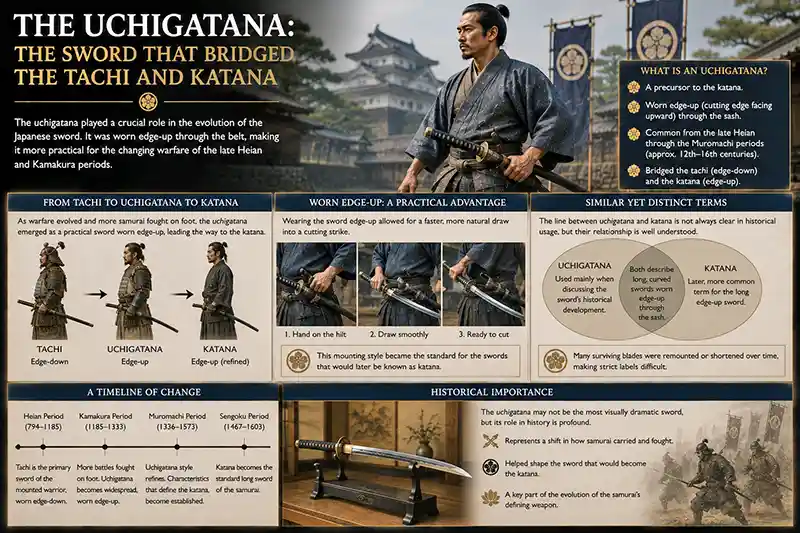
Between the age of the tachi and the rise of the katana sits one of the most important names in Japanese sword history: the uchigatana. Today the term is far less famous than katana, yet the uchigatana helps explain how the long sword of the mounted samurai gradually developed into the edge-up sword associated with later warriors. Rather than representing a completely separate branch of sword design, it belongs near the center of that transition.
Early uchigatana were generally more practical and less prestigious than the elaborate tachi carried by high-ranking mounted warriors. They became increasingly important as Japanese warfare changed and large numbers of warriors fought on foot. Most significantly, the uchigatana was worn thrust through the belt with its cutting edge facing upward, reversing the traditional edge-down suspension associated with the tachi.
That mounting style affected how the sword could be handled. With the edge already facing upward, the blade could be drawn in a manner that flowed naturally into a cutting motion. As edge-up swords became increasingly common, the visual and functional characteristics associated with the later katana became more firmly established.
The terminology becomes complicated because uchigatana and katana are not always cleanly separated in historical usage. Over time, katana became the more familiar term for the long, curved sword worn edge-up through the sash, while uchigatana is especially useful when discussing the weapon's development and its relationship to earlier tachi. Trying to assign every surviving blade exclusively to one category can oversimplify a history in which blades were remounted, shortened, and used across generations.
This makes the uchigatana less visually dramatic than the enormous odachi or unusually proportioned nagamaki, but historically it may be even more important. It represents a change in how Japanese warriors carried their swords, how they fought, and ultimately how the archetypal samurai sword came to look. The katana did not simply replace the tachi overnight. The uchigatana helps us see the long transition that occurred between them.
Japanese Swords Compared: How the Major Types Differed
Seen individually, the differences between Japanese swords can seem subtle. Placed side by side, however, the extraordinary range of the tradition becomes much easier to understand. Some names describe swords separated primarily by length, others are strongly associated with particular mounting styles or historical periods, and a few overlap so much that forcing them into completely separate categories can be misleading.
The comparison below is therefore best treated as a reference rather than a rigid classification system. Historical blades varied considerably, measurements were not perfectly standardized across every period, and swords were sometimes shortened or remounted long after they were originally forged.
| Sword Type | General Size | Defining Characteristic | Historical Association | Traditional Carry or Mounting |
|---|---|---|---|---|
| Chokuto | Varied | Straight, usually single-edged early Japanese sword | Ancient Japan, particularly before curved swords became dominant | Varied by period and mounting |
| Tachi | Long sword | Curved blade strongly associated with earlier samurai sword traditions | Especially prominent among mounted warriors from the late Heian and Kamakura periods | Traditionally suspended edge-down |
| Uchigatana | Long sword | Important predecessor and developmental form of the later katana | Became increasingly important as fighting on foot grew more common | Worn edge-up through the belt |
| Katana | Long sword, commonly over 2 shaku | Curved, single-edged sword that became the most famous samurai blade | Especially associated with the later samurai era | Worn edge-up through the obi |
| Wakizashi | Generally 1 to 2 shaku | Short sword commonly paired with the katana | Closely associated with the Edo-period daisho | Worn through the obi |
| Tanto | Generally under 1 shaku | Compact Japanese blade produced in many different forms | Used across centuries of Japanese warrior history | Varied according to mounting and period |
| Odachi / Nodachi | Large to exceptionally large sword | Oversized Japanese sword with terminology that frequently overlaps | Associated with medieval battlefields as well as ceremonial and religious examples | Carrying method depended heavily on the sword's dimensions |
| Nagamaki | Long blade with unusually long handle | Extended wrapped grip sometimes approaching the blade in length | Associated particularly with medieval Japanese warfare | Held as a two-handed sword rather than mounted like a conventional katana |
What becomes especially clear from this comparison is that Japanese sword names do not all describe the same kind of difference. Katana, wakizashi, and tanto can be distinguished partly through blade length. Tachi and katana are strongly connected to differences in mounting and historical context. Nagamaki is immediately recognizable because of its proportions, while odachi and nodachi demonstrate how two historical terms can overlap rather than defining perfectly separate weapons.
That complexity is precisely what makes Japanese swords so interesting. There was no single progression in which one sword disappeared and another instantly replaced it. Different forms coexisted, changed, were remounted, and sometimes survived for centuries beyond the circumstances that originally produced them. The familiar katana was part of this much larger family rather than the template from which every Japanese sword was derived.
Why Were Japanese Swords Curved?
The curve of a Japanese sword is so visually distinctive that it can seem as though it must have been the starting point of the tradition. As the straight chokuto demonstrates, it was not. Curved Japanese blades emerged over time, and their development appears to have resulted from a combination of changing weapon design, methods of manufacture, and the requirements of the warriors who carried them.
One important factor was mounted combat. As the tachi became associated with Japan's mounted warrior class, a curved cutting blade was well suited to sweeping cuts delivered from horseback. The curvature helped create a blade whose geometry favored slicing as it moved through a target rather than relying entirely on a straight chopping motion. This does not mean Japanese swords were curved for one single battlefield technique, but mounted warfare formed an important part of the environment in which the classic curved tachi developed.
Manufacturing also played a role. Traditional Japanese swordsmiths could combine steels with different properties and use differential hardening, applying insulating clay in different thicknesses before heating and quenching the blade. During the complex transformations that occurred as the steel heated and cooled, the blade could change curvature. Swordsmiths learned to anticipate and control these effects as part of producing the finished sword.
The amount and location of curvature were never universal. Some swords display a pronounced curve closer to the hilt, a form often associated with earlier tachi, while others show curvature distributed more evenly along the blade. Still others are comparatively straight. Japanese sword specialists use these differences in sori, or curvature, as one of many clues when studying the period, school, and style of a blade.
Curvature also changed alongside the ways swords were carried and used. As mounted tachi gave way to edge-up swords increasingly associated with fighting on foot, sword proportions continued to evolve. There was no moment when Japanese swordmakers discovered one perfect curve and simply repeated it for the next several centuries.
The famous arc of the katana is therefore better understood as the result of a long evolution than as a mysterious secret of Japanese swordmaking. Curvature became one of the tradition's defining characteristics, but Japanese smiths continually adjusted where that curve appeared and how pronounced it was to suit the swords they were creating.
How Japanese Sword Lengths Were Traditionally Classified
Modern sword descriptions usually give blade length in inches or centimeters, but historical Japanese swords were measured using traditional Japanese units. The most important of these was the shaku, a unit roughly equivalent to 30.3 centimeters or 11.9 inches. When classifying swords, the relevant measurement was generally the nagasa, the length of the blade measured from the tip to the notch at the back of the blade where the tang begins, following a straight line rather than tracing the curve of the cutting edge.
These measurements help explain the familiar distinction between tanto, wakizashi, and katana. A blade with a nagasa under one shaku was generally classified as a tanto. Blades between one and two shaku fell into the shoto, or short-sword, range commonly associated with wakizashi. Blades exceeding two shaku belonged to the daito, or long-sword, range that includes katana and tachi.
| Traditional Classification | Blade Length | Approximate Modern Measurement | Common Examples |
|---|---|---|---|
| Tanto | Under 1 shaku | Under about 30.3 cm / 11.9 in | Tanto |
| Shoto | 1 to 2 shaku | About 30.3-60.6 cm / 11.9-23.9 in | Wakizashi |
| Daito | Over 2 shaku | Over about 60.6 cm / 23.9 in | Katana, tachi |
These boundaries are extremely useful, but they do not tell us everything about a sword's identity. A blade longer than two shaku does not automatically become a katana. A tachi can occupy the same general length category, and unusually large swords such as odachi extend far beyond the minimum dimensions of a daito. Mounting, period, construction, curvature, and historical context still matter.
The measurement system also reveals why katana, wakizashi, and tanto can sometimes feel more like points along a continuum than completely unrelated weapons. A blade just below two shaku and another just above it may be quite similar physically even though they fall on opposite sides of a traditional classification boundary. Japanese sword terminology gives us useful categories, but the swords themselves did not suddenly change shape when a measurement crossed a particular line.
Understanding the shaku system makes the enormous range of Japanese swords easier to visualize. From a tanto measuring less than a foot to an odachi with a blade several feet long, swordsmiths were working within a tradition that could scale the fundamental idea of the Japanese blade to dramatically different proportions.
How Japanese Sword Shapes Changed Across the Samurai Era
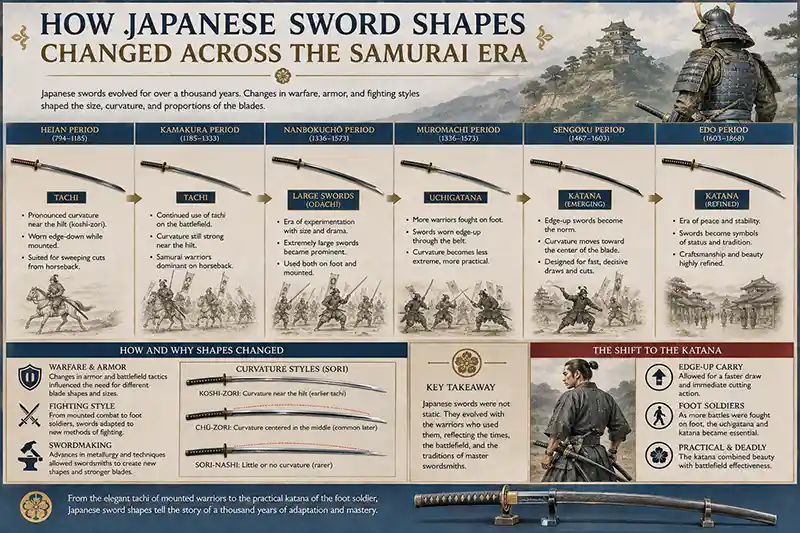
Japanese swords did not follow a simple path from one design to another. Their proportions changed repeatedly as warfare, armor, fighting styles, manufacturing traditions, and social conditions evolved. For specialists studying an unsigned blade today, details such as curvature, width, point shape, taper, and overall silhouette can even provide clues about when and where the sword may have been made.
Earlier curved swords such as the tachi were often characterized by pronounced curvature concentrated closer to the hilt. This form, known as koshi-zori, created the graceful sweeping profile associated with many swords from the late Heian and Kamakura periods. As swordmaking developed, however, curvature could migrate toward the center of the blade, become shallower, or appear in different combinations depending on period and school.
Blade proportions changed as well. Some periods favored relatively slender, elegant swords, while eras of intense warfare encouraged broader and more imposing blades. During the Nanbokucho period in the fourteenth century, for example, exceptionally large swords and dramatic proportions became particularly notable. The enormous odachi associated with medieval Japan belongs to this broader world of experimentation with scale.
Later changes in warfare brought different priorities. By the Muromachi and Sengoku periods, armies increasingly consisted of large numbers of warriors fighting on foot, and the edge-up uchigatana became progressively more important. The transition toward the katana was therefore not simply a change in blade shape. It was connected to a larger transformation in how swords were carried and how Japanese warfare itself was organized.
After the beginning of the Edo period in the seventeenth century, Japan entered a long era of relative internal peace. Swords remained deeply important to the samurai, but their social and symbolic roles became increasingly prominent alongside their practical function as weapons. The paired katana and wakizashi became closely associated with samurai status, while swordsmiths continued working within traditions inherited from centuries of battlefield development.
This long evolution is why identifying a Japanese sword solely by its familiar curved silhouette can miss so much of its history. A sword's curve, length, width, point, and mounting can preserve traces of the world in which it was created. Japanese swords were not static objects carried unchanged throughout the samurai era. Their shapes evolved along with the warriors who used them.
What Makes a Japanese Sword a Japanese Sword?
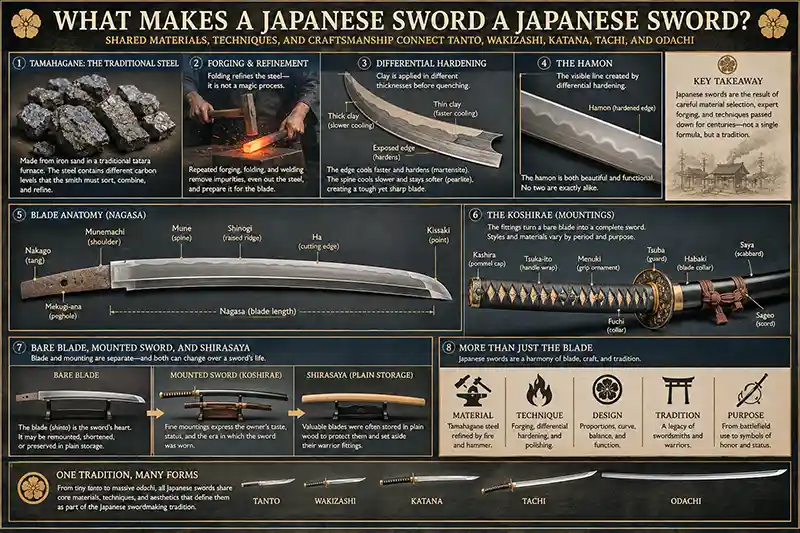
With so many different lengths, shapes, and mounting styles, it is reasonable to ask what actually connects a tiny tanto, an elegant tachi, and an enormous odachi. Their proportions may be dramatically different, but traditional Japanese swords share a vocabulary of construction and craftsmanship that makes them part of the same broader swordmaking tradition.
At the center of that tradition is the blade itself. Traditional Japanese swordsmiths worked with tamahagane, steel produced from iron sand in a traditional smelting furnace known as a tatara. The resulting material contained areas with different carbon contents, requiring the smith to carefully select, combine, forge, and refine pieces of steel before the blade could take its final form. Contrary to popular mythology, folding was not a magical process that made Japanese steel inherently superior to all other steels. It was a practical method of refining and homogenizing the material available to the smith.
Traditional blades could also combine steels of differing properties in various constructions. Swordsmithing schools developed multiple approaches, but the underlying challenge was similar: a cutting edge benefits from hardness, while the rest of a sword must tolerate the stresses placed upon a long blade. Japanese smiths developed sophisticated ways of balancing those requirements rather than simply attempting to make the entire sword as hard as possible.
Differential hardening became one of the tradition's most recognizable techniques. Before quenching, a smith could apply clay in differing thicknesses along the blade. The cutting edge cooled differently from areas protected by thicker clay, producing different metallurgical structures within the finished sword. The visible boundary associated with this process is the hamon, the hardened pattern running along the blade that has become one of the most recognizable features of traditionally made Japanese swords.
The blade was only one part of the complete weapon. Components such as the tsuba guard, tsuka handle, saya scabbard, and numerous smaller fittings could transform a bare blade into a finished sword. These mountings could be replaced during the sword's life, which is one reason an old blade might survive in fittings very different from those it originally carried.
This separation between blade and mounting is crucial to understanding Japanese swords. A centuries-old tachi blade could be shortened and remounted for later use, while valuable blades might eventually be stored in plain wooden shirasaya rather than their historical combat fittings. The identity of a Japanese sword therefore exists partly in its blade, partly in its mounting, and partly in the history connecting the two.
That shared craftsmanship is what connects swords that otherwise seem remarkably different. Tanto, wakizashi, katana, tachi, and odachi were not merely the same weapon produced at different sizes, but they emerged from a swordmaking culture with common materials, techniques, components, and aesthetic traditions. Their diversity becomes much easier to appreciate once we recognize the foundation they shared.
Why Were Some Japanese Swords Shortened and Remounted?
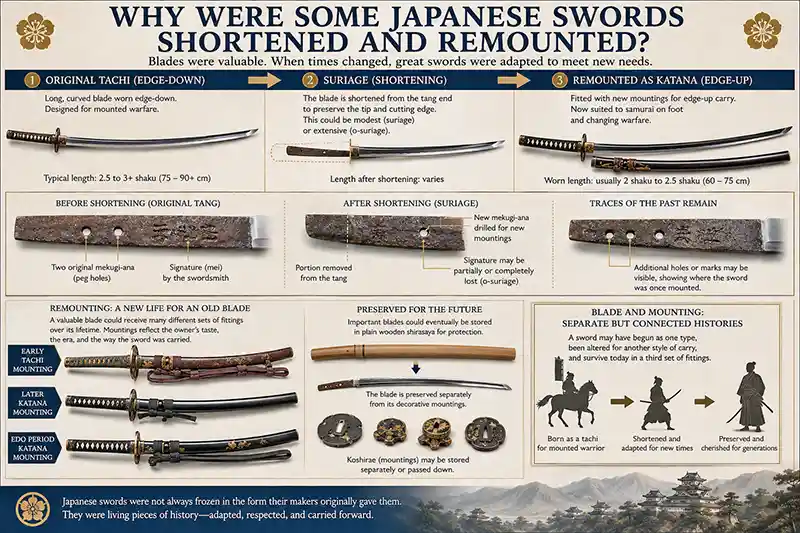
One of the most important things to understand about surviving Japanese swords is that the form we see today may not be the form the sword originally had. High-quality blades could remain valuable for generations, surviving changes in warfare, fashion, ownership, and sword-carrying customs. Rather than discard an older blade when those circumstances changed, Japanese craftsmen could modify it and place it in new mountings.
The most dramatic alteration was known as suriage, the shortening of a sword from the tang end. This could transform the proportions of an older blade without cutting away its carefully formed point. In more extensive cases, known as o-suriage, so much of the original tang could be removed that the swordsmith's signature was lost entirely.
Tachi were particularly affected by this practice. A long blade originally made for edge-down tachi mountings could survive into periods when shorter, edge-up swords had become more practical or fashionable. By shortening the blade and fitting it with new mountings, an older sword could continue serving generations after the world for which it was originally forged had changed.
This creates a fascinating challenge for historians and collectors. A blade mounted as a katana today may have begun its life centuries earlier as a tachi. The current handle and scabbard might be far younger than the blade itself, and even the tang can contain evidence of holes drilled for earlier handle configurations. Specialists therefore examine the blade's shape, curvature, tang, file marks, inscriptions, and other characteristics rather than assuming its present mounting tells its complete history.
Remounting did not necessarily require shortening. Valuable blades could receive multiple sets of fittings over their lifetimes as owners, fashions, and circumstances changed. Eventually, an important blade might be placed in plain wooden shirasaya for preservation while its decorative or historical koshirae was stored separately.
This is one reason Japanese sword classification can become surprisingly complicated. The blade and the complete mounted sword have related but separate histories. A sword may have begun as one type, been altered for another style of carry, and survive today in a third set of fittings. Japanese swords were not always frozen in the form their makers originally gave them. Some continued evolving for centuries after they left the forge.
How Samurai Actually Wore Their Swords
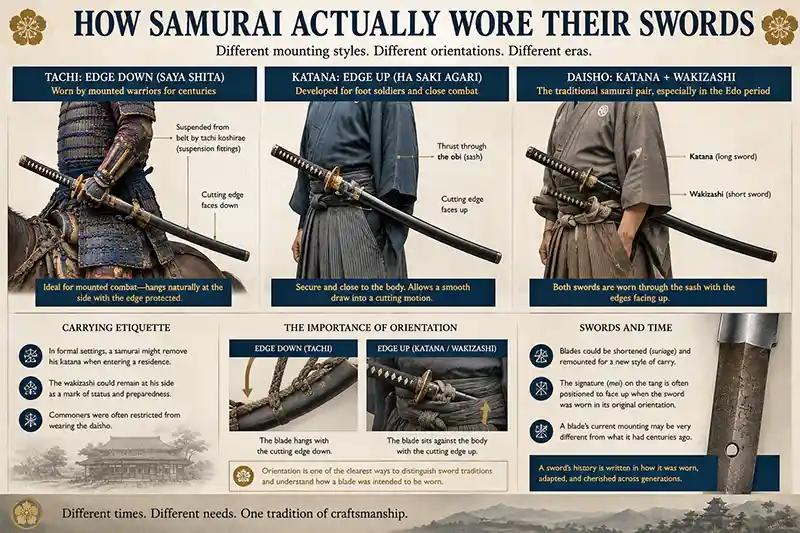
The way a Japanese sword was worn was not merely a matter of convenience. Mounting and carrying style changed across centuries, and those differences can help distinguish sword traditions that otherwise look remarkably similar. In fact, the orientation of the cutting edge is one of the clearest visual clues separating the classic tachi from the later katana.
A tachi was traditionally suspended from the warrior's belt using fittings attached to its scabbard, with the cutting edge facing downward. This arrangement was closely associated with mounted warriors and allowed the sword to hang naturally at the side while riding. Elaborate tachi mountings could include specialized suspension fittings that make them recognizable even when the blade itself is hidden inside the scabbard.
The katana and uchigatana were normally carried differently. Instead of hanging from suspension cords, the scabbard was thrust directly through the obi, or sash, with the cutting edge facing upward. This positioned the sword securely against the body and allowed the wearer to draw the blade in a way that could flow directly into a cutting motion.
When a wakizashi accompanied the katana, both swords could be worn through the sash to form the daisho. The shorter wakizashi sat alongside the longer sword, creating the distinctive paired arrangement associated especially with samurai during the Edo period. Sword etiquette also affected when each weapon remained with its owner. Depending on circumstances and status, the long sword might be removed when entering a residence while the shorter wakizashi could remain closer at hand.
These carrying conventions also help explain why identifying a Japanese sword purely from its blade can be difficult. A centuries-old blade might have begun life in tachi mountings, later been shortened, and eventually been worn edge-up in katana fittings. In some cases, specialists can even use the placement of a swordsmith's signature on the tang as evidence of the orientation in which a blade was originally intended to be worn.
The familiar image of a samurai with two swords thrust through his sash is therefore only one chapter of a much longer history. Earlier mounted warriors carried their swords differently, individual blades could change mountings over time, and the way a sword hung at a warrior's side could reveal almost as much about its historical identity as the shape of the blade itself.
Were Japanese Swords Really as Perfect as Legend Claims?
Few historical weapons have accumulated as much mythology as the Japanese sword. Popular culture has sometimes transformed the katana into an almost supernatural object, supposedly capable of slicing through other swords, cutting armor effortlessly, or holding an indestructible edge. Traditional Japanese swords could be extraordinary examples of craftsmanship, but their real achievement becomes more impressive, not less, when those legends are separated from reality.
Japanese swordsmiths were working with the materials and technology available to them. Tamahagane could contain considerable variation in carbon content and impurities, which is precisely why careful sorting, forging, folding, and welding were valuable parts of the process. Folding helped refine and distribute the material more evenly. It did not create a magical metal stronger than anything produced elsewhere in the world.
Differential hardening involved another deliberate compromise. A hard cutting edge could hold a keen edge, while a comparatively softer body and spine could help the blade tolerate stresses that an extremely hard sword might not withstand as well. This combination was sophisticated, but it did not make the finished blade indestructible. Japanese swords could chip, bend, crack, suffer damage from poor use, and eventually require repair or polishing just like other historical weapons.
The same applies to their reputation for cutting armor. Samurai armor evolved specifically to protect its wearer, and attacking heavily protected areas with the edge of a valuable sword was hardly equivalent to slicing an unarmored target. Japanese swordsmanship included cuts and thrusts directed toward vulnerable openings, and swords existed within a much larger battlefield system that included bows, spears, polearms, firearms, and other weapons.
Even the katana's status as the samurai's ultimate battlefield weapon deserves qualification. For substantial periods of Japanese history, bows and later weapons such as the yari played enormously important roles in warfare. The sword was prestigious, versatile, and culturally significant, but samurai did not spend every battle settling the outcome through cinematic sword duels. Our look at the biggest myths about samurai swords examines several of these enduring legends in greater detail.
None of this diminishes Japanese swordmaking. The remarkable part is that generations of craftsmen learned to manipulate imperfect raw materials with extraordinary precision, producing blades that balanced competing properties while also developing a sophisticated artistic tradition. Japanese swords do not need supernatural abilities to be exceptional. Their documented history is considerably more interesting than the mythology built around them.
Why Did Samurai Carry Two Swords?
The image of a samurai carrying a long katana and shorter wakizashi is so familiar that the pairing can seem as old as the samurai themselves. In reality, the formal association between the two developed over time. By the Edo period, the paired long and short swords known as the daisho had become one of the most recognizable markers of samurai status.
The word daisho comes from the concepts of daito and shoto, essentially "long sword" and "short sword." The pair did not necessarily have to consist of two perfectly matched blades, although wealthy owners could commission coordinated mountings that made the swords appear as a deliberate set. What mattered most was the relationship between a longer and shorter sword carried together.
There were practical advantages to having both. The katana provided the reach of a full-length sword, while the wakizashi offered a more compact blade that was easier to handle in confined spaces. The shorter sword could also remain available in circumstances where etiquette required the longer sword to be removed, giving the samurai a weapon that could stay closer at hand.
The daisho eventually carried meaning beyond simple practicality. During the relatively peaceful Edo period, social distinctions became increasingly regulated, and the wearing of paired swords became closely associated with membership in the samurai class. A beautifully mounted daisho could communicate rank, wealth, taste, and identity before either blade ever left its scabbard.
Not every pair looked identical. Some daisho used matching guards, handle fittings, lacquerwork, or decorative themes, while others paired swords with less coordinated appearances. Blades could also be much older than their mountings, meaning a samurai might carry swords forged in different periods that had been fitted together as a pair later in their histories.
The daisho therefore captures an important transformation in the history of Japanese swords. Weapons created for fighting gradually acquired an additional role as visible symbols of social position and warrior identity. By the Edo period, the two swords at a samurai's waist could say almost as much about who he was as the armor worn by warriors on the battlefields of earlier centuries.
How to Tell Japanese Sword Types Apart at a Glance
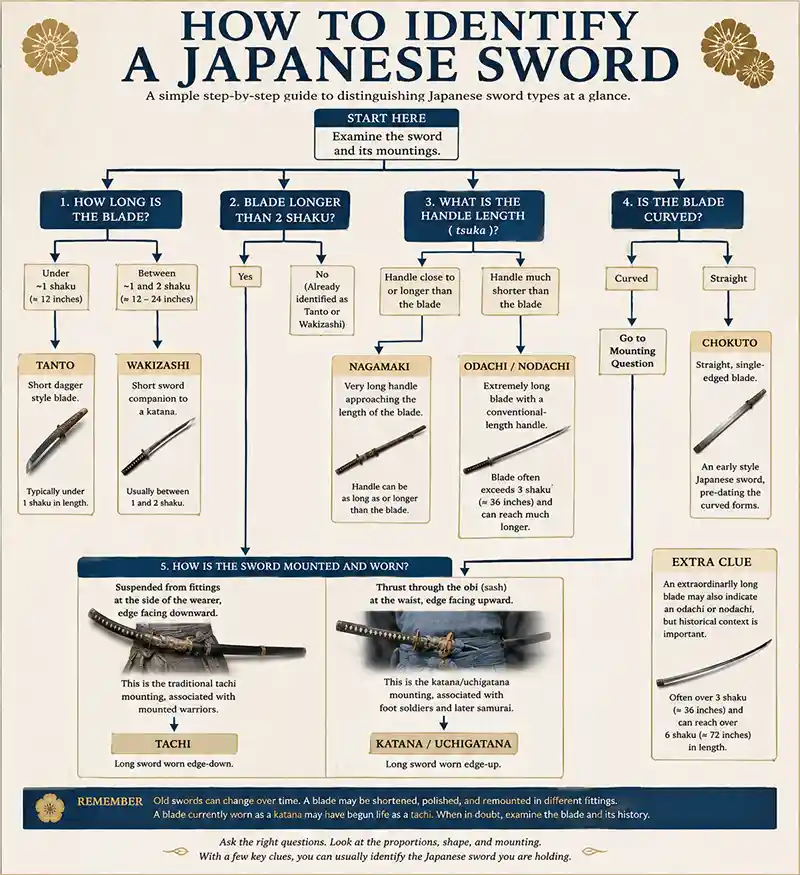
After seeing so many Japanese sword types, identifying an unfamiliar blade can initially seem difficult. The easiest approach is not to focus on one feature, but to work through a handful of visual clues in order: blade length, handle length, curvature, mounting style, and the way the sword was intended to be worn. Together, these characteristics can narrow the possibilities surprisingly quickly.
Start with overall size. A very short blade under roughly one shaku immediately points toward the tanto category, while a blade between approximately one and two shaku suggests a wakizashi or another short-sword form. Once the blade exceeds two shaku, length alone becomes less useful because katana, tachi, and other long swords can occupy overlapping ranges. An extraordinarily long blade may suggest an odachi or nodachi, but historical context is still necessary before assigning a precise label.
Next, examine the proportions. An unusually long handle approaching the length of the blade is the strongest clue that you may be looking at a nagamaki. A conventional-length handle paired with an enormous blade instead points more toward the odachi family. Straight construction can suggest an early chokuto, although the existence of other straight Japanese blades means shape alone should never be treated as absolute proof.
For curved long swords, mounting can be more informative than the blade. A sword suspended from specialized fittings with the cutting edge facing downward strongly suggests tachi-style mounting. A long sword thrust through the sash with the cutting edge upward belongs to the tradition associated with the uchigatana and katana. This distinction becomes especially valuable because tachi and katana blades can sometimes look remarkably similar when removed from their mountings.
Finally, remember that an old Japanese sword may have changed during its lifetime. Blades were shortened, polished, remounted, and passed through generations of owners. A blade currently fitted as a katana may have begun as a tachi, while a blade stored in plain shirasaya provides almost no information about how it was historically carried. When the evidence conflicts, the most accurate identification may require examining the blade itself rather than its present fittings.
The goal is not to force every sword into a category within seconds. Instead, ask a sequence of questions: How long is the blade? How long is the handle? Is it straight or curved? How is it mounted? Which direction does the edge face when worn? Those clues turn what initially looks like a confusing collection of similar curved swords into a much more understandable family of designs.
Japanese Sword Types Through History: A Visual Timeline
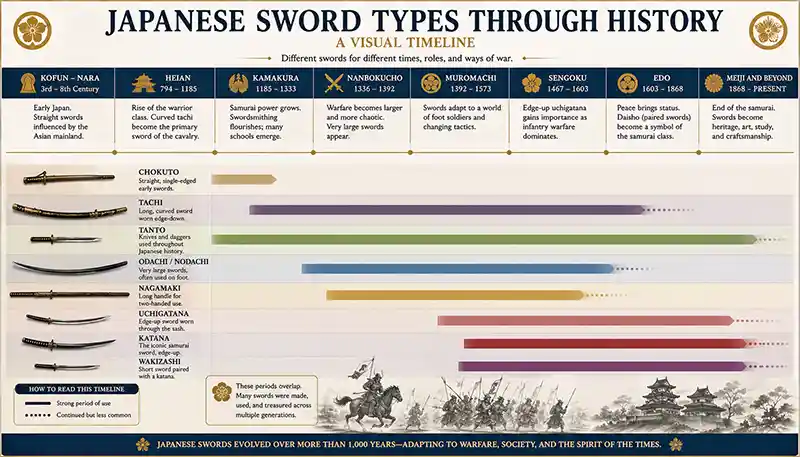
Looking at Japanese swords chronologically reveals something that individual descriptions can easily hide: many of these weapons overlapped for centuries. The development of the Japanese sword was not a sequence in which one design disappeared as soon as another arrived. Older forms continued to be used, blades were remounted for new generations, and different sword types existed simultaneously because they served different purposes.
The earliest swords in our guide belong to a period before the samurai had developed into the warrior class we recognize today. Straight chokuto were present in ancient Japan during the Kofun and Nara periods, reflecting both domestic swordmaking and strong technological influences from the Asian mainland. By the late Heian period, however, curved tachi had emerged and were becoming closely associated with Japan's rising mounted warrior class.
The Kamakura period brought some of the most celebrated developments in Japanese swordmaking as the samurai became increasingly important politically and militarily. Tachi remained prominent, while tanto were also produced in significant numbers. Swordsmithing traditions flourished in different regions, creating schools whose blades could vary in shape, construction, curvature, and other characteristics.
During the turbulent centuries that followed, Japanese swords grew even more diverse. The Nanbokucho period became particularly notable for dramatic proportions and unusually large blades, while swords such as the odachi and nagamaki became associated with medieval warfare. Later, during the Muromachi and Sengoku periods, fighting increasingly centered on large armies operating on foot, helping edge-up uchigatana become progressively more important.
By the late medieval period, the katana had emerged as the dominant form of long sword worn through the sash, while shorter wakizashi developed alongside it. During the Edo period, the pairing of long and short swords became formalized into the daisho strongly associated with samurai identity. At the same time, older blades continued circulating, sometimes shortened from tachi and remounted to suit newer fashions and methods of carry.
The end of the samurai class in the nineteenth century did not end the Japanese sword tradition. Historic blades were preserved, swordsmithing continued under changing circumstances, and Japanese swords eventually became objects of scholarship, collecting, martial arts practice, cultural preservation, and craftsmanship. The swords we separate into neat categories today are therefore snapshots taken from a tradition that was continuously changing for more than a thousand years.
Which Japanese Sword Was the Longest?
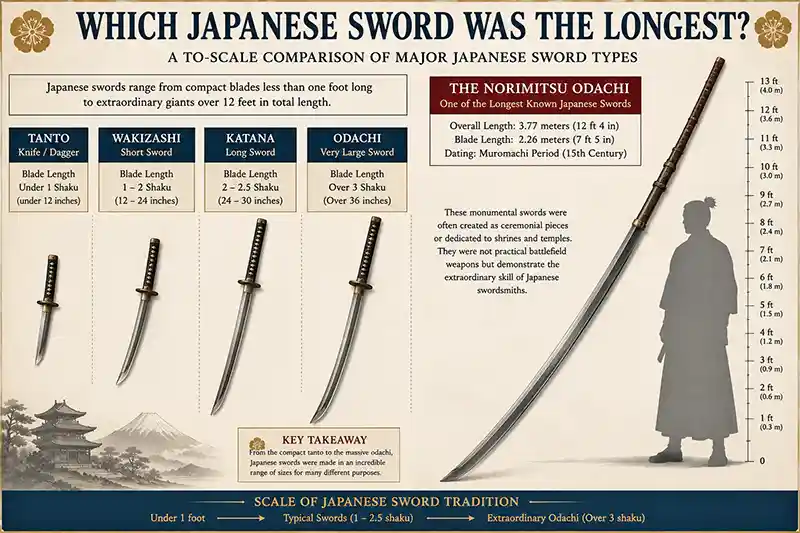
Among the major Japanese sword types, the odachi occupies the upper end of the scale. While katana and tachi commonly had blades measuring a little over two shaku, some odachi extended far beyond ordinary sword proportions. Historical examples survive with blades exceeding three shaku, and a small number of extraordinary ceremonial swords reached dimensions that make even a typical odachi appear modest.
One of the most famous examples is the enormous Norimitsu Odachi, a Japanese blade traditionally dated to the fifteenth century. Its overall length is reported at roughly 3.77 meters, or more than 12 feet, with a blade approximately 2.26 meters long. At that scale, the sword was clearly far removed from the dimensions of an ordinary battlefield weapon and demonstrates how extremely large blades could also be produced for ceremonial, dedicatory, or display purposes.
This is why asking for the "longest Japanese sword" requires distinguishing between practical weapons and extraordinary oversized examples. An odachi intended to be carried and used by a warrior might already dwarf a katana, but Japanese swordsmiths were capable of producing blades far larger than anything a person could realistically wear at the waist. Some monumental swords were associated with shrines and religious offerings rather than ordinary combat.
The nagamaki complicates visual comparisons in a different way. Its blade could be substantial, but much of the weapon's impressive overall length came from its unusually long handle. An odachi, by contrast, achieved its enormous proportions primarily through the length of the blade itself. Two weapons of similar total length could therefore have completely different proportions and methods of handling.
These extremes make the scale of Japanese swordmaking remarkable. At one end sits the tanto, with a blade under approximately one foot. At the other are monumental odachi whose blades could be several times the length of a conventional katana. Few comparisons demonstrate more clearly why "Japanese sword" describes an entire tradition rather than a single familiar shape.
Which Japanese Sword Was the Shortest?
At the opposite end of the spectrum from the enormous odachi was the tanto. With a blade generally measuring less than one shaku, or roughly 30 centimeters, the tanto occupied the shortest major blade-length category within the Japanese sword tradition. Some examples approached the upper limit closely, while others were considerably smaller.
Calling the tanto a small sword can be slightly misleading because its dimensions overlap with what modern readers would normally consider a knife or dagger. Historically, however, tanto were made within the Japanese swordmaking tradition and could display many of the same sophisticated features found on larger blades, including carefully formed points, differential hardening, visible hamon, elaborate mountings, and blades produced by highly regarded swordsmiths.
There were also specialized short blades that complicate any attempt to identify one exact "shortest Japanese sword." Small utility blades such as kogatana could be carried in pockets built into the scabbards of larger swords, and other compact blades existed for specialized purposes. These are important parts of Japanese edged-weapon history, but they are not generally treated as equivalent to the major sword categories compared throughout this guide.
Within that broader sword classification, the tanto provides the clearest counterpart to the odachi. One could have a blade shorter than a modern ruler, while the other could reach extraordinary dimensions measured in feet. Yet both could emerge from the same larger traditions of Japanese blade-making and craftsmanship.
That contrast is part of what makes Japanese swords so much more diverse than the familiar katana suggests. Swordsmiths were not endlessly reproducing one curved blade at slightly different sizes. They created weapons across a remarkable range of proportions, and the tanto shows how much of that tradition could be concentrated into an exceptionally compact blade.
Were All Japanese Swords Made for Samurai?
Because Japanese swords are so closely associated with the samurai today, it is easy to imagine that every traditional blade was created specifically for a member of the warrior class. The reality was considerably broader. Japanese swords existed for more than a thousand years, crossing periods in which political systems, military organizations, social classes, and restrictions on weapon ownership changed dramatically.
Many of the swords in this guide were unquestionably connected with warriors. Tachi became closely associated with mounted elites, while katana and wakizashi eventually became powerful symbols of samurai identity. During the Edo period in particular, the daisho became so strongly connected with samurai status that the paired swords functioned as visible markers of social class as well as weapons.
But sword ownership and use were not identical in every century. Before the rigid social order associated with the Edo period, Japan experienced long eras of warfare in which armed retainers, foot soldiers, warrior monks, local fighting forces, and other combatants existed alongside the elite figures we commonly label samurai. Different regulations and circumstances affected who could carry particular weapons at different points in Japanese history.
Some Japanese swords were also made for purposes that had little to do with ordinary battlefield use. Exceptionally large blades could be dedicated to shrines, while ornate swords might serve ceremonial, diplomatic, religious, or status-related functions. As we have already seen with monumental odachi, the fact that an object was constructed in the form of a sword does not automatically mean it was intended to be carried into battle.
Even after the age of the samurai ended, Japanese swordmaking did not disappear. Blades continued to be produced under changing laws and circumstances, while older swords became objects of preservation, study, collecting, martial tradition, and cultural importance. The Japanese sword outlived the social class with which it had become most famous.
So while the samurai are essential to the history of Japanese swords, they do not completely define it. These blades belonged to a much larger story involving warfare, religion, craftsmanship, social status, ceremony, and eventually cultural preservation. The sword of the samurai was also the work of the swordsmith, the offering of the shrine, the inheritance of later generations, and ultimately one of Japan's most enduring forms of material culture.
Why Japanese Sword Names Can Be So Confusing
By this point, one pattern should be clear: Japanese sword terminology rarely fits into perfectly separate boxes. Some names describe blade length, some describe how a sword was mounted or worn, some are associated with particular historical periods, and others overlap so heavily that two different terms can sometimes describe essentially the same blade. Modern attempts to organize every Japanese sword into a tidy list can therefore create distinctions that were never quite so rigid historically.
Katana and tachi provide the clearest example. Their blades can overlap considerably in length, curvature, and overall appearance, while mounting and orientation often provide stronger clues to their historical identity. Uchigatana adds another layer because the term is closely connected with the development of the edge-up sword that eventually became familiar as the katana.
Odachi and nodachi create a different problem. The terms are frequently presented today as though they describe two precisely defined sword types, yet their historical usage overlaps. Assigning each name a strict modern length range may make comparison charts easier to build, but it can imply a level of standardization that did not necessarily exist.
Even apparently straightforward length categories have complications. Tanto, wakizashi, and long swords can be separated using traditional measurements, but a blade's identity was not determined by length alone in every circumstance. Sword terminology developed over centuries rather than being established all at once by a single classification system.
Then there is the problem of swords changing over time. A tachi blade could be shortened and remounted as a katana. A valuable blade might lose its original fittings entirely and survive in shirasaya. A swordsmith's work could therefore outlive the mounting style, military environment, and terminology that surrounded the blade when it was first forged.
The best way to understand Japanese sword names is to treat them as historical descriptions rather than perfectly rigid specifications. Length, shape, mounting, period, and context all contribute evidence. Sometimes one name is clearly appropriate. Sometimes two terms overlap. And sometimes the most historically accurate answer requires acknowledging that a centuries-old sword refuses to fit neatly into the categories we use today.
From Battlefield Weapons to Cultural Treasures
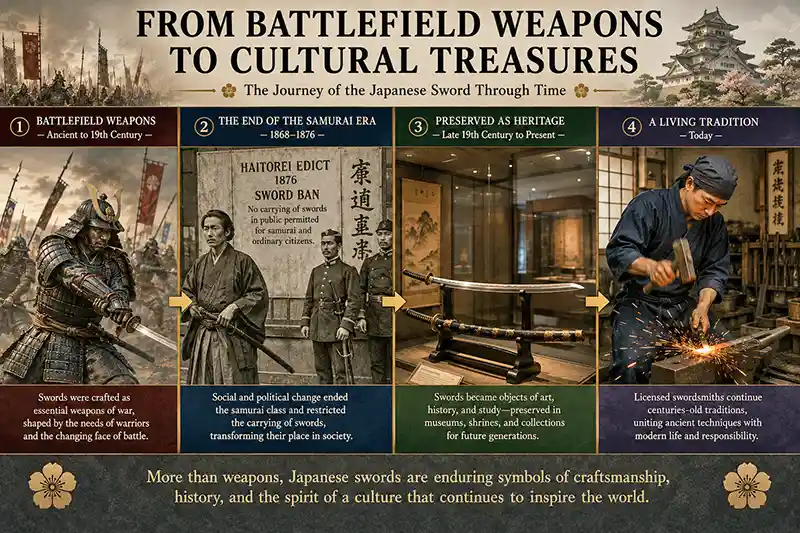
For centuries, Japanese swords evolved alongside warfare. Their dimensions, curvature, mountings, and methods of carry changed as mounted warriors gave way to armies fighting increasingly on foot and as the political role of the samurai changed. By the nineteenth century, however, the world that had shaped those weapons was disappearing.
The Meiji Restoration of 1868 transformed Japan's political and social structure, dismantling the old feudal order and eventually eliminating the samurai as a legally privileged class. In 1876, the Haitorei Edict broadly prohibited the public wearing of swords by most former samurai and civilians, with exemptions for certain officials and military personnel. A pair of swords that had once visibly marked samurai status could no longer occupy the same place in everyday public life.
Swordmaking consequently entered a difficult new era. The disappearance of the traditional warrior class sharply reduced demand, forcing craftsmen connected with sword production to adapt their skills to other forms of metalwork and decorative art. Japanese swordmaking did not vanish, but its relationship with society had fundamentally changed.
Historic swords also acquired a different kind of importance. Blades once valued as weapons or family possessions increasingly became objects of artistic, historical, and cultural study. Swordsmith signatures, forging traditions, hamon, blade shapes, mountings, and regional schools could be examined not merely for their practical qualities but as evidence of centuries of Japanese craftsmanship.
Today, traditionally made Japanese swords remain subject to regulation in Japan, and licensed swordsmiths continue a craft whose roots extend back through the same history we have followed in this guide. Important historic blades are preserved in museums, shrines, collections, and cultural institutions, while traditional sword arts keep aspects of their handling and use alive in an entirely different world from the battlefields that produced them.
The transformation is remarkable. The tachi of the mounted warrior, the katana at the samurai's waist, and the enormous odachi of medieval Japan began as products of particular historical needs. Centuries later, surviving examples allow us to study not only how people fought, but how craftsmen solved problems, how styles changed, and how objects created for one purpose can acquire entirely new meanings as the world around them changes.
The Japanese Sword Was Never Just the Katana
The katana became the international symbol of the samurai, but Japanese sword history is far too large to be represented by a single blade. Centuries before the katana appeared, straight chokuto were already being forged in Japan. Curved tachi later hung from the belts of mounted warriors, tanto provided compact blades for close use, enormous odachi pushed swordmaking to extraordinary dimensions, and the unusually proportioned nagamaki explored an entirely different relationship between blade and handle.
Even the swords that appear most similar reveal how much the tradition changed. The transition from tachi to uchigatana and eventually katana reflects changes in warfare and methods of carry, while the wakizashi shows how a shorter sword could acquire enormous social importance as part of the daisho. Meanwhile, overlapping terms such as odachi and nodachi remind us that historical weapons do not always fit the clean categories we create for them centuries later.
What connects these blades is not one standardized shape. It is a shared tradition of swordmaking that continually adapted to new warriors, new battlefields, new social structures, and new generations of craftsmen. Blades changed length. Curvature shifted. Mountings were replaced. Old swords were shortened and given new lives. Weapons eventually became heirlooms, artistic objects, and cultural treasures.
That is what makes Japanese swords so fascinating to study visually. Place a tanto beside a katana and the difference is obvious. Add a tachi, wakizashi, nagamaki, chokuto, and enormous odachi, and the familiar image of the "samurai sword" begins to dissolve into something much richer: more than a thousand years of experimentation with steel, geometry, craftsmanship, and the changing needs of the people who carried these blades.
The katana deserves its fame. But it makes far more sense when viewed beside the swords that came before it, developed alongside it, and occupied completely different places within Japanese history. There was never just one Japanese sword. There was an entire evolving family of blades, and every one of them tells a different part of the story.
What Is the Difference Between a Katana and a Tachi?
The katana and tachi are both curved, single-edged Japanese swords, and their blades can sometimes look remarkably similar. One of the clearest historical differences is how they were traditionally mounted and worn. A tachi was typically suspended from the belt with its cutting edge facing downward, while a katana was normally thrust through the obi with its cutting edge facing upward.
Tachi are generally associated with earlier mounted samurai and became prominent centuries before the katana. Katana became increasingly important as warfare shifted toward fighting on foot and eventually became the long sword most closely associated with later samurai. Blade length and curvature can provide additional clues, but they do not create an absolute dividing line because individual swords varied and older tachi blades were sometimes shortened and remounted in katana-style fittings.
What Is the Difference Between a Katana and a Wakizashi?
The primary difference between a katana and a wakizashi is blade length. A katana generally falls within the daito, or long-sword, category with a blade exceeding two shaku, roughly 60.6 centimeters or 23.9 inches. A wakizashi generally has a blade between one and two shaku, placing it within the shorter shoto category.
During the Edo period, the two swords became closely associated through the daisho. The katana served as the longer sword while the wakizashi accompanied it as the shorter blade. Although wakizashi can resemble scaled-down katana, historical examples varied considerably in curvature, proportions, construction, and mountings, so the difference involves more than simply shrinking the same sword design.
What Is the Difference Between a Tanto and a Wakizashi?
The clearest difference between a tanto and a wakizashi is blade length. A tanto traditionally has a blade under one shaku, roughly 30.3 centimeters or 11.9 inches, while a wakizashi generally falls between one and two shaku, approximately 30.3 to 60.6 centimeters or 11.9 to 23.9 inches. This places the two blades on opposite sides of an important traditional length boundary.
Their roles and proportions could differ as well. The wakizashi functioned as a short sword and became famous as the companion to the katana in the samurai daisho. The more compact tanto existed in numerous forms and was carried as a close-range sidearm across a much longer span of Japanese warrior history. Individual examples varied considerably, so blade length provides a more reliable general distinction than expecting every tanto or wakizashi to have one standardized shape.
What Is the Difference Between an Odachi and a Nodachi?
There is no universally accepted historical distinction separating an odachi from a nodachi into two precisely defined sword types. Both terms have been used for exceptionally large Japanese swords, and their meanings can overlap considerably depending on the period, source, and context. Odachi essentially means "great sword" or "large sword," while nodachi is commonly interpreted as "field sword."
Modern sources sometimes assign different blade lengths or purposes to the two names, but those neat classifications can imply more historical standardization than actually existed. It is generally more accurate to treat odachi and nodachi as closely related and sometimes overlapping terms rather than assuming every example can be definitively placed into one completely separate category.
Why Did Samurai Wear the Katana With the Edge Facing Up?
The katana was normally worn thrust through the obi with its cutting edge facing upward, unlike the earlier tachi, which was traditionally suspended edge-down. This edge-up orientation worked naturally with the way the katana was carried close against the body and allowed the sword to be drawn in a motion that could transition directly into a cut.
The change was part of a broader evolution in Japanese sword use rather than a single invention that suddenly replaced the tachi. As warfare increasingly involved warriors fighting on foot, the uchigatana and later katana became more prominent. Their edge-up mounting became one of the most recognizable distinctions between later samurai swords and the edge-down tachi associated strongly with earlier mounted warriors.
Did Samurai Carry Their Swords on Their Backs?
Samurai did not normally carry katana on their backs in the way frequently depicted in modern movies, games, and fantasy artwork. The katana was typically worn through the obi at the waist with its cutting edge facing upward, while the earlier tachi was traditionally suspended from the belt with its edge facing downward. These methods kept the sword accessible and reflected the mounting systems designed for each weapon.
Exceptionally large swords such as odachi create a more complicated picture because some were too long to draw conventionally from the waist. Historical sources and artwork indicate that oversized swords could be transported in different ways depending on their dimensions and circumstances, and back carrying is sometimes associated with these unusually large weapons. That should not be generalized into the idea that wearing a sword across the back was the normal method for carrying an ordinary samurai sword.
Why Did Samurai Carry a Wakizashi With Their Katana?
The wakizashi gave the samurai a shorter sword that complemented the longer katana. Its compact size made it easier to handle in confined spaces, and it could remain closer to its owner in situations where etiquette required the long sword to be removed. Together, the katana and wakizashi formed the daisho, meaning "large-small."
By the Edo period, carrying the paired long and short swords had become closely associated with samurai status. The daisho therefore served a purpose beyond simply giving a warrior two different blade lengths. Coordinated mountings could turn the pair into a visible expression of identity, rank, wealth, and taste, making the two swords one of the most recognizable symbols of the samurai class.
What Is the Difference Between a Katana and an Uchigatana?
The distinction between katana and uchigatana is not as clean as many modern sword lists suggest. The uchigatana developed as an edge-up sword worn through the belt and became increasingly important as Japanese warfare shifted toward fighting on foot. Over time, this tradition evolved into the form commonly identified as the katana, and the terminology can overlap depending on the historical period and context.
It is therefore misleading to imagine the uchigatana and katana as two completely separate sword designs with universally different dimensions or shapes. Uchigatana is particularly useful when discussing the historical development of the edge-up Japanese long sword, while katana became the more familiar term for the later form associated with the samurai. The relationship is better understood as an evolution with overlapping terminology than a sharp boundary between two unrelated weapons.
What Is the Difference Between a Katana and an Odachi?
The most obvious difference between a katana and an odachi is size. A katana is a conventional Japanese long sword generally worn through the obi, while an odachi is an oversized Japanese sword that can have a substantially longer blade. Some historical odachi reached dimensions that made carrying and drawing them like an ordinary katana impractical.
Their historical roles also differed. Katana became closely associated with the everyday sword wear of later samurai, while odachi are particularly associated with medieval battlefield use, along with ceremonial and religious examples. There was considerable variation within both categories, so there is no single length or shape that describes every example, but an odachi's unusually large scale remains its defining characteristic.
What Is the Difference Between a Nagamaki and a Naginata?
The nagamaki and naginata can look similar because both combine a long cutting blade with an extended grip or shaft, but they belong to different weapon traditions. A nagamaki is essentially a sword with an unusually long handle, often wrapped in a manner similar to the grip of other Japanese swords. A naginata is a polearm, with a curved blade mounted onto a much longer wooden shaft.
Their proportions provide one of the easiest visual clues. On a nagamaki, the long handle could approach the length of the blade, giving the weapon an unusual but distinctly sword-like construction. A naginata typically has a much longer shaft in relation to its blade, providing the reach expected from a polearm. Although both weapons could deliver powerful sweeping cuts, they should not be treated as interchangeable names for the same weapon.
Which Japanese Sword Came Before the Katana?
Several important Japanese sword traditions existed before the katana. Ancient straight swords known as chokuto appeared centuries earlier, while the curved tachi became one of the most important swords of Japan's emerging warrior class. The tachi is particularly significant to the katana's story because it established many of the curved blade characteristics now associated with Japanese swords.
The transition was gradual rather than a simple moment when the tachi was replaced by the katana. The edge-up uchigatana became increasingly prominent during the medieval period and helped establish the sword tradition from which the later katana emerged. The familiar katana was therefore the product of centuries of changing sword design, warfare, mounting styles, and methods of carry rather than the starting point of Japanese swordmaking.
Are Japanese Swords Still Made Today?
Yes. Traditional Japanese swords are still made in Japan by licensed swordsmiths using methods descended from historical swordmaking traditions. Modern traditionally made Japanese swords are commonly called shinsakuto, meaning newly made swords, and their production is regulated under Japanese law.
These swords are not simply mass-produced replicas of historical weapons. Licensed smiths continue specialized processes involving traditionally prepared steel, forging, shaping, heat treatment, polishing, and mounting, with different craftspeople often responsible for different stages of the finished sword. Modern Japanese swords may be created for martial arts, collecting, artistic appreciation, ceremonial purposes, or preservation of the swordsmithing tradition itself.
How Long Is a Katana?
Katana varied considerably in size, so there is no single historical length that applies to every example. Traditionally, a katana belongs to the daito, or long-sword, category, meaning its blade length exceeds two shaku, approximately 60.6 centimeters or 23.9 inches. Many surviving katana have blade lengths somewhere around 60 to 75 centimeters, although examples outside that range exist.
When comparing measurements, it is important to distinguish blade length from the overall length of the sword. Traditional Japanese measurements generally refer to the nagasa, measured from the tip of the blade to the notch at the base of the cutting edge, rather than including the handle. Differences in historical period, swordsmithing tradition, intended wearer, and individual blade design produced considerable variation among katana.
What Is a Shaku?
A shaku is a traditional Japanese unit of length equal to approximately 30.3 centimeters, or about 11.9 inches. It is particularly useful when studying Japanese swords because traditional blade classifications were often based on measurements expressed in shaku rather than modern centimeters or inches.
As a general classification, blades shorter than one shaku fall into the tanto range, blades between one and two shaku fall into the shoto or short-sword range associated with weapons such as the wakizashi, and blades exceeding two shaku fall into the daito or long-sword category associated with swords such as the katana and tachi. These measurements refer to blade length rather than the complete weapon from pommel to point.
Were All Japanese Swords Curved?
No. Although curvature became one of the most recognizable characteristics of Japanese swords, some of Japan's earliest swords were straight. Ancient blades commonly classified as chokuto generally had straight profiles and appeared centuries before the curved tachi and katana traditions most closely associated with the samurai.
Curved blades became increasingly important as Japanese sword design evolved, but even then the amount and location of curvature varied considerably. A tachi might display pronounced curvature concentrated closer to the hilt, while swords from other periods could have shallower or differently distributed curvature. The familiar sweeping profile of the katana therefore represents only one part of a much longer and more varied history of Japanese blade design.
What Is the Hamon on a Japanese Sword?
The hamon is the visible pattern associated with the hardened edge of many traditionally made Japanese swords. It is created through differential heat treatment, in which different portions of the blade cool at different rates during hardening. This allows the cutting edge to become very hard while other portions of the blade retain different mechanical characteristics.
The hamon is therefore not simply a decorative line painted or engraved onto the blade. Its appearance results from changes in the steel created during the hardening process, although skilled swordsmiths also developed distinctive hamon patterns that became important aesthetic features of their work. Proper polishing reveals these structures and can make the boundary between differently treated areas of the blade much easier to see.
What Is a Shirasaya?
A shirasaya is a plain wooden storage mounting traditionally used to protect a Japanese sword blade when it is not installed in its normal decorative or functional fittings. It typically consists of an undecorated wooden scabbard and matching handle that fit together around the blade, creating the simple appearance for which shirasaya are known.
Unlike complete sword mountings known as koshirae, a shirasaya is primarily intended for storage rather than combat. It generally lacks features such as a tsuba, elaborate wrapping, and other fittings associated with a sword prepared to be worn and used. This distinction is important because modern reproductions sometimes imitate the minimalist appearance of shirasaya while presenting them as if they were a historical fighting style of sword mounting.
Are Tachi, Katana, and Wakizashi Made the Same Way?
Tachi, katana, and wakizashi belong to the broader tradition of Japanese swordmaking and can share many fundamental techniques, including forged steel construction, careful shaping, heat treatment, polishing, and specialized mountings. Traditionally made examples may also display features such as a hardened cutting edge and visible hamon. That does not mean every sword was constructed according to one identical formula.
Japanese swordmaking changed across centuries, regions, schools, individual smiths, and intended uses. Blade proportions, curvature, thickness, cross-sectional geometry, tang construction, heat treatment, and other characteristics could vary substantially. A tachi made for a medieval mounted warrior should therefore not be imagined simply as a katana placed in different fittings, just as a wakizashi was not necessarily produced by taking a standard katana design and making every dimension proportionally smaller.
What these swords share is a connected swordmaking tradition rather than a single standardized manufacturing specification. Their differences are part of what allows historians and sword specialists to study individual blades for clues about when, where, and sometimes by whom they were made.
You May Also Be Interested In:
- A Visual Guide to Martial Arts Weapons Around the World
- Five Types of Deadly Japanese Swords
- What Is Kendo? Beginner Guide to Japanese Sword Training
- New Weapons This Week! Swords, Blades & Batons!
- Real vs. Decorative Samurai Swords: What You Need to Know
- Did Samurai Really Test Their Swords On People?
- The Biggest Myths About Samurai Swords
- Samurai Sword Buying Guide: Which Katana is Best?
- What Is a Bokken? A Beginner Guide to Wooden Swords
- What Is a Shinai? Beginner Guide to Kendo Training Swords
Leave a Reply