



Why the Yari Was the Weapon That Won Japan's Greatest Battles
July 31st, 2026
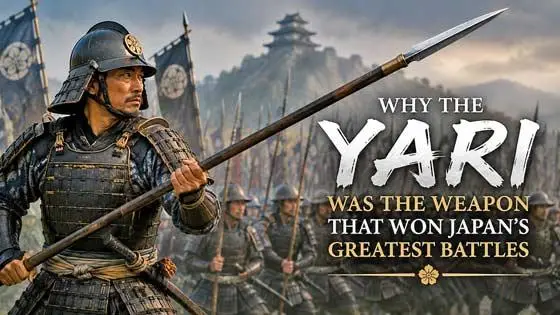
For centuries, the sword has dominated stories about the samurai, but the weapon that truly changed Japanese warfare was often much simpler. The yari, a straight-bladed spear carried by everyone from humble foot soldiers to legendary generals, gave armies the reach, discipline, and battlefield control needed to defeat even the most skilled swordsmen. It wasn't flashy, and it wasn't romanticized like the katana, yet it became one of the most important military weapons in Japanese history.
As warfare evolved, the yari transformed how battles were fought. Massive formations of spear-wielding soldiers could stop cavalry charges, overwhelm enemy lines, and turn ordinary infantry into a force capable of defeating elite warriors. Some of Japan's greatest military victories were built on tactics that depended on the yari, proving that organization and teamwork often mattered more than individual swordsmanship.
In this article, we'll explore how the yari rose to dominate medieval battlefields, why many famous samurai trusted it over the sword, and how one of Japan's simplest weapons became the foundation of some of its greatest military triumphs.
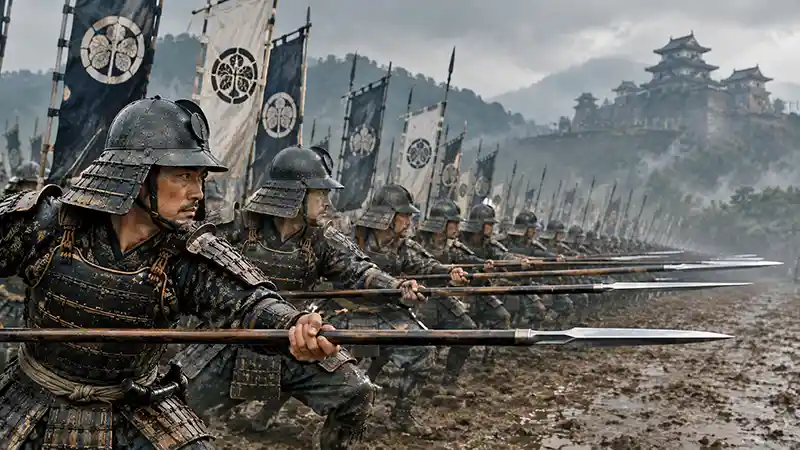
The yari was a remarkably simple weapon. It consisted of a straight steel blade mounted on a long wooden shaft, yet that straightforward design transformed the way wars were fought in feudal Japan. While legendary swords often captured the glory, the yari gave armies something far more valuable: reach, discipline, and the ability to fight together as a coordinated force.
Earlier Japanese warfare placed a greater emphasis on individual combat, where mounted samurai armed with bows and swords could distinguish themselves through personal skill. As conflicts grew larger and armies expanded into the tens of thousands, however, battles became less about individual duels and more about maintaining formation. The yari fit this new style of warfare perfectly.
Unlike a sword, which required a warrior to close the distance before striking, the yari allowed soldiers to threaten an enemy several feet away. That extra reach made it difficult for swordsmen to approach safely and gave organized infantry the ability to stop charging opponents before they could break through the line. Even highly skilled samurai had to respect a disciplined formation of spear-wielding soldiers.
The weapon was also surprisingly versatile. Although most people think of the yari as a thrusting spear, experienced warriors could slash, parry, sweep, and redirect attacks using both the blade and the shaft. It wasn't simply a long stick with a point. In trained hands, it became one of the most adaptable battlefield weapons in Japanese history, earning a place alongside the greatest traditional weapons ever carried into combat.
Its success wasn't based on making the sword obsolete. Instead, the yari changed how entire armies fought. It rewarded teamwork over individual heroics and helped create the disciplined formations that would dominate Japan's greatest military campaigns for centuries.
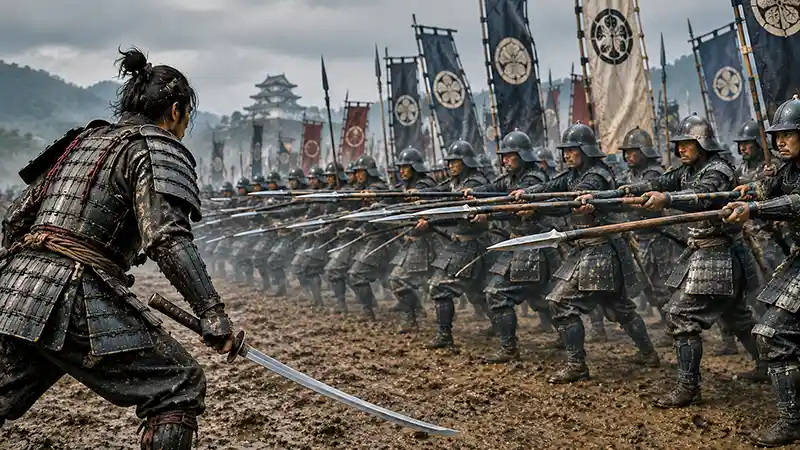
For much of history, the spear consistently outperformed the sword in large-scale warfare. Japan was no exception. While the katana became the legendary symbol of the samurai, the yari offered something far more valuable in battle: distance. A warrior armed with a spear could threaten an opponent several feet before a swordsman was close enough to strike, forcing even highly skilled fighters to approach with extreme caution.
That advantage became even greater when soldiers fought together. A lone swordsman might be able to outmatch a single spearman under the right circumstances, but facing a disciplined line of yari was another matter entirely. Every step forward meant entering the range of multiple spear points at once, making it incredibly difficult to break through an organized formation.
The yari also required less time to master than a sword. Becoming an expert swordsman demanded years of dedicated practice, but armies could train large numbers of ashigaru to fight effectively with spears in a much shorter period. This allowed Japanese warlords to field disciplined infantry that relied on teamwork instead of individual duels, dramatically changing the balance of power during the Sengoku period.
That doesn't mean the sword became obsolete. Once an opponent slipped inside the spear's effective range, the yari became more difficult to maneuver. Many samurai carried both weapons, using the spear to dominate open combat before relying on a sword if the fighting closed to arm's length. The relationship between these weapons was complementary rather than competitive, much like the one explored in our guide to the samurai sword vs. katana.
Modern experiments, historical records, and centuries of military experience all point to the same conclusion: on an open battlefield, reach usually defeated elegance. The sword may have become the icon of the samurai, but the spear was often the weapon that determined who walked away from the battle alive.
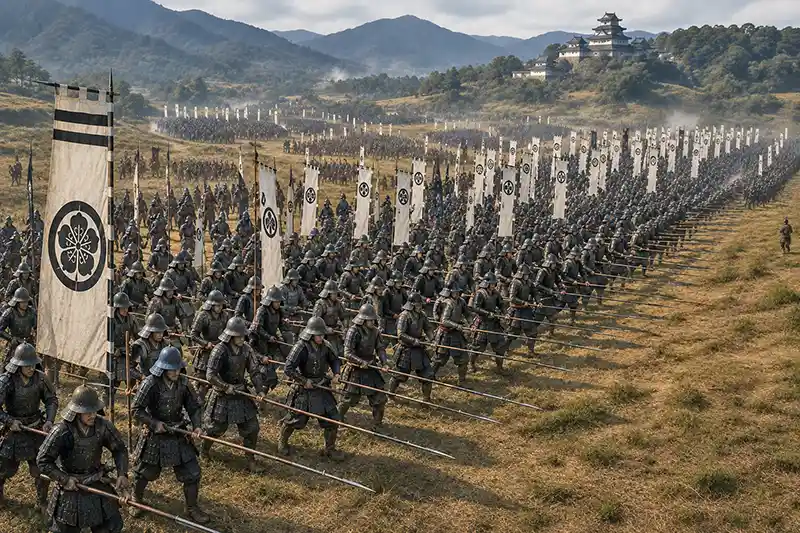
The yari did more than improve individual combat. It transformed ordinary foot soldiers into one of the most effective military forces Japan had ever seen. These soldiers, known as ashigaru, were originally recruited from farming communities, but as the Sengoku period intensified, they became disciplined professional infantry capable of changing the outcome of entire wars.
Armed with long yari, ashigaru fought in tightly organized formations that emphasized cooperation over individual heroics. Instead of charging forward alone, each soldier relied on the men beside him. Rows of spear points projected toward the enemy, creating a moving barrier that was incredibly difficult to penetrate. Even experienced samurai found it dangerous to attack a well-trained spear wall head-on.
The effectiveness of these formations reshaped Japanese warfare. Powerful warlords such as Oda Nobunaga recognized that disciplined infantry could overcome enemies who depended primarily on traditional mounted samurai. Combined with firearms and coordinated battlefield tactics, massed yari formations helped unify Japan during one of the most turbulent periods in its history.
This shift also changed the role of the samurai. Individual skill still mattered, but victory increasingly depended on leadership, planning, and the ability to coordinate thousands of soldiers. The era of heroic one-on-one duels gave way to organized armies where discipline often mattered more than personal bravery. The same battlefield evolution that elevated the yari also influenced weapons such as the naginata, as commanders favored weapons that could dominate space and work effectively within large formations.
The rise of the ashigaru proved one of history's most important military lessons: an army of disciplined soldiers working together could defeat opponents who were individually more skilled. The yari wasn't simply a better weapon. It was the foundation of a completely new way of fighting.
The yari was not merely a weapon handed to common foot soldiers. Many of Japan's most respected samurai trained extensively with the spear and carried it into battle by choice. For experienced warriors, the yari offered the reach of a polearm without sacrificing the precision needed for individual combat.
Some samurai became so closely associated with spear fighting that their weapons earned names and legends of their own. Honda Tadakatsu, one of Tokugawa Ieyasu's most celebrated generals, was famously linked to the spear known as Tonbokiri, or "Dragonfly Cutter." According to legend, the blade was so sharp that a dragonfly landing on it would be cut in two. Whether or not that story was literal, it reflects the enormous prestige that a masterfully forged yari could carry.
The spear also allowed elite warriors to fight effectively from horseback. A mounted samurai could use the yari to thrust at infantry, challenge enemy riders, or exploit openings while maintaining greater reach than a sword provided. On foot, the same weapon could deliver rapid thrusts, sweeping parries, and controlled attacks aimed at gaps in armor.
This versatility explains why samurai often treated the sword as a secondary weapon during major battles. The katana remained essential once fighting became close and chaotic, but the yari was frequently the first weapon used when opposing forces met. It gave the warrior more options before an enemy came within arm's reach.
Popular culture tends to portray every great samurai as a swordsman first, but that image leaves out much of their actual training. Samurai studied multiple weapons because survival depended on adapting to different opponents, terrain, and battlefield conditions. Our article on the biggest myths about samurai swords explores how the katana's later fame often overshadows the weapons samurai relied on during real warfare.
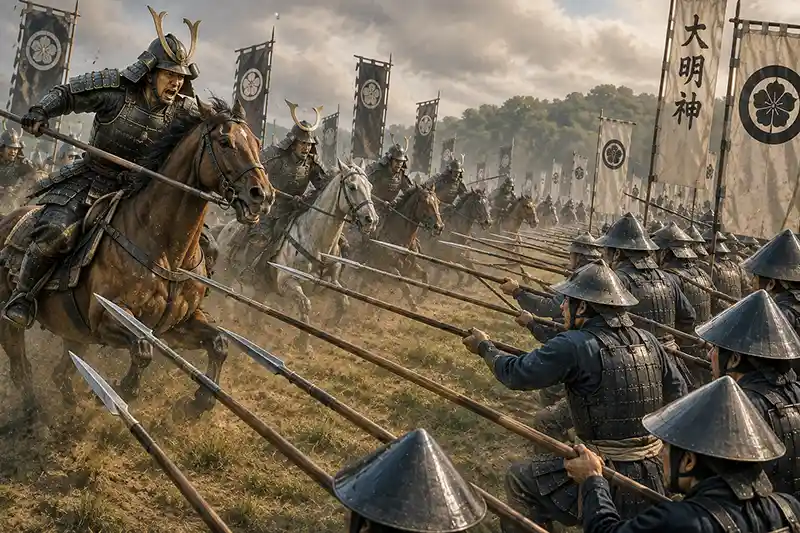
For centuries, mounted warriors dominated battlefields because of their speed, height, and momentum. A charging horse could overwhelm scattered infantry, allowing cavalry to break enemy lines before swords were ever drawn. The yari helped change that balance by giving foot soldiers a practical way to stop mounted attacks without needing horses of their own.
The key was discipline rather than bravery. Instead of rushing forward to meet a charge, rows of ashigaru lowered their spears and held formation. A horse instinctively hesitates when faced with a wall of sharp points, making it difficult to charge directly into a tightly packed line. Even if the charge continued, the long reach of the yari allowed soldiers to threaten both the rider and the horse before either came within striking distance.
Elite samurai also used the yari from horseback, creating deadly cavalry duels where reach often determined the winner. A mounted warrior armed with a spear could strike earlier than an opponent carrying only a sword, giving him a decisive advantage during the first moments of an encounter. This flexibility made the yari valuable whether fighting on foot or in the saddle.
The success of the yari against cavalry mirrors the role played by long spears throughout military history. Time and again, disciplined infantry proved that organization could overcome speed and individual skill. Japanese commanders recognized this reality, making spear formations one of the foundations of their battlefield strategy while swords remained important secondary weapons. Even famous blades such as the tachi were most effective once a warrior had already survived the initial clash of longer weapons.
The image of a lone samurai defeating waves of enemies with a sword is unforgettable, but real battles were rarely fought that way. More often, victory belonged to the army that maintained its formations, controlled the battlefield, and used weapons like the yari to neutralize an enemy's greatest strengths before close combat ever began.
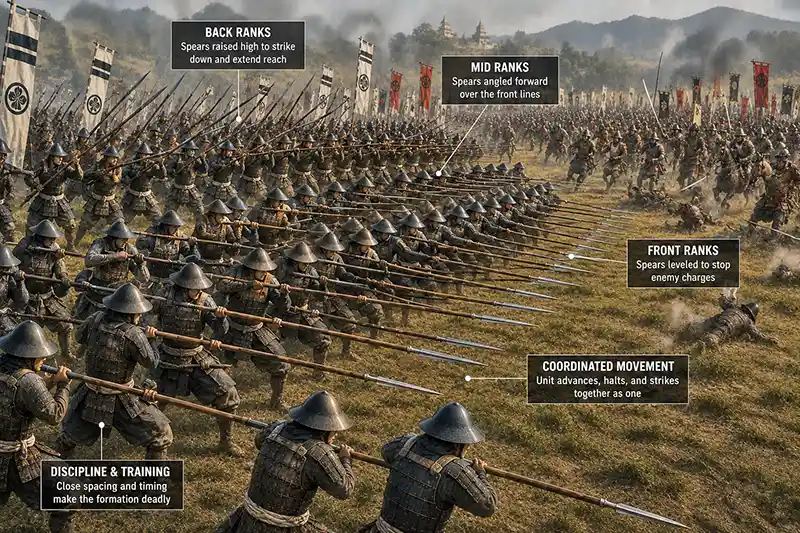
The yari's effectiveness did not come from the weapon alone. Its real power appeared when soldiers used it as part of a coordinated system. Commanders trained ashigaru to move, halt, lower their spears, and advance together, turning hundreds of individual weapons into a single wall of steel.
Spearmen could form defensive ranks to absorb an enemy charge, then push forward once the attacking force lost momentum. Front rows threatened the enemy directly, while soldiers behind them extended additional spear points over their shoulders. This layered reach made it extremely difficult for swordsmen or cavalry to break through without suffering heavy losses.
Some yari formations also relied on repeated downward strikes rather than simple thrusts. Longer spears could be raised and driven down into advancing enemies, creating a brutal rhythm that disrupted shields, helmets, and tightly packed troops. The technique required discipline, since poorly timed movements could leave gaps in the formation or cause soldiers to interfere with one another.
Commanders combined these spear units with archers, matchlock gunners, and cavalry. Firearms could weaken an approaching force, yari formations could stop the survivors, and mounted samurai could exploit any break in the enemy line. The yari became so important because it worked as part of a larger battlefield plan rather than depending on one warrior's skill.
This was the opposite of the heroic sword duel celebrated in later stories. The deadliest yari tactics were repetitive, organized, and impersonal. Soldiers survived by holding their position, trusting the men beside them, and following orders even when the enemy was only a few feet away. That discipline is what turned a simple spear into one of the weapons that won Japan's greatest battles.
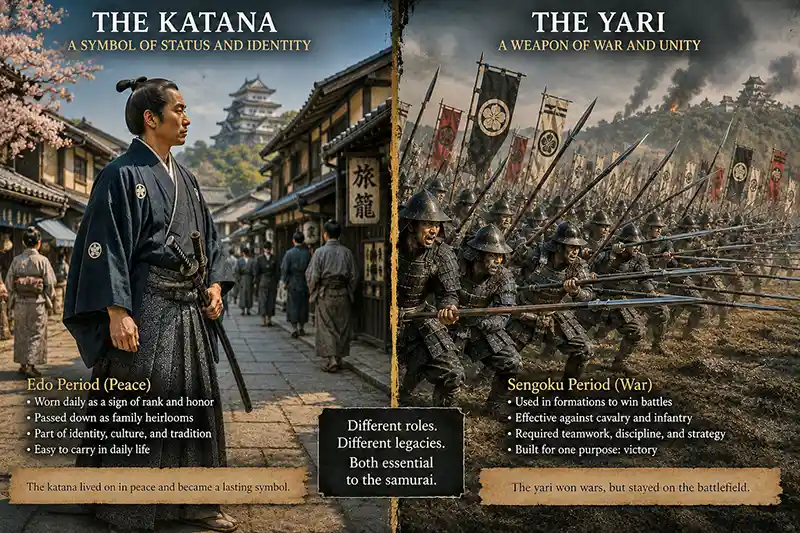
The yari may have helped win battles, but the katana became the weapon that defined the samurai in the public imagination. That difference had less to do with battlefield effectiveness and more to do with symbolism. A spear belonged to formations, campaigns, and armies. A sword stayed with the samurai after the battle was over.
During the long peace of the Edo period, the katana became increasingly tied to rank, identity, and social status. It could be worn in daily life, carried through towns, displayed in formal settings, and passed down as a family heirloom. The yari was far less practical outside war. Its length made it difficult to carry casually, and it had little place in the routines of a peaceful society.
The sword also fit the stories people wanted to tell. Duels between two warriors were easier to romanticize than rows of infantry advancing behind spear points. Later theater, literature, film, and television turned the katana into a symbol of honor, discipline, and individual skill. The yari, by contrast, remained connected to teamwork, military organization, and the less glamorous realities of mass combat.
That romantic image has created several lasting misconceptions. Many people now assume samurai relied on the sword as their primary weapon in every situation, even though bows, spears, polearms, and firearms were often more important in actual warfare. Our guide to real vs. decorative samurai swords shows how the reputation of the katana continues to shape the way Japanese weapons are understood and collected today.
The katana deserves its fame, but fame should not be confused with battlefield dominance. The sword became the enduring icon of the samurai because it survived into peaceful daily life and inspired powerful legends. The yari remained what it had always been: a practical weapon built to win wars.
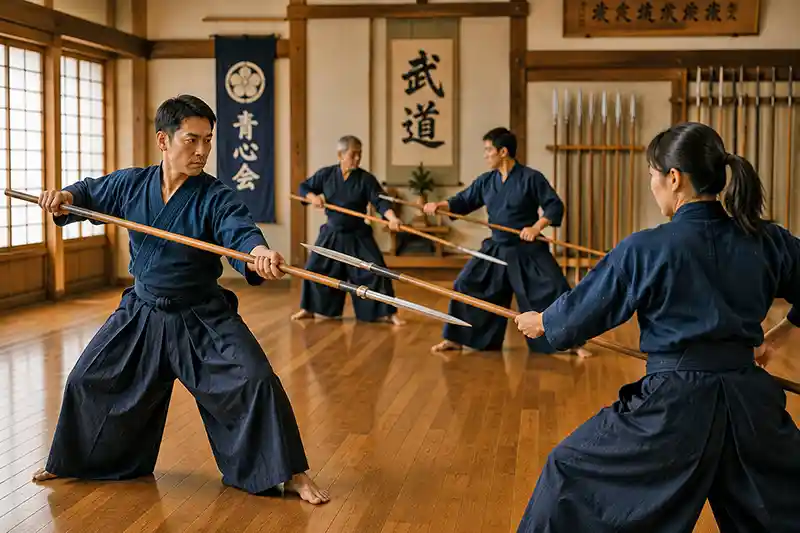
The yari disappeared from warfare as firearms and modern military tactics replaced traditional weapons, but its techniques did not vanish with it. Several classical Japanese martial arts preserved methods for thrusting, parrying, controlling distance, and moving with a spear. These traditions kept the yari alive as a system of disciplined movement rather than a weapon intended for modern combat.
Training with a spear teaches lessons that are difficult to learn with a shorter weapon. Because the shaft extends so far beyond the body, every movement must be deliberate. Poor footwork can leave the practitioner off balance, while an uncontrolled thrust can expose the entire body. Students learn to move the weapon and their body as a single unit, using precise timing instead of relying on strength alone.
Distance remains the most important lesson. A yari practitioner must understand exactly where the spear is effective and recognize the danger of allowing an opponent to move inside its reach. That constant awareness develops patience, positioning, and the ability to control space before an exchange begins.
Modern practitioners often begin with safer training equipment before handling more realistic weapons. Wooden weapons and padded alternatives allow students to practice partner drills while reducing the risk of injury. Our selections of wooden swords and foam practice swords offer similar ways to develop distance, coordination, and control during weapon-based training.
The yari's legacy survives because its principles extend far beyond the spear itself. Timing, reach, formation, and disciplined movement remain central ideas in martial arts today. Although the great spear formations of feudal Japan are gone, the skills that made them effective continue to be studied centuries later.
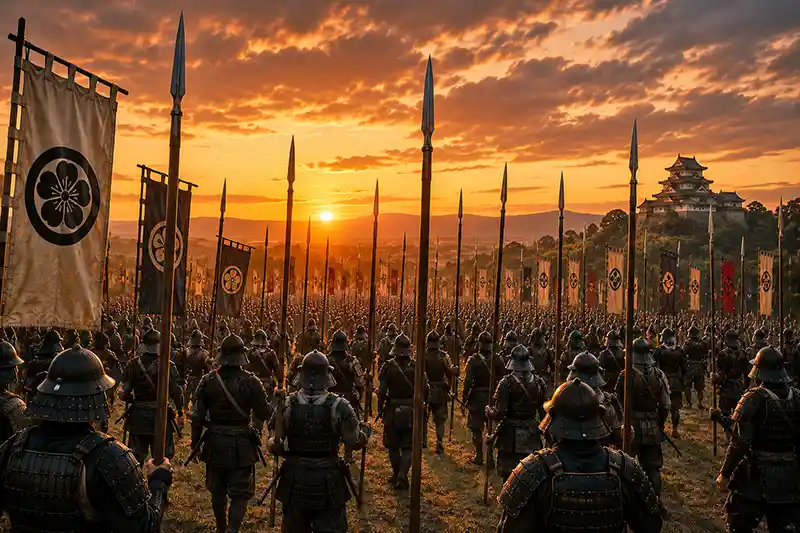
Ask someone to name a famous Japanese weapon, and the answer will almost always be the katana. Mention the yari, and many people won't recognize the name at all. Yet if you had stood on a battlefield during the Sengoku period, the weapon you would have seen most often was not a sword. It was a forest of spear points stretching across the landscape, carried by thousands of disciplined soldiers who determined the outcome of Japan's greatest wars.
The yari succeeded because it solved the problems real armies faced. It gave infantry the reach to challenge cavalry, allowed commanders to build disciplined formations, and could be mastered far more quickly than the sword. While weapons such as the wakizashi and tanto filled important roles as companion blades, the yari remained the weapon that controlled the battlefield itself.
Its influence can still be seen today. Military historians continue to point to spear formations as one of the greatest tactical innovations in Japanese warfare, while martial artists preserve the techniques that once gave armies their decisive advantage. The weapon may no longer decide battles, but the principles behind it continue to shape how people study distance, timing, and coordinated movement.
History has a way of celebrating the most glamorous weapons instead of the most practical ones. The katana earned its legendary reputation through craftsmanship, symbolism, and centuries of storytelling. The yari earned its place through results. Without it, many of Japan's most famous victories might never have happened.
The next time you picture a samurai army marching to war, look beyond the swords hanging at their sides. The true backbone of those armies was often the long, unassuming spear carried in their hands. The yari may never rival the katana in fame, but it unquestionably deserves a place among the greatest battlefield weapons in Japanese history.
In many battles, yes. While nearly every samurai carried a sword, the yari was often their primary weapon on the battlefield. Its superior reach made it more effective during the opening stages of combat, whether fighting on foot or from horseback. Swords typically became important only after the distance had closed or if a spear was lost or broken.
This difference between battlefield reality and popular culture is one reason the yari is often overlooked today. The katana became the enduring symbol of the samurai, but historical records show that spears played a far greater role in many of Japan's largest and most decisive battles.
Yes, especially when used by disciplined soldiers fighting in formation. A single spearman facing a charging horse had no guarantees, but a tightly organized line of ashigaru presenting dozens of yari at once created a serious obstacle. Horses are naturally reluctant to run into a wall of sharp spear points, making it difficult for cavalry to maintain the momentum needed to break through a formation.
The yari's effectiveness came from teamwork rather than individual strength. By holding their positions and keeping their spear points aligned, ashigaru could disrupt cavalry charges, protect one another, and force mounted samurai to rethink their approach. It was this combination of reach, discipline, and coordination that made the yari one of the most successful battlefield weapons in Japanese history.
The yari was designed primarily for thrusting, not slashing. Its straight blade allowed force to travel directly into the target, making it highly effective against armored opponents and easier to control during long-reaching attacks. The simple shape also made the weapon durable and well suited to the disciplined formations that dominated Japanese battlefields.
Curved blades, like those found on the naginata or katana, excel at slicing motions. The yari sacrificed some cutting ability in exchange for faster, more accurate thrusts and greater penetration. That design made it one of the most practical and efficient battlefield weapons ever used by the samurai, proving that simplicity often outperformed more elaborate weapons in the chaos of war.
No. Although the yari became the signature weapon of ashigaru infantry, Japanese armies relied on a mix of specialized troops. Some soldiers carried bows, others operated matchlock firearms, and many served as support personnel responsible for logistics, engineering, or transporting supplies. Successful armies depended on these different roles working together rather than everyone carrying the same weapon.
Even so, yari-equipped ashigaru formed the backbone of many Sengoku-era armies. Their disciplined spear formations protected archers and gunners, resisted cavalry charges, and held the battle line while other units maneuvered. Without these spear-bearing infantry, many of Japan's greatest military victories would have been far more difficult to achieve.
Yes, although they are most famous for their role in large-scale warfare. Skilled samurai trained extensively with the yari and could use it very effectively in single combat. Its exceptional reach allowed the wielder to keep an opponent at a distance, control the pace of the fight, and strike before a swordsman could get close enough to attack.
That advantage came with a tradeoff. If an opponent managed to slip inside the spear's effective range, the yari became much more difficult to maneuver than a sword. For that reason, many samurai also carried a katana or another sidearm as a backup. In the hands of an experienced warrior, however, the yari was a formidable dueling weapon that demanded patience, precision, and excellent footwork rather than brute strength.
Some yari reached astonishing lengths of 15 to 20 feet, with a few exceptional examples extending even farther. These extra-long spears, known as nagae yari or "long-shaft yari," were designed for massed infantry formations rather than individual combat. Their tremendous reach allowed several ranks of soldiers to threaten an advancing enemy at the same time, making them especially effective against cavalry and dense infantry formations.
Despite their advantages, these oversized yari were difficult to carry and maneuver outside of organized formations. They required disciplined teamwork and open ground to be used effectively. Shorter yari remained the preferred choice for many samurai because they offered a better balance of reach, speed, and versatility in the unpredictable conditions of real combat.
No. Firearms changed Japanese warfare, but they did not immediately replace the yari. In fact, the two weapons often worked together. Matchlock gunners could fire volleys to disrupt an advancing enemy, while yari formations protected them during the long process of reloading. Once the enemy closed the distance, the spear once again became the primary weapon.
The yari remained a cornerstone of Japanese armies well into the late Sengoku period because it was reliable, inexpensive, and highly effective in disciplined formations. Rather than disappearing overnight, it gradually faded only as warfare modernized and traditional samurai armies gave way to new military systems. For centuries, the yari and the firearm complemented each other, proving that even revolutionary new technology rarely replaces proven battlefield tactics all at once.
Almost never. Unlike a javelin, the yari was far too valuable to throw in battle. Once a warrior released his primary weapon, he immediately lost the reach that gave him such an important advantage. Instead, samurai and ashigaru used the yari for controlled thrusts, parries, and sweeping techniques while keeping both hands firmly on the shaft.
Although a desperate warrior might throw a damaged spear under extraordinary circumstances, it was not part of normal battlefield tactics. The yari was designed to stay in the wielder's hands, where its reach and precision could be used throughout the fight.
Yes, under the right circumstances. The yari's straight, narrow blade concentrated force into a small point, making it better suited for penetrating armor than many cutting weapons. Skilled warriors often aimed for weak points such as the throat, under the arms, or gaps around the joints rather than trying to drive straight through the strongest parts of the armor.
Even when it failed to penetrate completely, the yari's reach allowed soldiers to keep opponents off balance and create openings for follow-up attacks. Its ability to threaten armored enemies from a safe distance was one reason it became such a dominant battlefield weapon.
Yes. Just as legendary swords were given names, some famous yari earned names and reputations of their own. The best-known example is Honda Tadakatsu's spear, Tonbokiri, which became one of Japan's Three Great Spears. According to legend, it was so sharp that a dragonfly landing on its blade was sliced in two.
Whether every legend is historically accurate is impossible to know, but these stories show that exceptional spears could become just as respected and celebrated as the finest samurai swords.
In this article, we'll explore how the yari rose to dominate medieval battlefields, why many famous samurai trusted it over the sword, and how one of Japan's simplest weapons became the foundation of some of its greatest military triumphs.
Why the Yari Changed Japanese Warfare
The yari was a remarkably simple weapon. It consisted of a straight steel blade mounted on a long wooden shaft, yet that straightforward design transformed the way wars were fought in feudal Japan. While legendary swords often captured the glory, the yari gave armies something far more valuable: reach, discipline, and the ability to fight together as a coordinated force.
Earlier Japanese warfare placed a greater emphasis on individual combat, where mounted samurai armed with bows and swords could distinguish themselves through personal skill. As conflicts grew larger and armies expanded into the tens of thousands, however, battles became less about individual duels and more about maintaining formation. The yari fit this new style of warfare perfectly.
Unlike a sword, which required a warrior to close the distance before striking, the yari allowed soldiers to threaten an enemy several feet away. That extra reach made it difficult for swordsmen to approach safely and gave organized infantry the ability to stop charging opponents before they could break through the line. Even highly skilled samurai had to respect a disciplined formation of spear-wielding soldiers.
The weapon was also surprisingly versatile. Although most people think of the yari as a thrusting spear, experienced warriors could slash, parry, sweep, and redirect attacks using both the blade and the shaft. It wasn't simply a long stick with a point. In trained hands, it became one of the most adaptable battlefield weapons in Japanese history, earning a place alongside the greatest traditional weapons ever carried into combat.
Its success wasn't based on making the sword obsolete. Instead, the yari changed how entire armies fought. It rewarded teamwork over individual heroics and helped create the disciplined formations that would dominate Japan's greatest military campaigns for centuries.
Why Spears Beat Swords on the Battlefield
For much of history, the spear consistently outperformed the sword in large-scale warfare. Japan was no exception. While the katana became the legendary symbol of the samurai, the yari offered something far more valuable in battle: distance. A warrior armed with a spear could threaten an opponent several feet before a swordsman was close enough to strike, forcing even highly skilled fighters to approach with extreme caution.
That advantage became even greater when soldiers fought together. A lone swordsman might be able to outmatch a single spearman under the right circumstances, but facing a disciplined line of yari was another matter entirely. Every step forward meant entering the range of multiple spear points at once, making it incredibly difficult to break through an organized formation.
The yari also required less time to master than a sword. Becoming an expert swordsman demanded years of dedicated practice, but armies could train large numbers of ashigaru to fight effectively with spears in a much shorter period. This allowed Japanese warlords to field disciplined infantry that relied on teamwork instead of individual duels, dramatically changing the balance of power during the Sengoku period.
That doesn't mean the sword became obsolete. Once an opponent slipped inside the spear's effective range, the yari became more difficult to maneuver. Many samurai carried both weapons, using the spear to dominate open combat before relying on a sword if the fighting closed to arm's length. The relationship between these weapons was complementary rather than competitive, much like the one explored in our guide to the samurai sword vs. katana.
Modern experiments, historical records, and centuries of military experience all point to the same conclusion: on an open battlefield, reach usually defeated elegance. The sword may have become the icon of the samurai, but the spear was often the weapon that determined who walked away from the battle alive.
The Rise of the Ashigaru and the Spear Wall
The yari did more than improve individual combat. It transformed ordinary foot soldiers into one of the most effective military forces Japan had ever seen. These soldiers, known as ashigaru, were originally recruited from farming communities, but as the Sengoku period intensified, they became disciplined professional infantry capable of changing the outcome of entire wars.
Armed with long yari, ashigaru fought in tightly organized formations that emphasized cooperation over individual heroics. Instead of charging forward alone, each soldier relied on the men beside him. Rows of spear points projected toward the enemy, creating a moving barrier that was incredibly difficult to penetrate. Even experienced samurai found it dangerous to attack a well-trained spear wall head-on.
The effectiveness of these formations reshaped Japanese warfare. Powerful warlords such as Oda Nobunaga recognized that disciplined infantry could overcome enemies who depended primarily on traditional mounted samurai. Combined with firearms and coordinated battlefield tactics, massed yari formations helped unify Japan during one of the most turbulent periods in its history.
This shift also changed the role of the samurai. Individual skill still mattered, but victory increasingly depended on leadership, planning, and the ability to coordinate thousands of soldiers. The era of heroic one-on-one duels gave way to organized armies where discipline often mattered more than personal bravery. The same battlefield evolution that elevated the yari also influenced weapons such as the naginata, as commanders favored weapons that could dominate space and work effectively within large formations.
The rise of the ashigaru proved one of history's most important military lessons: an army of disciplined soldiers working together could defeat opponents who were individually more skilled. The yari wasn't simply a better weapon. It was the foundation of a completely new way of fighting.
The Samurai Who Preferred the Yari
The yari was not merely a weapon handed to common foot soldiers. Many of Japan's most respected samurai trained extensively with the spear and carried it into battle by choice. For experienced warriors, the yari offered the reach of a polearm without sacrificing the precision needed for individual combat.
Some samurai became so closely associated with spear fighting that their weapons earned names and legends of their own. Honda Tadakatsu, one of Tokugawa Ieyasu's most celebrated generals, was famously linked to the spear known as Tonbokiri, or "Dragonfly Cutter." According to legend, the blade was so sharp that a dragonfly landing on it would be cut in two. Whether or not that story was literal, it reflects the enormous prestige that a masterfully forged yari could carry.
The spear also allowed elite warriors to fight effectively from horseback. A mounted samurai could use the yari to thrust at infantry, challenge enemy riders, or exploit openings while maintaining greater reach than a sword provided. On foot, the same weapon could deliver rapid thrusts, sweeping parries, and controlled attacks aimed at gaps in armor.
This versatility explains why samurai often treated the sword as a secondary weapon during major battles. The katana remained essential once fighting became close and chaotic, but the yari was frequently the first weapon used when opposing forces met. It gave the warrior more options before an enemy came within arm's reach.
Popular culture tends to portray every great samurai as a swordsman first, but that image leaves out much of their actual training. Samurai studied multiple weapons because survival depended on adapting to different opponents, terrain, and battlefield conditions. Our article on the biggest myths about samurai swords explores how the katana's later fame often overshadows the weapons samurai relied on during real warfare.
How the Yari Defeated Cavalry
For centuries, mounted warriors dominated battlefields because of their speed, height, and momentum. A charging horse could overwhelm scattered infantry, allowing cavalry to break enemy lines before swords were ever drawn. The yari helped change that balance by giving foot soldiers a practical way to stop mounted attacks without needing horses of their own.
The key was discipline rather than bravery. Instead of rushing forward to meet a charge, rows of ashigaru lowered their spears and held formation. A horse instinctively hesitates when faced with a wall of sharp points, making it difficult to charge directly into a tightly packed line. Even if the charge continued, the long reach of the yari allowed soldiers to threaten both the rider and the horse before either came within striking distance.
Elite samurai also used the yari from horseback, creating deadly cavalry duels where reach often determined the winner. A mounted warrior armed with a spear could strike earlier than an opponent carrying only a sword, giving him a decisive advantage during the first moments of an encounter. This flexibility made the yari valuable whether fighting on foot or in the saddle.
The success of the yari against cavalry mirrors the role played by long spears throughout military history. Time and again, disciplined infantry proved that organization could overcome speed and individual skill. Japanese commanders recognized this reality, making spear formations one of the foundations of their battlefield strategy while swords remained important secondary weapons. Even famous blades such as the tachi were most effective once a warrior had already survived the initial clash of longer weapons.
The image of a lone samurai defeating waves of enemies with a sword is unforgettable, but real battles were rarely fought that way. More often, victory belonged to the army that maintained its formations, controlled the battlefield, and used weapons like the yari to neutralize an enemy's greatest strengths before close combat ever began.
The Battle Tactics That Made the Yari Deadly
The yari's effectiveness did not come from the weapon alone. Its real power appeared when soldiers used it as part of a coordinated system. Commanders trained ashigaru to move, halt, lower their spears, and advance together, turning hundreds of individual weapons into a single wall of steel.
Spearmen could form defensive ranks to absorb an enemy charge, then push forward once the attacking force lost momentum. Front rows threatened the enemy directly, while soldiers behind them extended additional spear points over their shoulders. This layered reach made it extremely difficult for swordsmen or cavalry to break through without suffering heavy losses.
Some yari formations also relied on repeated downward strikes rather than simple thrusts. Longer spears could be raised and driven down into advancing enemies, creating a brutal rhythm that disrupted shields, helmets, and tightly packed troops. The technique required discipline, since poorly timed movements could leave gaps in the formation or cause soldiers to interfere with one another.
Commanders combined these spear units with archers, matchlock gunners, and cavalry. Firearms could weaken an approaching force, yari formations could stop the survivors, and mounted samurai could exploit any break in the enemy line. The yari became so important because it worked as part of a larger battlefield plan rather than depending on one warrior's skill.
This was the opposite of the heroic sword duel celebrated in later stories. The deadliest yari tactics were repetitive, organized, and impersonal. Soldiers survived by holding their position, trusting the men beside them, and following orders even when the enemy was only a few feet away. That discipline is what turned a simple spear into one of the weapons that won Japan's greatest battles.
Why the Katana Became More Famous Than the Yari
The yari may have helped win battles, but the katana became the weapon that defined the samurai in the public imagination. That difference had less to do with battlefield effectiveness and more to do with symbolism. A spear belonged to formations, campaigns, and armies. A sword stayed with the samurai after the battle was over.
During the long peace of the Edo period, the katana became increasingly tied to rank, identity, and social status. It could be worn in daily life, carried through towns, displayed in formal settings, and passed down as a family heirloom. The yari was far less practical outside war. Its length made it difficult to carry casually, and it had little place in the routines of a peaceful society.
The sword also fit the stories people wanted to tell. Duels between two warriors were easier to romanticize than rows of infantry advancing behind spear points. Later theater, literature, film, and television turned the katana into a symbol of honor, discipline, and individual skill. The yari, by contrast, remained connected to teamwork, military organization, and the less glamorous realities of mass combat.
That romantic image has created several lasting misconceptions. Many people now assume samurai relied on the sword as their primary weapon in every situation, even though bows, spears, polearms, and firearms were often more important in actual warfare. Our guide to real vs. decorative samurai swords shows how the reputation of the katana continues to shape the way Japanese weapons are understood and collected today.
The katana deserves its fame, but fame should not be confused with battlefield dominance. The sword became the enduring icon of the samurai because it survived into peaceful daily life and inspired powerful legends. The yari remained what it had always been: a practical weapon built to win wars.
The Yari's Legacy in Modern Martial Arts
The yari disappeared from warfare as firearms and modern military tactics replaced traditional weapons, but its techniques did not vanish with it. Several classical Japanese martial arts preserved methods for thrusting, parrying, controlling distance, and moving with a spear. These traditions kept the yari alive as a system of disciplined movement rather than a weapon intended for modern combat.
Training with a spear teaches lessons that are difficult to learn with a shorter weapon. Because the shaft extends so far beyond the body, every movement must be deliberate. Poor footwork can leave the practitioner off balance, while an uncontrolled thrust can expose the entire body. Students learn to move the weapon and their body as a single unit, using precise timing instead of relying on strength alone.
Distance remains the most important lesson. A yari practitioner must understand exactly where the spear is effective and recognize the danger of allowing an opponent to move inside its reach. That constant awareness develops patience, positioning, and the ability to control space before an exchange begins.
Modern practitioners often begin with safer training equipment before handling more realistic weapons. Wooden weapons and padded alternatives allow students to practice partner drills while reducing the risk of injury. Our selections of wooden swords and foam practice swords offer similar ways to develop distance, coordination, and control during weapon-based training.
The yari's legacy survives because its principles extend far beyond the spear itself. Timing, reach, formation, and disciplined movement remain central ideas in martial arts today. Although the great spear formations of feudal Japan are gone, the skills that made them effective continue to be studied centuries later.
Why the Yari Deserves More Respect Than It Gets
Ask someone to name a famous Japanese weapon, and the answer will almost always be the katana. Mention the yari, and many people won't recognize the name at all. Yet if you had stood on a battlefield during the Sengoku period, the weapon you would have seen most often was not a sword. It was a forest of spear points stretching across the landscape, carried by thousands of disciplined soldiers who determined the outcome of Japan's greatest wars.
The yari succeeded because it solved the problems real armies faced. It gave infantry the reach to challenge cavalry, allowed commanders to build disciplined formations, and could be mastered far more quickly than the sword. While weapons such as the wakizashi and tanto filled important roles as companion blades, the yari remained the weapon that controlled the battlefield itself.
Its influence can still be seen today. Military historians continue to point to spear formations as one of the greatest tactical innovations in Japanese warfare, while martial artists preserve the techniques that once gave armies their decisive advantage. The weapon may no longer decide battles, but the principles behind it continue to shape how people study distance, timing, and coordinated movement.
History has a way of celebrating the most glamorous weapons instead of the most practical ones. The katana earned its legendary reputation through craftsmanship, symbolism, and centuries of storytelling. The yari earned its place through results. Without it, many of Japan's most famous victories might never have happened.
The next time you picture a samurai army marching to war, look beyond the swords hanging at their sides. The true backbone of those armies was often the long, unassuming spear carried in their hands. The yari may never rival the katana in fame, but it unquestionably deserves a place among the greatest battlefield weapons in Japanese history.
Did samurai use the yari more than the katana?
In many battles, yes. While nearly every samurai carried a sword, the yari was often their primary weapon on the battlefield. Its superior reach made it more effective during the opening stages of combat, whether fighting on foot or from horseback. Swords typically became important only after the distance had closed or if a spear was lost or broken.
This difference between battlefield reality and popular culture is one reason the yari is often overlooked today. The katana became the enduring symbol of the samurai, but historical records show that spears played a far greater role in many of Japan's largest and most decisive battles.
Could a yari really stop a charging horse?
Yes, especially when used by disciplined soldiers fighting in formation. A single spearman facing a charging horse had no guarantees, but a tightly organized line of ashigaru presenting dozens of yari at once created a serious obstacle. Horses are naturally reluctant to run into a wall of sharp spear points, making it difficult for cavalry to maintain the momentum needed to break through a formation.
The yari's effectiveness came from teamwork rather than individual strength. By holding their positions and keeping their spear points aligned, ashigaru could disrupt cavalry charges, protect one another, and force mounted samurai to rethink their approach. It was this combination of reach, discipline, and coordination that made the yari one of the most successful battlefield weapons in Japanese history.
Why did the yari have a straight blade instead of a curved one?
The yari was designed primarily for thrusting, not slashing. Its straight blade allowed force to travel directly into the target, making it highly effective against armored opponents and easier to control during long-reaching attacks. The simple shape also made the weapon durable and well suited to the disciplined formations that dominated Japanese battlefields.
Curved blades, like those found on the naginata or katana, excel at slicing motions. The yari sacrificed some cutting ability in exchange for faster, more accurate thrusts and greater penetration. That design made it one of the most practical and efficient battlefield weapons ever used by the samurai, proving that simplicity often outperformed more elaborate weapons in the chaos of war.
Did every ashigaru carry a yari?
No. Although the yari became the signature weapon of ashigaru infantry, Japanese armies relied on a mix of specialized troops. Some soldiers carried bows, others operated matchlock firearms, and many served as support personnel responsible for logistics, engineering, or transporting supplies. Successful armies depended on these different roles working together rather than everyone carrying the same weapon.
Even so, yari-equipped ashigaru formed the backbone of many Sengoku-era armies. Their disciplined spear formations protected archers and gunners, resisted cavalry charges, and held the battle line while other units maneuvered. Without these spear-bearing infantry, many of Japan's greatest military victories would have been far more difficult to achieve.
Were yari ever used in one-on-one duels?
Yes, although they are most famous for their role in large-scale warfare. Skilled samurai trained extensively with the yari and could use it very effectively in single combat. Its exceptional reach allowed the wielder to keep an opponent at a distance, control the pace of the fight, and strike before a swordsman could get close enough to attack.
That advantage came with a tradeoff. If an opponent managed to slip inside the spear's effective range, the yari became much more difficult to maneuver than a sword. For that reason, many samurai also carried a katana or another sidearm as a backup. In the hands of an experienced warrior, however, the yari was a formidable dueling weapon that demanded patience, precision, and excellent footwork rather than brute strength.
What was the longest type of yari ever used?
Some yari reached astonishing lengths of 15 to 20 feet, with a few exceptional examples extending even farther. These extra-long spears, known as nagae yari or "long-shaft yari," were designed for massed infantry formations rather than individual combat. Their tremendous reach allowed several ranks of soldiers to threaten an advancing enemy at the same time, making them especially effective against cavalry and dense infantry formations.
Despite their advantages, these oversized yari were difficult to carry and maneuver outside of organized formations. They required disciplined teamwork and open ground to be used effectively. Shorter yari remained the preferred choice for many samurai because they offered a better balance of reach, speed, and versatility in the unpredictable conditions of real combat.
Did the yari become obsolete after firearms were introduced?
No. Firearms changed Japanese warfare, but they did not immediately replace the yari. In fact, the two weapons often worked together. Matchlock gunners could fire volleys to disrupt an advancing enemy, while yari formations protected them during the long process of reloading. Once the enemy closed the distance, the spear once again became the primary weapon.
The yari remained a cornerstone of Japanese armies well into the late Sengoku period because it was reliable, inexpensive, and highly effective in disciplined formations. Rather than disappearing overnight, it gradually faded only as warfare modernized and traditional samurai armies gave way to new military systems. For centuries, the yari and the firearm complemented each other, proving that even revolutionary new technology rarely replaces proven battlefield tactics all at once.
Did samurai ever throw the yari like a javelin?
Almost never. Unlike a javelin, the yari was far too valuable to throw in battle. Once a warrior released his primary weapon, he immediately lost the reach that gave him such an important advantage. Instead, samurai and ashigaru used the yari for controlled thrusts, parries, and sweeping techniques while keeping both hands firmly on the shaft.
Although a desperate warrior might throw a damaged spear under extraordinary circumstances, it was not part of normal battlefield tactics. The yari was designed to stay in the wielder's hands, where its reach and precision could be used throughout the fight.
Could a yari pierce samurai armor?
Yes, under the right circumstances. The yari's straight, narrow blade concentrated force into a small point, making it better suited for penetrating armor than many cutting weapons. Skilled warriors often aimed for weak points such as the throat, under the arms, or gaps around the joints rather than trying to drive straight through the strongest parts of the armor.
Even when it failed to penetrate completely, the yari's reach allowed soldiers to keep opponents off balance and create openings for follow-up attacks. Its ability to threaten armored enemies from a safe distance was one reason it became such a dominant battlefield weapon.
Did famous samurai name their yari?
Yes. Just as legendary swords were given names, some famous yari earned names and reputations of their own. The best-known example is Honda Tadakatsu's spear, Tonbokiri, which became one of Japan's Three Great Spears. According to legend, it was so sharp that a dragonfly landing on its blade was sliced in two.
Whether every legend is historically accurate is impossible to know, but these stories show that exceptional spears could become just as respected and celebrated as the finest samurai swords.
You May Also Be Interested In:
- Why the Naginata Became Japan's Most Elegant Battlefield Weapon
- Secrets of the Kusarigama: The Rise of Japan's Legendary Chain Weapon
- What Is the Best Sword of All Time? A Look at History's Greatest Blades
- The Strangest Weapons Ever Carried Into Real Battles
- Ultimate Throwing Weapon Showdown! Which Weapon Is The BEST?
- Which Weapon Would You Choose To Defend Yourself?
- Was the Seax Really a Viking Weapon?
- Which Throwing Weapon Would You Choose?
- 5 Deadly Sai Weapon Types
- Which Weapon Would You Choose To Survive The Upside Down?
Leave a Reply